

|
시장보고서
상품코드
2113366
혈액 검사 : 시장 점유율 분석, 업계 동향과 통계, 성장 예측(2026-2031년)Blood Testing - Market Share Analysis, Industry Trends & Statistics, Growth Forecasts (2026 - 2031) |
||||||
 Mordor Intelligence
Mordor Intelligence에 따르면 혈액 검사 시장 규모는 2026년에 1,035억 3,000만 달러에 달하고, 2031년까지 1,448억 달러로 확대되어 CAGR 6.94%로 성장할 것으로 예측됩니다.
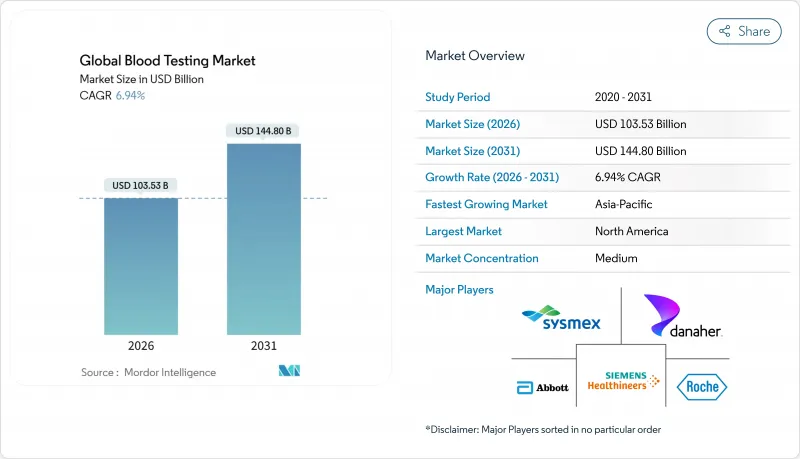
본 보고서에서는 시장을 검사 유형별(혈당, 지질 패널, PSA, BUN 등), 제품별(기기 및 소모품), 기술별(임상화학, 분자진단, 면역측정법 등), 최종사용자별(진단 검사 기관, 병원 등), 지역별(북미, 유럽, 아시아태평양 등)로 분류하고 있습니다. 본 보고서에서는 상기 각 부문별 시장 규모(단위 : 백만 달러)를 제시하고 있습니다.
세계 혈액 검사 시장의 동향 및 인사이트
만성 질환의 부담 증가가 정기적 및 예방적 혈액 검사 수요를 촉진
심혈관질환, 당뇨병, 만성 신장질환은 15억 명에게 영향을 미치고 있으며, 연례 건강검진에서 지질, 헤모글로빈 A1c, 크레아티닌에 대한 정기적인 검사를 촉진하고 있습니다. 2024년 USPSTF(미국 예방 서비스 태스크포스)의 개정으로 지질 패널의 대상이 40-75세의 모든 성인으로 확대되어 미국의 선별 검사 대상자가 2,000만 명 증가했습니다. 당뇨병 유병률은 2024년에 성인 5억 3,700만 명에 달하며, 2045년까지 7억 8,300만 명에 이를 가능성이 있어, 이로 인해 혈당 및 A1c 검사의 연간 수요가 확고해질 것입니다. 이러한 정기 검사는 자발적 검사 수요가 둔화되더라도 실험실의 검사 건수를 안정적으로 유지해 주지만, 더 엄격해진 일괄 지급 계약으로 인해 이익률이 제한되고 있어 고처리량 자동화에 대한 의존도가 높아지고 있습니다.
신속한 자동화 및 현장 진단(Point-of-Care) 분석 장비의 혁신
2025년 3월, 벡만 콜터(Beckman Coulter)사의 ‘DxC 500i’가 FDA 승인을 획득하여, 지역 병원을 위해 설계된 시간당 400건의 검사 처리 능력을 갖춘 플랫폼이 제공되었습니다. 애보트(Abbott)사는 2025년 1월, 자사의 휴대용 i-STAT에 대한 고감도 트로포닌 I 측정법의 승인을 획득하여, 병상에서 15분 이내에 심근경색을 배제할 수 있게 되었습니다. 시스멕스는 혈액 검사 기기 ‘XW-100’에 대해 CLIA 면제 인증을 획득하여, 진료소에서 검사 기사의 입회 없이도 전혈구 계수를 실시할 수 있게 되었습니다. POC(POC(Point-of-Care)) 기기는 의료의 신속화에 기여하는 한편, 시약 비용이 중앙 검사실의 동등 제품에 비해 40-60% 높아지기 때문에 비용에 민감한 의료기관에게는 과제가 되고 있습니다.
여러 지역에서의 엄격한 규제 승인
EU의 IVDR(의료기기 규정)에 따라 수천 개의 검사법이 재분류되었으나, 2024년 말 시점에서 지정된 통지 기관은 불과 4곳에 그쳐 승인 병목 현상이 발생하고 있으며, 연구개발 예산이 대량 생산형 패널로 이동하고 있습니다. FDA의 2024년 5월 LDT(실험실 개발 검사) 규정에 따르면, 분석 대상 물질마다 50만-200만 달러의 검증 비용과 12-24개월의 소요 기간이 부과되게 되어, 병원이 개발하는 검사의 진입 장벽이 높아지고 있습니다. 중국의 NMPA는 200-500명의 환자를 대상으로 한 다기관 공동 임상시험을 요구하고 있으며, 승인까지의 기간이 30개월에 달하고 있습니다.
부문 분석
감염병 혈청학 검사는 WHO가 2030년까지 C형 간염 진단률 90% 달성을 추진하고 있으며, 사하라 이남 아프리카 전역에서 HIV 신속 자가 검사 키트의 승인이 진행되고 있는 점에 힘입어, 2031년까지 연평균 성장률(CAGR) 8.12%로 가장 높은 성장세를 보일 것으로 예측됩니다. 한편, 혈당 검사는 5억 3,700만 명의 당뇨병 환자에 힘입어 2025년에도 여전히 혈액 검사 시장에서 가장 큰 점유율(29.5%)을 차지하고 있습니다. 2024년 3월에 승인된 덱스콤(Dexcom)의 ‘스텔로(Stelo)’를 비롯한 시판용 연속 혈당 모니터의 등장으로, 인슐린 치료를 받고 있는 환자들은 간헐적인 손가락 채혈 검사에서 점차 벗어나게 될 것입니다. 지질 패널 검사는 2024년 USPSTF 지침이 5년마다 한 번씩 선별 검사를 권장함에 따라 혜택을 보고 있지만, 소매 약국에서의 제공으로 인해 수요가 분산되고 있습니다. PSA 검사의 검사 건수는 공동 의사결정 지침에 따라 연 1회 선별검사가 제한되면서 감소 추세를 보이고 있지만, 만성 신장병의 유병률이 높기 때문에 BUN 및 크레아티닌 검사는 안정적인 수준을 유지하고 있습니다. TSH 및 비타민 D 검사의 이용에 대해서는 보험사의 면밀한 검토가 진행되어 유익성이 낮은 예방적 검사 의뢰가 줄어드는 반면, hs-CRP는 심혈관질환의 위험 계층화에서 틈새 시장을 계속 차지하고 있습니다.
수요의 다양성은 단일 검사 항목 의뢰에서 시약비와 임상적 가치를 최적화하는 알고리즘에 기반한 검사 패널로의 구조적 전환을 부각시키고 있습니다. 혈청학 검사, 혈당 검사, 지질 검사를 예방 의료 패널로 묶는 검사 기관은 처리 능력을 높이고, 더 많은 청구 가능 단위를 통해 분석 장비에 대한 투자를 상각할 수 있습니다. 감염병 혈청학 검사 분야의 혈액 검사 시장 규모가 확대됨에 따라, 항원 라이브러리를 확충하고 다항목 신속 검사 카드를 개발하는 플랫폼 공급업체는 공중보건 분야 입찰에서 점유율을 확보하게 될 것입니다. 한편, 자가 모니터링 기술의 성장으로 인해 수익이 중앙 검사실에서 소매 채널로 이동하고 있으며, 이는 혈액 검사 시장이 점차 분산형 생태계로 전환되고 있음을 시사합니다.
2025년 매출에서 소모품이 차지하는 비중은 55.4%로, 이는 검사 기관의 지속적인 시약 지출과 전 세계적으로 큰 점유율을 차지할 것으로 추정되는 BD사의 바큐테이너(Vacutainer) 튜브의 보급 현황과 일치합니다. 검사 비용 인하로 인해 검사 기관은 시약 대량 구매 계약을 협상하고, 수율이 낮은 추적 검사를 줄이는 리플렉스 로직을 채택해야 하는 상황에 직면해 있습니다. 그러나 시설들이 노후화된 분석 장비를 전처리 단계의 선별 및 바코드 검증을 자동화하는 통합형 화학·면역측정 플랫폼으로 교체함에 따라, 장비 시장은 2031년까지 연평균 성장률(CAGR) 7.21%로 확대될 전망입니다. 이러한 업그레이드를 통해 오류율이 낮아지고, 검사 결과 반환 시간이 단축되며, 검사 기술자 인력 부족 문제가 완화될 것입니다.
설비 투자 예산 측면에서는 오픈 채널 방식을 채택하고 미들웨어의 상호 운용성을 지원하는 분석 장비가 우선적으로 고려되고 있습니다. 검사당 시약 비용은 높아지지만, POC(Point-of-Care) 기기가 외래 진료나 응급 의료 현장에 보급됨에 따라, 기기용 혈액 검사 시장의 규모는 더욱 확대되고 있습니다. 검사실의 완전 자동화는 여전히 고급 틈새 시장이지만, 연간 100만 건 이상의 검사를 처리하는 학술 기관들 사이에서 지지를 넓혀가고 있으며, 30-40%의 인건비 절감 효과로 인해 200만-500만 달러의 투자가 정당화되고 있습니다. 전반적으로, 장비 도입과 시약 렌탈 모델을 세트로 제공하는 공급업체는 수년에 걸친 소모품 현금 흐름을 확보하고 있으며, 장비 판매 대수가 증가하는 상황에서도 소모품이 수익의 대부분을 차지하는 경향이 더욱 뚜렷해지고 있습니다.
지역별 분석
북미는 예방 검사 패널에 대한 메디케어 적용 범위 확대와 퀘스트 다이아그노스틱스(Quest Diagnostics) 및 래보코프(LabCorp)의 압도적인 규모에 힘입어 2025년 전 세계 매출의 43.6%를 차지했습니다. 미국의 검사 기관은 2024년에 140억 건의 검사를 처리하여 850억 달러의 매출을 기록했으나, 검사 건수가 많은 20가지 검사 항목에서 임상 검사 요금표(CLFS)에 따른 평균 8%의 요금 인하에 직면하여 이익률이 압박받고 있습니다. 인력 부족이 우려되고 있습니다. 2023년에는 검사 기관의 70%가 인력 부족을 보고했으며, 미국 노동통계국(BLS)은 2033년까지 검사 기술자의 고용 증가율을 불과 11%로 예측하고 있는데, 이는 퇴직자 보충에 필요한 수준보다 낮은 수치입니다. 캐나다에서는 일상적인 검사를 주(州) 허브로 일원화하여 비용 절감 효과를 거두고 있지만, 외래 환자의 검사 결과 회신까지 걸리는 시간이 24-48시간으로 늘어났습니다.
아시아태평양은 연평균 성장률(CAGR) 8.54%로 가장 빠르게 성장하고 있는 지역입니다. 중국의 ‘건강 중국 2030’ 정책에서는 4억 명의 근로자에 대한 연례 건강 검진이 의무화되어 있어, 다국적 기업의 제품보다 20-30% 저렴한 가격으로 책정된 Mindray, Autobio, Maccura사의 분석 기기에 대한 수요를 자극하고 있습니다. 인도의 ‘아유슈만 바라트’는 5억 5,000만 명의 국민을 대상으로 하지만, 보험금 지급 처리에 90일이 소요되어 소규모 검사 기관에 부담이 되고 있습니다. 일본의 초고령화 사회는 지질 및 신장 기능 검사 수요를 끌어올리고 있지만, 정부의 가격 상한선 설정으로 인해 2024년에는 검사 기관에 대한 보상액이 5-7% 삭감되어 자동화에 대한 투자가 촉진되고 있습니다.
유럽에서는 IVDR(체외진단용 의료기기 규정)로의 전환에 따른 과제와 연간 지출 증가율을 1-2%로 제한하는 예산 상한선 사이의 균형을 맞춰야 합니다. 독일에서는 2024년 보수 6% 삭감에 따라 8,000곳의 검사 시설이 급속히 통합되었습니다. 한편, 영국에서는 2024년 6월 Synnovis사가 랜섬웨어 공격을 받아 3주 동안 서비스가 중단되었으며, 이에 따라 NHS(국민보건서비스)가 사이버 보안 의무화를 도입했습니다. 프랑스에서는 가격 규제 대상인 검사 네트워크가 8-12%의 이익률을 유지하기 위해 자동화에 대한 투자를 적극적으로 추진하고 있습니다. 걸프협력회의(GCC) 회원국들은 석유 수입을 재원으로 하는 예산을 진단 허브에 배정하고 있으며, 사우디아라비아만 해도 640억 달러를 계상하고 있습니다. 한편, 사하라 이남 아프리카에서는 HIV 및 말라리아 검사가 기부자 프로그램에 크게 의존하고 있어, 혈액 검사 업계에 민간 검사 기관의 진출이 미흡합니다. 남미에서는 중산층의 확대에 따라 수요가 증가하고 있지만, 통화 변동과 규제 불일치가 다국적 기업의 진입을 방해하고 있으며, 그 결과 Dasa나 Chopo와 같은 지역 체인업체들이 현지 기반의 현금 결제 모델을 통해 시장을 독점하고 있습니다.
기타 혜택:
- 엑셀 형식의 시장 예측(ME) 시트
- 3개월간의 애널리스트 지원
자주 묻는 질문
목차
제1장 소개
제2장 조사 방법
제3장 주요 요약
제4장 시장 구도
제5장 시장 규모와 성장 예측
제6장 경쟁 구도
제7장 시장 기회와 향후 전망
KSM 26.08.25According to Mordor Intelligence, the blood testing market size is expected to reach USD 103.53 billion in 2026 and is forecast to climb to USD 144.80 billion by 2031, advancing at a 6.94% CAGR.
This report Segments the Industry Into by Test Type (Glucose, Lipid Panel, PSA, BUN, and More), by Product (Instruments and Consumables), by Technology (Clinical Chemistry, Molecular Diagnostics, Immunoassay and Others), by End User (Diagnostics Laboratories, Hospitals and Others), and Geography (North America, Europe, Asia-Pacific and More). The Report Offers the Value (in USD Million) for the Above Segments.
Global Blood Testing Market Trends and Insights
Rising Chronic-Disease Burden Fueling Routine & Preventive Blood Panels
Cardiovascular disease, diabetes, and chronic kidney disease affect 1.5 billion people and prompt recurring lipid, hemoglobin A1c, and creatinine testing in annual checkups . The 2024 USPSTF update expanded lipid-panel eligibility to every adult 40-75 years, widening U.S. screening by 20 million lives. Diabetes prevalence hit 537 million adults in 2024 and could reach 783 million by 2045, locking in annual glucose and A1c demand. These routine panels stabilize laboratory volumes even when discretionary testing softens, although tighter bundled-payment contracts now cap margins, prompting more reliance on high-throughput automation.
Rapid Automation & Point-of-Care Analyzer Innovation
FDA clearance of Beckman Coulter's DxC 500i in March 2025 delivered a 400-test-per-hour platform sized for community hospitals. Abbott gained January 2025 clearance for a high-sensitivity troponin I assay on its handheld i-STAT, enabling 15-minute myocardial-infarction rule-out at the bedside. Sysmex secured CLIA-waived status for its XW-100 hematology analyzer, allowing physician offices to run complete blood counts without a technologist. While POC devices accelerate care, reagent costs run 40-60% higher than central-lab equivalents, challenging cost-sensitive sites.
Stringent Multi-Region Regulatory Approvals
EU-IVDR reclassified thousands of assays, yet only four notified bodies were designated by end-2024, creating approval bottlenecks and shifting R&D budgets toward high-volume panels. FDA's May 2024 LDT rule now imposes USD 500,000-2 million validation costs per analyte and 12-24-month timelines, raising barriers for hospital-developed tests. China's NMPA demands multi-center trials enrolling 200-500 patients, stretching approvals to 30 months.
Other drivers and restraints analyzed in the detailed report include:
- Government-Funded Screening & Early-Diagnosis Programs
- Lab Reflex-Testing Algorithms Reducing Reagent Waste
- High Capex & Consumable Costs for Next-Gen Analyzers
For complete list of drivers and restraints, kindly check the Table Of Contents.
Segment Analysis
Infectious-disease serology is projected to post the fastest 8.12% CAGR through 2031 as the WHO pushes 90% hepatitis C diagnosis by 2030 and rapid HIV self-tests gain approval across sub-Saharan Africa. Conversely, glucose assays still held the largest blood testing market share at 29.5% in 2025, supported by 537 million individuals with diabetes. The arrival of over-the-counter continuous glucose monitors, including Dexcom's Stelo cleared in March 2024, will gradually divert insulin-treated patients away from episodic finger-stick testing. Lipid panels benefit from 2024 USPSTF guidelines recommending five-year screening intervals, yet retail pharmacy offerings fragment demand. PSA volumes soften as shared-decision guidelines curb annual screening, while BUN and creatinine remain stable due to chronic kidney disease prevalence. TSH and vitamin D utilization face payer scrutiny, trimming low-yield preventive orders, whereas hs-CRP retains a niche in cardiology risk stratification.
Demand diversity underscores a structural pivot from single-analyte orders to algorithm-guided panels that optimize reagent spend and clinical value. Laboratories that bundle serology, glucose, and lipid assays into preventive-care panels achieve higher throughput and amortize analyzer investments over more billable units. As the blood testing market size for infectious-disease serology climbs, platform vendors that broaden antigen libraries and develop multiplex rapid cards will seize share in public-health tenders. Meanwhile, growth in self-monitoring technologies shifts revenue from central labs to retail channels, signaling a gradual tilt in the blood testing market toward decentralized ecosystems.
Consumables represented 55.4% of 2025 revenue, consistent with laboratories' recurring reagent spend and the ubiquity of BD Vacutainer tubes, which hold an estimated significant global share. Shrinking fee schedules drive laboratories to negotiate high-volume reagent contracts and adopt reflex logic that trims low-yield follow-ons. Yet instruments are set for a 7.21% CAGR through 2031 as facilities replace aging analyzers with integrated chemistry-immunoassay platforms that automate pre-analytic sorting and barcode verification. Such upgrades lower error rates, shorten turnaround, and alleviate technologist shortages.
Capital budgets favor analyzers that run open channels and support middleware interoperability. The blood testing market size for instruments further expands as point-of-care devices penetrate ambulatory and emergency settings, despite higher per-test reagent costs. Total laboratory automation remains a premium niche but gains traction among academic centers processing more than 1 million annual tests, where 30-40% labor savings justify USD 2-5 million outlays. Overall, suppliers that bundle instrument placements with reagent-rental models lock in multi-year consumable cash flows, reinforcing consumables' revenue dominance even as instrument volumes rise.
Complete Report Scope:
- By Test Type
- Glucose
- Lipid Panel
- PSA
- BUN
- TSH
- Infectious-Disease Serology
- Vitamin D
- High-sensitivity CRP
- By Product
- Instruments
- Consumables (Kits, Reagents and others)
- By Technology
- Clinical Chemistry
- Molecular Diagnostics
- Immunoassay
- Others
- By End User
- Diagnostics Laboratories
- Hospitals
- Others
- By Geography
- North America
- United States
- Canada
- Mexico
- South America
- Brazil
- Argentina
- Rest of South America
- Europe
- Germany
- United Kingdom
- France
- Italy
- Spain
- Rest of Europe
- Asia-Pacific
- China
- Japan
- India
- South Korea
- Australia
- Rest of APAC
- Middle East and Africa
- GCC
- South Africa
- Rest of MEA
- North America
Geography Analysis
North America held 43.6% of global 2025 revenue, propelled by Medicare coverage for preventive panels and the outsized scale of Quest Diagnostics and LabCorp. U.S. laboratories processed 14 billion tests in 2024 for USD 85 billion but face Clinical Laboratory Fee Schedule cuts averaging 8% on 20 high-volume assays, compressing margins. A workforce deficit looms: 70% of labs reported staffing shortages in 2023, and BLS projects just 11% technologist employment growth through 2033, below retirement-replacement needs. Canada centralizes routine testing into provincial hubs, saving cost but extending outpatient turnaround to 24-48 hours.
Asia-Pacific is the fastest-growing region at an 8.54% CAGR. China's Healthy China 2030 policy mandates annual exams for 400 million workers, stimulating demand for Mindray, Autobio, and Maccura analyzers priced 20-30% below multinationals. India's Ayushman Bharat covers 550 million lives, yet 90-day claim lags strain small labs. Japan's super-aged population fuels lipid and kidney-function testing, but government price ceilings trimmed lab reimbursement by 5-7% in 2024, motivating automation investment.
Europe balances IVDR transition hurdles with budget caps that restrict spending growth to 1-2% annually. Germany's 8,000 lab sites consolidated rapidly after a 6% fee cut in 2024, while the U.K. experienced a three-week service disruption in June 2024 when a ransomware attack hit Synnovis, prompting NHS cybersecurity mandates. France's price-scheduled lab networks invest heavily in automation to maintain 8-12% margins. Gulf Cooperation Council states allocate oil-backed budgets to diagnostic hubs-Saudi Arabia alone earmarked USD 64 billion whereas sub-Saharan Africa relies heavily on donor programs for HIV and malaria testing, leaving the blood testing industry underpenetrated by commercial labs. South America's middle-class expansion lifts demand, but currency volatility and inconsistent regulations deter multinationals, enabling regional chains such as Dasa and Chopo to dominate through localized cash-pay models.
- Abbott Laboratories
- Beckton Dickinson
- bioMerieux
- Bio-Rad Laboratories
- Cepheid
- Danaher (-Beckman Coulter)
- DiaSorin
- Roche
- Grifols
- Hologic
- Laboratory Corp of America
- Mindray Medical
- Ortho Clinical Diagnostics
- PerkinElmer (-Revvity)
- Quest Diagnostics
- QuidelOrtho
- Siemens Healthineers
- Sysmex
- Thermo Fisher Scientific
- Trinity Biotech
Additional Benefits:
- The market estimate (ME) sheet in Excel format
- 3 months of analyst support
TABLE OF CONTENTS
1 Introduction
- 1.1 Study Assumptions & Market Definition
- 1.2 Scope of the Study
2 Research Methodology
3 Executive Summary
4 Market Landscape
- 4.1 Market Overview
- 4.2 Market Drivers
- 4.2.1 Rising Chronic-Disease Burden Fueling Routine & Preventive Blood Panels
- 4.2.2 Rapid Automation & Point-Of-Care Analyzer Innovation
- 4.2.3 Government-Funded Screening & Early-Diagnosis Programs
- 4.2.4 Lab Reflex-Testing Algorithms Reducing Reagent Waste & Boosting Throughput
- 4.2.5 Home Micro-Sampling & DIY Phlebotomy Kits Enabling Remote Testing
- 4.2.6 AI-Driven Decision Support Monetizing Longitudinal Lab Datasets
- 4.3 Market Restraints
- 4.3.1 Stringent Multi-Region Regulatory Approvals (FDA, EU-IVDR, NMPA)
- 4.3.2 High Capex & Consumable Costs for Next-Gen Analyzers
- 4.3.3 Shortage Of Trained Laboratory Technologists Worldwide
- 4.3.4 Data-Privacy Compliance Hurdles for Cloud-Connected Instruments
- 4.4 Supply-Chain Analysis
- 4.5 Regulatory Landscape
- 4.6 Technological Outlook
- 4.7 Porter's Five Forces
- 4.7.1 Bargaining Power of Suppliers
- 4.7.2 Bargaining Power of Buyers/Consumers
- 4.7.3 Threat of New Entrants
- 4.7.4 Threat of Substitute Products
- 4.7.5 Intensity of Competitive Rivalry
5 Market Size & Growth Forecasts (Value)
- 5.1 By Test Type
- 5.1.1 Glucose
- 5.1.2 Lipid Panel
- 5.1.3 PSA
- 5.1.4 BUN
- 5.1.5 TSH
- 5.1.6 Infectious-Disease Serology
- 5.1.7 Vitamin D
- 5.1.8 High-sensitivity CRP
- 5.2 By Product
- 5.2.1 Instruments
- 5.2.2 Consumables (Kits, Reagents and others)
- 5.3 By Technology
- 5.3.1 Clinical Chemistry
- 5.3.2 Molecular Diagnostics
- 5.3.3 Immunoassay
- 5.3.4 Others
- 5.4 By End User
- 5.4.1 Diagnostics Laboratories
- 5.4.2 Hospitals
- 5.4.3 Others
- 5.5 By Geography
- 5.5.1 North America
- 5.5.1.1 United States
- 5.5.1.2 Canada
- 5.5.1.3 Mexico
- 5.5.2 South America
- 5.5.2.1 Brazil
- 5.5.2.2 Argentina
- 5.5.2.3 Rest of South America
- 5.5.3 Europe
- 5.5.3.1 Germany
- 5.5.3.2 United Kingdom
- 5.5.3.3 France
- 5.5.3.4 Italy
- 5.5.3.5 Spain
- 5.5.3.6 Rest of Europe
- 5.5.4 Asia-Pacific
- 5.5.4.1 China
- 5.5.4.2 Japan
- 5.5.4.3 India
- 5.5.4.4 South Korea
- 5.5.4.5 Australia
- 5.5.4.6 Rest of APAC
- 5.5.5 Middle East and Africa
- 5.5.5.1 GCC
- 5.5.5.2 South Africa
- 5.5.5.3 Rest of MEA
- 5.5.1 North America
6 Competitive Landscape
- 6.1 Market Concentration
- 6.2 Market Share Analysis
- 6.3 Company Profiles (includes Global level Overview, Market level overview, Core Segments, Financials as available, Strategic Information, Market Rank/Share for key companies, Products & Services, and Recent Developments)
- 6.3.1 Abbott Laboratories
- 6.3.2 Becton Dickinson
- 6.3.3 bioMerieux SA
- 6.3.4 Bio-Rad Laboratories
- 6.3.5 Cepheid
- 6.3.6 Danaher (-Beckman Coulter)
- 6.3.7 DiaSorin
- 6.3.8 F. Hoffmann-La Roche AG
- 6.3.9 Grifols S.A.
- 6.3.10 Hologic
- 6.3.11 Laboratory Corp of America
- 6.3.12 Mindray Medical
- 6.3.13 Ortho Clinical Diagnostics
- 6.3.14 PerkinElmer (-Revvity)
- 6.3.15 Quest Diagnostics
- 6.3.16 QuidelOrtho
- 6.3.17 Siemens Healthineers
- 6.3.18 Sysmex Corporation
- 6.3.19 Thermo Fisher Scientific
- 6.3.20 Trinity Biotech
7 Market Opportunities & Future Outlook
- 7.1 White-Space & Unmet-Need Assessment


