
|
시장보고서
상품코드
2113405
미국의 바이오마커 : 시장 점유율 분석, 업계 동향과 통계, 성장 예측(2026-2031년)United States Biomarkers - Market Share Analysis, Industry Trends & Statistics, Growth Forecasts (2026 - 2031) |
||||||
 Mordor Intelligence
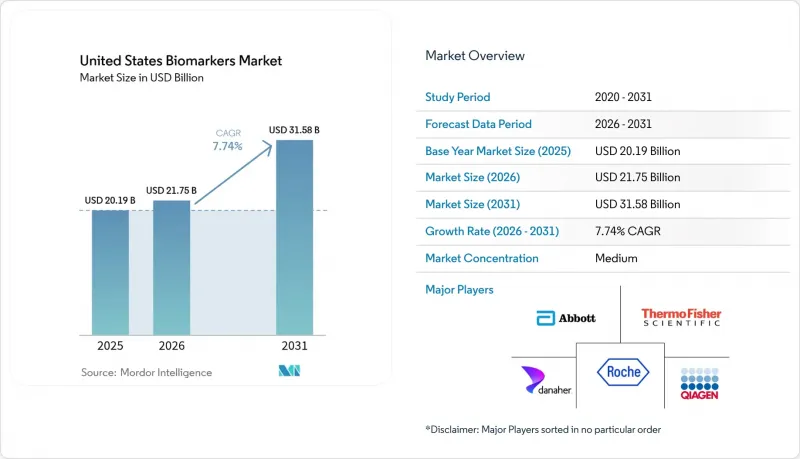
Mordor Intelligence에 따르면 미국의 바이오마커 시장 규모는 2025년 201억 9,000만 달러에서 2026년에는 217억 5,000만 달러로 확대되고, 2026년부터 2031년까지 CAGR 7.74%를 기록하며 2031년에는 315억 8,000만 달러에 달할 것으로 예측됩니다.
본 보고서는 제품별(소모품, 기기, 서비스·소프트웨어), 질환별(종양학, 심혈관질환 등), 종류별(유효성 바이오마커, 안전성 바이오마커, 검증용 바이오마커), 기전별(유전자 바이오마커 등), 용도별(임상 진단, 신약 개발 등)로 분류되어 있습니다. 시장 전망은 금액(달러) 기준으로 제시되어 있습니다.
미국 바이오마커 시장의 동향 및 인사이트
미국 내 암 부담 증가 및 만성 질환 유병률 상승
암 발생률 예측에 따르면, 2030년까지 미국에서는 연간 약 200만 명의 신규 환자가 발생할 것으로 예상되며, 그중에서도 폐암과 대장암은 환자 수가 많아 바이오마커에 기반한 치료법 선택이 효과적입니다. 만성 심혈관질환 및 대사성 질환은 많은 성인 인구에 영향을 미치고 있으며, 이로 인해 의료 시스템 전반의 치료 프로토콜에 통합된 심장 및 대사 바이오마커에 대한 수요가 유지되고 있습니다. 2030년까지 65세 이상 성인이 미국 인구에서 차지하는 비율이 증가할 것으로 예상되는 인구 고령화에 따라 동반 질환이 증가하고 있으며, 치료 시작을 신속히 하기 위한 워크플로우를 효율화하는 다중 질환 패널이 주목받고 있습니다. 분자 프로파일링을 통해 진행성 암 환자의 상당 부분에서 치료에 활용할 수 있는 돌연변이가 확인되며, 이를 통해 특정 상황에서 경험적 치료법을 능가하는 효과를 보이는 표적 치료에 대한 접근이나 정밀 의학 임상시험 참여가 가능해집니다. FDA의 종양 비특이적 바이오마커 정책 및 CLIA에 기반한 검사실 품질 기준 등의 규제 프로그램은 검사 성능의 표준화를 지속적으로 추진하고 있으며, 이는 미국 바이오마커 시장에 대한 보험사 측의 신뢰를 뒷받침하고 있습니다.
혈액 유래 신경퇴행성 질환 바이오마커에 관한 CMS의 보험 적용 시범 사업이 조기 발견을 촉진
2024년 CMS가 발표한, 인산화 타우와 아밀로이드 베타의 비율을 측정하는 혈장 검사에 관한 보험 적용 결정안에서는 경도 인지 장애(MCI) 환자에서 알츠하이머병의 병리를 배제하는 데 있어 이러한 검사의 역할이 인정되었습니다. ‘증거 개발을 수반하는 보험 적용(Coverage with Evidence Development)’ 모델에서는 결과 데이터를 수집하기 위한 전향적 등록 연구가 요구되며, 이를 통해 실제 환경에서의 성능과 임상적 이점을 바탕으로 보험 급여가 결정됩니다. 임상의들은 진단 워크플로우에 혈액 검사를 통합하고 있으며, 이를 통해 진단까지 걸리는 시간이 단축되고 질병 진행 초기 단계에서의 치료 계획 수립이 지원되고 있습니다. 민간 보험사들은 메디케어의 시범 사업을 주시하며, 고령자의 전문의 의뢰 가정으로 바이오마커 검사 결과를 활용하는 방침을 수립하고 있습니다. 각 진단 기기 제조사들은 전문 시설 이외의 기관으로 보험 적용 범위가 확대됨에 따라, 대량 처리에 대응할 수 있도록 면역분석법 및 질량 분석법 플랫폼의 확장을 추진하고 있습니다. CLIA(임상 검사법) 및 지방·국가 차원의 보험 적용 결정은 미국 바이오마커 시장에서 분산형 검사 시설의 품질 및 접근성에 관한 기준을 지속적으로 뒷받침하고 있습니다.
복잡한 환급 제도와 진화하는 FDA의 IVD/LDT 규제가 시장 출시까지의 시간을 연장
FDA가 제안한 실험실 개발 검사(LDT) 규제 프레임워크로 인해 병원 내 검사에 대한 시판 전 심사 요건이 확대되고 있으며, 이로 인해 개발 주기가 장기화되고 병원 및 학술 기관 실험실의 신청 비용이 증가하고 있습니다. 많은 기관들이 혁신 파이프라인을 재검토하거나, 미국 바이오마커 시장의 규제 및 품질 요건을 감당할 수 있는 상업적 파트너를 모색하고 있습니다. 메디케어 관리 계약업체(MAC)마다 보험 적용 방침이 제각각이기 때문에 승인 상황에 지역별 편차가 발생하여 예측 가능한 환급이 제한되고 있습니다. 사전 승인이나 의학적 필요성 심사 같은 관리 절차가 추가됨에 따라, 확고한 임상적 근거를 갖춘 검사라 하더라도 검사 의뢰율이 감소하고 있습니다. 새로운 바이오마커 범주에 대한 구체적인 CPT 코드가 존재하지 않기 때문에 지급액이 낮은 ‘기타’ 코드를 사용할 수밖에 없거나 청구가 기각되는 경우가 많아, 이것이 도입 지연으로 이어지고 있습니다. 이러한 장벽들이 복합적으로 작용하여, 본래라면 임상적 요구를 충족시켜야 할 신규 검사의 시장 진입 및 보급이 지연되고 있습니다.
부문 분석
2025년에는 종양의 특성 평가 및 치료법 선택을 위한 종합적인 유전체 프로파일링의 광범위한 도입에 힘입어, 종양학 분야가 질환별 매출의 36.02%를 차지했습니다. 미국 바이오마커 시장에서는 비소세포폐암, 대장암, 유방암 및 악성 흑색종의 치료 방침을 결정하는 표적에 대한 검사가 정착되어 있으며, 이는 임상시험 참여 및 표적 치료제 접근을 뒷받침하고 있습니다. 신경 질환 분야는 최근의 보험 적용 시범 사업을 거쳐, 알츠하이머병이 의심되는 사례의 선별 진단을 위해 일차 진료에서 혈장 내 인산화 타우 및 아밀로이드 분석이 일상적으로 사용됨에 따라, 2031년까지 연평균 성장률(CAGR) 8.86%로 성장할 것으로 예상됩니다. 고감도 트로포닌이나 나트륨 이뇨 펩타이드와 같은 심혈관계 바이오마커는 외래 관리에서 연속 측정을 통해 치료량을 조정하고 잔존 위험을 평가하는, 지침에 기반한 진료를 뒷받침하고 있습니다. 면역학 프로그램은 C-반응성 단백질 및 항-CCP 항체와 같은 바이오마커에 의존하고 있지만, 시장의 성숙화와 우수한 성능을 지닌 새로운 마커의 부족으로 인해 그 성장이 제한되고 있습니다.
만성 신장병의 병기 분류를 위한 신장·비뇨기계 검사는 여전히 필수적이지만, 보험사가 가치 기반 모델을 적용함에 따라 가격 압박으로 인해 수익 성장에 어려움이 발생하고 있습니다. 감염증 및 패혈증 바이오마커는 병원 환경에서의 조기 개입과 항생제의 적정 사용을 목적으로 한 관리 프로토콜을 지속적으로 뒷받침하고 있습니다. 헤모글로빈 A1c 및 TSH와 같은 대사·내분비 바이오마커는 고위험군을 식별하고 모니터링하는 지역 주민 건강 증진 이니셔티브를 통해 검사 건수를 유지하고 있습니다. 호흡기 및 소화기 질환의 신흥 분야에는 비침습적 섬유화 병기 분류와 표현형에 기반한 천식 평가가 포함되어 있으며, 검증이 완료되면 침습적 시술에 대한 의존도를 낮출 수 있을 가능성이 있습니다. 미국 바이오마커 시장에서는 정밀 진단의 주축으로 종양학이 여전히 자리 잡고 있는 반면, 최근의 보험 적용 동향과 새로운 혈액 검사법에 따라 신경학이 가장 빠르게 성장하는 질환 영역이 되고 있습니다.
2025년에는 병원, 참조 센터, 제약 연구 기관의 검사실에서 면역분석, PCR, 시퀀싱 각 워크플로우용 시약 및 키트에 대한 대량 주문이 지속됨에 따라 소모품이 매출의 51.78%를 차지했습니다. 미국 바이오마커 시장은 종양학, 순환기학, 감염증 프로그램의 일상적인 검사를 뒷받침하는 이러한 주요 투입 자재의 안정적인 공급망에 계속해서 의존하고 있습니다. ‘서비스·소프트웨어’는 구조화된 결과에 대한 임상 기준에 따라 변이 판정, 주석 달기, 보고서 생성을 자동화하는 클라우드 바이오인포매틱스에 힘입어 2031년까지 연평균 성장률(CAGR) 10.05%를 기록하며 가장 빠르게 성장하는 부문입니다. 의료 기관에서는 AI를 활용한 해석 모듈을 전자건강기록(EHR)에 통합하고, 임상적으로 활용 가능한 소견을 치료 경로에 반영함으로써 검사 의뢰의 일관성과 결과 보고까지 걸리는 시간을 개선하고 있습니다. 각 벤더사는 약물유전학에 기반한 의사결정 지원이나 순환 종양 DNA의 변화를 시간 경과에 따라 추적하는 등의 차별화를 꾀하고 있으며, 이는 임상의가 치료 방침을 조정하는 데 도움이 되고 있습니다. 또한, 미국의 바이오마커 업계에서는 ?랩 처리와 전문가 검토를 결합한 번들형 서비스도 등장하여 지역 의료기관의 인력 배치 부담을 경감시키고 있습니다.
비용 절감 압력으로 인해 설비 투자 예산에 영향을 미치고 있어 장비 수요는 여전히 들쑥날쑥하지만, 규모 확대가 영업이익률 향상으로 이어지는 분야에서는 고처리량 시퀀서 및 자동화 플랫폼으로의 업그레이드가 계속되고 있습니다. 레퍼런스 실험실은 전문적인 판정 업무를 분자 종양 위원회나 유전적 위험 상담을 수행하는 중앙 관리 팀에 외주화하고 있으며, 이를 통해 권고 사항의 명확성이 향상되고 편차가 감소합니다. 환자별 결과를 산출하는 소프트웨어 구성요소는 CLIA의 감독 대상이며, 자동화를 통해 전문가의 검토와 비교하여 일관된 결과를 얻을 수 있음을 검증해야 합니다. 미국 바이오마커 시장은 LOINC 및 SNOMED 용어 체계 간의 수동 매핑을 줄여주는 템플릿 기반 보고서 작성 및 표준화된 코드에 대한 투자의 혜택을 받고 있습니다. 이러한 제품 수준의 동향은 소모품 판매량을 보완하는 분석 및 서비스를 통한 지속적인 수익원으로의 전환을 촉진하고 있습니다.
기타 혜택:
- 엑셀 형식의 시장 예측(ME) 시트
- 3개월간의 애널리스트 지원
자주 묻는 질문
목차
제1장 소개
제2장 조사 방법
제3장 주요 요약
제4장 시장 구도
제5장 시장 규모와 성장 예측
제6장 경쟁 구도
제7장 시장 기회와 향후 전망
KSMAccording to Mordor Intelligence, the United States biomarkers market size is expected to grow from USD 20.19 billion in 2025 to USD 21.75 billion in 2026 and is forecast to reach USD 31.58 billion by 2031 at 7.74% CAGR over 2026-2031.
This report is Segmented by Product (Consumables, Instruments, and Services & Software), Disease (Oncology, Cardiovascular Disorders, and More), Type (Efficacy Biomarkers, Safety Biomarkers, and Validation Biomarkers), Mechanism (Genetic Biomarkers, and More), and Application (Clinical Diagnostics, Drug Discovery & Development, and More). The Market Forecasts are Provided in Terms of Value (USD).
United States Biomarkers Market Trends and Insights
Rising Oncology Burden and Chronic Disease Prevalence in the U.S.
Cancer incidence projections indicate that the United States will see around 2 million new diagnoses annually through 2030, with lung and colorectal cancers representing large case volumes that benefit from biomarker-guided therapy selection. Chronic cardiovascular and metabolic conditions affect a large adult population, which sustains demand for cardiac and metabolic biomarkers embedded in treatment protocols across health systems. An aging demographic profile, with adults aged 65 and older expected to represent a rising share of the U.S. population by 2030, is increasing co-morbidities and encouraging multi-disease panels that streamline workflows for faster treatment initiation. Molecular profiling identifies actionable mutations in a significant share of advanced-stage cancers, which enables enrollment in precision trials and access to targeted therapies that outperform empirical regimens in specific settings. Regulatory programs such as the FDA's tumor-agnostic biomarker policies and laboratory quality rules under CLIA continue to standardize assay performance, which supports payer confidence in the United States biomarkers market.
CMS Coverage Pilots for Blood-Based Neurodegenerative Biomarkers Catalyzing Earlier Detection
CMS draft coverage determinations in 2024 for plasma assays that measure phosphorylated tau and amyloid-beta ratios recognized their role in ruling out Alzheimer pathology in patients with mild cognitive impairment. Coverage with evidence development models require prospective registries to gather outcomes, which link reimbursement to real-world performance and clinical benefit. Clinicians are layering blood tests into diagnostic workflows, which shortens time to diagnosis and supports care planning earlier in the disease course. Private insurers are observing Medicare pilots and adapting policies that use biomarker documentation as a predicate for specialty referrals in older adults. Diagnostic companies are scaling immunoassay and mass spectrometry platforms for high-volume processing as coverage expands beyond specialty centers. CLIA and local or national coverage determinations continue to anchor quality and access parameters for decentralized testing sites in the United States biomarkers market.
Complex Reimbursement and Evolving FDA IVD/LDT Regulation Increases Time-to-Market
The FDA's proposed framework to regulate laboratory-developed tests expands premarket review expectations for in-house assays, which lengthens development cycles and increases submission costs for hospital and academic laboratories. Many institutions are reassessing innovation pipelines or seeking commercial partners that can shoulder regulatory and quality requirements under the United States biomarkers market. Fragmented coverage policies across Medicare Administrative Contractors create region-by-region variability in approvals that constrains predictable reimbursement. Prior authorization and medical necessity checks add administrative steps that lower ordering rates even for tests with strong clinical evidence. The absence of specific CPT codes for newer biomarker categories often forces use of miscellaneous codes that pay at lower rates or face denials, which delays adoption. These barriers collectively slow market entry and scale for novel assays that would otherwise meet clinical needs.
Other drivers and restraints analyzed in the detailed report include:
- Data Liquidity via TEFCA/USCDI+ Enabling RWE Pipelines for Validation and Label Expansion
- Falling NGS/Multi-Omics Costs Enabling Broader Discovery and Clinical Validation
- High Assay Development and Multi-Site Clinical Validation Costs
For complete list of drivers and restraints, kindly check the Table Of Contents.
Segment Analysis
Oncology accounted for 36.02% of disease-specific revenue in 2025 supported by widespread adoption of comprehensive genomic profiling for tumor characterization and therapy selection. The United States biomarkers market has embedded testing for targets that guide treatment in non-small cell lung cancer, colorectal cancer, breast cancer, and melanoma, and this underpins clinical trial enrollment and access to targeted agents. Neurological Disorders are expected to grow at a 8.86% CAGR through 2031 as plasma phospho-tau and amyloid assays move into routine use in primary care to triage suspected Alzheimer cases after recent coverage pilots. Cardiovascular biomarkers such as high-sensitivity troponin and natriuretic peptides support guideline-driven care that uses serial measurements to titrate therapy and assess residual risk in outpatient management. Immunology programs rely on biomarkers such as C-reactive protein and anti-CCP antibodies, though expansion is tempered by market maturity and fewer novel markers with superior performance.
Renal and urologic testing for chronic kidney disease staging remains essential, although pricing pressure challenges revenue growth as payers apply value-based models. Infectious disease and sepsis biomarkers continue to support stewardship protocols that target early intervention and better antibiotic use in hospital settings. Metabolic and endocrine biomarkers like hemoglobin A1c and TSH sustain volume through population health initiatives that identify and monitor at-risk individuals. Emerging areas in respiratory and gastrointestinal disorders include noninvasive fibrosis staging and phenotype-based asthma assessment, which may reduce reliance on invasive procedures once validation completes. The United States biomarkers market continues to see oncology as the anchor for precision diagnostics while neurology is the fastest-moving disease area based on recent coverage trends and new blood-based modalities.
Consumables held 51.78% of revenue in 2025 as labs across hospitals, reference centers, and pharma research maintained high-volume ordering for reagents and kits across immunoassays, PCR, and sequencing workflows. The United States biomarkers market continues to depend on stable supply chains for these core inputs, which underpins routine testing across oncology, cardiology, and infectious disease programs. Services & Software is the fastest-growing category at a 10.05% CAGR through 2031, driven by cloud bioinformatics that automates variant calling, annotation, and report generation aligned to clinical standards for structured results. Health systems are embedding AI-enabled interpretation modules within EHRs to route clinically actionable findings into care pathways that improve ordering consistency and turnaround times. Vendors are differentiating with pharmacogenomic decision support and longitudinal tracking of circulating tumor DNA changes, which help clinicians adapt therapy sequences. The United States biomarkers industry is also seeing bundled offerings that combine wet-lab processing with expert review, which simplifies staffing needs for community providers.
Instrument demand remains mixed as cost containment pressures influence capital budgets, yet upgrades to higher-throughput sequencers and automation platforms continue where scale brings operating margin benefits. Reference labs are outsourcing specialist interpretation to centralized teams that run molecular tumor boards and hereditary risk consultations, which can improve clarity and reduce variability in recommendations. Software components that output patient-specific results fall within CLIA oversight, which requires validation that automation yields concordant results compared to expert review. The United States biomarkers market benefits from investments in template-based reporting and standardized codes that reduce manual mapping across LOINC and SNOMED terminologies. These product-layer dynamics reinforce a shift toward recurring revenue streams from analytics and services that complement consumable volumes.
Complete Report Scope:
- By Disease
- Oncology
- Cardiovascular Disorders
- Neurological Disorders
- Immunological & Inflammatory Disorders
- Renal & Urologic Disorders
- Infectious Diseases & Sepsis
- Metabolic & Endocrine Disorders
- Respiratory Disorders
- Gastrointestinal & Hepatic Disorders
- By Type
- Efficacy Biomarkers
- Prognostic Biomarkers
- Predictive Biomarkers
- Pharmacodynamic Biomarkers
- Surrogate Endpoint Markers
- Safety Biomarkers
- Validation Biomarkers
- Efficacy Biomarkers
- By Mechanism
- Genetic (Genomic) Biomarkers
- Epigenetic Biomarkers
- Proteomic Biomarkers
- Metabolomic Biomarkers
- Lipidomic Biomarkers
- Imaging Biomarkers
- By Application
- Clinical Diagnostics
- Drug Discovery & Development
- Personalized Medicine
- Disease Risk Assessment
- Prognosis & Monitoring
- By Product
- Consumables
- Instruments
- Services & Software
List of Companies Covered in this Report:
- Abbott Laboratories
- F. Hoffmann-La Roche Ltd (Roche Diagnostics)
- Thermo Fisher Scientific
- QIAGEN
- Danaher Corporation (Beckman Coulter Diagnostics)
- Siemens Healthineers
- Bio-Rad Laboratories
- Agilent Technologies
- Illumina
- Revvity, Inc. (formerly PerkinElmer Life Sciences)
- Merck KGaA (MilliporeSigma in the U.S.)
- Beckton Dickinson
- Hologic
- Sysmex Corporation (Sysmex Inostics)
- Myriad Genetics
- Quanterix Corporation
- GE HealthCare Technologies Inc.
- bioMerieux S.A.
- Exact Sciences
- Guardant Health, Inc.
- Natera, Inc.
- GRAIL, LLC
- Foundation Medicine, Inc.
- Veracyte, Inc.
- Bio-Techne
- Olink Holding AB (publ)
- Seer, Inc.
- Standard BioTools Inc. (including SomaLogic)
- Adaptive Biotechnologies Corp.
- Tempus Labs, Inc.
- Eurofins
- 10x Genomics, Inc.
Additional Benefits:
- The market estimate (ME) sheet in Excel format
- 3 months of analyst support
TABLE OF CONTENTS
1 Introduction
- 1.1 Study Assumptions & Market Definition
- 1.2 Scope of the Study
2 Research Methodology
3 Executive Summary
4 Market Landscape
- 4.1 Market Overview
- 4.2 Market Drivers
- 4.2.1 Rising Oncology Burden and Chronic Disease Prevalence in the U.S.
- 4.2.2 Broader Adoption of Biomarker-Based Clinical Diagnostics & Screening Across the U.S. Health Systems
- 4.2.3 Acceleration of Companion Diagnostics Embedded in Drug Labels and Clinical Trials
- 4.2.4 Falling NGS/Multi-Omics Costs Enabling Broader Discovery and Clinical Validation
- 4.2.5 CMS Coverage Pilots for Blood-Based Neurodegenerative Biomarkers Catalyzing Earlier Detection
- 4.2.6 Data Liquidity Via TEFCA/USCDI+ Enabling RWE Pipelines for Validation and Label Expansion
- 4.3 Market Restraints
- 4.3.1 Complex Reimbursement and Evolving FDA IVD/LDT Regulation Increases Time-To-Market
- 4.3.2 High Assay Development and Multi-Site Clinical Validation Costs
- 4.3.3 Limited Assay Standardization/Interoperability Across Platforms Hampers Payer Acceptance
- 4.3.4 Algorithmic Transparency and Change-Control Expectations for AI Biomarkers Slow Adoption
- 4.4 Value / Supply-Chain Analysis
- 4.5 Regulatory Landscape
- 4.6 Technological Outlook
- 4.7 Porter's Five Forces
- 4.7.1 Bargaining Power of Suppliers
- 4.7.2 Bargaining Power of Buyers
- 4.7.3 Threat of New Entrants
- 4.7.4 Threat of Substitutes
- 4.7.5 Intensity of Competitive Rivalry
5 Market Size & Growth Forecasts (Value, USD)
- 5.1 By Disease
- 5.1.1 Oncology
- 5.1.2 Cardiovascular Disorders
- 5.1.3 Neurological Disorders
- 5.1.4 Immunological & Inflammatory Disorders
- 5.1.5 Renal & Urologic Disorders
- 5.1.6 Infectious Diseases & Sepsis
- 5.1.7 Metabolic & Endocrine Disorders
- 5.1.8 Respiratory Disorders
- 5.1.9 Gastrointestinal & Hepatic Disorders
- 5.2 By Type
- 5.2.1 Efficacy Biomarkers
- 5.2.1.1 Prognostic Biomarkers
- 5.2.1.2 Predictive Biomarkers
- 5.2.1.3 Pharmacodynamic Biomarkers
- 5.2.1.4 Surrogate Endpoint Markers
- 5.2.2 Safety Biomarkers
- 5.2.3 Validation Biomarkers
- 5.2.1 Efficacy Biomarkers
- 5.3 By Mechanism
- 5.3.1 Genetic (Genomic) Biomarkers
- 5.3.2 Epigenetic Biomarkers
- 5.3.3 Proteomic Biomarkers
- 5.3.4 Metabolomic Biomarkers
- 5.3.5 Lipidomic Biomarkers
- 5.3.6 Imaging Biomarkers
- 5.4 By Application
- 5.4.1 Clinical Diagnostics
- 5.4.2 Drug Discovery & Development
- 5.4.3 Personalized Medicine
- 5.4.4 Disease Risk Assessment
- 5.4.5 Prognosis & Monitoring
- 5.5 By Product
- 5.5.1 Consumables
- 5.5.2 Instruments
- 5.5.3 Services & Software
6 Competitive Landscape
- 6.1 Market Concentration
- 6.2 Market Share Analysis
- 6.3 Company Profiles (includes Global level Overview, Market level overview, Core Business Segments, Financials, Headcount, Key Information, Market Rank, Market Share, Products and Services, and analysis of Recent Developments)
- 6.3.1 Abbott Laboratories
- 6.3.2 F. Hoffmann-La Roche Ltd (Roche Diagnostics)
- 6.3.3 Thermo Fisher Scientific Inc.
- 6.3.4 QIAGEN N.V.
- 6.3.5 Danaher Corporation (Beckman Coulter Diagnostics)
- 6.3.6 Siemens Healthineers AG
- 6.3.7 Bio-Rad Laboratories, Inc.
- 6.3.8 Agilent Technologies, Inc.
- 6.3.9 Illumina, Inc.
- 6.3.10 Revvity, Inc. (formerly PerkinElmer Life Sciences)
- 6.3.11 Merck KGaA (MilliporeSigma in the U.S.)
- 6.3.12 Becton, Dickinson and Company (BD)
- 6.3.13 Hologic, Inc.
- 6.3.14 Sysmex Corporation (Sysmex Inostics)
- 6.3.15 Myriad Genetics, Inc.
- 6.3.16 Quanterix Corporation
- 6.3.17 GE HealthCare Technologies Inc.
- 6.3.18 bioMerieux S.A.
- 6.3.19 Exact Sciences Corporation
- 6.3.20 Guardant Health, Inc.
- 6.3.21 Natera, Inc.
- 6.3.22 GRAIL, LLC
- 6.3.23 Foundation Medicine, Inc.
- 6.3.24 Veracyte, Inc.
- 6.3.25 Bio-Techne Corporation
- 6.3.26 Olink Holding AB (publ)
- 6.3.27 Seer, Inc.
- 6.3.28 Standard BioTools Inc. (including SomaLogic)
- 6.3.29 Adaptive Biotechnologies Corp.
- 6.3.30 Tempus Labs, Inc.
- 6.3.31 Eurofins Scientific SE
- 6.3.32 10x Genomics, Inc.
7 Market Opportunities & Future Outlook
- 7.1 White-space & Unmet-Need Assessment