

|
시장보고서
상품코드
2113421
부유식 생산 시스템(FPS) : 시장 점유율 분석, 업계 동향과 통계, 성장 예측(2026-2031년)Floating Production Systems (FPS) - Market Share Analysis, Industry Trends & Statistics, Growth Forecasts (2026 - 2031) |
||||||
 Mordor Intelligence
Mordor Intelligence에 따르면 부유식 생산 시스템 시장 규모는 2025년에 666억 달러로 평가되며, 2026년 732억 1,000만 달러에서 2031년까지 1,173억 5,000만 달러에 달할 것으로 예측되며, 예측 기간(2026-2031년) 동안 CAGR은 9.92%가 될 전망입니다.
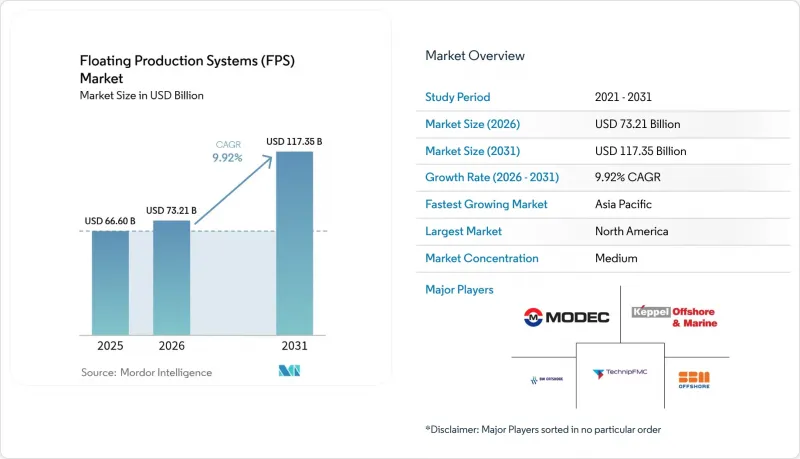
본 보고서는 유형별(FPSO, 텐션 레그 플랫폼, SPAR, 반잠수식, 바지선), 수심별(얕은 바다, 심해, 초심해), 건조 방법별(신조, 개조), 및 지역별(북미, 유럽, 아시아태평양, 남미, 중동 및 아프리카)로 분류되어 있습니다. 시장 규모 및 전망은 금액(달러) 기준으로 제시되어 있습니다.
세계 부유식 생산 시스템(FPS) 시장의 동향 및 인사이트
심해 탐사에 대한 투자 증가
각 운영사들이 기존 생산 지역 이외의 곳에서 큰 영향을 미칠 만한 발견을 추구하는 가운데, 자본은 심해 및 초심해 해역으로 급속히 유입되고 있습니다. 가이아나에 위치한 엑슨모빌의 4번째 FPSO는 이 나라의 가동 능력을 하루 90만 배럴로 끌어올렸으며, 원유 가격이 중간 수준일 때도 수익성을 유지할 수 있는 초심해 유전에 대한 투자자들의 신뢰를 입증하고 있습니다. 셰브론의 ‘앵커’ 및 BP의 ‘카스키다’ 개발 프로젝트에서는 20 kpsi의 해저 구조물을 채택하여, 기존 설비로는 채굴할 수 없었던 고제3기층의 원유를 생산하고 있습니다. 앙골라에서 토탈에너지즈가 진행 중인 카민호 프로젝트는 아프리카의 개척 지역이 고정식 플랫폼에 의존하지 않고도 수십억 달러 규모의 부유식 설비 투자를 유치할 수 있게 되었음을 보여줍니다. 이러한 프로젝트들은 전반적으로 기술의 성숙도, 견고한 저류층 생산성, 그리고 세제상의 우대 조치가 부유식 생산 시스템 시장의 신규 건설 계약 파이프라인을 어떻게 뒷받침하고 있는지를 보여줍니다.
얕은 해역의 매장량 감소로 인해 생산이 외해로 이동하고 있다
북해 및 기타 대륙붕 지역의 저류층 고갈로 인해, 운영사들은 기술적으로 부유식 개념만이 실현 가능한 더 깊은 터비다이트 광구로 플랫폼을 재배치해야 하는 상황에 직면해 있습니다. 에퀴노르(Equinor)가 추진하는 100억 노르웨이 크로네 규모의 오세베르그(Oseberg) 유전 수명 연장 프로젝트에서는 전기화를 활용하여 생산 정점을 2040년 이후까지 연장하는 동시에, 인근의 더 깊은 목표 지역에 대한 투자를 위해 고정식 플랫폼 예산을 확보하고 있습니다. 멕시코만의 기존 사업자들도 유사한 전략을 채택하고 있습니다. 반잠수식 플랫폼 ‘웨일(Whale)’은 2025년 1월 일일 10만 배럴의 생산능력으로 가동을 시작하여, 폐쇄 시기가 다가오고 있던 구형 탑사이드의 생산량을 보충했습니다. 그 결과, 선체, 계류 로프 및 해저 시스템에 대한 수요가 구조적으로 증가하고 있으며, 이러한 자산들은 주요 광구권 생산량이 감소한 후 새로운 유전으로 전용될 수 있습니다. 이를 통해 재배치 가능한 FPSO의 매력이 더욱 높아지고 있습니다.
원유 가격 변동
부유식 개발은 자본 집약적이며 회수 기간도 수년 단위로 길기 때문에 원유 가격의 급격한 변동으로 인해 최종 투자 결정이 동결될 가능성이 있습니다. 2024년 후반, 벤치마크 가격이 배럴당 70달러 아래로 떨어졌을 때, 운영사들은 멕시코만에서 진행 중이던 여러 타이백 계획을 일시 중단했고, 이에 따라 시추 장비 가동률도 5퍼센트 포인트 하락했습니다. 대형 통합 기업들은 헤지가 가능하지만, 독립 기업들은 종종 선물 가격이 안정될 때까지 승인을 미루기 때문에 선체 제조업체 입장에서는 수주 패턴이 불규칙해집니다. 한편, 부유식 생산 시스템 시장은 현재 구조적인 손익분기점 하락의 혜택을 받고 있습니다. 많은 심해 프로젝트는 표준화와 디지털 최적화를 거쳐 배럴당 45-50달러 수준에서도 수익성을 확보할 수 있어, 단기적인 가격 충격의 영향이 완화되고 있습니다.
부문 분석
FPSO 유닛을 대상으로 하는 부유식 생산 시스템의 시장 규모는 2025년에 360억 3,000만 달러에 달하며, 연평균 성장률(CAGR) 10.12%에 힘입어 2031년까지 거의 두 배로 증가할 전망입니다. FPSO는 사이클론이 발생하기 쉬운 해역에서도 뛰어난 성능을 발휘하며, 유전의 경제성이 변화함에 따라 재배치가 가능하며, 브라질 연안의 SBM사가 소유한 ‘알미란테 타만다레’호가 보여주듯이, 일일 22만 5,000배럴 이상의 처리 능력을 탑사이드에 통합하고 있습니다. 텐션 레그 플랫폼은 허브 억제가 필수적인 가늘고 긴 초심해 대상지에서 계속 운영되고 있는 반면, SPAR 및 반잠수식 플랫폼은 가혹한 환경에서의 시추 및 초기 생산 시험에서 여전히 중요한 역할을 수행하고 있습니다. 시장 환경의 변화는 CO₂ 스트리핑 컬럼 및 육상 전원 연결 기능을 통합한 FPSO에서 가장 두드러지게 나타나며, 이러한 기술은 기존의 반잠수식 플랫폼이나 바지에 사후 장착하기 어렵습니다.
2세대 FPSO에서는 디지털 트윈을 활용하여 장비의 피로를 예측하고, 가스 리프트 배분을 최적화하며, 유지보수 일정을 수립하고 있으며, 그 결과 가동률은 96%를 초과하고 있습니다. 이러한 개선 사항이 부유식 생산 시스템 시장에서 해당 부문의 두드러진 성장을 뒷받침하고 있으며, 금융 관계자들에게 FPSO의 수익원을 준인프라로 취급할 것을 촉구하고 있습니다. 바지선 등 틈새 선체 등급은 아시아의 얕은 델타 지대에서 전략적 중요성을 유지하고 있지만, 그 성장 가능성은 수심 제한으로 인해 한계에 도달했습니다. 전반적으로, 사업자들이 새로운 탈탄소화 요건에 부합하는 유연하고 소규모 운영이 가능한 솔루션을 추구하는 가운데, FPSO는 앞으로도 절대적인 수익과 수요 증가 양면에서 주도적인 위치를 계속 유지할 것입니다.
지역별 분석
북미는 2025년에도 38.30%의 수익 점유율을 유지했습니다. 그 기반이 되는 곳은 멕시코만으로, 미국 에너지 정보청(EIA)은 2025년 해당 지역의 해양 석유 생산량이 하루 180만 배럴(b/d)로 안정될 것으로 예측하고 있습니다. 배리모어나 소드피쉬와 같은 새로 발견된 유전들은 기존 파이프라인 허브를 활용하고 있으며, 규제 안정성 덕분에 중형 FPSO에 적합한 타이백 프로젝트의 안정적인 수주 잔고가 촉진되고 있습니다. 멕시코의 심해 살리나 분지는 아직 평가 단계에 있지만, 재정적 인센티브가 마련되면 추가적인 성장이 예상됩니다. 캐나다의 베이 뒤 노르(Bay du Nord)는 캐나다 최초의 플로터 대응 가능 광구이며, 개발이 진행되면 뉴펀들랜드 조선소의 개조를 넘어 지역의 제조 능력을 확대하게 될 것입니다.
아시아태평양은 가장 빠르게 성장하는 지역이며, 중국, 인도네시아, 호주가 자국의 탄화수소 자원을 우선시하고 있어 2031년까지 연평균 성장률(CAGR)은 11.18%를 기록하고 있습니다. 중국해양석유(CNOOC)의 기록적인 발견 성공으로 조선소는 극심한 바쁜 시기를 맞이했으며, 중국의 계약업체들은 국가의 기후 목표를 지원하면서 액체 생산량을 늘리기 위해 세계 최초의 탄소 회수 장치를 갖춘 FPSO를 취항시켰습니다. 인도네시아에서 개정된 생산분배계약은 동 칼리만탄 연안의 프론티어 광구에 대한 신속한 수익화를 목표로 하고 있으며, 이 지역에서는 리스 앤 오퍼레이트 방식의 FPSO가 가장 현실적인 수송 경로가 되고 있습니다. 한편, 한국과 일본은 인근 시장에 하이엔드 탑사이드 모듈, 동적 위치 유지 추진기, 극저온 장비를 공급함으로써 지역의 경쟁력을 강화하고 있습니다.
유럽의 시장 점유율은 안정적이지만, 북해가 성숙기에 접어들었기 때문에 성장률은 비교적 낮은 편입니다. 그렇긴 하지만, 영국 셰틀랜드 제도 서부의 전력 공급 타이백 사업과 노르웨이의 육상 전력 공급 이니셔티브 덕분에, 저탄소 운영에 대응하는 고사양 부유식 설비로 구성된 틈새 클러스터가 유지되고 있습니다. 또한 남쪽 지중해에서는 키프로스와 이스라엘 연안의 심해 광구가 FID(최종 투자 결정) 전 단계에 있어, 이번 10년 후반에는 수주를 끌어올릴 가능성이 있습니다. 러시아 북극권의 FPSO 계획은 지정학적 제약으로 인해 일시 중단되어 있으며, 이로 인해 유럽의 엔지니어링 역량은 아프리카의 메가 프로젝트와 브라질의 프리솔트층 개발 프로젝트로 전환되고 있습니다. 전반적으로, 지리적 분산화를 통해 부유식 생산 시스템 시장은 특정 해역의 경기 변동에 따른 영향을 완화할 수 있습니다.
기타 혜택:
- 엑셀 형식의 시장 예측(ME) 시트
- 3개월간의 애널리스트 지원
자주 묻는 질문
목차
제1장 소개
제2장 조사 방법
제3장 주요 요약
제4장 시장 구도
제5장 시장 규모와 성장 예측
제6장 경쟁 구도
제7장 시장 기회와 향후 전망
KSM 26.08.25According to Mordor Intelligence, the floating production systems market size was valued at USD 66.60 billion in 2025 and estimated to grow from USD 73.21 billion in 2026 to reach USD 117.35 billion by 2031, at a CAGR of 9.92% during the forecast period (2026-2031).
This report is Segmented by Type (FPSO, Tension Leg Platform, SPAR, Semi-Submersible, and Barge), Water Depth (Shallow Water, Deepwater, and Ultra-Deepwater), Build Method (Newbuild and Conversion), and Geography (North America, Europe, Asia-Pacific, South America, and Middle East and Africa). The Market Sizes and Forecasts are Provided in Terms of Value (USD).
Global Floating Production Systems (FPS) Market Trends and Insights
Rising Deep-water Exploration Investments
Capital is moving rapidly into deep and ultra-deepwater acreage as operators chase high-impact discoveries outside legacy provinces. ExxonMobil's fourth FPSO in Guyana lifts the country's installed capacity toward 900,000 b/d and underscores investor confidence in ultra-deep finds that remain profitable at mid-cycle oil prices. Chevron's Anchor and BP's Kaskida developments utilize a 20 kpsi subsea architecture to deliver Paleogene barrels that conventional equipment could not unlock. TotalEnergies' Kaminho project in Angola demonstrates that African frontiers can now absorb multi-billion-dollar floating investments without relying on fixed platforms. Collectively, these programs illustrate how technology maturity, robust reservoir productivity, and fiscal incentives are sustaining a pipeline of new build contracts for the floating production systems market.
Declining Shallow-water Reserves Shifting Production Offshore
Reservoir depletion across the North Sea and other shelf provinces is pushing operators to re-platform toward deeper turbidite plays where only floating concepts are technically feasible. Equinor's NOK 10 billion life extension of Oseberg leverages electrification to extend plateau production beyond 2040, while freeing fixed-platform budgets for deeper targets nearby. Gulf of Mexico incumbents mirror this strategy: the Whale semi-submersible began pumping in January 2025 with a 100,000 b/d capacity, replacing output from legacy topsides that were approaching decommissioning. The consequence is a structural rise in demand for hulls, mooring lines, and subsea systems that can be redirected to new reservoirs once primary leases decline, thereby reinforcing the attractiveness of redeployable FPSOs.
Crude-oil Price Volatility
Floating developments are capital-intensive and rely on multi-year payback horizons so that rapid oil-price swings can freeze final investment decisions. Operators paused several Gulf of Mexico tie-backs in late 2024 when benchmark prices dipped below USD 70/bbl, and rig utilization slid five percentage points in tandem. While integrated majors can hedge, independents often defer sanctioning until strip prices stabilize, creating a lumpy ordering pattern for hull fabricators. The counterweight is that the floating production systems market now benefits from lower structural breakevens-many deepwater projects operate profitably at USD 45-50/bbl after standardization and digital optimization-softening the impact of short-term price shocks.
Other drivers and restraints analyzed in the detailed report include:
- Advances in FPSO Conversion Technologies
- Energy-security Push by Emerging Economies
- High CAPEX & OPEX Requirements
For complete list of drivers and restraints, kindly check the Table Of Contents.
Segment Analysis
The floating production systems market size for FPSO units stood at USD 36.03 billion in 2025 and, supported by a 10.12% CAGR, is set to nearly double by 2031. FPSOs perform well in cyclonic basins, can be relocated as field economics evolve, and integrate topside processing for 225,000 b/d or more, as evidenced by SBM's Almirante Tamandare unit off Brazil. Tension-leg platforms continue to serve slender ultra-deep targets where heave suppression is vital, while SPARs and semi-subs retain roles in harsh-environment drilling and early production testing. The market's environmental pivot is most visible in FPSOs that bundle CO2-stripping columns and shore-power readiness, technologies that are harder to retrofit on legacy semi-subs or barges.
Second-generation FPSOs are utilizing digital twins to predict equipment fatigue, optimize gas-lift allocation, and schedule maintenance, resulting in uptime exceeding 96%. These improvements underpin the segment's leading growth within the floating production systems market and encourage financiers to treat FPSO revenue streams as quasi-infrastructure. Niche hull classes, such as barges, retain strategic importance for shallow Asian deltas, but their growth potential is capped by water-depth limits. Overall, FPSOs will continue ruling both absolute revenue and incremental demand as operators seek flexible, low-staffed solutions that align with emerging decarbonization mandates.
Complete Report Scope:
- By Type
- FPSO
- Tension Leg Platform
- SPAR
- Semi-submersible
- Barge
- By Water Depth
- Shallow Water (Below 400 m)
- Deepwater (400 to 1,500 m)
- Ultra-deepwater (Above 1,500 m)
- By Build Method
- Newbuild
- Conversion
- By Geography
- North America
- United States
- Canada
- Mexico
- Europe
- Germany
- United Kingdom
- Norway
- Russia
- Rest of Europe
- Asia-Pacific
- China
- India
- Thailand
- Vietnam
- Australia
- Rest of Asia-Pacific
- South America
- Brazil
- Trinidad and Tobago
- Rest of South America
- Middle East and Africa
- Saudi Arabia
- United Arab Emirates
- Qatar
- Egypt
- Nigeria
- Angola
- Namibia
- Rest of Middle East and Africa
- North America
Geography Analysis
North America retained a 38.30% revenue share in 2025, anchored by the Gulf of Mexico, where the U.S. Energy Information Administration projects stable offshore oil output of 1.80 million barrels per day (b/d) for 2025. Discoveries, such as Ballymore and Swordfish, leverage existing pipeline hubs, and regulatory certainty fosters a steady backlog of tie-backs that favor mid-sized FPSOs. Mexico's deepwater Salina Basin, although still at the appraisal stage, promises upside once fiscal incentives mature. Canada's Bay du Nord is the country's first floater-ready prospect and, should it proceed, will extend regional fabrication capacity beyond Newfoundland yard upgrades.
Asia-Pacific is the fastest-growing territory, recording an 11.18% CAGR to 2031 as China, Indonesia, and Australia prioritize domestic hydrocarbons. CNOOC's record discovery success keeps shipyards busy, and Chinese contractors have launched the world's first carbon-capture-equipped FPSO to underpin national climate goals while boosting liquids output. Indonesia's reformed production-sharing contracts are designed for the rapid monetization of frontier blocks off East Kalimantan, where lease-and-operate FPSOs offer the most feasible evacuation route. Meanwhile, Korea and Japan strengthen regional competitiveness by supplying high-end topside modules, dynamic positioning thrusters, and cryogenic equipment to neighboring markets.
Europe's share is stable but relatively low-growth, limited by the maturity of the North Sea. Nevertheless, the United Kingdom's electrified West of Shetland tie-backs and Norway's power-from-shore initiatives sustain a niche cluster of high-specification floaters equipped for low-carbon operations. Further south, Mediterranean deepwater acreage off Cyprus and Israel is at pre-FID stage and could lift orders later in the decade. Russia's Arctic FPSO ambitions pause under geopolitical constraints, redirecting European engineering capacity toward African mega-projects and Brazilian pre-salt campaigns. Overall, geographic diversification cushions the floating production systems market from cyclical swings in any single basin.
- SBM Offshore N.V.
- MODEC Inc.
- BW Offshore Ltd
- Keppel Offshore & Marine Ltd
- Samsung Heavy Industries Co. Ltd
- Bumi Armada Berhad
- TechnipFMC plc
- Hyundai Heavy Industries Co. Ltd
- Mitsubishi Heavy Industries Ltd
- Teekay Corporation
- Sembcorp Marine Ltd
- Offshore Oil Engineering Co. (CNOOC)
- COSCO Shipyard Group Co.
- Daewoo Shipbuilding & Marine Engineering Co. Ltd
- Aker Solutions ASA
- Petrofac Ltd
- China Harbor Engineering Co. Ltd
- Yinson Holdings Berhad
- Saipem S.p.A.
- Wood Group PLC
Additional Benefits:
- The market estimate (ME) sheet in Excel format
- 3 months of analyst support
TABLE OF CONTENTS
1 Introduction
- 1.1 Study Assumptions & Market Definition
- 1.2 Scope of the Study
2 Research Methodology
3 Executive Summary
4 Market Landscape
- 4.1 Market Overview
- 4.2 Offshore Active Rig Count
- 4.3 Market Drivers
- 4.3.1 Rising deep-water exploration investments
- 4.3.2 Declining shallow-water reserves shifting production offshore
- 4.3.3 Advances in FPSO conversion technologies
- 4.3.4 Energy-security push by emerging economies
- 4.3.5 Surge in marginal-field leasing models
- 4.3.6 Electrification of topsides lowering OPEX
- 4.4 Market Restraints
- 4.4.1 Crude-oil price volatility
- 4.4.2 High CAPEX & OPEX requirements
- 4.4.3 Limited mega-hull shipyard capacity
- 4.4.4 ESG-linked financing constraints
- 4.5 Supply-Chain Analysis
- 4.6 Regulatory Landscape
- 4.7 Technological Outlook
- 4.8 Porter's Five Forces
- 4.8.1 Bargaining Power of Suppliers
- 4.8.2 Bargaining Power of Consumers
- 4.8.3 Threat of New Entrants
- 4.8.4 Threat of Substitutes
- 4.8.5 Intensity of Competitive Rivalry
5 Market Size & Growth Forecasts
- 5.1 By Type
- 5.1.1 FPSO
- 5.1.2 Tension Leg Platform
- 5.1.3 SPAR
- 5.1.4 Semi-submersible
- 5.1.5 Barge
- 5.2 By Water Depth
- 5.2.1 Shallow Water (Below 400 m)
- 5.2.2 Deepwater (400 to 1,500 m)
- 5.2.3 Ultra-deepwater (Above 1,500 m)
- 5.3 By Build Method
- 5.3.1 Newbuild
- 5.3.2 Conversion
- 5.4 By Geography
- 5.4.1 North America
- 5.4.1.1 United States
- 5.4.1.2 Canada
- 5.4.1.3 Mexico
- 5.4.2 Europe
- 5.4.2.1 Germany
- 5.4.2.2 United Kingdom
- 5.4.2.3 Norway
- 5.4.2.4 Russia
- 5.4.2.5 Rest of Europe
- 5.4.3 Asia-Pacific
- 5.4.3.1 China
- 5.4.3.2 India
- 5.4.3.3 Thailand
- 5.4.3.4 Vietnam
- 5.4.3.5 Australia
- 5.4.3.6 Rest of Asia-Pacific
- 5.4.4 South America
- 5.4.4.1 Brazil
- 5.4.4.2 Trinidad and Tobago
- 5.4.4.3 Rest of South America
- 5.4.5 Middle East and Africa
- 5.4.5.1 Saudi Arabia
- 5.4.5.2 United Arab Emirates
- 5.4.5.3 Qatar
- 5.4.5.4 Egypt
- 5.4.5.5 Nigeria
- 5.4.5.6 Angola
- 5.4.5.7 Namibia
- 5.4.5.8 Rest of Middle East and Africa
- 5.4.1 North America
6 Competitive Landscape
- 6.1 Market Concentration
- 6.2 Strategic Moves (M&A, Partnerships, PPAs)
- 6.3 Market Share Analysis (Market Rank/Share for key companies)
- 6.4 Company Profiles (includes Global level Overview, Market level overview, Core Segments, Financials as available, Strategic Information, Products & Services, and Recent Developments)
- 6.4.1 SBM Offshore N.V.
- 6.4.2 MODEC Inc.
- 6.4.3 BW Offshore Ltd
- 6.4.4 Keppel Offshore & Marine Ltd
- 6.4.5 Samsung Heavy Industries Co. Ltd
- 6.4.6 Bumi Armada Berhad
- 6.4.7 TechnipFMC plc
- 6.4.8 Hyundai Heavy Industries Co. Ltd
- 6.4.9 Mitsubishi Heavy Industries Ltd
- 6.4.10 Teekay Corporation
- 6.4.11 Sembcorp Marine Ltd
- 6.4.12 Offshore Oil Engineering Co. (CNOOC)
- 6.4.13 COSCO Shipyard Group Co.
- 6.4.14 Daewoo Shipbuilding & Marine Engineering Co. Ltd
- 6.4.15 Aker Solutions ASA
- 6.4.16 Petrofac Ltd
- 6.4.17 China Harbor Engineering Co. Ltd
- 6.4.18 Yinson Holdings Berhad
- 6.4.19 Saipem S.p.A.
- 6.4.20 Wood Group PLC
7 Market Opportunities & Future Outlook
- 7.1 White-space & Unmet-Need Assessment


