

|
시장보고서
상품코드
2113429
아시아태평양의 고흡수성 수지(SAP) : 시장 점유율 분석, 업계 동향과 통계, 성장 예측(2026-2031년)Asia-Pacific Superabsorbent Polymers (SAP) - Market Share Analysis, Industry Trends & Statistics, Growth Forecasts (2026 - 2031) |
||||||
 Mordor Intelligence
Mordor Intelligence에 따르면 아시아태평양의 고흡수성 수지 시장 규모는 2025년 188만 톤에서 2026년에는 200만 톤으로 확대해, 2026년부터 2031년까지 CAGR 6.51%를 기록하며 2031년까지 275만 톤에 달할 것으로 예측됩니다.
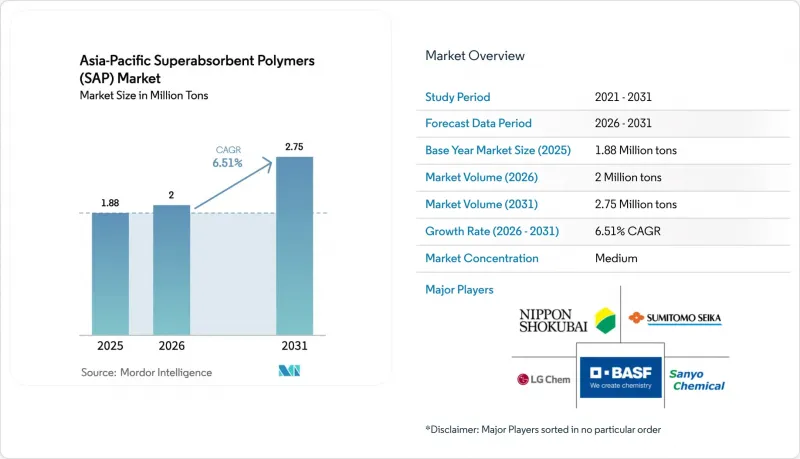
본 보고서는 제품 유형(폴리아크릴아미드, 아크릴산계, 기타), 용도(아기 기저귀, 성인용 요실금 용품, 여성 위생용품, 농업용 자재, 기타), 및 지역(중국, 인도, 일본, 한국, 호주·뉴질랜드, 기타 아시아태평양)별로 분류되어 있습니다. 시장 전망은 톤 기준으로 제시되어 있습니다.
아시아태평양 고흡수성 수지(SAP) 시장의 동향 및 인사이트
위생 의식의 고취와 가처분 소득의 증가
중국과 인도의 지방 도시에서는 가구 소득 증가에 따라 천 제품에서 일회용 제품으로의 전환이 진행되고 있으며, 많은 3급 도시권에서는 보급률이 15% 미만에 그치고 있지만, 연안 지역의 평균 보급률인 90% 이상으로 급격히 추격하는 추세가 보입니다. 유니-참의 구자라트주 신공장은 해당 회사의 인도 내 생산량을 50% 끌어올릴 전망입니다. 한편, 킴벌리 클라크가 2025년 9월 완공 예정인 5,000만 달러 규모의 난징 3단계 프로젝트에서는 내륙 지역의 수요에 대응하기 위해 4개의 생산 라인이 추가될 예정입니다. 정부의 위생 계몽 캠페인 덕분에 농촌 지역에서도 기저귀 사용이 정착되고 있으며, 소득 탄력성의 추정치가 1.2에서 1.5인 점을 고려할 때, GDP의 확대가 고흡수성 수지의 소비량으로 직접 연결된다는 점이 시사됩니다. 다국적 기업들은 세제상의 이점을 얻기 위해 생산의 현지화를 추진하고 있지만, 여전히 더 얇은 심재용으로 맞춤 제작된 지역산 SAP 등급에 의존하고 있습니다. 단기적인 거시경제 사이클에도 불구하고, 이러한 성장 요인의 중기적인 여지는 여전히 건재합니다.
급속한 고령화가 성인용 요실금 제품 수요를 끌어올리고 있다
일본의 성숙한 시장에서는 이미 성인용 팬티형 기저귀 판매량이 유아용 기저귀를 넘어섰으며, 한국에서는 65세 이상 인구 비율이 2070년까지 46.4%에 달할 전망입니다. 성인용 팬티형 기저귀의 단가는 유아용 제품보다 30%-50% 높아, 재습기 방지 및 탈취 효과가 뛰어난 화학 기술을 보유한 SAP 공급업체에게 유리한 상황입니다. 중국의 대도시권에서도 인구 고령화가 가속화됨에 따라 유사한 경향이 나타나기 시작하고 있습니다. 이러한 수요 구조의 변화는 범용 제품 제조사보다 고도의 표면 처리 기술을 보유한 제조사에 유리하게 작용합니다. 장기적인 전망이 확립되어 있으므로, 기존 기업들은 유아용 기저귀 판매량을 유지하면서도 고수익률 제품군에 연구개발 자원을 배분할 수 있습니다.
아크릴산 원료 가격 변동
중국의 아크릴산 현물 가격은 2022년 2월 톤당 1만 5,800위안에서 2022년 12월까지 6,550위안으로 하락하여, 기저귀 관련 고정 계약에 묶여 있는 SAP 제조사의 이익률을 압박했습니다. BASF와 창홍 폴리머의 신규 아크릴레이트 생산 설비로 인해 2026년까지 450킬로톤 이상의 생산능력이 추가되어 가격 급등을 완화할 가능성이 있지만, 통합이 진행되기 전까지는 가격 변동에 대한 노출 위험이 여전히 심각합니다. 산요 화학이 16억 엔의 손실을 기록한 끝에 2024년 3월에 철수한 것은, 통합형이 아닌 생산자가 가장 취약하다는 점을 여실히 드러내고 있습니다. 헤지 전략이나 프로판을 원료로 하는 아크릴산 제조 경로를 통해 단기적인 악영향은 완화될 가능성이 있지만, 가격 변동성은 여전히 예상 성장률을 1.1%포인트 끌어내리고 있습니다.
부문별 분석
폴리아크릴아미드는 2025년에 지역 총 생산량의 25.74%를 차지하며 연평균 성장률(CAGR) 6.08%를 기록하고 있으며, 아시아태평양의 고흡수성 수지 시장에서 기존 화학제품 중 가장 빠른 성장을 이루고 있습니다. 아크릴산계 등급은 뛰어난 흡수성과 유지력 덕분에 여전히 고급 유아용 및 성인용 브리프 시장을 독점하고 있지만, 가격에 민감한 농업용 및 여성 위생용품 틈새 시장에서는 폴리아크릴아미드에 시장 점유율을 내주고 있습니다.
각 제조사는 아크릴산계 SAP의 표면 처리 기술을 개선함으로써 젤 블로킹을 줄이고 기저귀 코어 부위를 얇게 만들 수 있게 되었습니다. 이는 장당 비용 절감을 목표로 하는 가치 브랜드에게 중요한 요건입니다. 일본촉매가 2022년에 실시한 전 세계 설비 개보수를 통해 공장 생산성이 약 10% 향상된 것은, 기존 기업들이 시장 점유율을 지키기 위해 공정 효율 향상에 주력하고 있음을 여실히 보여줍니다. BAYSE 등의 파일럿 도입에 힘입어, 바이오 기반 또는 셀룰로오스 그래프트형 SAP는 두 자릿수 성장을 기록하고 있습니다. 이러한 추세는 급격한 대체가 아닌 단계적인 배합 전환을 시사하며, 기존 화학제품과 신흥 화학제품 모두의 공급망이 향후 10년 동안 공존하게 될 것입니다.
기타 혜택:
- 엑셀 형식의 시장 예측(ME) 시트
- 3개월간의 애널리스트 지원
자주 묻는 질문
목차
제1장 소개
제2장 조사 방법
제3장 주요 요약
제4장 시장 구도
제5장 시장 규모와 성장 예측
제6장 경쟁 구도
제7장 시장 기회와 향후 전망
KSM 26.08.25According to Mordor Intelligence, the Asia-Pacific superabsorbent polymers market size is expected to grow from 1.88 million tons in 2025 to 2 million tons in 2026 and is forecast to reach 2.75 million tons by 2031 at a 6.51% CAGR over 2026-2031.
This report is Segmented by Product Type (Polyacrylamide, Acrylic Acid Based, and Others), Application (Baby Diapers, Adult Incontinence Products, Feminine Hygiene, Agriculture Support, and Others), and Geography (China, India, Japan, South Korea, Australia and New Zealand, and Rest of Asia-Pacific). The Market Forecasts are Provided in Terms of Volume (Tons).
Asia-Pacific Superabsorbent Polymers (SAP) Market Trends and Insights
Rising Hygiene Awareness And Disposable Incomes
Lower-tier cities in China and India are switching from cloth to disposables as household incomes rise, keeping penetration below 15% in many Tier-3 districts but creating a steep catch-up path to coastal averages above 90%. Unicharm's new Gujarat plant will lift its Indian output by 50%, while Kimberly-Clark's USD 50 million Nanjing Phase III project, due September 2025, adds four lines aimed at inland demand. Government sanitation campaigns have normalized diaper use even in rural settings, and income elasticity estimates between 1.2 and 1.5 signal that GDP expansion translates directly into superabsorbent polymer offtake. Multinationals localize production for fiscal advantages, yet still rely on regionally sourced SAP grades customized for thinner cores. The driver's medium-term runway remains intact despite near-term macro cycles.
Rapid Aging Population Boosting Adult Incontinence Product Demand
Japan's mature market already sells more adult pants than baby diapers, and South Korea's 65-plus cohort is on track to hit 46.4% by 2070. Adult briefs command unit prices 30%-50% higher than baby products, rewarding SAP suppliers capable of low-rewet, odor-control chemistries. Chinese urban centers are beginning to shift in the same direction as population aging accelerates. This demand mix change favors producers with advanced surface-treatment know-how over commodity players. Long-term visibility allows incumbents to allocate research and development toward high-margin grades even while defending baby-diaper volumes.
Volatile Acrylic Acid Feedstock Pricing
Spot acrylic acid in China fell from CNY 15,800 per ton in February 2022 to CNY 6,550 by December 2022, squeezing margins for SAP makers tied to fixed diaper contracts. New acrylate units from BASF and Changhong Polymer will add more than 450 kilotons of capacity by 2026, potentially tempering spikes, but exposure remains acute until integration spreads. Sanyo Chemical's March 2024 exit after a JPY 1.6 billion loss spotlights how non-integrated producers are most vulnerable. Hedging strategies and propane-based acrylic routes may mitigate the short-term drag, yet pricing volatility still subtracts 1.1 percentage points from forecast growth.
Other drivers and restraints analyzed in the detailed report include:
- Expansion Of Diaper Manufacturing Capacity Within APAC
- Government Incentives For Water-Saving Agriculture Using SAP Hydrogels
- Environmental And End-Of-Life Concerns For Petro-Based SAP
For complete list of drivers and restraints, kindly check the Table Of Contents.
Segment Analysis
Polyacrylamide captured 25.74% of regional volume in 2025 and is on track for a 6.08% CAGR, giving it the fastest growth among established chemistries in the Asia-Pacific superabsorbent polymers market. Acrylic-acid grades still dominate premium baby and adult briefs thanks to superior absorption and retention, but they concede price-sensitive agricultural and feminine-care niches to polyacrylamide.
Producers enhance acrylic-acid SAP through surface-treatment upgrades that cut gel-blocking and enable thinner diaper cores, a key requirement for value brands pushing down gram-per-piece costs. Nippon Shokubai's 2022 global retrofit that lifted plant productivity by roughly 10% underscores how incumbents lean on process gains to defend share. Bio-based or cellulose-grafted SAP posts double-digit growth, helped by pilot launches such as BAYSE. The trajectory suggests a gradual mix shift rather than a sudden displacement, so supply chains for both legacy and emerging chemistries will coexist through the decade.
Complete Report Scope:
- By Product Type
- Polyacrylamide
- Acrylic Acid based
- Others
- By Application
- Baby Diapers
- Adult Incontinence Products
- Feminine Hygiene
- Agriculture Support
- Others
- By Geography
- China
- India
- Japan
- South Korea
- Australia and New Zealand
- Rest of Asia-Pacific
List of Companies Covered in this Report:
- ADM
- BASF SE
- Chemtex Speciality Limited
- Evonik Industries AG
- Formosa Plastics Group (Nan Ya Plastics)
- Gel Frost Packs Kalyani Enterprises
- Kao Corporation
- LG Chem
- NIPPON SHOKUBAI CO.,LTD.
- Qingdao SOCO New Material Co.,Ltd.
- SANYO CHEMICAL, LTD.
- Satellite Chemical Co., Ltd.
- Shandong Nuoer Biological Technology
- SNF Floerger
- SUMITOMO SEIKA CHEMICALS CO.,LTD.
- Wanhua Chemical Group Co., Ltd.
- Yixing Danson Technology
- Zhejiang Satellite Petrochemical
Additional Benefits:
- The market estimate (ME) sheet in Excel format
- 3 months of analyst support
TABLE OF CONTENTS
1 Introduction
- 1.1 Study Assumptions and Market Definition
- 1.2 Scope of the Study
2 Research Methodology
3 Executive Summary
4 Market Landscape
- 4.1 Market Overview
- 4.2 Market Drivers
- 4.2.1 Rising hygiene awareness and disposable incomes
- 4.2.2 Rapid ageing population boosting adult-incontinence product demand
- 4.2.3 Expansion of diaper manufacturing capacity within APAC
- 4.2.4 Government incentives for water-saving agriculture using SAP hydrogels
- 4.2.5 Shift toward bio-based SAP chemistries
- 4.3 Market Restraints
- 4.3.1 Volatile acrylic-acid feedstock pricing
- 4.3.2 Environmental and end-of-life concerns for petro-based SAP
- 4.3.3 Looming micro-plastics regulations on absorbent hygiene products
- 4.4 Value Chain Analysis
- 4.5 Porter's Five Forces
- 4.5.1 Bargaining Power of Suppliers
- 4.5.2 Bargaining Power of Buyers
- 4.5.3 Threat of New Entrants
- 4.5.4 Threat of Substitutes
- 4.5.5 Degree of Competition
5 Market Size and Growth Forecasts (Volume)
- 5.1 By Product Type
- 5.1.1 Polyacrylamide
- 5.1.2 Acrylic Acid based
- 5.1.3 Others
- 5.2 By Application
- 5.2.1 Baby Diapers
- 5.2.2 Adult Incontinence Products
- 5.2.3 Feminine Hygiene
- 5.2.4 Agriculture Support
- 5.2.5 Others
- 5.3 By Geography
- 5.3.1 China
- 5.3.2 India
- 5.3.3 Japan
- 5.3.4 South Korea
- 5.3.5 Australia and New Zealand
- 5.3.6 Rest of Asia-Pacific
6 Competitive Landscape
- 6.1 Market Concentration
- 6.2 Strategic Moves
- 6.3 Market Share/Ranking Analysis
- 6.4 Company Profiles (includes Global level Overview, Market level overview, Core Segments, Financials as available, Strategic Information, Market Rank/Share for key companies, Products and Services, and Recent Developments)
- 6.4.1 ADM
- 6.4.2 BASF SE
- 6.4.3 Chemtex Speciality Limited
- 6.4.4 Evonik Industries AG
- 6.4.5 Formosa Plastics Group (Nan Ya Plastics)
- 6.4.6 Gel Frost Packs Kalyani Enterprises
- 6.4.7 Kao Corporation
- 6.4.8 LG Chem
- 6.4.9 NIPPON SHOKUBAI CO.,LTD.
- 6.4.10 Qingdao SOCO New Material Co.,Ltd.
- 6.4.11 SANYO CHEMICAL, LTD.
- 6.4.12 Satellite Chemical Co., Ltd.
- 6.4.13 Shandong Nuoer Biological Technology
- 6.4.14 SNF Floerger
- 6.4.15 SUMITOMO SEIKA CHEMICALS CO.,LTD.
- 6.4.16 Wanhua Chemical Group Co., Ltd.
- 6.4.17 Yixing Danson Technology
- 6.4.18 Zhejiang Satellite Petrochemical
7 Market Opportunities and Future Outlook
- 7.1 White-space and unmet-need assessment


