|
시장보고서
상품코드
2113435
항공우주용 접착제 : 시장 점유율 분석, 업계 동향과 통계, 성장 예측(2026-2031년)Aerospace Adhesives - Market Share Analysis, Industry Trends & Statistics, Growth Forecasts (2026 - 2031) |
||||||
 Mordor Intelligence
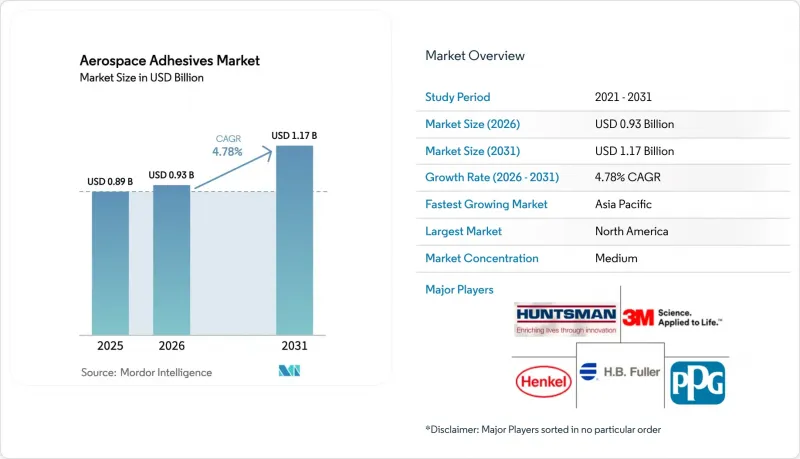
Mordor Intelligence에 따르면 항공우주용 접착제 시장 규모는 2025년 8억 9,000만 달러, 2026년 9억 3,000만 달러에서 2031년까지 11억 7,000만 달러로 확대될 것으로 예측되며, 2026년부터 2031년까지 연평균 성장률(CAGR)은 4.78%가 될 전망입니다.
본 보고서는 기술별(수성, 용제계, 반응성), 수지 종류별(에폭시, 폴리우레탄,실리콘, 기타), 기능별(구조용 및 비구조용), 용도별(OEM 및 MRO), 지역별(아시아태평양, 북미, 유럽, 남미, 중동 및 아프리카)로 분류되어 있습니다. 시장 예측은 금액(달러) 기준으로 제시되어 있습니다.
세계 항공우주용 접착제 시장의 동향 및 인사이트
항공기 제조에서 복합재료의 보급 확대
현재 보잉 787 및 에어버스 A350 두 기종 모두에서 탄소섬유 강화 플라스틱이 구조 중량의 상당 부분을 차지하고 있습니다. 이러한 변화로 인해 수천 개에 달하는 기계식 체결 부품이 고강도 접착 접합부로 대체되어 적층재의 완전성이 확보되고 있습니다. NASA의 AERoBOND 프로그램에서는 배리어 플라이 필름계 접착제를 사용함으로써 표면 마모를 줄일 수 있으며, 그 결과 동체 조립에 드는 노동력이 감소한다는 사실이 확인되었습니다. 마찬가지로, COMAC의 C919 날개 상자에서도 이러한 필름계 시스템이 채택되어, 기존의 알루미늄 리벳 접합에 비해 날개 질량을 줄이는 데 성공했습니다. 이러한 진전은 2030년까지 기체를 납품하겠다는 COMAC의 목표를 뒷받침하는 것입니다. 에폭시계 구조용 등급은 120°C-180°C의 경화 프로파일에서 강화 프리프레그 공정과의 적합성 및 업계 기준을 상회하는 랩 전단 강도를 발휘하는 능력으로 시장을 선도하고 있습니다. 아시아 공급업체들이 오토클레이브 생산능력을 확대하고 있는 반면, 인증 지연으로 인해 헨켈의 ‘LOCTITE EA 9695’ 및 사이텍의 ‘FM 300’ 시리즈가 시장에서 확고한 입지를 다지고 있습니다.
에어버스 및 보잉의 생산 확대에 대응하는 자동 로봇 접착 라인
에어버스사는 필름형 및 페이스트형 접착제를 고정밀도로 도포하는 자동화 셀에 막대한 예산을 할당하고 있습니다. 이 투자는 2026년 말까지 A320 패밀리의 생산을 확대하겠다는 에어버스사의 목표에 있어 매우 중요합니다. 2024년, 보잉사의 ‘동체 자동 수직 조립 라인(Fuselage Automated Upright Build line)’은 737 MAX의 패널 사이클 타임을 단축하는 데 성공하여 스크랩을 대폭 줄였습니다. 일렉트로임팩트(ElectroImpact) 및 MTorres의 턴키 시스템에는 적외선 예열 스테이션이 탑재되어 있어, 기판 온도를 60°C까지 상승시킴으로써 ?아웃 및 보이드 억제를 강화합니다. 스피릿 에어로시스템즈는 2025년에 접착제 폐기량이 감소했다고 보고했으며, 이로 인해 위치타 및 프레스토윅 사업장에서 상당한 비용 절감이 이루어졌습니다. 이는 개방 시간이 20-45분인 2액형 반응성 에폭시 수지를 사용함으로써 실현되었으며, 로봇에 의한 택트 사이클과 완벽하게 부합합니다.
에폭시 및 이소시아네이트 원료 공급망의 변동
2024년, 세계 생산능력의 상당 부분을 차지하는 중국이 전력 배급제 하에서 수출 할당량에 직면함에 따라, 비스페놀 A 및 에피클로로히드린 원료 시장에 변동이 발생했습니다. 이러한 상황으로 인해 가격이 급등했고, 유럽의 배합 제조업체들은 인도나 중동의 공급처로 눈을 돌릴 수밖에 없었습니다. 톨루엔 디이소시아네이트 및 메틸렌 디페닐 디이소시아네이트도 가격 변동을 겪었습니다. BASF, 코베스트로, 완화(Wanhua) 등 주요 기업들은 불가항력을 선언했고, 그 결과 접착제의 납기일이 연장되었습니다. 한편, OEM과의 고정 가격 계약으로 인해 1차 공급업체들은 비용을 다운스트림로 전가할 수 없게 되었고, 그 결과 이익률이 압박받으며 공급망 리스크가 높아졌습니다.
부문 분석
용제형 시스템은 경화 속도가 빠르고 공정에 익숙하다는 점 덕분에 2025년에도 항공우주용 접착제 시장에서 58.12%의 점유율을 유지했습니다. 그러나 그 VOC(휘발성 유기 화합물) 배출량은 규제 강화와 점점 더 상충되는 상황에 놓여 있습니다. 이에 따라 수성계 접착제로의 전환이 가속화되어, 2031년까지 연평균 성장률(CAGR) 4.98%가 될 전망입니다. 수성 항공우주용 접착제 시장은 OEM의 패널 조립 및 내장재 개조 증가에 힘입어 성장할 것으로 예상됩니다. 반응성 2액형 에폭시 수지나 폴리우레탄 수지를 활용하는 로봇 접착 라인은 작업 시간의 길이와 초기 접착력 향상이라는 장점을 살려 타크트 타임의 신뢰성을 높이고 있습니다. 아시아태평양에서는 주로 수성 수지의 경화에 필수적인 습도 관리실 투자 부족으로 인해 도입 속도가 더뎠으나, OEM의 조달 조건에 VOC 상한치가 명시됨에 따라 설비 투자가 가속화될 전망입니다.
자동화는 도포의 편차를 최소화하는 데 있어 매우 중요한 역할을 하고 있습니다. 목표 중량의 ±5% 정밀도를 가진 비전 가이드식 로봇이 수성 페이스트를 도포함으로써, 수작업에 비해 더 균일한 접착 라인을 확보하고 재작업량을 대폭 줄입니다. 작업자들로부터 재고 감소가 보고되고 있으며, 그 요인으로 1액형 수성 제품의 포트 라이프가 길고 유해 물질의 운송 분류가 그리 엄격하지 않다는 점이 꼽히고 있습니다. 그 결과, 수성 제품에 대한 전문 지식이 없는 공급업체는 신규 제조 프로그램에서 배제될 위험에 직면해 있습니다.
2025년에는 에폭시 수지가 매출의 50.23%를 차지하며 화학 종류별 최대 점유율을 기록했습니다. 2031년까지의 연평균 성장률(CAGR)은 5.12%로 예측되며, 에폭시 수지의 부상은 높은 유리전이온도(Tg), 내피로성, 그리고 120°C에서 180°C 범위에서 작동하는 탄소섬유의 경화 주기와 원활한 호환성에서 기인합니다. 또한, 에폭시 수지의 우위는 극저온 탱크의 시제품 단계까지 미치고 있으며, 그 고무 개질 매트릭스는 극한의 -180°C 환경에서도 연성을 유지합니다. 반면, 폴리우레탄은 탄성률이 낮아 내부 용도로만 제한되는 등 뒤처진 모습을 보이고 있지만, 핫멜트 등급은 측벽 패널 분야에서 틈새 시장을 개척하여 생산 라인의 신속한 전환을 가능하게 하고 있습니다. 반면, 실리콘은 나셀의 방화벽이나 항공전자 장비 베이에서 그 진가를 발휘하고 있으며, 200°C를 넘는 온도에서도 진동 감쇠 효과를 발휘하지만, 가격이 비싸기 때문에 사용량은 제한적입니다.
REACH 및 CARB 규제를 준수하기 위해 에폭시 수지 공급업체들은 잔류 아민 및 유리 단량체 함량을 줄이기 위해 적극적으로 노력하고 있습니다. 업계의 혁신적인 정신을 상징하듯, 헥세셀(Hexcel)은 나노실리카 강화 에폭시에 대한 특허를 취득하여, 인성과 저점도 필름 성형성 사이의 미묘한 균형을 입증했습니다. 앞으로 저 SVHC 화학 기술과 첨단 디지털 경화 동역학 모델링을 통합하는 수지 공급업체들은, 특히 중요한 플랫폼 갱신 주기에서 기존 업체들을 능가할 태세를 갖추고 있습니다.
지역별 분석
2025년 매출 중 북미가 40.14%를 차지했습니다. 이러한 견조한 수요는 보잉사의 737 MAX 및 787 생산은 물론, F-35 및 KC-46과 같은 방위 프로그램에 의해 뒷받침되고 있습니다. 이 지역에서 로봇 접착 센터의 조기 도입과 VOC 규제를 준수하는 수성 제품의 사용은 스크랩을 최소화할 뿐만 아니라 지속가능성에 기여한다는 점에서도 높이 평가받고 있습니다. 또한 워싱턴주, 사우스캐롤라이나주, 텍사스주, 위치타 등에서는 OEM과 공급업체가 동일한 지역에 집적되어 있어 파일럿 라인에서의 검증 속도가 빨라지고 물류 비용이 절감되며, 이 지역의 지배적 지위가 확고해지고 있습니다.
아시아태평양은 가장 빠르게 성장하는 지역으로, 2031년까지 연평균 성장률(CAGR) 5.21%를 기록할 것으로 예상됩니다. 이 지역의 항공우주용 접착제 시장 점유율은 중국 상용 항공기(COMAC)의 C919 제트기 인도와 타타 에어버스의 C295 생산 라인 확대를 원동력으로 확대될 전망입니다. 일본과 한국도 미쓰비시의 ‘스페이스젯’이 부활하고, KAI의 KF-21 전투기가 탄력을 받으면서 시장에 기여하고 있습니다. 현재 이 지역의 VOC(휘발성 유기 화합물) 관련 규제는 비교적 완만하지만, REACH 기준 준수를 위한 움직임이 있어, 이것이 수성 제품에 대한 투자를 뒷받침하고 있습니다. 또한, 싱가포르, 쿠알라룸푸르, 광저우 등의 도시에서 급성장하고 있는 MRO(정비·수리·점검) 생태계가 접착제 개조 수요를 뒷받침하고 있습니다.
유럽은 프랑스, 독일, 영국, 스페인에 걸쳐 있는 에어버스 시설에 힘입어 매우 중요한 역할을 수행하고 있습니다. 수소 추진에 관한 연구로 인해 연구 개발 자금이 접착제의 극저온 시험에 투입되고 있습니다. 한편, REACH 규제로 인해 용제계 제품의 단계적 폐지가 가속화되고 있습니다. 공급망의 긴축과 공동 엔지니어링 노력으로 인해 업계에서는 재인증 주기가 가속화되고 있습니다. 중동, 남미, 아프리카의 신흥 시장은 규모는 작지만, 기체 현대화 및 새로운 복합재 부품 제조 거점 설립을 원동력으로 삼아 성장세를 보이고 있습니다. 현지 기업과의 합작 사업을 검토하고 있는 각 공급업체들은, 이러한 지역들이 항공우주 산업의 밸류체인 내에서 위상을 높여가는 가운데, 조기에 우위를 확보할 수 있도록 전략적 입지를 구축하고 있습니다.
기타 혜택:
- 엑셀 형식의 시장 예측(ME) 시트
- 3개월간 애널리스트의 지원
자주 묻는 질문
목차
제1장 소개
제2장 조사 방법
제3장 주요 요약
제4장 시장 구도
제5장 시장 규모와 성장 예측
제6장 경쟁 구도
제7장 시장 기회와 향후 전망
KSM 26.08.25According to Mordor Intelligence, the aerospace adhesives market size is projected to expand from USD 0.89 billion in 2025 and USD 0.93 billion in 2026 to USD 1.17 billion by 2031, registering a CAGR of 4.78% between 2026 to 2031.
This report is Segmented by Technology (Waterborne, Solvent-Borne, and Reactive), Resin Type (Epoxy, Polyurethane, Silicone, and Others), Function Type (Structural and Non-Structural), End-Use (OEM and MRO), and Geography (Asia-Pacific, North America, Europe, South America, and Middle-East and Africa). The Market Forecasts are Provided in Terms of Value (USD).
Global Aerospace Adhesives Market Trends and Insights
Increasing Penetration of Composites in Aircraft Manufacturing
Carbon-fiber-reinforced polymers now account for a significant portion of the structural weight in both the Boeing 787 and the Airbus A350. This shift has replaced thousands of mechanical fasteners with high-strength adhesive joints, ensuring the integrity of the laminate. NASA's AERoBOND program has confirmed that using barrier-ply film adhesives can reduce surface abrasion, leading to a decrease in fuselage assembly labor. Similarly, COMAC's C919 wing box utilizes these film systems, achieving a reduction in wing mass compared to traditional aluminum riveting. This advancement bolsters COMAC's ambition of delivering its units by 2030. Epoxy-based structural grades lead the market, thanks to their compatibility with toughened prepreg cycles at cure profiles of 120 °C - 180 °C, and their ability to produce lap-shear strengths exceeding industry standards. While Asian suppliers are expanding their autoclave capacities, qualification delays have solidified the positions of Henkel's LOCTITE EA 9695 and Cytec's FM 300 series in the market.
Automated Robotic Bonding Lines to Meet Airbus and Boeing Ramp-Up
Airbus has earmarked a significant budget for automated cells that apply film and paste adhesives with high accuracy. This investment is pivotal for Airbus's ambition to ramp up production of the A320 family by late 2026. In 2024, Boeing's Fuselage Automated Upright Build line successfully cut the panel cycle time for the 737 MAX and achieved a notable reduction in scrap. Turnkey systems from Electroimpact and MTorres feature infrared pre-heat stations, elevating substrate temperatures to 60 °C, which bolsters wet-out and void control. Spirit AeroSystems reported a reduction in adhesive waste in 2025, translating to substantial cost savings across its Wichita and Prestwick sites. This was achieved using two-part reactive epoxies with open times of 20 to 45 minutes, perfectly aligning with robotic takt cycles.
Volatility in Epoxy and Isocyanate Feed-Stock Supply Chains
In 2024, volatility hit bisphenol-A and epichlorohydrin feedstocks as China, holding a significant share of global capacity, faced export quotas amid power rationing. This scenario led to price spikes, compelling European formulators to turn to sources in India and the Middle East. Toluene diisocyanate and methylene diphenyl diisocyanate experienced fluctuations. Major players like BASF, Covestro, and Wanhua declared force majeure, resulting in an extension of adhesive lead times. Meanwhile, fixed-price contracts with OEMs hindered Tier 1 suppliers from passing costs downstream, thereby compressing margins and heightening supply-chain risks.
Other drivers and restraints analyzed in the detailed report include:
- Expansion of National Defense Budgets (U.S., China, India)
- Growth of Commercial-Space Launch and In-Orbit-Service Programs
- Stringent REACH/CARB VOC Caps Curbing Solvent Systems
For complete list of drivers and restraints, kindly check the Table Of Contents.
Segment Analysis
Solvent-borne systems retained a 58.12% aerospace adhesives market share in 2025 because of rapid cure and process familiarity. However, their VOC emissions are increasingly at odds with tightening regulations. This has paved the way for waterborne chemistries, which are set to post a 4.98% CAGR through 2031. The market for waterborne aerospace adhesives is anticipated to grow, buoyed by gains in OEM panel assemblies and interior retrofits. Robotic bonding lines, utilizing reactive two-part epoxies and polyurethanes, benefit from open times and heightened initial tack, enhancing takt reliability. While Asia-Pacific has been slow to adopt, primarily due to a lack of investment in humidity-controlled rooms essential for waterborne curing, references in OEM procurement clauses to VOC ceilings are poised to spur accelerated capital spending.
Automation plays a pivotal role in minimizing application variability. Vision-guided robots, with an accuracy of +-5% of the target weight, apply waterborne pastes, ensuring more uniform bond lines compared to manual methods and significantly cutting down rework. Operators have noted reduced inventories, attributing it to the longer pot life of single-component waterborne products and their less stringent hazardous-material shipping classification. Consequently, suppliers lacking expertise in waterborne products face the risk of being sidelined from new-build programs.
Epoxy resins accounted for 50.23% of revenue in 2025, capturing the largest share by chemistry. With a 5.12% CAGR through 2031, epoxy's ascent is attributed to its elevated Tg, fatigue resistance, and seamless compatibility with carbon-fiber cure cycles, operating between 120 °C and 180 °C. Furthermore, epoxy's prominence extends to cryogenic tank prototypes, where its rubber-modified matrices maintain ductility even at a frigid -180 °C. While polyurethanes lag due to their lower modulus, limiting them to interior applications, hot-melt grades are carving a niche in sidewall panels, facilitating quicker line moves. Silicones, on the other hand, find their forte in nacelle firewalls and avionics bays, offering vibration damping at temperatures exceeding 200 °C, albeit at a premium price that restricts volume.
In response to REACH and CARB restrictions, epoxy suppliers are actively reducing residual amine and free monomer content. Highlighting the industry's innovative spirit, Hexcel secured a patent for a nano-silica-toughened epoxy, showcasing the delicate balance between toughness and low-viscosity film castability. Looking ahead, resin vendors that integrate low-SVHC chemistry with advanced digital cure-kinetics modeling are poised to outpace traditional players, especially during pivotal platform refresh cycles.
Complete Report Scope:
- By Technology
- Waterborne
- Solvent-Borne
- Reactive
- By Resin Type
- Epoxy
- Polyurethane
- Silicone
- Others
- By Function Type
- Structural
- Non-Structural
- By End-Use
- Original Equipment Manufacturer (OEM)
- Maintenance, Repair and Operations (MRO)
- By Geography
- Asia-Pacific
- China
- Japan
- India
- South Korea
- Australia and New Zealand
- Rest of Asia-Pacific
- North America
- United States
- Canada
- Mexico
- Europe
- Germany
- United Kingdom
- France
- Italy
- Spain
- Rest of Europe
- South America
- Brazil
- Argentina
- Rest of South America
- Middle-East and Africa
- Saudi Arabia
- South Africa
- Rest of Middle-East and Africa
- Asia-Pacific
Geography Analysis
North America produced 40.14% of the 2025 revenue. The robust demand is buoyed by Boeing's production of the 737 MAX and 787, alongside the F-35 and KC-46 defense programs. The region's early adoption of robotic bonding centers, combined with the use of VOC-compliant waterborne products, not only minimizes scrap but also garners sustainability credits. Furthermore, the co-location of OEMs and suppliers in states like Washington, South Carolina, Texas, and Wichita accelerates pilot-line validation, reduces logistics costs, and solidifies the region's dominant position.
Asia-Pacific is the fastest-growing region, forecast to post a 5.21% CAGR through 2031. The region's share of the aerospace adhesives market is set to increase, driven by COMAC's delivery of C919 jets and Tata-Airbus's ramping up of the C295 line. Japan and South Korea are also contributing, with Mitsubishi's SpaceJet making a comeback and KAI's KF-21 fighter gaining traction. While regional regulations on VOCs are currently more lenient, there's a move towards aligning with REACH standards, fueling investments in waterborne products. Additionally, a burgeoning MRO ecosystem in cities like Singapore, Kuala Lumpur, and Guangzhou bolsters the demand for adhesive retrofits.
Europe plays a crucial role, bolstered by Airbus facilities spread across France, Germany, the UK, and Spain. Research into hydrogen propulsion is channeling research and development funds into adhesive cryogenic testing. Meanwhile, the REACH legislation is hastening the phase-out of solvent-borne products. With tight supply chains and collaborative engineering efforts, the industry is witnessing accelerated recertification cycles. Emerging markets in the Middle East, South America, and Africa, though smaller, are gaining momentum, driven by fleet modernization and new composite-part fabrication centers. Suppliers eyeing joint ventures with local entities are strategically positioning themselves for early advantages as these regions ascend the aerospace value chain.
- 3M
- Arkema
- Ashland
- Beacon Adhesives Inc.
- Chemetall GmbH (BASF)
- DELO Industrie Klebstoffe GmbH & Co. KGaA
- Dymax
- Flamemaster Corp.
- Gurit Services AG
- H.B. Fuller Company
- Henkel AG & Co. KGaA
- Hernon Manufacturing Inc
- Hexcel Corporation
- Huntsman International LLC.
- Hybond
- Hylomar Products
- IPS Corporation
- L&L Products
- Master Bond Inc.
- Parker Hannifin Corp
- Parson Adhesives Inc.
- Permabond LLC
- PPG Industries Inc.
- Sika AG
- Solvay
Additional Benefits:
- The market estimate (ME) sheet in Excel format
- 3 months of analyst support
TABLE OF CONTENTS
1 Introduction
- 1.1 Study Assumptions and Market Definition
- 1.2 Scope of the Study
2 Research Methodology
3 Executive Summary
4 Market Landscape
- 4.1 Market Overview
- 4.2 Market Drivers
- 4.2.1 Increasing penetration of composites in aircraft manufacturing
- 4.2.2 Automated robotic bonding lines to meet Airbus and Boeing ramp-up
- 4.2.3 Expansion of national defense budgets (U.S., China, India)
- 4.2.4 Growth of commercial-space launch and in-orbit-service programs
- 4.2.5 Cryogenic-ready adhesives for hydrogen-propelled aircraft
- 4.3 Market Restraints
- 4.3.1 Volatility in epoxy and isocyanate feed-stock supply chains
- 4.3.2 Stringent REACH/CARB VOC caps curbing solvent systems
- 4.3.3 Qualification bottlenecks for bio-based and recycled chemistries
- 4.4 Value Chain Analysis
- 4.5 Porter's Five Forces
- 4.5.1 Bargaining Power of Suppliers
- 4.5.2 Bargaining Power of Buyers
- 4.5.3 Threat of New Entrants
- 4.5.4 Threat of Substitutes
- 4.5.5 Degree of Competition
5 Market Size and Growth Forecasts (Value)
- 5.1 By Technology
- 5.1.1 Waterborne
- 5.1.2 Solvent-Borne
- 5.1.3 Reactive
- 5.2 By Resin Type
- 5.2.1 Epoxy
- 5.2.2 Polyurethane
- 5.2.3 Silicone
- 5.2.4 Others
- 5.3 By Function Type
- 5.3.1 Structural
- 5.3.2 Non-Structural
- 5.4 By End-Use
- 5.4.1 Original Equipment Manufacturer (OEM)
- 5.4.2 Maintenance, Repair and Operations (MRO)
- 5.5 By Geography
- 5.5.1 Asia-Pacific
- 5.5.1.1 China
- 5.5.1.2 Japan
- 5.5.1.3 India
- 5.5.1.4 South Korea
- 5.5.1.5 Australia and New Zealand
- 5.5.1.6 Rest of Asia-Pacific
- 5.5.2 North America
- 5.5.2.1 United States
- 5.5.2.2 Canada
- 5.5.2.3 Mexico
- 5.5.3 Europe
- 5.5.3.1 Germany
- 5.5.3.2 United Kingdom
- 5.5.3.3 France
- 5.5.3.4 Italy
- 5.5.3.5 Spain
- 5.5.3.6 Rest of Europe
- 5.5.4 South America
- 5.5.4.1 Brazil
- 5.5.4.2 Argentina
- 5.5.4.3 Rest of South America
- 5.5.5 Middle-East and Africa
- 5.5.5.1 Saudi Arabia
- 5.5.5.2 South Africa
- 5.5.5.3 Rest of Middle-East and Africa
- 5.5.1 Asia-Pacific
6 Competitive Landscape
- 6.1 Market Concentration
- 6.2 Strategic Moves
- 6.3 Market Share(%)/Ranking Analysis
- 6.4 Company Profiles (includes Global level Overview, Market level overview, Core Segments, Financials as available, Strategic Information, Products and Services, and Recent Developments)
- 6.4.1 3M
- 6.4.2 Arkema
- 6.4.3 Ashland
- 6.4.4 Beacon Adhesives Inc.
- 6.4.5 Chemetall GmbH (BASF)
- 6.4.6 DELO Industrie Klebstoffe GmbH & Co. KGaA
- 6.4.7 Dymax
- 6.4.8 Flamemaster Corp.
- 6.4.9 Gurit Services AG
- 6.4.10 H.B. Fuller Company
- 6.4.11 Henkel AG & Co. KGaA
- 6.4.12 Hernon Manufacturing Inc
- 6.4.13 Hexcel Corporation
- 6.4.14 Huntsman International LLC.
- 6.4.15 Hybond
- 6.4.16 Hylomar Products
- 6.4.17 IPS Corporation
- 6.4.18 L&L Products
- 6.4.19 Master Bond Inc.
- 6.4.20 Parker Hannifin Corp
- 6.4.21 Parson Adhesives Inc.
- 6.4.22 Permabond LLC
- 6.4.23 PPG Industries Inc.
- 6.4.24 Sika AG
- 6.4.25 Solvay
7 Market Opportunities and Future Outlook
- 7.1 White-Space and Unmet-Need Assessment
- 7.2 Emergence of Bio-Based, Low-VOC Aerospace Adhesives
- 7.3 Upcoming Commercial Space Exploration and Tourism Programs