

|
시장보고서
상품코드
2113447
바이오뱅크 : 시장 점유율 분석, 업계 동향과 통계, 성장 예측(2026-2031년)Biobank - Market Share Analysis, Industry Trends & Statistics, Growth Forecasts (2026 - 2031) |
||||||
 Mordor Intelligence
Mordor Intelligence에 따르면 2026년 바이오뱅크 시장 규모는 580억 8,000만 달러로 추정되며, 2025년 553억 5,000만 달러에서 확대되어 2031년에는 738억 7,000만 달러에 달할 것으로 예측됩니다.
2026년부터 2031년까지 연평균 성장률(CAGR) 4.93%로 성장할 것으로 전망됩니다.
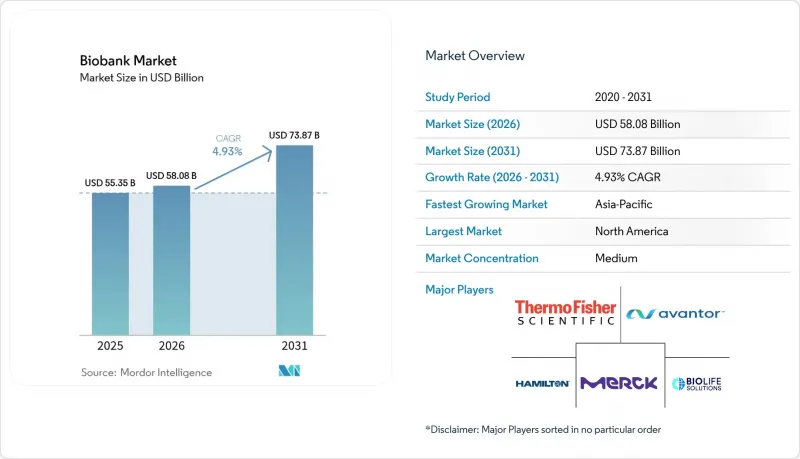
본 보고서는 장비별(극저온 보존 시스템[냉장고, 냉동고, 제빙기], 경보·감시 시스템, 배지·소모품), 용도별(재생의료, 신약 개발 등), 소유 형태별(공공기관/정부, 학술기관/비영리단체 등), 지역별(북미, 유럽, 아시아태평양 등)로 분류되어 있습니다. 시장 예측은 금액(달러) 기준으로 제시되어 있습니다.
세계 바이오뱅크 시장의 동향 및 인사이트
재생의학 분야의 혁신
시더스-사이나이 의료센터가 달성한 뒤쉐인형 근이영양증 치료용 카디오스피어 유래 세포 등의 획기적인 성과는 단일 세포 유형이 여러 치료 경로에 활용될 수 있음을 보여줍니다. ALS(근위축성 측삭 경화증)용 유전자 편집 전구 세포에는 세포의 완전성과 유전체 안정성을 모두 보장할 수 있는 바이오뱅크가 필요합니다. ARPA-H의 EMBODY 프로그램에서는 복잡한 면역 세포의 재프로그래밍을 지원할 수 있는 인프라가 요구되고 있습니다. 미세 중력 환경에서 배양된 줄기세포에 대한 연구 결과에 따르면, 궤도 상의 생산 기술이 조만간 지상에서의 처리 공정에 영향을 미칠 것으로 시사되고 있습니다. 이러한 변화들이 복합적으로 작용함에 따라, 바이오뱅크 시장은 단순한 보관 창고가 아닌 소규모 제조 공장과 유사한 시설로 전환되고 있습니다.
만성 질환 발병률 증가
UCLA 연구팀은 바이오뱅크에 보관된 유전 정보와 전자건강기록을 연계함으로써 표준 약물에 대한 환자의 반응을 예측할 수 있음을 보여주었습니다. 중국에서는 2024년에 중증 지중해빈혈에 대한 제대혈 이식 건수가 3만 건에서 4만 건 가까이 증가하여, 보존된 재료에 대한 임상적 의존도가 높음을 보여주었습니다. 톈진에서 19년 동안 성공을 거두고 있는 자가 제대혈 이식은 적절하게 보존된 검체의 장기적인 유용성을 입증하고 있습니다. 제대혈과 하플로아이덴티컬 기증자를 결합한 ‘하플로코드’ 프로토콜은 검체의 활용을 극대화하기 위해 기존 은행에 대한 수요를 높이고 있습니다. 만성 질환이 증가함에 따라 바이오뱅크 시장은 연구 중심 운영에서 치료 중심 운영으로 전환되고 있습니다.
복잡하고 끊임없이 변화하는 규제 체계
EU의 ‘인간 유래 물질에 관한 규정 2024/1938’에 따라 2027년까지 워크플로우의 대대적인 개편이 요구됩니다. 플로리다주의 2025년 줄기세포법에 따르면, FDA 등록 시설에 보관되어 있는 경우 FDA 미승인 치료법도 허용되고 있어, 주를 넘나드는 규정 준수상의 과제가 발생하고 있습니다. 중국이 계획하고 있는 유전자 자원 규제 완화는 성장 기회를 가져다주는 한편, 당분간은 불확실성도 야기합니다. 이처럼 규정이 서로 다르기 때문에 바이오뱅크는 품질 관리 시스템에 병행하여 자금을 투입할 수밖에 없으며, 비용이 증가하는 동시에 승인까지 걸리는 기간도 길어지고 있습니다. 자금력이 있는 사업자는 우위를 점하고 있어, 바이오뱅크 시장은 더 대규모의 다국적 기관으로 기울어질 가능성이 있습니다.
부문 분석
2025년 바이오뱅크 시장의 장비 부문 시장 규모 중 극저온 보관 시스템이 48.05%로 가장 큰 비중을 차지했습니다. 최종사용자들은 온도 균일성이 더 높고 에너지 소비량이 적은 냉동고로 전환하고 있으며, 7.78%라는 견실한 연평균 성장률(CAGR)을 유지하고 있습니다. 하이얼 바이오메디컬(Haier Biomedical)과 같은 공급업체들은 이중 냉매 이중화 기능과 터치스크린을 통한 진단 기능을 갖춘 와이드 입구 모델을 출시했습니다. 규제 당국이 지속적인 데이터 로깅을 요구함에 따라, 경보 및 모니터링 플랫폼은 가장 빠르게 성장하는 하위 부문이 되었습니다. SPT Labtech사의 공압식 ‘Arktic XC’ 시스템의 등장으로 수작업이 줄어들었고, 추적성을 저해하지 않으면서 처리 능력이 향상되었습니다.
보관용 액세서리도 진화하고 있습니다. 고밀도로 적재 가능한 랙과 레이저 각인된 바코드를 통해 학술 기관은 기존 설치 공간에서 용량을 극대화할 수 있게 되었습니다. 시설들이 질소 사용량 감축을 모색하는 가운데, ±5°C의 균일성을 실현하는 기계식 초저온 냉동고가 지지를 얻고 있습니다. 이러한 변화들은 전반적으로 하드웨어, 소프트웨어, 분석 기능이 융합된 장비 환경의 도래를 나타내며, 신규 공급업체의 진입 장벽을 높이는 동시에 바이오뱅크 시장 내의 경쟁 구조를 재편하고 있습니다.
지역별 분석
2025년, 북미는 전 세계 매출의 35.90%를 차지했습니다. 이는 명확한 규정 준수 방향을 제시하는 FDA 지침과 주요 공급업체들의 수십억 달러 규모의 자본 투자가 뒷받침된 결과입니다. 서모피셔(Thermo Fisher)는 국내 콜드체인 및 분석 장비 생산 체계를 강화하기 위해 20억 달러를 투자하고 있습니다. ATCC가 BARDA와 체결한 8,700만 달러 규모의 계약은 팬데믹에 대비한 생물자원 저장소에 대한 연방 정부의 지원을 뒷받침하고 있습니다. 캐나다에서의 정밀 의학의 지속적인 도입과 멕시코에서의 임상시험 활동 활성화가 해당 지역의 검체 수요를 뒷받침하며 바이오뱅크 시장의 수익을 끌어올리고 있습니다.
유럽에서는 규정 2024/1938에 기반한 규제 조화가 추진되고 있으며, 4,500만 유로(5,200만 달러) 규모의 ‘Genome of Europe’ 이니셔티브와 같은 국경을 초월한 프로젝트가 촉진되고 있습니다. 영국 바이오뱅크의 20만 개 유전체 공개는 해당 은행이 주력 데이터 리소스로서의 입지를 공고히 하고 있습니다. 독일의 연합 네트워크는 보관 중인 90만 점의 생체 시료에 대해 수천 건의 요청을 처리하며, 운영 투명성의 벤치마크를 확립하고 있습니다. 남유럽 국가들은 EU 자금을 활용하여 냉동고 수용 능력과 디지털 동의 도구를 확충함으로써, 더 광범위한 바이오뱅크 시장 전반에 걸쳐 검체의 이용 가능성을 확대하고 있습니다.
아시아태평양은 연평균 성장률(CAGR) 9.72%로 성장하고 있으며, 이는 세계에서 가장 빠른 속도입니다. 중국은 유전자 자원 수출 규제를 완화할 계획이며, 다국적 연구 개발(R&D) 파트너십을 촉진하고 있습니다. 2024년에는 국내 제대혈 치료 건수가 4만 건 가까이 급증하며, 보존된 치료법에 대한 임상적 준비가 완료되었음이 입증되었습니다. 일본은 동종 제대혈 이식 분야에서 계속해서 선도적인 위치를 유지하고 있으며, SK 팜테크가 2억 6,000만 달러를 투자해 건설하는 한국 시설을 통해 GMP 기준의 보관 능력이 확대될 것입니다. 호주와 한국은 견고한 윤리적 틀과 중개 연구 프로그램을 통해 지역 내 성장 동력을 강화하고 있으며, 이러한 요소들이 결합되어 바이오뱅크 시장을 주도하고 있습니다.
기타 혜택:
- 엑셀 형식의 시장 예측(ME) 시트
- 3개월간의 애널리스트 지원
자주 묻는 질문
목차
제1장 소개
제2장 조사 방법
제3장 주요 요약
제4장 시장 구도
제5장 시장 규모와 성장 예측
제6장 경쟁 구도
제7장 시장 기회와 향후 전망
KSM 26.08.25According to Mordor Intelligence, biobank market size in 2026 is estimated at USD 58.08 billion, growing from 2025 value of USD 55.35 billion with 2031 projections showing USD 73.87 billion, growing at 4.93% CAGR over 2026-2031.
This report is Segmented by Equipment (Cryogenic Storage Systems [Refrigerators, Freezers, Ice Machines], Alarm and Monitoring Systems, Media & Consumables), Application (Regenerative Medicine, Drug Discovery, and More), Ownership Type (Public/Government, Academic/Non-profit and More), and Geography (North America, Europe, Asia-Pacific, and More). The Market Forecasts are Provided in Terms of Value (USD).
Global Biobank Market Trends and Insights
Innovations in Regenerative Medicine
Breakthroughs such as Cedars-Sinai's cardiosphere-derived cells for Duchenne muscular dystrophy show how a single cell type can serve multiple therapeutic paths. Gene-edited progenitor cells for ALS require biobanks to guarantee both cellular integrity and genomic stability. ARPA-H's EMBODY program demands infrastructure that is able to support complex immune-cell reprogramming. Research on microgravity-grown stem cells suggests that orbital production techniques will soon influence ground-based processing. Collectively, these shifts push the biobank market toward facilities that resemble small-scale manufacturing plants rather than passive warehouses.
Growing Incidences of Chronic Diseases
The UCLA team showed that linking biobank genetics to electronic health records predicts patient responses to standard drugs. In China, cord-blood transplants for Thalassemia Major climbed from 30,000 to nearly 40,000 cases in 2024, demonstrating clinical reliance on banked materials. Tianjin's 19-year-old autologous cord-blood success underscores the long-term utility of well-preserved samples. Haplocord protocols that combine cord blood with haploidentical donors maximise sample use, raising demand on existing repositories. As chronic conditions proliferate, the biobank market is shifting from research-centric to therapy-centric operations.
Complex & Evolving Regulatory Regimes
The EU's Regulation 2024/1938 on substances of human origin will demand major workflow upgrades by 2027. Florida's 2025 stem-cell statute permits non-FDA-approved therapies if stored in FDA-registered facilities, creating cross-state compliance puzzles. China's planned relaxation of genetic-resource controls offers growth but brings interim uncertainty. Such divergent rules force biobanks to fund parallel quality systems, adding cost while lengthening approval timelines. Well-capitalised operators gain an advantage, potentially tilting the biobank market toward larger, multinational institutions.
Other drivers and restraints analyzed in the detailed report include:
- Advances in Drug Discovery & Development
- Government & NGO Funding Inflows
- High Total Ownership Cost of Cryogenic Infrastructure
For complete list of drivers and restraints, kindly check the Table Of Contents.
Segment Analysis
Cryogenic storage systems generated the most significant portion of 48.05% in the biobank market size for equipment in 2025. End users are migrating towards freezers that achieve tighter temperature uniformity and lower energy draw, sustaining a robust 7.78% CAGR. Vendors such as Haier Biomedical introduced wide-neck models with dual-coolant redundancy and touchscreen diagnostics. Alarm and monitoring platforms represent the quickest-moving subsegment because regulators now expect continuous data logging. The arrival of SPT Labtech's pneumatic arktic XC system reduces manual handling, raising throughput without compromising traceability.
Storage accessories are also evolving. Densely stacked racking and laser-etched barcodes help academic centres squeeze capacity from existing footprints. Mechanical ultra-low freezers offering +-5 °C uniformity are gaining favor as facilities attempt to lower nitrogen usage. Collectively, these shifts point to an equipment landscape where hardware, software and analytics converge, elevating entry requirements for new suppliers and reshaping competition inside the biobank market.
Complete Report Scope:
- By Product
- Cryogenic Storage Systems
- Refrigerators
- Freezers
- Ice Machines
- Alarm & Monitoring Systems
- Media & Consumables
- Cryogenic Storage Systems
- By Application
- Regenerative Medicine
- Drug Discovery
- Disease & Epidemiology Research
- Life-Science & Genomic Research
- By Ownership Type
- Public/Government
- Academic/Non-profit
- Private & Commercial
- By Geography
- North America
- United States
- Canada
- Mexico
- Europe
- Germany
- United Kingdom
- France
- Italy
- Spain
- Rest of Europe
- Asia-Pacific
- China
- Japan
- India
- Australia
- South Korea
- Rest of Asia-Pacific
- Middle East & Africa
- GCC
- South Africa
- Rest of Middle East & Africa
- South America
- Brazil
- Argentina
- Rest of South America
- North America
Geography Analysis
North America generated 35.90% of global revenue in 2025, anchored by FDA guidelines that provide a clear compliance path and by multi-billion-dollar capital commitments from major suppliers. Thermo Fisher is investing USD 2 billion to reinforce domestic cold-chain and analytical production. ATCC's USD 87 million BARDA contract underscores federal support for pandemic-ready repositories.Continued precision-medicine roll-outs in Canada and heightened clinical-trial activity in Mexico sustain regional sample demand, bolstering revenues for the biobank market.
Europe's harmonised regulatory approach under Regulation 2024/1938 is stimulating cross-border projects such as the EUR 45 (USD 52) million Genome of Europe initiative. The UK Biobank's 200,000-genome release cements its status as a flagship data resource. Germany's federated network processes thousands of requests against 900,000 stored biospecimens, setting a benchmark for operational transparency. Southern European countries leverage EU funding to upgrade freezer capacity and digital-consent tools, broadening sample accessibility across the broader biobank market.
Asia-Pacific is advancing at a 9.72% CAGR, the fastest worldwide. China plans to relax genetic-resource export rules, encouraging multinational R&D partnerships. National cord-blood treatments escalated to nearly 40,000 cases in 2024, proving clinical readiness for banked therapies. Japan remains a leader in allogeneic cord-blood transplants, and SK pharmteco's USD 260 million Korean facility will expand GMP-grade storage capacity. Australia and South Korea strengthen regional momentum through strong ethics frameworks and translational-research programmes, collectively propelling the biobank market.
- Thermo Fisher Scientific
- Beckton Dickinson
- Merck
- BioLife Solutions
- Hamilton Company
- Avantor Inc. (VWR)
- Tecan Group
- Stem Cell Technologies
- CENTOGENE N.V.
- Bio-Techne Corp.
- Azenta
- Cryoport Inc.
- QIAGEN
- BioIVT
- Chart Industries
- Coriell Institute for Medical Research
- UK Biobank
- China Cord Blood Corp.
- Biovault
- Precision Cellular Storage
Additional Benefits:
- The market estimate (ME) sheet in Excel format
- 3 months of analyst support
TABLE OF CONTENTS
1 Introduction
- 1.1 Study Assumptions & Market Definition
- 1.2 Scope of the Study
2 Research Methodology
3 Executive Summary
4 Market Landscape
- 4.1 Market Overview
- 4.2 Market Drivers
- 4.2.1 Innovations in Regenerative Medicine
- 4.2.2 Growing Incidences of Chronic Diseases
- 4.2.3 Advances in Drug Discovery & Development
- 4.2.4 Government & NGO Funding Inflows
- 4.2.5 AI-Driven Sample-Quality Analytics Adoption
- 4.2.6 Decentralized Blockchain-Enabled Consent Networks
- 4.3 Market Restraints
- 4.3.1 Complex & Evolving Regulatory Regimes
- 4.3.2 High Total Ownership Cost of Cryogenic Infrastructure
- 4.3.3 Litigation Over Donor Privacy & Data Ownership
- 4.3.4 Liquid-Nitrogen Price Volatility
- 4.4 Porter's Five Forces Analysis
- 4.4.1 Bargaining Power of Suppliers
- 4.4.2 Bargaining Power of Buyers
- 4.4.3 Threat of New Entrants
- 4.4.4 Threat of Substitutes
- 4.4.5 Intensity of Competitive Rivalry
5 Market Size & Growth Forecasts (Value in USD)
- 5.1 By Product
- 5.1.1 Cryogenic Storage Systems
- 5.1.1.1 Refrigerators
- 5.1.1.2 Freezers
- 5.1.1.3 Ice Machines
- 5.1.2 Alarm & Monitoring Systems
- 5.1.3 Media & Consumables
- 5.1.1 Cryogenic Storage Systems
- 5.2 By Application
- 5.2.1 Regenerative Medicine
- 5.2.2 Drug Discovery
- 5.2.3 Disease & Epidemiology Research
- 5.2.4 Life-Science & Genomic Research
- 5.3 By Ownership Type
- 5.3.1 Public/Government
- 5.3.2 Academic/Non-profit
- 5.3.3 Private & Commercial
- 5.4 By Geography
- 5.4.1 North America
- 5.4.1.1 United States
- 5.4.1.2 Canada
- 5.4.1.3 Mexico
- 5.4.2 Europe
- 5.4.2.1 Germany
- 5.4.2.2 United Kingdom
- 5.4.2.3 France
- 5.4.2.4 Italy
- 5.4.2.5 Spain
- 5.4.2.6 Rest of Europe
- 5.4.3 Asia-Pacific
- 5.4.3.1 China
- 5.4.3.2 Japan
- 5.4.3.3 India
- 5.4.3.4 Australia
- 5.4.3.5 South Korea
- 5.4.3.6 Rest of Asia-Pacific
- 5.4.4 Middle East & Africa
- 5.4.4.1 GCC
- 5.4.4.2 South Africa
- 5.4.4.3 Rest of Middle East & Africa
- 5.4.5 South America
- 5.4.5.1 Brazil
- 5.4.5.2 Argentina
- 5.4.5.3 Rest of South America
- 5.4.1 North America
6 Competitive Landscape
- 6.1 Market Concentration
- 6.2 Market Share Analysis
- 6.3 Company Profiles (includes Global level Overview, Market level overview, Core Segments, Financials as available, Strategic Information, Market Rank/Share for key companies, Products & Services, and Recent Developments)
- 6.3.1 Thermo Fisher Scientific Inc.
- 6.3.2 Becton, Dickinson & Company
- 6.3.3 Merck KGaA
- 6.3.4 BioLife Solutions Inc.
- 6.3.5 Hamilton Company
- 6.3.6 Avantor Inc. (VWR)
- 6.3.7 Tecan Group Ltd.
- 6.3.8 STEMCELL Technologies
- 6.3.9 CENTOGENE N.V.
- 6.3.10 Bio-Techne Corp.
- 6.3.11 Azenta Life Sciences
- 6.3.12 Cryoport Inc.
- 6.3.13 QIAGEN N.V.
- 6.3.14 BioIVT
- 6.3.15 Chart Industries
- 6.3.16 Coriell Institute for Medical Research
- 6.3.17 UK Biobank
- 6.3.18 China Cord Blood Corp.
- 6.3.19 Biovault Family
- 6.3.20 Precision Cellular Storage
7 Market Opportunities & Future Outlook
- 7.1 White-space & Unmet-Need Assessment


