|
시장보고서
상품코드
2113455
일회용 의료기기 센서 : 시장 점유율 분석, 업계 동향과 통계, 성장 예측(2026-2031년)Disposable Medical Devices Sensors - Market Share Analysis, Industry Trends & Statistics, Growth Forecasts (2026 - 2031) |
||||||
 Mordor Intelligence
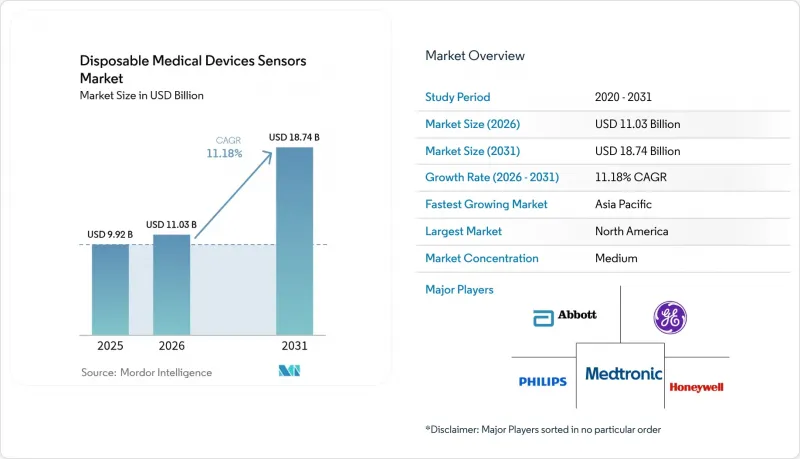
Mordor Intelligence에 따르면 일회용 의료기기 센서 시장 규모는 2025년에 99억 2,000만 달러로 평가되며, 2026년 110억 3,000만 달러에서 2031년까지 187억 4,000만 달러에 달할 것으로 예측되며, 예측 기간(2026-2031년) 동안 CAGR은 11.18%가 될 전망입니다.
본 보고서는 제품별(바이오센서, 이미지 센서, 가속도 센서, 압력 센서 등), 용도별(환자 모니터링 등), 최종사용자별(병원·진료소 등), 기술별(MEMS, CMOS 등), 지역별(북미, 유럽, 아시아태평양, 중동 및 아프리카, 남미)로 분류되어 있습니다. 시장 예측은 금액(달러) 기준으로 제시되어 있습니다.
세계 일회용 의료기기 센서 시장의 동향 및 인사이트
만성 질환 유병률 증가
2024년, 당뇨병을 앓고 있는 성인 수는 5억 3,700만 명을 넘어섰으며, 60개국에서 600만 명 이상의 사용자를 지원하는 애보트(Abbott)사의 ‘FreeStyle Libre’와 같은 일회용 혈당 모니터링 센서에 대한 전례 없는 수요를 불러일으키고 있습니다. 심혈관질환이 여전히 전 세계 사망 원인 1위를 차지하고 있는 만큼, 의료 서비스 제공자들은 장기적인 심장 리듬 평가를 위해 일회용 심장 센서를 점점 더 선호하고 있습니다. 연속 사용이 가능한 일회용 솔루션은 멸균 작업을 불필요하게 하고, 장기간 사용 시에도 정확도를 유지하기 때문에 고령화 사회에서 만성 질환 관리 프로토콜을 뒷받침하고 있습니다. 의료 시스템이 단편적인 치료에서 지속적인 치료로 전환됨에 따라, 일회용 의료기기 센서 시장은 재구매 수요를 통해 지속적인 수익원을 확보하고 있습니다.
현장 진단(Point-of-Care) 수요 확대
팬데믹은 환자 곁에서 실시하는 검사의 임상적 가치를 재확인시켰으며, 일회용 바이오센서가 응급실이나 지방 진료소에서 신속한 항원 검출에 필수적임이 입증되었습니다. 미국 규제 당국은 적격한 현장 진단 기기에 대해 신속 승인 절차를 허용함으로써 시장 진입 장벽을 지속적으로 낮추고 있으며, 시장 출시 속도를 높이고 있습니다. 스마트폰에 연결되는 센서 스틱은 즉각적인 측정 결과 표시와 클라우드 업로드를 가능하게 하여 진단 데이터의 흐름을 혁신하고 있습니다. 진단의 신속화는 환자의 대기 시간을 단축하고, 후속 비용을 절감하며, 임상 결과에 대한 기대치를 높여 일회용 의료용 센서 시장의 지속적인 성장을 보장합니다.
엄격한 규제 승인 절차
2026년 2월에 시행될 미국의 새로운 품질 시스템 규정(QSR)으로 인해 임상시험 및 문서 작성 부담이 증가하여, 중소 혁신 기업의 경우 시장 출시까지의 기간이 길어질 가능성이 있습니다. 상호 운용성에 관한 지침에 따라, 시장 출시 전 신청 시 규정 준수 증빙 자료를 제출해야 할 의무가 부과되어 검증 비용이 증가하고 있습니다. 지역 간 규제 조화가 여전히 제한적이기 때문에 기업들은 여러 승인 절차를 거쳐야 하며, 이는 전 세계적인 제품 출시를 지연시키고 일회용 의료기기 센서 시장의 성장을 일시적으로 둔화시킬 가능성이 있습니다.
부문 분석
2025년, 바이오센서는 매출의 48.12%를 차지하며 일회용 의료기기 센서 시장의 주요 성장 동력으로서의 역할을 강화했습니다. 혈당 및 심장 마커 모니터링에서는 전기화학식이 주류를 이루는 반면, 신속한 결과가 필수적인 감염증 선별 검사에서는 광학식 바이오센서의 활용이 가속화되고 있습니다. 이미지 센서는 소형 CMOS 칩의 발전으로 캡슐 내시경 및 일회용 내시경이 보급되고 임상 적용 범위가 확대됨에 따라 13.38%라는 가장 높은 연평균 성장률(CAGR)을 보이고 있습니다. 압력 센서는 보정이 필요한 재사용 가능한 트랜스듀서를 대체하며, 중환자실(ICU)에서 여전히 없어서는 안 될 존재입니다. 가속도 센서, 온도 프로브 및 하이브리드 장치는 병원이나 재택 환경에서 다중 매개변수 모니터링을 위한 지속적으로 확장되는 툴킷을 구성하고 있습니다.
병원과 보험사가 만성 질환 및 수술 후 회복에 대한 지속적인 모니터링을 권장함에 따라, 2025년 매출의 46.05%를 환자 모니터링이 차지했습니다. 미국 내 원격 모니터링에 관한 규제가 대규모 도입을 뒷받침하고 있어, 이 분야의 일회용 의료기기 센서 시장 점유율은 꾸준히 상승하고 있습니다. 한편, 진단 분야에서는 POC(Point-of-Care) 플랫폼의 보급으로 인해 검사가 중앙 집중식 검사실에서 병상, 소매 클리닉, 나아가 가정으로 이동함에 따라 연평균 성장률(CAGR)이 14.11%로 가장 높은 성장세를 보이고 있습니다. 신속 항원 검사 및 랩-온-어-칩(Lab-on-a-chip) 카트리지를 통해 진단 시간이 몇 시간에서 몇 분으로 단축되어, 환자 분류 및 감염 차단 노력이 개선되고 있습니다.
지역별 분석
2025년, 북미는 전 세계 매출의 38.21%를 차지했습니다. 이는 정교한 지불자 제도와 원격 모니터링(RPM)의 보상 범위가 급속히 확대된 데 힘입은 결과입니다. 특정 의료기기 분류에 대한 FDA의 면제 조치로 인해 승인 주기가 단축되고 지속적인 혁신이 촉진되고 있습니다. 주요 공급업체들은 센서 데이터를 전자건강기록(EHR)과 통합하고 있으며, 이로 인해 표준화된 통신 프로토콜이 요구되어 병원 네트워크 전반에 걸친 도입이 촉진되고 있습니다.
아시아태평양은 2031년까지 연평균 성장률(CAGR) 12.29%를 기록할 것으로 예상되며, 이는 세계에서 가장 빠른 성장률입니다. 공중보건 인프라에 대한 정부 투자, 만성 질환 부담의 급증, 그리고 소비자의 구매력 향상이 수요를 견인하고 있습니다. 중국의 보험 환급 정책 개정과 인도의 비용 중심 혁신 문화는 현지 제조업체들에게 호재가 되어 기존 다국적 기업들에 도전하고 있습니다. 벤처 자금 조달은 이전 최고점보다 둔화되었지만, 전략적 투자자들은 여전히 차별화된 합리적인 가격의 솔루션을 제공하는 기업들을 지원하고 있으며, 일회용 의료기기 센서 시장의 총 잠재 시장 규모를 확대하고 있습니다.
유럽에서는 생분해성 센서 도입을 가속화하는 환경 요건을 반영한 EU 의료기기 규정에 힘입어 꾸준한 성장이 나타나고 있습니다. 지속가능성에 관한 규제로 인해 기업들은 제품 및 공급망을 재설계해야 하는 상황에 직면해 있으며, 이에 따라 재료 과학자와 의료기기 제조업체 간의 새로운 협력이 이루어지고 있습니다. 중동 및 아프리카 및 남미에서는 병원 건설과 국민건강보험 제도의 도입이 가속화됨에 따라 미개척 비즈니스 기회가 널리 존재합니다. 현지 상황에 맞춰 견고하고 저비용의 일회용 제품을 개발하는 공급업체는 선점 우위를 확보하고, 일회용 의료기기 센서 시장의 세계 다양성을 강화하게 될 것입니다.
기타 혜택:
- 엑셀 형식의 시장 예측(ME) 시트
- 3개월간의 애널리스트 지원
자주 묻는 질문
목차
제1장 소개
제2장 조사 방법
제3장 주요 요약
제4장 시장 구도
제5장 시장 규모와 성장 예측
제6장 경쟁 구도
제7장 시장 기회와 향후 전망
KSM 26.08.25According to Mordor Intelligence, the disposable medical device sensors market size was valued at USD 9.92 billion in 2025 and estimated to grow from USD 11.03 billion in 2026 to reach USD 18.74 billion by 2031, at a CAGR of 11.18% during the forecast period (2026-2031).
This report is Segmented by Product (Biosensors, Image Sensors, Accelerometers, Pressure Sensors, and More), Application (Patient Monitoring, and More), End-User (Hospitals & Clinics, and More), Technology (MEMS, CMOS, and More), Geography (North America, Europe, Asia-Pacific, The Middle East and Africa, and South America). The Market Forecasts are Provided in Terms of Value (USD).
Global Disposable Medical Devices Sensors Market Trends and Insights
Growing Prevalence of Chronic Diseases
The number of adults living with diabetes exceeded 537 million in 2024, spurring unprecedented demand for disposable glucose-monitoring sensors such as Abbott's FreeStyle Libre, which supports more than 6 million users across 60 countries. Providers increasingly favor single-use cardiac sensors for long-term rhythm assessment as cardiovascular disease remains the top global mortality cause. Continuous, disposable solutions remove sterilization tasks and maintain accuracy over extended use, supporting chronic-care protocols for aging populations. As health systems pivot from episodic to continuous care, the disposable medical device sensors market gains an enduring revenue stream from refill demand.
Rising Demand for Point-of-Care Diagnostics
The pandemic reinforced the clinical value of near-patient testing, and disposable biosensors proved essential for rapid antigen detection in emergency departments and rural clinics. U.S. regulators continue to ease market entry by granting expedited pathways for qualified point-of-care devices, enhancing speed to market. Smartphone-connected sensor sticks permit immediate readouts and cloud upload, reshaping diagnostic data flows. Faster diagnosis trims patient wait times, cuts downstream costs, and elevates clinical outcome expectations, ensuring a sustained lift for the disposable medical device sensors market.
Stringent Regulatory Approval Process
New U.S. Quality System Regulation rules, effective February 2026, add clinical and documentation burdens that may lengthen time-to-market for smaller innovators. Interoperability guidelines now require compliance evidence during premarket submissions, driving extra verification costs. As harmonization across regions remains limited, firms must navigate multiple approval tracks, which can delay global releases and temporarily moderate growth for the disposable medical device sensors market.
Other drivers and restraints analyzed in the detailed report include:
- Expansion of Wearable Health Monitoring Devices
- Technological Advancements in Biosensor Miniaturization
- Concerns Over Data Privacy and Security
For complete list of drivers and restraints, kindly check the Table Of Contents.
Segment Analysis
Biosensors captured 48.12% of revenue in 2025, reinforcing their role as the principal growth engine of the disposable medical device sensors market. Electrochemical formats dominate glucose and cardiac-marker monitoring, while optical biosensors accelerate infectious-disease screening where rapid turnaround is critical. Image sensors hold the fastest 13.38% CAGR because advances in compact CMOS chips elevate capsule endoscopy and single-use scopes, broadening clinical reach. Pressure sensors remain staples in intensive-care units, replacing reusable transducers that require calibration. Accelerometers, temperature probes and hybrid devices complete an expanding toolkit for multi-parameter monitoring in hospital and home settings.
Patient monitoring held 46.05% of 2025 revenue as hospitals and payers endorsed continuous surveillance for chronic ailments and post-procedure recovery. Remote monitoring codes in the United States underpin large-scale rollouts, pushing disposable medical device sensors market share steadily higher in this category. Diagnostics, however, shows the sharpest 14.11% CAGR as point-of-care platforms shift testing from centralized labs to bedsides, retail clinics and even homes. Rapid antigen assays and lab-on-a-chip cartridges reduce diagnosis time from hours to minutes, improving triage and containment efforts.
Complete Report Scope:
- By Product
- Biosensors
- Electrochemical Biosensors
- Optical Biosensors
- Image Sensors
- Accelerometers
- Pressure Sensors
- Temperature Sensors
- Other Products
- Biosensors
- By Application
- Patient Monitoring
- Diagnostics
- Therapeutics
- By End-User
- Hospitals & Clinics
- Home-care Settings
- Diagnostic Laboratories
- Ambulatory Surgical Centers
- Research & Academic Institutes
- By Technology
- MEMS
- CMOS
- 3-D Printed Polymeric Sensors
- Nanotechnology-enabled Sensors
- RFID / NFC Tags
- Geography
- North America
- United States
- Canada
- Mexico
- Europe
- Germany
- United Kingdom
- France
- Italy
- Spain
- Rest of Europe
- Asia-Pacific
- China
- Japan
- India
- Australia
- South Korea
- Rest of Asia-Pacific
- Middle East & Africa
- GCC
- South Africa
- Rest of Middle East & Africa
- South America
- Brazil
- Argentina
- Rest of South America
- North America
Geography Analysis
North America accounted for 38.21% of global revenue in 2025, sustained by sophisticated payer systems and rapid RPM reimbursement expansion. FDA exemptions for specific device classes shorten approval cycles and invite continued innovation. Leading providers integrate sensor data with electronic health records, demanding standardized communication protocols and boosting uptake across hospital networks.
Asia-Pacific is projected to register a 12.29% CAGR through 2031, the fastest worldwide. Government investment in public health infrastructure, a soaring chronic-disease burden, and rising consumer purchasing power fuel demand. China's updated reimbursement policies and India's cost-driven innovation culture provide fertile ground for local producers, challenging incumbent multinationals. Although venture financing cooled from prior peaks, strategic investors still back firms with differentiated, affordable solutions, enlarging total addressable volume for the disposable medical device sensors market.
Europe shows consistent growth supported by the EU Medical Device Regulation, which embeds environmental requirements that accelerate biodegradable sensor adoption. Sustainability mandates cause firms to redesign products and supply chains, spawning collaboration between materials scientists and device makers. The Middle East, Africa, and South America collectively offer untapped opportunities as hospital construction and universal health-coverage initiatives gather pace. Suppliers that tailor rugged, low-cost disposables to local conditions stand to capture early mover advantages and strengthen global diversity in the disposable medical device sensors market.
- Medtronic
- GE Healthcare
- Koninklijke Philips
- Abbott Laboratories
- Honeywell International
- NXP Semiconductors
- Sensirion
- Dexcom
- Roche
- OmniVision Technologies Inc.
- STMicroelectronics
- TDK InvenSense
- Smiths Group
- Starboard Medical Inc.
- Shenzhen Med-Link Electronics
- Medical Sensors India Pvt. Ltd.
- Tekscan Inc.
- Nova Biomedical
- Lifescan
- Cardea Bio (Paragraf)
- Gentag
Additional Benefits:
- The market estimate (ME) sheet in Excel format
- 3 months of analyst support
TABLE OF CONTENTS
1 Introduction
- 1.1 Study Assumptions & Market Definition
- 1.2 Scope of the Study
2 Research Methodology
3 Executive Summary
4 Market Landscape
- 4.1 Market Overview
- 4.2 Market Drivers
- 4.2.1 Growing Prevalence of Chronic Diseases
- 4.2.2 Rising Demand for Point-of-Care Diagnostics
- 4.2.3 Expansion of Wearable Health Monitoring Devices
- 4.2.4 Technological Advancements in Biosensor Miniaturization
- 4.2.5 Increasing Adoption in Emerging Markets
- 4.2.6 Supportive Government and Reimbursement Policies
- 4.3 Market Restraints
- 4.3.1 Stringent Regulatory Approval Process
- 4.3.2 Concerns Over Data Privacy And Security
- 4.3.3 Price Sensitivity in Cost-Constrained Settings
- 4.3.4 Limited Standardization and Interoperability
- 4.4 Regulatory Landscape
- 4.5 Porter's Five Forces Analysis
- 4.5.1 Threat of New Entrants
- 4.5.2 Bargaining Power of Buyers
- 4.5.3 Bargaining Power of Suppliers
- 4.5.4 Threat of Substitutes
- 4.5.5 Competitive Rivalry
5 Market Size & Growth Forecasts (Value, USD)
- 5.1 By Product
- 5.1.1 Biosensors
- 5.1.1.1 Electrochemical Biosensors
- 5.1.1.2 Optical Biosensors
- 5.1.2 Image Sensors
- 5.1.3 Accelerometers
- 5.1.4 Pressure Sensors
- 5.1.5 Temperature Sensors
- 5.1.6 Other Products
- 5.1.1 Biosensors
- 5.2 By Application
- 5.2.1 Patient Monitoring
- 5.2.2 Diagnostics
- 5.2.3 Therapeutics
- 5.3 By End-User
- 5.3.1 Hospitals & Clinics
- 5.3.2 Home-care Settings
- 5.3.3 Diagnostic Laboratories
- 5.3.4 Ambulatory Surgical Centers
- 5.3.5 Research & Academic Institutes
- 5.4 By Technology
- 5.4.1 MEMS
- 5.4.2 CMOS
- 5.4.3 3-D Printed Polymeric Sensors
- 5.4.4 Nanotechnology-enabled Sensors
- 5.4.5 RFID / NFC Tags
- 5.5 Geography
- 5.5.1 North America
- 5.5.1.1 United States
- 5.5.1.2 Canada
- 5.5.1.3 Mexico
- 5.5.2 Europe
- 5.5.2.1 Germany
- 5.5.2.2 United Kingdom
- 5.5.2.3 France
- 5.5.2.4 Italy
- 5.5.2.5 Spain
- 5.5.2.6 Rest of Europe
- 5.5.3 Asia-Pacific
- 5.5.3.1 China
- 5.5.3.2 Japan
- 5.5.3.3 India
- 5.5.3.4 Australia
- 5.5.3.5 South Korea
- 5.5.3.6 Rest of Asia-Pacific
- 5.5.4 Middle East & Africa
- 5.5.4.1 GCC
- 5.5.4.2 South Africa
- 5.5.4.3 Rest of Middle East & Africa
- 5.5.5 South America
- 5.5.5.1 Brazil
- 5.5.5.2 Argentina
- 5.5.5.3 Rest of South America
- 5.5.1 North America
6 Competitive Landscape
- 6.1 Market Concentration
- 6.2 Market Share Analysis
- 6.3 Company Profiles (includes Global level Overview, Market level overview, Core Business Segments, Financials, Headcount, Key Information, Market Rank, Market Share, Products and Services, and analysis of Recent Developments)
- 6.3.1 Medtronic plc
- 6.3.2 GE Healthcare
- 6.3.3 Koninklijke Philips N.V.
- 6.3.4 Abbott Laboratories
- 6.3.5 Honeywell International Inc.
- 6.3.6 NXP Semiconductors
- 6.3.7 Sensirion AG
- 6.3.8 Dexcom Inc.
- 6.3.9 F. Hoffmann-La Roche Ltd.
- 6.3.10 OmniVision Technologies Inc.
- 6.3.11 STMicroelectronics
- 6.3.12 TDK InvenSense
- 6.3.13 Smiths Medical
- 6.3.14 Starboard Medical Inc.
- 6.3.15 Shenzhen Med-Link Electronics
- 6.3.16 Medical Sensors India Pvt. Ltd.
- 6.3.17 Tekscan Inc.
- 6.3.18 Nova Biomedical
- 6.3.19 LifeScan Inc.
- 6.3.20 Cardea Bio (Paragraf)
- 6.3.21 Gentag Inc.
7 Market Opportunities & Future Outlook
- 7.1 White-space & Unmet-need Assessment