

|
시장보고서
상품코드
2113481
교통신호 인식 : 시장 점유율 분석, 업계 동향과 통계, 성장 예측(2026-2031년)Traffic Signal Recognition - Market Share Analysis, Industry Trends & Statistics, Growth Forecasts (2026 - 2031) |
||||||
 Mordor Intelligence
Mordor Intelligence에 따르면 교통신호 인식 시장 규모는 2025년 62억 7,000만 달러에서 2026년에는 65억 1,000만 달러로 확대되고, 2026년부터 2031년까지 CAGR 3.89%를 기록하며 2031년까지 78억 9,000만 달러에 달할 것으로 예측됩니다.
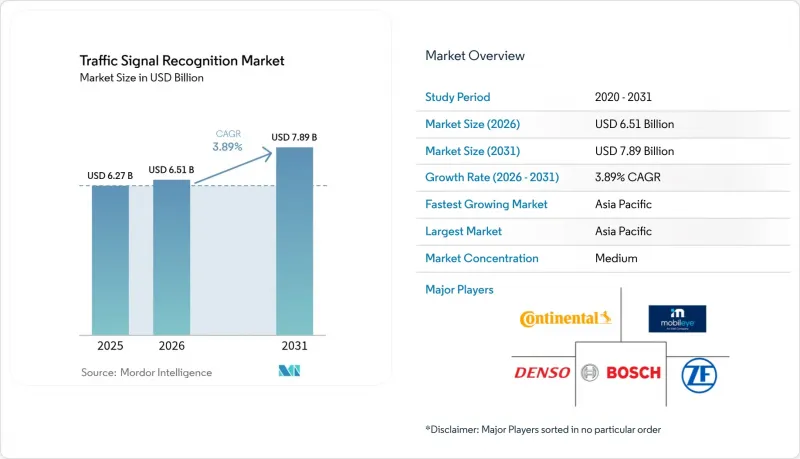
본 보고서는 감지 방법(색상 기반 감지, 형상 기반 감지, 특징 기반 감지), 센서 기술(카메라 시스템, 레이더 지원형 교통신호 인식(TSR) 등), 차량 유형(승용차 등), 구성요소(하드웨어 및 소프트웨어), 최종사용자(OEM 및 애프터마켓), 그리고 지역별로 분류되어 있습니다. 시장 전망은 금액(달러) 기준으로 제시되어 있습니다.
세계 교통신호 인식 시장의 동향 및 인사이트
규제에 따른 ADAS 탑재 의무화
법적 구속력을 가진 규정에 따라 신호등 감지 기능은 선택 사양에서 필수 안전 기능으로 변화했습니다. 2024년 7월에 시행되는 유럽연합(EU)의 ‘일반 안전 규정 II’에서는 모든 신차에 교통 신호 입력을 기반으로 한 지능형 속도 지원 시스템의 탑재가 의무화되어 있습니다. 또한, 자동 긴급 제동에 관한 미국 도로교통안전국(NHTSA)의 병행 규제로 인해 인식 시스템에 대한 수요가 증가하고 있습니다. 각 OEM 업체들은 현재 향후 규제 제정을 대비해 확장 가능한 인식 능력을 중심으로 전기 시스템을 설계하고 있으며, 이를 통해 교통신호 인식 시장에서 향후 수년간의 수요가 사실상 확보되었습니다.
카메라의 비용 곡선이 대당 10달러 미만으로 떨어짐
이미징 센서는 한때 첨단 운전자 지원 시스템을 양산차에서 멀어지게 했던 비용 장벽을 마침내 극복했습니다. 소니의 자동차용 CMOS 로드맵과 온세미(Onsemi)의 3µm 픽셀 공정 도입으로 단가는 10달러 미만으로 떨어진 반면, HDR은 120dB로 향상되었고, 암전류는 28분의 1로 감소했습니다. 저가화로 인해 OEM 각사는 차량당 8대 이상의 카메라를 탑재할 수 있게 되었으며, 시야각이 증가함에 따라 눈부심, 역광, LED 깜빡임과 같은 상황에서도 전반적으로 인식 정확도가 향상되고 있습니다.
시야 불량이나 극한의 기상 조건 하에서의 낮은 인식 정확도
눈, 안개, 폭우는 여전히 카메라의 과제로 남아 있으며, 성능 저하를 초래하고 일반 시민의 신뢰를 떨어뜨리는 요인이 되고 있습니다. Snow-CLOCs(동계 감지 정확도 86.61%)와 같은 실험실에서의 성과는 아직 실제 도로에서 안정적인 성능으로 이어지지 못하고 있으며, 개발자들은 LiDAR와 카메라의 융합 및 열화상 오버레이 도입을 모색하고 있습니다. 신뢰성 격차는 규제 당국의 우려 사항으로 대두되고 있으며, 당국은 핸즈프리 주행에 관한 법규를 추진하기 전에 명확하게 정의된 성능 범위를 요구하고 있습니다.
부문 분석
2025년, 교통신호 인식 시장 매출 중 색상 기반 감지가 45.71%를 차지하고 있으며, 이는 RGB 임계값이 오랫동안 사용되어 왔음을 뒷받침합니다. 그러나 컨볼루션 네트워크와 트랜스포머 네트워크가 가림 현상이나 변화하는 조명 조건에서 뛰어난 성능을 발휘하는 것으로 입증됨에 따라, 딥러닝 기반 감지 기술은 2031년까지 연평균 성장률(CAGR) 4.47%로 성장하고 있습니다. 딥러닝 기반 교통신호 인식 시장의 규모는 2031년까지 기하급수적으로 확대될 것으로 예상되며, 이는 각 OEM 업체들이 소프트웨어 업그레이드를 통해 정확도를 높이고자 하는 의향을 반영한 것입니다.
YOLOv5 및 어텐션 기반 네트워크는 현재 추론 시간을 45밀리초 미만으로 억제하면서 95% 이상의 정확도와 98% 이상의 재현율을 달성하여 실시간 안전 요건을 충족하고 있습니다. OTA(Over-the-Air) 파이프라인이 성숙해짐에 따라, 자동차 제조사들은 에지 케이스 영상을 활용해 모델을 재학습시키고, 하드웨어를 교체하지 않고도 업데이트를 배포할 수 있게 될 것입니다. 교통신호 인식 시장은 차별화 요소가 회로 설계가 아닌 데이터 큐레이션에 있는 AI 중심의 스택으로 계속 전환되고 있습니다.
2025년, 카메라 시스템은 교통신호 인식 시장 매출의 62.55%를 차지했습니다. 이는 BOM 비용의 감소와 시스템의 효율성 및 기능성을 향상시킨 첨단 소프트웨어 도구의 통합이 주요 원동력입니다. 이 압도적인 점유율은 교통신호 인식 애플리케이션에서 카메라 시스템의 채택이 확대되고 있음을 보여줍니다. 성장률은 둔화되고 있지만, 지속적인 기술 발전에 힘입어 교통신호 인식 분야의 카메라 시스템 시장 규모는 2031년까지 높은 연평균 성장률(CAGR)로 급속히 확대될 것으로 예측됩니다.
LiDAR와 카메라의 융합은 연평균 성장률(CAGR) 4.12%로 가장 빠르게 성장하는 하위 부문이며, Hesai와 같은 공급업체들이 가격을 50% 인하할 계획을 세우고 있어, 이에 따라 솔리드 스테이트 유닛이 주류 사양 범위에 포함될 전망입니다. SparseLIF 및 유사한 프레임워크는 포인트 클라우드의 기하학적 구조와 이미지의 텍스처를 정합하여, 눈부심이나 강우로 인해 카메라 시야가 가려진 경우에도 인식을 유지할 수 있는 중복성을 제공합니다. 레이더 지원형 옵션은 위상 변화를 예측하는 속도 벡터를 추가하여, 멀티 센서 융합이 교통신호 인식 시장을 어떻게 변화시키고 있는지를 보여줍니다.
지역별 분석
아시아태평양은 2025년 교통신호 인식 시장 매출 점유율의 38.31%를 차지하며 1위를 차지했으며, 2031년까지 연평균 성장률(CAGR) 3.98%로 성장할 것으로 전망됩니다. 국내 규제, 스마트 시티 시범 사업 및 수직 통합으로 인해 교통신호 인식 시장은 중국, 일본, 한국에 집중되어 있습니다. 선전의 V2I 회랑에서는 테스트용 차량 군에 실시간 신호 위상 지도가 제공되는 반면, 도쿄의 센서 산업은 전 세계 OEM 제조업체에 HDR 이미저를 공급하고 있습니다. 지역 특유의 고밀도 교통은 다양한 데이터세트를 생성하여 딥러닝의 견고성을 높이고, 전 세계적인 검증 주기를 가속화하고 있습니다.
유럽은 일반 안전 규정 II(General Safety Regulation II)에 힘입어 이를 따르고 있습니다. 콘티넨탈의 신규 사업 부문인 ‘Aumovio’와 보쉬의 센서 퓨전 제품군이 공급 기반을 구축하고 있는 반면, 엄격한 사이버 보안 규제가 데이터 처리 아키텍처를 형성하고 있습니다. 독일과 영국의 보험 텔레매틱스 분야에서는 검증된 규정 준수가 보상을 받는 구조로 되어 있어, 소비자의 수요를 교통신호 인식 시장으로 이끌고 있습니다.
북미에서는 연방 정부의 안전 규제와 벤처 캐피탈의 지원을 받은 자율주행 파일럿 사업이 호재로 작용하고 있습니다. 캘리포니아주의 극한 상황에 대한 법적 검토로 인해 공급업체들은 페일세이프 성능에 대한 문서화를 요구받고 있는 반면, 캐나다의 겨울 기후는 악천후 하에서 시험을 수행하기 위한 천연 실험장이 되고 있습니다. 이러한 요인들이 결합되어 다양하면서도 상호연결된 지역 구조가 유지되고 있으며, 한 지역에서의 진전은 전 세계에 분산된 OEM 프로그램을 통해 다른 지역으로 신속하게 파급되고 있습니다.
기타 혜택:
- 엑셀 형식의 시장 예측(ME) 시트
- 3개월간의 애널리스트 지원
자주 묻는 질문
목차
제1장 소개
제2장 조사 방법
제3장 주요 요약
제4장 시장 구도
제5장 시장 규모와 성장 예측
제6장 경쟁 구도
제7장 시장 기회와 향후 전망
KSM 26.08.25According to Mordor Intelligence, the traffic signal recognition market size is expected to grow from USD 6.27 billion in 2025 to USD 6.51 billion in 2026 and is forecast to reach USD 7.89 billion by 2031 at 3.89% CAGR over 2026-2031.
This report is Segmented by Detection Method (Color-Based Detection, Shape-Based Detection, and Feature-Based Detection), Sensor Technology (Camera Systems, Radar-Assisted TSR, and More), Vehicle Type (Passenger Cars and More), Component (Hardware and Software), End-User (OEM and Aftermarket), and Geography. The Market Forecasts are Provided in Terms of Value (USD).
Global Traffic Signal Recognition Market Trends and Insights
Regulation-Mandated ADAS Inclusion
Binding rules have turned traffic light detection from an optional extra into a required safety feature. The European Union's General Safety Regulation II, effective July 2024, obliges every new model to include intelligent speed assistance underpinned by traffic-signal inputs, while a parallel NHTSA rule on automatic emergency braking heightens demand for perception suites. OEMs now architect their electrical systems around scalable perception capacity that anticipates future rule-making, effectively locking in multi-year demand for the traffic signal recognition market.
Camera Cost Curve Drops Below USD 10/Unit
Imaging sensors finally cleared the cost hurdle that once kept advanced vision off mass-market vehicles. Sony's automotive CMOS roadmap and onsemi's 3 µm pixel process have driven unit prices beneath USD 10 while boosting HDR to 120 dB and cutting dark current by 28 times. Low prices let OEMs deploy eight or more cameras per vehicle, multiplying viewpoints that collectively raise recognition precision across glare, back-light, and LED-flicker scenarios.
Poor Recognition in Low-Visibility and Weather Eextremes
Snow, fog, and heavy rain still challenge cameras, creating service drops that undermine public trust. Laboratory gains such as Snow-CLOCs (86.61% detection accuracy in winter) have yet to translate into uniform street performance, pushing developers toward LiDAR-camera fusion and thermal overlays. Reliability gaps weigh on regulators who demand clearly defined performance envelopes before advancing hands-free legislation.
Other drivers and restraints analyzed in the detailed report include:
- Level-2 Plus Autonomy Proliferation
- V2I-Enabled Dynamic Sign Updates
- Country-Specific Dataset Validation Costs
For complete list of drivers and restraints, kindly check the Table Of Contents.
Segment Analysis
Color-based Detection held 45.71% of the traffic signal recognition market revenue in 2025, a testament to its long-standing use of RGB thresholds. Yet Deep-Learning Detection is rising at 4.47% CAGR to 2031 as convolutional and transformer networks prove superior under occlusion and variable lighting. The traffic signal recognition market size for Deep-Learning Detection is projected to grow exponentially by 2031, reflecting OEM preferences for software-upgradable accuracy gains.
YOLOv5 and attention-based networks now achieve more than 95% precision and over 98% recall while keeping inference below 45 ms, meeting real-time safety budgets. As over-the-air pipelines mature, automakers can retrain models on edge-case footage and push updates without hardware swaps. The traffic signal recognition market continues transitioning toward AI-centric stacks where differentiators sit in data curation, not circuit design.
In 2025, Camera Systems captured 62.55% of the traffic signal recognition market revenue, driven by declining BOM costs and the integration of advanced software tooling, which enhanced system efficiency and functionality. This dominance highlights the growing adoption of Camera Systems in traffic signal recognition applications. Despite a moderation in growth rates, the market size for Camera Systems in traffic signal recognition is projected to surge at a strong CAGR through 2031, supported by continuous technological advancements.
LiDAR-Camera Fusion is the fastest-advancing sub-segment at 4.12% CAGR as suppliers like Hesai plan 50% price cuts that place solid-state units within mainstream trims. SparseLIF and similar frameworks align point-cloud geometry with image texture, producing redundancy that sustains recognition when glare or precipitation blinds cameras. Radar-assisted options add speed vectors that predict phase changes, illustrating how multi-sensor blending reshapes the traffic signal recognition market.
Complete Report Scope:
- By Detection Method
- Color-based Detection
- Shape-based Detection
- Feature / Deep-Learning Detection
- By Sensor Technology
- Camera Systems
- Radar-Assisted TSR
- LiDAR-Camera Fusion
- Multi-modal
- By Vehicle Type
- Passenger Cars
- Light Commercial Vehicles
- Medium and Heavy Commercial Vehicles
- Buses and Coaches
- By Component
- Hardware
- Software
- By End-User
- OEM-installed
- Aftermarket Retrofit
- Geography
- North America
- United States
- Canada
- Rest of North America
- South America
- Brazil
- Argentina
- Rest of South America
- Europe
- Germany
- United Kingdom
- France
- Spain
- Italy
- Rest of Europe
- Asia-Pacific
- China
- Japan
- South Korea
- India
- Rest of Asia-Pacific
- Middle East and Africa
- Saudi Arabia
- United Arab Emirates
- Egypt
- South Africa
- Rest of Middle East and Africa
- North America
Geography Analysis
Asia-Pacific led with 38.31% of the traffic signal recognition market revenue share in 2025 and is expected to grow at a 3.98% CAGR through 2031. Domestic regulations, smart-city pilots, and vertical integration concentrate the traffic signal recognition market in China, Japan, and South Korea. Shenzhen's V2I corridors feed real-time phase maps to test fleets, while Tokyo's sensor industry supplies HDR imagers to global OEMs. Regional high-density traffic creates diverse datasets that sharpen deep-learning robustness and accelerate global validation cycles.
Europe follows, propelled by General Safety Regulation II. Continental's new Aumovio division and Bosch's sensor-fusion suites anchor supply, while stringent cybersecurity rules shape data-handling architectures. Insurance telematics in Germany and the United Kingdom reward verified compliance, channeling consumer demand into the traffic signal recognition market.
North America benefits from federal safety mandates and venture-backed autonomy pilots. California's edge-case legal scrutiny pushes suppliers to document fail-safe performance, while Canada's winter climate provides natural laboratories for adverse-weather testing. Together, these factors sustain a diversified yet interconnected geography where advances in one region ripple quickly to others through globally distributed OEM programs.
- Continental AG
- Robert Bosch GmbH
- DENSO Corporation
- Mobileye (Intel)
- ZF Friedrichshafen AG
- HELLA (FORVIA)
- Aptiv PLC
- Valeo SA
- Magna International Inc.
- Panasonic Holdings
- Hyundai Mobis
- Hitachi Astemo
- Veoneer / S-SW
- Ford Motor Company
- General Motors Company
- Tesla Inc.
- NVIDIA Corporation
Additional Benefits:
- The market estimate (ME) sheet in Excel format
- 3 months of analyst support
TABLE OF CONTENTS
1 Introduction
- 1.1 Study Assumptions & Market Definition
- 1.2 Scope of the Study
2 Research Methodology
3 Executive Summary
4 Market Landscape
- 4.1 Market Overview
- 4.2 Market Drivers
- 4.2.1 Regulation-mandated ADAS inclusion
- 4.2.2 Camera Cost Curve Drops Below USD10/unit
- 4.2.3 Level-2 Plus Autonomy Proliferation
- 4.2.4 V2I-Enabled Dynamic Sign Updates
- 4.2.5 HD-Map Digital-Twin Build-Outs
- 4.2.6 Insurance Telematics Rewarding TSR Accuracy
- 4.3 Market Restraints
- 4.3.1 Poor Recognition in Low-Visibility and Weather Extremes
- 4.3.2 Country-Specific Dataset Validation Costs
- 4.3.3 Cyber-Liability For Erroneous Sign Display
- 4.3.4 OEM Budget Shift to Competing Sensor Priorities
- 4.4 Value / Supply-Chain Analysis
- 4.5 Regulatory Landscape
- 4.6 Technological Outlook
- 4.7 Porter's Five Forces
- 4.7.1 Threat of New Entrants
- 4.7.2 Bargaining Power of Buyers/Consumers
- 4.7.3 Bargaining Power of Suppliers
- 4.7.4 Threat of Substitute Products
- 4.7.5 Intensity of Competitive Rivalry
5 Market Size & Growth Forecasts (Value (USD))
- 5.1 By Detection Method
- 5.1.1 Color-based Detection
- 5.1.2 Shape-based Detection
- 5.1.3 Feature / Deep-Learning Detection
- 5.2 By Sensor Technology
- 5.2.1 Camera Systems
- 5.2.2 Radar-Assisted TSR
- 5.2.3 LiDAR-Camera Fusion
- 5.2.4 Multi-modal
- 5.3 By Vehicle Type
- 5.3.1 Passenger Cars
- 5.3.2 Light Commercial Vehicles
- 5.3.3 Medium and Heavy Commercial Vehicles
- 5.3.4 Buses and Coaches
- 5.4 By Component
- 5.4.1 Hardware
- 5.4.2 Software
- 5.5 By End-User
- 5.5.1 OEM-installed
- 5.5.2 Aftermarket Retrofit
- 5.6 Geography
- 5.6.1 North America
- 5.6.1.1 United States
- 5.6.1.2 Canada
- 5.6.1.3 Rest of North America
- 5.6.2 South America
- 5.6.2.1 Brazil
- 5.6.2.2 Argentina
- 5.6.2.3 Rest of South America
- 5.6.3 Europe
- 5.6.3.1 Germany
- 5.6.3.2 United Kingdom
- 5.6.3.3 France
- 5.6.3.4 Spain
- 5.6.3.5 Italy
- 5.6.3.6 Rest of Europe
- 5.6.4 Asia-Pacific
- 5.6.4.1 China
- 5.6.4.2 Japan
- 5.6.4.3 South Korea
- 5.6.4.4 India
- 5.6.4.5 Rest of Asia-Pacific
- 5.6.5 Middle East and Africa
- 5.6.5.1 Saudi Arabia
- 5.6.5.2 United Arab Emirates
- 5.6.5.3 Egypt
- 5.6.5.4 South Africa
- 5.6.5.5 Rest of Middle East and Africa
- 5.6.1 North America
6 Competitive Landscape
- 6.1 Market Concentration
- 6.2 Strategic Moves
- 6.3 Market Share Analysis
- 6.4 Company Profiles (includes Global Level Overview, Market Level Overview, Core Segments, Financials as Available, Strategic Information, Market Rank/Share for Key Companies, Products and Services, SWOT Analysis, and Recent Developments)
- 6.4.1 Continental AG
- 6.4.2 Robert Bosch GmbH
- 6.4.3 DENSO Corporation
- 6.4.4 Mobileye (Intel)
- 6.4.5 ZF Friedrichshafen AG
- 6.4.6 HELLA (FORVIA)
- 6.4.7 Aptiv PLC
- 6.4.8 Valeo SA
- 6.4.9 Magna International Inc.
- 6.4.10 Panasonic Holdings
- 6.4.11 Hyundai Mobis
- 6.4.12 Hitachi Astemo
- 6.4.13 Veoneer / S-SW
- 6.4.14 Ford Motor Company
- 6.4.15 General Motors Company
- 6.4.16 Tesla Inc.
- 6.4.17 NVIDIA Corporation
7 Market Opportunities & Future Outlook
- 7.1 White-space & Unmet-need Assessment


