

|
시장보고서
상품코드
2113489
자동차 자동 긴급 제동(AEB) 시스템 : 시장 점유율 분석, 업계 동향과 통계, 성장 예측(2026-2031년)Automotive Autonomous Emergency Braking System - Market Share Analysis, Industry Trends & Statistics, Growth Forecasts (2026 - 2031) |
||||||
 Mordor Intelligence
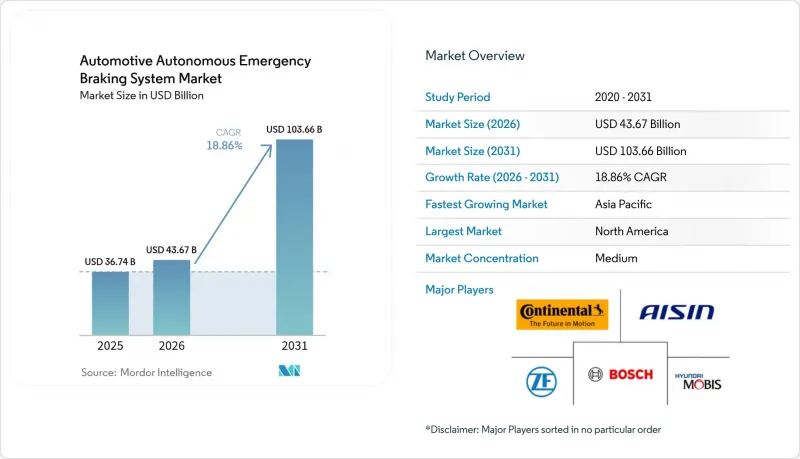
Mordor Intelligence에 따르면 2026년 자동차 자동 긴급 제동(AEB) 시스템 시장 규모는 436억 7,000만 달러로 추정되며, 2025년 367억 4,000만 달러에서 확대되어 2031년에는 1,036억 6,000만 달러에 달할 것으로 예측됩니다.
2026년부터 2031년까지의 연평균 성장률(CAGR)은 18.86%에 달할 전망입니다.
본 보고서는 차량 유형별(승용차, 소형 상용차 등), 구성요소 기술별(레이더식, 카메라식, 라이다식 AEB 등), 작동 속도 등급별(저속, 고속, 보행자용 AEB 등), 판매 채널별(OEM 탑재, 애프터마켓용 사후 장착 등)로 분류되어 있습니다. 시장 예측은 금액(달러) 기준으로 제시되어 있습니다.
세계 자동차 자동 긴급 제동(AEB) 시스템 시장의 동향 및 인사이트
AEB 탑재 의무화에 관한 규제
정부의 AEB 요건 도입은 기존 자동차 업계의 도입 주기를 뛰어넘는 불가피한 시장 확대를 가져오고 있습니다. NHTSA의 최종 규정에서는 AEB 시스템이 시속 90마일까지의 속도에서 자동 제동을 작동시킬 수 있는 능력을 갖추어야 한다고 의무화하고 있습니다. 또한 보행자 감지 기능은 어둠 속에서도 효과적으로 작동해야 하며, 2029년 9월까지 완전한 준수가 요구됩니다. 이 규제는 특정 기술에 얽매이지 않는 요건이며, 성능 기반 접근 방식을 채택하고 있어 제조사는 엄격한 유효성 기준을 충족하면서도 최적의 센서 조합을 선택할 수 있습니다. 예비 테스트 결과, 2023년형 토요타 코롤라만이 이러한 종합적인 기준을 충족하는 것으로 밝혀졌으며, 이는 업계 전반에 걸쳐 대대적인 기술 업그레이드가 필요함을 시사합니다. 이 규제 체계는 통합된 센서 퓨전 솔루션을 제공할 수 있는 기술적으로 진보된 공급업체에 유리한 최소 성능 기준을 확립함으로써, 경쟁 구도를 근본적으로 변화시킬 것입니다. 대당 82달러로 추정되는 도입 비용은 예상되는 52.4억-65억 2,000만 달러의 수명주기 순이익에 비하면 극히 미미한 장벽에 불과하며, 도입 가속화에 대한 설득력 있는 경제적 근거가 됩니다.
NCAP 5성급 안전 등급에 대한 소비자 수요 증가
소비자의 안전 의식이 높아짐에 따라 규제상 최저 기준을 뛰어넘는 구매 결정이 촉진되고 있으며, 최고 수준의 안전 평가를 획득한 차량에는 시장에서 프리미엄 가격이 형성되고 있습니다. 유로 NCAP의 2026년 개정 프로토콜에서는 교차로에서의 충돌 회피 및 자전거 탑승자 감지 기능을 포함한 강화된 AEB(자동 긴급 제동) 시험 시나리오가 도입되어, 제조사들은 최고 등급을 획득하기 위해 첨단 센서 통합이 요구되고 있습니다. 미국 도로안전보험협회(IIHS)가 엄격한 AEB 규제를 제안한 것은 현행 시스템이 어두운 곳에서 성능이 현저히 떨어진다는 소비자의 인식을 반영한 것으로, 적외선 카메라나 첨단 센서 융합 기술을 도입하는 제조사에게 차별화의 기회를 제공하고 있습니다. 이러한 소비자 주도적 수요는 안전 기술이 중요한 차별화 요소가 되는 고급차 부문에 특히 큰 영향을 미치고 있으며, 볼보와 같은 제조사는 ‘시티 세이프티(City Safety)’ 기술을 활용하여 측정 가능한 충돌 감소 효과를 입증하고 있습니다. 2033년까지 이어지는 NCAP 로드맵은 기술의 지속적인 진화를 요구하는 요건을 보장하고, 시장의 정체 현상을 방지하며, 지속적인 혁신에 대한 투자를 촉진하고 있습니다. 첨단 안전 기능을 갖춘 볼보 차량 소유자에게 할인을 제공하는 리버티 뮤추얼의 ‘TechSafety’ 프로그램은 소비자의 수요와 AEB의 유효성을 인정하는 보험 업계의 인식이 어떻게 연결되어 있는지를 보여줍니다.
프리미엄 AEB용 LiDAR 및 멀티 센서 스택의 높은 비용
라이더(LiDAR)는 뛰어난 감지 능력을 갖추고 있음에도 불구하고, 탑재 비용이 장벽이 되어 보급이 제한되고 있습니다. 그 결과, 프리미엄 차량과 양산 차량 카테고리 간에 시장 세분화가 발생하고 있습니다. Hesai와 같은 기업들은 2025년까지 LiDAR 가격을 50% 인하할 계획을 세우고 있지만, 현재 비용은 여전히 레이더와 카메라의 조합보다 훨씬 높아 도입이 하이엔드 차량 부문으로 한정되고 있습니다. 올리버 와이먼(Oliver Wyman)의 분석에 따르면, LiDAR는 긴급 제동과 같은 안전상 매우 중요한 용도에서 뛰어난 정확도를 제공하지만, 레이더의 해상도 향상과 비용 효율성 개선으로 인해 경쟁 압박에 직면해 있습니다. 이러한 과제는 중복성과 성능 향상을 위해 LiDAR, 레이더, 카메라를 결합한 멀티센서 융합 아키텍처에서 더욱 심각해지고 있으며, 시스템이 복잡해짐에 따라 통합 비용과 검증 요건도 증가하고 있습니다. Aeva Technologies가 양산차용 Tier 1 LiDAR 공급업체로 선정된 것은 FMCW 기술에 대한 시장의 신뢰를 입증합니다. 그러나 전환 일정이 2025년대 중반까지 이어진다는 점은 막대한 기술적 과제와 비용 최적화가 필요함을 시사합니다. 이러한 비용상의 제약은 특히 상용차 도입에 영향을 미칩니다. 상용차 플릿 운영사는 첨단 안전 기능보다 총소유비용(TCO)을 우선시하기 때문에 대량 생산 부문에서 라이다 기반 AEB의 보급이 지연될 가능성이 있습니다.
부문 분석
승용차는 규제와 부합하는 소비자의 안전에 대한 기대감 고조를 배경으로, 자동 긴급 제동 시장에서 73.05%라는 최대 점유율을 차지하고 있습니다. 대형 상용차는 2025년 시장 점유율이 6.20%에 그치지만, 총중량(GVW) 1만 1파운드를 초과하는 트럭을 대상으로 하는 FMCSA 규정을 배경으로 13.65%라는 가장 높은 연평균 성장률(CAGR)로 점유율을 확대하고 있습니다. 이러한 높은 성장 기반을 바탕으로, 차량 함대는 전략적 발판으로서의 입지가 확고해졌으며, 1,500달러부터 판매되는 사후 장착 키트는 충돌로 인한 가동 중단 시간 단축 및 보험료 환급을 통해 투자 회수가 가능해졌습니다. E-Commerce 물류로 인한 배송 거리 증가에 따라 소형 상용차는 20.75%의 시장 점유율을 유지하고 있습니다. 규제 준수 기한이 다가오면서 차량 함대의 구매 주기가 단축됨에 따라, 대형 상용차용 자동 긴급 제동 시장 규모는 2026년부터 2031년 사이에 3배 이상으로 증가할 것으로 예측됩니다.
차량 함대는 기술의 발전 방향에도 영향을 미치고 있습니다. ZF사의 500만 대를 대상으로 하는 브레이크 바이 와이어(Brake-by-Wire) 프로그램은 상용 플랫폼이 규모의 경제를 창출하고, 이것이 나중에 승용차 부문으로 파급될 수 있는 힘을 보여주고 있습니다. 1차 공급업체들은 현재 트랙터 운전실이나 트레일러 앞부분에 클립으로 부착할 수 있는 모듈형 센서 세트를 설계하고 있으며, 이를 통해 가동 중지 시간을 최소화하고 서비스 부품의 표준화를 도모하고 있습니다. 이러한 부문 간 기술 흐름에 힘입어 자동 긴급 제동(AEB) 업계는 생산량과 혁신의 선순환을 유지하고 있습니다.
2025년에는 레이더가 자동 긴급 제동 시장에서 45.75%의 점유율을 차지했으며, 전천후 환경에서의 견고성과 꾸준히 낮아지는 비용 곡선으로 높은 평가를 받았습니다. 카메라 전용 시스템은 22.40%를 차지하고 있지만, 저조도 환경에서의 성능에 한계가 있어, 그 결과 19.90%의 점유율을 차지하는 레이더·카메라 융합 시스템의 보급이 확대되고 있습니다. LiDAR는 아직 발전 단계에 있지만, 수직 공진기 면발광 레이저(VCSEL) 및 FMCW 아키텍처를 통해 부품 원가(BOM)가 대폭 절감되고 10cm 미만의 거리 측정 정확도가 실현됨에 따라 연평균 성장률(CAGR) 30.55%라는 급성장을 이루고 있습니다. 초음파 유닛은 저속 주행용으로 3.85% 수준에 머물러 있습니다. LiDAR를 핵심으로 하는 시스템의 자동 긴급 제동 시장 점유율은, 솔리드 스테이트 센서에 대한 전 세계 OEM 수주 잔고가 60억 달러를 넘어서는 것을 배경으로, 2031년까지 15.80%에 근접할 것으로 예상됩니다.
기술 융합이 진행될 가능성이 높아지고 있습니다. 하이브리드 모듈은 고해상도 중거리 매핑용 협시야 LiDAR와 악천후에서도 신뢰성을 확보하기 위한 광시야 레이더를 통합하여, 비용 대비 우수한 커버리지를 실현하고 있습니다. 레이더 DSP, AI 가속기, 라이더 제어를 단일 칩에 통합한 반도체의 로드맵은 추가적인 통합을 예고하고 있으며, 이는 자동 긴급 제동(AEB) 업계 내 경쟁을 더욱 치열하게 만들 것입니다.
지역별 분석
북미는 2025년 매출의 34.05%를 차지하고 있으며, 이러한 위상은 엄격한 연방 안전 기준과 적극적인 도입을 촉진하는 익숙한 소송 환경에 의해 뒷받침되고 있습니다. 또한, 이 지역에서는 차량의 평균 사용 연수가 길기 때문에 보험상의 이점을 얻기 위해 규정 준수를 가속화하는 차량 대수가 증가하고 있으며, 이것이 견조한 사후 장착 수요를 뒷받침하고 있습니다. 북미의 자동 긴급 제동 시장 규모는 FMVSS 127의 단계적 준수 기간과 맞물려 2031년까지 352억 8,000만 달러에 달할 것으로 전망됩니다.
유럽은 29.85%의 시장 점유율로 그 뒤를 잇고 있으며, 27개 회원국 간 안전 요건을 통일하고 AEB를 보다 광범위한 ADAS(첨단 운전자 보조 시스템) 프레임워크에 통합하는 ‘일반 안전 규정 II(General Safety Regulation II)’에 힘입고 있습니다. 유럽에 기반을 둔 OEM 기업들은 AEB, 차선 유지 보조, 어댑티브 크루즈 컨트롤 기능을 공유 센서 어레이에 통합하는 중앙 집중형 E/E 아키텍처를 선호하고 있으며, 이를 통해 공급업체의 규모의 경제가 향상되고 자동 긴급 제동 시장에서의 수익성이 개선되고 있습니다.
아시아태평양은 2025년에 28.35%의 점유율을 기록했으나, BYD 등 중국 OEM 업체들이 1만 5,000달러 미만으로 판매되는 저가형 전기자동차에 AEB를 탑재하고 있어 12.15%라는 가장 높은 연평균 성장률(CAGR)을 보이고 있습니다. 국산 칩셋과 수직 통합형 센서 공급망을 통해 비용 구조가 압축되어, 유럽의 생산 대수를 훨씬 능가하는 대규모 도입이 가능해졌습니다. 2025년 2월부터 호주에서 도입되는 모든 신형 승용차에 자동 긴급 제동 장치 탑재 의무화로 인해, 해당 지역의 규제 대상 범위가 확대되어 지역 성장세가 유지될 전망입니다. 현재의 추세가 지속된다면, 아시아태평양의 자동 긴급 제동 시장 규모는 2030년까지 북미를 추월할 가능성이 있습니다.
기타 혜택:
- 엑셀 형식의 시장 예측(ME) 시트
- 3개월간의 애널리스트 지원
자주 묻는 질문
목차
제1장 소개
제2장 조사 방법
제3장 주요 요약
제4장 시장 구도
제5장 시장 규모와 성장 예측
제6장 경쟁 구도
제7장 시장 기회와 향후 전망
KSM 26.08.25According to Mordor Intelligence, the automotive autonomous emergency braking system market size in 2026 is estimated at USD 43.67 billion, growing from 2025 value of USD 36.74 billion with 2031 projections showing USD 103.66 billion, growing at 18.86% CAGR over 2026-2031.
This report is Segmented by Vehicle Type (Passenger Cars, Light Commercial Vehicles, and More), Component Technology (Radar-Based, Camera-Based, LiDAR-Based AEB, and More), Operating Speed Class (Low-Speed, High-Speed, Pedestrian AEB, and More), and Sales Channel (OEM-Installed, Aftermarket Retrofit, and More). The Market Forecasts are Provided in Terms of Value (USD).
Global Automotive Autonomous Emergency Braking System Market Trends and Insights
Regulatory Mandates for Mandatory AEB Installation
Government-imposed AEB requirements create non-negotiable market expansion that transcends traditional automotive adoption cycles. NHTSA's final rule mandates that AEB systems be capable of automatic braking at speeds up to 90 mph. That pedestrian detection functionality should operate effectively in darkness, with full compliance required by September 2029.The regulation's performance-based approach, rather than technology-specific requirements, enables manufacturers to choose optimal sensor combinations while meeting stringent effectiveness thresholds. Preliminary testing reveals that only the 2023 Toyota Corolla meets these comprehensive standards, indicating substantial technology upgrades required across the industry. This regulatory framework fundamentally alters competitive dynamics by establishing minimum performance baselines that favor technologically sophisticated suppliers capable of delivering integrated sensor fusion solutions. The estimated USD 82 per vehicle implementation cost represents a minimal barrier relative to the projected USD 5.24 to USD 6.52 billion lifetime net benefits, creating compelling economic justification for accelerated adoption.
Rising Consumer Demand for NCAP 5-Star Safety Ratings
Consumer safety consciousness drives purchasing decisions beyond regulatory minimums, creating market premiums for vehicles achieving top-tier safety ratings. Euro NCAP's updated 2026 protocols introduce enhanced AEB testing scenarios, including junction collision avoidance and cyclist detection capabilities, with manufacturers requiring advanced sensor integration to achieve maximum ratings. The Insurance Institute for Highway Safety's advocacy for stringent AEB regulations reflects consumer awareness that current systems significantly underperform in darkness, creating differentiation opportunities for manufacturers deploying infrared cameras and advanced sensor fusion. This consumer-driven demand particularly influences premium vehicle segments where safety technology is a key differentiator, with manufacturers like Volvo leveraging City Safety technology to demonstrate measurable crash reduction benefits. The NCAP roadmap extending through 2033 ensures continuous technology evolution requirements, preventing market stagnation and rewarding ongoing innovation investments. Liberty Mutual's TechSafety program, offering discounts to Volvo owners with advanced safety features, demonstrates how consumer demand intersects with the insurance industry's recognition of AEB effectiveness.
High Cost of LiDAR & Multi-Sensor Stacks for Premium AEB
LiDAR integration costs constrain widespread adoption despite superior detection capabilities, creating market segmentation between premium and volume vehicle categories. While companies like Hesai plan to reduce LiDAR prices by 50% in 2025, current costs still exceed radar-camera combinations by substantial margins, limiting deployment to higher-end vehicle segments. Oliver Wyman's analysis indicates that LiDAR provides superior accuracy for safety-critical applications like emergency braking but faces competitive pressure due to improved radar resolution and cost-effectiveness. The challenge intensifies multi-sensor fusion architectures that combine LiDAR, radar, and cameras to achieve redundancy and enhanced performance, as system complexity increases, integration costs, and validation requirements. Aeva Technologies' selection as a Tier 1 LiDAR supplier for series production vehicles demonstrates market confidence in FMCW technology. However, the transition timeline extending to mid-decade reflects the substantial engineering and cost optimization required. This cost constraint particularly affects commercial vehicle adoption, where fleet operators prioritize total cost of ownership over premium safety features, potentially delaying LiDAR-based AEB penetration in high-volume segments.
Other drivers and restraints analyzed in the detailed report include:
- Declining Radar & Camera Sensor Cost with Scalable 4D Fusion
- AI-Enhanced Imaging Radar Unlocking Low-Cost High-Resolution Perception
- Sensor Performance Limits in Adverse Weather & False Positives
For complete list of drivers and restraints, kindly check the Table Of Contents.
Segment Analysis
Passenger cars hold the largest autonomous emergency braking market share at 73.05%, benefiting from rising consumer safety expectations that align with regulation. Heavy commercial vehicles represented only 6.20% of the market share in 2025, yet are climbing at the highest CAGR of 13.65% on the back of FMCSA rules covering trucks above 10,001 lb GVW. This high-growth base positions fleets as a strategic beachhead, with retrofit kits priced from USD 1,500 achieving payback through collision-related downtime reduction and insurance rebates. Light commercial vans retain a 20.75% share as e-commerce logistics multiply delivery miles. The heavy commercial vehicles' autonomous emergency braking market size is projected to more than triple between 2026 and 2031 as fleet purchasing cycles compress around compliance deadlines.
Fleets are also influencing technology paths. ZF's brake-by-wire program covering 5 million units demonstrates commercial platforms' power to set scale economies that later cascade into passenger segments. Tier 1 suppliers now design modular sensor suites that clip onto tractor cabs or trailer noses, minimizing downtime and standardizing service parts. This cross-segment technology flow ensures the autonomous emergency braking industry retains a virtuous cycle of volume and innovation.
Radar dominated the autonomous emergency braking market with a 45.75% share in 2025, prized for all-weather robustness and steadily falling cost curves. Camera-only systems cover 22.40% but struggle in lowlight, driving uptake of radar-camera fusion that occupies a 19.90% share. LiDAR, though nascent, is surging at 30.55% CAGR as vertical cavity surface-emitting lasers and FMCW architectures slash BOM and deliver sub-10 cm range accuracy. Ultrasonic units remain parked at 3.85% for low-speed maneuvers. The autonomous emergency braking market share of LiDAR-centric systems is expected to approach 15.80% by 2031, supported by global OEM order books exceeding USD 6 billion for solid-state sensors.
Convergence is increasingly likely. Hybrid modules integrate a narrow-field LiDAR for high-resolution mid-range mapping with wide-field radar to secure adverse-weather reliability, yielding cost-balanced coverage. Semiconductor roadmaps embedding radar DSP, AI accelerators, and LiDAR control on a single die promise further consolidation, amplifying competitive tension inside the autonomous emergency braking industry.
Complete Report Scope:
- By Vehicle Type
- Passenger Cars
- Light Commercial Vehicles
- Medium and Heavy Commercial Vehicles
- By Component Technology
- Radar-based AEB
- Camera-based AEB
- LiDAR-based AEB
- Sensor-Fusion AEB (Radar + Camera)
- Ultrasonic-based AEB
- By Operating Speed Class
- Low-Speed AEB (Less Than 40 Kmph)
- High-Speed AEB (More Than 40 Kmph)
- Pedestrian AEB
- Junction or Intersection AEB
- By Sales Channel
- OEM-Installed
- Aftermarket Retrofit
- Fleet Retrofit Service
- By Geography
- North America
- United States
- Canada
- Rest of North America
- Europe
- Germany
- United Kingdom
- France
- Italy
- Spain
- Rest of Europe
- Asia-Pacific
- China
- Japan
- India
- South Korea
- Australia
- Rest of Asia-Pacific
- South America
- Brazil
- Argentina
- Rest of South America
- Middle East and Africa
- Saudi Arabia
- United Arab Emirates
- South Africa
- Nigeria
- Rest of Middle East and Africa
- North America
Geography Analysis
North America commanded 34.05% of 2025 revenue, a position underpinned by rigorous federal safety standards and a familiar litigation landscape that encourages proactive adoption. The region's high-average-vehicle age also underwrites robust retrofit demand as fleets accelerate compliance to capture insurance benefits. The autonomous emergency braking market size in North America is set to reach USD 35.28 billion by 2031, paralleling the staged FMVSS 127 compliance window.
Europe followed with 29.85% market share, supported by the General Safety Regulation II that synchronizes safety requirements across 27 member states and embeds AEB within a wider umbrella of Advanced Driver Assistance Systems. Euro-centric OEMs favour centralized E/E architectures that host AEB, lane-keep and adaptive cruise on a shared sensor array, improving scale effects for suppliers and boosting profitability within the autonomous emergency braking market.
Asia-Pacific posted 28.35% share in 2025 yet registers the highest 12.15% CAGR as Chinese OEMs like BYD inject AEB into budget EVs retailing below USD 15,000. Domestic chipsets and vertically integrated sensor supply chains compress cost structures, unlocking mass-volume deployments that dwarf European build counts. Australia's mandate for AEB on all new passenger cars from February 2025 widens regulatory coverage in the region, sustaining regional momentum. The autonomous emergency braking market size in Asia-Pacific could surpass North America before 2030 if current trajectories hold.
- Robert Bosch GmbH
- Continental AG
- ZF Friedrichshafen AG
- Denso Corporation
- Autoliv Inc.
- Hyundai Mobis Co. Ltd.
- WABCO Holdings Inc.
- Valeo SA
- Aisin Corporation
- Aptiv PLC
- Mobileye N.V.
- Magna International Inc.
Additional Benefits:
- The market estimate (ME) sheet in Excel format
- 3 months of analyst support
TABLE OF CONTENTS
1 Introduction
- 1.1 Study Assumptions & Market Definition
- 1.2 Scope of the Study
2 Research Methodology
3 Executive Summary
4 Market Landscape
- 4.1 Market Overview
- 4.2 Market Drivers
- 4.2.1 Regulatory Mandates for Mandatory AEB Installation
- 4.2.2 Rising Consumer Demand for NCAP 5-Star Safety Ratings
- 4.2.3 Declining Radar & Camera Sensor Cost With Scalable 4D Fusion
- 4.2.4 AI-Enhanced Imaging Radar Unlocking Low-Cost High-Resolution Perception
- 4.2.5 Usage-Based Insurance Discounts Tied to AEB-Equipped Vehicles
- 4.2.6 Night-Time Pedestrian AEB Requirements in China & US
- 4.3 Market Restraints
- 4.3.1 High Cost of LiDAR & Multi-Sensor Stacks for Premium AEB
- 4.3.2 Sensor Performance Limits in Adverse Weather & False Positives
- 4.3.3 Semiconductor Shortages for 77 GHz Radar Chipsets
- 4.3.4 Intensifying IP Litigation Around mmWave Radar Algorithms
- 4.4 Value / Supply-Chain Analysis
- 4.5 Porter's Five Forces
- 4.5.1 Threat of New Entrants
- 4.5.2 Bargaining Power of Buyers/Consumers
- 4.5.3 Bargaining Power of Suppliers
- 4.5.4 Threat of Substitute Products
- 4.5.5 Intensity of Competitive Rivalry
5 Market Size & Growth Forecasts (Value, USD)
- 5.1 By Vehicle Type
- 5.1.1 Passenger Cars
- 5.1.2 Light Commercial Vehicles
- 5.1.3 Medium and Heavy Commercial Vehicles
- 5.2 By Component Technology
- 5.2.1 Radar-based AEB
- 5.2.2 Camera-based AEB
- 5.2.3 LiDAR-based AEB
- 5.2.4 Sensor-Fusion AEB (Radar + Camera)
- 5.2.5 Ultrasonic-based AEB
- 5.3 By Operating Speed Class
- 5.3.1 Low-Speed AEB (Less Than 40 Kmph)
- 5.3.2 High-Speed AEB (More Than 40 Kmph)
- 5.3.3 Pedestrian AEB
- 5.3.4 Junction or Intersection AEB
- 5.4 By Sales Channel
- 5.4.1 OEM-Installed
- 5.4.2 Aftermarket Retrofit
- 5.4.3 Fleet Retrofit Service
- 5.5 By Geography
- 5.5.1 North America
- 5.5.1.1 United States
- 5.5.1.2 Canada
- 5.5.1.3 Rest of North America
- 5.5.2 Europe
- 5.5.2.1 Germany
- 5.5.2.2 United Kingdom
- 5.5.2.3 France
- 5.5.2.4 Italy
- 5.5.2.5 Spain
- 5.5.2.6 Rest of Europe
- 5.5.3 Asia-Pacific
- 5.5.3.1 China
- 5.5.3.2 Japan
- 5.5.3.3 India
- 5.5.3.4 South Korea
- 5.5.3.5 Australia
- 5.5.3.6 Rest of Asia-Pacific
- 5.5.4 South America
- 5.5.4.1 Brazil
- 5.5.4.2 Argentina
- 5.5.4.3 Rest of South America
- 5.5.5 Middle East and Africa
- 5.5.5.1 Saudi Arabia
- 5.5.5.2 United Arab Emirates
- 5.5.5.3 South Africa
- 5.5.5.4 Nigeria
- 5.5.5.5 Rest of Middle East and Africa
- 5.5.1 North America
6 Competitive Landscape
- 6.1 Market Concentration
- 6.2 Strategic Moves
- 6.3 Market Share Analysis
- 6.4 Company Profiles (Includes Global Level Overview, Market Level Overview, Core Segments, Financials as Available, Strategic Information, Market Rank/Share for Key Companies, Products & Services, and Recent Developments)
- 6.4.1 Robert Bosch GmbH
- 6.4.2 Continental AG
- 6.4.3 ZF Friedrichshafen AG
- 6.4.4 Denso Corporation
- 6.4.5 Autoliv Inc.
- 6.4.6 Hyundai Mobis Co. Ltd.
- 6.4.7 WABCO Holdings Inc.
- 6.4.8 Valeo SA
- 6.4.9 Aisin Corporation
- 6.4.10 Aptiv PLC
- 6.4.11 Mobileye N.V.
- 6.4.12 Magna International Inc.
7 Market Opportunities & Future Outlook
- 7.1 White-space & Unmet-Need Assessment


