

|
시장보고서
상품코드
2113522
생선 및 새우용 사료첨가물 : 시장 점유율 분석, 업계 동향 및 통계, 성장 예측(2026-2031년)Fish And Shrimp Feed Additives - Market Share Analysis, Industry Trends & Statistics, Growth Forecasts (2026 - 2031) |
||||||
 Mordor Intelligence
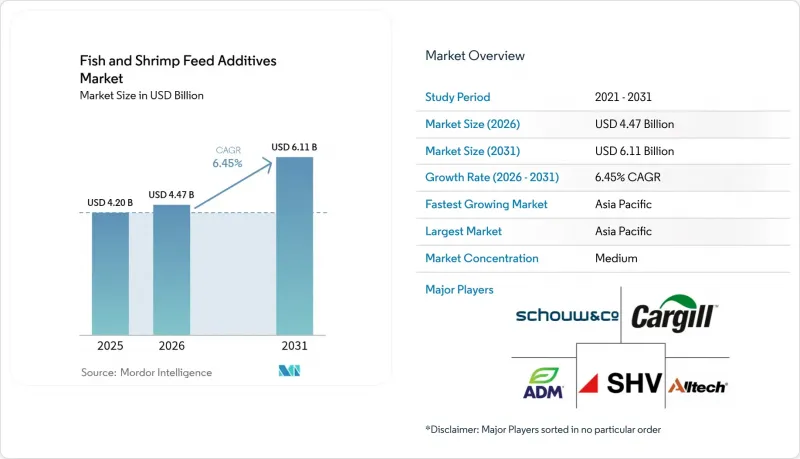
Mordor Intelligence에 의하면, 2026년 생선 및 새우용 사료첨가물 시장 규모는 44억 7,000만 달러로 추정되고 있으며, 2025년 42억 달러에서 2031년에는 61억 1,000만 달러에 달할 것으로 예측됩니다.
또한 2026-2031년 연평균 성장률(CAGR) 6.45%를 기록할 전망입니다.
본 보고서는 대상 동물(어류 및 새우), 첨가제 유형(아미노산, 항생제, 비타민,항산화제, 사료용 효소, 프로바이오틱스, 유기산, 에센셜 오일 및 식물 추출물 등), 형태(건조, 액체, 캡슐화), 지역(북미, 남미, 유럽, 아시아태평양 등)별로 분류되어 있습니다. 시장 전망은 금액(달러) 기준으로 제시되어 있습니다.
전 세계 어류·새우용 사료 첨가제 시장 동향 및 인사이트
전 세계 수산물 소비 확대
고품질이면서 추적 가능성이 확보된 수산물에 대한 수요가 증가함에 따라, 생산자들은 사료 전환율을 높이고 환경 부하를 최소화하는 첨가제를 사용하여 사료의 품질 향상을 도모하고 있습니다. 고부가가치 수입업체들은 시장 진입 조건으로 항생제 미사용 인증을 의무화하고 있으며, 이로 인해 면역력을 지원하는 화합물은 단순한 옵션에서 필수 원료로 변화하고 있습니다. 필레의 품질, 색상, 오메가-3 지방산 함량을 향상시키는 특수 원료는 소매 채널에서 가격 프리미엄을 확보하고 있습니다. DSM-Firmenich사의 ‘Sustell’과 같은 디지털 지속가능성 플랫폼은 양식업자들이 첨가제와 관련된 탄소 감축량을 정량화하고 이를 구매자에게 전달하는 데 도움을 주고 있습니다. 천연 어업공급이 소비를 따라가지 못하는 가운데, 양식업의 확대가 장기적인 첨가제 수요를 뒷받침하고 있습니다.
수출 지향형 양식업의 확대
에콰도르의 새우 양식업자들은 수출 인증이 유럽 및 북미로의 장기간 물류 과정에서 생존율을 유지하면서 항생제 잔류물을 억제하는 프로바이오틱스와 효소의 도입을 어떻게 촉진하고 있는지 보여주고 있습니다. 베트남과 인도네시아에서도 유사한 경향이 관찰되며, 이들 국가에서는 수입업체가 요구하는 3단계 검사 체제에 드는 비용을 고품질 첨가제가 상쇄하고 있습니다. BioMar사가 제시하는 “새우 1kg당 5.2kg의 CO2 환산치”와 같은 탄소 발자국 공개는 인증 절차를 간소화하는 저환경부하 사료 배합의 가치를 부각시키고 있습니다. 수출을 통한 프리미엄 가격이 생존율과 성장률을 향상시키는 투자를 정당화하며, 가격에 민감한 시장에서도 첨가제 지출을 뒷받침하고 있습니다.
전 세계적인 항생제 사용 금지로 인해 사료 배합 변경 비용이 증가
FDA(미국 식품의약국)의 ‘업계 지침 293’ 및 EFSA(유럽 식품안전청)의 최신 정보에 따라, 대체 원료에 대해 추가적인 시험, 문서화 및 검증 절차가 요구되고 있습니다. 항생제가 포함되지 않은 사료로 재처방하기 위해서는 시험, 분석 및 모니터링 인프라가 필요하며, 이는 수익을 실현하기까지 비용 증가를 초래합니다. 소규모 사료 제조업체는 전담 연구개발 팀이 부족하기 때문에 다국적 기업의 고가 턴키 솔루션에 의존할 수밖에 없는 상황입니다. 수입 시장마다 다른 규제는 제품 출시를 더욱 복잡하게 만들고, 규제 대응 팀의 부담을 가중시키며, 신규 첨가물의 수익화까지 걸리는 기간을 연장시키고 있습니다.
부문 분석
2025년, 어류 및 새우용 사료 첨가제 시장 규모의 70.45%를 어류가 차지했습니다. 연어, 송어, 농어의 양식업은 더 큰 바이오매스 양과 안정적인 물류를 활용하여 첨가제 비용을 전체 생산량에 분산시키고, 규모의 경제를 강화하고 있습니다. 효소 복합체를 통한 사료 전환율 향상은 수익성을 높여, 고가의 배합제 도입을 정당화하고 있습니다. 새우 양식 사업은 생산량은 적지만, 동남아시아와 남미의 집약형 양식 시스템에서는 대량 폐사를 방지하기 위해 면역력을 높이는 배합이 필요하기 때문에 7.38%의 연평균 성장률(CAGR)을 기록하고 있습니다.
양식 종의 다양화로 인해 틈새 시장 기회가 창출되고 있습니다. 바라만디, 메기, 그리고 새롭게 등장한 육상 양식 해양 어종에는 각각에 맞춘 미량 영양소의 배합이 요구됩니다. 정밀 사료 공급용 하드웨어를 통해 종별로 최적의 투여가 가능해지며, 캡슐화된 프로바이오틱스와 에센셜 오일 블렌드의 효능이 향상됩니다. DSM-Firmenich사의 농어 및 농어과 어종용 ‘Sustell’ 모듈은 맞춤형 지속가능성 분석에 대한 추세를 여실히 보여주고 있습니다. 순환식 양식 시스템을 채택하는 생산자가 늘어남에 따라 용출을 최소화하는 수중 안정성 첨가제 시장 점유율이 확대될 것이며, 어류 및 새우 제품 라인 모두에서 수량 증가를 상회하는 가치 성장을 가져올 것입니다.
지역별 분석
아시아태평양은 2025년 매출의 36.58%를 차지하며 1위를 차지할 것으로 예상되며, 2031년까지 연평균 성장률(CAGR) 6.92%로 확대될 것으로 전망되어, 어류 및 새우용 사료 첨가제 시장의 핵심 축으로서의 입지를 공고히할 것으로 보입니다. 중국에서 순환식 양식 시스템으로의 전환에 따라, 정밀도가 높고 물에 안정된 첨가제에 대한 수요가 증가하고 있습니다. 베트남 및 인도네시아의 새우 수출업체들은 유럽연합(EU) 및 미국 바이어들이 요구하는 항생제 미사용 인증 요건을 충족하기 위해 프로바이오틱스와 유기산에 의존하고 있습니다. 인도 연안 지역의 양식 확대와 인도네시아의 바라만디 양식 노력이 새로운 생산량 증가를 이끌고 있으며, 이는 Skretting 및 NewSeas와 같은 파트너십을 통해 뒷받침되고 있습니다.
남미도 아시아와 마찬가지로 활기를 띠고 있으며, 2023년 에콰도르의 새우 수출량은 120만 메트르톤으로 72억 달러에 달하고,, 생존율 향상 및 탄소 라벨과 관련된 첨가제 판매를 견인하고 있습니다. 칠레의 연어 생산자들은 질병 관리에 어려움을 겪고 있으며, 산성화제 및 백신 효과를 높이는 영양소에 대한 지출을 늘리고 있습니다. 브라질의 틸라피아 양식장은 저렴한 현지산 사료를 활용할 수 있는 효소 혼합물에 투자하여 단위 비용 경쟁력을 유지하고 있습니다. 지속 가능한 생산과 추적성을 목표로 한 정부 보조금이 이 지역 전반에 걸쳐 기능성 첨가제의 도입을 더욱 촉진하고 있습니다.
유럽과 북미는 규제 기준을 형성하는 성숙해 가면서도 영향력이 큰 시장입니다. 노르웨이의 대형 연어 생산 기업들은 살의 색상과 오메가-3 지방산 함량을 유지하기 위해 캡슐화된 아스타잔틴이나 조류 유래 오일을 찾고 있습니다. 캐나다에서는 급성장하는 육상 양식 부문이 첨가제 배합을 최적화하는 AI 기반 사료 공급 실험을 진행하고 있습니다. 엄격한 승인 제도는 철저한 자료를 갖춘 공급업체를 우대하고, 신규 진입을 제한하는 동시에 확고한 브랜드의 입지를 강화하고 있습니다.
중동 및 아프리카는 아직 발전 단계에 있지만 빠르게 성장하고 있습니다. 이집트의 틸라피아 양식 붐과 사우디아라비아의 식량 안보에 대한 투자로 인해, 첨가제 공급과 연계된 기술 지원에 대한 수요가 높아지고 있습니다. 나이지리아와 남아프리카공화국에서는 메기 및 해양 양식 사업이 확대되고 있으며, 고온 기후에서 사료의 저장 기간을 연장해 주는 비용 대비 효과가 높은 산미제가 선호되고 있습니다. DSM-Firmenich사가 이집트에 건설한 1만 메트르톤 규모의 공장은 리드 타임과 수입 관세를 줄이기 위한 현지 생산 전환을 여실히 보여주고 있습니다.
기타 혜택:
- 엑셀 형식 시장 예측(ME) 시트
- 3개월간의 애널리스트 지원
자주 묻는 질문
목차
제1장 서론
제2장 조사 방법
제3장 주요 요약
제4장 시장 구도
제5장 시장 규모와 성장 예측
제6장 경쟁 구도
제7장 시장 기회와 향후 전망
LSH 26.08.25According to Mordor Intelligence, the fish and shrimp feed additives market size in 2026 is estimated at USD 4.47 billion, growing from 2025 value of USD 4.20 billion with 2031 projections showing USD 6.11 billion, growing at 6.45% CAGR over 2026-2031.
This report is Segmented by Animal Type (Fish and Shrimp), Additive Type (Amino Acids, Antibiotics, Vitamins, Antioxidants, Feed Enzymes, Probiotics, Organic Acids, Essential Oils and Plant Extracts, and More), Form (Dry, Liquid, and Encapsulated), and Geography (North America, South America, Europe, Asia-Pacific, and More). The Market Forecasts are Provided in Terms of Value (USD).
Global Fish And Shrimp Feed Additives Market Trends and Insights
Growing global seafood consumption
Escalating demand for premium, traceable seafood encourages producers to upgrade rations with additives that boost feed conversion rates and minimize environmental footprints. High-value importers tie antibiotic-free certification to market access, turning immune-supporting compounds from optional extras into essential inputs. Specialized ingredients that enhance fillet quality, color, and omega-3 profiles secure price premiums in retail channels. Digital sustainability platforms, such as DSM-Firmenich's Sustell, help farmers quantify additive-linked carbon reductions and communicate them to buyers. As consumption outpaces supply from capture fisheries, aquaculture expansion reinforces long-term additive demand.
Expansion of export-oriented aquaculture
Ecuadorian shrimp operators exemplify how export accreditation drives the adoption of probiotics and enzymes that curb antibiotic residues while preserving survival during lengthy logistics to Europe and North America. Similar patterns hold in Vietnam and Indonesia, where premium additives offset the costs of triple testing regimes required by importers. Carbon footprint disclosures, such as BioMar's 5.2 kg CO2-equivalent per kg shrimp benchmark, underline the value of low-impact formulations that simplify certification. Export premiums justify investments that raise survival and growth, reinforcing additive spend even in price-sensitive markets.
Global antibiotic bans raising reformulation costs
FDA (Food and Drug Administration) Guidance for Industry 293 and EFSA updates impose extra testing, documentation, and validation steps for alternative ingredients. Reformulating feeds without antibiotics demands trials, analytics, and monitoring infrastructure that raise costs before returns materialize. Smaller mills lack dedicated R&D teams, pushing them toward turnkey solutions from multinationals at premium pricing. Divergent rules across import markets further complicate rollouts, stretching regulatory teams thin and extending time to revenue for new additives.
Other drivers and restraints analyzed in the detailed report include:
- Government incentives and subsidies for sustainable aquaculture
- Precision feeding platforms boosting additive utilization
- Carbon-footprint reporting pressure on synthetic additives
For complete list of drivers and restraints, kindly check the Table Of Contents.
Segment Analysis
The fish occupied 70.45% of the fish and shrimp feed additives market size in 2025. Salmon, trout, and sea bass farms leverage higher biomass volumes and stable logistics to spread additive costs across output, reinforcing economies of scale. Improved feed conversion from enzyme complexes raises profitability, justifying premium formulations. Shrimp operations, while smaller in volume, post a 7.38% CAGR because intensive systems in Southeast Asia and South America need immune-supporting blends to prevent mass mortality events.
Species diversification introduces niche opportunities. Barramundi, catfish, and emerging land-based marine species require tailored micronutrient profiles. Precision-feeding hardware allows species-specific dosing, boosting the efficacy of encapsulated probiotics and essential oil blends. DSM-Firmenich's Sustell module for sea bass and sea bream illustrates the trend toward bespoke sustainability analytics. As more producers adopt recirculating aquaculture systems, water-stable additives that minimize leaching will claim higher shares, lifting value growth above volume gains in both fish and shrimp lines.
Complete Report Scope:
- By Animal Type
- Fish
- Shrimp
- By Additive Type
- Amino Acids
- Antibiotics
- Vitamins
- Antioxidants
- Feed Enzymes
- Probiotics
- Organic Acids
- Essential Oils and Plant Extracts
- Minerals
- Prebiotics
- By Form
- Dry (Powder/Granules)
- Liquid
- Encapsulated/Coated
- By Geography
- North America
- United States
- Canada
- Mexico
- Rest of North America
- South America
- Brazil
- Ecuador
- Chile
- Rest of South America
- Europe
- Germany
- United Kingdom
- France
- Spain
- Norway
- Russia
- Rest of Europe
- Asia-Pacific
- China
- India
- Japan
- Vietnam
- Indonesia
- Rest of Asia-Pacific
- Middle East
- Saudi Arabia
- United Arab Emirates
- Rest of Middle East
- Africa
- Egypt
- Nigeria
- Rest of Africa
- North America
Geography Analysis
Asia-Pacific led with 36.58% of 2025 revenue and is projected to compound at 6.92% through 2031, cementing its status as the anchor of the fish and shrimp feed additives market. China's transition toward recirculating aquaculture systems intensifies demand for precise, water-stable additives. Vietnamese and Indonesian shrimp exporters rely on probiotics and organic acids to satisfy antibiotic-free certifications required by European Union and United States buyers. India's coastal expansion and Indonesia's barramundi initiatives are adding fresh volume, supported by partnerships such as Skretting and NewSeas.
South America mirrors Asia's intensity, with Ecuador's shrimp exports in 2023 topping USD 7.2 billion from 1.2 million metric tons, anchoring additive sales tied to survival improvement and carbon labeling. Chilean salmon producers struggle with disease control, channeling spending toward acidifiers and vaccine-supportive nutrients. Brazilian tilapia farms invest in enzyme blends that unlock cheaper local feedstuffs, keeping unit costs competitive. Government subsidies aimed at sustainable output and traceability further encourage functional additive uptake across the region.
Europe and North America represent mature yet influential destinations that shape regulatory norms. Norway's salmon giants demand encapsulated astaxanthin and algae oil to sustain flesh color and omega-3 levels. Canada's growing land-based sector experiments with AI-based feeding that optimizes additive inclusion. Stringent approval regimes favor suppliers with robust dossiers, limiting new entrants and strengthening established brands.
Middle East and Africa are nascent but fast-growing. Egypt's tilapia boom and Saudi Arabia's food-security investments create appetite for technical support bundled with additive supply. Nigeria and South Africa expand catfish and marine operations, favoring cost-effective acidifiers that extend feed shelf life in hot climates. DSM-Firmenich's 10,000 metric tons plant in Egypt underscores the move toward local production that trims lead times and import duties
- Cargill Incorporated
- Nutreco (SHV Holdings N.V.)
- Alltech Inc
- ADM (Archer Daniels Midland Company)
- Biomar Group (Schouw & Co.)
- DSM-Firmenich
- Evonik Industries AG
- Ridley Corporation
- Adisseo (BlueStar Group)
- BASF SE
- Kemin Industries Inc
- Aker Biomarine
- Calanus AS
- Charoen Pokphand Foods (CP Group)
- Grobest
Additional Benefits:
- The market estimate (ME) sheet in Excel format
- 3 months of analyst support
TABLE OF CONTENTS
1 Introduction
- 1.1 Study Assumptions and Market Definition
- 1.2 Scope of the Study
2 Research Methodology
3 Executive Summary
4 Market Landscape
- 4.1 Market Overview
- 4.2 Market Drivers
- 4.2.1 Growing global seafood consumption
- 4.2.2 Expansion of export-oriented aquaculture
- 4.2.3 Government incentives and subsidies for sustainable aquaculture
- 4.2.4 Functional feed additives for immune modulation
- 4.2.5 Adoption of insect- and algae-based additive ingredients
- 4.2.6 Precision feeding platforms boosting additive utilization
- 4.3 Market Restraints
- 4.3.1 Raw-material price volatility
- 4.3.2 Recurring disease outbreaks in aquaculture
- 4.3.3 Global antibiotic bans raising reformulation costs
- 4.3.4 Carbon-footprint reporting pressure on synthetic additives
- 4.4 Regulatory Landscape
- 4.5 Technological Outlook
- 4.6 Porter's Five Forces Analysis
- 4.6.1 Bargaining Power of Suppliers
- 4.6.2 Bargaining Power of Buyers
- 4.6.3 Threat of New Entrants
- 4.6.4 Threat of Substitutes
- 4.6.5 Intensity of Competitive Rivalry
5 Market Size and Growth Forecasts (Value)
- 5.1 By Animal Type
- 5.1.1 Fish
- 5.1.2 Shrimp
- 5.2 By Additive Type
- 5.2.1 Amino Acids
- 5.2.2 Antibiotics
- 5.2.3 Vitamins
- 5.2.4 Antioxidants
- 5.2.5 Feed Enzymes
- 5.2.6 Probiotics
- 5.2.7 Organic Acids
- 5.2.8 Essential Oils and Plant Extracts
- 5.2.9 Minerals
- 5.2.10 Prebiotics
- 5.3 By Form
- 5.3.1 Dry (Powder/Granules)
- 5.3.2 Liquid
- 5.3.3 Encapsulated/Coated
- 5.4 By Geography
- 5.4.1 North America
- 5.4.1.1 United States
- 5.4.1.2 Canada
- 5.4.1.3 Mexico
- 5.4.1.4 Rest of North America
- 5.4.2 South America
- 5.4.2.1 Brazil
- 5.4.2.2 Ecuador
- 5.4.2.3 Chile
- 5.4.2.4 Rest of South America
- 5.4.3 Europe
- 5.4.3.1 Germany
- 5.4.3.2 United Kingdom
- 5.4.3.3 France
- 5.4.3.4 Spain
- 5.4.3.5 Norway
- 5.4.3.6 Russia
- 5.4.3.7 Rest of Europe
- 5.4.4 Asia-Pacific
- 5.4.4.1 China
- 5.4.4.2 India
- 5.4.4.3 Japan
- 5.4.4.4 Vietnam
- 5.4.4.5 Indonesia
- 5.4.4.6 Rest of Asia-Pacific
- 5.4.5 Middle East
- 5.4.5.1 Saudi Arabia
- 5.4.5.2 United Arab Emirates
- 5.4.5.3 Rest of Middle East
- 5.4.6 Africa
- 5.4.6.1 Egypt
- 5.4.6.2 Nigeria
- 5.4.6.3 Rest of Africa
- 5.4.1 North America
6 Competitive Landscape
- 6.1 Market Concentration
- 6.2 Strategic Moves
- 6.3 Market Share Analysis
- 6.4 Company Profiles (Includes Global Level Overview, Market Level Overview, Core Segments, Financials as Available, Strategic Information, Market Rank/Share, Products and Services, and Recent Developments)
- 6.4.1 Cargill Incorporated
- 6.4.2 Nutreco (SHV Holdings N.V.)
- 6.4.3 Alltech Inc
- 6.4.4 ADM (Archer Daniels Midland Company)
- 6.4.5 Biomar Group (Schouw & Co.)
- 6.4.6 DSM-Firmenich
- 6.4.7 Evonik Industries AG
- 6.4.8 Ridley Corporation
- 6.4.9 Adisseo (BlueStar Group)
- 6.4.10 BASF SE
- 6.4.11 Kemin Industries Inc
- 6.4.12 Aker Biomarine
- 6.4.13 Calanus AS
- 6.4.14 Charoen Pokphand Foods (CP Group)
- 6.4.15 Grobest


