

|
시장보고서
상품코드
2113575
최소 침습 수술 기기 : 시장 점유율 분석, 업계 동향 및 통계, 성장 예측(2026-2031년)Minimally Invasive Surgery Devices - Market Share Analysis, Industry Trends & Statistics, Growth Forecasts (2026 - 2031) |
||||||
 Mordor Intelligence
Mordor Intelligence에 의하면, 최소 침습 수술 기기 시장 규모는 2025년 365억 2,000만 달러에서 2026년에는 389억 달러에 이르고, 2026-2031년 CAGR 6.52%로 성장을 지속하여 2031년에는 533억 3,000만 달러에 달할 것으로 예측됩니다.
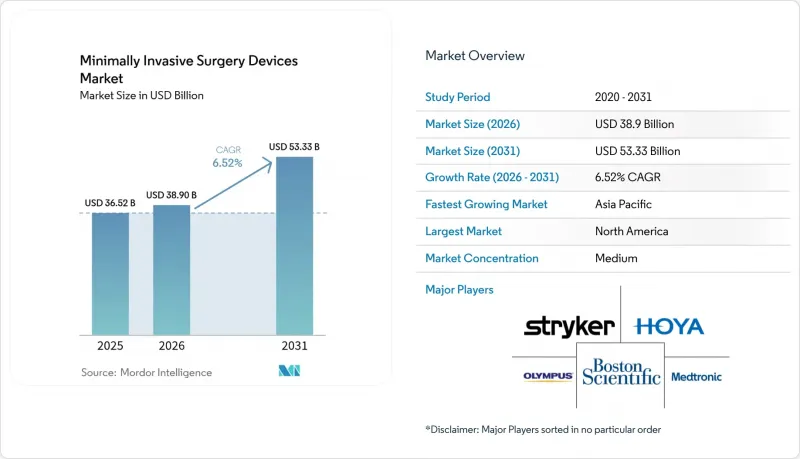
본 보고서는 제품 유형(핸드헬드 기구, 가이드 디바이스, 전기 수술 기구, 내시경 기구 등), 용도(미용, 심혈관, 소화기 등), 최종 사용자(병원 등), 지역(북미, 유럽, 아시아태평양, 중동 및 아프리카, 남미)별로 분류되어 있습니다. 시장 예측은 금액(달러) 기준으로 제시되어 있습니다.
전 세계 최소 침습 수술 기기 시장 동향 및 인사이트
개복 수술에 대한 MIS의 수용도 증가
저침습 치료를 원하는 환자들의 목소리가 커지고, MIS를 우선시하는 프로토콜을 정한 병원의 방침, 그리고 보험사의 인센티브가 MIS의 보급을 가속화하고 있습니다. 보스턴 사이언티피크(Boston Scientific)의 ‘FARAPULSE’ 펄스 필드 절제 시스템은 출시 후 12개월 만에 매출 10억 달러를 돌파하며, 치료 성과를 유지하면서도 시술의 복잡성을 줄여주는 기술에 대한 높은 수요를 입증하고 있습니다. 이러한 변화는 심장 리듬 관리 분야에서 가장 두드러지며, 펄스 필드 에너지는 열 치료에 비해 선택적인 조직 표적화가 가능하고 합병증 발생률도 낮다는 장점이 있습니다. 의료 기관에서는 병상 이용률 향상과 재입원율 감소가 나타나고 있으며, 이는 MIS를 우선시하는 경향을 더욱 공고히 하고 있습니다. 보험사들도 현재 저침습적 시술에 대해 유리한 보험 적용 조건을 일상적으로 제공하고 있어, 경제적 근거와 임상적 근거가 일치하고 있습니다. 연수 커리큘럼에서 MIS 역량이 핵심 기술로 자리 잡음에 따라, 최소 침습 수술 기기 시장은 장기적인 성장을 위한 견고한 기반을 다져가고 있습니다.
만성 질환 및 생활습관병 유병률 증가
당뇨병, 심혈관 질환, 비만의 전 세계 유병률 증가에 따라, 저침습적 치료법에 적합한 수술 건수가 증가하고 있습니다. 애보트(Abbott)사의 FDA 승인 제품인 ‘텐다인(Tendyne)’ 경카테터 승모판 치환술은 개흉 수술이 적합하지 않은 환자를 치료할 수 있게 하여, 구조적 심장 질환 중재술 분야에서 큰 틈새 시장을 개척하고 있습니다. 심방세동은 전 세계적으로 3,350만 명에게 영향을 미치고 있으며, 개흉 수술 없이 근치적 치료를 제공하는 카테터 절제술 시스템에 대한 지속적인 수요를 창출하고 있습니다. 싱글 포트 비만 치료술은 수술 후 통증을 완화하고 회복 기간을 단축함으로써, 체중 감량 수술의 대상 환자층을 확대되고 있습니다. 의료 시스템이 사후 대응형에서 예방 의료로 전환됨에 따라, 최소 침습 의료기기는 만성 질환의 부담을 경감시키는 비용 효율적인 도구로 자리매김하고 있습니다. 그 결과로 발생하는 시술 건수 증가는 최소 침습 수술 기기 시장의 점진적인 성장을 뒷받침하고 있습니다.
숙련된 최소 침습 수술(MIS) 외과의사 부족
고도의 로봇 수술이나 싱글포트 수술 기술을 습득하려면 지도자의 감독 하에 50-100건의 수술 경험이 필요하며, 이러한 장벽은 장비를 이용할 수 있는 지역이라 하더라도 도입을 가로막는 요인이 되고 있습니다. 신흥 시장에서는 고소득 지역으로의 외과 의사 유출로 인해 현지 의료 체계가 약화되면서 심각한 인력 부족이 발생하고 있습니다. 시뮬레이션 프로그램, 원격 지도, 증강현실(AR)을 통한 안내는 기술 격차를 완화할 수는 있지만, 완전히 해소할 수는 없습니다. 펠로우십 프로그램에 자금을 지원하는 정책 조치는 확대되고 있지만, 충분히 훈련된 전문의를 양성하기까지 걸리는 시간적 지연은 여전히 최소 침습 수술 장비 시장의 구조적인 걸림돌이 되고 있습니다.
부문 분석
핸드헬드 기기는 최소 침습 수술 기기 시장 규모에서 계속해서 가장 큰 점유율을 차지할 것으로 보이며, 2025년에는 매출의 37.65%를 차지할 전망입니다. 복강경 수술, 내시경 검사, 카테터를 이용한 시술 등 폭넓은 분야에서 널리 보급되어 있기 때문에 새로운 수술법이 등장하더라도 그 견조한 성장세는 유지될 것입니다. 한편, 로봇 보조 시스템은 절대값으로는 작지만, 병원이 복잡한 수술을 수행하기 위해 그 정밀도와 인체공학적 이점을 활용하고 있기 때문에 해당 카테고리에서 가장 빠른 연평균 성장률(CAGR) 9.12%를 나타낼 것으로 예측됩니다. 카테터나 가이드와이어와 같은 유도용 기기는 여전히 필수적이며, 꾸준한 점진적 성장을 이어가고 있습니다. 전기 수술 플랫폼은 혈관을 보다 확실하게 봉쇄하는 첨단 에너지원으로 전환되고 있으며, 절제 장치는 주변 조직에 대한 손상을 최소화하는 펄스 필드 기술로 전환되고 있습니다.
시장 진출기업들은 싱글 포트 로봇 수술에 투자를 집중하고 있으며, 이러한 시스템이 휴대용 기기에서 선호되는 멀티 포트 구성에 대한 의존도를 점차 낮출 것으로 전망됩니다. AI 연동형 4K 및 8K 영상 표시 기능으로의 업그레이드를 통해 기존 복강경이 혁신되어, 진단 정확도를 높이는 동시에 수명을 연장하고 있습니다. 절제용 레이저는 이비인후과 및 산부인과 수술에서 정밀한 조직 절제에 널리 보급되고 있어, 최소 침습 수술 기기 시장의 잠재적 규모를 확대되고 있습니다. 기술 사이클이 가속화되는 가운데, 제품 구성은 앞으로도 소프트웨어로 강화된 하드웨어 쪽으로 계속 기울어질 것이지만, 핵심이 되는 기계식 기구는 합리적인 가격과 익숙한 조작성 덕분에 여전히 중요한 위치를 차지할 것입니다.
지역별 분석
북미는 2025년에도 세계 매출의 42.00%를 차지했습니다. 이는 견실한 보험 환급, 충실한 연수 체계, 그리고 획기적인 의료기기 시장 출시 기간을 단축하는 신속한 규제 승인 절차가 뒷받침하고 있습니다. 통합이 진행되고 있는 의료 시스템은 조직 전체에 걸친 조달 계약을 체결하고 있으며, 주요 공급업체는 여러 주에 걸쳐 있는 병원 네트워크 전체에서 확장 가능한 접근성을 확보하고 있습니다. 고령화와 만성 질환의 높은 유병률은 수술 건수의 꾸준한 증가를 뒷받침하고 있으며, 한편 학술 기관이 선도적으로 개발한 신기술은 지역 의료 현장에 보급되고 있습니다.
아시아태평양은 가장 빠르게 성장하는 지역으로, 설비 용량 확대, 중산층 소득 증가, 그리고 정부의 의료 관광 추진에 힘입어 2031년까지 연평균 성장률(CAGR) 9.98%로 성장을 이어가고 있습니다. 중국은 국내 혁신을 촉진하는 동시에, 전 세계 의료기기 기업과 제휴하여 기술 이전을 촉진하고 있습니다. 인도의 비용 중심 시장에서는 가격대에 맞추어 서유럽 시스템을 개조하는 등 가성비가 뛰어난 플랫폼이 채택되고 있습니다. 일본은 외과 의사 부족 해소와 고령화 사회에 대응하기 위해 하이엔드 로봇 솔루션을 도입하고 있습니다. 한국은 최첨단 병원을 활용하여 성형 수술이나 척추 수술을 원하는 해외 환자를 유치하고 있습니다.
유럽의 엄격한 MDR(의료기기 규정) 체계는 제품의 고품질화를 촉진하는 한편, 승인 주기를 장기화시키고 탄탄한 임상 자료의 제출을 요구하고 있습니다. 독일은 여전히 제조의 거점이며, 영국의 NHS(국민보건서비스)는 근거 창출을 촉진하는 대규모 데이터 세트를 제공합니다. 중동 및 아프리카는 아직 발전 단계에 있지만, 특히 해외 의료 여행을 줄이려는 GCC 국가들을 중심으로 플래그십 3차 의료 기관에 대한 투자가 진행되고 있습니다. 라틴아메리카에서는 도입 현황에 편차가 보이지만, 브라질에서는 민관 협력을 통해 거시경제의 변동에도 불구하고 발전세가 유지되고 있습니다. 전반적으로 지역별 차이로 인해 공급업체는 규정 준수를 확보하면서 최소 침습 수술 기기 시장을 확대하기 위한 세심한 시장 진출 전략을 채택할 수밖에 없습니다.
기타 혜택:
- 엑셀 형식 시장 예측(ME) 시트
- 3개월간의 애널리스트 지원
자주 묻는 질문
목차
제1장 서론
제2장 조사 방법
제3장 주요 요약
제4장 시장 구도
제5장 시장 규모와 성장 예측
제6장 경쟁 구도
제7장 시장 기회와 향후 전망
LSH 26.08.25According to Mordor Intelligence, the minimally invasive surgery devices market size is expected to grow from USD 36.52 billion in 2025 to USD 38.9 billion in 2026 and is forecast to reach USD 53.33 billion by 2031 at 6.52% CAGR over 2026-2031.
This report is Segmented by Product Type (Handheld Instruments, Guiding Devices, Electrosurgical Devices, Endoscopic Devices, and More), Application (Aesthetic, Cardiovascular, Gastrointestinal, and More), End User (Hospitals, and More), and Geography (North America, Europe, Asia Pacific, Middle East & Africa, South America). The Market Forecasts are Provided in Terms of Value (USD).
Global Minimally Invasive Surgery Devices Market Trends and Insights
Higher Acceptance of MIS Over Open Surgery
Growing patient advocacy for less traumatic care, hospital mandates that prioritize MIS-first protocols, and payor incentives are accelerating adoption. Boston Scientific's FARAPULSE pulsed-field ablation system surpassed USD 1 billion in revenue within 12 months of launch, underscoring appetite for technologies that reduce procedural complexity while preserving outcomes. The shift is most pronounced in cardiac rhythm management, where pulsed-field energy offers selective tissue targeting and lower complication rates than thermal modalities. Institutions are seeing bed-utilization efficiencies and readmission reductions that further solidify MIS preference. Insurers now routinely provide favorable coverage terms for minimally invasive interventions, aligning economic and clinical rationales. As training curricula reposition MIS competencies as core skills, the minimally invasive surgery devices market gains a durable foundation for long-term growth.
Rising Prevalence of Chronic & Lifestyle Diseases
Global incidence of diabetes, cardiovascular disorders, and obesity is elevating surgical volumes suitable for less invasive solutions. Abbott's FDA-approved Tendyne transcatheter mitral valve replacement treats patients unfit for open surgery, opening a sizeable niche in structural heart interventions. Atrial fibrillation affects 33.5 million people worldwide, creating sustained demand for catheter-based ablation systems that offer definitive therapy without sternotomy. Single-port bariatric techniques are expanding eligibility for weight-loss surgery by lowering postoperative pain and improving recovery times. As healthcare systems pivot from reactive to preventive care, minimally invasive devices are positioned as cost-effective tools that curb chronic disease burdens. The resulting procedural growth underpins incremental gains in the minimally invasive surgery devices market.
Shortage of Skilled MIS Surgeons
Advanced robotic and single-port techniques require 50-100 supervised cases for proficiency, a hurdle that slows adoption even where hardware is available. Emerging markets experience pronounced shortages as surgeon migration toward higher-income regions erodes local capacity. Simulation programs, remote mentoring, and augmented reality guidance mitigate but do not eliminate skills gaps. Policy initiatives that fund fellowship programs are expanding, yet the time lag to produce fully trained specialists remains a structural brake on the minimally invasive surgery devices market.
Other drivers and restraints analyzed in the detailed report include:
- Rapid Adoption of Robotic-Assisted Platforms
- AI-Guided Visualization Improving Surgical Accuracy
- Capital-Intensive Robotic Systems
For complete list of drivers and restraints, kindly check the Table Of Contents.
Segment Analysis
Handheld instruments continued to command the largest portion of the minimally invasive surgery devices market size, generating 37.65% of revenue in 2025. Their ubiquity across laparoscopy, endoscopy, and catheter-based procedures ensures resilience even as new modalities arise. Conversely, robotic-assisted systems, though smaller in absolute value, are forecast to post a 9.12% CAGR, the swiftest in the category, as hospitals leverage their precision and ergonomic benefits to tackle complex surgeries. Guiding devices such as catheters and guidewires remain indispensable, providing steady incremental growth. Electrosurgical platforms are migrating to advanced energy sources that seal vessels more reliably, and ablation devices are shifting toward pulsed-field technologies that minimize collateral tissue damage.
Market entrants are funneling investment into single-port robotics, positioning these systems to erode dependence on multi-port configurations favored by handheld tools. AI-linked 4K and 8K visualization upgrades rejuvenate legacy laparoscopes, extending their lifespan while elevating diagnostic accuracy. Ablative lasers are finding traction in precise tissue removal for ENT and gynecologic procedures, expanding the addressable space of the minimally invasive surgery devices market. As technology cycles quicken, the product mix will continue to tilt toward software-enhanced hardware, yet core mechanical instruments will preserve relevance through affordability and familiarity.
Complete Report Scope:
- By Product Type
- Handheld Instruments
- Guiding Devices
- Guiding Catheters
- Guidewires
- Electrosurgical Devices
- Endoscopic Devices
- Laparoscopic Devices
- Monitoring & Visualization Devices
- Ablation Devices
- Laser-based Devices
- Robotic-assisted Surgical Systems
- Other MIS Devices
- By Application
- Aesthetic
- Cardiovascular
- Gastrointestinal
- Gynecological
- Orthopedic
- Urological
- Neurological
- Other Applications
- By End User
- Hospitals
- Ambulatory Surgical Centers
- Specialty Clinics
- By Geography
- North America
- United States
- Canada
- Mexico
- Europe
- Germany
- United Kingdom
- France
- Italy
- Spain
- Rest of Europe
- Asia Pacific
- China
- Japan
- India
- Australia
- South Korea
- Rest of Asia-Pacific
- Middle East & Africa
- GCC
- South Africa
- Rest of Middle East & Africa
- South America
- Brazil
- Argentina
- Rest of South America
- North America
Geography Analysis
North America maintained 42.00% of global revenue in 2025, underpinned by robust reimbursement, advanced training pipelines, and rapid regulatory pathways that shorten time-to-market for breakthrough devices. Consolidating health systems negotiate enterprise-wide procurement contracts, granting leading suppliers scalable access across multistate hospital networks. The aging demographic and high chronic-disease prevalence underpin steady procedural expansion, while academic centers pioneer novel techniques that diffuse into community settings.
Asia Pacific represents the fastest-growing territory, advancing at a 9.98% CAGR through 2031, fueled by capacity additions, rising middle-class incomes, and government promotion of medical tourism. China fosters domestic innovation while partnering with global device firms to spur technology transfer. India's cost-sensitive market turns to value-engineered platforms, often refurbishing Western systems to meet price points. Japan deploys premium robotic solutions to address surgeon shortages and accommodate an aging populace. Korea leverages state-of-the-art hospitals to attract international patients seeking aesthetic and spinal procedures.
Europe's stringent MDR framework fosters high product quality but lengthens approval cycles, requiring robust clinical dossiers. Germany remains a manufacturing stronghold, and the United Kingdom's NHS provides large-scale data sets that facilitate evidence generation. Middle East and Africa, though nascent, are investing in flagship tertiary centers, particularly in GCC nations that seek to reduce outbound medical travel. Latin America shows uneven adoption; Brazil's public-private mix sustains progress despite macroeconomic volatility. Collectively, regional heterogeneity compels suppliers to adopt nuanced entry strategies that safeguard compliance while scaling the minimally invasive surgery devices market.
- Abbott Laboratories
- Boston Scientific
- Intuitive Surgical
- Medtronic
- Johnson & Johnson
- Stryker
- Olympus
- Koninklijke Philips
- Zimmer Biomet
- HOYA
- Conmed
- Renishaw plc
- Smiths Group
- B. Braun
- Karl Storz
- Arthrex
- Teleflex
- Cook Group
- Becton Dickinson & Co.
- GE Healthcare Technologies Inc.
Additional Benefits:
- The market estimate (ME) sheet in Excel format
- 3 months of analyst support
TABLE OF CONTENTS
1 Introduction
- 1.1 Study Assumptions & Market Definition
- 1.2 Scope of the Study
2 Research Methodology
3 Executive Summary
4 Market Landscape
- 4.1 Market Overview
- 4.2 Market Drivers
- 4.2.1 Higher Acceptance of MIS Over Open Surgery
- 4.2.2 Rising Prevalence of Chronic & Lifestyle Diseases
- 4.2.3 Rapid Adoption of Robotic-Assisted Platforms
- 4.2.4 Reimbursement Tweaks Favouring Outpatient MIS
- 4.2.5 AI-Guided Visualization Improving Surgical Accuracy
- 4.2.6 Demand for Single-Port & Natural-Orifice Mis
- 4.3 Market Restraints
- 4.3.1 Shortage of Skilled MIS Surgeons
- 4.3.2 Capital-Intensive Robotic Systems
- 4.3.3 Supply-Chain Fragility for Key Disposables
- 4.3.4 Cyber-Security Risks in Connected OR Suites
- 4.4 Technological Outlook
- 4.5 Porter's Five Forces Analysis
- 4.5.1 Threat of New Entrants
- 4.5.2 Bargaining Power of Buyers
- 4.5.3 Bargaining Power of Suppliers
- 4.5.4 Threat of Substitutes
- 4.5.5 Intensity of Competitive Rivalry
5 Market Size & Growth Forecasts (Value in USD)
- 5.1 By Product Type
- 5.1.1 Handheld Instruments
- 5.1.2 Guiding Devices
- 5.1.2.1 Guiding Catheters
- 5.1.2.2 Guidewires
- 5.1.3 Electrosurgical Devices
- 5.1.4 Endoscopic Devices
- 5.1.5 Laparoscopic Devices
- 5.1.6 Monitoring & Visualization Devices
- 5.1.7 Ablation Devices
- 5.1.8 Laser-based Devices
- 5.1.9 Robotic-assisted Surgical Systems
- 5.1.10 Other MIS Devices
- 5.2 By Application
- 5.2.1 Aesthetic
- 5.2.2 Cardiovascular
- 5.2.3 Gastrointestinal
- 5.2.4 Gynecological
- 5.2.5 Orthopedic
- 5.2.6 Urological
- 5.2.7 Neurological
- 5.2.8 Other Applications
- 5.3 By End User
- 5.3.1 Hospitals
- 5.3.2 Ambulatory Surgical Centers
- 5.3.3 Specialty Clinics
- 5.4 By Geography
- 5.4.1 North America
- 5.4.1.1 United States
- 5.4.1.2 Canada
- 5.4.1.3 Mexico
- 5.4.2 Europe
- 5.4.2.1 Germany
- 5.4.2.2 United Kingdom
- 5.4.2.3 France
- 5.4.2.4 Italy
- 5.4.2.5 Spain
- 5.4.2.6 Rest of Europe
- 5.4.3 Asia Pacific
- 5.4.3.1 China
- 5.4.3.2 Japan
- 5.4.3.3 India
- 5.4.3.4 Australia
- 5.4.3.5 South Korea
- 5.4.3.6 Rest of Asia-Pacific
- 5.4.4 Middle East & Africa
- 5.4.4.1 GCC
- 5.4.4.2 South Africa
- 5.4.4.3 Rest of Middle East & Africa
- 5.4.5 South America
- 5.4.5.1 Brazil
- 5.4.5.2 Argentina
- 5.4.5.3 Rest of South America
- 5.4.1 North America
6 Competitive Landscape
- 6.1 Market Concentration
- 6.2 Market Share Analysis
- 6.3 Company Profiles (includes Global level Overview, Market level overview, Core Segments, Financials as available, Strategic Information, Market Rank/Share for key companies, Products & Services, and Recent Developments)
- 6.3.1 Abbott Laboratories
- 6.3.2 Boston Scientific Corporation
- 6.3.3 Intuitive Surgical Inc.
- 6.3.4 Medtronic
- 6.3.5 Johnson & Johnson (Ethicon)
- 6.3.6 Stryker Corporation
- 6.3.7 Olympus Corporation
- 6.3.8 Koninklijke Philips N.V.
- 6.3.9 Zimmer Biomet Holdings Inc.
- 6.3.10 HOYA Corporation
- 6.3.11 CONMED Corporation
- 6.3.12 Renishaw plc
- 6.3.13 Smith & Nephew plc
- 6.3.14 B. Braun Melsungen AG
- 6.3.15 Karl Storz SE & Co. KG
- 6.3.16 Arthrex Inc.
- 6.3.17 Teleflex Incorporated
- 6.3.18 Cook Medical LLC
- 6.3.19 Becton Dickinson & Co.
- 6.3.20 GE Healthcare Technologies Inc.
7 Market Opportunities & Future Outlook
- 7.1 White-space & Unmet-need Assessment


