
|
시장보고서
상품코드
2113583
ABS 수지 : 시장 점유율 분석, 업계 동향 및 통계, 성장 예측(2026-2031년)Acrylonitrile Butadiene Styrene (ABS) Resin - Market Share Analysis, Industry Trends & Statistics, Growth Forecasts (2026 - 2031) |
||||||
 Mordor Intelligence
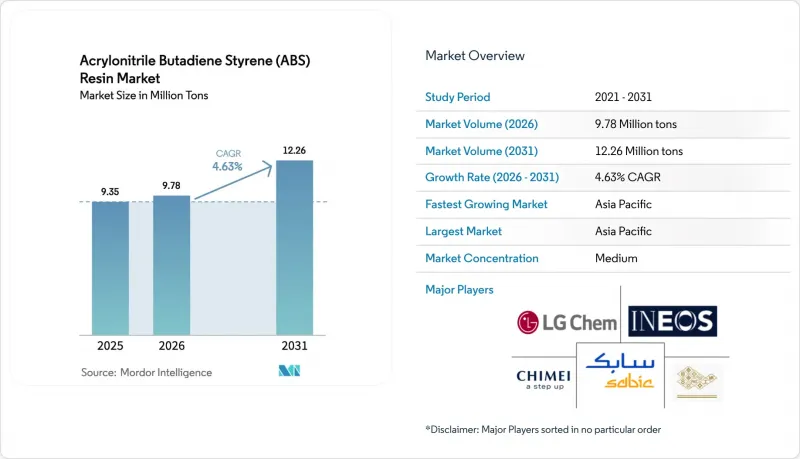
Mordor Intelligence에 의하면, ABS 수지 시장 규모는 2025년 935만 톤에서 2026년에는 978만 톤으로 확대되고, 2026-2031년 CAGR 4.63%로 성장을 지속하여 2031년에는 1,226만 톤에 이를 것으로 예측됩니다.
본 보고서는 가공 기술(사출 블로우 성형, 압출 블로우 성형 등), ABS 등급(범용, 고충격성 등), 최종 사용자 산업(자동차 및 운송, 전자 등), 지역(아시아태평양, 북미, 유럽 등)별로 분류되어 있습니다. 시장 예측은 수량(톤) 기준으로 제시되어 있습니다.
세계 ABS 수지 시장 동향 및 인사이트
e-모빌리티 플랫폼에서의 경량화 및 금속 대체
전기자동차 제조업체들은 배터리의 무게를 상쇄하고 주행 거리를 연장하기 위해 강철이나 알루미늄 대신 강화 ABS를 채택하고 있습니다. SABIC사가 2025년에 상용화한 장섬유 강화 ABS ‘ENLITE’는 UL 94 HB 난연성 기준을 충족하면서 배터리 트레이 커버의 무게를 25-30% 줄여줍니다. Trinseo사는 차량 1대당 18kg의 경량화를 실현하고, 1회 충전당 주행 거리를 약 2km 연장하는 도어 모듈을 공동 개발했습니다. 중국의 스타트업 기업들은 여전히 언더바디 실드에 폴리프로필렌을 선호하고 있지만, 유럽의 OEM 업체들은 표면 외관이 중요한 부분에는 ABS를 지정하고 있습니다. 미국 화학 산업 협회(ACC)에 따르면, 2023년 북미의 경차에 사용된 ABS 사용량은 24파운드이며, 이 수치는 배터리식 전기차 플랫폼의 보급에 따라 증가할 전망입니다. EU의 2027년 CO2 배출 목표에 따라 경량화 추세가 더욱 가속화되고 있으며, 자동차 제조업체들은 ISO 3795 연소 시험을 통과하는 난연 등급의 사전 인증을 추진하도록 촉구하고 있습니다.
고광택·내열 등급이 필요한 스마트 홈 가전
터치 조작이 가능한 냉장고, IoT 지원 세탁기, 인덕션 레인지에는 광택을 유지하고 내열성을 갖추며 정전기 방전으로부터 전자 기기를 보호하는 ABS 컴파운드가 필요합니다. LG전자의 2025년형 프리미엄 냉장고에는 휨 온도가 95°C를 초과하는 내열성 ABS가 채택되어, 남아시아의 여름철 운송 시에도 더 얇은 벽 두께와 더 큰 디스플레이를 구현하고 있습니다. 삼성은 표면 저항률이 101°Ω/sq 미만인 등급을 새롭게 발표했습니다. 이를 통해 Wi-Fi 모듈 주변의 정전기 방전을 최소화할 수 있습니다. 인도 에너지 효율국은 2026년에 가전제품의 에너지 라벨 기준을 상향 조정할 예정이며, 월풀은 2023년부터 탑로딩 세탁기의 ABS 함유율을 재료비의 8%에서 12%로 높였습니다. 무할로겐 난연제는 컴파운드 비용을 3-5% 증가시키지만, RoHS 및 REACH의 수출 요건을 충족합니다.
변동이 심한 아크릴로니트릴 원료 가격
아크릴로니트릴은 ABS 비용의 35-40%를 차지하고 있으며, 2024년 동북아시아 현물 가격이 25% 하락함에 따라 유럽과 미국의 비통합형 생산 업체들의 이익률이 크게 압박받았습니다. 독일과 텍사스의 생산 시설에서는 톤당 150-200달러의 이익률 압박을 받아 2025년 3분기에 생산 라인을 중단했습니다. 프로파일렌 가격의 변동이 문제를 더욱 심각하게 만들고 있습니다. 2025년 초, 정유시설의 가동 중단으로 인해 미국 멕시코만 연안 지역의 계약 가격은 18% 급등했으나, 아시아의 나프타 크래커가 다시 풀가동으로 돌아오자 가격은 다시 하락했습니다. 자동차 업계의 1차 공급업체들은 수지 가격의 분기별 재검토를 점점 더 강력히 요구하고 있어, 위험이 업스트림로 전가되고 있습니다. INEOS나 포모사 플라스틱과 같은 수직 통합형 기업들은 톤당 100-120달러의 우위를 누리고 있어, 시장 침체를 극복할 수 있습니다. 국제에너지기구(IEA)는 2027년까지 원유 가격이 대체로 안정될 것으로 전망하고 있으나, 중동의 프로판 공급을 불확실성 요인으로 지적하고 있습니다.
부문별 분석
2025년,ABS 수지 시장에서 사출 블로우 성형은 48.21%의 점유율을 차지하고 있으며, 가전, 자동차, 전자기기 제조업체들이 짧은 사이클 타임을 선호함에 따라 2031년까지 연평균 성장률(CAGR) 5.2%를 유지할 것으로 예측됩니다. ENGEL사가 2025년에 출시한 인몰드 라벨링 기능을 갖춘 서보 유압식 성형기는 유럽의 전력 가격 급등 속에서도 개당 에너지 소비량을 18% 절감했습니다. 압출 블로우 성형은 대형 부품 시장에서 회전 성형과의 경쟁으로 인해 완만한 성장에 그치고 있습니다. 사출 신장 블로우 성형은 주로 화장품 및 의약품 병에 사용되지만, EU와 인도의 일회용 플라스틱 금지 조치의 영향을 받고 있습니다.
Haitian이나 Borch와 같은 중국 기계 제조업체들은 2024년에 유럽의 경쟁사보다 25-30% 저렴한 가격의 전전기식 사출 블로우 성형 시스템을 출시하여, 아세안 및 남아시아 전역에서의 보급을 가속화하고 있습니다. BMW의 2025년형 전기 SUV ‘iX’는 배터리 열 관리를 위해 사출 블로우 성형된 ABS 덕트를 채택하여 이 기술의 범용성을 부각시키고 있습니다. ABS 표층 사이에 재생 폴리프로필렌을 끼워 넣는 ‘공동 사출 블로우 성형’은 EU의 에코디자인에 따른 재생 소재 함유율 규정을 충족하기 위해 보쉬(Bosch)사에 의해 시범 도입되고 있습니다. ISO 16012에 기반한 검증 기법이 보급되고 있으며, Tier 1 공급업체들은 공차 기준의 엄격화가 사출 블로우 성형을 유리하게 만드는 요인 중 하나라고 지적하고 있습니다.
지역별 분석
아시아태평양은 2025년에 총 생산량의 76.12%를 차지할 것이며, 2031년까지 연평균 성장률(CAGR) 5.23%로 성장할 전망입니다. 이는 INEOS-Sinopec 닝보 및 절강 석화 저우산과 같은 거대 통합 단지가 원료 물류 비용을 톤당 80-100달러 절감하고, 아크릴로니트릴 가격 변동을 완화하고 있는 점이 뒷받침되고 있습니다. 인도에서는 가전제품 생산의 급증에 따라 수요가 대폭 증가하고 있으며, 에너지 효율국(Bureau of Energy Efficiency)의 2026년 기준 라벨이 내열성 ABS의 채택을 뒷받침하고 있습니다. 아세안(ASEAN) 지역에서는 PTT 세계 케미칼과 찬드라 아슬리가 이전한 가전 생산 라인을 위해 생산 능력을 확대함에 따라 성장이 가속화되고 있습니다.
북미 시장의 성장은 자동차 생산 대수가 정체된 것과 내장 부품에서 TPO로의 대체 현상에 영향을 받고 있습니다. SABIC의 텍사스 공장은 데이터센터용 랙에 사용되는 난연성 등급 제품을 공급하고 있으며, 한편 멕시코산 크롬 도금 트림의 재수출로 인해 USMCA에 따른 크롬 규제가 다가오는 상황에서도 전기도금용 ABS 시장은 견조한 모습을 보이고 있습니다.
유럽 시장은 VOC 규제 및 탄소 국경 조정 조치의 강화로 중소 성형 제조업체의 비용 상승을 초래하고 있지만, 여전히 성장을 이어가고 있습니다. 독일의 각 OEM 업체들은 PC-ABS 블렌드로의 전환을 추진하고 있으며, 코베스트로의 ‘베이블렌드’는 폭스바겐 및 BMW의 2025년형 대시보드에 채택되었습니다. 남미의 ABS 수요는 브라질의 자동차 및 가전 부문이 주도하고 있지만, 환율 변동으로 인해 유니겔의 이익률은 압박을 받고 있습니다. 중동 및 아프리카의 ABS 수요는 SABIC의 주바이르 공장의 저비용 생산과 사우디아라비아의 하류 산업 다각화에 힘입어 지탱되고 있습니다.
기타 혜택:
- 엑셀 형식 시장 예측(ME) 시트
- 3개월간의 애널리스트 지원
자주 묻는 질문
목차
제1장 서론
제2장 조사 방법
제3장 주요 요약
제4장 시장 구도
제5장 시장 규모와 성장 예측
제6장 경쟁 구도
제7장 시장 기회와 향후 전망
LSH 26.08.25According to Mordor Intelligence, the acrylonitrile butadiene styrene resin market size is expected to grow from 9.35 Million tons in 2025 to 9.78 Million tons in 2026 and is forecast to reach 12.26 Million tons by 2031 at 4.63% CAGR over 2026-2031.
This report is Segmented by Processing Technology (Injection Blow Molding, Extrusion Blow Molding, and More), ABS Grade (General-Purpose, High-Impact, and More), End-User Industry (Automotive and Transportation, Electronics, and More), and Geography (Asia-Pacific, North America, Europe, and More). The Market Forecasts are Provided in Terms of Volume (Tons).
Global Acrylonitrile Butadiene Styrene (ABS) Resin Market Trends and Insights
Lightweighting and Metal Replacement in E-Mobility Platforms
Electric-vehicle makers are swapping steel and aluminum for reinforced ABS to offset battery mass and extend range. SABIC's ENLITE long-glass-fiber ABS, commercialized in 2025, trims 25-30% weight from battery-tray covers while meeting UL 94 HB flammability limits. Trinseo co-developed door modules that remove 18 kg per vehicle and add roughly 2 km of driving range per charge. Chinese start-ups still favor polypropylene in under-body shields, but European OEMs specify ABS where surface appearance matters. The American Chemistry Council puts ABS use in North American light vehicles at 24 lb in 2023, a figure set to rise with battery-electric platforms. EU 2027 CO2 targets tighten the push toward lightweighting, nudging automakers to pre-qualify flame-retardant grades that pass ISO 3795 burn tests.
Smart-Home Appliances Requiring High-Gloss Heat-Resistant Grades
Touch-enabled refrigerators, IoT washing machines, and inductive cooktops need ABS compounds that stay glossy, resist heat, and shield electronics from static discharge. LG Electronics' 2025 premium refrigerators use heat-resistant ABS with a deflection temperature above 95 °C, allowing thinner walls and larger displays during South Asian summer transport. Samsung debuted a grade whose surface resistivity under 101° Ω/sq minimizes electrostatic discharge around Wi-Fi modules. India's Bureau of Energy Efficiency raises appliance energy-label hurdles in 2026, and Whirlpool has lifted ABS content in its top-load washers from 8% to 12% of material cost since 2023. Halogen-free flame retardants add 3-5% to compounding cost but satisfy RoHS and REACH export requirements.
Volatile Acrylonitrile Feedstock Prices
Acrylonitrile makes up 35-40% of ABS cost, and a 25% drop in Northeast Asian spot prices during 2024 slashed margins for non-integrated producers in Europe and the United States. German and Texan facilities idled lines in Q3 2025 after margin compression of USD 150-200 per ton. Propylene volatility compounds the issue: U.S. Gulf Coast contracts spiked 18% in early 2025 after refinery outages, only to retreat once Asian naphtha crackers ramped. Automotive Tier 1 suppliers increasingly insist on quarterly resin price resets, pushing risk back upstream. Vertically integrated players such as INEOS and Formosa Plastics enjoy a USD 100-120 per ton advantage and can weather downdrafts. The International Energy Agency expects broadly stable crude through 2027 but flags Middle East propane supply as a wild card.
Other drivers and restraints analyzed in the detailed report include:
- Asia-Pacific Capacity Expansions and Down-Stream Integration
- Demand for Electroplatable ABS in 5G mmWave Radomes
- Substitution by Bio-Based/Compostable Polymers in Electronics
For complete list of drivers and restraints, kindly check the Table Of Contents.
Segment Analysis
Injection blow molding held a 48.21% share of the acrylonitrile butadiene styrene (ABS) resin market size in 2025 and is forecast to secure a 5.2% CAGR through 2031 as appliance, auto, and electronics producers favor its short cycle times. ENGEL's 2025 servo-hydraulic machine with in-mold labeling cut per-part energy use 18% amid surging European electricity prices. Extrusion blow molding is growing slowly as rotational molding competes for large-format parts. Injection stretch blow molding is used mainly for cosmetic and pharma bottles and faces single-use plastics bans in the EU and India.
Chinese machinery makers such as Haitian and Borch rolled out all-electric injection-blow systems priced 25-30% below European rivals in 2024, accelerating uptake across ASEAN and South Asia. BMW's 2025 iX electric SUV uses injection-blow-molded ABS ducts for battery thermal control, underscoring the technology's versatility. Co-injection blow molding that sandwiches recycled polypropylene between ABS skins is being piloted by Bosch to hit EU Ecodesign recycled-content rules. ISO 16012 validation practices are spreading, and tier-one suppliers cite tighter tolerances as a factor favoring injection blow molding.
Complete Report Scope:
- By Processing Technology
- Injection Blow Molding
- Extrusion Blow Molding
- Injection Stretch Blow Molding
- By ABS Grade
- General-Purpose
- High-Impact
- Electro-plating
- Flame-Retardant
- Heat-Resistant
- By End-user Industry
- Automotive and Transportation
- Electronics
- Consumer Goods and Appliances
- Construction
- Other End-user Industries
- By Geography
- Asia-Pacific
- China
- India
- Japan
- South Korea
- Thailand
- Vietnam
- Malaysia
- Indonesia
- Rest of Asia-Pacific
- North America
- United States
- Canada
- Mexico
- Europe
- Germany
- United Kingdom
- France
- Italy
- Spain
- Russia
- Turkey
- Nordics
- Rest of Europe
- South America
- Brazil
- Argentina
- Colombia
- Rest of South America
- Middle East and Africa
- Saudi Arabia
- United Arab Emirates
- Qatar
- Egypt
- South Africa
- Nigeria
- Rest of Middle East and Africa
- Asia-Pacific
Geography Analysis
Asia-Pacific captured 76.12% of volume in 2025 and will grow at 5.23% CAGR through 2031, anchored by mega-integrated complexes such as INEOS-Sinopec Ningbo and Zhejiang Petrochemical Zhoushan that slice USD 80-100 per ton in feedstock logistics and blunt acrylonitrile gyrations. India's demand rises significantly on surging appliance output, with Bureau of Energy Efficiency 2026 labels nudging heat-resistant ABS adoption. ASEAN growth accelerates as PTT Global Chemical and Chandra Asri add capacity serving relocated appliance lines.
North America market growth is influenced by flat auto builds and TPO substitution in interiors. SABIC's Texas plant supplies flame-retardant grades for data-center racks, while Mexico's re-export of chrome-plated trim keeps electroplating ABS afloat despite looming USMCA chromium limits.
Europe's market is growing under tightening VOC and carbon-border rules that elevate costs for smaller molders. German OEMs shift to PC-ABS blends, and Covestro's Bayblend won 2025 dashboards at Volkswagen and BMW. Brazil's auto and appliance sectors lead South America ABS demand, though exchange-rate swings squeeze Unigel's margins. The Middle East and Africa's ABS demand is backed by SABIC's low-cost Jubail output and Saudi downstream diversification.
- BEPL
- CHIMEI
- ELIX POLYMERS
- Eni S.p.A.
- Formosa Plastics Group
- INEOS
- JSR Corporation
- KUMHO PETROCHEMICAL
- LG Chem
- LOTTE Chemical Corporation
- NIPPON A&L INC.
- PetroChina Company Limited
- SABIC
- Shandong INEOS-YPC
- Techno-UMG Co., Ltd.
- TORAY INDUSTRIES, INC.
- TotalEnergies
- Trinseo
Additional Benefits:
- The market estimate (ME) sheet in Excel format
- 3 months of analyst support
TABLE OF CONTENTS
1 Introduction
- 1.1 Study Assumptions and Market Definition
- 1.2 Scope of the Study
2 Research Methodology
3 Executive Summary
4 Market Landscape
- 4.1 Market Drivers
- 4.1.1 Lightweighting and Metal-Replacement in E-Mobility Platforms
- 4.1.2 Smart-Home Appliances Requiring High-Gloss Heat-Resistant Grades
- 4.1.3 Asia-Pacific Capacity Expansions and Down-Stream Integration
- 4.1.4 Demand for Electroplatable ABS in 5G mmWave Radomes
- 4.1.5 Halogen-Free Flame-Retardant Cockpit Components for Regional Jets
- 4.2 Market Restraints
- 4.2.1 Volatile Acrylonitrile Feedstock Prices
- 4.2.2 Substitution by Bio-Based/Compostable Polymers in Electronics
- 4.2.3 Stringent Nordic VOC Limits on ABS Processing Plants
- 4.3 Value Chain Analysis
- 4.4 Pricing Trends
- 4.5 Regulatory Outlook
- 4.6 Porter's Five Forces
- 4.6.1 Bargaining Power of Suppliers
- 4.6.2 Bargaining Power of Buyers
- 4.6.3 Threat of New Entrants
- 4.6.4 Threat of Substitutes
- 4.6.5 Degree of Competition
5 Market Size and Growth Forecasts (Volume)
- 5.1 By Processing Technology
- 5.1.1 Injection Blow Molding
- 5.1.2 Extrusion Blow Molding
- 5.1.3 Injection Stretch Blow Molding
- 5.2 By ABS Grade
- 5.2.1 General-Purpose
- 5.2.2 High-Impact
- 5.2.3 Electro-plating
- 5.2.4 Flame-Retardant
- 5.2.5 Heat-Resistant
- 5.3 By End-user Industry
- 5.3.1 Automotive and Transportation
- 5.3.2 Electronics
- 5.3.3 Consumer Goods and Appliances
- 5.3.4 Construction
- 5.3.5 Other End-user Industries
- 5.4 By Geography
- 5.4.1 Asia-Pacific
- 5.4.1.1 China
- 5.4.1.2 India
- 5.4.1.3 Japan
- 5.4.1.4 South Korea
- 5.4.1.5 Thailand
- 5.4.1.6 Vietnam
- 5.4.1.7 Malaysia
- 5.4.1.8 Indonesia
- 5.4.1.9 Rest of Asia-Pacific
- 5.4.2 North America
- 5.4.2.1 United States
- 5.4.2.2 Canada
- 5.4.2.3 Mexico
- 5.4.3 Europe
- 5.4.3.1 Germany
- 5.4.3.2 United Kingdom
- 5.4.3.3 France
- 5.4.3.4 Italy
- 5.4.3.5 Spain
- 5.4.3.6 Russia
- 5.4.3.7 Turkey
- 5.4.3.8 Nordics
- 5.4.3.9 Rest of Europe
- 5.4.4 South America
- 5.4.4.1 Brazil
- 5.4.4.2 Argentina
- 5.4.4.3 Colombia
- 5.4.4.4 Rest of South America
- 5.4.5 Middle East and Africa
- 5.4.5.1 Saudi Arabia
- 5.4.5.2 United Arab Emirates
- 5.4.5.3 Qatar
- 5.4.5.4 Egypt
- 5.4.5.5 South Africa
- 5.4.5.6 Nigeria
- 5.4.5.7 Rest of Middle East and Africa
- 5.4.1 Asia-Pacific
6 Competitive Landscape
- 6.1 Market Concentration
- 6.2 Strategic Moves
- 6.3 Market Share Analysis
- 6.4 Company Profiles (includes Global-level Overview, Market-level Overview, Core Segments, Financials, Strategic Info, Products and Services, Recent Developments)
- 6.4.1 BEPL
- 6.4.2 CHIMEI
- 6.4.3 ELIX POLYMERS
- 6.4.4 Eni S.p.A.
- 6.4.5 Formosa Plastics Group
- 6.4.6 INEOS
- 6.4.7 JSR Corporation
- 6.4.8 KUMHO PETROCHEMICAL
- 6.4.9 LG Chem
- 6.4.10 LOTTE Chemical Corporation
- 6.4.11 NIPPON A&L INC.
- 6.4.12 PetroChina Company Limited
- 6.4.13 SABIC
- 6.4.14 Shandong INEOS-YPC
- 6.4.15 Techno-UMG Co., Ltd.
- 6.4.16 TORAY INDUSTRIES, INC.
- 6.4.17 TotalEnergies
- 6.4.18 Trinseo
7 Market Opportunities and Future Outlook
- 7.1 White-Space and Unmet-Need Assessment
- 7.2 Growing usage of PC-ABS Resin in Industrial Applications