|
시장보고서
상품코드
2113648
휴대용 의료 전자기기 : 시장 점유율 분석, 업계 동향 및 통계, 성장 예측(2026-2031년)Portable Medical Electronic Products - Market Share Analysis, Industry Trends & Statistics, Growth Forecasts (2026 - 2031) |
||||||
 Mordor Intelligence
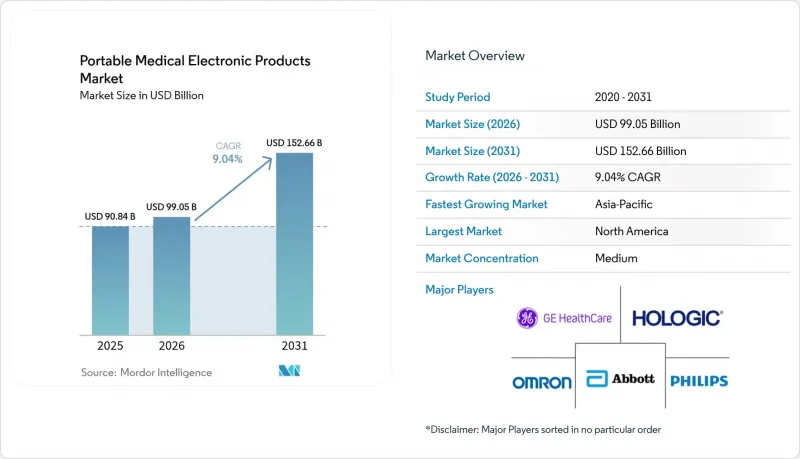
Mordor Intelligence에 의하면, 휴대용 의료 전자기기 시장 규모는 2025년에 908억 4,000만 달러, 2026년 990억 5,000만 달러에서 2031년까지 1,526억 6,000만 달러에 이를 것으로 예측되며, 예측 기간(2026년-2031년) CAGR은 9.04%를 기록할 전망입니다.
본 보고서는 제품 유형(진단용 영상 시스템 등), 구성 부품(센서, 배터리·전원 모듈 등), 휴대성 유형(핸드헬드형 등), 최종 사용자(병원, 진료소·클리닉 등), 지역(북미, 유럽, 아시아태평양 등)별로 세분화되어 있습니다. 시장 예측은 금액(달러) 기준으로 제시되어 있습니다.
전 세계 휴대용 의료 전자 제품 시장 동향 및 인사이트
가정 내 만성 질환 모니터링에 대한 수요 증가
의료 시스템에서는 예방 가능한 재입원 및 정기적인 내원을 줄이기 위해 커넥티드 모니터 도입이 진행되고 있습니다. 메디케어·메디케이드 서비스 센터(CMS)는 2024년에 원격 환자 모니터링에 대한 보상 범위를 확대하여, 지불 기관의 재택 기술에 대한 지지를 나타냈습니다. 주요 의료 제공업체의 데이터에 따르면, 모니터링 대상 환자가 매일 측정값을 전송함으로써 응급실 이용이 15-20% 감소했습니다. 현재 원격 모니터링 등록자의 대부분은 당뇨병, 심혈관 질환, 만성 폐쇄성 폐질환(COPD) 환자가 차지하고 있으며, 이는 휴대용 의료 전자 제품 시장에 있어 확장 가능한 타겟층을 형성하고 있습니다. 임상 결과가 안정적으로 나타나면서 보험사들은 보장 범위를 확대되고 있습니다. 기기 제조업체들은 1차 진료 분야의 인력 부족을 극복하기 위해 하드웨어, 클라우드 분석, 임상 지도를 결합한 턴키 방식의 서비스 패키지를 제공함으로써 이에 대응하고 있습니다.
웨어러블 건강·피트니스 전자기기의 급속한 보급
스마트 워치와 피트니스 밴드에 대한 소비자의 친숙함이 의료용 웨어러블 기기의 학습 곡선을 단축시키고, 규제 대상 적응증으로의 확장을 가능하게 하고 있습니다. 출하 대수 면에서는 북미가 선두를 차지하고 있지만, 아시아태평양에서는 지역 스마트폰 브랜드들이 SpO2 및 ECG 기능을 대중용 기기에 탑재함에 따라 2024년에는 성장률 측면에서 유럽을 추월했습니다. 스포츠 과학 분야의 지지가 조기 보급을 뒷받침하는 한편, 보험사들은 검증된 활동 데이터에 대한 보험료 할인 시범 도입을 추진하고 있습니다. 블루투스와 원격 의료의 원활한 통합을 통해 웨어러블 기기는 AI 알고리즘에 데이터를 공급하는 지속적인 데이터 스트림의 진입점으로 자리매김했으며, 이를 통해 휴대용 의료 전자 제품 시장의 가치 제안이 더욱 높아지고 있습니다. 규제 당국은 현재 ISO/IEC 표준 60601-1-11을 참조하여 신체 착용형 센서의 승인 절차를 효율화하고 있으며, 평균 심사 기간을 15% 단축하고 있습니다.
사이버 보안 및 환자 데이터 개인정보 보호에 대한 책임
FDA의 2024년 사이버 보안 지침에 따르면, 제조업체는 설계 단계부터 시판 후 지원에 이르기까지 위협 완화 프로토콜을 의무적으로 포함해야 합니다. EU의 GDPR(EU 개인정보보호규정)에 따라 위반 시 연간 매출액의 4%에 달하는 벌금이 부과됨에 따라, 조달 팀은 구매 전에 침투 테스트 증빙 자료를 요구하고 있습니다. 병원 측은 제로 트러스트 아키텍처가 도입되지 않은 한, 새로운 의료기기를 전자의무기록의 핵심 시스템에 연결하는 것을 주저하고 있습니다. 각 벤더사는 하드웨어의 ‘루트 오브 트러스트(Root of Trust)’ 및 무선 패치 적용(OTA 패치)에 투자하고 있으며, 그 결과 부품 원가가 상승하여 휴대용 의료 전자기기 시장의 가격 책정에 영향을 미치고 있습니다. 2025년에는 사이버 보험료가 전년 대비 15% 상승했는데, 이는 네트워크 연결형 주입 펌프 및 심전도 모니터에 대한 공격 빈도가 증가하고 있음을 반영합니다.
부문 분석
모니터링 기기는 가장 큰 수익을 창출하여, 2025년에는 휴대용 의료 전자 제품 시장에서 45.02%의 점유율을 차지했습니다. 성숙한 임상 검증과 보험 환급 지원이 병원 및 재택치료 기관에서 이를 우선적으로 조달하는 배경이 되고 있습니다. 모바일 의료 앱 및 소프트웨어는 기여도는 작지만, 스마트폰이 FDA 승인 진단 도구로 변모함에 따라 13.72%라는 가장 높은 연평균 성장률(CAGR)을 보이고 있습니다. 이러한 급속한 성장은 소프트웨어가 기존의 카메라, 마이크, 관성 센서를 활용함으로써 환자 참여 방식을 재정의하고 있기 때문입니다. 진단용 영상 시스템은 특히 응급 트리아지용 휴대용 초음파 장치 분야에서 전문적인 보급률을 유지하고 있습니다. 전기 신경 자극 장치 등의 치료용 기기는 가치 기반 의료(Value-Based Care)의 인센티브에 힘입어 꾸준한 성장을 이루고 있습니다. 휴대용 의료 전자 제품 시장은 하드웨어와 소프트웨어를 융합한 솔루션의 혜택을 받고 있으며, 그 대표적인 예가 Withings사의 ‘BeamO’입니다. 이 제품의 4-in-1 생체 신호 측정 기능은 가정에서의 예방적 건강 검진을 촉진하고 있습니다.
소프트웨어의 확장성이 뛰어난 경제성은 전 세계적인 보급을 가속화하고 있습니다. 규제 관련 서류가 갖춰지면 추가 유통 비용은 제로에 가까워지는 추세를 보이며, 프리미엄 분석 서비스 구독과 연계된 프리미엄 모델이 유리해집니다. 기존 의료기기 제조업체들은 클라우드 대시보드와 AI 기반 분류 권고 기능을 탑재하여 대응하고 있으며, 앱을 주축으로 하는 경쟁사들과의 격차를 좁혀가고 있습니다. 의료 제공업체들이 혈당 센서, 혈압계, 체중계에서 수집된 데이터를 통합한 통합 뷰를 요구하는 가운데, 크로스 플랫폼 간의 상호 운용성이 차별화 요인으로 부상하고 있습니다. 그 결과, 휴대용 의료 전자 제품 시장에서 애플리케이션 프로그래밍 인터페이스(API)를 통한 라이선싱 수익은 하드웨어 이익률보다 빠른 속도로 성장하고 있습니다.
2025년 휴대용 의료 전자 제품 시장의 구성 요소별 매출 점유율에서 센서는 35.08%로 1위를 유지했으나, 프로세서 및 전용 AI 칩은 15.12%라는 눈부신 연평균 성장률(CAGR)을 기록하고 있습니다. 이러한 성장세는 병상에서의 부정맥 감지나 패혈증 예측과 같은 실시간 추론 워크로드에 기인합니다. 반도체 공급업체들은 전원 관리 기능을 통합한 신경 처리 유닛을 번들로 제공함으로써 기판의 부품 수를 줄이고 시스템 비용을 절감하고 있습니다. 통신 모듈은 5G 및 Wi-Fi 6의 도입으로 혜택을 보고 있으며, 유선 연결 없이도 고해상도 이미지 전송을 가능하게 하고 있습니다. 디스플레이는 햅틱 피드백 기능을 갖춘 AMOLED 터치스크린으로 전환되고 있어, 기술적 지식이 없는 간병인이라도 조작법을 쉽게 익힐 수 있게 되었습니다.
엣지 처리를 통해 기존에 클라우드에서 호스팅되던 분석 처리가 이전됨에 따라 지연 시간이 대폭 단축될 뿐만 아니라, 데이터 주권에 관한 법규 준수 또한 용이해집니다. 병원 측은 네트워크 장애 시에도 중단 없이 지속되는 On-Premise 의사 결정을 중시하는 반면, 재택 사용자는 즉시 활용할 수 있는 인사이트력을 높이 평가했습니다. 프로세서 업그레이드로 인해 기기의 평균 수명이 4년으로 단축되는 교체 주기가 촉진되어, 정기적인 수익 기회가 확대되고 있습니다. 의료가 예측 의료로 전환됨에 따라 알고리즘의 복잡성이 증가하여 연산 수요가 높아지고 있으며, 휴대용 의료 전자 제품 시장 전반에 걸쳐 프로세서 로드맵에 대한 지속적인 투자가 보장되고 있습니다.
지역별 분석
북미는 견고한 보험 지급 제도와 활기찬 혁신 생태계의 뒷받침을 받아 2025년에는 전 세계 매출의 37.98%를 차지하며 계속해서 주도적인 위치를 유지했습니다. 클라우드 하이퍼스케일러와 기기 제조업체 간의 협력을 통해 AI 도입이 가속화되는 한편, 국내 반도체 산업에 대한 우대 조치가 공급 위험 노출을 완화하고 있습니다. 캐나다의 단일 지불자 모델은 만성 질환 환자층을 대상으로 한 생체 신호 모니터에 대해 예측 가능한 조달 물량을 창출하고 있습니다. 멕시코는 제조 거점인 동시에 신흥 고객 기반으로도 기능하고 있으며, 물류 리드타임을 단축하기 위해 미국 국경 인근에 전자기기 수탁 제조업체를 유치하고 있습니다. 그 결과, 휴대용 의료 전자제품 시장은 대륙 전체에 걸친 수직 통합형 밸류체인의 혜택을 누리고 있습니다.
아시아태평양은 인구 동향의 변화, 가처분 소득 증가, 정부의 경기 부양책이 맞물려 2031년까지 11.24%라는 가장 높은 연평균 성장률(CAGR)을 나타낼 전망입니다. 중국의 규제 개혁으로 인해 클래스 II 제품의 승인 절차가 간소화되어, 국제적인 브랜드들이 현지 생산을 진행하도록 장려되고 있습니다. 일본의 초고령 사회에서는 간병인 부족을 보완하기 위해 원격 모니터링이 도입되고 있으며, 국내 혁신 기업들이 AI 탑재 재택 로봇의 시범 운영을 추진하고 있습니다. 인도에서는 지방 진료소를 대상으로 비용 대비 효과가 높은 진단 기술을 우선시하고 있어, 기존 네트워크를 활용한 스마트폰 연동형 하드웨어가 선호되고 있습니다. 한국에서는 전국적인 5G 커버리지 덕분에 구급차 이송 중에도 저지연 원격 심전도(ECG)가 가능해졌습니다. 이러한 다양한 시장 성장 촉진요인에는 상황에 맞는 시장 진출 전략이 요구되지만, 종합적으로는 휴대용 의료 전자 제품 시장의 출하량 전망을 더욱 견고하게 만들고 있습니다.
유럽에서는 MDR(의료기기 규정) 준수, 디지털 헬스 분야에 대한 막대한 자금 지원, 국경을 초월한 원격의료 추진을 배경으로 꾸준한 확대가 나타나고 있습니다. 독일의 제조 역량을 바탕으로 센서 모듈의 지역 공급이 뒷받침되고 있는 반면, 프랑스에서는 혈압 측정용 웨어러블 기기의 보험 적용을 포함한 예방 의료에 공공 투자가 집중되고 있습니다. 영국은 규제 측면에서의 자율성을 활용하여, AI 진단 기술 시장 출시를 가속화하는 조건부 승인 제도를 도입하고 있습니다. 예산 제약에 직면한 남유럽 국가들에서는 초기 비용을 최소화하기 위해 ‘디바이스 애즈 어 서비스(DaaS)’ 모델을 채택하고 있습니다. GDPR(EU 개인정보보호규정)의 시행은 사이버 보안 모범 사례를 정립하고, 유럽공급업체들이 개인정보 보호 중심 설계를 전 세계로 수출할 수 있는 입지를 다지고 있습니다. 이는 결과적으로 휴대용 의료 전자기기 시장에 대한 신뢰를 높이는 데 기여하고 있습니다.
기타 혜택:
- 엑셀 형식 시장 예측(ME) 시트
- 3개월간의 애널리스트 지원
자주 묻는 질문
목차
제1장 서론
제2장 조사 방법
제3장 주요 요약
제4장 시장 구도
제5장 시장 규모와 성장 예측
제6장 경쟁 구도
제7장 시장 기회와 향후 전망
LSH 26.08.25According to Mordor Intelligence, the portable medical electronic products market size was valued at USD 90.84 billion in 2025 and estimated to grow from USD 99.05 billion in 2026 to reach USD 152.66 billion by 2031, at a CAGR of 9.04% during the forecast period (2026-2031).
This report is Segmented by Product Type (Diagnostic Imaging Systems, and More], and More), Component (Sensors, Batteries & Power Modules, and More), Portability Type (Hand-Held, and More), End User (Hospitals, Physician Offices & Clinics, and More), and Geography (North America, Europe, Asia-Pacific and More). The Market Forecasts are Provided in Terms of Value (USD).
Global Portable Medical Electronic Products Market Trends and Insights
Escalating Demand for Home-Based Chronic-Disease Monitoring
Health systems are deploying connected monitors to cut preventable readmissions and routine clinic visits. The Centers for Medicare & Medicaid Services expanded reimbursement for remote patient monitoring in 2024, signalling payer endorsement of at-home technology. Data from major providers show 15-20% drops in emergency department use when monitored patients transmit daily metrics. Diabetes, cardiovascular disease, and COPD now account for most remote-monitoring enrollments, creating a scalable addressable base for the portable medical electronic products market. Clinical outcomes remain stable, encouraging payers to widen coverage horizons. Device makers are responding with turnkey service bundles that combine hardware, cloud analytics, and clinical coaching to overcome staffing constraints in primary care.
Rapid Adoption of Wearable Health & Fitness Electronics
Consumer familiarity with smartwatches and fitness bands shortens the learning curve for medical wearables, enabling cross-over into regulated indications. North America leads shipments, yet Asia-Pacific overtook Europe in 2024 unit growth after regional smartphone brands embedded SpO2 and ECG functions in mass-market devices. Sports-science endorsements drive early uptake, while insurers experiment with premium discounts for verified activity data. Seamless Bluetooth-to-telemedicine integration positions wearables as the on-ramp for continuous data streams that feed AI algorithms, thereby amplifying the value proposition of the portable medical electronic products market. Regulatory agencies now reference ISO/IEC standard 60601-1-11 to streamline approvals for body-worn sensors, cutting average review times by 15%.
Cyber-Security & Patient-Data Privacy Liabilities
The FDA's 2024 cybersecurity guidance obliges manufacturers to embed threat-mitigation protocols from design through post-market support. EU GDPR fines now reach 4% of annual revenue for breaches, pushing procurement teams to demand penetration-testing evidence before purchase. Hospitals hesitate to connect new devices to electronic health-record backbones without zero-trust architectures. Vendors invest in hardware root-of-trust and over-the-air patching, raising bill-of-materials costs that ripple through pricing in the portable medical electronic products market. Cyber-insurance premiums climbed 15% year-on-year in 2025, reflecting rising attack frequency on connected infusion pumps and cardiac monitors.
Other drivers and restraints analyzed in the detailed report include:
- Advances in Low-Power Miniaturised Medical Components
- Aging Population Driving Imaging & Monitoring Needs
- High Upfront Costs & Limited Reimbursement Pathways
For complete list of drivers and restraints, kindly check the Table Of Contents.
Segment Analysis
Monitoring devices generated the largest revenue, commanding 45.02% share of the portable medical electronic products market in 2025. Their mature clinical validation and reimbursement backing underpin procurement preference across hospitals and home-care agencies. Mobile medical apps and software, although contributing a small base, exhibit the fastest 13.72% CAGR as smartphones morph into FDA-cleared diagnostic tools. This surge is redefining patient engagement because software leverages pre-existing cameras, microphones, and inertial sensors. Diagnostic imaging systems maintain specialized penetration, particularly hand-carried ultrasound for emergency triage. Therapeutic devices such as electrical nerve stimulators post steady growth supported by value-based care incentives. The portable medical electronic products market benefits from blended hardware-software propositions exemplified by Withings' BeamO, whose 4-in-1 vitals capture encourages preventive check-ups from home.
Software's scalable economics accelerates global diffusion; once a regulatory dossier is in place, incremental distribution costs trend toward zero, favouring freemium models tied to premium analytics subscriptions. Traditional device makers respond by embedding cloud dashboards and AI triage recommendations, closing the gap with app-first competitors. Cross-platform interoperability emerges as a differentiator, as providers seek unified views that aggregate data from blood-glucose sensors, blood-pressure cuffs, and weight scales. Consequently, licensing revenue from application-programming interfaces grows faster than hardware margins within the portable medical electronic products market.
Sensors retained 35.08% revenue leadership in the portable medical electronic products market size for components in 2025, yet processors and dedicated AI chips register a striking 15.12% CAGR. The momentum stems from real-time inference workloads such as arrhythmia detection and sepsis prediction at the bedside. Semiconductor vendors bundle neural-processing units with integrated power-management, shrinking board count and lowering system cost. Communication modules gain from 5G and Wi-Fi 6 adoption, enabling high-resolution imaging transfer without tethered connections. Displays transition to AMOLED touchscreens with haptic feedback, simplifying user training for non-technical caregivers.
Edge processing relocates analytics previously hosted in the cloud, slashing latency and easing compliance with data-sovereignty laws. Hospitals value on-premises decisions that continue uninterrupted during network outages, while home users appreciate immediate actionable insights. Processor upgrades trigger replacement cycles that shorten average device life to four years, expanding annuity revenue opportunities. As healthcare moves towards predictive medicine, algorithm complexity intensifies compute demand, ensuring sustained investment in processor roadmaps across the portable medical electronic products market.
Complete Report Scope:
- By Product Type
- Diagnostic Imaging Systems
- Monitoring Devices
- Cardiac Monitoring
- Neuro Monitoring
- Respiratory Monitoring
- Fetal & Neonatal Monitoring
- Multi-parameter Monitors
- Therapeutic Devices
- Mobile Medical Apps & Software
- Other Products
- By Component
- Sensors
- Batteries & Power Modules
- Communication Modules (BT/Wi-Fi/5G)
- Display & Interface Modules
- Processors & AI Chips
- By Portability Type
- Hand-held
- Wearable
- Portable Trolley-mounted
- By End User
- Hospitals
- Physician Offices & Clinics
- Home-care Settings
- Emergency Medical Services
- Military & Remote Healthcare
- Geography
- North America
- United States
- Canada
- Mexico
- Europe
- Germany
- United Kingdom
- France
- Italy
- Spain
- Rest of Europe
- Asia-Pacific
- China
- Japan
- India
- South Korea
- Australia
- Rest of Asia-Pacific
- Middle East and Africa
- GCC
- South Africa
- Rest of Middle East and Africa
- South America
- Brazil
- Argentina
- Rest of South America
- North America
Geography Analysis
North America retained leadership with 37.98% of global revenue in 2025, supported by robust reimbursement frameworks and a vibrant innovation ecosystem. Collaboration between cloud hyperscalers and device firms accelerates AI deployment, while domestic semiconductor incentives mitigate supply-risk exposure. Canada's single-payer model creates predictable procurement volumes for vital-sign monitors targeting chronic-disease cohorts. Mexico doubles as manufacturing hub and emerging customer base, drawing contract electronics makers near the United States border to shorten logistics lead times. Consequently, the portable medical electronic products market benefits from vertically integrated value chains across the continent.
Asia-Pacific posts the fastest 11.24% CAGR to 2031 as demographic shifts, rising disposable incomes, and government stimulus coalesce. China's regulatory reforms streamline Class II approvals, encouraging international brands to localize production. Japan's super-aged society adopts remote monitoring to offset caregiver shortages, spurring domestic innovators to pilot AI in-home robots. India prioritizes cost-effective diagnostics for rural health clinics, favouring smartphone-tethered hardware that leverages existing networks. South Korea's nationwide 5G coverage enables low-latency tele-ECG during ambulance transit. These diverse drivers require nuanced go-to-market strategies yet collectively fortify volume outlook for the portable medical electronic products market.
Europe experiences steady expansion underpinned by MDR compliance, significant digital-health funding, and cross-border telemedicine initiatives. Germany's manufacturing prowess anchors regional supply for sensor modules, while France channels public investment toward preventive care that includes reimbursing blood-pressure wearables. The United Kingdom capitalizes on regulatory autonomy to introduce conditional approvals that hasten AI diagnostics to market. Southern European nations, facing budgetary constraints, adopt device-as-a-service models to minimize upfront expenditure. GDPR enforcement shapes cybersecurity best practice, positioning European vendors to export privacy-centric designs globally, which in turn elevates trust in the portable medical electronic products market.
- Koninklijke Philips
- GE Healthcare
- Medtronic
- Abbott Laboratories
- Omron Healthcare Co. Ltd
- Beckton Dickinson
- Siemens Healthineers
- Samsung Electronics (Samsung Healthcare)
- FUJIFILM
- Hologic
- Boston Scientific
- Dexcom
- Masimo
- Nihon Kohden
- Mindray Bio-Medical Electronics
- Resmed
- Smiths Group
- Insulet
- iRhythm Technologies
- AliveCor
- Baxter
- BIOTRONIK
- Beurer
- Qardio Inc.
Additional Benefits:
- The market estimate (ME) sheet in Excel format
- 3 months of analyst support
TABLE OF CONTENTS
1 Introduction
- 1.1 Study Assumptions & Market Definition
- 1.2 Scope of the Study
2 Research Methodology
3 Executive Summary
4 Market Landscape
- 4.1 Market Overview
- 4.2 Market Drivers
- 4.2.1 Escalating Demand For Home-Based Chronic-Disease Monitoring
- 4.2.2 Rapid Adoption Of Wearable Health & Fitness Electronics
- 4.2.3 Advances In Low-Power Miniaturised Medical Components
- 4.2.4 Aging Population Driving Imaging & Monitoring Needs
- 4.2.5 On-Device AI Inference Accelerating Point-Of-Care Diagnostics
- 4.2.6 Regulatory Fast-Track Pathways For Connected Class II Devices
- 4.3 Market Restraints
- 4.3.1 Cyber-Security & Patient-Data Privacy Liabilities
- 4.3.2 High Upfront Costs & Limited Reimbursement Pathways
- 4.3.3 Battery Lifespan & Thermal-Management Limitations
- 4.3.4 Volatile Supply Of Specialised Medical Semiconductor Chips
- 4.4 Technological Outlook
- 4.5 Porter's Five Forces
- 4.5.1 Threat of New Entrants
- 4.5.2 Bargaining Power of Buyers/Consumers
- 4.5.3 Bargaining Power of Suppliers
- 4.5.4 Threat of Substitute Products
- 4.5.5 Intensity of Competitive Rivalry
5 Market Size & Growth Forecasts (Value, USD)
- 5.1 By Product Type
- 5.1.1 Diagnostic Imaging Systems
- 5.1.2 Monitoring Devices
- 5.1.2.1 Cardiac Monitoring
- 5.1.2.2 Neuro Monitoring
- 5.1.2.3 Respiratory Monitoring
- 5.1.2.4 Fetal & Neonatal Monitoring
- 5.1.2.5 Multi-parameter Monitors
- 5.1.3 Therapeutic Devices
- 5.1.4 Mobile Medical Apps & Software
- 5.1.5 Other Products
- 5.2 By Component
- 5.2.1 Sensors
- 5.2.2 Batteries & Power Modules
- 5.2.3 Communication Modules (BT/Wi-Fi/5G)
- 5.2.4 Display & Interface Modules
- 5.2.5 Processors & AI Chips
- 5.3 By Portability Type
- 5.3.1 Hand-held
- 5.3.2 Wearable
- 5.3.3 Portable Trolley-mounted
- 5.4 By End User
- 5.4.1 Hospitals
- 5.4.2 Physician Offices & Clinics
- 5.4.3 Home-care Settings
- 5.4.4 Emergency Medical Services
- 5.4.5 Military & Remote Healthcare
- 5.5 Geography
- 5.5.1 North America
- 5.5.1.1 United States
- 5.5.1.2 Canada
- 5.5.1.3 Mexico
- 5.5.2 Europe
- 5.5.2.1 Germany
- 5.5.2.2 United Kingdom
- 5.5.2.3 France
- 5.5.2.4 Italy
- 5.5.2.5 Spain
- 5.5.2.6 Rest of Europe
- 5.5.3 Asia-Pacific
- 5.5.3.1 China
- 5.5.3.2 Japan
- 5.5.3.3 India
- 5.5.3.4 South Korea
- 5.5.3.5 Australia
- 5.5.3.6 Rest of Asia-Pacific
- 5.5.4 Middle East and Africa
- 5.5.4.1 GCC
- 5.5.4.2 South Africa
- 5.5.4.3 Rest of Middle East and Africa
- 5.5.5 South America
- 5.5.5.1 Brazil
- 5.5.5.2 Argentina
- 5.5.5.3 Rest of South America
- 5.5.1 North America
6 Competitive Landscape
- 6.1 Market Concentration
- 6.2 Market Share Analysis
- 6.3 Company Profiles (includes Global level Overview, Market level overview, Core Segments, Financials as available, Strategic Information, Market Rank/Share for key companies, Products & Services, and Recent Developments)
- 6.3.1 Koninklijke Philips N.V.
- 6.3.2 GE Healthcare
- 6.3.3 Medtronic plc
- 6.3.4 Abbott Laboratories
- 6.3.5 Omron Healthcare Co. Ltd
- 6.3.6 Becton Dickinson & Company
- 6.3.7 Siemens Healthineers AG
- 6.3.8 Samsung Electronics (Samsung Healthcare)
- 6.3.9 Fujifilm Holdings Corporation
- 6.3.10 Hologic Inc.
- 6.3.11 Boston Scientific Corporation
- 6.3.12 Dexcom Inc.
- 6.3.13 Masimo Corporation
- 6.3.14 Nihon Kohden Corporation
- 6.3.15 Mindray Bio-Medical Electronics
- 6.3.16 ResMed Inc.
- 6.3.17 Smith & Nephew plc
- 6.3.18 Insulet Corporation
- 6.3.19 iRhythm Technologies Inc.
- 6.3.20 AliveCor Inc.
- 6.3.21 Baxter International
- 6.3.22 Biotronik SE & Co. KG
- 6.3.23 Beurer GmbH
- 6.3.24 Qardio Inc.
7 Market Opportunities & Future Outlook
- 7.1 White-space & Unmet-Need Assessment