|
시장보고서
상품코드
2113672
양성자 펌프 억제제 : 시장 점유율 분석, 업계 동향 및 통계, 성장 예측(2026-2031년)Proton Pump Inhibitors - Market Share Analysis, Industry Trends & Statistics, Growth Forecasts (2026 - 2031) |
||||||
 Mordor Intelligence
Mordor Intelligence에 의하면, 양성자 펌프 억제제 시장 규모는 2026년에 140억 4,000만 달러로 추정되고 예측 기간(2026-2031년) CAGR 5.14%로 성장을 지속하여, 2031년에는 180억 3,000만 달러에 이를 전망입니다.
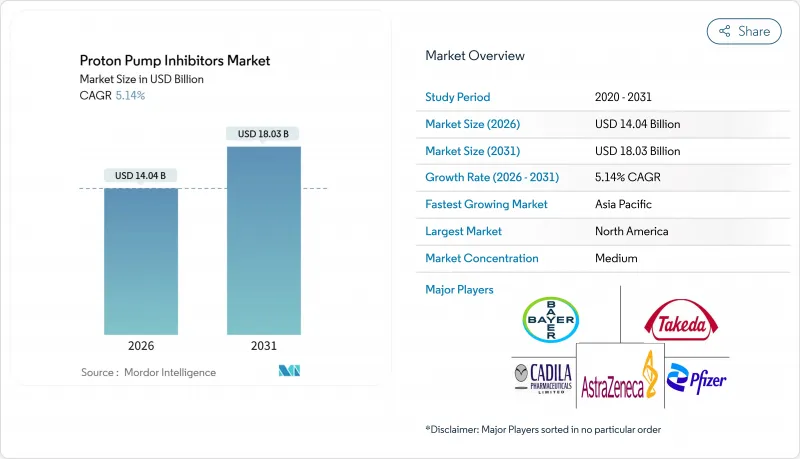
본 보고서는 약제 유형(일반의약품 및 처방약), 투여 경로(경구 및 정맥 내), 적응증(GERD, 소화성 궤양 등), 유통 채널(병원 약국 등), 지역(북미, 유럽, 아시아태평양, 중동 및 아프리카, 남미)별로 분류되어 있습니다. 시장 전망은 금액(달러) 기준으로 제시되어 있습니다.
세계의 양성자 펌프 억제제 시장 동향 및 인사이트
소화기 질환 유병률이 높은 고령화 사회
고령자는 젊은 층에 비해 역류 증상 및 소화성 궤양 합병증의 발병률이 2배에 달할 전망입니다. 하부 식도 괄약근의 긴장 저하, 다약제 병용으로 인한 점막 손상, 그리고 식도열공탈장의 유병률이 이러한 위험을 더욱 높이고 있습니다. 전 세계 60세 이상 인구는 2030년까지 14억 명을 넘어설 것으로 예상되며, 아시아태평양이 가장 급격한 증가세를 주도하고 있습니다. 이러한 인구 급증으로 인해 처방량이 확대되고 있습니다. 이는 고령 환자가 위산 배출 능력 저하나 NSAID 병용 요법으로 인해 더 높은 용량이나 장기 투여가 필요한 경우가 많기 때문입니다.
GERD 및 소화성 궤양 질환의 부담 증가
도시화와 식생활의 서유럽화로 인해 전 세계 GERD 유병률은 약 13%에 달하며, 아시아의 대도시권에서는 기존 5% 미만 수준에서 10% 이상으로 상승했습니다. 만성적인 NSAID 복용자에게는 여전히 소화성 궤양이 나타나며, 이 환자층은 고령화에 따라 확대되고 있습니다. 그 결과, 수요는 양극화되고 있습니다. 즉, 합병증이 없는 GERD에 대한 저용량·단기 투여와 궤양 관리를 위한 고용량·장기 투여로 나뉘며, 다양한 용량을 갖춘 기업이 유리해집니다.
PPI의 장기 사용에 대한 안전성 우려
2024년 관찰 연구에 따르면, 양성자 펌프 억제제(PPI)에 대한 만성적인 노출이 급성 간질성 신염, 만성 신장 질환의 진행 및 비타민 B12 결핍증의 위험 증가와 관련이 있는 것으로 나타났으며, 위험비(hazard ratio)는 1.3에서 1.8 사이였습니다. 이에 따라 FDA 및 EMA가 경고를 발령함에 따라, 의사들은 단계적 감량 프로토콜이나 필요 시 투여 방식을 채택하게 되었고, 그 결과 환자 1인당 평균 치료 기간이 단축되었습니다.
부문 분석
처방약 부문은 2025년에는 비교적 작은 시장 규모였으나, 졸린저-엘리슨 증후군 및 헬리코박터 파일로리 박멸 치료에 필요한 고용량 투여로 인해 2031년까지 연평균 7.54%의 성장률을 보일 것으로 예측됩니다. 건강보험 처방약 목록에서는 OTC(일반의약품) 구매보다 처방약에 대한 지원이 더 후하게 설정되는 경우가 많아, 간접적으로 환자를 의사 주도 치료로 유도하고 있습니다. 한편, 규모가 큰 OTC 시장에서는 자체 브랜드 제네릭 의약품과의 경쟁이 격화되어 평균 판매 가격에 압박을 가하고 있습니다. 규제에 따른 OTC로의 전환은 접근성을 확대시켰지만, 판매 채널의 경제성을 낮은 마진 구조로 전환시켰으며, 제조업체들은 판매량 확대와 수익성 사이의 균형을 모색할 수밖에 없게 되었습니다.
처방약 브랜드의 경우, 라이프사이클 관리는 여전히 매우 중요합니다. 양성자 펌프 억제제와 NSAIDs 또는 항생제를 조합한 복합제는 보호 기간을 연장하고 더 높은 환급액을 확보합니다. 규제 당국은 복약 순응도나 안전성의 우월성을 입증하는 근거가 있을 경우 이러한 제형을 권장하고 있으며, 이로 인해 핵심 분자의 독점권이 상실되더라도 브랜드 제품의 중요성은 더욱 높아지고 있습니다.
경구 제제는 그 편의성과 만성 위식도 역류병(GERD)에서의 광범위한 사용으로 인해 2025년 판매량의 58.65%를 계속 차지하고 있습니다. 그러나 중환자실이나 수술 후 관리 현장에서 경구 섭취가 어려운 경우, 신속한 산 분비 억제가 필요한 스트레스성 궤양 예방 프로토콜로 인해 정맥 내(IV) 제제 수요는 연평균 성장률(CAGR) 7.65%로 증가하고 있습니다. 병원들은 공급업체와 직접 정맥 주사제의 일괄 계약을 협상하며, 많은 경우 처방집에 독점적으로 등재되는 대가로 상당한 할인을 확보하고 있지만, 무균 제조의 복잡성이 높아 기존 제조업체들에게 유리한 장벽이 되고 있습니다. 2024년 판토프라졸 주사제의 제네릭 의약품 승인은 시장의 전환점이 될 것이며, 구매 기준이 브랜드 선호에서 비용 효율성으로 전환될 것으로 예측됩니다.
지역별 분석
북미는 높은 의료비 지출과 확고한 처방 관행에 힘입어 2025년에는 세계 시장 점유율의 42.65%를 차지했습니다. 2024년 FDA의 안전성 관련 공지로 인해 장기 사용은 억제되었지만, 임상의들이 고위험군에서 궤양 예방을 계속 우선시함에 따라 전체 사용량에는 실질적인 영향이 없었습니다. 캐나다에서는 환급 규정이 엄격해짐에 따라, 주로 8주를 초과하는 처방 연장에 있어 내시경 검사가 의무화됨에 따라 장기 치료가 다소 억제되고 있습니다.
아시아태평양은 가장 빠르게 성장하고 있으며, 2031년까지 연평균 성장률(CAGR)은 6.43%로 예측됩니다. GERD(위식도 역류 질환) 유병률 증가, 중산층 소득 증가, 그리고 광범위한 제네릭 의약품 생산이 이러한 성장의 원동력이 되고 있습니다. 인도 및 중국의 제약사들은 비용 면에서의 우위를 활용하여 시장 접근성을 확대하고 있는 반면, 보노플라잔의 라이선싱 계약은 가격에 민감한 시장에 적합한 로열티 기반의 비즈니스 모델로 선발 제약사들이 전환하고 있음을 보여줍니다. 인도 의약품관리총국(DCG)이 보노프라잔의 여러 적응증에 대해 승인을 내린 것은 이 약물의 급속한 보급을 뒷받침할 환경이 조성되었음을 입증합니다.
유럽의 성장 추세는 견조하지만 속도는 완만합니다. 이는 자가 투여 기간을 제한하고 단계적 감량 프로토콜을 의무화하는 유럽의약품청(EMA)의 엄격한 표시 요건에 의해 제약받고 있기 때문입니다. EU의 2024년 개정 신청 절차에 관한 위임 규정은 표시 조화에 따른 행정적 부담을 경감하고, 제형 변경 제품의 도입을 가속화할 가능성이 있습니다.
중동 및 아프리카에서는 도입이 초기 단계에 있습니다. 걸프협력회의(GCC) 회원국에서는 민간 보험의 적용 범위가 확대되고 있어, 도시 지역 병원에서 프리미엄 브랜드 제품의 보급을 뒷받침하고 있습니다. 반면, 사하라 이남 아프리카에서는 저비용 제네릭 의약품을 우선시하는 필수 의약품 목록에 중점을 두고 있습니다. 남미에서는 진척도에 편차가 나타나고 있으며, 브라질과 아르헨티나의 거시경제 변동이 가격 협상에 영향을 미치고 있습니다. 그럼에도 불구하고, 치료가 충분히 이루어지지 않는 환자층이 다수 존재하기 때문에 비용 효율성이 뛰어난 공급업체에게는 장기적인 성장 여지가 있습니다.
기타 혜택 :
- 엑셀 형식 시장 예측(ME) 시트
- 3개월간의 애널리스트 지원
자주 묻는 질문
목차
제1장 서론
제2장 조사 방법
제3장 주요 요약
제4장 시장 구도
제5장 시장 규모 및 성장 예측
제6장 경쟁 구도
제7장 시장 기회 및 향후 전망
KTH 26.08.26According to Mordor Intelligence, the proton pump inhibitors market size is estimated at USD 14.04 billion in 2026, and is expected to reach USD 18.03 billion by 2031, at a CAGR of 5.14% during the forecast period (2026-2031).
This report is Segmented by Drug Type (OTC Drugs and Prescription Drugs), Route of Administration (Oral and Intravenous), Indication (GERD, Peptic Ulcer Disease, and More), Distribution Channel (Hospital Pharmacies, and More), and Geography (North America, Europe, Asia-Pacific, Middle East and Africa, and South America). Market Forecasts are Provided in Terms of Value (USD).
Global Proton Pump Inhibitors Market Trends and Insights
Aging Population with Higher G.I. Disorder Prevalence
Older adults experience double the incidence of reflux symptoms and peptic complications compared with younger cohorts. Declining lower esophageal sphincter tone, polypharmacy-induced mucosal injury, and the prevalence of hiatal hernia compound this risk. The worldwide population aged 60 years and above is on track to exceed 1.4 billion by 2030, with Asia-Pacific driving the steepest gains. This demographic surge elevates prescription volumes because elderly patients often need higher or prolonged dosing due to reduced acid clearance and concurrent NSAID therapy.
Increasing Burden of GERD And Peptic Ulcer Disease
Urbanization and dietary Westernization have pushed global GERD prevalence to roughly 13%, while metropolitan Asia has climbed from historical baselines below 5% to more than 10%. Peptic ulcer disease persists among chronic NSAID users, a cohort expanding alongside aging populations. The result is split demand: low-dose short courses for uncomplicated GERD versus high-dose prolonged regimens for ulcer management, favoring firms with diverse dosage strengths.
Safety Concerns Over Long-Term PPI Use
A 2024 observational study linked chronic exposure to proton pump inhibitors to higher risks of acute interstitial nephritis, progression of chronic kidney disease, and vitamin B12 deficiency, with hazard ratios ranging from 1.3 to 1.8. The resulting FDA and EMA warnings have prompted physicians to adopt step-down protocols and on-demand dosing, thereby shortening the average treatment duration per patient.
Other drivers and restraints analyzed in the detailed report include:
- Expanded OTC Switches and Self-Medication Trends
- Growing Availability of Low-Cost Generics in Emerging Markets
- Patent Expiries Leading to Price Erosion
For complete list of drivers and restraints, kindly check the Table Of Contents.
Segment Analysis
The prescription segment contributed a smaller base in 2025, yet is forecast to grow at 7.54% annually through 2031, driven by higher-dose requirements for Zollinger-Ellison syndrome and H. pylori eradication. Health-insurance formularies often subsidize prescriptions more heavily than OTC purchases, indirectly steering patients toward clinician-directed therapy. Conversely, the larger OTC block faces intensifying competition from private-label generics that pressure average selling prices. Regulatory OTC switches broadened access but shifted channel economics toward thin margins, obliging manufacturers to balance volume gains against profitability.
Lifecycle management remains pivotal for prescription brands. Combination products pairing proton pump inhibitors with NSAIDs or antibiotics extend protection periods and command higher reimbursement. Regulatory agencies encourage such formulations when evidence supports superior adherence or safety, thereby reinforcing the relevance of branded products even as core molecules lose exclusivity.
Oral formulations still account for 58.65% of the 2025 volume, benefiting from their convenience and widespread use in chronic GERD. However, intravenous (IV) demand is rising at a 7.65% CAGR due to stress-ulcer prophylaxis protocols in intensive-care units and post-operative settings that require rapid acid suppression when oral intake is compromised. Hospitals negotiate bulk IV contracts directly with suppliers, often securing steep discounts in exchange for formulary exclusivity, yet the higher complexity of sterile manufacturing creates barriers that favor established producers. Approval of generic pantoprazole injection in 2024 marked a market tipping point that is expected to shift purchasing criteria from brand preference to cost efficiency.
Complete Report Scope:
- By Drug Type
- OTC Drugs
- Omeprazole
- Lansoprazole
- Esomeprazole
- Other OTC Drugs
- Prescription Drugs
- Rabeprazole
- Dexlansoprazole
- Pantoprazole
- Other Prescription Drugs
- OTC Drugs
- By Route Of Administration
- Oral
- Intravenous
- By Indication
- Gastroesophageal Reflux Disease (GERD)
- Peptic Ulcer Disease
- H. Pylori Eradication
- Zollinger-Ellison Syndrome
- Other Indications
- By Distribution Channel
- Hospital Pharmacies
- Retail Pharmacies & Drug Stores
- Online Pharmacies
- Geography
- North America
- United States
- Canada
- Mexico
- Europe
- Germany
- United Kingdom
- France
- Italy
- Spain
- Rest Of Europe
- Asia-Pacific
- China
- Japan
- India
- Australia
- South Korea
- Rest Of Asia-Pacific
- Middle East And Africa
- GCC
- South Africa
- Rest Of Middle East And Africa
- South America
- Brazil
- Argentina
- Rest Of South America
- North America
Geography Analysis
North America commanded 42.65% global share in 2025, supported by high health-care expenditure and entrenched prescribing habits. FDA safety communications in 2024 tempered chronic use, but did not materially impact overall volume, as clinicians continued to prioritize ulcer prophylaxis in high-risk populations. Canada's tighter reimbursement rules modestly curtail long-term therapy, chiefly by requiring endoscopic confirmation to extend scripts beyond eight weeks.
The Asia-Pacific region is the fastest-growing, with a 6.43% CAGR projected to 2031. Rising GERD prevalence, escalating middle-class incomes, and extensive generic production underpin this momentum. Indian and Chinese manufacturers leverage cost advantages to widen access, while licensing deals for vonoprazan demonstrate an originator pivot to royalty-based models that suit price-sensitive markets. Regulatory clearance by India's Drug Controller General for multiple vonoprazan indications confirms an environment conducive to the rapid uptake of this medication.
Europe's trajectory remains steady but slower, curtailed by stringent EMA labeling that limits the length of self-medication and mandates step-down protocols. The EU's 2024 delegated regulation on variation procedures eases administrative burdens for label harmonization, potentially accelerating the introduction of reformulated products.
The Middle East and Africa are at an earlier stage of adoption. Gulf Cooperation Council nations expand private insurance coverage, supporting the uptake of premium-branded products in urban hospitals. At the same time, sub-Saharan Africa focuses on essential medicine lists that prioritize low-cost, generic medications. South America exhibits uneven progress, with macroeconomic volatility in Brazil and Argentina impacting price negotiations; nevertheless, large, under-treated patient pools offer long-term upside for cost-efficient suppliers.
- Abbott Laboratories
- Aurobindo Pharma
- AstraZeneca
- Zydus Group
- Cipla
- Dr. Reddy's Laboratories
- Eisai
- GlaxoSmithKline
- Johnson & Johnson
- Lupin
- Mylan
- Novartis
- Perrigo Company
- Pfizer
- Sanofi
- Sun Pharmaceuticals Industries
- Takeda Pharmaceuticals
- Teva Pharmaceutical Industries
Additional Benefits:
- The market estimate (ME) sheet in Excel format
- 3 months of analyst support
TABLE OF CONTENTS
1 Introduction
- 1.1 Study Assumptions & Market Definition
- 1.2 Scope Of The Study
2 Research Methodology
3 Executive Summary
4 Market Landscape
- 4.1 Market Overview
- 4.2 Market Drivers
- 4.2.1 Ageing Population with Higher G.I. Disorder Prevalence
- 4.2.2 Increasing Burden of GERD And Peptic Ulcer Disease
- 4.2.3 Expanded OTC Switches and Self-Medication Trends
- 4.2.4 Growing Availability of Low-Cost Generics in Emerging Markets
- 4.2.5 Rising Prevalence of Bariatric Surgery Requiring Post-Operative Acid Suppression
- 4.2.6 Adoption of Quadruple H. Pylori Therapies Incorporating PPIs
- 4.3 Market Restraints
- 4.3.1 Safety Concerns Over Long-Term PPI Use
- 4.3.2 Patent Expiries Leading to Price Erosion
- 4.3.3 Preference Shift Toward Potassium-Competitive Acid Blockers
- 4.3.4 Regulatory Scrutiny on OTC Labeling and Duration Limits
- 4.4 Value / Supply-Chain Analysis
- 4.5 Regulatory Landscape
- 4.6 Technological Outlook
- 4.7 Porter's Five Forces Analysis
- 4.7.1 Threat Of New Entrants
- 4.7.2 Bargaining Power Of Buyers/Consumers
- 4.7.3 Bargaining Power Of Suppliers
- 4.7.4 Threat Of Substitute Products
- 4.7.5 Intensity Of Competitive Rivalry
5 Market Size & Growth Forecasts (Value, USD)
- 5.1 By Drug Type
- 5.1.1 OTC Drugs
- 5.1.1.1 Omeprazole
- 5.1.1.2 Lansoprazole
- 5.1.1.3 Esomeprazole
- 5.1.1.4 Other OTC Drugs
- 5.1.2 Prescription Drugs
- 5.1.2.1 Rabeprazole
- 5.1.2.2 Dexlansoprazole
- 5.1.2.3 Pantoprazole
- 5.1.2.4 Other Prescription Drugs
- 5.1.1 OTC Drugs
- 5.2 By Route Of Administration
- 5.2.1 Oral
- 5.2.2 Intravenous
- 5.3 By Indication
- 5.3.1 Gastroesophageal Reflux Disease (GERD)
- 5.3.2 Peptic Ulcer Disease
- 5.3.3 H. Pylori Eradication
- 5.3.4 Zollinger-Ellison Syndrome
- 5.3.5 Other Indications
- 5.4 By Distribution Channel
- 5.4.1 Hospital Pharmacies
- 5.4.2 Retail Pharmacies & Drug Stores
- 5.4.3 Online Pharmacies
- 5.5 Geography
- 5.5.1 North America
- 5.5.1.1 United States
- 5.5.1.2 Canada
- 5.5.1.3 Mexico
- 5.5.2 Europe
- 5.5.2.1 Germany
- 5.5.2.2 United Kingdom
- 5.5.2.3 France
- 5.5.2.4 Italy
- 5.5.2.5 Spain
- 5.5.2.6 Rest Of Europe
- 5.5.3 Asia-Pacific
- 5.5.3.1 China
- 5.5.3.2 Japan
- 5.5.3.3 India
- 5.5.3.4 Australia
- 5.5.3.5 South Korea
- 5.5.3.6 Rest Of Asia-Pacific
- 5.5.4 Middle East And Africa
- 5.5.4.1 GCC
- 5.5.4.2 South Africa
- 5.5.4.3 Rest Of Middle East And Africa
- 5.5.5 South America
- 5.5.5.1 Brazil
- 5.5.5.2 Argentina
- 5.5.5.3 Rest Of South America
- 5.5.1 North America
6 Competitive Landscape
- 6.1 Market Concentration
- 6.2 Market Share Analysis
- 6.3 Company Profiles {(Includes Global Level Overview, Market Level Overview, Core Segments, Financials as Available, Strategic Information, Market Rank/Share for Key Companies, Products & Services, and Recent Developments)}
- 6.3.1 Abbott Laboratories
- 6.3.2 Aurobindo Pharma
- 6.3.3 AstraZeneca
- 6.3.4 Cadila Pharmaceuticals
- 6.3.5 Cipla Limited
- 6.3.6 Dr. Reddy's Laboratories
- 6.3.7 Eisai Inc.
- 6.3.8 GlaxoSmithKline PLC
- 6.3.9 Johnson & Johnson (Janssen)
- 6.3.10 Lupin Limited
- 6.3.11 Mylan N.V.
- 6.3.12 Novartis AG (Sandoz)
- 6.3.13 Perrigo Company PLC
- 6.3.14 Pfizer Inc.
- 6.3.15 Sanofi SA
- 6.3.16 Sun Pharmaceutical Industries
- 6.3.17 Takeda Pharmaceuticals
- 6.3.18 Teva Pharmaceutical Industries
7 Market Opportunities & Future Outlook
- 7.1 White-Space & Unmet-Need Assessment