|
시장보고서
상품코드
2113677
다중 인증(MFA) : 시장 점유율 분석, 업계 동향 및 통계, 성장 예측(2026-2031년)Multifactor Authentication (MFA) - Market Share Analysis, Industry Trends & Statistics, Growth Forecasts (2026 - 2031) |
||||||
 Mordor Intelligence
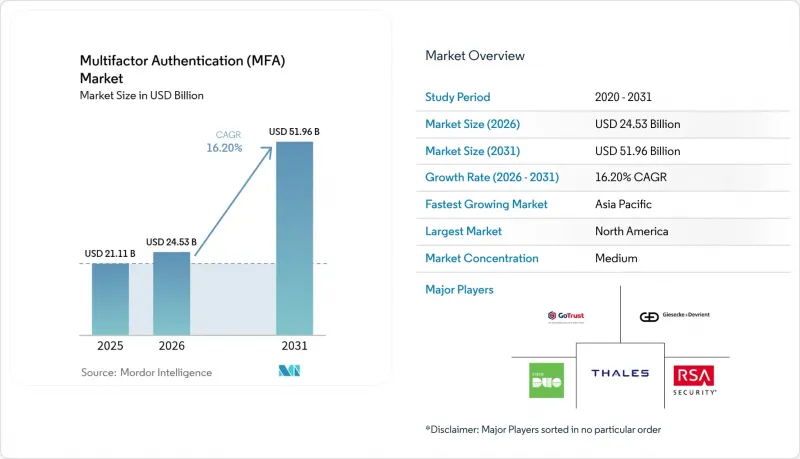
Mordor Intelligence에 의하면, 다중 인증(MFA) 시장 규모는 2025년에 211억 1,000만 달러로 평가되었습니다. 2026년 245억 3,000만 달러에서 2031년까지 519억 6,000만 달러에 이를 것으로 예상되며, 예측 기간(2026-2031년) CAGR은 16.20%를 나타낼 전망입니다.
본 보고서는 제공 형태(하드웨어, 소프트웨어, 서비스), 인증 모델(2단계 인증, 다단계 인증 등), 도입 형태(On-Premise, 클라우드, 하이브리드), 기업 규모(중소기업, 대기업),접속 채널(VPN 및 원격 로그인 등), 최종 사용자 산업(은행 및 금융기관 등), 그리고 지역별로 분류되어 있습니다. 시장 예측은 금액(달러) 기준으로 제시되어 있습니다.
세계의 다중 인증(MFA) 시장 동향 및 인사이트
규제 대상 산업에서의 제로 트러스트 보안 아키텍처로의 급속한 전환
제로 트러스트 설계도에서는 모든 세션에서 지속적인 신원 확인이 요구됨에 따라, MFA는 단순한 선택적 부가 기능에서 핵심적인 제어 수단으로 그 위상이 높아지고 있습니다. 캐나다의 은행들은 OSFI B-13에 따라 SMS OTP 사용을 폐지해야 하며, 이에 따라 하드웨어 토큰 및 생체 인증 요소가 일상 업무에 도입될 예정입니다. 캐피탈 원을 비롯한 미국의 주요 금융 기관들은 2025년 말까지 직원의 비밀번호를 폐지하고, 자격 증명 도용(credential stuffing) 위험을 줄여주는 장치 인증서에 연동된 패스키로 대체했습니다. 이에 대응하여 각 벤더들은 직원, 고객, 기기의 각 ID에 걸친 인증을 통합하는 플랫폼 기반을 구축하고 있으며, 다중 인증(MFA) 시장 생태계를 확대되고 있습니다.
랜섬웨어-어-서비스(RaaS)의 급증으로 보험료 인상이 초래되고 있습니다.
사이버 보험사들은 현재 피싱 공격에 강한 다중 인증(MFA)을 기본적인 보안 대책으로 삼고 있습니다. 이메일이나 SMS를 통한 일회용 비밀번호(OTP)가 여전히 사용되고 있는 경우, 보험 계약 체결이 거부되거나 보험료가 인상될 수 있으므로, MFA에 대한 투자는 보험 비용을 직접적으로 헤지하는 수단이 되고 있습니다. 중간자 공격 키트가 보편화됨에 따라 이사회는 경계 방화벽에 대한 자금 배분에서 ID 보증으로 중점을 옮기고 있으며, 이는 그동안 현대화에 소극적이었던 중견 기업들의 다중 인증(MFA) 시장 수요를 뒷받침하고 있습니다.
레거시 SCADA/ICS 환경에서 MFA의 상호 운용성 한계
산업용 네트워크는 결정론적 지연과 지속적인 가동 시간에 의존합니다. 로그인 절차를 추가하면 다운타임 위험이 발생하기 때문에 플랜트 운영자는 완전한 MFA를 도입하는 대신 OT와 IT를 분리하고 있으며, 이로 인해 중공업 분야의 다중 인증(MFA) 시장 매출은 정체 상태에 있습니다.
부문 분석
소프트웨어 솔루션은 2025년 매출의 47.90%를 차지하며, 다중 인증(MFA) 시장에서 가장 큰 점유율을 기록했습니다. 구독형 라이선싱, API 툴킷, 클라우드 콘솔은 하이브리드 근무 환경에서의 도입을 효율화합니다. 기업이 경계 제어를 규정 준수 보고 및 적응형 위험 지표를 통합한 아이덴티티 패브릭으로 전환함에 따라, 이 부문의 가치 제안은 더욱 확대될 것입니다. WebAuthn 툴체인 및 SDK가 주도하는 패스워드 없는 플랫폼은 18.85%의 연평균 성장률(CAGR)을 기록하고 있으며, 이는 인증 정보 데이터베이스를 불필요하게 만들고 피싱을 근본적으로 방지하는 인증 방식에 대한 구매자의 선호도를 반영합니다. 격리된 보안 요소에 의한 저장이 의무화된 규제 대상 워크로드의 경우, 하드웨어는 여전히 필수적이지만 칩 부족으로 인해 토큰 비용이 상승하면서 예산이 소프트웨어 쪽으로 이동하고 있습니다.
도입에 관한 전문 지식에 대한 수요가 높아지는 가운데, 매니지드 서비스는 매력적인 틈새 시장이 되고 있습니다. 서비스 파트너는 등록 캠페인 설계, 레거시 앱 개조, MFA 대시보드 모니터링을 수행하며, 일회성 제품 도입을 지속적인 컨설팅 수익으로 전환하고 있습니다. 그 결과, 대형 통합 업체들은 도입을 보다 광범위한 제로 트러스트 프로젝트와 함께 제공함으로써 평균 계약 금액을 끌어올리고, 다중 인증(MFA) 시장에서 플랫폼 중심의 조달로의 전환을 촉진하고 있습니다.
2025년 매출의 45.95%는 2단계 인증이 차지했으며, 그 주된 요인은 신속한 위험 감소를 실현하는 인증 앱과 SMS 코드 때문입니다. 그러나 브라우저 및 모바일 OS 공급업체들이 FIDO2를 기본 워크플로에 통합함에 따라, 피싱 공격에 강한 패스키 시장은 연평균 성장률(CAGR) 18.05%로 확대되고 있습니다. 마이크로소프트가 새로운 개인용 계정을 기본적으로 비밀번호 없이 사용할 수 있도록 하기로 한 결정은 강력한 참조 모델이 되고 있습니다. 3개 이상의 인증 요소가 필요한 다중 인증 프레임워크는 일부 정부 기관 및 금융 부문에서는 여전히 필수적이지만, 보다 광범위한 상업 분야에서는 인증 요소의 강도를 동적으로 높이는 위험 기반 오케스트레이션으로 관심이 이동하고 있습니다.
지역별 분석
북미는 2025년에 매출의 37.35%를 차지했으며, 2031년까지 연평균 성장률(CAGR) 13.95%를 나타낼 것으로 전망됩니다. 핵심 인프라의 사이버 보안에 관한 미국의 대통령령과 캐나다의 OSFI B-13 규제가 결합되어 MFA를 제도화하고 있는 한편, 해당 지역에 본사를 둔 ID SaaS 벤더의 생태계가 혁신 주기를 활발하게 유지하고 있습니다. 이처럼 제로 트러스트 도입이 정착 단계에 접어들고, 벤더들이 적응형 분석 기능의 업셀링을 추진함에 따라 북미의 다중 인증(MFA) 시장 규모는 꾸준히 확대되고 있습니다.
아시아태평양은 정부 주도의 ID 프로그램 덕분에 연평균 성장률(CAGR) 16.35%의 궤도에 올라 있습니다. 일본의 ‘마이넘버’ 스마트폰 인증은 현재 650개 이상의 기업에서 로그인 기반으로 활용되고 있으며, 싱가포르의 은행에서는 SMS를 대체하여 FIDO 토큰이 도입되어 주류로 자리 잡아가고 있습니다. 호주의 디지털 ID 프레임워크에서는 연방 정부 서비스를 위해 패스키가 도입되었으며, 민간 부문에서도 유사한 움직임이 잇따르고 있습니다. 동남아시아와 인도 등 신흥 경제국에서는 기존의 비밀번호 단계를 건너뛰고 직접 모바일 생체 인증으로 전환함으로써 시장 성장 여지를 확대되고 있습니다.
유럽에서는 규정 2024/1183에 따라 27개국에서 지갑 로그인이 표준화되어 견조한 두 자릿수 성장을 보이고 있습니다. 공공 부문 수요 규모가 공급업체의 사업 확장을 보장하고 있으며, 민간 온라인 서비스 제공업체는 상호 운용성을 확보하지 못할 경우 고객 이탈을 초래할 위험이 있습니다. 중동 및 아프리카는 기반 규모는 작지만, 클라우드 전환 및 사이버 복원력 강화 노력에 따라 도입이 확대되고 있어 전 세계 다중 인증(MFA) 시장에 다양한 수익원을 제공합니다.
기타 혜택 :
- 엑셀 형식 시장 예측(ME) 시트
- 3개월간의 애널리스트 지원
자주 묻는 질문
목차
제1장 서론
제2장 조사 방법
제3장 주요 요약
제4장 시장 구도
제5장 시장 규모 및 성장 예측
제6장 경쟁 구도
제7장 시장 기회 및 향후 전망
KTH 26.08.26According to Mordor Intelligence, the multifactor authentication market size was valued at USD 21.11 billion in 2025 and estimated to grow from USD 24.53 billion in 2026 to reach USD 51.96 billion by 2031, at a CAGR of 16.20% during the forecast period (2026-2031).
This report is Segmented by Offering Type (Hardware, Software, Services), Authentication Model (Two-Factor, Multifactor, and More), Deployment Mode (On-Premises, Cloud, Hybrid), Enterprise Size (SMEs, Large Enterprises), Access Channel (VPN and Remote Login, and More), End-User Industry (Banking and Financial Institutions, and More), and by Geography. The Market Forecasts are Provided in Terms of Value (USD).
Global Multifactor Authentication (MFA) Market Trends and Insights
Rapid Migration to Zero-Trust Security Architectures Across Regulated Industries
Zero-trust blueprints now require continuous identity checks on every session, elevating MFA from an optional add-on to core control. Canadian banks must abandon SMS OTP under OSFI B-13, pushing hardware tokens and biometric factors into routine operations. U.S. financial majors, including Capital One have pledged to remove employee passwords by end-2025, substituting device-certificate-anchored passkeys that cut credential-stuffing risk. Vendors respond by building platform fabrics that unify authentication across workforce, customer, and machine identities, strengthening the multifactor authentication market's ecosystem breadth.
Surge in Ransomware-as-a-Service Driving Insurance Premium Hikes
Cyber insurers now treat phishing-resistant MFA as baseline hygiene. Policies are refused or repriced upward where email-only or SMS-OTP remains in place, making MFA investment a direct insurance-cost hedge. As adversary-in-the-middle kits commoditize, boards shift funding from perimeter firewalls to identity assurance, propelling multifactor authentication market demand among mid-size enterprises previously slow to modernize.
Legacy SCADA/ICS Environments' Limited MFA Interoperability
Industrial networks depend on deterministic latency and continuous uptime. Injecting extra login steps risks downtime, so plant operators isolate OT from IT rather than retrofit full MFA, capping reachable multifactor authentication market revenue in heavy industry.
Other drivers and restraints analyzed in the detailed report include:
- Mandated FIDO-Based Strong Authentication for EU e-Government Portals
- Push-Notification Phishing Kits Raising Demand for Phishing-Resistant MFA
- Rising OTP SMS Costs Amid A2P Fee Inflation
For complete list of drivers and restraints, kindly check the Table Of Contents.
Segment Analysis
Software solutions generated 47.90% of 2025 revenue and anchor the largest slice of the multifactor authentication market. Subscription licensing, API toolkits, and cloud consoles streamline rollouts across hybrid workforces. The segment's value proposition scales further as enterprises migrate perimeter controls into identity fabrics that integrate compliance reporting and adaptive risk metrics. Passwordless platforms-led by WebAuthn toolchains and SDKs-are clocking 18.85% CAGR, reflecting buyer preference for factors that erase credential databases and defeat phishing at the root. Hardware remains indispensable for regulated workloads that stipulate isolated secure-element storage, yet chip shortages inflate token costs and nudge budgets toward software.
Demand for implementation expertise turns managed services into an attractive niche. Service partners design enrollment campaigns, retrofit legacy apps, and monitor MFA dashboards, turning one-off product placement into recurring advisory revenue. As a result, large integrators bundle rollouts with broader zero-trust projects, lifting average contract values and reinforcing the multifactor authentication market's shift to platform-centric procurement.
Two-factor login still underpins 45.95% of 2025 revenue, primarily through authenticator apps and SMS codes that deliver quick risk reduction. However, phishing-resistant passkeys are expanding at 18.05% CAGR as browser and mobile-OS vendors bake FIDO2 into native workflows. Microsoft's decision to make new consumer accounts passwordless by default supplies a powerful reference model. Multifactor frameworks requiring three or more factors remain compulsory in select government and financial segments, but the broader commercial appetite pivots toward risk-based orchestration that elevates factor strength dynamically.
Complete Report Scope:
- By Offering Type
- Hardware
- Tokens (USB, Smart-card, Smartkey)
- Biometric Devices (Fingerprint, Palm-vein, Facial)
- Other Devices (Wearables, Smartcards-NFC)
- Software
- Authenticator Solutions (TOTP, Push, U2F)
- Mobile Apps (Native, SDK)
- Services
- Managed and Professional Services
- Hardware
- By Authentication Model
- Two-Factor (2FA)
- Multifactor (3F and 4F)
- Adaptive / Risk-Based MFA
- Password-less (WebAuthn, Passkeys)
- By Deployment Mode
- On-premises
- Cloud
- Public
- Private
- Hybrid
- By Enterprise Size
- Small and Medium-sized Enterprises (SMEs)
- Large Enterprises
- By Access Channel
- VPN and Remote Login
- Web and SaaS Applications
- Mobile Workforce
- By End-user Industry
- Banking and Financial Institutions
- Cryptocurrency and Web3 Exchanges
- Technology (SaaS, IT Services, DevOps)
- Government (Federal, State, Local, Integrators)
- Healthcare and Pharmaceutical
- Retail and E-commerce
- Energy, Utilities and Manufacturing
- Education, Immigration and Public Services
- By Geography
- North America
- United States
- Canada
- South America
- Brazil
- Rest of South America
- Europe
- United Kingdom
- Germany
- France
- Rest of Europe
- Asia-Pacific
- China
- Japan
- India
- South Korea
- Rest of Asia-Pacific
- Middle East and Africa
- Middle East
- GCC
- Turkey
- Israel
- Rest of Middle East
- Africa
- South Africa
- Nigeria
- Egypt
- Rest of Africa
- Middle East
- North America
Geography Analysis
North America retained 37.35% revenue in 2025 and should log 13.95% CAGR to 2031. U.S. executive orders on critical-infrastructure cybersecurity and Canadian OSFI B-13 collectively institutionalize MFA, while the ecosystem of identity SaaS vendors headquartered in the region keeps innovation cycles brisk. The multifactor authentication market size for North America thus scales steadily as zero-trust procurement enters the maintenance phase and vendors upsell adaptive analytics.
Asia-Pacific is on a 16.35% CAGR trajectory thanks to government identity programs. Japan's My Number smartphone credential now underpins login for over 650 firms, and Singapore's banks have replaced SMS with FIDO tokens, broadening mainstream adoption. Australia's Digital ID framework rolls out passkeys for federal services, spurring private-sector copycats. Emerging economies across Southeast Asia and India extend market runway by leapfrogging legacy passwords straight into mobile biometrics.
Europe advances at solid double digits as Regulation 2024/1183 standardizes wallet login across 27 nations. Public-sector volume guarantees vendor scale, and private online-service providers must interoperate or risk customer churn. The Middle East and Africa, though starting from a smaller base, record increasing deployments aligned with cloud migration and cyber-resilience bids, adding diversified revenue streams to the global multifactor authentication market.
- Giesecke+Devrient GmbH
- Thetis
- GoTrustID Inc.
- Thales Group
- Duo Security (Cisco Systems Inc.)
- RSA Security LLC
- Okta Inc.
- Google LLC (Alphabet Inc.)
- Ping Identity Corp.
- ManageEngine (Zoho Corp.)
- Microsoft Corp.
- TeleSign Corp. (Proximus Group)
- HID Global Corp.
- OneSpan Inc.
- CyberArk Software Ltd.
- ForgeRock Inc.
- Entrust Corp.
- SecureAuth Corp.
- Symantec Corp. (Broadcom Inc.)
- Keyless Technologies
- Secret Double Octopus
- Trusona Inc.
Additional Benefits:
- The market estimate (ME) sheet in Excel format
- 3 months of analyst support
TABLE OF CONTENTS
1 INTRODUCTION
- 1.1 Study Assumptions and Market Definition
- 1.2 Scope of the Study
2 RESEARCH METHODOLOGY
3 EXECUTIVE SUMMARY
4 MARKET LANDSCAPE
- 4.1 Market Overview
- 4.2 Market Drivers
- 4.2.1 Rapid migration to Zero-Trust security architectures across regulated industries
- 4.2.2 Surge in ransomware-as-a-service driving insurance premium hikes
- 4.2.3 Mandated FIDO-based strong authentication for e-Government portals in EU
- 4.2.4 Push-notification phishing kits raising demand for phishing-resistant MFA
- 4.2.5 AI-powered deep-fake attacks forcing higher-factor biometrics
- 4.2.6 Mandalorian Class Public-Private threat-intel sharing models (US and Five-Eyes)
- 4.3 Market Restraints
- 4.3.1 Legacy SCADA/ICS environments limited MFA interoperability
- 4.3.2 Rising OTP SMS costs amid A2P fee inflation
- 4.3.3 Fragmented mobile authenticator UX hurting workforce adoption
- 4.3.4 Hardware token chip shortages and secure-element supply risk
- 4.4 Supply-Chain Analysis
- 4.5 Regulatory and Technological Outlook
- 4.6 Porter's Five Forces
- 4.6.1 Threat of New Entrants
- 4.6.2 Bargaining Power of Suppliers
- 4.6.3 Bargaining Power of Buyers
- 4.6.4 Threat of Substitutes
- 4.6.5 Competitive Rivalry
5 MARKET SIZE AND GROWTH FORECASTS (VALUE)
- 5.1 By Offering Type
- 5.1.1 Hardware
- 5.1.1.1 Tokens (USB, Smart-card, Smartkey)
- 5.1.1.2 Biometric Devices (Fingerprint, Palm-vein, Facial)
- 5.1.1.3 Other Devices (Wearables, Smartcards-NFC)
- 5.1.2 Software
- 5.1.2.1 Authenticator Solutions (TOTP, Push, U2F)
- 5.1.2.2 Mobile Apps (Native, SDK)
- 5.1.3 Services
- 5.1.3.1 Managed and Professional Services
- 5.1.1 Hardware
- 5.2 By Authentication Model
- 5.2.1 Two-Factor (2FA)
- 5.2.2 Multifactor (3F and 4F)
- 5.2.3 Adaptive / Risk-Based MFA
- 5.2.4 Password-less (WebAuthn, Passkeys)
- 5.3 By Deployment Mode
- 5.3.1 On-premises
- 5.3.2 Cloud
- 5.3.2.1 Public
- 5.3.2.2 Private
- 5.3.3 Hybrid
- 5.4 By Enterprise Size
- 5.4.1 Small and Medium-sized Enterprises (SMEs)
- 5.4.2 Large Enterprises
- 5.5 By Access Channel
- 5.5.1 VPN and Remote Login
- 5.5.2 Web and SaaS Applications
- 5.5.3 Mobile Workforce
- 5.6 By End-user Industry
- 5.6.1 Banking and Financial Institutions
- 5.6.2 Cryptocurrency and Web3 Exchanges
- 5.6.3 Technology (SaaS, IT Services, DevOps)
- 5.6.4 Government (Federal, State, Local, Integrators)
- 5.6.5 Healthcare and Pharmaceutical
- 5.6.6 Retail and E-commerce
- 5.6.7 Energy, Utilities and Manufacturing
- 5.6.8 Education, Immigration and Public Services
- 5.7 By Geography
- 5.7.1 North America
- 5.7.1.1 United States
- 5.7.1.2 Canada
- 5.7.2 South America
- 5.7.2.1 Brazil
- 5.7.2.2 Rest of South America
- 5.7.3 Europe
- 5.7.3.1 United Kingdom
- 5.7.3.2 Germany
- 5.7.3.3 France
- 5.7.3.4 Rest of Europe
- 5.7.4 Asia-Pacific
- 5.7.4.1 China
- 5.7.4.2 Japan
- 5.7.4.3 India
- 5.7.4.4 South Korea
- 5.7.4.5 Rest of Asia-Pacific
- 5.7.5 Middle East and Africa
- 5.7.5.1 Middle East
- 5.7.5.1.1 GCC
- 5.7.5.1.2 Turkey
- 5.7.5.1.3 Israel
- 5.7.5.1.4 Rest of Middle East
- 5.7.5.2 Africa
- 5.7.5.2.1 South Africa
- 5.7.5.2.2 Nigeria
- 5.7.5.2.3 Egypt
- 5.7.5.2.4 Rest of Africa
- 5.7.5.1 Middle East
- 5.7.1 North America
6 COMPETITIVE LANDSCAPE
- 6.1 Market Concentration
- 6.2 Strategic Moves (Funding, Partnerships)
- 6.3 Market Share Analysis
- 6.4 Company Profiles (includes Global Level Overview, Market Level Overview, Core Segments, Financials as available, Strategic Information, Market Rank/Share, Products and Services, Recent Developments)
- 6.4.1 Giesecke+Devrient GmbH
- 6.4.2 Thetis
- 6.4.3 GoTrustID Inc.
- 6.4.4 Thales Group
- 6.4.5 Duo Security (Cisco Systems Inc.)
- 6.4.6 RSA Security LLC
- 6.4.7 Okta Inc.
- 6.4.8 Google LLC (Alphabet Inc.)
- 6.4.9 Ping Identity Corp.
- 6.4.10 ManageEngine (Zoho Corp.)
- 6.4.11 Microsoft Corp.
- 6.4.12 TeleSign Corp. (Proximus Group)
- 6.4.13 HID Global Corp.
- 6.4.14 OneSpan Inc.
- 6.4.15 CyberArk Software Ltd.
- 6.4.16 ForgeRock Inc.
- 6.4.17 Entrust Corp.
- 6.4.18 SecureAuth Corp.
- 6.4.19 Symantec Corp. (Broadcom Inc.)
- 6.4.20 Keyless Technologies
- 6.4.21 Secret Double Octopus
- 6.4.22 Trusona Inc.
7 MARKET OPPORTUNITIES AND FUTURE OUTLOOK
- 7.1 White-space and Unmet-Need Assessment