

|
시장보고서
상품코드
2113691
자동차 터보차저 : 시장 점유율 분석, 업계 동향 및 통계, 성장 예측(2026-2031년)Automotive Turbocharger - Market Share Analysis, Industry Trends & Statistics, Growth Forecasts (2026 - 2031) |
||||||
 Mordor Intelligence
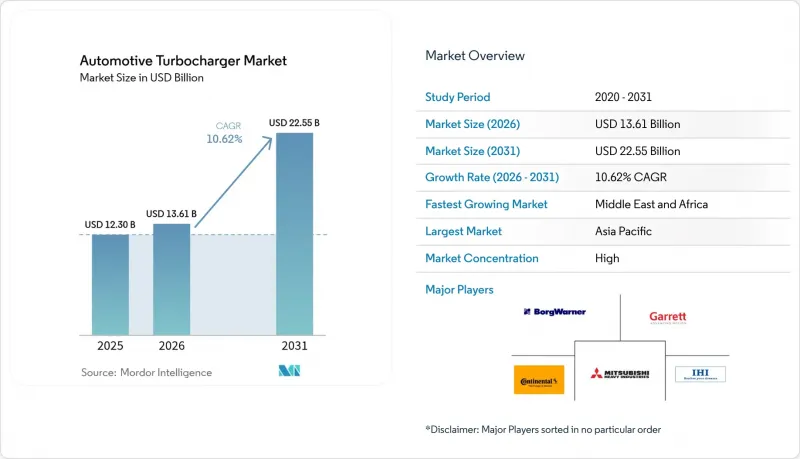
Mordor Intelligence에 의하면, 자동차 터보차저 시장 규모는 2025년에 123억 달러로 평가되었습니다. 2026년 136억 1,000만 달러에서 2031년까지 225억 5,000만 달러에 이를 것으로 예상되며, 예측 기간(2026-2031년) CAGR은 10.62%를 나타낼 전망입니다.
본 보고서는 차종별(승용차, 소형 상용차, 중형·대형 상용차, 오프로드 차량), 연료별(가솔린, 디젤,CNG/LPG, 수소 내연기관), 판매 채널별(OEM 순정 장착 및 애프터마켓), 터보 기술별(웨스트게이트, VGT, 트윈 스크롤 등), 그리고 지역별로 분류되어 있습니다. 시장 예측은 금액(달러) 및 수량(대)으로 제시되어 있습니다.
세계의 자동차 터보차저 시장 동향 및 인사이트
CO₂ 및 NOx 규제 강화가 터보 가솔린 엔진의 채택을 가속화
배출가스 규제는 전 세계 자동차 시장에서 터보차저 도입 전략을 근본적으로 변화시키고 있습니다. 유로 7 규제는 스파크 점화식 차량에 대한 입자 수 제한을 도입하여 모든 엔진에 가솔린 미립자 필터(GPF) 장착을 의무화했으며, 이로 인해 터보차저 장착 구성을 유리하게 만드는 기술적 요건이 발생하고 있습니다. 경차용 가솔린 엔진은 초저배기가스 기준을 충족하기 위해 첨단 연료 분사 및 연소 기술을 통합해야 하며, 배기가스 규제를 준수하면서도 필요한 출력 밀도를 달성하기 위해 터보차저가 필수적인 요소로 자리 잡고 있습니다. 이러한 규제의 단계적 도입으로 인해 배기가스 재순환(EGR) 및 후처리 시스템의 효율을 최적화하기 위한 가변 기하학적 터보차저에 대한 지속적인 수요가 발생하고 있습니다. 이 규제 체계는 유럽에 국한되지 않고, 전 세계 자동차 생산 대수의 40% 이상을 차지하는 중국과 인도에서도 유사한 기준이 도입되고 있습니다. 성능 특성을 유지하면서 이러한 기준을 충족해야 하는 기술적 복잡성으로 인해, 각 제조업체는 배기가스 요건에 따라 부스트 압력을 실시간으로 조정할 수 있는 첨단 터보차저 솔루션의 도입을 서두르고 있습니다.
플릿 평균 연비 규제에 대응하기 위한 엔진 다운사이징
차량군 평균 연비 규제로 인해 각 제조업체는 첨단 터보차저 기술을 통해 소형 배기량 엔진에서 최대의 효율을 이끌어내야 합니다. 북미의 ‘기업 평균 연비(CAFE)’ 기준과 유럽의 유사한 규제는 제조업체들에게 대배기량 자연흡기 엔진을 소형 터보차저 장착 엔진으로 대체할 경제적 인센티브를 제공합니다. 이러한 추세로 인해 제조업체들은 성능 특성을 유지하면서 대폭적인 연비 개선을 실현할 수 있게 되었으며, 터보차저가 장착된 엔진은 동급의 자연흡기 엔진에 비해 20-40% 뛰어난 연비 효율을 발휘합니다. 다운사이징 전략은 터보 랙을 최소화하면서 저회전 영역의 토크 출력을 극대화하는 트윈 스크롤 및 가변 기하학적 터보차저 기술을 통해 특히 큰 혜택을 보고 있습니다. 각 제조업체는 과도 응답 특성을 최적화하기 위해 일체형 배기 매니폴드 설계 및 전동 웨스트게이트 액추에이터의 채택을 확대되고 있습니다. 플릿 평균 목표를 달성하기 위한 경제적 압력은 소형 승용차부터 다운사이징 전략이 규제 준수에 최대의 효과를 가져다주는 중형 SUV에 이르기까지, 모든 차량 부문에서 터보차저 솔루션에 대한 지속적인 수요를 창출하고 있습니다.
BEV의 급속한 보급으로 인해 과급 시스템의 필요성이 사라집니다.
배터리식 전기차(BEV)의 보급은 제조업체들이 생산 능력을 전동 파워트레인으로 전환함에 따라 터보차저 수요에 구조적인 역풍이 되고 있습니다. BEV의 기본 아키텍처에서는 내연 기관이 배제되므로 과급 시스템이 더 이상 필요하지 않게 되며, 전기차 보급률과 터보차저 시장의 성장 사이에는 제로섬 관계가 발생합니다. 중국의 신에너지차 시장은 이러한 추세를 여실히 보여주고 있으며, BEV 판매 대수 증가는 기존 터보차저 솔루션에 대한 수요 감소와 직접적인 상관관계를 보이고 있습니다. 그러나 이러한 전환은 압축 공기 공급 시스템에 특수한 원심식 압축기가 필요한 연료전지 용도에서 터보차저 제조업체에 새로운 기회를 제공합니다. IHI 주식회사는 수소 연료전지 시스템 전용으로, 오일 프리 운전과 메카트로닉스 통합을 특징으로 하며, 연료전지의 효율을 최적화하는 전동 터보차저를 개발했습니다. 이 기술은 연료전지의 공기 공급 요건을 충족하는 동시에, 터보차저 제조업체가 보유한 회전 기계 및 공기역학 설계 분야의 핵심 강점을 유지하고 있습니다.
부문 분석
대조적으로, 승용차는 차량 함대 목표를 충족하는 소형 터보 가솔린 엔진이 널리 채택되고 있어 2025년에는 53.48%라는 가장 큰 터보차저 시장 점유율을 차지했습니다. 상용 트럭 및 버스는 22.37%, 소형 상용 밴은 18.29%를 차지하고 있습니다. 현재 장비 제조업체들은 정속 주행 시나 먼지가 많은 환경에서도 부스트 압력을 유지할 수 있는 가변 기하학적 구조 방식 및 전동 보조 방식의 유닛을 지정하고 있습니다. 오프로드 기계는 2026년부터 2031년에 걸쳐 연평균 성장률(CAGR) 12.35%로 성장할 전망이며, 이는 전 세계 터보차저 시장에서 가장 높은 성장률입니다.
이러한 성장세를 뒷받침하는 것은 개발도상국에서 일어나고 있는 농업 및 건설 기계 붐입니다. 터보 공급업체들은 이러한 가혹한 가동 주기에 대응하기 위해 수냉식 베어링 하우징과 더 광범위한 컴프레서 맵을 설계하고 있습니다. 배기가스 규제가 비도로용 엔진에도 적용됨에 따라, 각 OEM 업체들은 응답성이 뛰어난 터보와 호환성이 좋은 배기 후처리 시스템을 채택하고 있습니다. 따라서 비도로용 플랫폼을 위한 터보차저 시장 규모는 농촌 지역의 기계화 및 인프라 정비를 위한 정부 지출과 연동하여 확대되고 있습니다. 또한, 각 OEM 업체의 서비스 프로그램에서는 수명 주기 비용을 절감하고 가동률을 높게 유지하기 위해 리매뉴팩처링 제품의 도입도 추진하고 있습니다.
2025년에는 화물 운송 및 비도로 분야에서의 우위 덕분에 디젤 엔진이 터보차저 시장 규모의 60.02%를 차지했으나, 수소 내연기관(ICE)의 용도는 연평균 성장률(CAGR) 25.10%로 성장할 전망입니다. 커민스사의 신형 수소 엔진용 터보차저는 더 높은 배기 유량과 수증기에 대응하기 위해 맞춤형 공기역학적 설계를 채택하고 있습니다. 가솔린 엔진은 유로 7 규제 준수를 호재로 삼아 32.24%를 차지하고 있는 반면, CNG와 LPG를 합친 점유율은 6.08%에 그치고 있습니다.
수소 내연기관의 시험 결과에 따르면, 터보차저를 탑재했을 경우 자연흡기 모드와 비교해 최대 165%의 출력 향상이 확인되었으며, 재생 가능 수소를 사용하면 탄소 제로 연소가 가능해집니다. 이에 따라 각 터보차저 제조업체들은 수소 취성을 방지하는 씰 및 스테인리스 소재에 대한 투자를 추진하고 있습니다. 수소 시스템용 터보차저 시장 점유율은 현재로서는 낮은 편이지만, 강력한 정책 지원에 힘입어 향후 10년간 성장을 이끌어갈 전략적 부문으로 자리매김하고 있습니다.
지역별 분석
아시아태평양은 2025년에 48.41%의 점유율을 차지하며 전 세계 터보차저 시장을 주도했습니다. 이는 해당 지역이 세계 최대의 자동차 제조 거점이자 가장 빠르게 성장하는 자동차 시장이라는 위치를 반영한 것입니다. 한편, 중동 및 아프리카는 연평균 성장률(CAGR) 12.98%로 가장 빠른 성장이 예상됩니다. 중국의 대형 트럭 산업은 이 지역 시장 역학을 여실히 보여주며, 전년의 감소세에서 회복되어 2023년에는 약 90만 대가 판매되었습니다. CNG 및 LNG 트럭은 낮은 연료비와 배기가스 측면의 이점으로 인해 시장 점유율을 확대되고 있습니다. 이 지역은 생산 능력의 대폭적인 확대 혜택을 받고 있으며, 미쓰비시 중공업은 증가하는 현지 수요에 대응하기 위해 중국 내 터보차저 생산량을 연평균 20% 늘리고, 4개의 조립 라인을 추가하여 연간 생산 대수 435만 대를 달성했습니다.
유럽은 엄격한 배기가스 규제와 첨단 터보차저 시스템에 대한 기술적 리더십에 힘입어 여전히 큰 시장 점유율을 유지하고 있습니다. 2024년 5월에 발표된 유럽연합(EU)의‘유로 7’ 배기가스 규제에 따르면, NOx 및 미세먼지 배출 기준이 더욱 엄격해지는 동시에 배기가스 규제 준수를 위한 차량 내 모니터링 시스템이 도입됨에 따라, 가변 지오메트리 및 전동 터보차저 기술에 대한 지속적인 수요가 발생하고 있습니다. 이 규제의 시행 일정은 차종 카테고리별로 2026-2034년 단계적으로 도입될 예정이며, 유럽은 궁극적으로 세계 시장에 보급될 차세대 터보차저 기술의 시험장으로서의 위치를 차지하고 있습니다.
북미는 세계 시장의 18.37%를 차지하고 있으며, 그 성장은 모든 차종 부문에서 터보차저 채택을 촉진하는 ‘기업 평균 연비(CAFE) 기준’에 의해 주도되고 있습니다. 이 지역에서는 첨단 터보차저 기술에 크게 의존한 엔진 다운사이징 전략을 통해 제조업체들이 20-40%의 연비 향상을 실현하고 있는 점이 호재로 작용하고 있습니다. 커민스(Cummins)사가 2025년 1월, 램(Ram) 헤비듀티 트럭용 신형 가변 지오메트리 터보차저와 개선된 에어 매니지먼트 시스템을 탑재한 차세대 6.7L 터보 디젤 엔진을 출시한 것은 이 지역이 고성능 상용차 용도에 주력하고 있음을 보여줍니다. 북미 시장에서는 픽업 트럭과 상용차가 중시되고 있기 때문에 고토크 용도에 대응할 수 있는 견고한 터보차저 설계에 대한 수요가 발생하고 있습니다. 한편, 이 지역에서 48V 마일드 하이브리드 시스템의 보급은 전동 보조 터보차저 기술의 혁신을 촉진하고 있습니다.
기타 혜택 :
- 엑셀 형식 시장 예측(ME) 시트
- 3개월간의 애널리스트 지원
자주 묻는 질문
목차
제1장 서론
제2장 조사 방법
제3장 주요 요약
제4장 시장 구도
제5장 시장 규모 및 성장 예측
제6장 경쟁 구도
제7장 시장 기회 및 향후 전망
KTH 26.08.26According to Mordor Intelligence, the automotive turbocharger market size was valued at USD 12.30 billion in 2025 and estimated to grow from USD 13.61 billion in 2026 to reach USD 22.55 billion by 2031, at a CAGR of 10.62% during the forecast period (2026-2031).
This report is Segmented by Vehicle Type (Passenger Cars, Light Commercial Vehicles, Medium and Heavy Commercial Vehicles, and Off-Highway), Fuel Type (Gasoline, Diesel, CNG/LPG, and Hydrogen ICE), Sales Channel (OEM Fitment and Aftermarket), Turbo Technology (Wastegate, VGT, Twin-Scroll, and More) and Geography. The Market Forecasts are Provided in Terms of Value (USD) and Volume (Units).
Global Automotive Turbocharger Market Trends and Insights
Stricter CO2 and NOx Legislation Accelerating Turbo-Gasoline Adoption
Emissions regulations are fundamentally altering turbocharger deployment strategies across global automotive markets. The Euro 7 regulation introduces particulate number limits for spark ignition vehicles and mandates gasoline particulate filters for all engines, creating technical requirements that favor turbocharged configurations. Light-duty gasoline engines must integrate enhanced fuel injection and combustion technologies to meet ultra-low emissions thresholds, positioning turbochargers as essential for achieving required power density while maintaining emissions compliance. The regulation's phased implementation creates sustained demand for variable geometry turbochargers to optimize exhaust gas recirculation and aftertreatment system efficiency. This regulatory framework extends beyond Europe, with China and India implementing similar standards, representing over 40% of global vehicle production. The technical complexity of meeting these standards while maintaining performance characteristics drives manufacturers toward sophisticated turbocharging solutions that can modulate boost pressure in real-time based on emissions requirements.
Engine Downsizing for Fleet-Average Fuel-Economy Compliance
Fleet-average fuel economy regulations are compelling manufacturers to extract maximum efficiency from smaller displacement engines through advanced turbocharging. The Corporate Average Fuel Economy standards in North America and similar regulations in Europe create economic incentives for manufacturers to replace larger naturally aspirated engines with smaller turbocharged alternatives. This trend enables manufacturers to maintain performance characteristics while achieving significant fuel economy improvements, with turbocharged engines delivering 20-40% better fuel efficiency compared to naturally aspirated equivalents. The downsizing strategy particularly benefits from twin-scroll and variable geometry turbocharger technologies that minimize turbo lag while maximizing low-end torque production. Manufacturers are increasingly adopting integrated exhaust manifold designs and electric wastegate actuators to optimize transient response characteristics. The economic pressure to meet fleet-average targets creates sustained demand for turbocharging solutions across vehicle segments, from compact passenger cars to mid-size SUVs where downsizing strategies yield the greatest compliance benefits.
Rapid BEV Penetration Eliminates Forced-Induction Requirements
Battery electric vehicle adoption creates structural headwinds for turbocharger demand as manufacturers transition production capacity toward electric powertrains. The fundamental architecture of BEVs eliminates internal combustion engines, removing the need for forced induction systems and creating a zero-sum relationship between electric vehicle penetration and turbocharger market growth. China's new energy vehicle market demonstrates this dynamic, with BEV sales growth directly correlating with reduced demand for traditional turbocharging solutions. However, the transition creates opportunities for turbocharger manufacturers in fuel cell applications, where compressed air delivery systems require specialized centrifugal compressors. IHI Corporation developed electric turbochargers specifically for hydrogen fuel cell systems, featuring oil-free operation and mechatronic integration to optimize fuel cell efficiency. The technology addresses fuel cell air supply requirements while maintaining turbocharger manufacturers' core competencies in rotating machinery and aerodynamic design.
Other drivers and restraints analyzed in the detailed report include:
- Rising Commercial-Vehicle Output in Asia-Pacific Elevates Turbo Demand
- OEM Shift to 48V Electric-Assist Turbos for Transient Response
- Competitive Cost Of Modern Naturally-Aspirated Engines in Less than 1.2L
For complete list of drivers and restraints, kindly check the Table Of Contents.
Segment Analysis
Passenger cars, by contrast, hold the largest turbocharger market share at 53.48% in 2025, due to the widespread use of small, turbo-gasoline engines that satisfy fleet targets. Commercial trucks and buses contribute 22.37%, and light commercial vans make up 18.29%. Equipment makers now specify variable-geometry and electrically assisted units that maintain boost under constant-speed operation and dusty conditions. Off-highway machinery is on track for a 12.35% CAGR between 2026 and 2031, the fastest in the global turbocharger market.
The agriculture and construction machinery boom in developing economies underpins this momentum. Turbo suppliers are designing water-cooled bearing housings and wider compressor maps for these harsh duty cycles. As emissions laws reach non-road engines, OEMs adopt exhaust-aftertreatment that works best with a responsive turbo. The turbocharger market size allocated to off-highway platforms therefore, scales in tandem with government spending on rural mechanization and infrastructure builds. OEM service programs also push remanufactured units to control lifecycle cost and keep uptime high.
Diesel held 60.02% of the turbocharger market size in 2025 because of its dominance in freight and off-highway segments, yet hydrogen ICE applications will accelerate at a 25.10% CAGR. Cummins' new hydrogen engine turbo features bespoke aerodynamics to cope with higher exhaust flow and water vapor. Gasoline engines account for 32.24%, lifted by Euro 7 conformity, while CNG and LPG combined sit at 6.08%.
Hydrogen ICE testing shows up to 165% more power with turbocharging compared to naturally aspirated modes, and zero-carbon combustion is possible when renewable hydrogen is used. Turbo suppliers are therefore investing in seals and stainless materials that defeat hydrogen embrittlement. The turbocharger market share for hydrogen systems is low today, but strong policy backing positions it as a strategic segment for decade-end growth.
Complete Report Scope:
- By Vehicle Type
- Passenger Cars
- Light Commercial Vehicles
- Medium and Heavy Commercial Vehicles
- Off-highway (Agricultural, Construction)
- By Fuel Type
- Gasoline
- Diesel
- CNG/LPG
- Hydrogen Internal-Combustion
- By Sales Channel
- OEM Fitment
- Replacement / Aftermarket
- By Turbo Technology
- Wastegate Turbocharger
- Variable Geometry Turbocharger (VGT)
- Twin-Scroll Turbocharger
- Electric Turbocharger
- By Geography
- North America
- United States
- Canada
- Rest of North America
- South America
- Brazil
- Argentina
- Rest of South America
- Europe
- Germany
- United Kingdom
- France
- Italy
- Spain
- Russia
- Rest of Europe
- Asia-Pacific
- China
- India
- Japan
- South Korea
- Australia and New Zealand
- Rest of Asia-Pacific
- Middle East and Africa
- Turkey
- Saudi Arabia
- United Arab Emirates
- South Africa
- Rest of Middle East and Africa
- North America
Geography Analysis
Asia-Pacific dominates the global turbocharger market with a 48.41% share in 2025, reflecting the region's position as the world's largest automotive manufacturing hub and fastest-growing vehicle market, while the Middle East and Africa region is forecast to grow the fastest at 12.98% CAGR. China's heavy-duty trucking industry demonstrates the region's market dynamics, with approximately 900,000 units sold in 2023 following recovery from previous year declines. CNG and LNG trucks gain market share due to lower fuel costs and advantages in emissions. The region benefits from substantial manufacturing capacity expansion, with Mitsubishi Heavy Industries increasing Chinese turbocharger production by 20% annually to meet rising local demand, establishing four additional assembly lines to achieve an annual output of 4.35 million units.
Europe maintains a significant market share, driven by stringent emissions regulations and technological leadership in advanced turbocharger systems. The European Union's Euro 7 emissions regulation, published in May 2024, mandates stricter NOx and particulate matter limits while introducing onboard monitoring systems for emissions compliance, creating sustained demand for variable geometry and electric turbocharger technologies. The regulation's implementation timeline, spanning 2026 to 2034 across vehicle categories, positions Europe as a testing ground for next-generation turbocharger technologies that will eventually spread to global markets.
North America represents 18.37% of the global market, with growth driven by Corporate Average Fuel Economy standards that incentivize turbocharger adoption across vehicle segments. The region benefits from manufacturers achieving 20-40% fuel efficiency improvements through engine downsizing strategies that rely heavily on advanced turbocharging technologies. Cummins' launch of its next-generation 6.7L Turbo Diesel engine for Ram Heavy Duty trucks in January 2025, featuring a new variable-geometry turbocharger and improved air management systems, demonstrates the region's focus on high-performance commercial vehicle applications. The North American market's emphasis on pickup trucks and commercial vehicles creates demand for robust turbocharger designs capable of handling high-torque applications, while the region's adoption of 48V mild-hybrid systems drives innovation in electric-assist turbocharger technologies.
- Garrett Motion Inc.
- BorgWarner Inc.
- IHI Corporation
- Mitsubishi Heavy Industries Ltd.
- Cummins Inc. (Turbo Technologies)
- Continental AG
- BMTS Technology GmbH and Co. KG
- Keyyang Precision Co., Ltd.
- Rotomaster International
- Turbo Energy Private Limited
- MAHLE GmbH
- Valeo SA
- Eaton Corporation
- Hyundai Mobis
Additional Benefits:
- The market estimate (ME) sheet in Excel format
- 3 months of analyst support
TABLE OF CONTENTS
1 Introduction
- 1.1 Study Assumptions and Market Definition
- 1.2 Scope of the Study
2 Research Methodology
3 Executive Summary
4 Market Landscape
- 4.1 Market Overview
- 4.2 Market Drivers
- 4.2.1 Stricter CO2 and NOx legislation is accelerating turbo-gasoline adoption
- 4.2.2 Engine downsizing for fleet-average fuel-economy compliance
- 4.2.3 Rising commercial-vehicle output in Asia-Pacific elevates turbo demand
- 4.2.4 OEM shift to 48 V electric-assist turbos for transient response
- 4.2.5 Integration of e-turbos in hybrid and plug-in hybrid architectures
- 4.2.6 Early adoption in hydrogen ICE and fuel-cell air-compression stacks
- 4.3 Market Restraints
- 4.3.1 Rapid BEV penetration eliminates forced-induction requirements
- 4.3.2 Competitive cost of modern naturally-aspirated engines in less than 1.2 L
- 4.3.3 Turbo-lag perception limiting consumer acceptance in key markets
- 4.3.4 Critical-metal (Nd-Fe-B) supply risk for high-speed e-machine rotors
- 4.4 Value / Supply-Chain Analysis
- 4.5 Regulatory Landscape
- 4.6 Technological Outlook
- 4.7 Porter's Five Forces
- 4.7.1 Threat of New Entrants
- 4.7.2 Bargaining Power of Buyers / Consumers
- 4.7.3 Bargaining Power of Suppliers
- 4.7.4 Threat of Substitute Products
- 4.7.5 Intensity of Competitive Rivalry
5 Market Size and Growth Forecasts (Value and Volume)
- 5.1 By Vehicle Type
- 5.1.1 Passenger Cars
- 5.1.2 Light Commercial Vehicles
- 5.1.3 Medium and Heavy Commercial Vehicles
- 5.1.4 Off-highway (Agricultural, Construction)
- 5.2 By Fuel Type
- 5.2.1 Gasoline
- 5.2.2 Diesel
- 5.2.3 CNG/LPG
- 5.2.4 Hydrogen Internal-Combustion
- 5.3 By Sales Channel
- 5.3.1 OEM Fitment
- 5.3.2 Replacement / Aftermarket
- 5.4 By Turbo Technology
- 5.4.1 Wastegate Turbocharger
- 5.4.2 Variable Geometry Turbocharger (VGT)
- 5.4.3 Twin-Scroll Turbocharger
- 5.4.4 Electric Turbocharger
- 5.5 By Geography
- 5.5.1 North America
- 5.5.1.1 United States
- 5.5.1.2 Canada
- 5.5.1.3 Rest of North America
- 5.5.2 South America
- 5.5.2.1 Brazil
- 5.5.2.2 Argentina
- 5.5.2.3 Rest of South America
- 5.5.3 Europe
- 5.5.3.1 Germany
- 5.5.3.2 United Kingdom
- 5.5.3.3 France
- 5.5.3.4 Italy
- 5.5.3.5 Spain
- 5.5.3.6 Russia
- 5.5.3.7 Rest of Europe
- 5.5.4 Asia-Pacific
- 5.5.4.1 China
- 5.5.4.2 India
- 5.5.4.3 Japan
- 5.5.4.4 South Korea
- 5.5.4.5 Australia and New Zealand
- 5.5.4.6 Rest of Asia-Pacific
- 5.5.5 Middle East and Africa
- 5.5.5.1 Turkey
- 5.5.5.2 Saudi Arabia
- 5.5.5.3 United Arab Emirates
- 5.5.5.4 South Africa
- 5.5.5.5 Rest of Middle East and Africa
- 5.5.1 North America
6 Competitive Landscape
- 6.1 Market Concentration
- 6.2 Strategic Moves
- 6.3 Market Share Analysis
- 6.4 Company Profiles (includes Global level Overview, Market level overview, Core Segments, Financials as available, Strategic Information, Market Rank/Share for key companies, Products and Services, and Recent Developments)
- 6.4.1 Garrett Motion Inc.
- 6.4.2 BorgWarner Inc.
- 6.4.3 IHI Corporation
- 6.4.4 Mitsubishi Heavy Industries Ltd.
- 6.4.5 Cummins Inc. (Turbo Technologies)
- 6.4.6 Continental AG
- 6.4.7 BMTS Technology GmbH and Co. KG
- 6.4.8 Keyyang Precision Co., Ltd.
- 6.4.9 Rotomaster International
- 6.4.10 Turbo Energy Private Limited
- 6.4.11 MAHLE GmbH
- 6.4.12 Valeo SA
- 6.4.13 Eaton Corporation
- 6.4.14 Hyundai Mobis
7 Market Opportunities and Future Outlook
- 7.1 White-space and Unmet-Need Assessment


