

|
시장보고서
상품코드
2113694
소포제 : 시장 점유율 분석, 산업 동향·통계 데이터, 성장 예측(2026-2031년)Anti-foaming Agent - Market Share Analysis, Industry Trends & Statistics, Growth Forecasts (2026 - 2031) |
||||||
 Mordor Intelligence
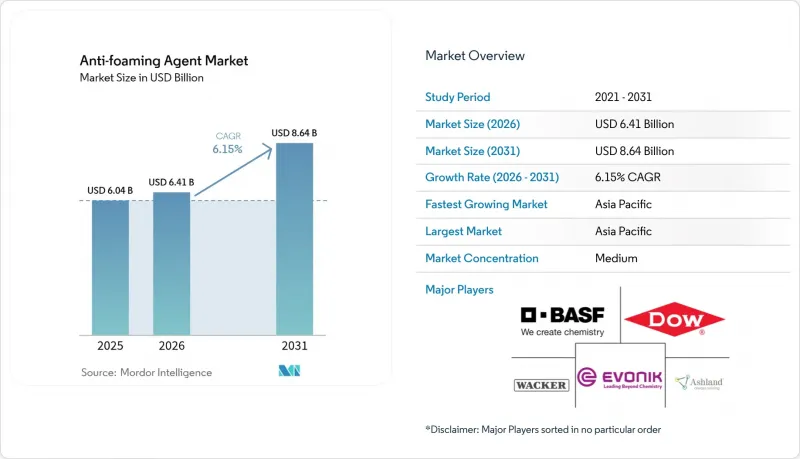
Mordor Intelligence에 따르면 소포제 시장 규모는 2025년 60억 4,000만 달러에서 2026년에는 64억 1,000만 달러로 확대하며, 2026-2031년에 CAGR 6.15%로 추이하며, 2031년에는 86억 4,000만 달러에 달할 것으로 예측됩니다.
이 보고서는 유형별(실리콘계 소포제, 유성 소포제 등), 용도별(펄프·제지, 도료·코팅, 식품 및 음료 등), 지역별(북미, 유럽, 아시아태평양, 남미, 중동 및 아프리카)로 분류되어 있습니다. 시장 예측은 금액(달러) 및 톤으로 제시되어 있습니다.
세계 소포제 시장의 동향 및 인사이트
양조, 청량음료, 유제품을 포함한 식품 및 음료 가공 산업의 확대
식품 및 음료 제조업체들은 신흥 시장의 1인당 소비량 증가에 대응하기 위해 대용량 발효조와 연속식 살균 장치를 도입하고 있습니다. 그러나 이러한 시스템은 기존의 배치식 장치에 비해 단위 처리량당 발포량이 많아집니다. 바커(Wacker)사의 양조용 ‘SILFOAM’ 제품 라인은 맥즙 비등 및 효모 증식시 발생하는 거품을 억제하기 위해 5-50 ppm의 첨가량을 권장하고 있습니다. 본 제품은 미국 식품의약국(FDA)의 21 CFR 173.340을 준수하며, 완성된 맥주에 이취가 혼입되지 않음을 보장합니다. 유제품 가공업체도 유사한 과제에 직면해 있습니다. 우유를 135℃에서 150℃로 초고온 살균하면 단백질에 의해 안정화된 거품이 발생하여, 이로 인해 열교환기가 막힐 우려가 있습니다. 이를 제어하지 않으면 열효율이 최대 12%까지 떨어질 수 있습니다. 또한 대두, 귀리, 아몬드 등 식물성 음료에 대한 수요 증가도 상황을 더욱 복잡하게 만들고 있습니다. 식물성 단백질은 카제인과는 다른 발포 특성을 보이기 때문에 효과를 확보하면서도 클린 라벨을 중시하는 소비자의 기호에도 부응하는 맞춤형 소포제 배합이 필요합니다.
거품이 발생하는 발효 관련 산업(생명공학, 효소, 바이오연료 등)의 성장
바이오의약품 수탁제조 기업은 2만 리터 규모의 일회용 바이오리액터를 사용하여 모노클로널 항체 및 재조합 단백질의 생산을 확대하고 있습니다. 이러한 시스템에서는 용존 산소 이송에 미세 기포 통기 방식이 사용되며, 이로 인해 자연적으로 거품이 발생합니다. 이를 관리하기 위해 모멘티브(Momentum)사의 식품 등급 실리콘 에멀전을 10-100 ppm 농도로 첨가하여, 세포 생존율이나 하류 크로마토그래피 공정에 영향을 미치지 않으면서 거품을 제거하고 있습니다. 마찬가지로 노보자임즈(Novozymes)나 DSM과 같은 산업용 효소 제조업체에서는 아밀라아제 및 프로테아제의 생산에 피드배치 발효법을 채택하고 있습니다. 이러한 공정에서 오프가스 필터로 거품이 유입되면 배압이 급격히 상승하여 바이오리액터의 유효 용적을 15%에서 20%까지 감소시키는 원인이 됩니다. 또한 리그노셀룰로오스계 원료를 에탄올로 전환하는 바이오연료 정제소도 효소 가수분해 및 동시 당화·발효 과정에서 거품과 관련된 문제에 직면하고 있습니다. 이러한 공정에서 소포제의 비용은 변동 운영비 총액의 0.8%에서 1.2%를 차지합니다. 이러한 비용 민감성으로 인해 제제 개발자들은 실리콘계 대체품에 비해 비용이 저렴하면서도 충분한 성능을 발휘하는 수성 폴리에테르계 소포제의 채택을 추진하고 있습니다. 그러나 교반이 심한 영역에서는 재발포가 여전히 과제로 남아 있습니다.
실리콘계·광유계·용제계 소포제 성분에 대한 엄격한 환경 규제.
유럽연합(EU)의 화학물질 등록,평가, 승인 및 제한에 관한 규정(REACH)은 씻어내는 형태의 퍼스널 케어 제품에서 D4, D5 및 D6 환상 실록산의 사용을 제한하고 있으며, 수생 퇴적물에서의 잔류성 및 생물 축적성에 대한 증거를 바탕으로 산업용 소포제에 대해서도 유사한 제한을 검토하고 있습니다. 이러한 기준치를 준수하기 위해 노력하는 공급업체는 제품 라인당 50만 달러에서 200만 달러에 달하는 연구개발 비용을 부담하게 되지만, 대체 화학물질이 고전단 또는 고온 용도에서 동등한 성능 수준을 달성할 수 있다는 보장은 없습니다. 미국에서는 환경보호청(EPA)이 ‘유해물질규제법(TSCA)’에 기반하여 소포제에 사용되는 특정 광물유 분획에 대한 심사를 진행하고 있으며, 신제품 등록이 지연되고 있으며, 이는 식품 접촉 용도의 유성 배합 제품 공급 제약으로 이어지고 있습니다. 규정 준수 요건에는 국제표준화기구(ISO) 14001 및 ISO 9001 인증도 포함되어 있으며, 다국적 기업의 바이어들은 공급업체 인증 절차의 일환으로 이러한 인증을 점점 더 필수 조건으로 요구하고 있습니다. 이러한 인증을 취득하지 못한 소규모 지역 제조업체들은 1차 고객과의 거래 기회를 잃을 위험에 직면해 있습니다. 이러한 규제상 과제는 특히 실리콘 및 광물유계 화학 물질에 있으며, 심각하며, 현재의 성능상 제한에도 불구하고 바이오 기반 대체재에 대한 관심이 높아지고 있습니다.
부문 분석
실리콘계 소포제는 2025년에 시장 점유율의 63.02%를 차지할 것으로 예상되며, 2031년까지 연평균 성장률(CAGR) 7.35%로 성장하여 유계 및 수계 대체품을 능가할 것으로 전망됩니다. 이러한 견고한 시장 지위는 폴리디메틸실록산이 -40°C에서 +200°C에 이르는 넓은 온도 범위에서 표면 활성을 유지할 수 있기 때문이며, 이는 열분해를 일으키지 않으면서 식물성 오일이나 광물유계 화학 물질로는 실현할 수 없는 특성입니다. Wacker사의 SILFOAM SE에 관한 기술 데이터 시트에 따르면 점도는 1,000-100,000 센티스톡스 범위이며, 이를 통해 제형 개발자는 제트 염색과 같은 고전단 공정이나,혐기성 소화 같은 저전단 공정을 포함한 다양한 용도에 맞춰 액적 크기와 확산 계수를 조정할 수 있습니다.
규제 당국의 승인으로는 미국 식품의약국(FDA)의 식품 접촉에 관한 연방규정집(CFR) 제21편 173.340,플라스틱에 관한 유럽연합(EU) 규정 10/2011, 그리고 음용수에 관한 전미위생재단/미국표준협회(NSF/ANSI) 60 등의 규제 당국 승인을 통해 제약 및 도시 하수 처리 등 위험에 민감한 산업 분야에서 실리콘의 입지는 더욱 공고해지고 있습니다.
지역별 분석
아시아태평양은 2025년에 전 세계 매출의 37.01%를 차지할 것으로 예상되며, 2031년까지 연평균 성장률(CAGR) 7.6%로 성장하여 가장 빠르게 성장하는 지역이 될 전망입니다. 2024년, 중국의 산업 폐수 배출량은 75억 입방미터를 초과했으며, 그 대부분은 섬유, 화학, 식품 가공 산업에서 발생했습니다. 생태환경부의 폐수 기준에 따르면 도시 하수 처리장의 경우 생화학적 산소 요구량(BOD)을 1리터당 10밀리그램(mg/L) 미만으로, 산업 폐수 배출자의 경우 30mg/L 미만으로 억제해야 합니다. 이러한 규제로 인해 사업자들은 폭기 시스템의 최적화와 활성 슬러지의 미생물 활동에 악영향을 미치지 않는 소포제 도입을 강요받고 있습니다. 마찬가지로 인도의 중앙공해관리위원회도 2024년에 기준을 강화하여 섬유 염색 공장에 대해 배출수 중 총 용존 고형물을 2,100mg/L 미만으로 제한할 것을 의무화했습니다. 이 목표를 달성하기 위해서는 다단계 처리 공정과 생물학적 단계 및 화학적 단계 모두에서 거품 억제가 필요합니다.
북미와 유럽은 여전히 소포제 시장을 주도하는 지역입니다. 그러나 최대 용도 분야인 펄프·제지 업계의 공장 폐쇄로 인해 이 지역들의 성장률은 세계 평균을 밑돌고 있습니다. 미국에서는 환경보호청(EPA)이 2024년에 발표한 퍼플루오로알킬 물질(PFAS) 및 폴리플루오로알킬 물질의 처리에 관한 지침에 따라 도시 하수 처리장에서 거품 분리 시스템 도입이 진행되고 있습니다. 이러한 시스템은 PFAS를 분해 처리하기 쉽도록 소량의 폐액으로 농축하므로 PFAS와 함께 농축되거나 이온교환수지를 오염시키지 않는 소포제가 필요합니다. 유럽에서는 유럽연합(EU)의 화학물질 등록, 평가, 허가 및 제한에 관한 규정(REACH)에 따른 사이클로실록산에 대한 규제로 인해 직쇄형 폴리디메틸실록산이나 바이오 유래 대체제로의 배합 변경이 진행되고 있습니다. 이러한 전환으로 인해 2024년에는 일시적으로 공급이 부족해져, 특정 식품 등급 부문에서 현물 가격이 8%에서 12% 상승했습니다.
세계 최대 유칼립투스 펄프 수출국인 브라질에서는 소포제가 대량으로 소비되고 있습니다. 그러나 경제의 불안정성과 통화 약세가 수입 수요에 주기적으로 영향을 미치고 있습니다. 아르헨티나와 칠레에서는 리튬 염수 처리의 확대에 따라 용매 추출시 거품 억제의 필요성이 높아지고 있습니다. 탄산리튬 생산이 예상대로 확대된다면, 이 용도가 지역별 수요 증가를 견인할 가능성이 있습니다. 중동에서는 사우디아라비아 및 아랍에미리트의 석유화학 단지에 있는 에틸렌 크래커와 폴리에틸렌 반응기에서 소포제가 사용되고 있습니다. 이러한 시설에서는 180℃를 초과하는 공정 조건을 견딜 수 있는 고온용 실리콘 제제가 선호됩니다. 한편, 나이지리아와 이집트에서는 도시 하수 처리 인프라에 대한 투자로 인해 비용 효율이 뛰어난 유성 및 수성 소포제에 대한 수요가 창출되고 있습니다. 다만, 이 지역에서의 조달은 개발 금융 기관의 자금 지원에 의존하는 경우가 많으며, 승인 절차에 수년이 소요되는 경우도 있습니다.
기타 혜택:
- Excel 형식의 시장 예측(ME) 시트
- 3개월간의 애널리스트 지원
자주 묻는 질문
목차
제1장 서론
제2장 분석 방법
제3장 개요
제4장 시장 구도
제5장 시장 규모·성장률 예측
제6장 경쟁 구도
제7장 시장 기회와 향후 전망
KSA 26.08.25According to Mordor Intelligence, the anti-foaming agents market size is expected to grow from USD 6.04 billion in 2025 to USD 6.41 billion in 2026 and is forecast to reach USD 8.64 billion by 2031 at 6.15% CAGR over 2026-2031.
This report is Segmented by Type (Silicon-Based Anti-Forming Agent, Oil-Based Anti-Forming Agent and More), Application (Pulp and Paper, Paints and Coatings, Food and Beverages and More) and Geography (North America, Europe, Asia-Pacific, South America, and Middle East and Africa). The Market Forecasts are Provided in Terms of Value (USD) and Volume (tonnes).
Global Anti-foaming Agent Market Trends and Insights
Expansion of food and beverage processing industries, including brewing, soft drinks, and dairy
Food and beverage manufacturers are adopting higher-capacity fermentation vessels and continuous-flow pasteurizers to address rising per-capita consumption in emerging markets. However, these systems produce more foam per unit throughput compared to traditional batch equipment. Wacker's SILFOAM product line for brewing recommends dosages between 5 and 50 parts per million (ppm) to manage foam during wort boiling and yeast propagation. The product complies with Food and Drug Administration (FDA) 21 CFR 173.340, ensuring no off-flavors are introduced into the finished beer. Dairy processors encounter similar challenges, as ultra-high-temperature sterilization of milk at 135 degrees Celsius to 150 degrees Celsius generates protein-stabilized foam that can clog heat exchangers, reducing thermal efficiency by up to 12 percent if not controlled. Additionally, the growing demand for plant-based beverages such as soy, oat, and almond adds complexity. Vegetable proteins exhibit different foaming behaviors compared to casein, necessitating customized antifoam formulations that ensure effectiveness while meeting clean-label consumer preferences.
Growth in fermentation-based industries like biotech, enzymes, and biofuels producing foam
Biopharmaceutical contract manufacturers are expanding the production of monoclonal antibodies and recombinant proteins using 20,000-liter single-use bioreactors. In these systems, dissolved oxygen transfer relies on fine-bubble aeration, which naturally generates foam. To manage this, Momentive's food-grade silicone emulsions are applied at concentrations of 10 to 100 parts per million (ppm) to collapse foam without affecting cell viability or downstream chromatography processes. Similarly, industrial enzyme producers, such as Novozymes and DSM, use fed-batch fermentation for amylase and protease production. In these processes, foam carryover into off-gas filters can cause backpressure spikes and reduce bioreactor working volume by 15 percent to 20 percent. Biofuel refineries converting lignocellulosic feedstocks into ethanol also face foam-related challenges during enzymatic hydrolysis and simultaneous saccharification-fermentation. In these operations, antifoam costs account for 0.8 percent to 1.2 percent of total variable operating expenses. This cost sensitivity is encouraging formulators to adopt water-based polyether defoamers, which provide acceptable performance at lower costs compared to silicone alternatives. However, re-foaming remains a challenge in high-agitation zones.
Strict environmental regulations on silicone, mineral-oil, and solvent-based defoamer components.
The European Union's Registration, Evaluation, Authorisation and Restriction of Chemicals (REACH) regulation restricts the use of D4, D5, and D6 cyclic siloxanes in wash-off personal care products and is considering similar restrictions for industrial antifoams due to evidence of persistence and bioaccumulation in aquatic sediments . Suppliers working to comply with these thresholds face research and development costs ranging from USD 500,000 to USD 2 million per product line, with no assurance that alternative chemistries will achieve the same performance levels in high-shear or high-temperature applications. In the United States, the Environmental Protection Agency's review under the Toxic Substances Control Act of certain mineral-oil fractions used in defoamers has delayed new product registrations, leading to supply constraints for oil-based formulations in food-contact applications. Compliance requirements also include International Organization for Standardization (ISO) 14001 and ISO 9001 certifications, which are increasingly mandated by multinational buyers as part of supplier qualification processes . Smaller regional producers without these certifications risk losing access to Tier-1 accounts. These regulatory challenges are particularly significant for silicone and mineral-oil chemistries, driving increased interest in bio-based alternatives despite their current performance limitations.
Other drivers and restraints analyzed in the detailed report include:
- Rising wastewater treatment needs in municipal and industrial plants to manage foam
- Demand for enhanced productivity in pulp and paper mills through stabilized operations
- Concerns over aquatic toxicity and bioaccumulation of certain antifoam chemistries
For complete list of drivers and restraints, kindly check the Table Of Contents.
Segment Analysis
Silicone-based anti-foaming agents accounted for 63.02% of the market share in 2025 and are projected to grow at a compound annual growth rate (CAGR) of 7.35% through 2031, surpassing oil-based and water-based alternatives. This strong market position is due to polydimethylsiloxane's ability to maintain surface activity across a wide temperature range of -40°C to +200°C, which is unmatched by vegetable-oil or mineral-oil chemistries without experiencing thermal degradation. According to Wacker's technical data sheets for SILFOAM SE, viscosities range from 1,000 to 100,000 centistokes, enabling formulators to adjust droplet size and spreading coefficients for varied applications, including high-shear processes like jet-dyeing and low-shear processes such as anaerobic digestion.
Regulatory approvals, including the United States Food and Drug Administration (FDA) 21 Code of Federal Regulations (CFR) 173.340 for food contact, European Union (EU) Regulation 10/2011 for plastics, and National Sanitation Foundation/American National Standards Institute (NSF/ANSI) 60 for potable water, further strengthen silicone's position in risk-sensitive industries such as pharmaceuticals and municipal water treatment.
Complete Report Scope:
- By Type
- Silicon-Based Anti-Forming Agent
- Oil-Based Anti-Forming Agent
- Water-Based Anti-Forming Agent
- By Application
- Pulp and Paper
- Paints and Coatings
- Food and Beverages
- Oil and Gas
- Water and Waste-water Treatment
- Pharmaceuticals and Bioprocessing
- Detergents and Cleaning Chemicals
- Textiles and Leather
- By Geography
- North America
- United States
- Canada
- Mexico
- Rest of North America
- Europe
- Germany
- United Kingdom
- Italy
- France
- Spain
- Netherlands
- Poland
- Belgium
- Sweden
- Rest of Europe
- Asia-Pacific
- China
- India
- Japan
- Australia
- South Korea
- Thailand
- Rest of Asia-Pacific
- South America
- Brazil
- Argentina
- Colombia
- Chile
- Peru
- Rest of South America
- Middle East and Africa
- South Africa
- Saudi Arabia
- United Arab Emirates
- Turkey
- Rest of Middle East and Africa
- North America
Geography Analysis
Asia-Pacific captured 37.01% of global revenue in 2025 and is forecast to grow at a compound annual growth rate (CAGR) of 7.6% through 2031, making it the fastest-growing region. In 2024, China's industrial wastewater discharge exceeded 7.5 billion cubic meters, with the textile, chemical, and food-processing industries contributing the majority. The Ministry of Ecology and Environment's effluent standards require biochemical oxygen demand levels below 10 milligrams per liter (mg/L) for municipal plants and 30 mg/L for industrial dischargers. These regulations are pushing operators to optimize aeration systems and adopt antifoams that do not interfere with activated-sludge microbiology. Similarly, India's Central Pollution Control Board tightened its norms in 2024, mandating textile dye houses to limit total dissolved solids in effluent to below 2,100 mg/L. Achieving this target requires multi-stage treatment processes and foam control at both biological and chemical stages.
North America and Europe remain the leading regions in the anti-foaming agent market. However, their growth rates are below the global average due to mill closures in the pulp and paper industry, which represents the largest application segment. In the United States, the Environmental Protection Agency's (EPA) 2024 guidance on per- and polyfluoroalkyl substances (PFAS) treatment is prompting municipal wastewater plants to adopt foam-fractionation systems. These systems concentrate PFAS into smaller waste streams for destruction, necessitating anti-foaming agents that do not co-concentrate with PFAS or foul ion-exchange resins. In Europe, restrictions under the European Union's Registration, Evaluation, Authorisation, and Restriction of Chemicals (REACH) regulation on cyclic siloxanes have driven reformulations toward linear polydimethylsiloxanes and bio-based alternatives. This transition temporarily constrained supply in 2024, leading to an 8% to 12% increase in spot prices for certain food-grade segments.
Brazil, the largest global exporter of eucalyptus pulp, consumes significant volumes of anti-foaming agents. However, economic instability and currency depreciation periodically impact import demand. In Argentina and Chile, the expansion of lithium-brine processing has increased the need for foam control during solvent extraction. This application could drive localized demand growth if lithium carbonate production scales as anticipated. In the Middle East, petrochemical complexes in Saudi Arabia and the United Arab Emirates utilize anti-foaming agents in ethylene crackers and polyethylene reactors. These facilities prefer high-temperature silicone formulations capable of withstanding process conditions exceeding 180 degrees Celsius. Meanwhile, in Nigeria and Egypt, investments in municipal wastewater infrastructure are creating opportunities for cost-effective oil-based and water-based anti-foaming agents. However, procurement in these regions often depends on funding from development-finance institutions, which can involve lengthy approval cycles lasting several years.
- BASF SE
- Dow Inc.
- Evonik Industries AG
- Wacker Chemie AG
- Ashland Global Holdings Inc.
- Clariant AG
- Shin-Etsu Chemical Co., Ltd.
- Ecolab Inc.
- Kemira Oyj
- Elementis plc
- Air Products & Chemicals Inc.
- Momentive Performance Materials Inc.
- Solvay SA
- BYK-Chemie GmbH
- Munzing Chemie
- Accepta Ltd.
- Applied Material Solutions Inc.
- PennWhite Ltd.
- World Chem Industries
- HiMedia Laboratories Pvt. Ltd.
Additional Benefits:
- The market estimate (ME) sheet in Excel format
- 3 months of analyst support
TABLE OF CONTENTS
1 INTRODUCTION
- 1.1 Study Assumptions and Market Definition
- 1.2 Scope of the Study
2 RESEARCH METHODOLOGY
3 EXECUTIVE SUMMARY
4 MARKET LANDSCAPE
- 4.1 Market Overview
- 4.2 Market Drivers
- 4.2.1 Expansion of food and beverage processing industries, including brewing, soft drinks, and dairy
- 4.2.2 Growth in fermentation-based industries like biotech, enzymes, and biofuels producing foam
- 4.2.3 Rising wastewater treatment needs in municipal and industrial plants to manage foam
- 4.2.4 Demand for enhanced productivity in pulp and paper mills through stabilized operations
- 4.2.5 Shift to high-speed bottling and packaging lines sensitive to liquid foaming.
- 4.2.6 Technical benefits of silicone-based antifoams, including thermal stability and broad compatibility
- 4.3 Market Restraints
- 4.3.1 Strict environmental regulations on silicone, mineral-oil, and solvent-based defoamer components
- 4.3.2 Concerns over aquatic toxicity and bioaccumulation of certain antifoam chemistries
- 4.3.3 Lower efficiency of bio-based defoamers compared to conventional silicone-based alternatives.
- 4.3.4 Supply chain disruptions affecting silicone oils, surfactants, and specialty waxes for defoamers.
- 4.4 Supply Chain Analysis
- 4.5 Regulatory Outlook
- 4.6 Porter's Five Forces
- 4.6.1 Threat of New Entrants
- 4.6.2 Bargaining Power of Buyers/Consumers
- 4.6.3 Bargaining Power of Suppliers
- 4.6.4 Threat of Substitute Products
- 4.6.5 Intensity of Competitive Rivalry
5 MARKET SIZE AND GROWTH FORECASTS (VALUE AND VOLUME)
- 5.1 By Type
- 5.1.1 Silicon-Based Anti-Forming Agent
- 5.1.2 Oil-Based Anti-Forming Agent
- 5.1.3 Water-Based Anti-Forming Agent
- 5.2 By Application
- 5.2.1 Pulp and Paper
- 5.2.2 Paints and Coatings
- 5.2.3 Food and Beverages
- 5.2.4 Oil and Gas
- 5.2.5 Water and Waste-water Treatment
- 5.2.6 Pharmaceuticals and Bioprocessing
- 5.2.7 Detergents and Cleaning Chemicals
- 5.2.8 Textiles and Leather
- 5.3 By Geography
- 5.3.1 North America
- 5.3.1.1 United States
- 5.3.1.2 Canada
- 5.3.1.3 Mexico
- 5.3.1.4 Rest of North America
- 5.3.2 Europe
- 5.3.2.1 Germany
- 5.3.2.2 United Kingdom
- 5.3.2.3 Italy
- 5.3.2.4 France
- 5.3.2.5 Spain
- 5.3.2.6 Netherlands
- 5.3.2.7 Poland
- 5.3.2.8 Belgium
- 5.3.2.9 Sweden
- 5.3.2.10 Rest of Europe
- 5.3.3 Asia-Pacific
- 5.3.3.1 China
- 5.3.3.2 India
- 5.3.3.3 Japan
- 5.3.3.4 Australia
- 5.3.3.5 South Korea
- 5.3.3.6 Thailand
- 5.3.3.7 Rest of Asia-Pacific
- 5.3.4 South America
- 5.3.4.1 Brazil
- 5.3.4.2 Argentina
- 5.3.4.3 Colombia
- 5.3.4.4 Chile
- 5.3.4.5 Peru
- 5.3.4.6 Rest of South America
- 5.3.5 Middle East and Africa
- 5.3.5.1 South Africa
- 5.3.5.2 Saudi Arabia
- 5.3.5.3 United Arab Emirates
- 5.3.5.4 Turkey
- 5.3.5.5 Rest of Middle East and Africa
- 5.3.1 North America
6 COMPETITIVE LANDSCAPE
- 6.1 Market Concentration
- 6.2 Strategic Moves
- 6.3 Market Ranking Analysis
- 6.4 Company Profiles (includes Global-level Overview, Market-level Overview, Core Segments, Financials (if available), Strategic Information, Market Rank/Share, Products and Services, Recent Developments)
- 6.4.1 BASF SE
- 6.4.2 Dow Inc.
- 6.4.3 Evonik Industries AG
- 6.4.4 Wacker Chemie AG
- 6.4.5 Ashland Global Holdings Inc.
- 6.4.6 Clariant AG
- 6.4.7 Shin-Etsu Chemical Co., Ltd.
- 6.4.8 Ecolab Inc.
- 6.4.9 Kemira Oyj
- 6.4.10 Elementis plc
- 6.4.11 Air Products & Chemicals Inc.
- 6.4.12 Momentive Performance Materials Inc.
- 6.4.13 Solvay SA
- 6.4.14 BYK-Chemie GmbH
- 6.4.15 Munzing Chemie
- 6.4.16 Accepta Ltd.
- 6.4.17 Applied Material Solutions Inc.
- 6.4.18 PennWhite Ltd.
- 6.4.19 World Chem Industries
- 6.4.20 HiMedia Laboratories Pvt. Ltd.


