

|
시장보고서
상품코드
2113703
유리섬유 강화 콘크리트(GFRC) 시장 점유율 분석, 산업 동향·통계 데이터, 성장 예측(2026-2031년)Glass Fiber Reinforced Concrete (GFRC) - Market Share Analysis, Industry Trends & Statistics, Growth Forecasts (2026 - 2031) |
||||||
 Mordor Intelligence
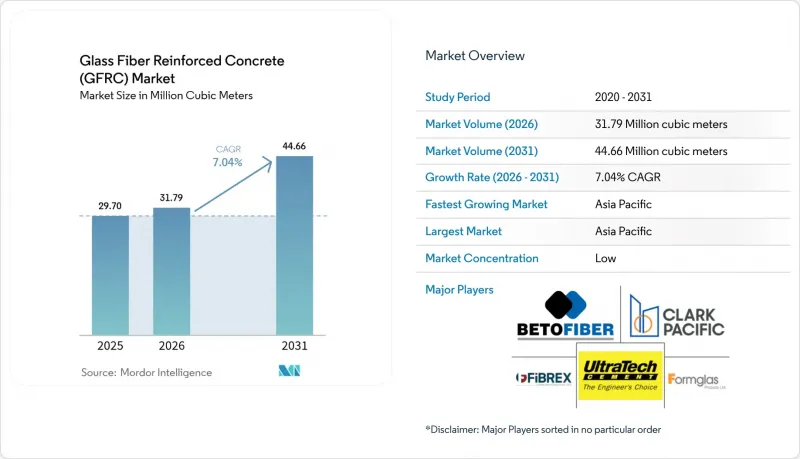
Mordor Intelligence에 따르면 2026년 유리섬유 강화 콘크리트(GFRC) 시장 규모는 3,179만 입방미터와 추산되고 있으며, 2025년 2,970만 입방미터로부터 확대하며, 2031년에는 4,466만 입방미터에 달할 것으로 예측됩니다.
2026-2031년의 연평균 성장률(CAGR)은 7.04%를 기록할 것으로 전망됩니다.
이 보고서는 공정 유형별(스프레이 공법, 프리믹스 공법, 하이브리드 공법), 용도별(상업 시설, 주택, 인프라, 산업·공공 시설), 지역별(아시아태평양, 북미, 유럽, 남미, 중동 및 아프리카)로 분류되어 있습니다. 시장 예측은 수량(입방미터) 단위로 표시됩니다.
전 세계 유리섬유 강화 콘크리트(GFRC) 시장의 동향 및 인사이트
친환경 건축(LEED 평가)에 대한 관심 증가
GFRC는 시멘트 클링커 사용량을 줄이고 단면 두께를 얇게 만들 수 있으며, 둘 다 내재 탄소량을 감소시킵니다. 이를 통해 얻는 크레딧은 상업용 건물이 LEED v4의 자재 및 자원 관련 벤치마크를 충족하는 데 도움이 됩니다. 또한 패널이 경량화됨에 따라 기초를 소형화하고 철골 프레임을 줄일 수 있으며, 개발업자는 운영 비용도 절감할 수 있습니다. 파일럿 연구에 따르면 GFRC 외피와 재활용 골재를 결합한 바닥 슬래브에서는 CO₂ 배출량을 최대 65%까지 줄일 수 있는 것으로 나타났으며, 이 결과는 현재 유럽 전역의 자발적 공개 보고서에서 인용되고 있습니다. 건물 소유주들의 환경 제품 선언(EPD)에 대한 수요가 높아짐에 따라 GFRC 제조사들은 벽돌 조적 구조나 프리캐스트 콘크리트에 비해 우위를 점하는 ‘크래들-투-게이트(Cradle-to-Gate)’ 데이터의 공개를 시작하고 있습니다. 이러한 정보 공개로 인해 공공 및 민간 입찰에서 GFRC의 채택률이 가속화되고 있습니다.
뛰어난 강도 대 중량 비율이 구조 비용과 물류 비용을 절감
GFRC 패널은 동등한 철근 콘크리트 부재에 비해 무게가 약 20% 가벼운 반면, 극한 인장 강도는 25-35% 더 높습니다. 중국 다롄만에서 터널 라이너를 설치한 인프라 팀은 얇은 GFRC 부문로 전환함으로써 크레인 작업 기간을 15일 단축했습니다. 또한 자중이 가벼워짐에 따라 기초의 전단력이 감소하여, 일본이나 캘리포니아에서 우려되는 내진성이 향상됩니다. 중량 기준 운임이 주류를 이루는 장거리 운송 노선에서는 운송 비용 절감 효과가 두드러집니다. 일반 콘크리트에 비해 섬유나 폴리머의 비용이 다소 비싸지만, 이러한 경제적 이점으로 인해 사업의 수익성이 강화됩니다.
연성 부족과 철근 콘크리트
섬유에 의한 브리징 효과로 인해 GFRC와 철근 콘크리트의 항복 후 거동 차이는 줄어들지만, 완전히 해소되지는 않습니다. 이러한 거동 특성은 전 세계의 내진 규정에서 중요한 요소로 간주되고 있습니다. 엔지니어들은 특히 인명 안전 하중을 지탱하는 고층 빌딩의 코어 부분에서 GFRC를 소성 힌지 영역에 적용하도록 지정하는 것에 여전히 우려를 가지고 있습니다. GFRC 패널과 내부 철근 케이지를 결합한 하이브리드 보강에 대한 시험 결과는 유망하지만, 중량과 부식 위험이 다시 발생하므로 GFRC의 두 가지 주요 장점이 상실되고 맙니다. 변위를 기반으로 한 내진 성능 확인을 위한 설계식이 국가 건축 기준에서 공식적으로 인정되기 전까지는 구조 설계에 대한 도입이 지연될 것입니다.
부문 분석
2025년에는 스프레이 공법이 유리섬유 강화 콘크리트(GFRC) 시장에서 출하량의 60.12%를 차지하며 시장을 주도했습니다. 또한 2031년까지 연평균 성장률(CAGR) 7.21%로 성장할 전망입니다. 실시간 도포 제어와 섬유 정렬성 향상으로 신뢰성 높은 인장 강도가 확보되어, 제조업체는 1.6 kN/m2의 풍하중 목표를 충족하는 초박형 패널을 성형할 수 있게 되었습니다. 자동 스프레이 건 도입으로 노동 시간이 30% 단축되어, 소량 생산의 경우에도 패널 1장당 비용을 절감하고 있습니다. 하이브리드 플랜트에서는 스프레이로 시공된 표면층 위에 미리 혼합된 뒷면층을 덧씌움으로써, 단 한 번의 공정으로 미적인 외관과 구조적 강도를 모두 확보하고 있습니다. 현장에서의 도입이 가장 빠르게 확대되고 있는 곳은 우아한 곡선과 신속한 시공이 요구되는 경기장 지붕이나 교통 허브입니다.
6축 로봇의 보급이 확대됨에 따라 스프레이 공법은 고급 파사드 공사의 범위를 넘어 그 적용 영역을 넓혀가고 있습니다. 현재, 연속 측정식 노즐이 주변 습도에 따라 슬러리의 유량을 조절하므로 튀는 양을 5% 미만으로 억제하여 수작업 후처리보다 비용을 절감할 수 있습니다. 이 공정은 여전히 양생실의 기후에 민감하지만, 센서 제어형 공조 시스템을 통해 온대 및 열대 지역에서의 수축 균열을 완화할 수 있습니다. 압축 강도 목표치가 100 MPa를 초과하는 경우, 프리믹스만을 사용하는 공정이 여전히 주류를 이루고 있지만, 사이클 시간이 길어 대량 생산되는 외장재에 적용하는 데에는 한계가 있습니다.
지역별 분석
아시아태평양은 2025년에 세계 총 생산량의 53.58%를 차지할 것으로 예상되며, 2031년까지 연평균 성장률(CAGR) 7.29%라는 가장 높은 성장 전망을 보이고 있습니다. 중국의 ‘일대일로’ 메가 프로젝트에서는 GFRC에 대한 수요가 있으며, 현지에서의 AR 섬유 생산을 통해 공급망이 단축되고 있습니다. 인도의 ‘스마트 시티 미션’에서는 교통망을 중심으로 한 허브 도시 건설에 1,650억 달러의 예산이 편성되었으며, 이들 도시의 대부분은 부식성이 강한 연안 지역에 위치해 있으며, GFRC 파사드에 최적입니다. 일본과 한국에서는 밀도를 2,200kg/m³ 이하로 억제하면서 1.2GPa의 굽힘 강도를 목표로 하는 내진 등급의 배합 설계를 정교화하고 있습니다. 정부가 지원하는 연구소 프로그램을 통해 이러한 배합이 인증되어 승인 기준이 대폭 낮아졌습니다.
북미는 생산량에서 2위를 차지하고 있으며, 그린 빌딩 도입 면에서 세계를 선도하고 있습니다. 캘리포니아주와 뉴욕주 전역에서 LEED 기준에 연동된 의무화 조치가 사양 결정에 대한 견인력을 강화하고 있는 한편, 미국의 연방 인프라 기금에서는 경량화가 가능한 GFRC 데크의 혜택을 받을 수 있는 교량 재시공 프로젝트에 240억 달러가 투입되고 있습니다. 캐나다의 한랭지 시험을 통해 동결-해동 내구성이 확인되었으며, 이는 11번 고속도로 고가교 보수 공사의 필수 조건이 되고 있습니다. 멕시코에서는 계속 확대되고 있는 유료 도로망에서 GFRC를 활용한 충돌 방지 난간의 적용이 검토되고 있으며, 경량 패널을 통해 야간 차선 폐쇄 작업이 간소화됩니다.
유럽에서는 보수 시장에 주력하고 있으며, 역사 지구에서 과도한 하중이 가해지는 석조 기초의 부담을 경감하기 위해 GFRC가 활용되고 있습니다. 독일에서는 진공 단열재를 결합한 대형 레인스크린 패널에 대한 실증 시험이 진행 중이며, 개정된 EPBD(에너지 성능에 관한 건축물 지침)에 기반한 ‘니어 제로 에너지’ 목표 달성을 목표로 하고 있습니다. 영국에서는 2025년에 계획 지침에 전체 수명 주기의 탄소 배출량 기준이 포함된 것을 계기로, 사무실 개보수 부문의 운영 방식이 재구축되고 있습니다. 프랑스에서는 산성비에 내성이 있으면서도 사암을 닮은 색조를 띠는 산화철 안료를 사용하여 GFRC에 착색함으로써, 문화재 보존 전문가들의 지지를 얻고자 하고 있습니다. 이탈리아에서는 대성당 복원 공사에서 이 소재의 높은 내충격성을 활용하여 가늘고 긴 아치형 쉘을 채택하고 있습니다.
기타 혜택:
- Excel 형식의 시장 예측(ME) 시트
- 3개월간의 애널리스트 지원
자주 묻는 질문
목차
제1장 서론
제2장 분석 방법
제3장 개요
제4장 시장 구도
제5장 시장 규모·성장률 예측
제6장 경쟁 구도
제7장 시장 기회와 향후 전망
KSA 26.08.25According to Mordor Intelligence, glass fiber reinforced concrete market size in 2026 is estimated at 31.79 million cubic meters, growing from 2025 value of 29.70 million cubic meters with 2031 projections showing 44.66 million cubic meters, growing at 7.04% CAGR over 2026-2031.
This report is Segmented by Process Type (Sprayed, Premix, and Hybrid), Application (Commercial, Residential, Infrastructure, and Industrial and Institutional), and Geography (Asia-Pacific, North America, Europe, South America, and Middle-East and Africa). The Market Forecasts are Provided in Terms of Volume (Cubic Meters).
Global Glass Fiber Reinforced Concrete (GFRC) Market Trends and Insights
Increased Emphasis on Green Buildings (LEED Ratings)
GFRC reduces cement clinker volume and supports thinner cross-sections, both of which lower embodied carbon. The resulting credits help commercial buildings meet LEED v4 material and resource benchmarks. Developers also gain operational savings because lighter panels permit smaller foundations and less steel framing. Pilot studies show up to 65% CO2 savings in floor slabs that combine GFRC skins with recycled aggregates, a result now cited in voluntary disclosure statements across Europe. Structure owners increasingly demand environmental product declarations, and GFRC makers have begun publishing cradle-to-gate data that compares favorably with masonry and precast concrete. These disclosures accelerate specification rates in both public and private tenders.
Superior Strength-to-Weight Ratio Reduces Structural and Logistics Cost
GFRC panels weigh roughly 20% less than comparable reinforced-concrete elements while delivering 25-35% higher ultimate tensile capacity. Infrastructure teams deploying tunnel liners in China's Dalian Bay shaved 15 days off crane work after switching to thin GFRC segments. Lower dead load also improves seismic resilience by cutting base shear forces, a concern in Japan and California. Transportation cost drops become notable on long-haul routes where weight-based freight tariffs dominate. These economic gains strengthen the business case despite fiber and polymer premiums relative to ordinary concrete.
Lack of Ductility vs. Steel-Reinforced Concrete
Fiber bridging narrows but does not close the gap between GFRC and steel in post-yield behavior, a property enshrined in seismic-resistance provisions worldwide. Engineers remain uneasy specifying GFRC for plastic hinge regions, particularly in high-rise cores that carry life-safety loads. Hybrid reinforcement trials mixing GFRC panels with internal steel cages show promise, yet add back both weight and corrosion risk, dulling two core advantages. Structural adoption will lag until national codes formally recognize design equations for displacement-based checks.
Other drivers and restraints analyzed in the detailed report include:
- Precast Adoption to Cut On-Site Labor and Cycle Time
- Growing Availability of Alkali-Resistant Glass Fiber Supply
- Limited Design Codes and Certification Standards
For complete list of drivers and restraints, kindly check the Table Of Contents.
Segment Analysis
The sprayed route led the glass fiber reinforced concrete market with 60.12% volume in 2025 and is on track for a 7.21% CAGR through 2031. Real-time deposition control and higher fiber alignment deliver reliable tensile capacity, letting producers mold ultra-thin panels that match 1.6 kN/m2 wind-load targets. Automated spray guns cut labor hours by 30%, pushing per-panel cost down even on low-volume runs. Hybrid plants overlay premix backing onto sprayed face coats, marrying cosmetic quality with structural heft in one pass. Field adoption rises fastest in stadium roofs and transit hubs that require graceful curves and rapid erection.
Growing penetration of six-axis robots expands the sprayed method beyond premium facade work. Continuous-measurement nozzles now adjust slurry flow for ambient humidity, reducing rebound to under 5% and costing less than manual cleanup. The process remains sensitive to curing-room climate, but sensor-driven HVAC mitigates shrinkage cracking in temperate and tropical zones. Premix-only lines still rule when compressive-strength targets top 100 MPa, yet their slower cycle time limits appeal for mass-produced cladding.
Complete Report Scope:
- By Process Type
- Sprayed
- Premix
- Hybrid
- By Application
- Commercial
- Residential
- Infrastructure
- Industrial and Institutional
- By Geography
- Asia-Pacific
- China
- India
- Japan
- South Korea
- Rest of Asia-Pacific
- North America
- United States
- Canada
- Mexico
- Europe
- Germany
- United Kingdom
- Italy
- France
- Rest of Europe
- South America
- Brazil
- Argentina
- Rest of South America
- Middle-East and Africa
- Saudi Arabia
- South Africa
- Rest of Middle-East and Africa
- Asia-Pacific
Geography Analysis
Asia-Pacific generated 53.58% of global volume in 2025 and carries the highest growth outlook at 7.29% CAGR to 2031. China's Belt and Road megaprojects demand GFRC, and localized AR-fiber production shortens supply chains. India's Smart Cities Mission budgets USD 165 billion for transit-oriented hubs, many in corrosive coastal zones perfectly suited to GFRC facades. Japan and South Korea refine seismic-grade mix designs, targeting 1.2 GPa flexural capacity while keeping density below 2,200 kg/m3. Government-backed lab programs certify these formulations, slashing approval hurdles.
North America ranks second in volume and leads in green-building adoption. LEED-linked mandates across California and New York add specification pull, while U.S. federal infrastructure funds channel USD 24 billion toward bridge replacement projects that can benefit from weight-saving GFRC decks. Canada's cold-climate trials confirm freeze-thaw durability, a prerequisite for Highway 11 viaduct retrofits. Mexico explores GFRC crash-barrier applications on its expanding toll-road network, where lighter panels simplify overnight lane closures.
Europe focuses on retrofit markets, using GFRC to relieve overstressed masonry foundations in historic districts. Germany pilots large-format rainscreen panels integrated with vacuum insulation, meeting near-zero energy targets under the updated EPBD. The United Kingdom reshapes the office refurb sector after whole-life carbon criteria entered planning guidance in 2025. France courts heritage-preservation specialists by coloring GFRC with iron oxide pigments that mimic sandstone while resisting acid rain. Italy deploys slender vault shells inside basilica restorations, exploiting the material's high impact resilience.
- Aparna RMC.
- ASAHI BUILDING-WALL CO.,LTD.
- BarChip Pty Ltd.
- Betofiber
- Buddy Rhodes Concrete Products
- Chiltern GRC Ltd
- Clark Pacific
- Dalian Shantai New Industrial Co. Ltd
- Fibrex Construction Group
- FIBROBETON
- Fishstone Studio Inc.
- Formglas Products Ltd
- Frey-Fil Corporation
- GB Architectural Cladding Products Ltd
- GRCUK
- Ibstock Plc.
- Lindner SE
- Loveld
- Low & Bonar
- Pennine Stone Ltd
- Polycon Group a.s
- Shanghai Zhuoou Building Decoration Engineering Co. Ltd
- SureCrete Design Products
- Telling Ltd
- Ultratech Cement Ltd
- Yeung's Fiberglass Company
Additional Benefits:
- The market estimate (ME) sheet in Excel format
- 3 months of analyst support
TABLE OF CONTENTS
1 Introduction
- 1.1 Study Assumptions and Market Definition
- 1.2 Scope of the Study
2 Research Methodology
3 Executive Summary
4 Market Landscape
- 4.1 Market Overview
- 4.2 Market Drivers
- 4.2.1 Increased emphasis on green buildings (LEED ratings)
- 4.2.2 Superior strength-to-weight ratio reduces structural and logistics cost
- 4.2.3 Precast adoption to cut on-site labor and cycle time
- 4.2.4 Growing availability of alkali-resistant (AR) glass fiber supply
- 4.2.5 Digital manufacturing (CNC molds, 3-D printed formwork) enables complex facades
- 4.3 Market Restraints
- 4.3.1 Lack of ductility vs. steel-reinforced concrete
- 4.3.2 Limited design codes and certification standards
- 4.3.3 High initial cost of proprietary premix/polymer systems
- 4.4 Value Chain Analysis
- 4.5 Porter's Five Forces
- 4.5.1 Bargaining Power of Suppliers
- 4.5.2 Bargaining Power of Buyers
- 4.5.3 Threat of New Entrants
- 4.5.4 Threat of Substitutes
- 4.5.5 Degree of Competition
5 Market Size and Growth Forecasts (Volume)
- 5.1 By Process Type
- 5.1.1 Sprayed
- 5.1.2 Premix
- 5.1.3 Hybrid
- 5.2 By Application
- 5.2.1 Commercial
- 5.2.2 Residential
- 5.2.3 Infrastructure
- 5.2.4 Industrial and Institutional
- 5.3 By Geography
- 5.3.1 Asia-Pacific
- 5.3.1.1 China
- 5.3.1.2 India
- 5.3.1.3 Japan
- 5.3.1.4 South Korea
- 5.3.1.5 Rest of Asia-Pacific
- 5.3.2 North America
- 5.3.2.1 United States
- 5.3.2.2 Canada
- 5.3.2.3 Mexico
- 5.3.3 Europe
- 5.3.3.1 Germany
- 5.3.3.2 United Kingdom
- 5.3.3.3 Italy
- 5.3.3.4 France
- 5.3.3.5 Rest of Europe
- 5.3.4 South America
- 5.3.4.1 Brazil
- 5.3.4.2 Argentina
- 5.3.4.3 Rest of South America
- 5.3.5 Middle-East and Africa
- 5.3.5.1 Saudi Arabia
- 5.3.5.2 South Africa
- 5.3.5.3 Rest of Middle-East and Africa
- 5.3.1 Asia-Pacific
6 Competitive Landscape
- 6.1 Market Concentration
- 6.2 Strategic Moves
- 6.3 Market Share (%)/Ranking Analysis
- 6.4 Company Profiles (includes Global Overview, Market-level Overview, Core Segments, Financials, Strategic Info, Rank/Share, Products and Services, Recent Developments)
- 6.4.1 Aparna RMC.
- 6.4.2 ASAHI BUILDING-WALL CO.,LTD.
- 6.4.3 BarChip Pty Ltd.
- 6.4.4 Betofiber
- 6.4.5 Buddy Rhodes Concrete Products
- 6.4.6 Chiltern GRC Ltd
- 6.4.7 Clark Pacific
- 6.4.8 Dalian Shantai New Industrial Co. Ltd
- 6.4.9 Fibrex Construction Group
- 6.4.10 FIBROBETON
- 6.4.11 Fishstone Studio Inc.
- 6.4.12 Formglas Products Ltd
- 6.4.13 Frey-Fil Corporation
- 6.4.14 GB Architectural Cladding Products Ltd
- 6.4.15 GRCUK
- 6.4.16 Ibstock Plc.
- 6.4.17 Lindner SE
- 6.4.18 Loveld
- 6.4.19 Low & Bonar
- 6.4.20 Pennine Stone Ltd
- 6.4.21 Polycon Group a.s
- 6.4.22 Shanghai Zhuoou Building Decoration Engineering Co. Ltd
- 6.4.23 SureCrete Design Products
- 6.4.24 Telling Ltd
- 6.4.25 Ultratech Cement Ltd
- 6.4.26 Yeung's Fiberglass Company
7 Market Opportunities and Future Outlook
- 7.1 White-space and Unmet-Need Assessment


