

|
시장보고서
상품코드
2113707
유도형 근접 센서 : 시장 점유율 분석, 산업 동향·통계 데이터, 성장 예측(2026-2031년)Inductive Proximity Sensor - Market Share Analysis, Industry Trends & Statistics, Growth Forecasts (2026 - 2031) |
||||||
 Mordor Intelligence
Mordor Intelligence에 따르면 세계의 유도형 근접 센서 시장 규모는 2025년 13억 8,000만 달러에서 2026년에는 14억 8,000만 달러로 확대하며, 2026-2031년에 CAGR 7.04%로 추이하며, 2031년에는 20억 8,000만 달러에 달할 것으로 예측됩니다.
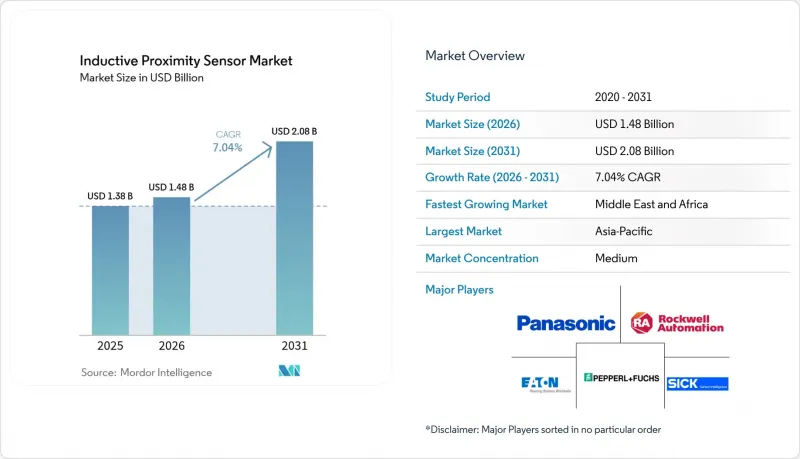
이 보고서는 최종사용자 산업별(자동차·운송 기계, 식품 및 음료 가공, 산업 기계·로봇 등), 감지 범위별(단거리, 중거리, 장거리),하우징 형태별(원통형, 직사각형 등), 설치 방식별(플래시/쉴드형, 비플래시/비쉴드형) 및 지역별로 분류되어 있습니다. 시장 예측은 금액(달러) 기준으로 제시되어 있습니다.
전 세계 유도형 근접 센서 시장의 동향 및 인사이트
인더스트리 4.0 주도 하에 공장 자동화 도입 가속화
현재, 완전 디지털화된 생산 라인에서는 부품의 존재 확인, 공구의 위치, 컨베이어 속도 감시를 위해 셀당 수백 개의 유도형 근접 센서가 도입되어 있으며, 타임스탬프가 포함된 데이터가 제공되고 있습니다. 이 데이터는 제조 실행 시스템(MES)을 통해 일정 최적화 및 불량품 감소로 이어지는 실용적인 인사이트으로 변환됩니다. 지멘스는 자사의 주력 전자기기 조립 공장 전체에 이러한 아키텍처를 확대한 결과, 2024년에는 생산성이 30% 향상되었다고 보고했습니다. 윤활유, 냉각제 및 외부 전자기장에 견디면서도 서브밀리미터급 정밀도를 실현하는 능력 덕분에, 유도식 감지 기술은 스마트 팩토리 툴키트의 중심적인 위치를 계속 차지하고 있습니다. 수요가 가장 급격하게 증가하고 있는 지역은 아시아태평양이며, 이 지역에서는 정부의 장려책에 힘입어 자동차, 소비자 가전 및 일반 기계 제조 시설의 기술 갱신 주기가 가속화되고 있습니다.
자동차 생산 확대와 유도형 센서의 통합
2024년 전기자동차(EV) 생산 대수가 사상 최고치를 기록한 데 따라, 주요 제조사들은 화이트 바디 및 배터리 모듈 생산 라인마다 수천 개의 유도형 센서를 도입하여 조기 마모가 나타나던 기계식 리미트 스위치를 대체했습니다. 예를 들어 테슬라의 기가팩토리 생산 라인에서는 라인당 2,000개 이상의 센서를 활용하여 배터리 정렬, 모듈 장착, 로봇 용접 토치의 위치를 접촉으로 인한 가동 중단 시간을 전혀 발생시키지 않고 확인하고 있습니다. 이 자동차 업계의 사례는 높은 처리량으로 연속 가동되는 공장에서 경화로 주변의 고온이나 대전류가 흐르는 배터리 서브시스템을 둘러싼 자기장에도 견딜 수 있는 유지보수가 필요 없는 설계가 얼마나 중요하게 여겨지는지를 여실히 보여줍니다.
감지 거리 제한 및 광전식 대체품과의 비교
전자기 유도의 물리적 특성으로 인해 주류 SKU에서는 신뢰할 수 있는 감지 거리가 40mm 정도로 제한되므로, 팔레트 셔틀, 고층 창고용 크레인 또는 실외 컨베이어 라인의 설계자는 수 미터 앞의 물체를 감지할 수 있는 광전식 또는 초음파 센서를 도입할 수밖에 없습니다. 배너 엔지니어링(Banner Engineering)사는 이동 거리가 100mm를 초과하면 창고 자동화 프로젝트에서 일반적으로 유도식 솔루션이 채택되지 않는다고 지적하며, 그 이유로 단일 장치의 간편성과 배선 복잡성 감소를 꼽고 있습니다. 시스템 통합사업자는 여러 유도형 노드를 클러스터링하여 이를 보완하려고 시도하기도 하지만, 이 방식은 I/O 수의 증가와 제어 캐비닛의 설치 면적 확대를 초래하여, 장거리 가시성이 최우선으로 요구되는 애플리케이션에서의 채택을 제한하고 있습니다.
부문 분석
2025년, 산업 기계 및 로봇 분야는 유도형 근접 센서 시장 점유율의 36.29%를 차지했습니다. 이는 CNC 라인, 갠트리 로더, 픽 앤 플레이스 셀이 24시간 생산 체제를 유지하기 위해 비접촉식 위치 확인에 의존하고 있음을 반영합니다. 이 부문은 유도형 근접 센서 시장 규모에서 절대 매출 기준으로 가장 큰 비중을 차지하고 있으며, 소형화, 다주파수 내성 및 신속한 보충 물류를 위한 시험장 역할을 계속하고 있습니다. 에너지 및 공공사업 분야는 2031년까지 연평균 성장률(CAGR) 7.21%를 기록할 것으로 예상되며, 풍력 터빈의 요 제어, 태양광 추적기, 스마트 그리드용 개폐기 프로젝트가 수익성이 높은 새로운 수입원으로 전환될 전망입니다.
자동차 공장에서는 2024-2025년에 걸친 모델 연도 전환 기간 중 대규모 센서 보충 프로그램이 지속되었습니다. 한편, 식품 등급 스테인리스강 유닛은 철저한 세척 주기가 이루어지는 음료 충전 라인에서 보급이 확대되었습니다. 항공우주 및 방위 분야에서는 액추에이터 및 착륙 장치 모듈용으로 기밀성이 높고 내진성이 뛰어난 제품이 지정되었습니다. 포장 및 물류 분야의 시스템 통합사업자들은 무인 야간 교대 근무시 유지보수 작업을 신속하게 수행하기 위해, 강화형 M12 커넥터와 고장 진단용 LED를 갖춘 센서를 채택했습니다.
5-15mm 범위를 커버하는 중거리 장치는 2025년 유도형 근접 센서 시장 규모의 45.27%를 차지하며, 연평균 성장률(CAGR) 8.54%로 가장 빠르게 확대될 것으로 예상되어, 코일 직경, 하우징 길이 및 타겟 재료의 허용 오차 간의 균형이 최적임을 보여줍니다. 이러한 범용적인 호환성 덕분에, 전체 기계 제품군에 걸쳐 표준화를 추진하는 OEM의 재고 비용을 절감하는 동시에, 시스템 설계자에게는 여유 있는 장착 공차를 설정할 수 있는 자유도를 제공합니다.
5mm 미만의 단거리 SKU는 마이크로 전자 조립, 외과용 기구 제조 및 실험실 자동화 분야에서 안정적인 수요를 얻고 있습니다. 이러한 분야에서는 감지 거리보다 마이크로미터 단위의 정밀도가 우선시됩니다. 15mm 이상의 장거리 유닛은 열팽창으로 인해 필요한 에어 갭이 넓어지기 때문에 제철소나 단조 프레스에서 용강 감지에 여전히 필수적입니다. 각 벤더들은 광학 센서와의 오랜 성능 격차를 해소하기 위해 하이브리드 공진 회로 및 더 높은 여기 전류를 활용한 실험을 계속하고 있습니다.
지역별 분석
아시아태평양은 2025년 유도형 근접 센서 시장 매출의 38.37%를 차지했습니다. 이는 중국이 추진하는 1조 4,000억 달러 규모의 ‘중국 제조 2025’ 부양책,일본의 ‘사회 5.0’이 중시하는 인간과 기계의 협업, 그리고 인도의 전자기기 및 전기자동차(EV) 생산 분야에서 ‘생산 연계형 인센티브(PLI)’가 급속히 확대된 데 힘입은 결과입니다. 각 지역의 OEM(Original Equipment Manufacturer)들은 적시(JIT) 물류 수요를 충족하고, 린(Lean) 생산 방식의 요건에 기반한 품질 게이트 자동화를 실현하기 위해 고밀도 IO-Link 어레이를 채택하고 있습니다.
북미 및 유럽은 성숙한 시장 환경에 있으며, 브라운필드(기존 공장)의 개조가 주류를 이루고 있습니다. 공장에서는 ISO 13374의 예측 유지보수 보고 요건 및 OSHA의 기계 안전 기준 업데이트를 준수하기 위해 기존의 PLC 아일랜드를 센서 허브로 개조하고 있습니다. 자동차의 전동화에 따라 모터·스테이터 및 배터리 모듈 생산 라인에 대한 새로운 설비 투자가 활발해지고 있으며, 이러한 라인에는 수백 개의 온도 정격 대응 유도형 노드가 필요합니다.
중동 및 아프리카는 사우디아라비아의 5,000억 달러 규모 산업 계획인 ‘비전 2030’과 UAE의 스마트 시티 구축(공공사업, 물류,건설 현장에 분산형 센서 네트워크를 도입하는 것)에 힘입어 2031년까지 7.96%라는 가장 높은 연평균 성장률(CAGR)을 기록할 전망입니다. 남미는 이에 뒤이어 성장할 전망이지만, 브라질의 차량 플랫폼 확대와 마모가 심한 광산 내부에서 견고한 비접촉 감지가 요구되는 칠레의 광업 자동화를 통해 국지적인 성장이 예상됩니다.
기타 혜택:
- Excel 형식의 시장 예측(ME) 시트
- 3개월간의 애널리스트 지원
자주 묻는 질문
목차
제1장 서론
제2장 분석 방법
제3장 개요
제4장 시장 구도
제5장 시장 규모·성장률 예측
제6장 경쟁 구도
제7장 시장 기회와 향후 전망
KSA 26.08.25According to Mordor Intelligence, the global inductive proximity sensors market size is expected to grow from USD 1.38 billion in 2025 to USD 1.48 billion in 2026 and is forecast to reach USD 2.08 billion by 2031 at 7.04% CAGR over 2026-2031.
This report is Segmented by End-User Industry (Automotive and Transportation, Food and Beverage Processing, Industrial Machinery and Robotics, and More), Sensing Range (Short-Range, Medium-Range, Long-Range), Housing Type (Cylindrical, Rectangular, and More), Installation Type (Flush/Shielded, Non-flush/Unshielded), and Geography. The Market Forecasts are Provided in Terms of Value (USD).
Global Inductive Proximity Sensor Market Trends and Insights
Accelerating Industry 4.0-Led Factory Automation Adoption
Fully digital production lines now deploy hundreds of inductive sensors per cell for part presence, tool position, and conveyor speed monitoring, supplying time-stamped data that manufacturing execution systems convert into actionable insights for schedule optimization and scrap reduction. Siemens reported 30% productivity gains in 2024 after scaling such architectures across its flagship electronics assembly plants. The ability to withstand lubricants, coolants, and stray electromagnetic fields while delivering sub-millimeter precision keeps inductive detection at the heart of the smart-factory toolkit. Demand spikes most sharply in Asia-Pacific, where government incentives accelerate technology refresh cycles across automotive, consumer electronics, and general machinery facilities.
Rising Automotive Production Integrating Inductive Sensors
The record EV build-out in 2024 pushed leading producers to adopt thousands of inductive sensors per body-in-white or battery module line, replacing mechanical limit switches that suffered early wear. Tesla's Gigafactory lines, for example, rely on more than 2,000 units per line to verify battery alignment, module seating, and robotic welding torch position with zero contact-related downtime. The automotive case underscores how high-throughput, continuous-operation plants value maintenance-free designs that survive elevated heat near curing ovens and the magnetic fields surrounding high-current battery subsystems.
Limited Sensing Distance Versus Photoelectric Alternatives
Electromagnetic induction physics caps reliable ranges near 40 mm for mainstream SKUs, forcing designers of pallet shuttles, high-bay storage cranes, or outdoor conveyor lines to deploy photoelectric or ultrasonic sensors able to detect objects across meters. Banner Engineering notes that warehouse automation projects routinely bypass inductive solutions once travel distances exceed 100 mm, citing single-device simplicity and lower wiring complexity. Integrators sometimes compensate by clustering multiple inductive nodes, yet the tactic inflates I/O count and control cabinet footprints, limiting uptake in applications where long-reach visibility is paramount.
Other drivers and restraints analyzed in the detailed report include:
- Growing Demand for Contact-Less Position Sensing in Harsh Environments
- Miniaturized ASIC Designs Enabling Integration into Cobots
- Electromagnetic Interference in High-Frequency Inverter Environments
For complete list of drivers and restraints, kindly check the Table Of Contents.
Segment Analysis
Industrial Machinery and Robotics held 36.29% of the inductive proximity sensors market share in 2025, reflecting how CNC lines, gantry loaders, and pick-and-place cells depend on contact-less position verification for around-the-clock output. The segment consumed the largest portion of the inductive proximity sensors market size in absolute revenue and remains a testing ground for miniaturization, multi-frequency immunity, and rapid refill logistics. Energy and Utilities is forecast to post a 7.21% CAGR to 2031, converting wind turbine yaw-control, solar tracker, and smart-grid switchgear projects into lucrative new revenue pools.
Automotive plants sustained sizeable sensor replenishment programs during 2024-2025 model-year changeovers, while food-grade stainless-steel units gained traction in beverage bottling lines that undergo aggressive wash-down cycles. Aerospace and Defense specified hermetically sealed, vibration-resistant variants for actuators and landing-gear modules. Packaging and Logistics integrators adopted sensors with reinforced M12 connectors and fault-diagnostics LEDs to speed maintenance on unstaffed night shifts.
Medium-range devices spanning 5-15 mm accounted for 45.27% of the inductive proximity sensors market size in 2025 and will expand fastest at an 8.54% CAGR, demonstrating the sweet spot between coil diameter, housing length, and target-material tolerance. Their universal compatibility lowers inventory overhead for OEMs standardizing across machine families while giving system designers freedom to allocate comfortable mounting tolerances.
Short-range SKUs below 5 mm enjoy steady pull from micro-electronics assembly, surgical-instrument production, and laboratory automation, where micrometer accuracy outranks standoff distance. Long-range units above 15 mm remain indispensable in steel mills and forging presses for hot-metal detection, where thermal expansion widens the necessary air gap. Vendors continue experimenting with hybrid resonant circuits and higher excitation currents to bridge the historic performance gap with optical sensors.
Complete Report Scope:
- By End-user Industry
- Automotive and Transportation
- Food and Beverage Processing
- Aerospace and Defense
- Industrial Machinery and Robotics
- Packaging and Logistics
- Energy and Utilities
- Other End-user Industry
- By Sensing Range
- Short-range (<=5 mm)
- Medium-range (5-15 mm)
- Long-range (>15 mm)
- By Housing Type
- Cylindrical
- Rectangular
- Ring-style
- Slot-style
- Other Housing Type
- By Installation Type
- Flush / Shielded
- Non-flush / Unshielded
- By Geography
- North America
- United States
- Canada
- Mexico
- Europe
- Germany
- United Kingdom
- France
- Russia
- Rest of Europe
- Asia-Pacific
- China
- Japan
- India
- South Korea
- Australia
- Rest of Asia-Pacific
- Middle East and Africa
- Middle East
- Saudi Arabia
- United Arab Emirates
- Rest of Middle East
- Africa
- South Africa
- Egypt
- Rest of Africa
- Middle East
- South America
- Brazil
- Argentina
- Rest of South America
- North America
Geography Analysis
Asia-Pacific controlled 38.37% of 2025 revenue in the inductive proximity sensors market, powered by China's USD 1.4 trillion "Made in China 2025" stimulus, Japan's Society 5.0 focus on human-machine collaboration, and India's Production-Linked Incentive bursts in electronics and EV production. Regional OEMs consume high-density IO-Link arrays to satisfy just-in-time logistics and automate quality gates under lean-manufacturing mandates.
North America and Europe present mature landscapes where Brownfield retrofits dominate; factories retrofit legacy PLC islands with sensor hubs to comply with ISO 13374 predictive-maintenance reporting and OSHA machine-safety updates. Automotive electrification revives fresh capital spending in motor-stator and battery-module lines that need hundreds of temperature-rated inductive nodes.
The Middle East and Africa segment will log the swiftest 7.96% CAGR to 2031, riding Saudi Arabia's USD 500 billion Vision 2030 industrial blueprint and UAE smart-city rollouts that embed distributed sensor networks inside utilities, logistics, and construction sites. South America trails but secures pockets of growth from Brazil's vehicle platform expansions and Chilean mining automation that favors robust, non-contact detection in abrasive pits.
- Pepperl+Fuchs SE
- Rockwell Automation, Inc.
- Panasonic Holdings Corporation (Panasonic Industry Co., Ltd.)
- Eaton Corporation plc
- SICK AG
- Omron Corporation
- Delta Electronics, Inc.
- Autonics Corporation
- Datalogic S.p.A.
- Riko Optoelectronics Technology Co., Ltd.
- Fargo Controls, Inc.
- Hans Turck GmbH & Co. KG
- Keyence Corporation
- Honeywell International Inc.
- Balluff GmbH
- K.A. Schmersal GmbH & Co. KG
- Euchner GmbH + Co. KG
- Baumer Holding AG
- IFM Electronic GmbH
- Banner Engineering Corp.
Additional Benefits:
- The market estimate (ME) sheet in Excel format
- 3 months of analyst support
TABLE OF CONTENTS
1 INTRODUCTION
- 1.1 Study Assumptions and Market Definition
- 1.2 Scope of the Study
2 RESEARCH METHODOLOGY
3 EXECUTIVE SUMMARY
4 MARKET LANDSCAPE
- 4.1 Market Overview
- 4.2 Market Drivers
- 4.2.1 Accelerating Industry 4.0-led factory automation adoption
- 4.2.2 Rising automotive production integrating inductive sensors
- 4.2.3 Growing demand for contact-less position sensing in harsh environments
- 4.2.4 Miniaturized ASIC designs enabling integration into cobots
- 4.2.5 Adoption in smart agriculture machinery for precision depth sensing
- 4.2.6 OEM preference for IO-Link-enabled sensors for predictive maintenance
- 4.3 Market Restraints
- 4.3.1 Limited sensing distance versus photoelectric alternatives
- 4.3.2 Price pressures due to commoditization in Asian supply base
- 4.3.3 Electromagnetic interference in high-frequency inverter environments
- 4.3.4 Supply-chain volatility for high-permeability ferrite cores
- 4.4 Industry Value / Supply-Chain Analysis
- 4.5 Regulatory Landscape and Standards
- 4.6 Technological Outlook (Edge and AI analytics)
- 4.7 Porter's Five Forces Analysis
- 4.7.1 Bargaining Power of Suppliers
- 4.7.2 Bargaining Power of Buyers
- 4.7.3 Threat of New Entrants
- 4.7.4 Threat of Substitutes
- 4.7.5 Intensity of Competitive Rivalry
5 MARKET SIZE AND GROWTH FORECASTS (VALUE)
- 5.1 By End-user Industry
- 5.1.1 Automotive and Transportation
- 5.1.2 Food and Beverage Processing
- 5.1.3 Aerospace and Defense
- 5.1.4 Industrial Machinery and Robotics
- 5.1.5 Packaging and Logistics
- 5.1.6 Energy and Utilities
- 5.1.7 Other End-user Industry
- 5.2 By Sensing Range
- 5.2.1 Short-range (<=5 mm)
- 5.2.2 Medium-range (5-15 mm)
- 5.2.3 Long-range (>15 mm)
- 5.3 By Housing Type
- 5.3.1 Cylindrical
- 5.3.2 Rectangular
- 5.3.3 Ring-style
- 5.3.4 Slot-style
- 5.3.5 Other Housing Type
- 5.4 By Installation Type
- 5.4.1 Flush / Shielded
- 5.4.2 Non-flush / Unshielded
- 5.5 By Geography
- 5.5.1 North America
- 5.5.1.1 United States
- 5.5.1.2 Canada
- 5.5.1.3 Mexico
- 5.5.2 Europe
- 5.5.2.1 Germany
- 5.5.2.2 United Kingdom
- 5.5.2.3 France
- 5.5.2.4 Russia
- 5.5.2.5 Rest of Europe
- 5.5.3 Asia-Pacific
- 5.5.3.1 China
- 5.5.3.2 Japan
- 5.5.3.3 India
- 5.5.3.4 South Korea
- 5.5.3.5 Australia
- 5.5.3.6 Rest of Asia-Pacific
- 5.5.4 Middle East and Africa
- 5.5.4.1 Middle East
- 5.5.4.1.1 Saudi Arabia
- 5.5.4.1.2 United Arab Emirates
- 5.5.4.1.3 Rest of Middle East
- 5.5.4.2 Africa
- 5.5.4.2.1 South Africa
- 5.5.4.2.2 Egypt
- 5.5.4.2.3 Rest of Africa
- 5.5.4.1 Middle East
- 5.5.5 South America
- 5.5.5.1 Brazil
- 5.5.5.2 Argentina
- 5.5.5.3 Rest of South America
- 5.5.1 North America
6 COMPETITIVE LANDSCAPE
- 6.1 Market Concentration
- 6.2 Strategic Moves
- 6.3 Market Share Analysis
- 6.4 Company Profiles (includes Global level Overview, Market level overview, Core Segments, Financials as available, Strategic Information, Market Rank/Share, Products and Services, Recent Developments)
- 6.4.1 Pepperl+Fuchs SE
- 6.4.2 Rockwell Automation, Inc.
- 6.4.3 Panasonic Holdings Corporation (Panasonic Industry Co., Ltd.)
- 6.4.4 Eaton Corporation plc
- 6.4.5 SICK AG
- 6.4.6 Omron Corporation
- 6.4.7 Delta Electronics, Inc.
- 6.4.8 Autonics Corporation
- 6.4.9 Datalogic S.p.A.
- 6.4.10 Riko Optoelectronics Technology Co., Ltd.
- 6.4.11 Fargo Controls, Inc.
- 6.4.12 Hans Turck GmbH & Co. KG
- 6.4.13 Keyence Corporation
- 6.4.14 Honeywell International Inc.
- 6.4.15 Balluff GmbH
- 6.4.16 K.A. Schmersal GmbH & Co. KG
- 6.4.17 Euchner GmbH + Co. KG
- 6.4.18 Baumer Holding AG
- 6.4.19 IFM Electronic GmbH
- 6.4.20 Banner Engineering Corp.
7 MARKET OPPORTUNITIES AND FUTURE OUTLOOK
- 7.1 White-space and Unmet-need Assessment


