

|
시장보고서
상품코드
2113712
파종 및 시비 기계 : 시장 점유율 분석, 업계 동향과 통계, 성장 예측(2026-2031년)Agricultural Planting and Fertilizing Machinery - Market Share Analysis, Industry Trends & Statistics, Growth Forecasts (2026 - 2031) |
||||||
 Mordor Intelligence
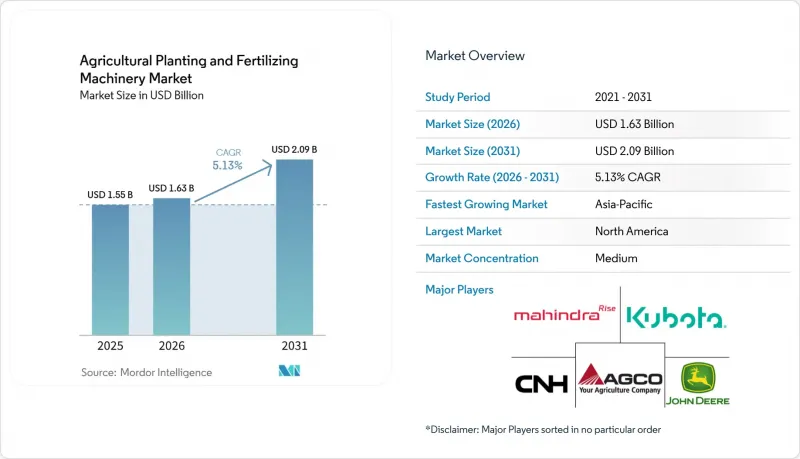
파종·시비 기계 시장 규모는 2025년에 15억 5,000만 달러로 평가되며, 2026년 16억 3,000만 달러에서 2031년까지 20억 9,000만 달러에 달할 것으로 예측되고 있으며, 예측 기간(2026-2031년)에 CAGR은 5.13%에 달할 전망입니다.
이 보고서는 유형별(파종 기계 및 시비 기계) 및 지역별(북미, 유럽, 아시아태평양, 남미, 중동 및 아프리카)로 분류되어 있습니다. 시장 전망은 금액(달러) 기준으로 제시되어 있습니다.
전 세계 파종·비료 살포 기계 시장의 동향 및 인사이트
농업 노동력 감소
파종·비료 살포 기계 시장은 주요 농업 지역 전반에 걸쳐 노동력 공급이 부족해지고 있는 상황에서 직접적인 호재를 받고 있습니다. 미국 농무부(USDA) 경제조사국에 따르면 H-2A 인증 고용 정원은 2005 회계연도의 약 4만 8,000건에서 2024 회계연도에는 약 38만 5,000건으로 증가한 반면,미국 농업통계국(USDA)은 2024년 고용 노동자의 평균 농업 총임금을 시간당 19.10달러로 보고했습니다. 그 결과, 농가에서는 노동력에 대한 의존도를 낮추고 제한된 파종 기간을 확보할 수 있는 파종기, 공압식 파종기, 모종 심기 기계, 비료 살포기를 더욱 중시하게 되었습니다.
농업기계화율의 향상
또한 일부 농산물 생산국에서 농업기계화율이 지속적으로 상승함에 따라 파종·비료 살포 기계 시장도 확대되고 있습니다. 이러한 추세는 아시아에서 특히 두드러지며, 정책 지원, 기계 금융 프로그램 및 계약 고용 모델이 농가가 기본적인 트랙터 도입에 그치지 않고 파종 및 비료 살포 효율을 높이는 더 정교한 농장용 장비로 전환하도록 지원하고 있습니다. 중국과 인도는 양국 모두 농업기계의 현대화와 정밀농업 노력을 지속적으로 지원하고 있으며, 이러한 전환 과정에서 여전히 중심적인 역할을 수행하고 있습니다. 그 결과, 파종·시비 기계 시장은 특히 한 번의 작업 주기 내에서 파종과 시비를 결합한 기기의 경우, 더 광범위한 잠재 고객층으로부터 혜택을 받고 있습니다.
높은 초기 설비 투자 비용
파종·시비 기계 시장은 여전히 높은 초기 설비 비용이라는 가장 큰 장벽에 직면해 있습니다. 'South African Journal of Plant and Soil'지에 2025년에 게재된 연구에서는 높은 초기 투자 비용이 정밀농업 도입의 주요 장벽이라고 지적하고 있습니다. 또한 2025년 'Frontiers in Sustainable Food Systems'지에 발표된 브라질 관련 연구에 따르면 리우그란데두술 주의 조사 대상 농가 중 64.6%가 여전히 정밀농업 기술을 도입하지 않은 것으로 밝혀졌습니다. 보조금 제도를 이용할 수 있는 경우에도 농가는 여전히 몇 시즌 치의 영업이익을 모두 소진할 수도 있는 막대한 자기 부담 비용에 직면하는 경우가 많습니다. 이러한 비용상의 제약으로 인해 특히 기계화 여지가 여전히 높은 시장에서 첨단 파종기, 모종 이식기, 비료 살포기의 보급이 제한되고 있습니다.
부문 분석
2025년 파종·비료 살포용 농업기계 시장에서 파종기는 시장 점유율의 60.4%를 차지하며, 본 조사 범위 내에서 가장 큰 제품 카테고리가 되었습니다. 이 카테고리가 선두를 유지하고 있는 이유는 곡물, 지방종자, 두류, 쌀, 원예 시스템에 관계없이 파종과 작물 심기가 여전히 보편적인 밭작업으로 남아 있는 한편, 파종기가 다양한 토양 조건과 농장 규모에서 가장 적응성이 높은 기계 유형으로 자리 잡고 있기 때문입니다. 또한 생산자들이 발아의 균일성, 고랑 간격의 정확성, 중첩 부분의 감소를 더욱 중요시함에 따라 고부가가치 줄 재배 시스템에서 정밀 파종기 및 공압식 파종기도 그 입지를 공고히 하고 있습니다.
비료 살포 기계는 2026-2031년까지 연평균 성장률(CAGR) 6.7%를 기록하며 가장 빠르게 성장하는 제품 카테고리가 될 것으로 예측됩니다. 이는 파종·비료 살포 기계 시장에서 영양 효율의 중요성이 높아지고 있음을 반영합니다. 가변 시비량형 살포기, 조내 시비기 및 종자·비료 겸용 파종기는 농가가 밭 작업 횟수를 줄이고, 영양소 공급 시기를 개선하며, 디젤 연료 소비량을 절감하는 동시에 작물의 뿌리권과 더 가까운 위치에 영양소를 공급할 수 있게 해줍니다. Deere &Company사는 2026년 및 2027년형 파종기를 위해 ExactShot을 통한 줄내 비료 시비와 ExactRate를 통한 줄 가장자리 비료 시비를 결합한 듀얼 비료 시스템을 발표하며 이러한 방향성을 제시했습니다. 이를 통해 줄내 영양소 투입량을 최대 66%까지 줄일 수 있게 됩니다. 나머지 시장 기회는 여전히 비용에 민감한 지역의 기계식 파종기나 주류 파종기에 집중되어 있지만, 전반적인 가치 구조는 파종과 시비를 통합한 시스템으로 꾸준히 전환되고 있습니다.
지역별 분석
2025년, 북미는 전 세계 파종·시비 기계 시장 가치의 35.0%를 차지했으나, 아시아태평양은 2026-2031년에 7.7%라는 가장 높은 연평균 성장률(CAGR)을 보일 것으로 예측됩니다. 북미가 주도적인 위치를 유지하고 있는 것은 대규모 줄 재배 농업의 운영, 잘 구축된 딜러 네트워크, 그리고 상업적 파종 활동 전반에 걸친 가이던스 시스템, 셧오프 기능 및 정밀 시비 시스템의 보급이 진행되고 있기 때문입니다. 미국 농무부 자연자원보전국은 2025년 12월, 7억 달러 규모의 ‘재생 농업 시범 프로그램’을 통해 추가적인 수요 신호를 보였습니다. 이 프로그램은 무경운 재배 시스템 및 영양 관리 개선 등 재생 농업 실천을 지원하는 것입니다. 아시아태평양이 더욱 빠르게 성장하고 있는 이유는 중국과 인도가 보조금 프로그램, 스마트 농업기계로의 교체, 그리고 장비 접근성 확대를 통해 기계화를 지속적으로 지원하고 있으며, 파종 및 비료 시비 작업 전반에 걸친 기계화가 심화되고 있기 때문입니다.
남미는 여전히 중요한 성장 요인으로 작용하고 있습니다. 이는 브라질의 대두와 옥수수 이모작 시스템에서 제한된 계절 기간 내에 광대한 농지를 커버할 수 있는 대용량 파종기 및 비료 살포기가 필요하기 때문입니다. 유럽에서는 특히 독일, 프랑스, 영국에서 농장들이 더욱 정밀한 파종 및 시비 시스템으로 지속적으로 전환함에 따라 장비 교체 및 업그레이드 수요가 두드러지고 있습니다. 덴마크에서는 2023년 모든 재배 지역에서 정밀농업 기술의 보급률이 높은 것으로 보고되어, 유럽의 선진 지역이 초기 도입 단계를 벗어나 시스템의 정교화와 지속적인 업그레이드로 전환하고 있는 실태가 부각되고 있습니다. 중동 및 아프리카는 여전히 시장 규모가 작지만, 두 지역 모두 식량안보 노력, 사막 농업에 대한 투자, 그리고 소유 장벽을 낮추는 종량제 기계화 모델을 통해 새로운 수요를 창출하고 있습니다.
파종·비료 살포 기계 시장은 성숙한 경제권에서의 교체 수요와 발전 중인 농업 시스템에서의 초기 도입에 힘입어 지역별로 확대될 것으로 예상됩니다. 북미 및 유럽에서는 향후 성장이 주로 프리미엄 열 단위 유닛의 업그레이드, 가변 시비 플랫폼, 그리고 농장이 생산성과 투입 비용을 보다 효율적으로 관리할 수 있도록 지원하는 통합형 디지털 생태계에 의해 주도될 전망입니다. 아시아태평양, 아프리카 및 남미 일부에서는 시장 확대가 지속적인 보조금, 저렴한 자금 조달, 그리고 기계의 사용과 소유를 분리하는 서비스 기반 접근 모델에 크게 의존하게 될 것입니다. 이러한 지역별 구성을 통해 파종 및 시비 기계 시장은 선진국에서의 고부가가치 기술 판매와 신흥 농업 지역에서의 광범위한 기계 도입 사이에서 균형을 유지할 것으로 예상됩니다.
기타 혜택:
- 엑셀 형식의 시장 예측(ME) 시트
- 3개월간 애널리스트 지원
자주 묻는 질문
목차
제1장 서론
제2장 조사 방법
제3장 개요
제4장 시장 구도
제5장 시장 규모와 성장 예측
제6장 경쟁 구도
제7장 시장 기회와 향후 전망
KSA 26.08.25According to Mordor Intelligence, the agricultural planting and fertilizing machinery market size was valued at USD 1.55 billion in 2025 and estimated to grow from USD 1.63 billion in 2026 to reach USD 2.09 billion by 2031, at a CAGR of 5.13% during the forecast period (2026-2031).
This report is Segmented by Type (Planting Machinery and Fertilizing Machinery) and Geography (North America, Europe, Asia-Pacific, South America, Middle East, and Africa). The Market Forecasts are Provided in Terms of Value (USD).
Global Agricultural Planting and Fertilizing Machinery Market Trends and Insights
Decline in Farm Labor Availability
The agricultural planting and fertilizing machinery market is gaining direct support from tighter labor availability across major farming regions. The United States Department of Agriculture (USDA) Economic Research Service showed that H-2A certified positions rose from nearly 48,000 in fiscal 2005 to about 385,000 in fiscal 2024, while the National Agricultural Statistics Service reported average gross farm wages for hired workers at USD 19.10 per hour in 2024. As a result, farms are placing greater value on seed drills, pneumatic planters, transplanters, and fertilizer applicators that reduce labor dependence and protect narrow planting windows.
Increased Farm Mechanization Rates
The agricultural planting and fertilizing machinery market is also expanding because farm mechanization rates continue to rise across several crop-producing economies. The trend is particularly visible in Asia, where policy support, machinery financing programs, and custom-hiring models are helping farmers move beyond basic tractor adoption toward more advanced field equipment that improves seeding and fertilizer placement efficiency. China and India remain central to this transition because both countries continue to support agricultural machinery modernization and precision farming initiatives. As a result, the agricultural planting and fertilizing machinery market is benefiting from a broader addressable customer base, particularly for equipment that combines planting and fertilizer application within a single operating cycle.
High Initial Equipment Investment
The agricultural planting and fertilizing machinery market still faces its strongest barrier in the form of high upfront equipment cost. A 2025 study published in the South African Journal of Plant and Soil identified high initial investment cost as a major barrier to precision agriculture adoption, while a 2025 Frontiers in Sustainable Food Systems study in Brazil found that 64.6% of surveyed farmers in Rio Grande do Sul remained non-adopters of precision agriculture technologies. Even when subsidy programs are available, farmers often continue to face meaningful co-payment burdens that can consume multiple seasons of operating margin. This cost constraint limits penetration of advanced planters, transplanters, and fertilizer applicators, particularly in markets where mechanization potential remains high.
Other drivers and restraints analyzed in the detailed report include:
- Growing Adoption of Precision Agriculture
- Government Subsidies And Low-Interest Credit Lines
- Semiconductor Tariff and Sensor Supply Volatility
For complete list of drivers and restraints, kindly check the Table Of Contents.
Segment Analysis
Planting Machinery accounted for 60.4% of the agricultural planting and fertilizing machinery market share in 2025, making it the largest product category across the report scope. The category maintains its lead because seeding and crop establishment remain universal field operations across cereals, oilseeds, pulses, rice, and horticulture systems, while seed drills remain the most adaptable machine type across varying soil conditions and farm sizes. Precision and pneumatic planters are also strengthening their position in high-value row-crop systems as growers place greater emphasis on emergence uniformity, row accuracy, and overlap reduction.
Fertilizing Machinery is projected to be the fastest-growing product category with a CAGR of 6.7% during 2026-2031, reflecting the rising importance of nutrient efficiency within the agricultural planting and fertilizing machinery market. Variable-rate spreaders, in-furrow applicators, and seed-cum-fertilizer drills help farms reduce field passes, improve nutrient timing, and lower diesel consumption while placing nutrients closer to the crop root zone. Deere & Company demonstrated this direction in 2026 when it introduced a dual-product fertilizer system for 2027 model-year planters that combines ExactShot in-furrow application with ExactRate alongside-the-row placement, enabling up to 66% savings in in-furrow nutrient input. The remaining market opportunity continues to center on mechanical drills and mainstream planters in cost-sensitive regions, although the overall value mix is steadily shifting toward integrated planting and fertilizing systems.
Complete Report Scope:
- By Type
- Planting Machinery
- Seed Drills
- Planters
- Transplanters
- Fertilizing Machinery
- Seed-cum-Fertilizer Drills
- Fertilizer Spreaders
- Liquid and Starter Fertilizer Applicators
- Planting Machinery
- By Geography
- North America
- United States
- Canada
- Mexico
- Rest of North America
- South America
- Brazil
- Argentina
- Rest of South America
- Europe
- Germany
- United Kingdom
- France
- Italy
- Spain
- Russia
- Rest of Europe
- Asia-Pacific
- China
- India
- Japan
- Australia
- Indonesia
- Thailand
- Rest of Asia-Pacific
- Middle East
- Saudi Arabia
- Turkey
- United Arab Emirates
- Rest of Middle East
- Africa
- South Africa
- Nigeria
- Egypt
- Rest of Africa
- North America
Geography Analysis
North America accounted for 35.0% of the global agricultural planting and fertilizing machinery market value in 2025, while Asia-Pacific is projected to record the fastest CAGR of 7.7% during 2026-2031. North America maintains its leadership because of large row-crop farming operations, well-developed dealer networks, and deeper penetration of guidance, shutoff, and precision nutrient application systems across commercial planting activities. The United States Department of Agriculture Natural Resources Conservation Service added another demand signal in December 2025 through its USD 700 million Regenerative Pilot Program, which supports regenerative farming practices, including no-till systems and improved nutrient management. Asia-Pacific is expanding more rapidly because China and India continue to support mechanization through subsidy programs, upgrades to intelligent machinery, and broader access to equipment, thereby deepening mechanization across planting and fertilizing operations.
South America remains an important growth contributor because Brazil's soybean and corn double-crop systems require high-capacity planters and fertilizer spreaders capable of covering large field areas within narrow seasonal windows. Europe is characterized more by replacement and upgrade demand, particularly in Germany, France, and the United Kingdom, where farms continue shifting toward more precise drilling and nutrient application systems. Denmark reported high penetration of precision agriculture technologies across crop areas in 2023, highlighting how advanced parts of Europe are moving beyond initial adoption toward system refinement and repeat upgrades. The Middle East and Africa remain smaller in scale, though both regions are generating new demand through food security initiatives, desert farming investments, and pay-per-use mechanization models that reduce ownership barriers.
The agricultural planting and fertilizing machinery market is anticipated to expand regionally, driven by replacement demand in mature economies and first-time adoption in developing agricultural systems. In North America and Europe, future growth is likely to be driven primarily by premium row-unit upgrades, variable-rate fertilizer platforms, and integrated digital ecosystems that help farms manage productivity and input costs more efficiently. Across Asia-Pacific, Africa, and parts of South America, expansion will depend more on subsidy continuity, affordable financing, and service-based access models that separate machinery usage from ownership. This regional mix is anticipated to keep the agricultural planting and fertilizing machinery market balanced between high-value technology sales in developed economies and broader unit adoption across emerging farming regions.
- Deere & Company
- CNH Industrial N.V.
- AGCO Corporation
- Kubota Corporation
- Mahindra & Mahindra Limited
- CLAAS KGaA mbH
- Bucher Industries AG
- Maschio Gaspardo S.p.A.
- Vaderstad AB
- Kinze Manufacturing, Inc.
- HORSCH Maschinen GmbH
- AMAZONEN-WERKE H. DREYER SE & Co. KG
- Bourgault Industries Ltd.
- Topcon Positioning Systems, Inc. (Topcon Corporation)
- LEMKEN GmbH & Co. KG
Additional Benefits:
- The market estimate (ME) sheet in Excel format
- 3 months of analyst support
TABLE OF CONTENTS
1 Introduction
- 1.1 Study Assumptions and Market Definition
- 1.2 Scope of the Study
2 Research Methodology
3 Executive Summary
4 Market Landscape
- 4.1 Market Overview
- 4.2 Market Drivers
- 4.2.1 Decline in farm labor availability
- 4.2.2 Increased farm mechanization rates
- 4.2.3 Growing adoption of precision agriculture
- 4.2.4 Government subsidies and low-interest credit lines
- 4.2.5 Agriculture-Technology-as-a-Service equipment access models
- 4.2.6 Regenerative-farming carbon-credit incentives for precision input placement
- 4.3 Market Restraints
- 4.3.1 High initial equipment investment
- 4.3.2 Complex operation and maintenance requirements
- 4.3.3 Semiconductor tariff and sensor supply volatility
- 4.3.4 Data privacy and cybersecurity concerns around connected machinery
- 4.4 Regulatory Landscape
- 4.5 Technological Outlook
- 4.6 Porter's Five Forces
- 4.6.1 Bargaining Power of Suppliers
- 4.6.2 Bargaining Power of Buyers
- 4.6.3 Threat of New Entrants
- 4.6.4 Threat of Substitute Products
- 4.6.5 Intensity of Competitive Rivalry
5 Market Size and Growth Forecasts (Value, USD)
- 5.1 By Type
- 5.1.1 Planting Machinery
- 5.1.1.1 Seed Drills
- 5.1.1.2 Planters
- 5.1.1.3 Transplanters
- 5.1.2 Fertilizing Machinery
- 5.1.2.1 Seed-cum-Fertilizer Drills
- 5.1.2.2 Fertilizer Spreaders
- 5.1.2.3 Liquid and Starter Fertilizer Applicators
- 5.1.1 Planting Machinery
- 5.2 By Geography
- 5.2.1 North America
- 5.2.1.1 United States
- 5.2.1.2 Canada
- 5.2.1.3 Mexico
- 5.2.1.4 Rest of North America
- 5.2.2 South America
- 5.2.2.1 Brazil
- 5.2.2.2 Argentina
- 5.2.2.3 Rest of South America
- 5.2.3 Europe
- 5.2.3.1 Germany
- 5.2.3.2 United Kingdom
- 5.2.3.3 France
- 5.2.3.4 Italy
- 5.2.3.5 Spain
- 5.2.3.6 Russia
- 5.2.3.7 Rest of Europe
- 5.2.4 Asia-Pacific
- 5.2.4.1 China
- 5.2.4.2 India
- 5.2.4.3 Japan
- 5.2.4.4 Australia
- 5.2.4.5 Indonesia
- 5.2.4.6 Thailand
- 5.2.4.7 Rest of Asia-Pacific
- 5.2.5 Middle East
- 5.2.5.1 Saudi Arabia
- 5.2.5.2 Turkey
- 5.2.5.3 United Arab Emirates
- 5.2.5.4 Rest of Middle East
- 5.2.6 Africa
- 5.2.6.1 South Africa
- 5.2.6.2 Nigeria
- 5.2.6.3 Egypt
- 5.2.6.4 Rest of Africa
- 5.2.1 North America
6 Competitive Landscape
- 6.1 Market Concentration
- 6.2 Strategic Moves
- 6.3 Market Share Analysis
- 6.4 Company Profiles (Includes Global level Overview, Market level Overview, Core Segments, Financials as Available, Strategic Information, Market Rank/Share for key companies, Products & Services, and Recent Developments)
- 6.4.1 Deere & Company
- 6.4.2 CNH Industrial N.V.
- 6.4.3 AGCO Corporation
- 6.4.4 Kubota Corporation
- 6.4.5 Mahindra & Mahindra Limited
- 6.4.6 CLAAS KGaA mbH
- 6.4.7 Bucher Industries AG
- 6.4.8 Maschio Gaspardo S.p.A.
- 6.4.9 Vaderstad AB
- 6.4.10 Kinze Manufacturing, Inc.
- 6.4.11 HORSCH Maschinen GmbH
- 6.4.12 AMAZONEN-WERKE H. DREYER SE & Co. KG
- 6.4.13 Bourgault Industries Ltd.
- 6.4.14 Topcon Positioning Systems, Inc. (Topcon Corporation)
- 6.4.15 LEMKEN GmbH & Co. KG


