

|
시장보고서
상품코드
2113713
배열회수보일러 : 시장 점유율 분석, 업계 동향과 통계, 성장 예측(2026-2031년)Heat Recovery Steam Generator - Market Share Analysis, Industry Trends & Statistics, Growth Forecasts (2026 - 2031) |
||||||
 Mordor Intelligence
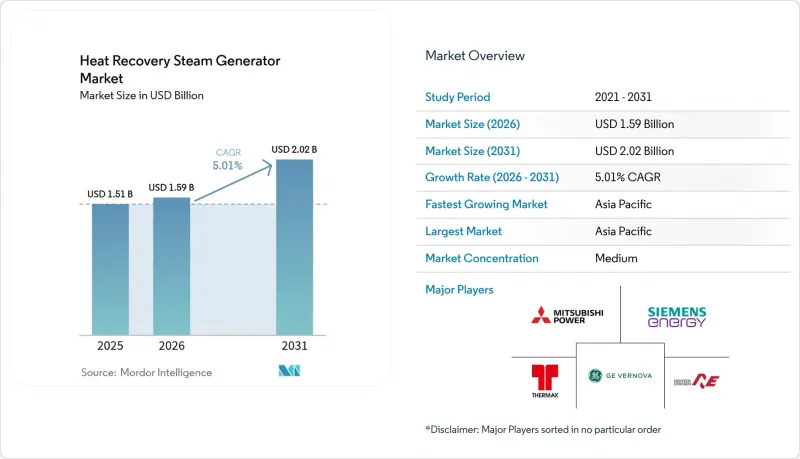
배열회수보일러 시장 규모는 2025년 15억 1,000만 달러에서 2026년에는 15억 9,000만 달러로 확대하며, 2026-2031년에 CAGR 5.01%로 추이하며, 2031년에는 20억 2,000만 달러에 달할 것으로 예측됩니다.
이 보고서는 설계별(수평 드럼형 HRSG, 수직 드럼형 HRSG 및 원패스형 HRSG), 최종사용자별(발전소, 석유 및 가스 시설, 화학·비료 공장, 금속·광업, 펄프·제지, 기타),지역별(북미, 유럽, 아시아태평양, 남미, 중동 및 아프리카)로 분류되어 있습니다. 시장 규모 및 전망은 금액(달러) 기준으로 제시되어 있습니다.
전 세계 배열 회수 보일러 시장의 동향 및 인사이트
CCGT 설비 용량 확대 계획
전 세계 개발 사업자들은 2028년까지 미국에서 18.7 GW를 초과하는 신규 복합 사이클 발전 용량의 가동을 예상하고 있으며, 사우디아라비아, 카타르, 중국에서도 병행하여 수 기가와트 규모의 프로젝트가 진행되고 있습니다. 프로젝트 후원사들은 수소 대응 터빈에서 발생하는 더 넓은 배기 가스 온도 범위에 대응하고, 배기 가스 재순환(EGR)을 통합하여 탄소 포집 비용을 6% 절감할 수 있는 HRSG를 지정하고 있습니다. 터빈의 수주 잔고가 2029년까지 이어지고 있는 만큼, 전력 회사들은 조기에 설비를 발주하고 있으며, 자체 모듈 제조 능력을 갖춘 공급업체로 경쟁 우위가 이동하고 있습니다. 견실한 파이프라인 덕분에 배열 회수 보일러 시장에는 향후 수년간의 수익 전망이 서 있지만, 일정상의 위험은 여전히 터빈 공급 상황과 자금 조달 진행 상황에 좌우됩니다. 소유주가 신속한 가동 개시, 부분 부하 시의 효율, 그리고 수소 함량이 높은 연소 가스 조건에서의 재료 내구성을 요구함에 따라 설계의 복잡성은 증가하는 추세입니다.
산업 부문의 배출 감축 규제
미국 환경보호청(EPA)은 현재 장기간 가동중인 석탄 화력 발전소 및 신규 베이스로드용 가스 화력 발전소에 대해 2032년까지 CO₂ 배출량을 90% 감축할 것을 의무화하고 있으며, 이에 따라 산업 단지에서는 HRSG 기술을 핵심으로 하는 열병합 발전소의 개보수 및 신설이 진행되고 있습니다. 독일의 BASF사가 건설한 160MW 규모의 히트펌프·증기 복합 시설로 대표되는 유럽 화학 제조업체의 사례는 이러한 규제가 환경 규정 준수를 에너지 효율화 투자로 전환시키는 구조를 여실히 보여주고 있습니다. 넷 제로(Net Zero)를 향한 길을 모색하는 시설에서는 공정용 증기와 용매 기반 회수 장치 모두에 공급하는 3중 압력 HRSG가 도입되고 있습니다. 화학 및 비료 제조업체들은 아민 재생 부하에 대응할 수 있는 구성을 모색하고 있으며, 이를 통해 처리 능력을 저해하지 않으면서 규제를 준수할 수 있게 되었습니다. 허가 취득 및 기술 통합을 조기에 확립한 선구자들은 전체 수명 주기 동안의 규정 준수 비용 절감과 탄소 크레딧을 통한 잠재적 수익 증대라는 혜택을 누리고 있습니다.
대안과 비교한 높은 설비 투자액과 긴 회수 기간
트리플 프레스처 HRSG를 장착한 일반적인 CCGT는 오픈 사이클 발전소보다 1MW당 25만 달러 더 비싸며, 가동률이 낮은 전력망에서는 투자 회수 기간이 8-12년으로 늘어납니다. 동남아시아와 아프리카의 개발 사업자들은 더 높은 자금 조달 스프레드에 직면해 있으며, 효율은 낮지만 저렴한 OCGT 세트로 조달하는 경향이 강해지고 있습니다. 따라서 폐열 회수 보일러 시장의 성장은 용량 지급 제도나 에너지 효율 향상 인센티브를 제공하는 지역에서 촉진되는 경향이 있습니다. 다자간 금융기관은 그린본드 체계를 통해 자금 조달 격차 해소를 도모하고 있으나, 자금 이체 시기의 지연으로 인해 수주 지연이 발생할 가능성이 있습니다.
부문 분석
원스루형 HRSG는 여전히 소수이지만, 2031년까지 연평균 성장률(CAGR) 6.46%로 성장할 것으로 예측됩니다. 한편, 드럼형 시스템은 2025년 매출의 58.12%를 차지했습니다. 수평 드럼형 유닛은 안정적인 증기 순도와 입증된 내구성을 제공하므로 베이스로드용 CCGT 블록에서 여전히 지배적인 위치를 유지하고 있습니다. 수직 드럼형은 특히 정유소 내부 등 공간이 제한된 개조 현장에서 활용되고 있습니다. 원스루형 폐열 회수 보일러 시장 규모는 2026년 4억 9,000만 달러에서 2031년까지 6억 7,000만 달러로 확대될 것으로 예상되며, 이에 따라 공급업체들은 퀵스타트 구조에 대한 투자를 강화하고 있습니다. 30분 미만의 시동 시간 덕분에 플랜트 운영자는 피크 시간대의 가격대를 정확하게 포착할 수 있지만, 드럼식 시스템에서는 여전히 평균 60분에서 90분이 소요됩니다. 수소 혼합 연료를 사용한 파일럿 시험에서는 원패스식 관 회로에서 염화물에 의한 응력 부식이 감소하는 것으로 나타났으며, 이 설계는 향후 연료 전환에 대한 대비책으로 자리매김하고 있습니다. 그러나 수질 요건은 여전히 엄격하여, 플랜트 소유주들은 터빈 블레이드를 보호하기 위해 응축수 정제 스키드에 대한 투자를 진행하고 있습니다.
800MW를 초과하는 메가 스케일의 CCGT 프로젝트에서는 익숙한 레이아웃과 규모의 경제가 중시되는 경향이 있으므로, 수평 드럼식 HRSG가 배열열 회수 보일러 시장의 대부분을 계속 차지할 것으로 보입니다. 각 OEM 업체들은 태국의 5,300MW M701JAC 클러스터에서 입증된 바와 같이, 3단 압력 시스템과 재열 시스템을 결합하여 복합 사이클의 순효율을 64% 이상으로 극대화하도록 설계하고 있습니다. 3D 프린팅을 통한 저압 이코노마이저 핀 및 첨단 T91 강철 헤더 등의 개선을 통해 사이클에 따른 피로가 경감되어, 그 결과 점검 주기가 연장됩니다. 예측 기간 중 스마트한 재 제거 및 적외선을 이용한 튜브 모니터링과 같은 단계적인 업그레이드를 통해 중규모 발전소에서 일회통과식 유닛이 보급되더라도 드럼형 구성의 경쟁 제품의 수명이 연장될 것입니다.
지역별 분석
아시아태평양은 시장 점유율과 성장 속도 양면에서 계속해서 주도적인 위치를 차지하고 있습니다. 이 지역은 2025년 전 세계 매출의 42.55%를 차지할 것이며, 5.73%의 연평균 성장률(CAGR)에 힘입어 2031년까지 2억 2,000만 달러의 매출 증가가 예상됩니다. 이는 중국, 인도, 베트남, 태국에서 진행 중인 수 기가와트 규모의 CCGT 확장 계획에 힘입은 결과입니다. 중국 후이저우(Huizhou)에 위치한 수소 대응 열병합 발전 블록은 첨단 핀 튜브 합금을 채택한 원스루(once-through)형 HRSG를 통합함으로써, 개발자가 자산을 수소 연소율 50%에 대응할 수 있도록 미래성을 확보한 좋은 사례입니다. 인도의 국가 수소 미션은 구자라트주 및 오디샤주에서 듀얼 연료 터빈을 이용한 열병합 발전 설비의 개보수 공사 가동을 지원하고 있습니다. 일본의 설비 갱신 프로젝트에서는 현지 조달 인센티브의 지원도 있으며, 브라운필드 계통 조정 플랜트용으로 소형 수직 드럼형 HRSG가 선호되고 있습니다.
북미에서는 설비 갱신 주기와 배출 기준을 활용하여 수요를 유지하고 있습니다. 미국 환경보호청(EPA)의 CO₂ 배출량 90% 감축 규정에 따라 용매 재생 열교환기용 예비 패드가 장착된 CCGT-HRSG 블록을 이용한 석탄 화력 발전소의 리파워링이 가속화되고 있습니다. 미국 멕시코만 연안의 정유소에서는 LNG 가격 변동 및 탄소 가격 책정안에 대한 헤지 수단으로, 항공기 유래 터빈에 직통식 HRSG를 채택하고 있습니다. 캐나다 앨버타주에 위치한 산업용 탄소 포집 허브에서는 연소 후 포집을 통합한 폐기물 에너지화 플랜트를 위해 HRSG 공급업체와 계약을 체결하여 비전력 분야에서의 활용 사례를 확대하고 있습니다.
유럽에서는 고효율이며 수소 혼입이 가능한 HRSG를 통해 탈탄소화를 추진하고 있습니다. 독일에서 대책이 없는 석탄 화력 발전의 단계적 폐지에 따라 전력 사업자들은 회수 대응을 염두에 둔 배가스 재순환 기능을 갖춘 삼중압·재열 시스템을 발주하고 있습니다. 네덜란드에서는 온실 원예 분야의 열병합발전(CHP) 설비 업그레이드를 장려하고 있으며, 소형 프레임 터빈과 결합된 소형 이중압식 HRSG를 위한 틈새 시장이 열리고 있습니다. 그러나 아시아의 압력 부품 제조업체에 대한 공급망 의존도가 높기 때문에 유럽 프로젝트는 물류 지연 위험에 노출되어 있으며, 현지에서의 모듈 조립에 대한 관심이 높아지고 있습니다.
중동에서는 ‘비전 2030’ 및 산업 다각화와 관련하여 수주가 가속화되고 있습니다. 사우디아라비아의 7.2GW CCGT 계획에서는 용매 재생에 대응하기 위해 정격 46 bar의 저압 증기를 처리하는 탄소 포집 대응 HRSG가 지정되어 있으며, 기존의 증발기 뱅크를 뛰어넘는 설계의 고도화가 시사되고 있습니다. 카타르의 노스필드 LNG 확장 프로젝트에서는 모듈 통합을 극대화하기 위해 항공기 파생형 터빈에 소형 HRSG를 채택하고 있습니다. 아랍에미리트(UAE)의 전력 회사는 98%의 가동률을 보장하는 서비스 계약을 중시하고 있으며, 이를 통해 OEM 제조사에 애프터서비스 수익이 창출되고 있습니다.
남미와 아프리카는 여전히 발전 단계에 있지만, 미래성이 기대되고 있습니다. 브라질에서는 태양광 및 풍력발전을 보완하기 위한 가스 화력 발전 용량 입찰이 진행되고 있으며, 그 중에는 현지 조달 규정을 충족하기 위해 현지에서 제조된 수직 드럼형 HRSG가 설치된 바이아 주의 발전소도 포함되어 있습니다. 나이지리아와 모잠비크에서는 산업단지를 위한 소형 CCGT 패키지에 대한 평가가 진행 중이지만, 자금 조달 문제는 여전히 남아 있습니다. 그럼에도 불구하고 해당 지역의 가스 매장량이 발견됨에 따라 인프라가 정비된다면 두 대륙은 장기적인 성장 유망 지역이 될 전망입니다.
기타 혜택:
- 엑셀 형식의 시장 예측(ME) 시트
- 3개월간의 애널리스트 지원
자주 묻는 질문
목차
제1장 서론
제2장 조사 방법
제3장 개요
제4장 시장 구도
제5장 시장 규모와 성장 예측
제6장 경쟁 구도
제7장 시장 기회와 향후 전망
KSA 26.08.25According to Mordor Intelligence, the heat recovery steam generator market size is expected to grow from USD 1.51 billion in 2025 to USD 1.59 billion in 2026 and is forecast to reach USD 2.02 billion by 2031 at 5.01% CAGR over 2026-2031.
This report is Segmented by Design (Horizontal Drum HRSG, Vertical Drum HRSG, and Once-Through HRSG), End User (Power Plants, Oil and Gas Facilities, Chemical and Fertilizer Plants, Metal and Mining, Pulp and Paper, and More), and Geography (North America, Europe, Asia-Pacific, South America, and Middle East and Africa). The Market Sizes and Forecasts are Provided in Terms of Value (USD).
Global Heat Recovery Steam Generator Market Trends and Insights
Expansion of CCGT Capacity Pipeline
Global developers anticipate commissioning more than 18.7 GW of new combined-cycle capacity in the United States by 2028, with parallel multigigawatt programs also advancing in Saudi Arabia, Qatar, and China. Project sponsors are specifying HRSGs that tolerate wider exhaust-gas temperatures from hydrogen-capable turbines and integrate exhaust-gas recirculation to cut carbon-capture costs by 6%. As turbine backlogs extend to 2029, utilities are placing early equipment orders, shifting the competitive advantage toward vendors with captive module fabrication capabilities. The robust pipeline provides multi-year revenue visibility for the heat recovery steam generator market, although schedule risk remains tied to turbine availability and financing milestones. Design complexity is trending upward because owners demand rapid starts, part-load efficiency, and materials resilience under high-hydrogen combustion gases.
Industrial Emission-Reduction Mandates
The US Environmental Protection Agency now requires 90% CO2 abatement for long-run coal and new baseload gas plants by 2032, prompting industrial campuses to retrofit or build cogeneration plants centered on HRSG technology. European chemical producers, exemplified by BASF's 160 MW heat-pump-steam complex in Germany, illustrate how mandates convert environmental compliance into energy-efficiency investments. Facilities pursuing net-zero pathways incorporate triple-pressure HRSGs that feed both process steam and solvent-based capture units. Chemical and fertilizer operators seek configurations compatible with amine regeneration loads, enabling them to comply without jeopardizing throughput. Early movers who master permitting and technology integration benefit from lower lifetime compliance costs and potential carbon credit upside.
High CAPEX & Long Pay-Back vs Alternatives
The typical CCGT equipped with a triple-pressure HRSG costs USD 0.25 million per MW more than an open-cycle plant, extending payback periods to 8-12 years in low-capacity-factor grids. Developers in Southeast Asia and Africa face higher financing spreads, tilting procurement toward less efficient but cheaper OCGT sets. Growth in the heat recovery steam generator market, therefore, tends to favor jurisdictions that offer capacity payments or energy-efficiency incentives. Multilateral lenders attempt to bridge the gap with green-bond frameworks, yet disbursement timelines can delay order intake.
Other drivers and restraints analyzed in the detailed report include:
- Operational-Cost Pressure in O&G & Chemicals
- CO2-Capture Integration Boosting Low-Pressure Steam Demand
- Gas-Price Volatility Dampening CCGT FIDs
For complete list of drivers and restraints, kindly check the Table Of Contents.
Segment Analysis
Once-through HRSGs, although still a minority, are projected to grow at a 6.46% CAGR through 2031, while drum-type systems accounted for 58.12% of the 2025 revenue. Horizontal drum units retain dominance in base-load CCGT blocks because they provide consistent steam purity and proven durability. Vertical drums serve space-constrained retrofit sites, particularly inside refineries. The heat recovery steam generator market size for once-through units is projected to rise from USD 0.49 billion in 2026 to USD 0.67 billion by 2031, reinforcing supplier focus on quick-start architectures. Startup curves of under 30 minutes enable plant operators to chase peak pricing windows, whereas drum systems still average 60 to 90 minutes. Hydrogen-blend pilots indicate lower chloride-induced stress corrosion on once-through tube circuitry, positioning the design as a hedge against future fuel shifts. That said, water-quality demands remain stringent; owners are investing in condensate polishing skids to safeguard turbine blades.
Horizontal drum HRSGs will continue to dominate the larger slice of the heat recovery steam generator market, as mega-scale CCGT projects exceeding 800 MW tend to opt for familiar layouts and economies of scale. OEMs package triple-pressure with reheat trains to maximize combined-cycle output beyond 64% net efficiency, as validated by Thailand's 5,300 MW M701JAC cluster. Enhancements, such as 3D-printed low-pressure economizer fins and advanced T91 steel headers, mitigate fatigue from cycling, thereby extending service intervals. Over the forecast horizon, incremental upgrades ask smart soot-blowing and infrared tube monitoring will prolong the competitive life of drum configurations, even as once-through units proliferate in mid-merit plants.
Complete Report Scope:
- By Design
- Horizontal Drum HRSG
- Vertical Drum HRSG
- Once-Through HRSG
- By End User
- Power Plants
- Oil and Gas Facilities
- Chemical and Fertilizer Plants
- Metal and Mining
- Pulp and Paper
- Other Industrial Users
- By Geography
- North America
- United States
- Canada
- Mexico
- Europe
- Germany
- United Kingdom
- France
- Italy
- NORDIC Countries
- Russia
- Rest of Europe
- Asia-Pacific
- China
- India
- Japan
- South Korea
- ASEAN Countries
- Rest of Asia-Pacific
- South America
- Brazil
- Argentina
- Rest of South America
- Middle East and Africa
- Saudi Arabia
- United Arab Emirates
- South Africa
- Rest of Middle East and Africa
- North America
Geography Analysis
Asia-Pacific continues to headline both market share and growth velocity. The region generated 42.55% of global 2025 revenue, and its 5.73% CAGR promises an incremental USD 0.22 billion by 2031, supported by multi-gigawatt CCGT expansions in China, India, Vietnam, and Thailand. China's Huizhou hydrogen-ready CHP block exemplifies how developers future-proof assets for 50% H2 firing, embedding once-through HRSGs with advanced fin-tube alloys. India's national hydrogen mission is spurring the commissioning of cogeneration retrofits with dual-fuel turbines in Gujarat and Odisha. Japan's fleet-renewal projects favor compact vertical-drum HRSGs for brownfield grid-balancing plants, aided by local content incentives.
North America leverages replacement cycles and emissions standards to sustain demand. The Environmental Protection Agency's 90% CO2 rule accelerates repowering of coal sites with CCGT-HRSG blocks that include spare pads for solvent regeneration exchangers. US Gulf Coast refineries embrace once-through HRSGs on aeroderivative turbines to hedge against LNG price volatility and carbon pricing proposals. Canada's Alberta industrial carbon-capture hub contracts HRSG suppliers for waste-to-energy plants integrating post-combustion capture, expanding non-utility use cases.
Europe pursues decarbonization through high-efficiency, hydrogen-blend-capable HRSGs. Germany's phase-out of unabated coal drives utilities to order triple-pressure, reheat systems with exhaust-gas recirculation for capture readiness. The Netherlands incentivizes combined heat-and-power upgrades in greenhouse horticulture, opening a niche segment for compact two-pressure HRSGs paired with small frame turbines. Supply-chain reliance on Asian pressure-part fabricators, however, exposes European projects to logistics delays, propelling interest in localized module assembly.
The Middle East records accelerating orders linked to Vision 2030 and industrial diversification. Saudi Arabia's 7.2 GW CCGT pipeline specifies carbon-capture-ready HRSGs rated for 46 bar low-pressure steam to accommodate solvent regeneration, signaling design upgrades beyond conventional evaporator banks. Qatar's North Field LNG expansion opts for compact HRSGs on aeroderivative turbines to maximize modular integration. United Arab Emirates utilities emphasize service contracts that guarantee 98% availability, funneling after-sales revenues to OEMs.
South America and Africa remain nascent but promising. Brazil tenders gas-fired thermal capacity to back solar and wind, including Bahia plants fitted with locally fabricated vertical-drum HRSGs to satisfy content rules. Nigeria and Mozambique evaluate small CCGT packages for industrial parks, but financing hurdles persist. Nonetheless, regional gas discoveries position both continents as long-term growth candidates once infrastructure matures.
- General Electric (GE Vernova)
- Siemens Energy AG
- Mitsubishi Power (MHI Group)
- Thermax Ltd.
- Nooter/Eriksen
- Doosan Enerbility
- CMI Energy
- Babcock & Wilcox Enterprises
- NEM Energy (John Cockerill)
- Harbin Boiler Co.
- BHI Co., Ltd.
- Kelvion Holding GmbH
- Alfa Laval AB
- AC BOILERS S.p.A.
- Sofinter S.p.A.
- Vogt Power International
- Struthers Energy & Power
- CMU Energy Solutions
- Mersen S.A.
- HTC Technologies
Additional Benefits:
- The market estimate (ME) sheet in Excel format
- 3 months of analyst support
TABLE OF CONTENTS
1 Introduction
- 1.1 Study Assumptions & Market Definition
- 1.2 Scope of the Study
2 Research Methodology
3 Executive Summary
4 Market Landscape
- 4.1 Market Overview
- 4.2 Market Drivers
- 4.2.1 Expansion of CCGT capacity pipeline
- 4.2.2 Industrial emission-reduction mandates
- 4.2.3 Operational-cost pressure in O&G & chemicals
- 4.2.4 CO?-capture integration boosting low-pressure steam demand
- 4.2.5 Modular LNG plants adopting compact HRSGs
- 4.2.6 Data-center micro-cogeneration deployment
- 4.3 Market Restraints
- 4.3.1 High CAPEX & long pay-back vs alternatives
- 4.3.2 Gas-price volatility dampening CCGT FIDs
- 4.3.3 Materials corrosion under high-H2 turbine exhaust
- 4.3.4 Limited skilled HRSG fabrication capacity
- 4.4 Supply-Chain Analysis
- 4.5 Regulatory Landscape
- 4.6 Technological Outlook
- 4.7 Porter's Five Forces
- 4.7.1 Bargaining Power of Suppliers
- 4.7.2 Bargaining Power of Buyers
- 4.7.3 Threat of New Entrants
- 4.7.4 Threat of Substitutes
- 4.7.5 Competitive Rivalry
5 Market Size & Growth Forecasts
- 5.1 By Design
- 5.1.1 Horizontal Drum HRSG
- 5.1.2 Vertical Drum HRSG
- 5.1.3 Once-Through HRSG
- 5.2 By End User
- 5.2.1 Power Plants
- 5.2.2 Oil and Gas Facilities
- 5.2.3 Chemical and Fertilizer Plants
- 5.2.4 Metal and Mining
- 5.2.5 Pulp and Paper
- 5.2.6 Other Industrial Users
- 5.3 By Geography
- 5.3.1 North America
- 5.3.1.1 United States
- 5.3.1.2 Canada
- 5.3.1.3 Mexico
- 5.3.2 Europe
- 5.3.2.1 Germany
- 5.3.2.2 United Kingdom
- 5.3.2.3 France
- 5.3.2.4 Italy
- 5.3.2.5 NORDIC Countries
- 5.3.2.6 Russia
- 5.3.2.7 Rest of Europe
- 5.3.3 Asia-Pacific
- 5.3.3.1 China
- 5.3.3.2 India
- 5.3.3.3 Japan
- 5.3.3.4 South Korea
- 5.3.3.5 ASEAN Countries
- 5.3.3.6 Rest of Asia-Pacific
- 5.3.4 South America
- 5.3.4.1 Brazil
- 5.3.4.2 Argentina
- 5.3.4.3 Rest of South America
- 5.3.5 Middle East and Africa
- 5.3.5.1 Saudi Arabia
- 5.3.5.2 United Arab Emirates
- 5.3.5.3 South Africa
- 5.3.5.4 Rest of Middle East and Africa
- 5.3.1 North America
6 Competitive Landscape
- 6.1 Market Concentration
- 6.2 Strategic Moves (M&A, Partnerships, PPAs)
- 6.3 Market Share Analysis (Market Rank/Share for key companies)
- 6.4 Company Profiles (includes Global level Overview, Market level overview, Core Segments, Financials as available, Strategic Information, Products & Services, and Recent Developments)
- 6.4.1 General Electric (GE Vernova)
- 6.4.2 Siemens Energy AG
- 6.4.3 Mitsubishi Power (MHI Group)
- 6.4.4 Thermax Ltd.
- 6.4.5 Nooter/Eriksen
- 6.4.6 Doosan Enerbility
- 6.4.7 CMI Energy
- 6.4.8 Babcock & Wilcox Enterprises
- 6.4.9 NEM Energy (John Cockerill)
- 6.4.10 Harbin Boiler Co.
- 6.4.11 BHI Co., Ltd.
- 6.4.12 Kelvion Holding GmbH
- 6.4.13 Alfa Laval AB
- 6.4.14 AC BOILERS S.p.A.
- 6.4.15 Sofinter S.p.A.
- 6.4.16 Vogt Power International
- 6.4.17 Struthers Energy & Power
- 6.4.18 CMU Energy Solutions
- 6.4.19 Mersen S.A.
- 6.4.20 HTC Technologies
7 Market Opportunities & Future Outlook
- 7.1 White-space & Unmet-Need Assessment


