|
시장보고서
상품코드
2113750
블루투스 LED 전구 : 시장 점유율 분석, 업계 동향 및 통계, 성장 예측(2026-2031년)Bluetooth LED Bulb - Market Share Analysis, Industry Trends & Statistics, Growth Forecasts (2026 - 2031) |
||||||
 Mordor Intelligence
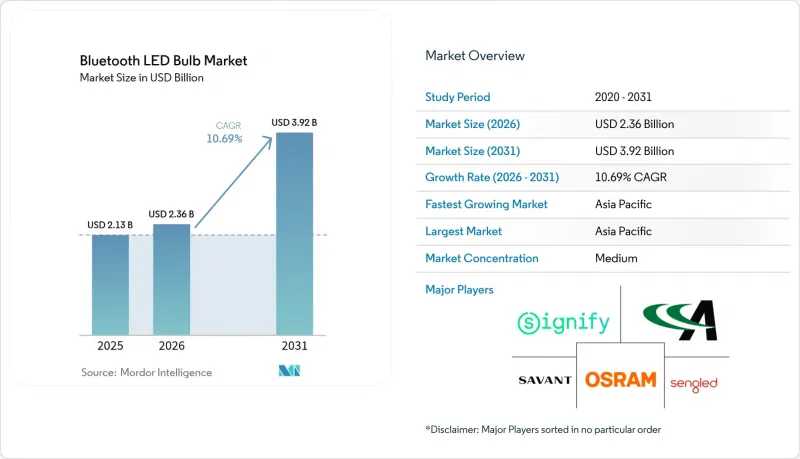
Mordor Intelligence에 의하면, 블루투스 LED 전구 시장 규모는 2025년에 21억 3,000만 달러로 평가되었습니다. 2026년 23억 6,000만 달러에서 2031년까지 39억 2,000만 달러에 이를 것으로 예상되며, 예측 기간(2026-2031년) CAGR은 10.69%를 나타낼 전망입니다.
본 보고서는 최종 사용자별(산업용, 상업용, 주거용), 전구 유형별(표준 A19/A60, 리플렉터 BR/PAR, 캔들형 및 장식용 등), 와트수별(9W 미만, 9W-14W, 기타),연결 프로토콜(블루투스 클래식, 블루투스 저에너지, 기타), 판매 채널(온라인 소매, 오프라인 소매, 기타), 지역별로 분류되어 있습니다. 시장 예측은 금액(달러) 기준으로 제시되어 있습니다.
세계의 블루투스 LED 전구 시장 동향 및 인사이트
스마트 홈에서 에너지 절약형 조명에 대한 수요 증가
음성 비서 생태계와 전력 회사의 리베이트 덕분에, 2024년에 주거용 전력에서 조명이 차지하는 비중이 8% 미만으로 떨어졌음에도 불구하고, 가구당 연결된 조명 기구 수는 2배로 증가했습니다. 유럽의 에코디자인 지침에 따라 할로겐 램프와 직관형 형광등이 금지됨에 따라, 중성선 배선 공사 없이도 조광 및 색온도 조정이 가능한 블루투스 지원 LED로 교체하는 사례가 잇따르고 있습니다. 독일과 프랑스는 모두 개조율이 3%를 상회하고 있으며, 현재는 새로운 배선 레이아웃에 스마트 대응 패널을 통합하고 있습니다. 미국에서는 연결형 전구 1개당 15-25달러의 리베이트를 통해 투자 회수 기간이 12개월 미만으로 단축되었습니다. 이러한 조치들이 맞물려 블루투스 LED 전구 시장에서 주거 부문이 주도적인 위치를 확립하고 있습니다.
IoT 및 스마트 빌딩 인프라의 보급
개발업체들은 조명 기구가 분산형 센서 플랫폼으로도 기능하기 때문에 블루투스 메쉬 조명을 기반 인프라로 간주하고 있습니다. 국제에너지기구(IEA)의 측정에 따르면, 개조된 오피스 타워에서 재실 데이터를 기반으로 HVAC 가동 일정을 제어한 결과, 18%-22%의 에너지 절감 효과가 확인되었습니다. 6미터를 초과하는 공장 천장의 경우, 500럭스의 조도 요건을 충족하기 위해 14W를 초과하는 출력의 전구가 필요하기 때문에 고출력 모델에 대한 수요가 증가하고 있습니다. 현재 광둥성의 공장에서는 1만 개 이상의 노드를 보유하고 지연 시간이 50밀리초 미만인 블루투스 메시 네트워크가 가동 중이며, 그 확장성이 입증되고 있습니다. 기업의 ESG 목표가 엄격해짐에 따라, 조명 데이터를 통합한 에너지 대시보드가 주류가 될 것입니다.
소비자가 느끼는 높은 초기 도입 비용
블루투스 지원 전구는 비연결형 LED에 비해 여전히 150%-200% 정도 비싸게 느껴집니다. 영국 및 호주에서 실시된 조사에 따르면, 3년 내에 투자 회수가 예상에도 불구하고 응답자의 48%가 초기 비용을 가장 큰 장벽으로 꼽았습니다. 인도와 브라질의 경우,월전기 요금이 30달러 미만이어서 절약 효과가 제한적이며, 투자 회수 기간이 5년을 초과하게 됩니다. 건축 연수가 오래된 주택의 경우, 배선 조정을 위해 전기 기술자의 작업이 필요한 경우가 많아 방당 75-150달러의 추가 비용이 발생하므로, DIY로 도입하는 매력은 줄어들고 있습니다. 부품 가격이 더욱 하락하거나 리베이트 제도가 확충되기 전까지는 가격에 대한 민감도가 단기적인 성장을 둔화시킬 것입니다.
부문 분석
주거용 부문이 47.70%라는 최대 시장 점유율을 차지하고 있지만, 산업용 부문은 연평균 성장률(CAGR) 11.68%로 확대될 것으로 예측되며, 블루투스 LED 전구 시장 내 다른 모든 분야를 능가하는 성장이 기대됩니다. 독일과 한국의 자동차 조립 공장에서는 현재 공정 전환 시 고와트수 조명 기구의 밝기를 조절하여 전력 사용량을 최대 30%까지 절감하고 있습니다. 상업시설에서는 재실 상황에 따른 제어를 실현하기 위해 다운라이트 개조가 지속적으로 이루어지고 있으며, 한 자릿수 성장률을 달성하고 있습니다. 주거 분야에서의 도입은 첫 구매 절차를 간소화하는 세트 판매 덕분에 여전히 큰 규모를 유지하고 있습니다.
공장에서는 1만 노드 규모의 네트워크라 하더라도 직접 포워딩을 통해 100밀리초 미만의 응답 시간이 보장되기 때문에 블루투스 메시(Bluetooth Mesh)가 선호되고 있습니다. 램프 고장으로 인한 생산 중단이 발생하기 전에 예측 유지보수 알림이 공장 관리자에게 전달됩니다. 호텔과 소매점에서는 길 안내 및 분위기 연출을 위한 조명을 도입하여, 단순한 조명 이상의 수익 기회를 창출하고 있습니다.
표준 A19/A60 모델은 에디슨식 나사 소켓이나 베요넷식 소켓에 호환되기 때문에 2025년 블루투스 LED 전구 시장에서 38.20%의 점유율을 확보했습니다. 한편, 반사형 BR/PAR 전구는 상업 고객들이 디스플레이의 정밀도를 높이기 위해 조광 가능한 백색 조명을 요구함에 따라 연평균 성장률(CAGR) 12.35%로 성장을 주도하고 있습니다. 호텔 및 레스토랑과 같은 접객 시설에서는 투숙객의 쾌적함을 높이기 위해 야간에는 2,700K, 주간에는 5,000K의 색온도 프로파일을 전환하고 있습니다.
장식용 필라멘트 스타일은 미적 취향을 충족시킬 뿐만 아니라, 현재는 RGB 어드레서블 기능도 탑재되어 있습니다. 특수 튜브는 루멘 출력보다 슬림한 형태가 중시되는 틈새 디스플레이 케이스에 채택되고 있습니다. 이러한 유형 전반에 걸쳐 내장 드라이버를 통해 경량화가 이루어졌으며, 방열성도 향상되었습니다.
지역별 분석
아시아태평양은 2025년 매출의 37.90%를 차지했으며, 연평균 성장률(CAGR) 12.28%를 기록할 전망입니다. 같은 해 중국에서는 42억 개의 LED 전구가 생산되었으며, 그중 18%가 블루투스 지원 제품이었습니다. 국내 시장 점유율의 60%를 샤오미(Xiaomi), 예일라이트(Yeelight), 오플(Opple)이 차지하고 있습니다. 인도에서는 ‘UJALA’ 사업을 통해 보급된 조명 인프라가 스마트화로 전환되는 시기를 맞이하고 있으며, 호주의 전력 회사에서는 시간대별 요금제 도입을 통해 투자 회수 기간을 18개월 미만으로 단축하고 있습니다.
북미는 2025년 매출의 약 28.10%를 차지했습니다. 미국은 45 lm/W의 광속 효율을 의무화하고 백열전구를 매장에서 퇴출시킴으로써 블루투스 LED 전구 수요를 끌어올렸습니다. 캐나다의 리베이트 제도는 미국의 인센티브와 유사하며, 한편 멕시코에서는 신축 주택 붐이 중국에서 수입되는 8달러 미만의 전구에 대한 수요를 뒷받침하고 있습니다.
유럽은 2025년 매출의 약 23.80%를 차지했습니다. ‘에코디자인 지침’에 따라 2024년 9월 할로겐 캡슐이 금지됨에 따라, 45 lm/W 및 2만 5,000시간의 수명이라는 목표를 충족하는 대체 제품으로의 전환이 진행되고 있습니다. 모스크바와 상트페테르부르크의 오피스 파크에서는 ISO 50001 준수를 위해 메쉬 조명이 도입되고 있는 반면, 걸프협력회의(GCC) 회원 도시에서는 예측 유지보수를 위해 블루투스 지원 가로등이 지정되고 있습니다. 사하라 이남 아프리카에서는 태양광 발전식 스마트 전구가 계획 정전이나 Off-grid 환경에서 수요를 충족시키고 있습니다.
기타 혜택 :
- 엑셀 형식 시장 예측(ME) 시트
- 3개월간의 애널리스트 지원
자주 묻는 질문
목차
제1장 서론
제2장 조사 방법
제3장 주요 요약
제4장 시장 구도
제5장 시장 규모 및 성장 예측
제6장 경쟁 구도
제7장 시장 기회 및 향후 전망
KTH 26.08.26According to Mordor Intelligence, the bluetooth lED bulb market size was valued at USD 2.13 billion in 2025 and estimated to grow from USD 2.36 billion in 2026 to reach USD 3.92 billion by 2031, at a CAGR of 10.69% during the forecast period (2026-2031).
This report is Segmented by End-User (Industrial, Commercial, and Residential), Bulb Type (Standard A19/A60, Reflector BR/PAR, Candle and Decorative, and More), Wattage (Below 9W, 9W-14W, and More), Connectivity Protocol (Bluetooth Classic, Bluetooth Low Energy, and More), Distribution Channel (Online Retail, Offline Retail, and More), and Geography. Market Forecasts are Provided in Terms of Value (USD).
Global Bluetooth LED Bulb Market Trends and Insights
Increasing Demand for Energy-Efficient Lighting in Smart Homes
Voice-assistant ecosystems and utility rebates have doubled the number of connected luminaires per household, even as lighting's share of residential electricity fell below 8% in 2024. Europe's Ecodesign Directive banned halogen and linear fluorescent lamps, triggering a replacement wave that favors Bluetooth-enabled LEDs, which offer dimming and tunable white light without requiring neutral-wire rewiring. Germany and France, both posting renovation rates above 3%, now embed smart-ready panels in new wiring layouts. In the United States, rebates of USD 15-25 per connected bulb cut payback to under 12 months. Collectively, these measures secure residential leadership in the Bluetooth LED bulb market.
Proliferation of IoT and Smart Building Infrastructure
Developers view Bluetooth Mesh lighting as foundational infrastructure because luminaires double as distributed sensor platforms. The International Energy Agency measured savings of 18%-22% when occupancy data guided HVAC scheduling in retrofitted office towers. Factory ceilings above six meters require bulbs with outputs exceeding 14 W to meet 500-lux requirements, spurring demand for high-output models. Guangdong plants now operate Bluetooth Mesh networks with over 10,000 nodes and sub-50 ms latency, underscoring their scalability. As corporate ESG targets tighten, energy dashboards integrating lighting data will become mainstream.
High Initial Installation Cost Perceived by Consumers
Bluetooth bulbs still carry a 150%-200% premium over non-connected LEDs. Surveys in the United Kingdom and Australia revealed that 48% of respondents identified upfront costs as the primary obstacle, despite three-year payback scenarios. In India and Brazil, monthly electricity bills under the USD 30 limit the savings potential, extending the payback period beyond five years. Older homes often require an electrician's labor for wiring adjustments, which can add USD 75-150 per room, making the do-it-yourself proposition less appealing. Until component prices fall further or rebates expand, price sensitivity will blunt near-term growth.
Other drivers and restraints analyzed in the detailed report include:
- Declining LED and Sensor Component Prices
- Emergence of Bluetooth Mesh 1.1 Enabling Large-Scale Lighting Networks
- Interoperability Issues Across Lighting Ecosystems
For complete list of drivers and restraints, kindly check the Table Of Contents.
Segment Analysis
The Residential segment secures the largest market share of 47.70%, while the industrial segment is projected to expand at a 11.68% CAGR, outpacing all other verticals in the Bluetooth LED bulb market. Automotive assembly plants in Germany and South Korea now dim high-wattage fixtures during changeovers, trimming electricity use by up to 30%. Commercial settings continue to retrofit downlights for occupancy-based control, achieving single-digit growth. Residential adoption remains sizable thanks to bundled deals that simplify first-time purchases.
Factories favor Bluetooth Mesh because directed forwarding guarantees sub-100 ms response even across 10,000-node networks. Predictive-maintenance alerts reach plant supervisors before lamp failure disrupts production. Hotels and retailers deploy lighting for way-finding and mood scenes, adding revenue opportunities beyond pure illumination.
Standard A19/A60 models secured 38.20% share of Bluetooth LED bulb market in 2025, owing to their fit in Edison screw and bayonet sockets. Reflector BR/PAR bulbs, however, lead growth with a 12.35% CAGR as commercial clients pursue tunable-white for display accuracy. Hospitality venues shift between 2,700 K evenings and 5,000 K daytime profiles to influence guest comfort.
Decorative filament styles satisfy aesthetic preferences yet now incorporate RGB addressability. Specialty tubes occupy niche display cases where slim form factors outweigh lumen output. Across these types, integrated drivers trim weight and improve heat dissipation.
Complete Report Scope:
- By End-User
- Industrial
- Commercial
- Residential
- By Bulb Type
- Standard A19 / A60
- Reflector (BR / PAR)
- Candle and Decorative
- Others
- By Wattage
- Below 9 W
- 9 W - 14 W
- Above 14 W
- By Connectivity Protocol
- Bluetooth Classic
- Bluetooth Low Energy (BLE)
- Bluetooth Mesh
- By Distribution Channel
- Online Retail
- Offline Retail
- Professional / OEM Installers
- By Geography
- North America
- United States
- Canada
- Mexico
- South America
- Brazil
- Argentina
- Rest of South America
- Europe
- Germany
- United Kingdom
- France
- Italy
- Spain
- Russia
- Rest of Europe
- Asia Pacific
- China
- Japan
- India
- South Korea
- Australia
- Rest of Asia Pacific
- Middle East and Africa
- Middle East
- Saudi Arabia
- United Arab Emirates
- Turkey
- Rest of Middle East
- Africa
- South Africa
- Nigeria
- Egypt
- Rest of Africa
- Middle East
- North America
Geography Analysis
Asia Pacific generated 37.90% of 2025 revenue and is heading for a 12.28% CAGR. China produced 4.2 billion LED bulbs that year, 18% of which were Bluetooth-enabled, with Xiaomi, Yeelight, and Opple holding 60% domestic share. India's UJALA-driven lamp base is now ripe for smart upgrades, and utilities in Australia shorten payback to under 18 months via time-of-use tariffs.
North America accounted for approximately 28.10% of 2025 revenue. The United States mandated 45 lm/W efficacy, removing incandescent lamps from store shelves and thereby boosting demand for Bluetooth LED bulbs. Canadian rebates mirror U.S. incentives, while Mexico's new housing boom fuels demand for sub-USD 8 bulbs imported from China.
Europe accounted for approximately 23.80% of 2025 sales. The Ecodesign Directive banned halogen capsules in September 2024, prompting replacements that meet 45 lm/W and 25,000-hour life targets. Office parks in Moscow and Saint Petersburg utilize mesh lighting for ISO 50001 compliance, while cities in the Gulf Cooperation Council specify Bluetooth-enabled streetlights for predictive maintenance. In Sub-Saharan Africa, solar-powered smart bulbs address load-shedding and off-grid needs.
- Signify N.V.
- Acuity Brands Inc.
- Savant Systems Inc. (GE Lighting)
- Osram GmbH
- Sengled Optoelectronics Co., Ltd.
- Buddy Technologies Ltd. (LIFX Lighting)
- Nanoleaf Canada Ltd.
- Wyze Labs, Inc.
- IKEA Systems B.V.
- Xiaomi Corporation
- TP-Link Technologies Co., Ltd.
- Cree Lighting, a company of IDEAL INDUSTRIES, Inc.
- Yeelight Technology Co., Ltd.
- Opple Lighting Co., Ltd.
- Luceco plc
- Hubbell Incorporated
- Zumtobel Group AG
- Delta Light N.V.
- Eaton Corporation plc
- Ilumi Solutions Inc.
Additional Benefits:
- The market estimate (ME) sheet in Excel format
- 3 months of analyst support
TABLE OF CONTENTS
1 INTRODUCTION
- 1.1 Study Assumptions and Market Definition
- 1.2 Scope of the Study
2 RESEARCH METHODOLOGY
3 EXECUTIVE SUMMARY
4 MARKET LANDSCAPE
- 4.1 Market Overview
- 4.2 Market Drivers
- 4.2.1 Increasing Demand for Energy-Efficient Lighting in Smart Homes
- 4.2.2 Proliferation of IoT and Smart Building Infrastructure
- 4.2.3 Declining LED and Sensor Component Prices
- 4.2.4 Government Incentives for Energy Conservation
- 4.2.5 Emergence of Bluetooth Mesh 1.1 Enabling Large-Scale Lighting Networks
- 4.2.6 Retailers Bundling Connected Bulbs with Voice Assistant Devices Boosting Uptake
- 4.3 Market Restraints
- 4.3.1 High Initial Installation Cost Perceived by Consumers
- 4.3.2 Interoperability Issues Across Lighting Ecosystems
- 4.3.3 Bluetooth Bandwidth Congestion in Dense Urban Multi-Device Environments
- 4.3.4 Rising Cybersecurity Certification Costs for Bluetooth Low Energy Devices
- 4.4 Impact of Macroeconomic Factors
- 4.5 Industry Value Chain Analysis
- 4.6 Technological Outlook
- 4.7 Regulatory Landscape
- 4.8 Porter's Five Forces Analysis
- 4.8.1 Bargaining Power of Buyers / Consumers
- 4.8.2 Bargaining Power of Suppliers
- 4.8.3 Threat of New Entrants
- 4.8.4 Threat of Substitute Products
- 4.8.5 Intensity of Competitive Rivalry
5 MARKET SIZE AND GROWTH FORECASTS
- 5.1 By End-User
- 5.1.1 Industrial
- 5.1.2 Commercial
- 5.1.3 Residential
- 5.2 By Bulb Type
- 5.2.1 Standard A19 / A60
- 5.2.2 Reflector (BR / PAR)
- 5.2.3 Candle and Decorative
- 5.2.4 Others
- 5.3 By Wattage
- 5.3.1 Below 9 W
- 5.3.2 9 W - 14 W
- 5.3.3 Above 14 W
- 5.4 By Connectivity Protocol
- 5.4.1 Bluetooth Classic
- 5.4.2 Bluetooth Low Energy (BLE)
- 5.4.3 Bluetooth Mesh
- 5.5 By Distribution Channel
- 5.5.1 Online Retail
- 5.5.2 Offline Retail
- 5.5.3 Professional / OEM Installers
- 5.6 By Geography
- 5.6.1 North America
- 5.6.1.1 United States
- 5.6.1.2 Canada
- 5.6.1.3 Mexico
- 5.6.2 South America
- 5.6.2.1 Brazil
- 5.6.2.2 Argentina
- 5.6.2.3 Rest of South America
- 5.6.3 Europe
- 5.6.3.1 Germany
- 5.6.3.2 United Kingdom
- 5.6.3.3 France
- 5.6.3.4 Italy
- 5.6.3.5 Spain
- 5.6.3.6 Russia
- 5.6.3.7 Rest of Europe
- 5.6.4 Asia Pacific
- 5.6.4.1 China
- 5.6.4.2 Japan
- 5.6.4.3 India
- 5.6.4.4 South Korea
- 5.6.4.5 Australia
- 5.6.4.6 Rest of Asia Pacific
- 5.6.5 Middle East and Africa
- 5.6.5.1 Middle East
- 5.6.5.1.1 Saudi Arabia
- 5.6.5.1.2 United Arab Emirates
- 5.6.5.1.3 Turkey
- 5.6.5.1.4 Rest of Middle East
- 5.6.5.2 Africa
- 5.6.5.2.1 South Africa
- 5.6.5.2.2 Nigeria
- 5.6.5.2.3 Egypt
- 5.6.5.2.4 Rest of Africa
- 5.6.5.1 Middle East
- 5.6.1 North America
6 COMPETITIVE LANDSCAPE
- 6.1 Market Concentration
- 6.2 Strategic Moves
- 6.3 Market Share Analysis
- 6.4 Company Profiles (includes Global level Overview, Market level overview, Core Segments, Financials as available, Strategic Information, Market Rank / Share for key companies, Products and Services, and Recent Developments)
- 6.4.1 Signify N.V.
- 6.4.2 Acuity Brands Inc.
- 6.4.3 Savant Systems Inc. (GE Lighting)
- 6.4.4 Osram GmbH
- 6.4.5 Sengled Optoelectronics Co., Ltd.
- 6.4.6 Buddy Technologies Ltd. (LIFX Lighting)
- 6.4.7 Nanoleaf Canada Ltd.
- 6.4.8 Wyze Labs, Inc.
- 6.4.9 IKEA Systems B.V.
- 6.4.10 Xiaomi Corporation
- 6.4.11 TP-Link Technologies Co., Ltd.
- 6.4.12 Cree Lighting, a company of IDEAL INDUSTRIES, Inc.
- 6.4.13 Yeelight Technology Co., Ltd.
- 6.4.14 Opple Lighting Co., Ltd.
- 6.4.15 Luceco plc
- 6.4.16 Hubbell Incorporated
- 6.4.17 Zumtobel Group AG
- 6.4.18 Delta Light N.V.
- 6.4.19 Eaton Corporation plc
- 6.4.20 Ilumi Solutions Inc.
7 MARKET OPPORTUNITIES AND FUTURE OUTLOOK
- 7.1 White-space and Unmet-Need Assessment