

|
시장보고서
상품코드
2113787
영국의 태양광발전 : 시장 점유율 분석, 업계 동향 및 통계, 성장 예측(2026-2031년)United Kingdom Solar Power - Market Share Analysis, Industry Trends & Statistics, Growth Forecasts (2026 - 2031) |
||||||
 Mordor Intelligence
Mordor Intelligence에 의하면, 영국의 태양광발전 시장 규모(설치용량 기반)는 2026년 20.85기가와트에서, 2031년까지 32.5기가와트로 확대되고 예측 기간(2026-2031년) CAGR은 9.28%를 나타낼 전망입니다.
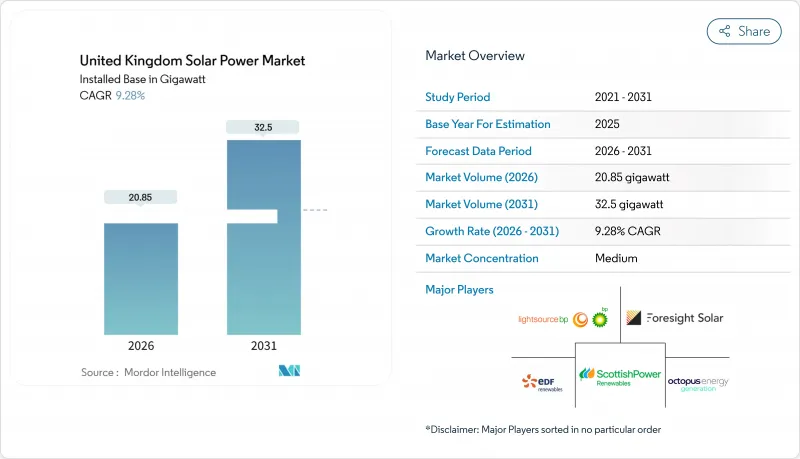
본 보고서는 기술별(태양광발전 및 집광형 태양광발전), 계통 연계 형태별(계통 연계형 및 독립형), 그리고 최종 사용자별(대규모 발전, 상업 및 산업용, 주거용)로 분류되어 있습니다. 시장 규모 및 전망은 설치 용량(GW) 단위로 표시되어 있습니다.
영국의 태양광발전 시장 동향 및 인사이트
재생에너지 의무(ROE) 인증서 연장이 기업의 PPA를 뒷받침
2027년 3월까지 시행되는 ROC(재생에너지 의무 증명서) 제도는 10-15년 기간의 기업 간 전력 구매 계약(PPA)을 뒷받침하며, 제조업체와 데이터센터가 변동이 심한 도매 가격에 대한 헤지를 하면서도 공시 의무를 이행할 수 있도록 합니다. 스코틀랜드와 잉글랜드에 집중된 산업 수요가 정오의 발전량을 흡수함으로써 발전 제한 위험이 낮아지고 있습니다. ROC의 최저 가격 책정으로 초기 현금 흐름의 위험이 완화되고 중규모 개발자에 대한 은행 대출이 촉진되고 있으나, 이 제도가 종료되기 전에 가동 시작이 쇄도할 것으로 예측됩니다. 대규모 CFD(차액결제계약) 입찰이 이루어지지 않을 경우, 2027년 이후 활동은 둔화될 가능성이 있습니다.
유틸리티 규모 프로젝트에서 그리드 패리티 달성이 상업용 태양광발전(Merchant Solar)을 가속화할 것입니다.
2024년에 kWh당 0.045파운드 미만의 균등화 발전 비용으로 인해, 잉글랜드 남부의 프로젝트는 도매 전력 수입, 내재적 편익 및 부대 서비스 수입에 의존할 수 있게 될 것입니다. 양면 모듈과 단축 추적기는 발전량을 향상시키며, GRIDSERVE사의 요크 사이트에서는 27MW의 에너지 저장 설비를 통합하여 여러 가치 창출원을 확보하고 있음이 입증되었습니다. 머천트 솔라의 실현 가능성을 통해 일사량이 풍부한 카운티에 파이프라인이 집중되어 기관 투자자의 자본을 유치하고 정책 리스크를 줄이고 있습니다.
토지 이용 계획상의 제약이 확장의 과제로 대두
농지로 분류됨에 따라 등급 1-3a 토양에서의 태양광발전이 저해되어, 승인까지의 기간이 18-24개월에 달하고 있습니다. 서머셋 및 노스요크셔의 프로젝트는 이중 이용 또는 브라운필드 부지 입지가 입증되지 않는 한 기각될 가능성이 있습니다. 매립지의 토양 정화 비용 급등이 이익률을 더욱 압박하고 있어, 개발업자들은 웨일스와 스코틀랜드로 눈을 돌리고 있습니다.
부문 분석
태양광발전 기술은 2025년에 영국의 태양광발전 시장 점유율의 100%를 차지했으며, 2031년까지 연평균 성장률(CAGR) 9.3%로 성장할 전망이어서, 영국의 태양광발전 시장은 계속해서 태양광발전이 주도하는 양상을 유지할 것입니다. 노스 요크셔에서 실시된 현장 시험 결과, 양면 수광형 모듈이 단면 수광형의 기준치보다 15-17% 더 많은 전력을 생산하는 것으로 나타나, 양면 수광형의 급속한 보급이 입증되었습니다. 하프 셀 및 멀티 버스바 설계는 저조도 조건에서 발전량을 더욱 향상시켜, 해당 국가의 확산 일사 프로파일에 적합합니다.
모듈의 혁신은 인버터의 동향과도 밀접하게 연동되어 있습니다. 비용 효율성 측면에서 유틸리티 규모의 태양광발전소에서는 스트링 인버터가 주류를 이루는 반면, 지붕 위에서는 굴뚝이나 나무로 인한 그늘의 영향을 줄일 수 있는 마이크로 인버터가 보급되고 있습니다. 추적식 시스템은 여전히 틈새 시장으로 남아 있지만, 사우샘프턴 대학의 시험을 통해 2026년부터 2028년에 걸쳐 고위도 지역에서 2축 추적 시스템의 가치가 정량화될 가능성이 있습니다. 이러한 발전들이 맞물리면서, 영국의 태양광발전 시장 전반에서 이 기술의 입지가 더욱 공고해질 것입니다.
기타 혜택 :
- 엑셀 형식 시장 예측(ME) 시트
- 3개월간의 애널리스트 지원
자주 묻는 질문
목차
제1장 서론
제2장 조사 방법
제3장 주요 요약
제4장 시장 구도
제5장 시장 규모 및 성장 예측
제6장 경쟁 구도
제7장 시장 기회 및 향후 전망
KTH 26.08.26According to Mordor Intelligence, the United Kingdom solar power market size in terms of installed base is expected to grow from 20.85 gigawatt in 2026 to 32.5 gigawatt by 2031, at a CAGR of 9.28% during the forecast period (2026-2031).
This report is Segmented by Technology (Solar Photovoltaic and Concentrated Solar Power), Grid Type (On-Grid and Off-Grid), and End-User (Utility-Scale, Commercial and Industrial, and Residential). The Market Sizes and Forecasts are Provided in Terms of Installed Capacity (GW).
United Kingdom Solar Power Market Trends and Insights
Renewable Energy Obligation Certificates Extension Spurs Corporate PPAs
The ROC window through March 2027 underpins 10-15-year corporate PPAs, letting manufacturers and data centers hedge volatile wholesale prices while meeting disclosure mandates. Industrial demand clusters in Scotland and England absorb midday generation, lowering curtailment risks. The ROC floor de-risks early cash flows, unlocking bank finance for mid-scale developers, yet a commissioning rush is expected before the mechanism sunsets. Without larger CFD rounds, post-2027 activity could soften.
Grid-Parity Achievement in Utility-Scale Projects Accelerates Merchant Solar
Levelized costs below GBP 0.045 per kWh in 2024 let southern English projects rely on wholesale, embedded-benefit, and ancillary-service revenues. Bifacial modules and single-axis trackers enhance yields, demonstrated by GRIDSERVE's York site, which integrates 27 MW storage to capture multiple value streams. Merchant viability concentrates pipelines in high-irradiance counties, attracting institutional capital and reducing policy risk.
Land-Use Planning Constraints Challenge Expansion
Agricultural land classifications hinder solar on Grade 1-3a soils, extending approvals to 18-24 months. Projects in Somerset and North Yorkshire face rejection unless dual-use or brownfield siting is proven. Elevated remediation costs on landfills further squeeze margins, shifting developers toward Wales and Scotland.
Other drivers and restraints analyzed in the detailed report include:
- National Grid ESO Reform Favors Distributed Participation
- Battery-Coupled Solar Economics Enhanced by Flexible Connection Code
- Import Dependency Risk from Xinjiang Silicon
For complete list of drivers and restraints, kindly check the Table Of Contents.
Segment Analysis
Solar photovoltaic technology captured 100% of the UK solar power market share in 2025 and is set to grow at a 9.3% CAGR through 2031, keeping the UK solar power market entirely PV-driven. Field tests in North Yorkshire show bifacial modules generating 15-17% more energy than monofacial references, validating rapid bifacial uptake. Half-cell and multi-busbar designs further boost low-light yields, aligning with the nation's diffuse-irradiance profile.
Module innovations dovetail with inverter trends: string inverters dominate utility arrays for cost efficiency, whereas microinverters prosper on rooftops by mitigating chimney and tree shading. Tracking remains niche, yet University of Southampton trials could quantify dual-axis value at high latitudes over 2026-2028. Collectively, these advancements reinforce the technology's lock-in across the UK solar power market.
Complete Report Scope:
- By Technology
- Solar Photovoltaic (PV)
- Concentrated Solar Power (CSP)
- By Grid Type
- On-Grid
- Off-Grid
- By End User
- Utility-Scale
- Commercial and Industrial (C&I)
- Residential
- By Component (Qualitative Analysis)
- Solar Modules/Panels
- Inverters (String, Central, Micro)
- Mounting and Tracking Systems
- Balance-of-System and Electricals
- Energy Storage and Hybrid Integration
List of Companies Covered in this Report:
- Lightsource bp Renewable Energy Investments Ltd
- EDF Renewables UK (Electricite de France SA)
- Octopus Energy Generation
- Foresight Solar Fund Ltd
- ScottishPower Renewables (Iberdrola SA)
- SSE Renewables
- Statkraft UK
- Vattenfall AB
- BayWa r.e. UK Ltd
- First Solar Inc.
- JinkoSolar Holding Co. Ltd
- Canadian Solar Inc.
- Trina Solar Co. Ltd
- Anesco Ltd
- Hive Energy Ltd
- Renewable Energy Systems Ltd
- Ecotricity Group Ltd
- Ameresco Inc.
- NextEnergy Capital Group
- Good Energy Group PLC
Additional Benefits:
- The market estimate (ME) sheet in Excel format
- 3 months of analyst support
TABLE OF CONTENTS
1 Introduction
- 1.1 Study Assumptions & Market Definition
- 1.2 Scope of the Study
2 Research Methodology
3 Executive Summary
4 Market Landscape
- 4.1 Market Overview
- 4.2 Market Drivers
- 4.2.1 Renewable Energy Obligation Certificates (ROCs) Extension Spurs Corporate PPAs
- 4.2.2 Grid-Parity Achievement in Utility-scale Projects Accelerating Merchant Solar
- 4.2.3 National Grid's ESO Reform Favouring Distributed Solar Participation
- 4.2.4 Rising Demand for Agri-PV to Decarbonise UK Farming Sector
- 4.2.5 Battery-Coupled Solar Economics Enhanced by Ofgem's Flexible Connection Code
- 4.2.6 OEM Supply-Chain Localisation Incentives Under UK Net-Zero Strategy
- 4.3 Market Restraints
- 4.3.1 Land-Use Planning Constraints in England's National Planning Policy Framework
- 4.3.2 Import Dependency Risk from Xinjiang Silicon Module Supply Chain
- 4.3.3 Grid Congestion & Long Queue Times for Connections in Northern England
- 4.3.4 Volatile CFD Strike Prices Limiting Small-scale Project Bankability
- 4.4 Supply-Chain Analysis
- 4.5 Regulatory Landscape
- 4.6 Technological Outlook
- 4.7 Porter's Five Forces
- 4.7.1 Bargaining Power of Suppliers
- 4.7.2 Bargaining Power of Buyers
- 4.7.3 Threat of New Entrants
- 4.7.4 Threat of Substitutes
- 4.7.5 Competitive Rivalry
- 4.8 PESTLE Analysis
5 Market Size & Growth Forecasts
- 5.1 By Technology
- 5.1.1 Solar Photovoltaic (PV)
- 5.1.2 Concentrated Solar Power (CSP)
- 5.2 By Grid Type
- 5.2.1 On-Grid
- 5.2.2 Off-Grid
- 5.3 By End User
- 5.3.1 Utility-Scale
- 5.3.2 Commercial and Industrial (C&I)
- 5.3.3 Residential
- 5.4 By Component (Qualitative Analysis)
- 5.4.1 Solar Modules/Panels
- 5.4.2 Inverters (String, Central, Micro)
- 5.4.3 Mounting and Tracking Systems
- 5.4.4 Balance-of-System and Electricals
- 5.4.5 Energy Storage and Hybrid Integration
6 Competitive Landscape
- 6.1 Market Concentration
- 6.2 Strategic Moves (M&A, Partnerships, PPAs)
- 6.3 Market Share Analysis (Market Rank/Share for key companies)
- 6.4 Company Profiles (includes Global level Overview, Market level overview, Core Segments, Financials as available, Strategic Information, Products & Services, and Recent Developments)
- 6.4.1 Lightsource bp Renewable Energy Investments Ltd
- 6.4.2 EDF Renewables UK (Electricite de France SA)
- 6.4.3 Octopus Energy Generation
- 6.4.4 Foresight Solar Fund Ltd
- 6.4.5 ScottishPower Renewables (Iberdrola SA)
- 6.4.6 SSE Renewables
- 6.4.7 Statkraft UK
- 6.4.8 Vattenfall AB
- 6.4.9 BayWa r.e. UK Ltd
- 6.4.10 First Solar Inc.
- 6.4.11 JinkoSolar Holding Co. Ltd
- 6.4.12 Canadian Solar Inc.
- 6.4.13 Trina Solar Co. Ltd
- 6.4.14 Anesco Ltd
- 6.4.15 Hive Energy Ltd
- 6.4.16 Renewable Energy Systems Ltd
- 6.4.17 Ecotricity Group Ltd
- 6.4.18 Ameresco Inc.
- 6.4.19 NextEnergy Capital Group
- 6.4.20 Good Energy Group PLC
7 Market Opportunities & Future Outlook
- 7.1 White-space & Unmet-Need Assessment


