|
시장보고서
상품코드
2113794
의료용 3D 프린팅 : 시장 점유율 분석, 업계 동향 및 통계, 성장 예측(2026-2031년)Healthcare 3D Printing - Market Share Analysis, Industry Trends & Statistics, Growth Forecasts (2026 - 2031) |
||||||
 Mordor Intelligence
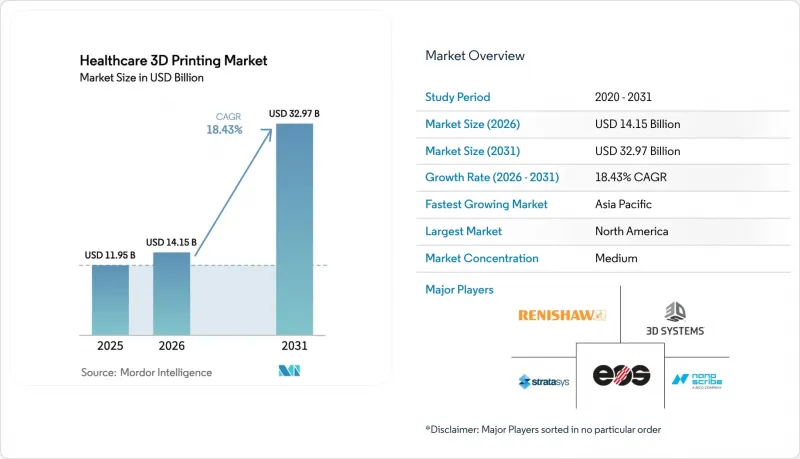
Mordor Intelligence에 의하면, 의료용 3D 프린팅 시장 규모는 2025년 119억 5,000만 달러로 평가되었습니다. 2026년 141억 5,000만 달러에서 2031년까지 329억 7,000만 달러로 확대되고 2026년부터 2031년까지 연평균 복합 성장률(CAGR)은 18.43%를 나타낼 전망입니다.
본 보고서는 기술별(스테레오리소그래피 등), 용도별(의료용 임플란트, 의수·의족 등), 소재별(금속·합금 등), 지역별(북미, 유럽, 아시아태평양, 중동 및 아프리카, 남미)로 분류되어 있습니다. 시장 전망은 금액(미 달러) 기준으로 제시되어 있습니다.
세계의 의료용 3D 프린팅 시장 동향 및 인사이트
적층 가공 기술의 발전 : 정밀도와 속도
전자빔 시스템은 현재 1자릿수 시간의 성형 사이클로 티타늄 격자 구조를 치밀화할 수 있게 되어, 환자별로 맞춤 제작된 척추 케이지를 같은 주 내에 납품하는 것이 가능해졌습니다. 다중 레이저 구성을 통해 치수 공차를 저해하지 않으면서 처리량이 2배로 증가함에 따라, 50-100장의 두개골 플레이트를 일괄 생산하여 비용 면에서 경쟁력을 갖출 수 있게 되었습니다. 표면 마감 품질이 향상됨에 따라, 기존에는 총 생산 시간의 20%-30%를 소요하던 연마 공정이 단축되었습니다. 부품당 비용이 낮아짐에 따라, 병원은 맞춤형 제작이라는 장점을 유지하면서도 기계 가공 제품의 가격과 경쟁할 수 있게 되었습니다. 이러한 효율화 효과가 더해져 해당 부문의 예상 연평균 성장률(CAGR)에 약 4.2%가 추가될 것입니다.
정형외과, 치과, 조직공학 분야의 임상 적응증 확대
치과 기공소에서는 48시간 이내에 클리어 얼라이너 모형을 제작할 수 있게 되어, 10일이 소요되던 열성형 워크플로우를 대체하고 있습니다. 바이오 프린팅된 혈관화 조직 구조체는 수 주간에 걸친 독성 시험에서도 생존성을 유지할 수 있게 되어, 의약품 스크리닝 기준을 충족하게 되었습니다. FDA의 바이오 프린팅 조직에 관한 지침안에서는 무균성 및 유효성 요건이 명확히 규정되어, 신청 시의 불확실성이 완화되었습니다. 증거가 축적되고 보험 환급 코드가 확대됨에 따라, 도입은 3차 의료기관에서 지역 병원으로 확대될 것입니다. 이러한 요인들이 복합적으로 작용하여 연평균 성장률(CAGR)에 3.8퍼센트 포인트의 기여도를 더할 것입니다.
3D 프린팅 의료기기에 대한 엄격한 규제 승인 절차
제조 공정의 변동성으로 인해 검증이 복잡해져, FDA 510(k) 신청 소요 기간이 수개월 연장될 뿐만 아니라 비용이 많이 드는 분말 특성 평가 시험이 필요하게 됩니다. 유럽의 MDR(의료기기 규정)에 따르면, 제조업체는 다공성 구조를 갖지 않는 기계 가공된 선행 제품과의 동등성을 입증해야 하며, 증거 요건이 엄격해졌습니다. 컨설팅 비용은 의료기기 신청 1건당 50만 달러를 초과하기도 하여, 스타트업 기업에게는 시장 진입 장벽이 되고 있습니다. ISO/ASTM 규격은 용어의 통일을 도모하고 있지만, 어디까지나 임의의 규격이기 때문에 기업은 지역별로 제각각인 규제에 대응할 수밖에 없습니다. 이러한 요인으로 인해 CAGR은 2.3퍼센트포인트 하락합니다.
부문 분석
스테레오 리소그래피는 2025년 매출의 38.42%를 차지하며, 의료용 3D 프린팅 시장에서 그 우위가 두드러졌습니다. 25마이크론 미만의 초미세 레이어는 투명 교정기나 두개안면 모델에 필요한 매끄러운 표면을 구현하며, 생체 적합성이 있는 포토폴리머는 FDA에 대한 재료 승인 절차를 간소화합니다. EBM(전기장 용융법)의 채택은 연평균 성장률(CAGR) 20.43%로 가속화되고 있습니다. 이는 고융점 티타늄을 잔류 기공 없이 용융할 수 있기 때문이며, 하중을 지탱하는 고관절 스템에 필수적입니다.
용융 적층 가공(FDM)는 비용 효율성이 중요한 해부학적 모델 분야에서 여전히 매력을 유지하고 있는 반면, 선택적 레이저 소결(SLS)은 나일론 분말과 오토클레이브 내성을 결합하여 치과 및 보청기 틈새 시장을 공략하고 있습니다. PolyJet의 다중 재료 기능은 수술 리허설에서 연골과 뼈를 구분하여 재현할 수 있으며, 바인더 제트 방식의 세라믹는 생체 활성 스캐폴드를 제공합니다. 적층 조형(LOM)은 수지 및 분말 시스템이 더 높은 정밀도로 동등한 경제성을 실현함에 따라 그 존재감이 점차 희미해지고 있습니다. 폐루프 방식의 용융 풀 모니터링 기능을 통합한 기술은 공정 검증에 관한 FDA 요건을 충족하고 있으며, 병원들은 규정 준수가 종합적으로 갖춰진 공급업체를 선택하고 있습니다.
지역별 분석
북미는 2025년 매출의 40.43%를 차지하며, 의료용 3D 프린팅 시장에서 가장 규모가 큰 지역 점유율을 기록했습니다. FDA의 적층 조형에 관한 지침과 CMS의 해부학 모델 보험 적용이 맞물리면서 대학 병원 및 지역 병원에서의 도입이 촉진되고 있습니다. 캐나다도 유사한 규제 체계를 채택하고 있으나, 주별 보상 제도의 차이로 인해 통일된 보급이 저해되고 있습니다. 멕시코는 미국으로의 수출을 목적으로 한 치과용 기기 수탁 제조를 유치하기 위해 면세 지역을 활용하고 있습니다.
아시아태평양은 중국, 일본, 한국이 국가 차원의 적층 가공 전략을 시행하고 있는 만큼, 2031년까지 연평균 성장률(CAGR) 19.54%를 나타낼 것으로 예측됩니다. 중국은 국내 분말 생산량을 확대하고 의료기기 승인을 신속화함으로써 수입 의존도를 낮췄습니다. 일본의 PMDA는 신속 승인 절차를 도입했으며, 현재 공적 보험에서 환자 맞춤형 티타늄 임플란트 비용이 보장되고 있습니다. 한국의 연구센터는 5년 이내에 임상시험을 실시하는 것을 목표로 혈관 형성 바이오 프린팅에 주력하고 있습니다. 인도는 정형외과 제품 수출 거점으로서의 입지를 확립하려 하고 있으나, 노동력 부족에 직면해 있습니다.
유럽은 2025년에 20%대 중반 시장 점유율을 유지했습니다. 독일의 보험사는 수술 가이드 비용을 환급하고 있으며, 이는 기기 수주를 촉진하고 있습니다. 영국의 NHS는 수요를 집중시키기 위해 3D 프린팅 허브를 중앙 관리하는 시범 사업을 실시했습니다. 프랑스는 ANSM(프랑스 의약품안전청)의 주관 하에 임플란트의 세관 심사 기간을 단축했습니다. 중동 및 아프리카 시장 점유율은 여전히 10% 미만에 머물러 있습니다. UAE의 프리존에는 정형외과 분야 스타트업들이 모여 있지만, 보험 급여 격차로 인해 지역 전체의 보급은 더딘 상황입니다. 남미 시장 점유율은 한 자릿수 초반에 머물러 있으며, 브라질에서는 주로 치과용 기기가 승인되고 있지만, 관세로 인해 기기 비용이 상승하고 있습니다.
기타 혜택 :
- 엑셀 형식 시장 예측(ME) 시트
- 3개월간의 애널리스트 지원
자주 묻는 질문
목차
제1장 서론
제2장 조사 방법
제3장 주요 요약
제4장 시장 구도
제5장 시장 규모 및 성장 예측
제6장 경쟁 구도
제7장 시장 기회 및 향후 전망
KTH 26.08.26According to Mordor Intelligence, the healthcare 3D printing market size is projected to expand from USD 11.95 billion in 2025 and USD 14.15 billion in 2026 to USD 32.97 billion by 2031, registering a CAGR of 18.43% between 2026 to 2031.
This report is Segmented by Technology (Stereo Lithography, and More), Application (Medical Implants, Prosthetics, and More), Material (Metals & Alloys, and More), and Geography (North America, Europe, Asia-Pacific, Middle East and Africa, and South America). The Market Forecasts are Provided in Terms of Value (USD).
Global Healthcare 3D Printing Market Trends and Insights
Advancements In Additive Manufacturing: Precision and Speed
Electron-beam systems now densify titanium lattices in single-digit-hour build cycles, enabling same-week delivery of patient-specific spinal cages. Multi-laser configurations double throughput without sacrificing dimensional tolerances, so batch production of 50-100 cranial plates becomes cost-competitive. Surface-finish gains reduce polishing, which formerly consumed 20%-30% of total production time. Lower per-part cost allows hospitals to match pricing on machined alternatives while retaining customization advantages. Such efficiencies collectively add roughly 4.2 percentage points to the sector's forecast CAGR.
Expanding Clinical Indications Across Orthopedics, Dental, and Tissue Engineering
Dental labs produce clear-aligner molds in under 48 hours, displacing thermoforming workflows that took 10 days. Bioprinted vascularized constructs now remain viable for multi-week toxicology tests, meeting pharmaceutical screening thresholds. The FDA's draft guidance on bioprinted tissues clarifies sterility and potency requirements, reducing filing uncertainty. As evidence accrues and reimbursement codes broaden, adoption will spread from tertiary centers to community hospitals. These factors collectively lift the CAGR contribution by 3.8 percentage points.
Stringent Regulatory Approval Pathways for 3D-Printed Medical Devices
Process variability complicates validation, extending FDA 510(k) timelines by several months and necessitating costly powder characterization tests. Under Europe's MDR, manufacturers must prove equivalence with machined predicates that lack porous architectures, inflating evidence requirements. Consulting fees can exceed USD 500,000 per device submission, deterring startups. ISO/ASTM standards harmonize terminology yet remain voluntary, so firms juggle fragmented regional rules. These factors reduce CAGR by 2.3 percentage points.
Other drivers and restraints analyzed in the detailed report include:
- Growing Acceptance of Patient-Specific Implants and Prosthetics
- Hospital-Based Point-of-Care 3D Printing Labs Reducing Surgical Lead Times
- Shortage of Skilled Additive Manufacturing Workforce in Healthcare
For complete list of drivers and restraints, kindly check the Table Of Contents.
Segment Analysis
Stereo lithography contributed 38.42% of 2025 revenue, underscoring its dominance within the healthcare 3D printing market. Ultra-fine layers below 25 microns provide the smooth surfaces required for clear aligners and craniofacial models, while biocompatible photopolymers simplify FDA material submissions. EBM adoption accelerates at a 20.43% CAGR because it fuses high-melting-point titanium without residual porosity, essential for load-bearing hip stems.
Fused deposition modeling retains appeal for budget-sensitive anatomical models, whereas selective laser sintering satisfies dental and hearing-aid niches by pairing nylon powders with autoclave stability. PolyJet's multi-material capability simulates cartilage versus bone in surgical rehearsals, and binder-jet ceramics supply bioactive scaffolds. Laminated-object manufacturing wanes as resin and powder systems match its economics with higher precision. Technologies that embed closed-loop melt-pool monitoring address FDA expectations for process validation, directing hospitals toward vendors offering turnkey compliance.
Complete Report Scope:
- By Technology
- Stereo Lithography
- Fused Deposition Modeling
- Selective Laser Sintering
- Electron Beam Melting
- PolyJet / MultiJet
- Binder Jetting
- Laminated Object Manufacturing
- By Application
- Medical Implants
- Prosthetics
- Surgical Guides & Anatomical Models
- Tissue Engineering & Bioprinting
- Wearable Devices
- By Material
- Metals & Alloys
- Polymers & Photopolymers
- Ceramics & Bioceramics
- Biomaterials / Bio-Inks
- Geography
- North America
- United States
- Canada
- Mexico
- Europe
- Germany
- United Kingdom
- France
- Italy
- Spain
- Rest Of Europe
- Asia-Pacific
- China
- Japan
- India
- Australia
- South Korea
- Rest Of Asia-Pacific
- Middle East And Africa
- GCC
- South Africa
- Rest Of Middle East And Africa
- South America
- Brazil
- Argentina
- Rest Of South America
- North America
Geography Analysis
North America contributed 40.43% of the 2025 revenue, the largest regional share of the healthcare 3D printing market. The FDA's additive-manufacturing guidance, coupled with CMS reimbursement for anatomical models, propels adoption across academic and community hospitals. Canada follows similar regulatory contours, yet provincial reimbursement heterogeneity tempers uniform uptake. Mexico utilizes duty-free zones to attract dental device contract manufacturing for export to the United States.
The Asia-Pacific region is expected to grow at a 19.54% CAGR through 2031, as China, Japan, and South Korea implement national additive manufacturing strategies. China scaled domestic powder output and expedited device approvals, reducing dependence on imports. Japan's PMDA introduced fast-track pathways, and public insurers now cover patient-specific titanium implants. South Korean research centers are focusing on vascularized bioprinting to conduct clinical trials within five years. India positions itself as an orthopedic export hub but faces workforce constraints.
Europe held a mid-20s share in 2025. German insurers reimburse surgical guides, spurring equipment orders; the United Kingdom's NHS pilots centralized 3D printing hubs to pool demand. France shortened customs implant reviews under its ANSM agency. The Middle East and Africa remain sub-10% share: the UAE's free zones host orthopedic startups, whereas broader regional adoption lags due to reimbursement gaps. South America captures a low single-digit share, with Brazil approving primarily dental devices; tariffs inflate equipment costs.
- 3D Systems
- Arcam AB
- Aspect Biosystems Ltd.
- Carbon Inc.
- Cellink AB
- EnvisionTEC GmbH
- EOS GmbH
- Formlabs Inc.
- GE Additive
- HP Inc.
- Materialise
- Medtronic
- Organovo
- Oxford Performance Materials
- Renishaw plc
- Siemens Healthineers
- SLM Solutions Group AG
- Stratasys
- Stryker
- Zimmer Biomet
Additional Benefits:
- The market estimate (ME) sheet in Excel format
- 3 months of analyst support
TABLE OF CONTENTS
1 Introduction
- 1.1 Study Assumptions & Market Definition
- 1.2 Scope of the Study
2 Research Methodology
3 Executive Summary
4 Market Landscape
- 4.1 Market Overview
- 4.2 Market Drivers
- 4.2.1 Advancements in Additive Manufacturing Precision and Speed
- 4.2.2 Expanding Clinical Indications Across Orthopedics, Dental, and Tissue Engineering
- 4.2.3 Growing Acceptance of Patient-Specific Implants and Prosthetics
- 4.2.4 Hospital-Based Point-of-Care 3D Printing Labs Reducing Surgical Lead Times
- 4.2.5 AI-Driven Automated Design Optimization Cutting Device Development Cycles
- 4.2.6 Reimbursement Codes Emerging for 3D-Printed Anatomical Models
- 4.3 Market Restraints
- 4.3.1 Stringent Regulatory Approval Pathways for 3D-Printed Medical Devices
- 4.3.2 Shortage of Skilled Additive Manufacturing Workforce in Healthcare
- 4.3.3 Lack of Standardized Sterilization Protocols for Porous Printed Implants
- 4.3.4 Rising Raw Material Supply Chain Volatility for Medical-Grade Powders & Polymers
- 4.4 Value / Supply-Chain Analysis
- 4.5 Regulatory Landscape
- 4.6 Technological Outlook
- 4.7 Porter's Five Forces Analysis
- 4.7.1 Bargaining Power of Buyers
- 4.7.2 Bargaining Power of Suppliers
- 4.7.3 Threat of New Entrants
- 4.7.4 Threat of Substitutes
- 4.7.5 Intensity of Competitive Rivalry
5 Market Size & Growth Forecasts (Value, USD)
- 5.1 By Technology
- 5.1.1 Stereo Lithography
- 5.1.2 Fused Deposition Modeling
- 5.1.3 Selective Laser Sintering
- 5.1.4 Electron Beam Melting
- 5.1.5 PolyJet / MultiJet
- 5.1.6 Binder Jetting
- 5.1.7 Laminated Object Manufacturing
- 5.2 By Application
- 5.2.1 Medical Implants
- 5.2.2 Prosthetics
- 5.2.3 Surgical Guides & Anatomical Models
- 5.2.4 Tissue Engineering & Bioprinting
- 5.2.5 Wearable Devices
- 5.3 By Material
- 5.3.1 Metals & Alloys
- 5.3.2 Polymers & Photopolymers
- 5.3.3 Ceramics & Bioceramics
- 5.3.4 Biomaterials / Bio-Inks
- 5.4 Geography
- 5.4.1 North America
- 5.4.1.1 United States
- 5.4.1.2 Canada
- 5.4.1.3 Mexico
- 5.4.2 Europe
- 5.4.2.1 Germany
- 5.4.2.2 United Kingdom
- 5.4.2.3 France
- 5.4.2.4 Italy
- 5.4.2.5 Spain
- 5.4.2.6 Rest Of Europe
- 5.4.3 Asia-Pacific
- 5.4.3.1 China
- 5.4.3.2 Japan
- 5.4.3.3 India
- 5.4.3.4 Australia
- 5.4.3.5 South Korea
- 5.4.3.6 Rest Of Asia-Pacific
- 5.4.4 Middle East And Africa
- 5.4.4.1 GCC
- 5.4.4.2 South Africa
- 5.4.4.3 Rest Of Middle East And Africa
- 5.4.5 South America
- 5.4.5.1 Brazil
- 5.4.5.2 Argentina
- 5.4.5.3 Rest Of South America
- 5.4.1 North America
6 Competitive Landscape
- 6.1 Market Concentration
- 6.2 Market Share Analysis
- 6.3 Company Profiles {(Includes Global Level Overview, Market Level Overview, Core Segments, Financials as Available, Strategic Information, Market Rank/Share for Key Companies, Products & Services, and Recent Developments)}
- 6.3.1 3D Systems Inc.
- 6.3.2 Arcam AB
- 6.3.3 Aspect Biosystems Ltd.
- 6.3.4 Carbon Inc.
- 6.3.5 Cellink AB
- 6.3.6 EnvisionTEC GmbH
- 6.3.7 EOS GmbH
- 6.3.8 Formlabs Inc.
- 6.3.9 GE Additive
- 6.3.10 HP Inc.
- 6.3.11 Materialise NV
- 6.3.12 Medtronic plc
- 6.3.13 Organovo Holdings Inc.
- 6.3.14 Oxford Performance Materials
- 6.3.15 Renishaw plc
- 6.3.16 Siemens Healthineers
- 6.3.17 SLM Solutions Group AG
- 6.3.18 Stratasys Ltd.
- 6.3.19 Stryker Corporation
- 6.3.20 Zimmer Biomet Holdings Inc.
7 Market Opportunities & Future Outlook
- 7.1 White-Space & Unmet-Need Assessment