
|
시장보고서
상품코드
2113812
항결핵 치료제 : 시장 점유율 분석, 업계 동향 및 통계, 성장 예측(2026-2031년)Anti-tuberculosis Drugs - Market Share Analysis, Industry Trends & Statistics, Growth Forecasts (2026 - 2031) |
||||||
 Mordor Intelligence
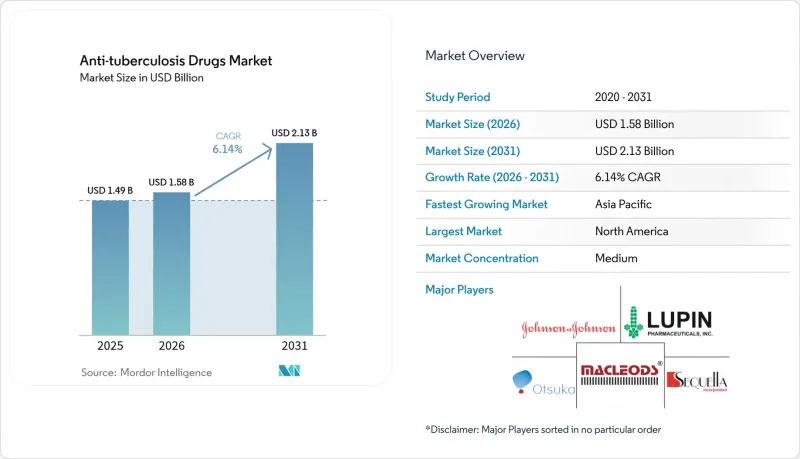
Mordor Intelligence에 의하면, 2026년 항결핵 치료제 시장 규모는 15억 8,000만 달러로 추정되고 2025년 14억 9,000만 달러에서 확대해, 2031년에는 21억 3,000만 달러에 이를 것으로 예측됩니다.
2026년부터 2031년까지의 연평균 성장률(CAGR)은 6.14%가 될 것으로 전망됩니다.
본 보고서는 약물 분류별(이소니아지드, 리팜핀, 에탐부톨, 피라지나미드, 플루오로퀴놀론계 약물 등), 최종 사용자(병원 및 진료소, 비영리 단체 등), 투여 경로(경구·주사제),유통 채널(병원 약국 등), 지역(북미, 유럽 등)별로 세분화되어 있습니다. 시장 전망은 금액(달러) 기준으로 제시되어 있습니다.
세계의 항결핵 치료제 시장 동향 및 인사이트
결핵 발병률 상승
2023년 전 세계 신규 발병자 수는 1,080만 명에 달하여, 공식적인 감시가 시작된 이래 최고치를 기록했으며, 코로나19로 인한 사망자 수를 넘어섰습니다. 인도, 인도네시아, 필리핀에서는 팬데믹 기간 동안 심각한 보고 지연이 발생했으며, 이로 인해 현재 지역사회 내 감염 확산이 가속화되고 있습니다. 동남아시아만으로도 전 세계 감염자의 46%를 차지하고 있으며, 급속한 도시화가 진행되는 지역에서의 빈곤에 따른 과밀화로 인해 그 부담은 더욱 커지고 있습니다. 이러한 상황에서 미치료 사례가 누적되면서 1차 및 2차 치료제에 대한 수요가 증가하고 있으며, 의료 예산이 여전히 부족한 지역에서도 항결핵 치료제 시장의 판매량 증가세가 유지되고 있습니다.
다제내성(MDR) 및 광범위내성(XDR) 균주의 급증
다제내성 결핵(MDR-TB)은 전체 사례의 약 5%에 불과하지만, 결핵으로 인한 사망의 최대 20%를 차지하고 있으며, 유전체 감시 결과에 따르면 내성 균주의 28%는 새로 발생한 것이 아니라 사람 간 감염을 통해 확산되고 있는 것으로 나타났습니다. 동유럽 및 사하라 이남 아프리카의 일부 지역에서는 세계에서 가장 높은 MDR 및 XDR 부담이 보고되고 있는 반면, 아시아에서는 XDR로 진행되기 전의 사례 수가 증가하고 있습니다. 진단된 다제내성 결핵(MDR-TB) 환자 중 적절한 치료를 받고 있는 비율은 44%에 불과하며, 항결핵 치료제 시장이 새로운 작용기전을 향한 개발을 지속할 수 있도록 파이프라인 혁신이 시급히 요구되고 있습니다.
약물 관련 이상반응
1차 치료법에서는 소아에서 최대 27%의 간독성이 나타나며, 특히 피라지나미드와 이소니아지드가 그 주된 원인으로 지목되고 있습니다. 리팜피신에 의한 급성 신장 손상 등 심각한 이상반응은 만성 신장 질환 환자의 관리를 복잡하게 만들고 있습니다. 이러한 안전성 우려로 인해 치료법이 변경되고 복약 순응도가 저하될 뿐만 아니라, 제약 기업들은 중증 소화기 계통 내약성 불내성에 대한 직장 좌약의 초기 연구를 포함하여 더 안전한 제형 개발을 서둘러야 하는 상황에 놓여 있습니다. 지속적인 독성 위험이 신약 도입 속도를 제한하고 있으며, 이는 항결핵 치료제 시장의 성장 가능성을 저해하고 있습니다.
부문 분석
항결핵 치료제 시장에서 리팜핀 시장 규모는 2025년에 4억 6,230만 달러에 달하여 31.02%의 점유율을 차지하며, 1차 선택 약제로서의 입지를 공고히 했습니다. 그러나 임상의들이 내성에 대처할 수 있는 치료법으로 전환함에 따라 베다킬린은 연평균 성장률(CAGR) 12.92%로 성장을 이어가고 있습니다. 이소니아지드와 에탐부톨은 치료적 중요성을 유지하고 있으나, 시장 포화와 내약성 문제로 인해 매출 전망은 정체 상태입니다. 프레토마니드는 WHO가 지원하는 BPaL 프로토콜에 채택되면서 성장을 가속화하고 있는 반면, 플루오로퀴놀론계 약물의 사용은 보고된 내성 양상에 따라 둔화되고 있습니다. TBAJ-876 및 감페보롤과 같은 파이프라인 후보 물질들은 차세대 화합물이 항결핵 치료제 시장 내 경쟁 구도를 어떻게 형성해 가고 있는지를 보여주고 있습니다. WHO는 28종의 유효한 임상시험용 약물을 집계하고 있으며, 그중 18종이 신규 화학물질입니다. 이는 견조하지만 여전히 위험을 수반하는 신약 개발 환경을 여실히 보여주고 있습니다.
임상 개발이 지속적으로 진전됨에 따라 상업적 기회가 더욱 부각되고 있습니다. 존슨앤드존슨의 PurF 억제제인 JNJ-6640은 ‘퍼스트-인-클래스(first-in-class)’가 될 가능성을 보여주고 있습니다. TB 얼라이언스가 5개국에서 진행 중인 TBAJ-876의 2상 임상시험은 베다킬린에 대한 내성 출현을 억제하는 것을 목표로 하고 있습니다. 유효성 데이터가 축적됨에 따라, 조달 기관과의 가격 협상을 통해 특히 가격에 민감한 중소득 국가에서 항결핵 치료제 시장 도입이 기존에 수요를 따라가지 못했던 지역에서 판매량이 대폭 증가할 것으로 예측됩니다.
2025년, 병원 및 진료소의 결핵 치료제 매출액은 6억 6,850만 달러에 달했으며, 중앙 집중식 조달 및 현장 진단 보급으로 인해 시장 점유율의 44.87%를 차지했습니다. 세계 펀드의 자금 지원과 게이츠 재단의 보조금으로 뒷받침되는 비영리 단체는 2031년까지 연평균 9.97%의 성장이 예상되며, 최종 사용자 중 가장 높은 성장률을 보이고 있습니다. 케랄라주의 ‘STEPS’나 인도의 ‘Ni-kshay Mitras’와 같은 민관 협력 모델은 자선 활동을 펼치는 파트너들이 의료 서비스가 미치지 못하는 지역의 ‘라스트 마일’ 의료 제공을 어떻게 강화하고 있는지를 보여줍니다. 민간 진단센터는 첨단 분자 검사를 통해 고객층이 확대됨에 따라 한 자릿수 중반의 성장률을 유지하고 있는 반면, 이동 진료소는 분쟁 지역이나 유목민 커뮤니티까지 서비스 범위를 확대하며 결핵 치료제 시장 전체의 보급률을 높이고 있습니다.
전략적으로, NGO는 현재 의약품 채택 결정에 지대한 영향력을 행사하고 있으며, 많은 경우 신약을 우선적으로 채택하는 BPaL/BPaLM 방식의 조달을 강력히 요구하고 있습니다. 이러한 자금력을 바탕으로 NGO는 제약사에 단계적 가격 책정을 수용하도록 압박하고 있으며, 세계 드럭 시설(GDF) 등의 제도를 통해 판매 수량에 기반한 계약을 촉진하고 있습니다. 개발 기업 입장에서는 수요에 맞춘 접근 프로그램이 평판 및 시장 점유율 향상으로 이어질 가능성이 있지만, 이는 유효 성분의 간헐적인 부족 상황 속에서도 공급 안정성이 보장되는 경우에 한합니다.
지역별 분석
북미는 전 세계 매출의 41.96%를 차지하고 있으며, 이는 고도의 감시 인프라, 보험에 의한 상환 제도, 그리고 부족 현상을 완화하기 위한 비상 비축 물자의 존재를 반영하고 있습니다. 이 지역의 미국 태생 인구를 대상으로 한 근절 추진책은 2025년까지 발병률을 10만 명당 0.4 미만으로 억제하는 것을 목표로 했으며, 이를 통해 예방적 리파펜틴 요법 및 고특이도 진단법의 도입이 촉진되고 있습니다. 그러나 공급망의 취약성은 여전히 남아 있습니다. 2023년 캘리포니아주에서 1차 선택 경구약의 재고 부족이 발생했을 때, 긴급 중앙 비축분이 투입되었습니다. 한편, 캐나다에서는 리팜핀 공급 중단에 직면하여 원주민 커뮤니티에 대한 의료 서비스 제공이 불충분해질 위험이 발생했습니다. 이러한 사태를 완화하기 위한 프로토콜에 따라, 항결핵 치료제 시장 수요를 안정화시키는 지속적인 재고 보충 계약이 추진되고 있습니다.
아시아태평양은 연평균 성장률(CAGR) 9.49%로 가장 빠르게 성장하고 있는 지역입니다. 인도에서는 7만 5,000명의 환자를 대상으로 한 BPaLM 도입과 8만 2,000명 이상이 등록된 ‘니 쿠샤이 미트라’를 통한 지역사회 지원이 대규모 시민 동원의 모범 사례가 되고 있습니다. 중국의 시공간 모델링에 따르면, 개입을 강화하지 않을 경우 2030년까지 국지적인 사망률 상승이 예상됩니다. 인도네시아는 M72/AS01E 백신 후보의 3상 임상시험에 참여하고 있으며, 최전선의 혁신 허브로서의 입지를 공고히 하고 있습니다(WHO.INT). 동남아시아는 감염자 수가 전체의 46%를 차지할 뿐만 아니라 의료 접근성에 격차가 있어, 향후 항결핵 치료제 시장 확대에 있어 매우 중요한 지역이 되고 있습니다.
유럽에서는 완만한 성장이 나타나고 있지만, 소아 발병률 증가에 직면해 있으며, 2023년에는 EU/EEA 29개국 전체에서 10% 증가한 3만 8,993건을 기록했습니다. 치료 성공률은 67.9%에 그쳐 목표치인 90%를 크게 밑도는 반면, 다제내성(MDR) 치료 완료율은 56%에 머물러 있어 새로운 치료법에 대한 잠재적 수요가 지속되고 있습니다. 루마니아의 AI를 활용한 아웃리치 활동과 ERA4TB 등의 컨소시엄은 차세대 치료법에 대한 지역적 투자를 상징합니다. 중동 및 아프리카 시장은 높은 약물 내성 부담과 자금 조달의 파편화가 특징이지만, 베다킬린의 가격 인하로 인해 접근성이 개선되고 있습니다. 브라질의 부처 간 결핵 퇴치 위원회가 주도하는 남미에서는 경구 병용 요법의 조달이 증가하고 있어, 항결핵 치료제 시장에 새로운 수요를 창출하고 있습니다.
기타 혜택 :
- 엑셀 형식 시장 예측(ME) 시트
- 3개월간의 애널리스트 지원
자주 묻는 질문
목차
제1장 서론
제2장 조사 방법
제3장 주요 요약
제4장 시장 구도
제5장 시장 규모 및 성장 예측
제6장 경쟁 구도
제7장 시장 기회 및 향후 전망
KTH 26.08.26According to Mordor Intelligence, the anti-tuberculosis drugs market size in 2026 is estimated at USD 1.58 billion, growing from 2025 value of USD 1.49 billion with 2031 projections showing USD 2.13 billion, growing at 6.14% CAGR over 2026-2031.
This report is Segmented by Drug Class (Isoniazid, Rifampin, Ethambutol, Pyrazinamide, Fluoroquinolones, and More), End User (Hospitals and Clinics, Non-Profit Organizations, and More), Route of Administration (Oral and Injectable), Distribution Channel (Hospital Pharmacies, and More), and Geography (North America, Europe, and More). The Market Forecasts are Provided in Terms of Value (USD).
Global Anti-tuberculosis Drugs Market Trends and Insights
Rising Prevalence of Tuberculosis
Worldwide incidence reached 10.8 million new cases in 2023, the highest since formal monitoring began and outpacing COVID-19 fatalities. India, Indonesia and the Philippines experienced severe notification gaps during pandemic years that now translate into intensified community transmission. Southeast Asia alone carries 46% of global infections, a burden magnified by poverty-related crowding in rapidly urbanizing districts. Across such settings, case backlogs elevate demand for first- and second-line medicines, preserving volume growth for the anti-tuberculosis drugs market even where health budgets remain constrained.
Incidence Surge of MDR & XDR Strains
MDR-TB constitutes roughly 5% of all cases yet accounts for up to 20% of TB mortality, and genomic surveillance shows 28% of resistant strains spread person-to-person rather than arising de novo. Eastern Europe and parts of sub-Saharan Africa post the world's highest MDR and XDR burden, while pre-XDR incidence is rising in Asia. Only 44% of diagnosed MDR-TB patients receive adequate therapy, underscoring the urgent need for pipeline innovation that keeps the anti-tuberculosis drugs market geared toward novel mechanisms of action.
Adverse Drug-Related Side-Effects
First-line regimens trigger hepatotoxicity rates of up to 27% in children, with pyrazinamide and isoniazid most implicated. Serious events such as rifampicin-induced acute kidney injury complicate management in chronic kidney disease patients. These safety concerns lead to regimen switches that undermine adherence and press innovators to pursue safer formulations, including early studies on rectal suppositories for severe digestive intolerance. Persistent toxicity risks cap uptake pace and weigh on the anti-tuberculosis drugs market growth potential.
Other drivers and restraints analyzed in the detailed report include:
- Short-Course All-Oral Regimen Breakthroughs
- AI-Enabled Radiology Screening Adoption
- High Cost of MDR/XDR Treatment
For complete list of drivers and restraints, kindly check the Table Of Contents.
Segment Analysis
The anti-tuberculosis drugs market size for rifampin reached USD 462.3 million in 2025, translating into a 31.02% share that confirms its front-line status. Bedaquiline, however, is advancing at a 12.92% CAGR as clinicians pivot toward regimens that withstand resistance. Isoniazid and ethambutol retain therapeutic relevance yet face flat revenue prospects because of saturation and intolerance issues. Pretomanid accelerates through inclusion in WHO-backed BPaL protocols, while fluoroquinolone use decelerates in response to documented resistance patterns. Pipeline candidates such as TBAJ-876 and ganfeborole illustrate how next-generation compounds are shaping competitive hierarchies within the anti-tuberculosis drugs market. The WHO counts 28 active investigational agents, of which 18 are new chemical entities, highlighting a robust but still risk-laden discovery landscape.
Continued clinical progress underscores commercial opportunity. Johnson & Johnson's JNJ-6640, a PurF inhibitor, demonstrates first-in-class potential. TB Alliance's five-country Phase 2 evaluation of TBAJ-876 seeks to mitigate emerging bedaquiline resistance. As efficacy data matures, pricing negotiations with procurement facilities could unlock sizeable incremental volumes, especially in price-sensitive Middle-Income settings where anti-tuberculosis drugs market adoption historically trailed need.
Hospitals and clinics generated USD 668.5 million in anti-tuberculosis drugs revenue in 2025, equal to 44.87% share aided by centralised procurement and on-site diagnostics. Non-profit organisations, fuelled by Global Fund disbursements and Gates Foundation grants, are forecast to grow 9.97% annually through 2031, the fastest among end users. Public-private engagement models like Kerala's STEPS and India's Ni-kshay Mitras demonstrate how philanthropic partners augment last-mile delivery in underserved districts. Private diagnostic centres maintain mid-single-digit expansion as advanced molecular testing broadens customer mix, while mobile clinics extend service reach into conflict zones and nomadic communities, deepening the overall anti-tuberculosis drugs market penetration.
Strategically, NGOs now wield outsize influence over formulary choices, often insisting on BPaL/BPaLM procurement that favours newer agents. Their funding leverage pressures manufacturers to accept tiered pricing and spurs volume-based agreements through mechanisms such as the Global Drug Facility. For developers, tailored access programmes can yield reputational and market-share gains, but only if supply security is guaranteed amid sporadic active-pharmaceutical-ingredient shortages.
Complete Report Scope:
- By Drug Class
- Isoniazid
- Rifampin
- Ethambutol
- Pyrazinamide
- Fluoroquinolones
- Bedaquiline
- Pretomanid
- Delamanid
- Aminoglycosides
- Thioamides
- Cyclic Peptides
- Other Drug Classes
- By End User
- Hospitals & Clinics
- Non-Profit Organizations
- Private Diagnostic Centers
- Others
- By Route of Administration
- Oral
- Injectable
- By Distribution Channel
- Hospital Pharmacies
- Retail Pharmacies
- Online Pharmacies
- Others (NGO & Donation Channels, Public Procurement & DOTS Programs)
- Geography
- North America
- United States
- Canada
- Mexico
- Europe
- Germany
- United Kingdom
- France
- Italy
- Spain
- Rest of Europe
- Asia-Pacific
- China
- Japan
- India
- South Korea
- Australia
- Rest of Asia-Pacific
- Middle East and Africa
- GCC
- South Africa
- Rest of Middle East and Africa
- South America
- Brazil
- Argentina
- Rest of South America
- North America
Geography Analysis
North America contributes 41.96% of global revenue, reflecting advanced surveillance infrastructure, insurance reimbursement and the presence of contingency stockpiles to buffer shortages. The region's elimination push among US-born populations targets incidence below 0.4 per 100,000 by 2025, fuelling uptake of preventive rifapentine regimens and high-specificity diagnostics. Yet supply-chain fragility persists: California's 2023 stock-out of first-line orals prompted emergency central buffer deployment while Canada grappled with rifampin interruptions that risk underserving Indigenous communities. Mitigation protocols drive steady replenishment contracts that stabilise demand within the anti-tuberculosis drugs market.
Asia-Pacific is the fastest-growing cluster at 9.49% CAGR. India's introduction of BPaLM for 75,000 patients and community sponsorship via more than 82,000 registered Ni-kshay Mitras illustrate public mobilization at scale. China's spatio-temporal modelling foresees localised mortality rises by 2030 without intensified intervention. Indonesia participates in Phase 3 trials for the M72/AS01E vaccine candidate, cementing its status as a front-line innovation hub [WHO.INT]. Southeast Asia's heavy 46% infection share plus uneven health access make the region pivotal to future anti-tuberculosis drugs market expansion.
Europe shows moderate growth but contends with rising paediatric incidence, up 10% to 38,993 cases across 29 EU/EEA countries in 2023. Treatment success remains at 67.9%, far below the 90% target, while MDR completion sits at 56%, sustaining latent demand for new regimens. Romania's AI-assisted outreach and consortiums such as ERA4TB exemplify regional investment in next-generation regimens. Middle East and Africa markets are shaped by high drug-resistant burden and fragmented funding, yet price cuts for bedaquiline are improving affordability. South America, led by Brazil's inter-ministerial TB elimination committee, displays rising procurement of oral combinations, creating fresh pull for the anti-tuberculosis drugs market.
- Johnson & Johnson
- Otsuka
- Lupin
- Macleods Pharmaceuticals Ltd.
- Viatris
- Novartis
- Sanofi
- Pfizer
- Cadila Healthcare (Zydus)
- Cipla
- Hetero Labs Ltd.
- Sandoz Group
- Strides Pharma Science Ltd.
- Shanghai Fosun Pharmaceutical Group
- Hikma Pharmaceuticals
- Sequella
Additional Benefits:
- The market estimate (ME) sheet in Excel format
- 3 months of analyst support
TABLE OF CONTENTS
1 Introduction
- 1.1 Study Assumptions & Market Definition
- 1.2 Scope of the Study
2 Research Methodology
3 Executive Summary
4 Market Landscape
- 4.1 Market Overview
- 4.2 Market Drivers
- 4.2.1 Rising Prevalence Of Tuberculosis
- 4.2.2 Incidence Surge Of MDR & XDR Strains
- 4.2.3 WHO End-TB Funding Momentum
- 4.2.4 Government-Led Awareness Initiatives
- 4.2.5 Short-Course All-Oral Regimen Breakthroughs
- 4.2.6 AI-Enabled Radiology Screening Adoption
- 4.3 Market Restraints
- 4.3.1 Adverse Drug-Related Side-Effects
- 4.3.2 High Cost Of MDR/XDR Treatment
- 4.3.3 Lengthy Treatment & Poor Adherence
- 4.3.4 API Supply-Chain Fragility (Rifapentine)
- 4.4 Porter's Five Forces
- 4.4.1 Threat of New Entrants
- 4.4.2 Bargaining Power of Buyers
- 4.4.3 Bargaining Power of Suppliers
- 4.4.4 Threat of Substitutes
- 4.4.5 Competitive Rivalry
5 Market Size & Growth Forecasts (Value, USD)
- 5.1 By Drug Class
- 5.1.1 Isoniazid
- 5.1.2 Rifampin
- 5.1.3 Ethambutol
- 5.1.4 Pyrazinamide
- 5.1.5 Fluoroquinolones
- 5.1.6 Bedaquiline
- 5.1.7 Pretomanid
- 5.1.8 Delamanid
- 5.1.9 Aminoglycosides
- 5.1.10 Thioamides
- 5.1.11 Cyclic Peptides
- 5.1.12 Other Drug Classes
- 5.2 By End User
- 5.2.1 Hospitals & Clinics
- 5.2.2 Non-Profit Organizations
- 5.2.3 Private Diagnostic Centers
- 5.2.4 Others
- 5.3 By Route of Administration
- 5.3.1 Oral
- 5.3.2 Injectable
- 5.4 By Distribution Channel
- 5.4.1 Hospital Pharmacies
- 5.4.2 Retail Pharmacies
- 5.4.3 Online Pharmacies
- 5.4.4 Others (NGO & Donation Channels, Public Procurement & DOTS Programs)
- 5.5 Geography
- 5.5.1 North America
- 5.5.1.1 United States
- 5.5.1.2 Canada
- 5.5.1.3 Mexico
- 5.5.2 Europe
- 5.5.2.1 Germany
- 5.5.2.2 United Kingdom
- 5.5.2.3 France
- 5.5.2.4 Italy
- 5.5.2.5 Spain
- 5.5.2.6 Rest of Europe
- 5.5.3 Asia-Pacific
- 5.5.3.1 China
- 5.5.3.2 Japan
- 5.5.3.3 India
- 5.5.3.4 South Korea
- 5.5.3.5 Australia
- 5.5.3.6 Rest of Asia-Pacific
- 5.5.4 Middle East and Africa
- 5.5.4.1 GCC
- 5.5.4.2 South Africa
- 5.5.4.3 Rest of Middle East and Africa
- 5.5.5 South America
- 5.5.5.1 Brazil
- 5.5.5.2 Argentina
- 5.5.5.3 Rest of South America
- 5.5.1 North America
6 Competitive Landscape
- 6.1 Market Concentration
- 6.2 Market Share Analysis
- 6.3 Company Profiles (includes Global level Overview, Market level overview, Core Segments, Financials as available, Strategic Information, Market Rank/Share for key companies, Products & Services, and Recent Developments)
- 6.3.1 Johnson & Johnson (Janssen)
- 6.3.2 Otsuka Pharmaceutical Co., Ltd.
- 6.3.3 Lupin Limited
- 6.3.4 Macleods Pharmaceuticals Ltd.
- 6.3.5 Viatris Inc.
- 6.3.6 Novartis AG
- 6.3.7 Sanofi
- 6.3.8 Pfizer Inc.
- 6.3.9 Cadila Healthcare (Zydus)
- 6.3.10 Cipla Ltd.
- 6.3.11 Hetero Labs Ltd.
- 6.3.12 Sandoz AG
- 6.3.13 Strides Pharma Science Ltd.
- 6.3.14 Shanghai Fosun Pharmaceutical Group
- 6.3.15 Hikma Pharmaceuticals
- 6.3.16 Sequella, Inc.
7 Market Opportunities & Future Outlook
- 7.1 White-space & Unmet-Need Assessment