

|
시장보고서
상품코드
2113821
시추 폐기물 관리 서비스 : 시장 점유율 분석, 업계 동향 및 통계, 성장 예측(2026-2031년)Drilling Waste Management Services - Market Share Analysis, Industry Trends & Statistics, Growth Forecasts (2026 - 2031) |
||||||
 Mordor Intelligence
Mordor Intelligence에 의하면, 2026년 시추 폐기물 관리 서비스 시장 규모는 73억 3,000만 달러로 추정되고 2025년 68억 7,000만 달러에서 확대해, 2031년에는 101억 5,000만 달러에 이를 것으로 예측됩니다.
2026-2031년 동안 연평균 성장률(CAGR) 6.72%로 성장할 것으로 전망됩니다.
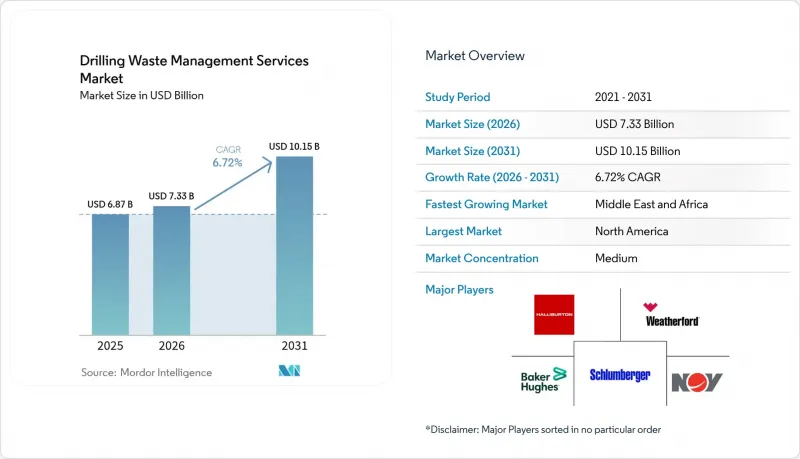
본 보고서는 폐기물 유형별(시추 컷팅, 사용 후 시추 유체, 생산수/기타 탐사·생산(E&P) 폐기물), 서비스별(고형물 분리, 처리·처분, 격리·취급, 기타),기술별(열탈착, 시추 컷팅 재주입, 기타), 운영 지역별(온쇼어, 오프쇼어), 지역별(북미, 아시아태평양, 중동 및 아프리카, 기타)로 분류되어 있습니다.
세계의 시추 폐기물 관리 서비스 시장 동향 및 인사이트
전 세계 배출 규제 강화
텍사스주가 40년 만에 유전 폐기물 관련 규제를 대대적으로 개정하고, 영국이 2025년 4월부터 디지털 추적 시스템 도입을 의무화하는 등 전 세계적으로 배출 제한이 강화되고 있습니다. 미국 환경보호청(EPA)의 해양 규정에 따르면, 현재 해안에서 3마일 이내의 해역에서 유성 유체의 배출이 금지되어 있으며, 비수성 유체에 대해서는 엄격한 독성 비율이 적용되고 있습니다. 이에 따라 해양 사업자들은 제로 배출을 달성하기 위해 선상 처리 및 시추 컷팅의 재주입에 주력하고 있습니다. 규제 당국의 실시간 모니터링 시스템 보급에 따라, 트럭을 이용한 운반 및 투기 처리가 아닌 첨단 처리 기술에 대한 투자가 요구되고 있습니다. 이러한 규제가 정착됨에 따라, 시추 컷팅 내 유분에 관한 엄격한 기준을 충족하는 소형 열탈착 장치에 대한 수요가 급증하고 있습니다.
심해·초심해에서의 시추 활동 확대
멕시코만에서 진행 중인 쉐브론사의 2만 psi 앵커 유전 프로젝트 등은 복잡한 유정이 폐기물 양을 얼마나 증가시키는지 보여주고 있습니다. 초심해 시추 작업에서는 고성능 유체가 사용되기 때문에 육상 매립 처리장에서는 수용할 수 없을 정도로 오염된 시추 컷팅이 훨씬 더 많이 발생합니다. 각 사업자들은 드릴십에 열기계식 세척 장치를 추가 설치하여 해상에서 수천 톤 규모의 석유 및 가스를 처리함으로써 비생산 시간을 최소화하고 있습니다. 탈착 처리와 슬러리 처리를 결합한 통합형 폐기물 처리 플랫폼은 물류 비용을 절감하고 제로 배출 기준을 충족합니다. 브라질, 노르웨이, 미국 멕시코만에서 새로운 심해 유전 개발이 승인됨에 따라, 이동식 해양 시스템을 보유한 서비스 제공업체들이 유망한 계약을 수주하고 있습니다.
시추 장비 수와 설비 투자 주기의 변동
시추 폐기물 처리 서비스에 대한 수요는 시추 장비의 가동 상황에 따라 변동합니다. Saudi Aramco가 2024년에 20건의 잭업식 시추 장비 용선 계약을 취소함에 따라, 중동의 시추 장비 수요 증가율은 4%에서 1%로 둔화되었고, 계약업체들은 모듈식 탈착 설비의 가동을 중단할 수밖에 없게 되었습니다. 서비스 제공업체는 경기 침체기에도 고가의 열처리 장비를 유지해야 하므로 현금 흐름에 부담이 가중되고 있습니다. 대기업들은 각 유역 간에 신속하게 이동 가능한 스키드 탑재형 시스템을 도입하여 리스크를 헤지하고 있지만, 가동률이 60% 미만으로 떨어지면 물류 비용이 상승합니다. 일일 수익 전망이 불투명해지면 신규 설비에 대한 자금 조달이 어려워지고, 그 결과 교체 주기가 장기화됩니다. 이러한 주기적인 압박은 첨단 기술에 대한 단기 투자를 억제하여 시추 폐기물 관리 서비스 시장의 성장을 둔화시키고 있습니다.
부문 분석
2025년, 시추 컷팅은 모든 유정 설계에서 보편적으로 발생하고, 직접 배출을 금지하는 복잡한 유분 함유 컷팅 처리 요건으로 인해 시추 폐기물 관리 서비스 시장 점유율의 57.25%를 차지했습니다. 장거리 수평 유정의 경우, 시추 피트 수가 늘어나고 시추 컷팅의 물류 부담도 증가하기 때문에 셰이커, 건조기, 열세척기에 대한 수요가 유지되고 있습니다. 한편, 생산수는 셰일 개발로 인해 고형 폐기물을 훨씬 능가하는 양의 염수가 배출됨에 따라 2031년까지 연평균 성장률(CAGR) 7.67%라는 빠른 속도로 확대되고 있습니다. 현재 서비스는 시추 컷팅 처리와 물 재활용 계약을 세트로 제공하고 있으며, 이는 사업자가 단일 창구를 통한 책임 소재를 원하고 있음을 반영합니다. 폐쇄형 진흙수 시스템은 유체 손실을 줄여주지만, 회수된 슬러지를 처리해야 할 필요성이 높아짐에 따라 액체 처리 플랫폼에 할당되는 시추 폐기물 관리 서비스 시장 규모를 확대시킵니다. 예측 기간 동안, 사업자들이 두 폐기물 범주를 모두 최적화하는 공급업체를 선호함에 따라, 시추 컷팅 및 물을 대상으로 하는 통합 계약이 시장 점유율에서 더 큰 비중을 차지할 것으로 예측됩니다.
생산수의 급증으로 인해 트럭 운송 거리를 줄여주는 이동식 증발 장치 및 결정화 장치에 대한 투자가 촉진되고 있습니다. 퍼미안 분지에서는 각 시추 패드에서 열 농축 장치와 결합된 전기 응집 장비의 시험 운영이 진행되고 있으며, 이를 통해 폐기물 발생량을 80% 줄이고 시추 완료 공사에 사용할 담수를 회수하고 있습니다. 사우디아라비아에서도 관개용수 재사용을 목적으로 유사한 시범 사업이 진행되고 있으며, 이는 해당 국가의 순환형 경제 비전에 부합하는 노력입니다. 시추 절삭물은 톤수 기준으로 여전히 주류를 이루고 있지만, 규제 당국이 주입정을 엄격하게 모니터링함에 따라 생산수의 밀도가 높아질 것으로 예측됩니다. 이에 따라 유체 처리 전문 기업들은 시추 폐기물 관리 서비스 시장에서 상당한 성장이 예상됩니다.
2025년에도 고형분 관리는 41.35%를 차지하여 여전히 가장 큰 부문이며, 이는 모든 시추 장비에 셰이커와 원심분리기 패키지의 탑재가 의무화되어 있음을 반영합니다. 그러나 ESG를 중시하는 사업자들이 폐기물을 재활용 자원으로 전환하는 솔루션을 선호함에 따라, 처리·처분 부문은 2031년까지 연평균 성장률(CAGR) 8.28%라는 가장 빠른 속도로 성장하고 있습니다. 현재 각 공급업체들은 열 탈착 기능을 갖춘 수직식 시추 절삭 건조기를 통합하여 기유를 최대 95%까지 회수함으로써, 신규 시추 슬러지 구매 비용을 배럴당 40-60달러 절감하고 있습니다. 그 결과, 처리에 할당되는 시추 폐기물 관리 서비스 시장 규모는 격리 관련 지출보다 더 빠르게 확대되고 있습니다. 서비스 기업들은 전략적인 매립지 및 주입정의 용량을 통해 확실한 처분 수단을 제공하고, 대출 기관의 요구 사항을 충족하는 ‘생산부터 폐기까지의 전 과정(cradle-to-grave)’에 걸친 규정 준수 증명서를 발급하고 있습니다.
유정 군이 중앙 처리 허브를 공유하는 경우, 격리 및 취급 업무는 여전히 중요성을 유지하고 있습니다. 시추 컷팅 재주입 서비스는 데크 공간이 제한적인 해양 사업자에게 매력적이며, 고압 슬러리 펌프 및 영구 격리 패커에 대한 틈새 수요를 주도하고 있습니다. 폐기물 추적을 수행하는 디지털 SaaS는 관리, 처리, 처분 데이터를 통합하는 ‘오버레이’ 서비스로 부상하고 있으며, 이를 통해 사업자는 탄소 집약도를 감사하고 지속가능성 보고서를 작성할 수 있게 됩니다. 이러한 융합은 시추 폐기물 관리 서비스 산업에서 단편적인 서비스 제공에서 엔드투엔드 플랫폼으로의 구조적 전환을 보여줍니다.
지역별 분석
2025년, 북미는 이 지역의 활발한 셰일 개발 활동을 배경으로 37.65%의 점유율로 시추 폐기물 관리 서비스 시장을 주도했습니다. 텍사스주의 유전 폐기물 관련 법규에 대한 대대적인 개정으로, 염수 주입량에 대한 최초의 제한과 피트에 대한 새로운 라이너 요건이 도입되었습니다. 이러한 규제로 인해 대용량 물 재활용 허브 및 이동식 탈착 설비에 대한 수요가 증가하고 있습니다. 퍼미안 분지의 생산수 물류는 이미 미국 5개 주를 합친 에너지 소비량을 초과하고 있으며, 이에 따라 전기화 파이프라인망과 태양광 발전을 활용한 처리 시설 개발이 진행되고 있습니다. 이 지역이 AI를 활용한 유체 처리 소프트웨어의 도입에 적극적인 점도 시장의 혁신을 더욱 촉진하고 있습니다.
유럽은 시추 장비 수가 감소하고 있음에도 불구하고 여전히 큰 영향력을 유지하고 있습니다. 노르웨이의 해양 폐기물 모니터링 체계는 규정 준수 분야의 골드 스탠다드로 자리매김하고 있으며, 북해의 모든 잭업식 시추 장비에 폐쇄형 진흙 처리 시스템 및 열 탈착 기술의 도입을 추진하고 있습니다. 2025년에 시행될 영국의 디지털 폐기물 추적 의무에 따라 제조부터 폐기에 이르는 전 과정에 걸친 문서화가 요구되며, 이를 통해 데이터 중심 서비스 모델의 수익원이 확대될 것입니다. 독일은 유성 시추 칩의 혼소 연소를 허용하는 이중 용도형 폐기물 발전 플랜트를 추진하고 있으며, 이는 시추 폐기물 관리 서비스 시장에서 순환 경제를 부각시키고 있습니다.
중동 및 아프리카는 2031년 연평균 성장률(CAGR)이 8.34%로 가장 빠르게 성장하고 있는 지역입니다. 사우디아라비아는 매립 처분에서 재활용 비율 90%를 목표로 하고 있으며, 합성 진흙물을 회수하는 모듈식 탈착 시범 사업에 자금을 지원하고 있습니다. 오만은 트럭 운송 거리가 300km를 초과하는 사막 지대의 클러스터 굴착에도 이 모델을 확대 적용하고 있으며, 현장 처리의 비용 효율성을 입증하고 있습니다. 나미비아나 케냐와 같은 아프리카 개척 지역에서는 제한된 인프라에 대응 가능한 이동식 격리·안정화 장치에 대한 새로운 수요가 발생하고 있습니다. 이러한 동향에 힘입어 MENA 지역 전체에 걸쳐 시추 폐기물 관리 서비스 산업에 활용될 견실한 프로젝트 파이프라인이 구축되고 있습니다.
중국과 인도가 주도하는 아시아태평양에서는 육상 탐사가 가속화되고 있으며, 각 주의 유정 폐쇄 규제가 강화되고 있습니다. 그러나 시추 장비의 분산과 자금 면의 제약으로 인해 최첨단 기술 도입은 지연되고 있습니다. 남미 성장의 중심은 브라질이며, 페트로브라스의 심해 프리솔트층 개발 프로젝트에서는 유체, 시멘트, 폐기물 처리를 통합한 계약이 규정되어 있어, 탈착 및 CRI(화학적 재활용) 역량을 갖춘 대형 서비스 기업이 우대받고 있습니다. 모든 지역에서 규제 조화와 ESG 금융이 시장을 표준화된 제로 배출 기준으로 이끌고 있습니다.
기타 혜택
- 엑셀 형식 시장 예측(ME) 시트
- 3개월간의 애널리스트 지원
자주 묻는 질문
목차
제1장 서론
제2장 조사 방법
제3장 주요 요약
제4장 시장 구도
제5장 시장 규모 및 성장 예측
제6장 경쟁 구도
제7장 시장 기회 및 향후 전망
KTH 26.08.26According to Mordor Intelligence, the drilling waste management services market size in 2026 is estimated at USD 7.33 billion, growing from 2025 value of USD 6.87 billion with 2031 projections showing USD 10.15 billion, growing at 6.72% CAGR over 2026-2031.
This report is Segmented by Waste Type (Drill Cuttings, Used Drilling Fluids, and Produced Water/Other E&P Wastes), Service (Solids Control, Treatment and Disposal, Containment and Handling, and More), Technology (Thermal Desorption, Cuttings Reinjection, and More), Location of Deployment (Onshore and Offshore), and Geography (North America, Asia-Pacific, Middle East and Africa, and More).
Global Drilling Waste Management Services Market Trends and Insights
Tightening Global Discharge Regulations
Worldwide discharge limits are intensifying as Texas implements its first overhaul of oilfield waste in four decades and the UK mandates a digital tracking system from April 2025. EPA offshore rules now prohibit the discharge of oil-based fluids within 3 miles of shore and impose strict toxicity ratios for non-aqueous fluids. Offshore operators, therefore, turn to onboard treatment and cuttings reinjection to achieve zero discharge. Regulators' wider use of real-time monitoring systems forces investment in advanced processing rather than truck-and-dump disposal. As these rules take hold, demand rises sharply for compact thermal desorption units that meet stringent oil-on-cuttings thresholds.
Growth in Deep-Water & Ultra-Deep-Water Drilling Activity
Projects such as Chevron's 20,000 psi Anchor field in the Gulf of Mexico demonstrate how complex wells multiply waste volumes. Ultra-deep campaigns rely on high-performance fluids, generating more contaminated cuttings that shore-based landfills cannot accept. Operators retrofit drillships with thermomechanical cleaners to process thousands of tonnes of oil and gas offshore, minimizing non-productive time. Integrated waste platforms that couple desorption with slurry-handling reduce logistics costs and meet zero-discharge standards. As Brazil, Norway, and the US Gulf sanction new deep-water fields, service providers with portable offshore systems secure premium contracts.
Volatile Rig-Count and Capex Cycles
Demand for drilling waste services swings with rig activity. Saudi Aramco's cancellation of 20 jack-up charters in 2024 reduced Middle East rig demand growth to 1% from 4% and forced contractors to idle modular desorption fleets. Service providers must maintain expensive thermal units even during downturns, straining cash flows. Large firms hedge by deploying skid-mounted systems that can relocate quickly between basins; however, logistics costs rise when utilization falls below 60%. Financing new equipment becomes challenging when day-rate visibility declines, thereby prolonging replacement cycles. This cyclical pressure reduces near-term investment in advanced technologies and tempers the drilling waste management services market.
Other drivers and restraints analyzed in the detailed report include:
- Shale Boom Driving High-Volume Cuttings in North America
- ESG-Linked Financing Favouring "Zero-Waste" Projects
- High Capital Cost of Onsite Treatment Technologies
For complete list of drivers and restraints, kindly check the Table Of Contents.
Segment Analysis
Drill cuttings commanded 57.25% of the drilling waste management services market share in 2025, thanks to their ubiquity across well designs and the complex oil-on-cuttings treatment requirements that prohibit direct discharge. Extended-reach horizontals generate longer footage and heavier cuttings logistics, sustaining demand for shakers, dryers, and thermal cleaners. The produced-water stream, meanwhile, is scaling faster at a 7.67% CAGR to 2031 as shale developments pump brine volumes that dwarf solid waste. Services now bundle cutting handling with water recycling contracts, reflecting operators' search for single-point accountability. Closed-loop mud systems reduce fluid losses but increase the need to process recovered slops, thereby boosting the drilling waste management services market size allocated to liquid treatment platforms. Over the forecast window, integrated contracts covering cuttings plus water are expected to capture a larger wallet share as operators favor vendors who optimize both waste categories.
The produced-water surge encourages investment in mobile evaporation and crystallizer units that reduce trucking miles. In the Permian, pads trial electro-coagulation rigs paired with thermal concentrators, cutting disposal volumes by 80% and reclaiming fresh water for completions. Similar pilots in Saudi Arabia target irrigation reuse, aligning with its circular economy vision. Although drill cutting remains dominant by tonnage value, the density of produced water is expected to rise as regulators scrutinize injection wells, positioning fluid-treatment specialists for premium growth within the drilling waste management services market.
Solids control remained the largest segment at 41.35% in 2025, reflecting the mandatory inclusion of shaker and centrifuge packages on every rig. Yet treatment and disposal are advancing fastest at an 8.28% CAGR to 2031 as ESG-focused operators favor solutions that transform waste into reusable resources. Vendors now integrate vertical cuttings dryers with thermal desorption to recover up to 95% of base oil, cutting new-mud purchases by USD 40-60 per barrel. The drilling waste management services market size allocated to treatment is therefore expanding more quickly than containment spending. Service companies provide disposal certainty through strategic landfill or injection well capacity, offering "cradle-to-grave" compliance certificates that meet the demands of lenders.
Containment and handling retain relevance where well clusters share central treatment hubs. Drill-cuttings reinjection services appeal to offshore operators constrained by deck space, driving niche demand for high-pressure slurry pumps and permanent isolation packers. Digital waste-tracking SaaS is emerging as an "overlay" service that stitches together control, treatment, and disposal data, enabling operators to audit carbon intensity and prepare sustainability reports. This convergence signals a structural migration from piecemeal offerings toward end-to-end platforms in the drilling waste management services industry.
Complete Report Scope:
- By Waste Type
- Drill Cuttings
- Used Drilling Fluids
- Produced Water/Other E&P Wastes
- By Service
- Solids Control
- Containment and Handling
- Treatment and Disposal
- Drill-Cuttings Reinjection
- Others
- By Technology
- Thermal Desorption
- Bioremediation and Composting
- Stabilisation/Solidification
- Cuttings Reinjection (CRI)
- Dewatering and Vacuum Transfer
- By Location of Deployment
- Onshore
- Offshore
- By Geography
- North America
- United States
- Canada
- Mexico
- Europe
- Germany
- United Kingdom
- Norway
- Russia
- Rest of Europe
- Asia-Pacific
- China
- India
- Japan
- South Korea
- ASEAN Countries
- Rest of Asia-Pacific
- South America
- Brazil
- Argentina
- Rest of South America
- Middle East and Africa
- Saudi Arabia
- United Arab Emirates
- Qatar
- South Africa
- Rest of Middle East and Africa
- North America
Geography Analysis
North America led the drilling waste management services market in 2025, with a 37.65% share, driven by the region's prolific shale activity. Texas's overhaul of oilfield-waste statutes introduces first-time limits on saltwater-injection volumes and new liner requirements for pits. These rules amplify demand for high-capacity water-recycling hubs and mobile desorption fleets. Produced-water logistics in the Permian already consume more energy than five US states, prompting the development of electrified pipeline networks and solar-powered treatment plants. The region's willingness to pilot AI-driven fluid-handling software further catalyzes market innovation.
Europe retains significant influence despite fewer rigs. Norway's offshore waste-monitoring regime remains the gold standard for compliance, driving adoption of closed-loop mud systems and thermal desorption on every North Sea jack-up. The United Kingdom's digital waste-tracking mandate, effective 2025, requires cradle-to-grave documentation, thereby extending the revenue for data-centric service models. Germany promotes dual-use waste-to-energy plants that accept oil-based cuttings for co-combustion, highlighting a circular economy within the drilling waste management services market.
Middle East and Africa represent the fastest-growing region, with an 8.34% CAGR through 2031. Saudi Arabia targets 90% landfill diversion and funds modular desorption pilots that reclaim synthetic muds. Oman extends the model to desert cluster drilling where trucking distances exceed 300 km, providing a cost case for onsite treatment. Africa's frontier plays in Namibia and Kenya create fresh demand for portable containment and stabilization units compatible with limited infrastructure. These dynamics establish a robust pipeline for the drilling waste management services industry across the MENA region.
Asia-Pacific, led by China and India, accelerates onshore exploration and tightens provincial well-closure rules; however, dispersed rig counts and capital constraints slow the deployment of premium technologies. South America's growth centers on Brazil, where Petrobras' deep-water pre-salt developments specify integrated fluids, cement, and waste contracts that reward major service houses with desorption and CRI capabilities. Across geographies, regulatory harmonization and ESG finance push the market toward standardized zero-discharge benchmarks.
- Schlumberger Ltd (SLB)
- Halliburton Company
- Baker Hughes Co.
- Weatherford International plc
- National Oilwell Varco Inc.
- TWMA Group Ltd
- SAR AS
- GN Solids Control
- Thermtech AS
- Newpark Resources Inc.
- Tervita Corp.
- Solids Control Services Ltd
- Eco-Logic Environmental Engineering Inc.
- Secure Energy Services Inc.
- Kosun Group
- Panther Fluids Management
- Scomi Group Bhd
- Derrick Equipment Company
- Ridgeline Canada Inc.
- STEP Oiltools
Additional Benefits:
- The market estimate (ME) sheet in Excel format
- 3 months of analyst support
TABLE OF CONTENTS
1 Introduction
- 1.1 Study Assumptions & Market Definition
- 1.2 Scope of the Study
2 Research Methodology
3 Executive Summary
4 Market Landscape
- 4.1 Market Overview
- 4.2 Onshore & Offshore Active Rig Count Analysis
- 4.3 Market Drivers
- 4.3.1 Tightening global discharge regulations
- 4.3.2 Growth in deep-water & ultra-deep-water drilling activity
- 4.3.3 Shale boom driving high-volume cuttings in North America
- 4.3.4 ESG-linked financing favouring "zero-waste" projects
- 4.3.5 Rapid adoption of modular thermal desorption units in MENA
- 4.3.6 Digital waste-tracking mandates by hydrocarbons regulators
- 4.4 Market Restraints
- 4.4.1 Volatile rig-count and capex cycles
- 4.4.2 High capital cost of onsite treatment technologies
- 4.4.3 Closed-loop drilling fluid systems reducing third-party volumes
- 4.4.4 Uncertain permitting for onshore cuttings reinjection in Europe
- 4.5 Supply-Chain Analysis
- 4.6 Regulatory Landscape
- 4.7 Technological Outlook
- 4.8 Porter's Five Forces
- 4.8.1 Bargaining Power of Suppliers
- 4.8.2 Bargaining Power of Buyers
- 4.8.3 Threat of New Entrants
- 4.8.4 Threat of Substitutes
- 4.8.5 Intensity of Competitive Rivalry
5 Market Size & Growth Forecasts
- 5.1 By Waste Type
- 5.1.1 Drill Cuttings
- 5.1.2 Used Drilling Fluids
- 5.1.3 Produced Water/Other E&P Wastes
- 5.2 By Service
- 5.2.1 Solids Control
- 5.2.2 Containment and Handling
- 5.2.3 Treatment and Disposal
- 5.2.4 Drill-Cuttings Reinjection
- 5.2.5 Others
- 5.3 By Technology
- 5.3.1 Thermal Desorption
- 5.3.2 Bioremediation and Composting
- 5.3.3 Stabilisation/Solidification
- 5.3.4 Cuttings Reinjection (CRI)
- 5.3.5 Dewatering and Vacuum Transfer
- 5.4 By Location of Deployment
- 5.4.1 Onshore
- 5.4.2 Offshore
- 5.5 By Geography
- 5.5.1 North America
- 5.5.1.1 United States
- 5.5.1.2 Canada
- 5.5.1.3 Mexico
- 5.5.2 Europe
- 5.5.2.1 Germany
- 5.5.2.2 United Kingdom
- 5.5.2.3 Norway
- 5.5.2.4 Russia
- 5.5.2.5 Rest of Europe
- 5.5.3 Asia-Pacific
- 5.5.3.1 China
- 5.5.3.2 India
- 5.5.3.3 Japan
- 5.5.3.4 South Korea
- 5.5.3.5 ASEAN Countries
- 5.5.3.6 Rest of Asia-Pacific
- 5.5.4 South America
- 5.5.4.1 Brazil
- 5.5.4.2 Argentina
- 5.5.4.3 Rest of South America
- 5.5.5 Middle East and Africa
- 5.5.5.1 Saudi Arabia
- 5.5.5.2 United Arab Emirates
- 5.5.5.3 Qatar
- 5.5.5.4 South Africa
- 5.5.5.5 Rest of Middle East and Africa
- 5.5.1 North America
6 Competitive Landscape
- 6.1 Market Concentration
- 6.2 Strategic Moves (M&A, Partnerships, PPAs)
- 6.3 Market Share Analysis (Market Rank/Share for key companies)
- 6.4 Company Profiles (includes Global level Overview, Market level overview, Core Segments, Financials as available, Strategic Information, Products & Services, and Recent Developments)
- 6.4.1 Schlumberger Ltd (SLB)
- 6.4.2 Halliburton Company
- 6.4.3 Baker Hughes Co.
- 6.4.4 Weatherford International plc
- 6.4.5 National Oilwell Varco Inc.
- 6.4.6 TWMA Group Ltd
- 6.4.7 SAR AS
- 6.4.8 GN Solids Control
- 6.4.9 Thermtech AS
- 6.4.10 Newpark Resources Inc.
- 6.4.11 Tervita Corp.
- 6.4.12 Solids Control Services Ltd
- 6.4.13 Eco-Logic Environmental Engineering Inc.
- 6.4.14 Secure Energy Services Inc.
- 6.4.15 Kosun Group
- 6.4.16 Panther Fluids Management
- 6.4.17 Scomi Group Bhd
- 6.4.18 Derrick Equipment Company
- 6.4.19 Ridgeline Canada Inc.
- 6.4.20 STEP Oiltools
7 Market Opportunities & Future Outlook
- 7.1 White-space & Unmet-Need Assessment


