|
시장보고서
상품코드
2113841
마이크로플루이딕스 : 시장 점유율 분석, 업계 동향 및 통계, 성장 예측(2026-2031년)Microfluidics - Market Share Analysis, Industry Trends & Statistics, Growth Forecasts (2026 - 2031) |
||||||
 Mordor Intelligence
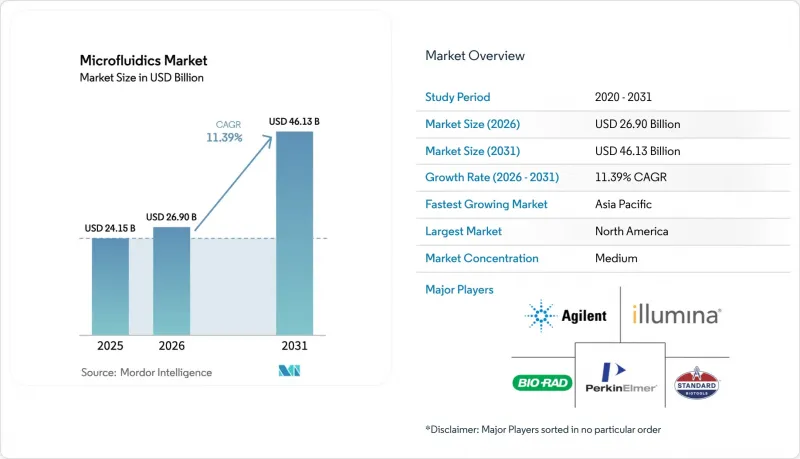
Mordor Intelligence에 의하면, 마이크로플루이딕스 시장 규모는 2025년에 241억 5,000만 달러로 평가되었습니다. 2026년에 269억 달러에 달하고, 2031년까지 461억 3,000만 달러에 이를 것으로 예측되며, 2026-2031년에 걸쳐 CAGR 11.39%로 성장할 전망입니다.
본 보고서는 제품 유형별(마이크로유체 기반 디바이스, 마이크로유체 구성 요소(마이크로유체 칩, 기타)), 용도별(약물 전달, 현장 진단, 기타),소재별(폴리머, 실리콘, 기타), 기술별(연속 유동 마이크로플루이딕스 기술, 기타), 최종 사용자별(진단 실험실, 기타), 지역별로 분류되어 있습니다. 시장 전망은 금액(달러) 기준으로 제시되어 있습니다.
세계의 마이크로플루이딕스 시장 동향 및 인사이트
현장 진단(Point-of-Care) 검사 수요 증가
의료진은 실시간 치료 방침 결정의 지침이 되고, 응급실 혼잡을 완화하며, 재입원을 방지하는 신속한 진단 결과를 중요하게 여기고 있습니다. 광학식 리더기와 결합된 마이크로플루이딕스 횡류 카트리지는 15분 이내에 정량적인 바이오마커 결과를 제공합니다. 그 예로, 임상적으로 유의미한 농도에서 혈류 감염을 감지하는 SepTec의 패혈증 검사를 들 수 있습니다. 2024년부터 2025년에 걸쳐 미국 식품의약국(FDA)은 마이크로플루이딕스식 COVID-19 검사에 대해 23건의 긴급사용승인(EUA)을 부여함으로써, 제조업체들이 현재 만성 질환 검사에 활용하고 있는 신속 심사 선례를 확립했습니다. 보험 급여 정책도 이에 발맞추고 있습니다. 메디케어의 ADLT(추가 진단 검사) 체계는 검사가 임상적 유용성을 입증할 경우 유리한 급여 조건을 제공하며, 이를 통해 병원들은 수작업 기반 워크플로우를 자동화된 밀폐형 마이크로플루이딕스 시스템으로 대체하도록 장려받고 있습니다. 그 효과는 즉각적으로 나타나고 있습니다. 추출, 증폭, 검출을 통합한 일회용 카트리지에 대한 수요가 급속히 증가하고 있으며, 특히 숙련된 검사 기사가 부족한 응급 진료 클리닉에서 이러한 경향이 두드러집니다. 공급망이 안정됨에 따라 각 제조업체는 심장, 대사, 호흡기 계통의 검사 패널을 아우르는 검사 메뉴 확충에 주력하고 있으며, 이는 마이크로플루이딕스 시장의 성장세를 더욱 강화하고 있습니다.
만성 질환 및 감염병 발생률 증가
당뇨병, 심혈관 질환, 만성 신장 질환이 전 세계적으로 부담이 커짐에 따라, 반복적인 정맥 천자를 필요로 하지 않는 지속적인 모니터링 솔루션에 대한 수요가 증가하고 있습니다. 간질액이나 타액을 분석하는 마이크로플루이딕스 센서는 소아 및 노인 의료에 적합하며, 치료 순응도를 향상시키고 보다 엄격한 치료 관리를 가능하게 합니다. 동시에, 증후군 감시 네트워크에서는 한 번의 측정으로 세균, 바이러스, 기생충 병원체를 구별할 수 있는 다중 PCR 마이크로플루이딕스 칩이 도입되어, 시약 절약과 의심 사례에 대한 격리 판단의 신속화로 이어지고 있습니다. 세계보건기구(WHO)는 2030년까지 저·중소득 지역의 비전염성 질환 부담이 34% 증가할 것으로 예측하고 있으며, 이는 합리적인 가격에 저전력 소비 진단 기법의 도입이 시급함을 여실히 보여주고 있습니다. 항생제 내성 스크리닝에서도 장점이 있습니다. 마이크로플루이딕스법을 이용한 감수성 검사에서는 배양법이 48시간이 소요되는 것과 대조적으로, 6시간 이내에 약물 반응 프로파일을 얻을 수 있어, 경험적 항생제 사용을 제한하는 적정 사용 프로그램을 지원합니다. 이러한 요인들이 결합되어, 마이크로플루이딕스 시장은 인프라 제약을 최소화하면서 다양한 검체 매트릭스를 처리할 수 있는 통합형 장치로 발전하고 있습니다.
높은 자본 비용과 워크플로우 통합의 과제
드롭렛 디지털 PCR 장비 구입에는 일반적으로 15만-25만 달러의 초기 비용이 필요하지만, 완전히 통합된 ‘오르간 온 칩(organ-on-a-chip)’ 스테이션의 경우, 부속 현미경, 인큐베이터, 서비스 계약 비용을 합산하면 50만 달러를 초과할 수도 있습니다. 상환 압박 속에서 운영되는 실험실은 특히 지불자 측의 심사에서 임상적 부가가치가 의문시되는 경우, 도입을 결정하는 데 주저하게 됩니다. CLIA의 정확도 기준을 충족하기 위해 팀이 마이크로플루이딕스 분석법과 기존 분석법을 병행하여 실시해야 하므로, 검증 기간은 6-12개월이 소요됩니다. 유나이티드 헬스케어는 2024년, 유용성에 대한 증거가 불충분하다는 이유로 여러 마이크로유체 액체 생검 검사의 보험 적용을 거부했습니다. 이는 소규모 실험실의 도입을 지연시키는 회의적인 태도를 보여줍니다. 현재 공유 서비스 모델이 등장하고 있습니다. 지역 기준 검사 기관이 집계된 검체량을 통해 장비 비용을 상각하고 있지만, 자원이 제한된 지역에서는 도입이 여전히 지연되고 있어 마이크로유체 시장의 성장을 저해하고 있습니다.
부문 분석
마이크로유체 부품은 2025년 마이크로유체 시장 규모의 55.56%를 차지했으며, 2031년까지 연평균 성장률(CAGR) 18.25%로 확대될 것으로 전망됩니다. 이는 최종 사용자가 고정형 장비를 채택하기보다는 독자적인 워크플로우를 구축하는 것을 선호하는 경향을 반영한 것입니다. 칩, 펌프, 밸브를 개별적으로 주문함으로써 연구자들은 특정 생물학적 분석에 맞추어 유로 형태, 액적 직경, 압력 프로파일을 조정할 수 있게 됩니다. 고성능 스크리닝을 수행하는 연구 그룹은 나노리터 단위의 반응을 분할하여 고가의 시약을 절약할 수 있는 액적 생성 칩을 선호하고 있습니다. 마이크로니들 어레이는 경피 백신 연구 분야에서 빠르게 보급되고 있으며, 이에 따라 부품에 대한 수요가 확대되고 있습니다. 이와 동시에, 통합형 디바이스는 현장 진단(Point-of-Care) 용도로 규제 당국의 승인을 계속 획득하고 있지만, 갱신 주기가 길어 새로운 분석법으로의 신속한 전환이 저해되고 있어, 마이크로플루이딕스 시장 내 부품 수요의 성장세가 유지되고 있습니다.
두 번째 요인은 관대한 라이선스 하에 포토마스크 파일과 제어 스크립트를 공개하는 오픈 하드웨어 커뮤니티의 부상으로, 이로 인해 학술 부문에서의 채택이 가속화되고 있습니다. 한국과 대만의 수탁 제조업체들은 경쟁력 있는 가격으로 PDMS 및 사이클로올레핀 폴리머의 소량 생산을 제공하여 진입 장벽을 낮추고 있습니다. 따라서 부품 중심 공급망은 단일 세포 시퀀싱, 오가노이드 배양, 농도 구배 생성에 대한 실험을 촉진하며, 마이크로유체 시장 전체의 확장에서 부품의 중요성을 더욱 강화하고 있습니다.
2025년 매출 중 현장 진단((PoC) 진단이 38.53%를 차지했으나, 제약 및 생명공학 연구 부문은 연평균 성장률(CAGR) 19.85%를 나타낼 것으로 예측되며, 신약 개발 그룹이 시약 절약 및 분석법 소형화를 우선시함에 따라 해당 부문의 마이크로플루이딕스 시장 점유율은 확대될 전망입니다. 액적 마이크로플루이딕스 기술은 라이브러리 스크리닝의 처리량을 최대 1,000배까지 줄여, 바이오의약품 기업이 일정 예산 내에서 더 광범위한 화합물을 검사할 수 있게 해줍니다. 찰스 리버(Charles River)와 같은 계약 연구 기관들은 2025년에 의뢰사 수요에 부응하기 위해 액적 기반 플랫폼을 확장하며 상업적 모멘텀을 강화했습니다.
단백질체학의 발전은 연구 수요를 더욱 증폭시키고 있습니다. 서모피셔가 Olink의 근접 신장 분석법을 통합함으로써, 마이크로플루이딕스 카트리지에서 처리되는 5,000유형의 단백질 패널이 실현되어, 중개 연구에 다중 측정 기능을 제공합니다. 진단 부문에서는 신속 증후군 패널이 응급실과 중환자실에서 카트리지 수요를 뒷받침하고 있지만, 보험 환급에 대한 모니터링이 가격 상한선을 억제하고 있습니다. 약물 전달 분야로의 응용은 여전히 탐색 단계이지만, 마이크로플루이딕스 기술로 제조된 나노입자는 mRNA 및 siRNA의 페이로드로 유망시되고 있어, 마이크로플루이딕스 시장에 새로운 중기적 수익원이 될 가능성을 시사하고 있습니다.
지역별 분석
북미는 2025년에도 34.13%의 매출 점유율을 유지했습니다. 이는 마이크로플루이딕스 진단법의 임상 검사를 신속화하는 FDA 승인 채널과, 유용성이 입증된 신규 분석법에 대해 보상하는 메디케어의 ADLT 보상 제도에 힘입은 결과입니다. 보스턴과 샌프란시스코 베이 지역에 집중된 벤처 투자는 혁신적인 스타트업과 제약사 고객 사이에서 신속한 반복 루프를 만들어내고 있습니다. ‘All of Us’와 같은 미국 국립보건원(NIH)의 프로그램은 수백만 건의 생체 시료를 공급하고 있어, 고성능 마이크로플루이딕스 전처리 키트에 대한 파이프라인 수요를 확실히 뒷받침하고 있습니다.
아시아태평양은 중국의 ‘제14차 5개년 계획’에서 국내 의료기기 개발에 150억 달러를 투자하고 마이크로플루이딕스 기술을 전략적 우선순위로 공식 지정함에 따라, 2031년까지 연평균 성장률(CAGR) 14.81%로 성장을 주도할 것으로 예측됩니다. 인도의 1차 진료 강화 프로그램에서는 분산형 진단이 의무화되어 있어, 콜드체인이 필요 없는 종이 기반 칩에 최적입니다. 일본에서는 고령화 사회를 배경으로 재택 모니터링 기기에 대한 수요가 증가하고 있는 반면, 한국에서는 반도체 기술의 우위 덕분에 칩 제조 비용이 절감되고 있습니다. 호주에서는 초기 단계의 임상 검사가 진행되고 있으며, 이는 동남아시아 진출의 발판이 되고 있습니다.
유럽에서는 학술지 발표 건수가 견조하지만, 임상 현장에의 도입은 지연되고 있습니다. IVDR에 따른 적합성 평가 확대는 소규모 제조업체에 부담을 주며, 시장 출시까지의 기간을 연장시키고 있습니다. 독일의 제약 클러스터는 대규모 마이크로플루이딕스 연구용 장비를 보유하고 있으나, 프랑스와 이탈리아의 보험 급여 제도가 불투명하여 병원의 구매가 지연되고 있습니다. 브렉시트 이후의 상황 차이는 영국과 EU 27개국 모두를 대상으로 하는 기업들에게 추가적인 복잡성을 야기하고 있습니다. 이러한 장벽이 있음에도 불구하고, ‘호라이즌 유럽’의 자금 지원을 받은 공동 프로젝트가 연구 개발의 추진력을 유지하고 있어, 유럽 전역에서 마이크로유체 시장의 중요성을 지탱하고 있습니다.
기타 혜택
- 엑셀 형식 시장 예측(ME) 시트
- 3개월간의 애널리스트 지원
자주 묻는 질문
목차
제1장 서론
제2장 조사 방법
제3장 주요 요약
제4장 시장 구도
제5장 시장 규모 및 성장 예측
제6장 경쟁 구도
제7장 시장 기회 및 향후 전망
KTH 26.08.26According to Mordor Intelligence, the microfluidics market size is projected to be USD 24.15 billion in 2025, USD 26.90 billion in 2026, and reach USD 46.13 billion by 2031, growing at a CAGR of 11.39% from 2026 to 2031.
This report is Segmented by Product Type (Microfluidic-Based Devices, Microfluidic Components [Microfluidic Chips, and More]), Application (Drug Delivery, Point-Of-Care Diagnostics, and More), Material (Polymer, Silicone, and More), Technology (Continuous-Flow Microfluidics, and More), End-User (Diagnostic Laboratories, and More), and Geography. The Market Forecasts are Provided in Terms of Value (USD).
Global Microfluidics Market Trends and Insights
Increasing Demand for Point-of-Care Testing
Healthcare providers value rapid diagnostic answers that guide real-time therapeutic choices, cut emergency room congestion, and prevent repeat admissions. Microfluidic lateral-flow cartridges paired with optical readers deliver quantitative biomarker results in under 15 minutes, exemplified by the SepTec sepsis test that flags bloodstream infections at clinically relevant concentrations. During 2024-2025 the U.S. FDA granted 23 Emergency Use Authorizations for microfluidic COVID-19 assays, cementing an accelerated review precedent manufacturers now leverage for chronic disease tests. Reimbursement policy also aligns; Medicare's ADLT framework offers favorable payment when assays demonstrate clinical utility, prompting hospitals to replace manual workflows with automated, closed microfluidic systems. The effect is immediate: demand for single-use cartridges that integrate extraction, amplification, and detection grows swiftly, especially in urgent-care clinics where skilled lab personnel are scarce. As supply chains stabilize, manufacturers focus on expanding test menus covering cardiac, metabolic, and respiratory panels, reinforcing the momentum of the microfluidics market.
Rising Incidences of Chronic and Infectious Diseases
A growing global burden of diabetes, cardiovascular disorders, and chronic kidney disease fuels continuous monitoring solutions that eliminate repeated venipuncture. Microfluidic sensors analyzing interstitial fluid or saliva suit pediatric and geriatric care, improving compliance and enabling tighter therapeutic control. At the same time, syndromic surveillance networks deploy multiplex PCR microfluidic chips that differentiate bacterial, viral, and parasitic pathogens in a single run, conserving reagents and shortening isolation decisions for suspected cases. The World Health Organization projects a 34% rise in non-communicable disease load across low- and middle-income regions by 2030, underscoring the urgency for affordable, low-power diagnostic formats. Antimicrobial resistance screening benefits as well; microfluidic susceptibility assays provide drug-response profiles within 6 hours versus 48 hours for culture, supporting stewardship programs that limit empiric antibiotic use. Collectively, these factors propel the microfluidics market toward integrated devices capable of handling diverse sample matrices under minimal infrastructure constraints.
High Capital Cost and Workflow Integration Challenges
Purchasing a droplet digital PCR rig typically demands USD 150,000-250,000 upfront, while fully integrated organ-on-chip stations surpass USD 500,000 once ancillary microscopes, incubators, and service contracts are tallied. Laboratories operating under reimbursement pressure hesitate to commit, especially when payer reviews question incremental clinical benefit. Validation periods last 6-12 months as teams run microfluidic and legacy assays in parallel to satisfy CLIA precision criteria. UnitedHealthcare denied coverage for multiple microfluidic liquid-biopsy tests in 2024, citing insufficient utility evidence, signaling skepticism that slows smaller labs. Shared-service models now emerge: regional reference labs amortize equipment across pooled sample volumes, but adoption still lags in resource-constrained regions, restraining the microfluidics market.
Other drivers and restraints analyzed in the detailed report include:
- AI-Enabled Lab-on-Chip for Decentralized Molecular Diagnostics
- Surge in Single-Cell Assays for Immuno-Oncology and Cell-Therapy R&D
- Regulatory Complexity Across Multi-Jurisdiction Clinical Use
For complete list of drivers and restraints, kindly check the Table Of Contents.
Segment Analysis
Microfluidic components accounted for a 55.56% microfluidics market size share in 2025 and are forecast to expand at an 18.25% CAGR to 2031, reflecting end-user preference for building bespoke workflows instead of adopting fixed instruments. Chips, pumps, and valves ordered a-la-carte enable researchers to tailor channel geometries, droplet diameters, and pressure profiles to specific biological assays. High-throughput screening groups favor droplet-generation chips that partition nanoliter reactions, conserving costly reagents. Microneedle arrays grow swiftly inside transdermal vaccine studies, broadening component demand. In parallel, integrated devices continue to secure regulatory clearances for point-of-care diagnostic use, yet their slower update cycle prevents rapid pivot to emerging assays, sustaining component momentum within the microfluidics market.
A second factor is the rise of open-hardware communities publishing photomask files and control scripts under permissive licenses, accelerating academic adoption. Contract manufacturers in South Korea and Taiwan offer short-run PDMS and cyclic-olefin-polymer fabrication at competitive pricing, lowering entry barriers. The component-centric supply chain therefore promotes experimentation in single-cell sequencing, organoid culture, and gradient generation, reinforcing the centrality of components to overall microfluidics market expansion.
Point-of-care diagnostics led 38.53% of 2025 revenue, yet pharmaceutical & biotechnology research is projected to register a 19.85% CAGR, lifting its microfluidics market share as drug discovery groups prioritize reagent savings and assay miniaturization. Droplet microfluidics reduces library screening volumes by up to 1,000-fold, enabling biopharma to test wider compound ranges at constant budget. Contract research organizations, such as Charles River, scaled droplet-based platforms in 2025 to meet sponsor demand, reinforcing commercial traction.
Proteomics advances further amplify research pull: Thermo Fisher's integration of Olink's proximity-extension assay yields 5,000-protein panels processed on microfluidic cartridges, equipping translational studies with multiplexed readouts. In diagnostics, rapid syndromic panels sustain cartridge volumes in emergency and critical-care units, but reimbursement vigilance caps price ceilings. Drug-delivery applications remain exploratory, though microfluidic-fabricated nanoparticles show promise for mRNA and siRNA payloads, implying new medium-term revenue avenues for the microfluidics market.
Complete Report Scope:
- By Product Type
- Microfluidic-based Devices
- Microfluidic Components
- Microfluidic Chips
- Micro-pumps
- Microneedles
- Other Components
- By Application
- Drug Delivery
- Point-of-care Diagnostics
- Pharmaceutical & Biotechnology Research
- High-throughput Screening
- Proteomics
- Genomics
- Cell-based Assay
- Capillary Electrophoresis
- Other Pharma/Biotech Research
- Clinical Diagnostics
- Other Applications
- By Material
- Polymer
- Silicone
- Glass
- Paper & Other Porous Substrates
- By Technology
- Continuous-flow Microfluidics
- Digital/Droplet Microfluidics
- Organ-on-Chip & Tissue-chip
- Acoustofluidics & Electrowetting
- Centrifugal & Paper-based Microfluidics
- By End-user
- Pharmaceutical & Biotechnology Companies
- Diagnostic Laboratories
- Academic & Research Institutes
- Hospitals & Clinics
- Contract Research & Manufacturing Organisations
- By Geography
- North America
- United States
- Canada
- Mexico
- Europe
- Germany
- United Kingdom
- France
- Italy
- Spain
- Rest of Europe
- Asia-Pacific
- China
- Japan
- India
- South Korea
- Australia
- Rest of Asia-Pacific
- Middle East & Africa
- GCC
- South Africa
- Rest of Middle East & Africa
- South America
- Brazil
- Argentina
- Rest of South America
- North America
Geography Analysis
North America retained 34.13% revenue share in 2025, anchored by FDA pathways that expedite clinical testing of microfluidic diagnostics and by Medicare ADLT reimbursement that rewards novel assays demonstrating utility. Venture investment clusters around Boston and the San Francisco Bay Area create rapid iteration loops between startup innovators and pharmaceutical clients. National Institutes of Health programs, such as All of Us, supply millions of biospecimens, ensuring pipeline demand for high-throughput microfluidic preparation kits.
Asia-Pacific is projected to lead growth at a 14.81% CAGR through 2031 as China's 14th Five-Year Plan channels USD 15 billion toward domestic medical-device development, officially naming microfluidics a strategic priority. India's primary-care upgrade programs mandate decentralized diagnostics, perfect for paper-based chips that function without cold chain. Japan's aging society drives home-based monitoring devices, while South Korea's semiconductor prowess lowers chip-fabrication costs. Australia hosts early-stage clinical trials, serving as a launchpad into Southeast Asia.
Europe demonstrates robust academic publication output but slower clinical adoption. The IVDR extension of conformity assessments burdens small manufacturers, extending time to market. Germany's pharma cluster maintains sizeable microfluidic research instrumentation, yet reimbursement uncertainty in France and Italy delays hospital purchases. Post-Brexit divergence adds further complexity for firms targeting both the United Kingdom and EU27. Despite these hurdles, collaborative projects funded under Horizon Europe sustain R&D momentum, preserving relevance of the microfluidics market across the continent.
- Abcam
- Agilent Technologies
- Becton Dickinson & Co.
- Bio-Rad Laboratories
- Biosurfit
- Dolomite Microfluidics (Blacktrace/Unchained Labs)
- Dropworks Inc.
- Emulate
- Fluigent
- Hesperos
- Illumina
- Micronit
- PerkinElmer
- QuidelOrtho
- Sphere Fluidics Ltd.
- Standard BioTools (Fluidigm)
- Thermo Fisher Scientific
- ZEON Corporation
Additional Benefits:
- The market estimate (ME) sheet in Excel format
- 3 months of analyst support
TABLE OF CONTENTS
1 Introduction
- 1.1 Study Assumptions & Market Definition
- 1.2 Scope of the Study
2 Research Methodology
3 Executive Summary
4 Market Landscape
- 4.1 Market Overview
- 4.2 Market Drivers
- 4.2.1 Increasing demand for point-of-care testing
- 4.2.2 Rising incidences of chronic and infectious diseases
- 4.2.3 Rapid turnaround time & device miniaturisation
- 4.2.4 AI-enabled lab-on-a-chip for decentralised molecular diagnostics
- 4.2.5 Surge in single-cell assays for immuno-oncology & cell-therapy R&D
- 4.3 Market Restraints
- 4.3.1 High capital cost & workflow integration challenges
- 4.3.2 Regulatory complexity across multi-jurisdiction clinical use
- 4.3.3 Limited reimbursement & low adoption in price-sensitive economies
- 4.3.4 Supply constraints in medical-grade elastomers & specialty polymers
- 4.4 Supply-Chain Analysis
- 4.5 Regulatory Landscape
- 4.6 Technological Outlook
- 4.7 Porter's Five Forces Analysis
- 4.7.1 Threat of New Entrants
- 4.7.2 Bargaining Power of Buyers
- 4.7.3 Bargaining Power of Suppliers
- 4.7.4 Threat of Substitutes
- 4.7.5 Competitive Rivalry
5 Market Size & Growth Forecasts (Value, USD)
- 5.1 By Product Type
- 5.1.1 Microfluidic-based Devices
- 5.1.2 Microfluidic Components
- 5.1.2.1 Microfluidic Chips
- 5.1.2.2 Micro-pumps
- 5.1.2.3 Microneedles
- 5.1.2.4 Other Components
- 5.2 By Application
- 5.2.1 Drug Delivery
- 5.2.2 Point-of-care Diagnostics
- 5.2.3 Pharmaceutical & Biotechnology Research
- 5.2.3.1 High-throughput Screening
- 5.2.3.2 Proteomics
- 5.2.3.3 Genomics
- 5.2.3.4 Cell-based Assay
- 5.2.3.5 Capillary Electrophoresis
- 5.2.3.6 Other Pharma/Biotech Research
- 5.2.4 Clinical Diagnostics
- 5.2.5 Other Applications
- 5.3 By Material
- 5.3.1 Polymer
- 5.3.2 Silicone
- 5.3.3 Glass
- 5.3.4 Paper & Other Porous Substrates
- 5.4 By Technology
- 5.4.1 Continuous-flow Microfluidics
- 5.4.2 Digital/Droplet Microfluidics
- 5.4.3 Organ-on-Chip & Tissue-chip
- 5.4.4 Acoustofluidics & Electrowetting
- 5.4.5 Centrifugal & Paper-based Microfluidics
- 5.5 By End-user
- 5.5.1 Pharmaceutical & Biotechnology Companies
- 5.5.2 Diagnostic Laboratories
- 5.5.3 Academic & Research Institutes
- 5.5.4 Hospitals & Clinics
- 5.5.5 Contract Research & Manufacturing Organisations
- 5.6 By Geography
- 5.6.1 North America
- 5.6.1.1 United States
- 5.6.1.2 Canada
- 5.6.1.3 Mexico
- 5.6.2 Europe
- 5.6.2.1 Germany
- 5.6.2.2 United Kingdom
- 5.6.2.3 France
- 5.6.2.4 Italy
- 5.6.2.5 Spain
- 5.6.2.6 Rest of Europe
- 5.6.3 Asia-Pacific
- 5.6.3.1 China
- 5.6.3.2 Japan
- 5.6.3.3 India
- 5.6.3.4 South Korea
- 5.6.3.5 Australia
- 5.6.3.6 Rest of Asia-Pacific
- 5.6.4 Middle East & Africa
- 5.6.4.1 GCC
- 5.6.4.2 South Africa
- 5.6.4.3 Rest of Middle East & Africa
- 5.6.5 South America
- 5.6.5.1 Brazil
- 5.6.5.2 Argentina
- 5.6.5.3 Rest of South America
- 5.6.1 North America
6 Competitive Landscape
- 6.1 Market Concentration
- 6.2 Market Share Analysis
- 6.3 Company Profiles (includes Global level Overview, Market level overview, Core Segments, Financials as available, Strategic Information, Market Rank/Share for key companies, Products & Services, and Recent Developments)
- 6.3.1 Abcam plc
- 6.3.2 Agilent Technologies Inc.
- 6.3.3 Becton Dickinson & Co.
- 6.3.4 Bio-Rad Laboratories Inc.
- 6.3.5 Biosurfit SA
- 6.3.6 Dolomite Microfluidics (Blacktrace/Unchained Labs)
- 6.3.7 Dropworks Inc.
- 6.3.8 Emulate Inc.
- 6.3.9 Fluigent SA
- 6.3.10 Hesperos Inc.
- 6.3.11 Illumina Inc.
- 6.3.12 Micronit BV
- 6.3.13 PerkinElmer Inc.
- 6.3.14 QuidelOrtho Corporation
- 6.3.15 Sphere Fluidics Ltd.
- 6.3.16 Standard BioTools (Fluidigm)
- 6.3.17 Thermo Fisher Scientific
- 6.3.18 ZEON Corporation
7 Market Opportunities & Future Outlook
- 7.1 White-space & Unmet-need Assessment