

|
시장보고서
상품코드
2113849
바이오칩 제품 : 시장 점유율 분석, 업계 동향 및 통계, 성장 예측(2026-2031년)Biochip Product - Market Share Analysis, Industry Trends & Statistics, Growth Forecasts (2026 - 2031) |
||||||
 Mordor Intelligence
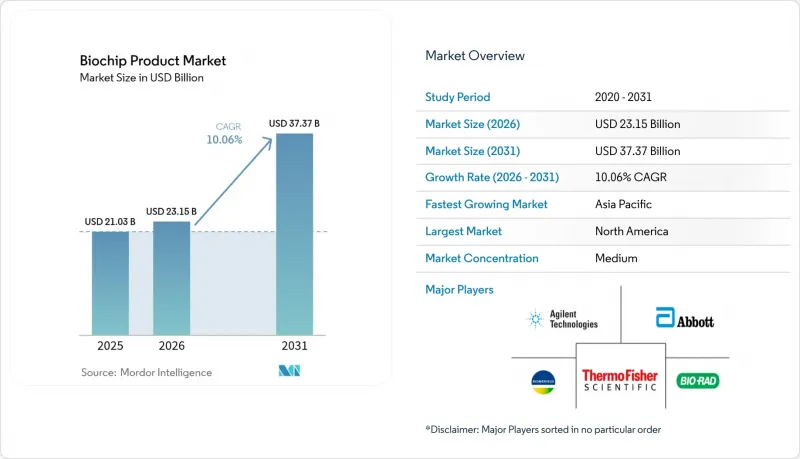
Mordor Intelligence에 의하면, 바이오칩 제품 시장 규모는 2025년 210억 3,000만 달러로 평가되었습니다. 2026년에는 231억 5,000만 달러로 확대되어 2026년부터 2031년에 걸쳐 CAGR 10.06%로 성장을 지속하여, 2031년에는 373억 7,000만 달러에 이를 것으로 예측됩니다.
본 보고서는 유형별(랩온어칩, 마이크로어레이), 제품 유형별(장비, 시약 및 소모품, 소프트웨어 및 서비스), 용도별(임상 진단, 신약 개발, 기타), 최종 사용자별(생명공학·제약 기업, 진단센터, 기타),지역별(북미, 유럽, 아시아태평양, 기타)로 분류되어 있습니다. 시장 예측은 금액(미 달러) 기준으로 제시되어 있습니다.
세계의 바이오칩 제품 시장 동향 및 인사이트
포인트 오브 케어 검사에 대한 수요 증가
휴대용 마이크로플루이딕스 카트리지를 통해 응급실에서의 진단 소요 시간이 몇 시간에서 몇 분으로 단축되어, 보다 신속한 트라이아지(triage)와 병상 관리가 가능해집니다. 지방 진료소에서는 중앙 검사실에 접근할 수 없더라도 스마트폰과 연동된 바이오칩 리더기를 이용하여 감염병 검사 패널을 처리하고 있어, 공평한 의료 서비스 제공 범위가 확대되고 있습니다. FDA의 2024년 품질 시스템 지침은 검사실에 맞춤형 벤치 분석법 대신 표준화된 상용 바이오칩 키트의 사용을 권장하고 있으며, 이를 통해 규정 준수 부담이 경감되고 시장 보급이 촉진되고 있습니다. 아시아태평양(APAC) 지역 각국의 보건부는 섬이나 산간 지역의 검체 운송 비용을 절감하기 위해 현장 진단(POC) 기기에 대한 보조금을 지급하고 있으며, 이로 인해 바이오칩 제품 시장 규모가 확대되고 있습니다. 이에 대응하여 각 제조업체는 상온에서 6개월간 보관 가능한 카트리지 세트를 출시함으로써, 외딴 지역의 시설에서 발생하는 콜드체인 문제를 해결하고 있습니다.
만성 질환 및 감염증 유병률 증가
5억 3,700만 명 이상의 성인이 당뇨병을 앓고 있어, 이에 따라 연속 혈당 모니터링에 대한 수요가 증가하고 있습니다. 현재, 마이크로플루이딕스 센서를 활용한 통증 없는 피부 패치가 이러한 수요를 충족시키고 있습니다(IDF.ORG). 순환기 전문의들은 단일 손가락 채혈 검체만으로 지질, 트로포닌,염증 마커를 추적할 수 있는 다항목 바이오칩 패널을 채택하여 검사 비용을 절감하고 있습니다. 팬데믹 기간 중 공항 및 학교의 감시 프로그램에 대한 투자를 통해, 공중보건 대시보드에 실시간으로 알림을 전송하고 재개 전략을 보호하는 휴대용 바이러스 RNA 카트리지의 역할이 확고해졌습니다. 종양학 프로토콜에서는 면역요법 투여량을 조정하기 위해 바이오마커의 경시적 모니터링이 점점 더 요구되고 있으며, 이러한 워크플로우에는 소량·고빈도의 바이오칩 분석법이 적합합니다. 이러한 추세들이 결합되어 소모품의 지속적인 판매가 강화되었으며, 바이오칩 제품 시장에서 시약 매출이 두 자릿수 성장을 기록하고 있습니다.
랩온칩 플랫폼의 설계상 복잡성과 소형화의 한계
서브미크론 수준의 채널 형성을 위해서는 클래스 100 클린룸과 펨토초 레이저 장비가 필요하며, 이로 인해 신규 진출기업의 설비 투자 비용이 증가하고 일회용 카트리지 단가가 상승하고 있습니다. mm 규모의 공간 내에 전기화학 센서, 광학 검출기, 마이크로 밸브를 통합하면 상호 간섭 위험이 높아져 분석 감도가 저하될 우려가 있습니다. 표면 화학 처리에서는 운송 및 보관 중에 접하게 되는 다양한 온도·습도 환경에서 생체 분자의 친화성과 시약의 안정성 사이의 균형을 맞추어야 합니다. 개발자가 IVDR 및 FDA 기준을 충족하기 위해 혈액, 타액, 조직 균질물을 사용하여 칩의 성능을 검증함에 따라 검증 주기가 장기화되고 있습니다. 이러한 과제는 중소기업에 특히 큰 영향을 미치고 있으며, 바이오칩 제품 시장의 치열한 경쟁을 완화시키고 있습니다.
부문 분석
랩온어칩(Lab-on-a-chip) 장치는 2025년에 바이오칩 제품 시장의 53.98% 점유율을 차지했으며, 2031년까지 연평균 성장률(CAGR) 10.63%로 성장할 전망입니다. 소형화된 ‘샘플 투 앤서(Sample-to-Answer)’ 카트리지는 소프트웨어 제어 하에 용해, 증폭, 검출 각 단계를 통합함으로써 임상 워크플로우를 효율화하고, 조작자에 의한 편차 및 생물학적 위험에 대한 노출을 줄입니다. 인공지능(AI) 모듈은 전혈 시료의 점도 변동을 보정하기 위해 시약의 유량을 실시간으로 조정하여 정확도를 더욱 높입니다. 엘라스토머 금형의 3D 프린팅을 통해 시제품 제작 리드타임이 몇 주에서 며칠로 단축되어, 희귀질환을 위한 맞춤형 분석법 개발이 촉진되고 있습니다.
마이크로어레이 플랫폼은 여전히 유전자 발현 프로파일링 및 SNP 유전형 분석 연구 보조금을 확보하고 있지만, 수동 세척 주기와 몇 시간에 이르는 하이브리다이제이션으로 인해 시간이 많이 소요되는 진단에는 적합하지 않습니다. 통합 칩은 시약 소비량을 최대 90%까지 줄여주므로, 병원 조달 팀은 낮은 총 소유 비용을 높이 평가했습니다. 연결형 리더의 도입 대수가 확대됨에 따라 소모품에 대한 지속적인 수요가 발생하고 있으며, 이는 바이오칩 제품 시장에서 랩온칩(Lab-on-a-Chip)의 리더십을 공고히 하고 있습니다.
시약 및 소모품은 2025년 매출의 40.95%를 차지했으며, 각 기기의 도입이 롱테일 카트리지 수요를 창출하여 매출 총이익률을 65% 이상으로 유지하고 있습니다. 그럼에도 불구하고 소프트웨어 및 서비스는 연평균 성장률(CAGR) 11.04%로 가장 빠르게 성장하는 분야입니다. 이는 알고리즘 구독을 통해 새로운 설비 투자가 필요 없이 진단 역량을 단계적으로 확대할 수 있기 때문입니다. 클라우드 기반 대시보드는 여러 검사 거점에서 환자 수준의 검사 결과를 동기화하여 역학적 모니터링 및 자동화된 품질 관리 경보를 가능하게 합니다.
성숙한 시장에서는 처리 능력이 검사량에 부합하게 되면 장비 판매가 정체되지만, 이에 따라 공급업체들은 설치된 리더기 1대당 수익을 확대하는 분석 패키지를 묶어 판매하고 있습니다. 애플리케이션 프로그래밍 인터페이스(API)를 통해 칩의 출력이 검사 정보 관리 시스템에 직접 연결되어 결과 입력 주기가 단축될 뿐만 아니라 규정 준수 추적성도 향상됩니다. 예측 유지보수 업데이트가 무선으로 전송됨에 따라 가동 중지 시간이 단축되고, 계약 서비스 요금이 데이터 서비스로 전환되면서 바이오칩 제품 시장의 수익 구조가 재편되고 있습니다.
지역별 분석
북미는 마이크로플루이딕스식 체외 진단 약물에 대한 FDA의 간소화된 510(k) 승인 절차와 다중 분자 패널을 포괄하는 CMS의 환급 제도를 배경으로, 2025년에는 매출의 39.00%를 차지했습니다. 매사추세츠주 및 캘리포니아주의 생명공학 클러스터에서는 프로토타입의 현장 시험을 수행하는 산학 협력을 통해 조기 도입이 촉진되고 있습니다. 캐나다의 단일 지불자 모델에서는 비용 대비 효과와 임상적 유용성을 입증한 카트리지를 우대하는 대량 계약이 체결되고 있는 반면, 멕시코에서는 확대되는 의료기기 제조 거점이 지역 시장에 소모품을 공급함으로써 수출 리드타임을 단축하고 있습니다.
아시아태평양은 중국의 28억 달러에 달하는 정밀의료 투자와 국내 공급업체를 우선시하는 각 성의 입찰에 힘입어 연평균 성장률(CAGR) 10.79%로 가장 빠르게 성장하고 있는 지역입니다. 일본에서는 FDA 및 EMA 기준과의 조화를 통해 승인 주기가 단축되어, 커넥티드 리더인 다국적 기업들 시장 진출이 촉진되고 있습니다. 인도의 ‘국가 디지털 헬스 미션’은 재택 만성 질환 모니터링을 추진하고 있어, 스마트폰과 연동되는 마이크로플루이딕스 센서의 보급을 뒷받침하고 있습니다. 한국의 ‘스마트 병원 이니셔티브’는 진단 데이터의 실시간 통합을 의무화하고 있어, 클라우드 지원 칩 공급업체들을 유치하고 있습니다. 이러한 정책들이 맞물려 바이오칩 제품 시장의 도입 대수를 확대하고, 시약 제조의 현지화를 심화시키고 있습니다.
유럽은 엄격한 성능 검증을 요구하면서도, 27개 회원국 전역에서 단일 시장 패스포트를 인정하는 IVDR(의료기기 규정) 체제 하에서 꾸준한 성장을 확보하고 있습니다. 독일의 정밀 가공 부문은 실리콘 및 유리 기판을 제조하고 있는 반면, 프랑스의 민관 유전체학 컨소시엄은 고다중도 암 패널을 구매하고 있습니다. 영국은 브렉시트 이후의 유연성을 활용하여 AI 기반 진단 기술을 위한 적응형 규제 샌드박스를 시범 도입함으로써 평균 승인 기간을 20% 단축했습니다. 중동 및 아프리카는 난민 캠프나 외딴 지역의 진료소에서 휴대용 칩이 감염병 선별 검사에 활용되는 ‘포인트 오브 케어(Point-of-Care)’의 중심지로 부상하고 있습니다. 라틴아메리카에서는 브라질의 검사 비용 전액 환급 대상 확대와 아르헨티나의 국내 생명공학 제조에 대한 세제 혜택이 호재로 작용하며, 바이오칩 제품 시장에 새로운 수요 거점이 형성되고 있습니다.
기타 혜택 :
- 엑셀 형식 시장 예측(ME) 시트
- 3개월간의 애널리스트 지원
자주 묻는 질문
목차
제1장 서론
제2장 조사 방법
제3장 주요 요약
제4장 시장 구도
제5장 시장 규모 및 성장 예측
제6장 경쟁 구도
제7장 시장 기회 및 향후 전망
KTH 26.08.26According to Mordor Intelligence, the biochip products market size is expected to grow from USD 21.03 billion in 2025 to USD 23.15 billion in 2026 and is forecast to reach USD 37.37 billion by 2031 at 10.06% CAGR over 2026-2031.
This report is Segmented by Type (Lab-On-A-Chip, Microarray), Product (Instruments, Reagents and Consumables, Software and Services), Application (Clinical Diagnostics, Drug Discovery, and Others), End-User (Biotechnology & Pharmaceutical Companies, Diagnostic Centers, and Others), and Geography (North America, Europe, Asia-Pacific, and Others). The Market Forecasts are Provided in Terms of Value (USD).
Global Biochip Product Market Trends and Insights
Increasing Demand for Point-of-Care Testing
Portable microfluidic cartridges shorten diagnostic turnaround from hours to minutes inside emergency departments, enabling faster triage and improved bed management. Rural clinics rely on smartphone-linked biochip readers to process infectious-disease panels without central laboratory access, widening equitable care delivery. The FDA's 2024 quality-systems guidance steers laboratories toward standardized, commercial biochip kits rather than customized bench assays, lowering compliance burden and boosting market uptake. Health ministries in APAC subsidize point-of-care devices to curb sample-transport costs across island and mountain geographies, expanding the biochip products market footprint. Commercial makers respond with cartridge bundles that store at ambient temperature for six months, eliminating cold-chain hurdles for remote facilities.
Rising Prevalence of Chronic & Infectious Diseases
More than 537 million adults live with diabetes, fueling continuous glucose monitoring demand that microfluidic sensors now address with painless skin patches IDF.ORG. Cardiovascular specialists adopt multiplex biochip panels to track lipid, troponin, and inflammatory markers from a single finger-stick sample, trimming laboratory fees. Pandemic-era investments in airport and school surveillance programs cement a role for portable viral-RNA cartridges that notify public-health dashboards in real time, safeguarding reopening strategies. Oncology protocols increasingly require longitudinal biomarker monitoring to adjust immunotherapy dosing, a workflow that favors low-volume, high-frequency biochip assays. Together, these patterns reinforce recurring consumable sales and drive double-digit reagent revenue growth inside the biochip products market.
Design Complexity & Miniaturization Limits of Lab-on-Chip Platforms
Sub-micron channel fabrication demands Class 100 clean rooms and femtosecond laser tools, inflating capital costs for new entrants and raising unit prices of disposable cartridges. Integration of electrochemical sensors, optical detectors, and micro-valves inside millimeter-scale footprints heightens risk of cross-interference that can erode analytical sensitivity. Surface-chemistry treatments must balance biomolecule affinity with reagent stability across varied temperature and humidity environments encountered during shipping and storage. Validation cycles lengthen as developers test chip performance against blood, saliva, and tissue homogenates to satisfy IVDR and FDA benchmarks. These hurdles disproportionately impact smaller firms, tempering competitive intensity inside the biochip products market.
Other drivers and restraints analyzed in the detailed report include:
- Expanding Proteomics & Genomics Applications in Oncology
- Rapid Adoption of Integrated Microfluidics in Veterinary Diagnostics
- Availability of Alternative High-Throughput Platforms
For complete list of drivers and restraints, kindly check the Table Of Contents.
Segment Analysis
Lab-on-a-chip devices commanded 53.98% of biochip products market share in 2025 and are poised to expand at a 10.63% CAGR through 2031. Miniaturized sample-to-answer cartridges streamline clinical workflows by embedding lysis, amplification, and detection steps under software control, limiting operator variability and biohazard exposure. Artificial-intelligence modules adjust reagent flow rates in real time to compensate for viscosity fluctuations in whole-blood samples, further enhancing precision. Three-dimensional printing of elastomer molds slashes prototype lead times from weeks to days, encouraging custom assay development for rare diseases.
Microarray platforms still attract research grants for gene-expression profiling and SNP genotyping, yet their manual wash cycles and multi-hour hybridization limit suitability for time-critical diagnostics. As reagent consumption drops by up to 90% on integrated chips, hospital procurement teams favour the lower total cost of ownership. The expanding installed base of connected readers seeds recurring consumable demand, cementing lab-on-chip leadership inside the biochip products market.
Reagents and consumables generated 40.95% of 2025 revenue as each instrument placement triggers a long-tail cartridge stream that sustains gross margins above 65%. Nonetheless, software and services represent the fastest-growing slice at an 11.04% CAGR because algorithm subscriptions unlock incremental diagnostics without fresh capital expenditure. Cloud-based dashboards sync patient-level outputs from multiple test sites, enabling epidemiological surveillance and automated quality control flags.
Instrument sales plateau in mature markets once capacity matches test volumes, driving vendors to bundle analytics packages that extend revenue per installed reader. Application-programming interfaces connect chip outputs directly to laboratory information management systems, shortening result-entry cycles and enhancing compliance traceability. As predictive-maintenance updates arrive over-the-air, downtime drops and contract service fees shift toward data services, reshaping profit pools within the biochip products market.
Complete Report Scope:
- By Type
- Lab-on-a-chip
- Microarray
- By Product
- Instruments
- Reagents and Consumables
- Software and Services
- By Application
- Clinical Diagnostics
- Drug Discovery
- Genomics and Proteomics
- Others (environmental, food-testing, forensics)
- By End-user
- Biotechnology & Pharmaceutical Companies
- Hospitals & Diagnostic Centers
- Academic & Research Institutes
- By Geography
- North America
- United States
- Canada
- Mexico
- Europe
- Germany
- United Kingdom
- France
- Italy
- Spain
- Rest of Europe
- Asia-Pacific
- China
- Japan
- India
- Australia
- South Korea
- Rest of Asia-Pacific
- Middle East and Africa
- GCC
- South Africa
- Rest of Middle East and Africa
- South America
- Brazil
- Argentina
- Rest of South America
- North America
Geography Analysis
North America contributed 39.00% revenue in 2025 on the back of FDA's streamlined 510(k) path for microfluidic in vitro diagnostics and CMS reimbursement that covers multiplex molecular panels. biotechnology clusters in Massachusetts and California foster early-stage adoption via academic-industry collaborations that field-test prototypes. Canada's single-payer model negotiates volume contracts that reward cartridges demonstrating cost-effectiveness and clinical utility, while Mexico's growing medical-device manufacturing base supplies consumables to regional markets and lowers export lead times.
Asia-Pacific represents the fastest-growing geography with a 10.79% CAGR, propelled by China's USD 2.8 billion precision-medicine investment and provincial tenders favoring domestic suppliers. Japan's harmonization with FDA and EMA standards shortens approval cycles, encouraging multinational launches of connected readers. India's National Digital Health Mission promotes home-based chronic-disease monitoring, spurring uptake of smartphone-paired microfluidic sensors. South Korea's Smart Hospital Initiative mandates real-time diagnostic data integration, attracting cloud-enabled chip vendors. These policies collectively expand installed bases and deepen localization of reagent manufacturing inside the biochip products market.
Europe secures steady growth under the IVDR framework that imposes rigorous performance verification yet grants a single market passport across 27 member states. Germany's precision-machining sector fabricates silicon and glass substrates, while France's public-private genomics consortium purchases high-multiplex cancer panels. The U.K. leverages post-Brexit flexibility to pilot adaptive regulatory sandboxes for AI-enhanced diagnostics, cutting average clearance times by 20%. Middle East and Africa emerge as point-of-care hotspots where portable chips aid infectious-disease screening in refugee camps and remote clinics. Latin America gains from Brazil's universal test reimbursement expansion and Argentina's tax breaks for local biotech manufacturing, establishing fresh demand pockets for the biochip products market.
- Abbott Laboratories
- Agilent Technologies
- Bio-Rad Laboratories
- Danaher (Cepheid & Molecular Devices)
- Thermo Fisher Scientific
- PerkinElmer (Revvity)
- Fluidigm (Standard BioTools)
- Illumina
- QIAGEN
- Merck
- BioMerieux
- Micronit
- Roche
- Becton Dickinson (BD)
- Tecan Group
- Luminex (DiaSorin)
- Nanosphere (SphereFluidics)
- Paragon Genomics
- Genalyte
- CustomArray
Additional Benefits:
- The market estimate (ME) sheet in Excel format
- 3 months of analyst support
TABLE OF CONTENTS
1 Introduction
- 1.1 Study Assumptions & Market Definition
- 1.2 Scope of the Study
2 Research Methodology
3 Executive Summary
4 Market Landscape
- 4.1 Market Overview
- 4.2 Market Drivers
- 4.2.1 Increasing Demand for Point-Of-Care (PoC) Testing
- 4.2.2 Rising Prevalence of Chronic & Infectious Diseases
- 4.2.3 Expanding Proteomics & Genomics Applications in Oncology
- 4.2.4 Rapid Adoption of Integrated Microfluidics in Veterinary Diagnostics
- 4.2.5 Venture Investment Surge in Single-Cell Analysis Start-Ups
- 4.3 Market Restraints
- 4.3.1 Design Complexity & Miniaturization Limits Of Lab-On-Chip Platforms
- 4.3.2 Availability Of Alternative High-Throughput Platforms (NGS, Mass-Spec)
- 4.3.3 Supply-Chain Instability For Specialty Polymers & Reagents
- 4.3.4 Data-Standardization Gaps Hindering Multi-Omics Biochip Interoperability
- 4.4 Supply-Chain Analysis
- 4.5 Regulatory Landscape
- 4.6 Technological Outlook
- 4.7 Porter's Five Forces
- 4.7.1 Threat of New Entrants
- 4.7.2 Bargaining Power of Buyers
- 4.7.3 Bargaining Power of Suppliers
- 4.7.4 Threat of Substitutes
- 4.7.5 Intensity of Competitive Rivalry
5 Market Size & Growth Forecasts (Value, USD)
- 5.1 By Type
- 5.1.1 Lab-on-a-chip
- 5.1.2 Microarray
- 5.2 By Product
- 5.2.1 Instruments
- 5.2.2 Reagents and Consumables
- 5.2.3 Software and Services
- 5.3 By Application
- 5.3.1 Clinical Diagnostics
- 5.3.2 Drug Discovery
- 5.3.3 Genomics and Proteomics
- 5.3.4 Others (environmental, food-testing, forensics)
- 5.4 By End-user
- 5.4.1 Biotechnology & Pharmaceutical Companies
- 5.4.2 Hospitals & Diagnostic Centers
- 5.4.3 Academic & Research Institutes
- 5.5 By Geography
- 5.5.1 North America
- 5.5.1.1 United States
- 5.5.1.2 Canada
- 5.5.1.3 Mexico
- 5.5.2 Europe
- 5.5.2.1 Germany
- 5.5.2.2 United Kingdom
- 5.5.2.3 France
- 5.5.2.4 Italy
- 5.5.2.5 Spain
- 5.5.2.6 Rest of Europe
- 5.5.3 Asia-Pacific
- 5.5.3.1 China
- 5.5.3.2 Japan
- 5.5.3.3 India
- 5.5.3.4 Australia
- 5.5.3.5 South Korea
- 5.5.3.6 Rest of Asia-Pacific
- 5.5.4 Middle East and Africa
- 5.5.4.1 GCC
- 5.5.4.2 South Africa
- 5.5.4.3 Rest of Middle East and Africa
- 5.5.5 South America
- 5.5.5.1 Brazil
- 5.5.5.2 Argentina
- 5.5.5.3 Rest of South America
- 5.5.1 North America
6 Competitive Landscape
- 6.1 Market Concentration
- 6.2 Strategic Moves (M&A, funding, partnerships)
- 6.3 Market Share Analysis
- 6.4 Company Profiles (includes Global level Overview, Market level overview, Core Segments, Financials as available, Strategic Information, Market Rank/Share for key companies, Products & Services, and Recent Developments)
- 6.4.1 Abbott Laboratories
- 6.4.2 Agilent Technologies
- 6.4.3 Bio-Rad Laboratories
- 6.4.4 Danaher (Cepheid & Molecular Devices)
- 6.4.5 Thermo Fisher Scientific
- 6.4.6 PerkinElmer (Revvity)
- 6.4.7 Fluidigm (Standard BioTools)
- 6.4.8 Illumina
- 6.4.9 Qiagen
- 6.4.10 Merck KGaA (Sigma-Aldrich)
- 6.4.11 BioMerieux
- 6.4.12 Micronit
- 6.4.13 Roche Diagnostics
- 6.4.14 Becton Dickinson (BD)
- 6.4.15 Tecan Group
- 6.4.16 Luminex (DiaSorin)
- 6.4.17 Nanosphere (SphereFluidics)
- 6.4.18 Paragon Genomics
- 6.4.19 Genalyte
- 6.4.20 CustomArray
7 Market Opportunities & Future Outlook
- 7.1 White-space & Unmet-need Assessment


