|
시장보고서
상품코드
2113852
클린룸 기술 : 시장 점유율 분석, 업계 동향 및 통계, 성장 예측(2026-2031년)Cleanroom Technology - Market Share Analysis, Industry Trends & Statistics, Growth Forecasts (2026 - 2031) |
||||||
 Mordor Intelligence
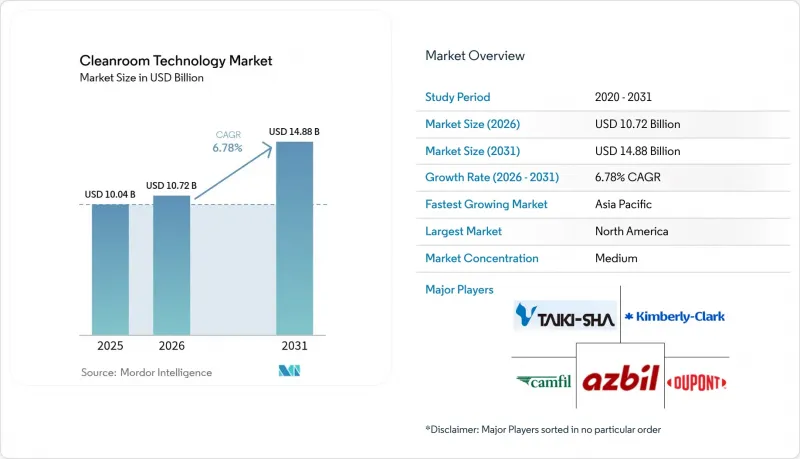
Mordor Intelligence에 의하면, 클린룸 기술 시장 규모는 2025년에 100억 4,000만 달러로 평가되었습니다. 2026년 107억 2,000만 달러에서 2031년까지 148억 8,000만 달러에 이를 것으로 예상되며, 예측 기간(2026-2031년) CAGR은 6.78%를 나타낼 전망입니다.
본 보고서는 구성 요소(설비 및 소모품), 건설 유형(표준 재래식 클린룸,모듈식 하드월 클린룸 등), 클린룸 분류(ISO 14644)(ISO 클래스 1-3, ISO 클래스 4-5 등), 최종 사용자(의약품 제조, 생명공학 연구 개발 및 생산 등), 지역별로 분류되어 있습니다. 시장 전망은 금액(미 달러) 기준으로 제시되어 있습니다.
세계의 클린룸 기술 시장 동향 및 인사이트
세포 및 유전자 치료제 제조가 모듈식 클린룸 혁신을 주도
2025년에는 유럽의 여러 시설이 가동을 시작했으며, 각 시설은 ‘생체 의약품’ 생산을 위해 ISO 클래스 5-7의 모듈식 스위트를 필요로 하고 있습니다. 노바티스는 35억 유로(40억 9,000만 달러) 규모의 국가 프로그램의 일환으로 슬로베니아에 위치한 완전 자동화된 바이러스 벡터 제조 거점을 가동했습니다. 한편, 로슈는 독일에 9,000만 유로(1억 518만 달러)를 투자해 유전자 치료 개발 센터를 개설했습니다. 두 프로젝트 모두 검증 주기를 단축하고 향후 규모 확장을 용이하게 하는 유연하고 사전 설계된 레이아웃을 중시하고 있습니다. 각국의 자금 지원 제도 덕분에 클린룸 기술 시장 전반에 걸쳐 수주량이 가속화되고 있습니다.
CHIPS법에 따른 반도체 생산 확대가 인프라 수요를 가속화
530억 달러 규모의 ‘CHIPS and Science Act’는 미국 내 반도체 제조 공장 건설에 전례 없는 붐을 일으켰습니다. 2025년에는 18개의 신규 공장이 착공되었으며, 각 공장은 0.1µm 미만의 제어 정밀도를 갖춘 ISO 4 또는 그 이상의 클린룸이 필요합니다. TSMC의 애리조나 복합 시설만 해도 6개의 팹이 계획되어 있으며, 이러한 메가 프로젝트의 규모가 수천 제곱미터에 달하는 제어 환경에 대한 수요로 직결되고 있음을 알 수 있습니다. 국내 장비 공급업체와 필터 제조업체는 수년 치의 수주 잔고를 보유하고 있으며, 이것이 클린룸 기술 시장의 호황을 뒷받침하고 있습니다.
PFAS 규제가 필터 미디어 비용 상승을 초래
미국 환경보호청(EPA)은 PFOA 및 PFOS의 음용수 내 농도 상한선을 4 ppt로 설정했습니다. 이에 따라 HEPA 및 ULPA 필터 매체에 일반적으로 사용되는 불소계 바인더와 실런트의 화학 물질이 단계적으로 폐지되게 되었습니다. 각 제조업체는 현재 대체 폴리머에 대한 검증을 진행하는 한편, 설비 갱신 비용을 부담하고 있으며, 그 비용은 부품 가격에 전가되고 있습니다. 구매자 입장에서는 2025년 초부터 필터 견적 가격이 분기마다 두 자릿수 상승세를 보이며, 클린룸 기술 시장 전체에서 운영 예산이 긴축되었습니다.
부문 분석
장비 부문은 2031년까지 연평균 성장률(CAGR) 7.18%를 나타낼 것으로 예측되며, 2025년 시점에서 클린룸 기술 시장의 54.66%를 차지했던 소모품 부문을 넘어설 전망입니다. 팹 및 치료 시설이 운영 비용 절감과 규정 준수 보고의 효율화를 추구하는 가운데, 에너지 효율이 뛰어난 팬·필터 유닛과 디지털 모니터링 기능이 탑재된 HVAC 시스템이 설비 투자를 주도하고 있습니다. 공장에서 배선이 내장된 모듈식 벽 패널은 설치 시간을 단축하는 동시에 현장 오염 위험을 줄여줍니다.
상대 습도 1% 미만에서 배터리 셀을 건조하도록 설계된 데시케이터 캐비닛, 분자 수준의 오염을 실시간으로 감지하는 AI 탑재 진공 펌프는 가치가 지능형 하드웨어로 이동하고 있음을 보여줍니다. 신규 시설의 가동에 따라 소모품 판매량은 여전히 꾸준히 증가하고 있지만, PFAS 관련 재료 변경으로 인한 이익률 압박으로 인해 이익의 원천이 고사양 장비 공급업체로 이동하고 있습니다.
2025년에는 입증된 구조적 무결성과 간소화된 규제 준수 검증에 힘입어 모듈식 하드월 챔버가 클린룸 기술 시장의 56.20%를 차지했습니다. 반도체, 항공우주, 수탁 제조 분야의 사용자들이 일시적인 생산 능력을 필요로 하는 가운데, 이동식 또는 휴대용 설계는 연평균 성장률(CAGR) 7.74%로 성장을 지속하고 있습니다. 이러한 사전 설계된 포드는 일반적으로 기존 공법으로 건설된 공간에 비해 프로젝트 기간을 60% 단축할 수 있어, 보조금 지급 기준일이나 제품 출시일이 임박한 경우 큰 이점이 됩니다.
복잡한 유틸리티 통합이 필수적인 상황에서는 기존의 전통적 공법을 이용한 클린룸이 여전히 중요한 역할을 하고 있습니다. 강성 벽식 클린룸은 진동 감쇠 및 전자기 차폐가 필요한 항공우주 및 방위 프로그램에 활용되고 있습니다. 기업들은 제품 수명 주기 전반에 걸친 탄소 발자국을 점점 더 중요하게 여기고 있으며, 재사용 가능한 모듈식 프레임은 기업의 지속가능성 목표와 부합하기 때문에 클린룸 기술 시장 내 점유율 변화를 촉진하고 있습니다.
지역별 분석
북미는 ‘CHIPS 법’에 기반한 메가 프로젝트와 광범위한 바이오의약품 파이프라인을 배경으로 2025년 매출의 33.62%를 차지했습니다. 이 지역에서는 2028년까지 새로운 ISO 4 및 그보다 더 엄격한 규격의 클린룸 가동이 지속될 전망이지만, 설치 업체 부족으로 인해 일부 일정이 지연되고 있습니다. 캐나다와 멕시코는 자동차용 전자기기 및 무균 주사제 제조 공장을 통해 기여하고 있지만, 규모 면에서는 여전히 2차적인 위치에 머물러 있습니다.
이어 유럽은 EU-MDR(의료기기 규정)에 대응하기 위한 개조 활동과 독일, 슬로베니아, 영국에서의 유전자 치료 생산 능력 급증에 힘입어 성장하고 있습니다. EU-ETS(EU 배출권 거래 제도) 4단계의 탄소 가격 책정은 에너지 회수 시스템 및 저풍속 기류 설계를 촉진하고 있으며, 각 공급업체로 하여금 HVAC(공조) 효율을 개선하도록 유도하고 있습니다. 동유럽 국가들은 모듈식 클린룸 조립에 있어 비용 경쟁력이 있는 인력을 제공함으로써 수탁 제조에 대한 투자를 유치하고 있습니다.
아시아태평양은 중국의 1,000억 달러 규모 300mm 팹 건설 계획, 대만의 750억 달러 규모 첨단 노드 프로그램, 그리고 한국의 810억 달러 규모 생산 능력 확대에 힘입어 7.32%라는 가장 높은 연평균 성장률(CAGR)을 보이고 있습니다. 와이드밴드갭 반도체 프로그램, 배터리 셀 기가팩토리, 백신 제조 허브가 해당 수요를 확대되고 있습니다. 인도 사난드에 위치한 인도 최초의 최첨단 팹이 2025년 중반에 검증 단계에 진입함에 따라, 고사양 클린룸 시설이 지역 전체에서 더욱 널리 채택될 조짐이 보입니다. 동남아시아의 기타 신흥 시장에서는 전자기기 조립의 이전을 활용하여 현지 클린룸 생산 능력을 강화하고 있습니다.
기타 혜택 :
- 엑셀 형식 시장 예측(ME) 시트
- 3개월간의 애널리스트 지원
자주 묻는 질문
목차
제1장 서론
제2장 조사 방법
제3장 주요 요약
제4장 시장 구도
제5장 시장 규모 및 성장 예측
제6장 경쟁 구도
제7장 시장 기회 및 향후 전망
KTH 26.08.26According to Mordor Intelligence, the cleanroom technology market size was valued at USD 10.04 billion in 2025 and estimated to grow from USD 10.72 billion in 2026 to reach USD 14.88 billion by 2031, at a CAGR of 6.78% during the forecast period (2026-2031).
This report is Segmented by Component (Equipment, and Consumables), Construction Type (Standard Stick-Built Cleanrooms, Modular Hardwall Cleanrooms, and More), Cleanroom Classification (ISO 14644) (ISO Class 1-3, ISO Class 4-5, and More), End-User (Pharmaceutical Manufacturing, Biotechnology R&D and Production, and More), and Geography. The Market Forecasts are Provided in Terms of Value (USD).
Global Cleanroom Technology Market Trends and Insights
Cell and Gene Therapy Manufacturing Drives Modular Cleanroom Innovation
Multiple European facilities reached operational status in 2025, each requiring ISO 5-7 modular suites for living-medicine production. Novartis brought its fully automated viral-vector site in Slovenia online, part of a EUR 3.5 billion (USD 4.09 billion) national program, while Roche opened a EUR 90 million (USD 105.18 million) gene-therapy development center in Germany. Both projects emphasize flexible, pre-engineered layouts that shorten validation cycles and ease future scale-ups. National funding schemes accelerate order flow across the cleanroom technology market.
CHIPS Act-Funded Semiconductor Expansion Accelerates Infrastructure Demand
The USD 53 billion CHIPS and Science Act ignited an unprecedented wave of United States fab construction. Eighteen new plants broke ground in 2025, each demanding ISO 4 or tighter rooms with sub-0.1 µm control. TSMC's Arizona complex alone plans six fabs, illustrating how megaproject footprints translate directly into thousands of square metres of controlled environment. Domestic tooling suppliers and filter makers report multi-year backlogs, lifting the cleanroom technology market.
PFAS Regulations Drive Filter Media Cost Inflation
The U.S. EPA set 4 ppt drinking-water limits for PFOA and PFOS, prompting a phased withdrawal of fluorinated binder and sealant chemistries common in HEPA and ULPA media. Manufacturers now validate alternative polymers while absorbing re-tooling expenses that flow into component pricing. For buyers, quarterly filter quotes increased by double digits in early 2025, tightening operating budgets across the cleanroom technology market.
Other drivers and restraints analyzed in the detailed report include:
- Silicon Carbide Wafer Processing Demands Ultra-Precision Environments
- EU-MDR Compliance Creates Retrofit Demand Surge
- Skilled Labor Shortage Delays Critical Infrastructure Projects
For complete list of drivers and restraints, kindly check the Table Of Contents.
Segment Analysis
The equipment segment is projected to grow at 7.18% CAGR through 2031, outstripping the consumables category that nonetheless held a 54.66% slice of the cleanroom technology market in 2025. Energy-efficient fan-filter units and digitally monitored HVAC systems lead capital spending as fabs and therapy sites target lower operating costs and streamlined compliance reporting. Modular wall panels with factory-integrated cabling reduce onsite contamination risks while trimming installation time.
Desiccator cabinets engineered for battery-cell drying below 1% relative humidity, along with AI-enabled vacuum pumps that detect molecular contamination in real time, demonstrate how value migrates to intelligent hardware. Consumables still post steady volume gains as new square footage comes online, yet margin pressure from PFAS-related material changes shifts profit pools toward high-specification equipment providers.
Modular hardwall rooms controlled 56.20% of the cleanroom technology market in 2025, helped by proven structural integrity and simplified regulatory validation. Mobile or portable designs record an 7.74% CAGR as semiconductor, space, and contract-manufacturing users seek temporary capacity. These pre-engineered pods typically cut project schedules by 60% compared with stick-built spaces, an advantage when grant milestones or product launch dates loom.
Traditional stick-built suites remain relevant where complex utilities integration is essential. Rigid-wall rooms serve aerospace and defense programs requiring vibration dampening and electromagnetic shielding. Firms increasingly weigh lifecycle carbon footprints, and reusable modular frames align with corporate sustainability targets, reinforcing the shift in share within the cleanroom technology market.
Complete Report Scope:
- By Component
- Equipment
- Cleanroom Air Showers
- HVAC Systems
- Laminar Air-flow Cabinets
- HEPA/ULPA Filters
- Desiccator Cabinets
- Fan-Filter Units
- Modular Cleanroom Structures
- Consumables
- Apparel
- Gloves
- Wipes
- Disinfectants and Cleaning Chemicals
- Vacuum Systems
- Adhesive Mats
- Equipment
- By Construction Type
- Standard Stick-Built Cleanrooms
- Modular Hardwall Cleanrooms
- Modular Softwall Cleanrooms
- Rigid-wall Cleanrooms
- Mobile/Portable Cleanrooms
- By Cleanroom Classification (ISO 14644)
- ISO Class 1-3
- ISO Class 4-5
- ISO Class 6-7
- ISO Class 8-9
- By End-User
- Pharmaceutical Manufacturing
- Biotechnology R&D and Production
- Medical Device Manufacturing
- Hospitals and Healthcare Facilities
- Semiconductor Fabrication
- Micro-electronics and Optics
- Food and Beverage Processing
- Aerospace and Defense
- Automotive and Battery Manufacturing
- Other End-users
- By Geography
- North America
- United States
- Canada
- Mexico
- Europe
- Germany
- United Kingdom
- France
- Italy
- Spain
- Netherlands
- Rest of Europe
- Asia-Pacific
- China
- Japan
- India
- South Korea
- South East Asia
- Taiwan
- Rest of Asia-Pacific
- South America
- Brazil
- Rest of South America
- Middle East
- Gulf Cooperation Council Countries
- Turkey
- Rest of Middle East
- Africa
- South Africa
- Rest of Africa
- North America
Geography Analysis
North America held 33.62% of 2025 revenue on the back of CHIPS Act megaprojects and an extensive biologics pipeline. The region continues to commission new ISO 4 and tighter suites through 2028, though installer shortages slow some timelines. Canada and Mexico contribute via automotive electronics and sterile injectables plants but remain secondary in scale.
Europe follows, propelled by EU-MDR retrofit activity and a surge in gene-therapy capacity across Germany, Slovenia, and the United Kingdom. Carbon-pricing under EU-ETS Phase IV incentivizes energy recovery systems and low-velocity airflow designs, pushing vendors to refine HVAC efficiency. Eastern European countries market cost-competitive labor for modular-room assembly, attracting investment in contract manufacturing.
Asia-Pacific displays the highest 7.32% CAGR, driven by China's USD 100 billion 300 mm fab pipeline, Taiwan's USD 75 billion advanced-node program, and South Korea's USD 81 billion capacity expansion. Wide-bandgap semiconductor programs, battery-cell gigafactories, and vaccine manufacturing hubs expand addressable demand. India's first leading-edge fab in Sanand entered validation in mid-2025, signalling broader regional adoption of high-specification suites. Other emerging markets in Southeast Asia leverage electronics assembly migration to bolster local cleanroom capacity.
- Azbil Corporation
- DuPont de Nemours Inc.
- Kimberly-Clark Corporation
- Camfil AB
- Taikisha Ltd.
- Ardmac Ltd.
- Terra Universal Inc.
- Clean Air Products Inc.
- Labconco Corporation
- Ansell Limited
- Illinois Tool Works Inc. (Texwipe)
- Berkshire Corporation
- ABN Cleanroom Technology NV
- Bouygues Energies and Services
- Skan AG
- Simplex Isolation Systems
- 3M Company
- Connect 2 Cleanrooms Ltd.
- Guardtech Cleanrooms Ltd.
Additional Benefits:
- The market estimate (ME) sheet in Excel format
- 3 months of analyst support
TABLE OF CONTENTS
1 INTRODUCTION
- 1.1 Study Assumptions and Market Definition
- 1.2 Scope of the Study
2 RESEARCH METHODOLOGY
3 EXECUTIVE SUMMARY
4 MARKET LANDSCAPE
- 4.1 Market Overview
- 4.2 Market Drivers
- 4.2.1 Rapid capacity expansion in EU cell and gene-therapy facilities demanding ISO 5-7 modular cleanrooms
- 4.2.2 CHIPS Act-funded United States fab construction adding Above 3 M sq ft of ISO 4 space (2025-28)
- 4.2.3 Surge in SiC wafer and advanced-packaging lines in Asia-Pacific requiring sub-0.1 µm control
- 4.2.4 EU-MDR transition forcing device SMEs to retrofit ISO 7 suites by 2027
- 4.2.5 Negative-pressure hospital wards post-COVID driving demand for healthcare cleanrooms
- 4.2.6 Li-ion gigafactories adopting ultra-dry modular cleanrooms (Less than 1 % RH)
- 4.3 Market Restraints
- 4.3.1 HEPA/ULPA media cost inflation from PFAS phase-out regulations
- 4.3.2 Shortage of ISO-certified installers in North America delaying projects Above 6 months
- 4.3.3 Energy-intensive HVAC facing carbon pricing under EU-ETS Phase IV
- 4.3.4 Semiconductor down-cycles triggering deferrals of ISO 1-3 projects
- 4.4 Industry Ecosystem Analysis
- 4.5 Regulatory Outlook (ISO Classification)
- 4.6 Technological Outlook
- 4.7 Porter's Five Forces Analysis
- 4.7.1 Bargaining Power of Suppliers
- 4.7.2 Bargaining Power of Buyers
- 4.7.3 Threat of New Entrants
- 4.7.4 Threat of Substitutes
- 4.7.5 Degree of Competition
- 4.8 Impact of Key Macroeconomic Trends on the Market
5 MARKET SIZE AND GROWTH FORECASTS (VALUES)
- 5.1 By Component
- 5.1.1 Equipment
- 5.1.1.1 Cleanroom Air Showers
- 5.1.1.2 HVAC Systems
- 5.1.1.3 Laminar Air-flow Cabinets
- 5.1.1.4 HEPA/ULPA Filters
- 5.1.1.5 Desiccator Cabinets
- 5.1.1.6 Fan-Filter Units
- 5.1.1.7 Modular Cleanroom Structures
- 5.1.2 Consumables
- 5.1.2.1 Apparel
- 5.1.2.2 Gloves
- 5.1.2.3 Wipes
- 5.1.2.4 Disinfectants and Cleaning Chemicals
- 5.1.2.5 Vacuum Systems
- 5.1.2.6 Adhesive Mats
- 5.1.1 Equipment
- 5.2 By Construction Type
- 5.2.1 Standard Stick-Built Cleanrooms
- 5.2.2 Modular Hardwall Cleanrooms
- 5.2.3 Modular Softwall Cleanrooms
- 5.2.4 Rigid-wall Cleanrooms
- 5.2.5 Mobile/Portable Cleanrooms
- 5.3 By Cleanroom Classification (ISO 14644)
- 5.3.1 ISO Class 1-3
- 5.3.2 ISO Class 4-5
- 5.3.3 ISO Class 6-7
- 5.3.4 ISO Class 8-9
- 5.4 By End-User
- 5.4.1 Pharmaceutical Manufacturing
- 5.4.2 Biotechnology R&D and Production
- 5.4.3 Medical Device Manufacturing
- 5.4.4 Hospitals and Healthcare Facilities
- 5.4.5 Semiconductor Fabrication
- 5.4.6 Micro-electronics and Optics
- 5.4.7 Food and Beverage Processing
- 5.4.8 Aerospace and Defense
- 5.4.9 Automotive and Battery Manufacturing
- 5.4.10 Other End-users
- 5.5 By Geography
- 5.5.1 North America
- 5.5.1.1 United States
- 5.5.1.2 Canada
- 5.5.1.3 Mexico
- 5.5.2 Europe
- 5.5.2.1 Germany
- 5.5.2.2 United Kingdom
- 5.5.2.3 France
- 5.5.2.4 Italy
- 5.5.2.5 Spain
- 5.5.2.6 Netherlands
- 5.5.2.7 Rest of Europe
- 5.5.3 Asia-Pacific
- 5.5.3.1 China
- 5.5.3.2 Japan
- 5.5.3.3 India
- 5.5.3.4 South Korea
- 5.5.3.5 South East Asia
- 5.5.3.6 Taiwan
- 5.5.3.7 Rest of Asia-Pacific
- 5.5.4 South America
- 5.5.4.1 Brazil
- 5.5.4.2 Rest of South America
- 5.5.5 Middle East
- 5.5.5.1 Gulf Cooperation Council Countries
- 5.5.5.2 Turkey
- 5.5.5.3 Rest of Middle East
- 5.5.6 Africa
- 5.5.6.1 South Africa
- 5.5.6.2 Rest of Africa
- 5.5.1 North America
6 COMPETITIVE LANDSCAPE
- 6.1 Market Concentration
- 6.2 Strategic Moves
- 6.3 Market Share Analysis
- 6.4 Company Profiles (includes Global level Overview, Market level overview, Core Segments, Financials as available, Strategic Information, Market Rank/Share, Products and Services, Recent Developments)
- 6.4.1 Azbil Corporation
- 6.4.2 DuPont de Nemours Inc.
- 6.4.3 Kimberly-Clark Corporation
- 6.4.4 Camfil AB
- 6.4.5 Taikisha Ltd.
- 6.4.6 Ardmac Ltd.
- 6.4.7 Terra Universal Inc.
- 6.4.8 Clean Air Products Inc.
- 6.4.9 Labconco Corporation
- 6.4.10 Ansell Limited
- 6.4.11 Illinois Tool Works Inc. (Texwipe)
- 6.4.12 Berkshire Corporation
- 6.4.13 ABN Cleanroom Technology NV
- 6.4.14 Bouygues Energies and Services
- 6.4.15 Skan AG
- 6.4.16 Simplex Isolation Systems
- 6.4.17 3M Company
- 6.4.18 Connect 2 Cleanrooms Ltd.
- 6.4.19 Guardtech Cleanrooms Ltd.
7 MARKET OPPORTUNITIES AND FUTURE OUTLOOK
- 7.1 White-space and Unmet-Need Assessment