

|
시장보고서
상품코드
2113854
중국의 에어백 시스템 : 시장 점유율 분석, 업계 동향 및 통계, 성장 예측(2026-2031년)China Airbag Systems - Market Share Analysis, Industry Trends & Statistics, Growth Forecasts (2026 - 2031) |
||||||
 Mordor Intelligence
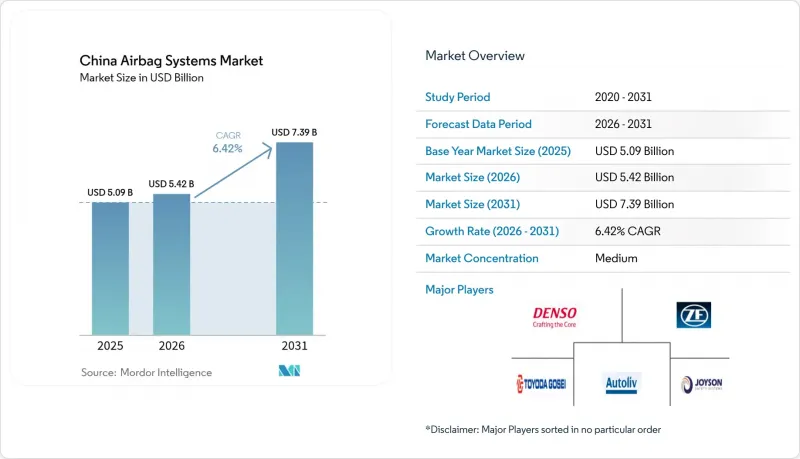
Mordor Intelligence에 의하면, 2026년 중국의 에어백 시스템 시장 규모는 54억 2,000만 달러로 추정되고 2025년 50억 9,000만 달러에서 확대해, 2031년에는 73억 9,000만 달러에 이를 것으로 예측됩니다.
2026년부터 2031년까지의 연평균 성장률(CAGR)은 6.42%를 나타낼 전망입니다.
본 보고서는 에어백 유형(전면 에어백, 측면 에어백 등), 차종(승용차, 소형 상용차 등), 구성 부품(에어백 모듈, 충돌 센서 등), 판매 채널(OEM 및 애프터마켓)별로 분류되어 있습니다. 시장 전망은 금액(달러) 기준으로 제시되어 있습니다.
중국의 에어백 시스템 시장 동향 및 인사이트
GB 15083 및 GB 14166 의무화 규정
GB 15083은 다양한 시나리오에 대한 충돌 성능 시험을 규정하고 있으며, GB 14166은 인플레이터의 화학 조성 및 작동 타이밍을 규정하고 있습니다. 공급업체는 SAMR 인증 시험소를 통해 2단계 전개, 측면 충돌 시 무결성, 아지드를 포함하지 않는 추진제의 안정성을 검증해야 합니다. 규정 준수로 인해 엔지니어링 예산은 소폭 증가하지만, 이러한 규정을 통해 매년 여러 신차 모델을 생산하기 위한 예측 가능한 기준이 확보됩니다. 인증된 시험 코스, 디지털 트윈, 추적성 소프트웨어를 보유한 대기업은 검증 주기를 5분의 1로 단축하여 시장 출시 시간 측면에서 우위를 점하고 있습니다. 소규모 국내 기업들은 자본 집약적인 충돌 시험 시설 건설을 피하기 위해 지린성이나 충칭시의 전문 시험소와 제휴하는 경우가 많으며, 이를 통해 중국의 에어백 시스템 시장 전체에서 협력을 통한 혁신이 강화되고 있습니다.
승용차 생산 대수 증가
생산 대수는 2024년에 2020년 이전 수준으로 회복될 것이며, 2027년까지 매년 꾸준한 증가세를 이어갈 것으로 예측됩니다. 생산은 광둥성, 상하이시, 후베이성에 집중되어 있어, 모듈 공급업체는 해상 운송을 통한 수입에 비해 물류 비용을 5분의 1로 절감할 수 있게 되었습니다. 2018년부터 2020년식 차량을 중심으로 한 교체 수요가 애프터마켓의 교체 수요를 자극하는 한편, 정부의 폐차 장려 정책이 차체 조립 공장의 생산량을 유지하고 있습니다. 예측 가능한 수주 상황 덕분에 1차 공급업체들은 우한의 메가 플랜트에 대한 투자를 단기간 내에 회수할 수 있게 되어, 중국의 에어백 시스템 시장에서 규모의 경제가 강화되고 있습니다.
리콜 관련 비용 및 책임의 급증
중국 국가시장감독관리총국(SAMR)은 선제적 조치로 EU 및 미국 규제 당국과 데이터 공유 협정을 체결하여, 국내에서 사고가 보고되기 전부터 예방적 리콜이 이루어지도록 하고 있습니다. BMW가 2024년에 다수의 차량을 리콜하기로 결정함에 따라, 해당 공급업체는 시정 조치 및 소송 비용에 충당하기 위해 막대한 충당금을 계상할 수밖에 없게 되었습니다. 그 결과, 제조물 책임 보험료가 대폭 급등하여 이익률이 낮은 중견 공급업체에 재정적 압박이 가해졌습니다. OEM(원청 브랜드 제조업체) 계약에는 리콜 위험을 사실상 하류로 전가하는 징벌적 위약금 조항이 포함되게 되었습니다. 이러한 감시 강화에 따라 공급업체들은 부품의 추적성을 확보하기 위해 블록체인 기술 도입을 추진하고 있습니다. 그러나 이러한 움직임은 경쟁이 치열한 중국의 에어백 시스템 시장에서 프로그램 견적 소요 기간을 연장하는 결과로 이어지고 있습니다.
부문 분석
2025년, 중국의 에어백 시스템 시장에서 전면 에어백은 41.15%라는 최대 점유율을 유지했으나, 중앙 에어백은 2031년까지 연평균 성장률(CAGR) 6.45%라는 견조한 성장이 예상됩니다. 이러한 급증은 상대방 보호를 평가 대상으로 하는 C-NCAP의 채점 규칙에 더해, 전기차의 실내 공간이 넓어지면서 실내 중앙부에 모듈을 설치할 공간이 생긴 데 기인합니다. 고급 세단 및 크로스오버 차량의 출시로 뒷받침되어, 중국의 센터 에어백 시장은 예측 기간 동안 상당한 성장을 이룰 것으로 전망됩니다. 각 공급업체들은 그동안 도입을 가로막았던 외관상의 문제인 시트 커버의 주름을 해소하기 위해 버스트 심(burst seam) 재봉 기술을 개선해 왔습니다. 한편, 규제 요건으로 인해 사이드 에어백 및 커튼 에어백에 대한 수요는 견조한 추세를 보이고 있으며, 무릎 에어백은 스포츠 세단에서 틈새 기능으로 자리 잡아가고 있습니다.
커튼 모듈은 듀얼 챔버 형태로 진화하여, 앞좌석과 뒷좌석 탑승자 모두에게 동시에 쿠션 효과를 제공합니다. 이러한 복잡화에 대응하기 위해 업계 선도 기업들은 고속 접이식 로봇과 레이저 유도식 재봉 테이블을 도입하여 생산 효율을 획기적으로 향상시키고 있습니다. 안전벨트 일체형 에어백은 여전히 실험 단계에 있지만, 자율주행 프로토타입을 위한 연구개발 보조금을 확보하여 장기적으로 관심이 높아질 가능성을 시사하고 있습니다. 센터 에어백의 급증은 단순한 일시적인 현상이 아닙니다. 그 기술적 진보, 특히 신소재와 소형 인플레이터 분야의 발전은 다른 모듈 카테고리에도 파급되고 있으며, 중국의 에어백 시스템 시장의 혁신 모멘텀을 더욱 강화하고 있습니다.
2025년에는 승용차가 납품 대수의 83.10%를 차지하여 2,100만 개 이상의 모듈에 해당했지만, 버스 및 장거리 버스는 연평균 성장률(CAGR) 6.46%로 이를 상회했습니다. 전자상거래 물류는 소형 상용차의 지속적인 교체 주기를 촉진하고 있는 반면, 친환경 도시 규제로 인해 사이드 롤오버 커튼을 기본 사양으로 장착한 전기 버스 입찰이 잇따르고 있습니다. 각 지자체는 공공 차량 탑승자의 안전을 최우선 과제로 삼고 있으며, 이에 따라 예측 기간 동안 중국의 상용 여객 운송용 에어백 시스템 시장은 상당한 성장을 이룰 것으로 예측됩니다.
위험물 운송 노선에서는 트럭에 듀얼 인플레이터식 운전석 에어백과 안전벨트 프리텐셔너의 장착이 의무화되어 있어, 이로 인해 운전실 1대당 가치가 현저히 상승하고 있습니다. 화물 운송 사업자들은 가동 중단 시간 단축 및 보험료 인하와 같은 이점을 인식하고 있으며, 이에 따라 고품질 안전 장비를 제공하는 공급업체의 협상력이 향상되고 있습니다. 더 두꺼운 스티어링 허브에 대응하는 대형 운전실이 등장함에 따라, 각 공급업체들은 현재 세단에 표준으로 장착된 것보다 대폭 업그레이드된 더 큰 운전석용 에어백을 시험하고 있습니다. 이러한 전문적인 기술적 노력은 중국의 에어백 시스템 시장의 승용차 수요 주기성을 상쇄하기 위해 많은 기업이 채택하고 있는 다각화 전략을 여실히 보여줍니다.
기타 혜택 :
- 엑셀 형식 시장 예측(ME) 시트
- 3개월간의 애널리스트 지원
자주 묻는 질문
목차
제1장 서론
제2장 조사 방법
제3장 주요 요약
제4장 시장 구도
제5장 시장 규모 및 성장 예측
제6장 경쟁 구도
제7장 시장 기회 및 향후 전망
KTH 26.08.26According to Mordor Intelligence, China airbag systems market size in 2026 is estimated at USD 5.42 billion, growing from 2025 value of USD 5.09 billion with 2031 projections showing USD 7.39 billion, growing at 6.42% CAGR over 2026-2031.
This report is Segmented by Airbag Type (Front Airbags, Side Airbags, and More), Vehicle Type (Passenger Cars, Light Commercial Vehicles, and More), Component (Airbag Module, Crash Sensor, and More), and Sales Channel (OEM and Aftermarket). The Market Forecasts are Provided in Terms of Value (USD).
China Airbag Systems Market Trends and Insights
Mandatory GB 15083 and GB 14166 Regulations
GB 15083 details multi-scenario crash performance tests, while GB 14166 governs inflator chemistry and timing. Suppliers must validate dual-stage deployment, side-impact integrity, and azide-free propellant stability through SAMR-accredited labs. Compliance increases engineering budgets by a minimal amount, but regulations ensure a predictable baseline for the production of multiple new vehicles each year . Established players with certified test corridors, digital twins, and traceability software shorten validation cycles by one-fifth, gaining a time-to-market edge. Smaller domestic firms often partner with specialty labs in Jilin or Chongqing to avoid capital-intensive crash facilities, reinforcing collaborative innovation across the Chinese airbag systems market.
Rising Passenger-Vehicle Output
Volumes rebounded to pre-2020 levels in 2024 and are projected to track a steady annual increase through 2027. Production is heavily concentrated in Guangdong, Shanghai, and Hubei, allowing module suppliers to offset logistics costs by one-fifth compared to sea freight imports. Fleet renewal waves from 2018-2020 vintages stimulate aftermarket replacements, while government scrappage incentives maintain throughput at body-assembly plants. The predictable order books enable tier-ones to amortize the Wuhan mega-plant over a shorter horizon, reinforcing scale economics within the China airbag systems market.
Recall-Related Cost and Liability Spikes
In a proactive move, SAMR has signed a data-sharing agreement with regulators in both the EU and the United States, leading to precautionary recalls even before any domestic incidents are reported. BMW's decision to recall a significant number of units in 2024 compelled its suppliers to set aside a substantial amount for remediation and legal expenses. As a result, product-liability insurance premiums surged considerably, putting financial pressure on mid-tier suppliers operating on slim margins. Original Equipment Manufacturer (OEM) contracts have evolved to incorporate punitive liquidated-damage clauses that effectively transfer the burden of recall risks downstream. This heightened scrutiny has led suppliers to adopt blockchain technology for part traceability. However, this move has also extended the duration of program quotations in the competitive Chinese airbag systems market.
Other drivers and restraints analyzed in the detailed report include:
- C-NCAP 2024 Star-Rating Upgrade for Center and Far-Side Airbags
- AI-Driven Occupant-Sensing Enables Adaptive Airbags
- Counterfeit/Grey-Market Airbags Erode Trust
For complete list of drivers and restraints, kindly check the Table Of Contents.
Segment Analysis
Front airbags retained the largest 41.15% slice of the China airbag systems market in 2025, yet center airbags are on track for a robust 6.45% CAGR through 2031. That surge stems from C-NCAP scoring rules that reward far-side protection, as well as from the increasing width of EV interiors, which creates space for mid-cabin modules. Driven by the launch of premium sedans and crossovers, the market for center airbags in China is expected to witness significant growth over the forecast period. Suppliers have refined burst-seam stitching techniques to eliminate seat-cover wrinkling, a cosmetic concern that previously hindered adoption. Meanwhile, regulatory mandates ensure consistent demand for side and curtain airbags, and knee airbags find their place as a niche feature in sports sedans.
Curtain modules are evolving into dual-chamber formats, offering simultaneous cushioning for both front- and rear-row occupants. To navigate this added complexity, industry leaders are turning to high-speed folding robots and laser-guided sewing tables, achieving notable improvements in production efficiency. While seatbelt-integrated airbags remain in the experimental phase, they're drawing R&D grants for autonomous-driving prototypes, hinting at a potential surge in interest in the long term. The center-airbag surge is not just a standalone event; its technological advancements, especially in novel fabrics and compact inflators, are permeating other module categories, amplifying the innovation momentum in China's airbag systems market.
Passenger cars commanded 83.10% of deliveries in 2025, translating to more than 21 million modules, but buses and coaches will outpace with a 6.46% CAGR. E-commerce logistics spur continuous light commercial-vehicle replacement cycles, while green-city mandates trigger electric bus tenders that specify side-rollover curtains as standard. Municipalities are prioritizing occupant safety for public fleets, driving the China airbag systems market for commercial passenger transport to experience significant growth over the forecast period.
In hazardous-materials corridors, trucks are now mandated to have dual-inflator driver bags and seatbelt pretensioners, leading to a notable increase in per-cab value. Freight operators, recognizing the benefits of reduced downtime and lower insurance rates, are elevating the bargaining power of premium safety vendors. With heavy-duty cabs accommodating thicker steering hubs, suppliers are now testing larger driver airbags, a significant upgrade from the standard found in sedans. This specialized engineering move underscores the diversification strategy many firms are adopting to counterbalance the cyclical demand for passenger cars in China's airbag systems market.
Complete Report Scope:
- By Airbag Type
- Front Airbags
- Side Airbags
- Curtain Airbags
- Knee Airbags
- Center Airbags
- Seatbelt Airbags
- By Vehicle Type
- Passenger Cars
- Light Commercial Vehicles
- Medium & Heavy Commercial Vehicles
- Buses & Coaches
- By Component
- Airbag Module
- Crash Sensor
- Inflator
- Diagnostic Sensor
- Control Unit
- Others
- By Sales Channel
- OEM
- Aftermarket
List of Companies Covered in this Report:
- Autoliv Inc.
- Joyson Safety Systems
- ZF Friedrichshafen AG (TRW)
- Toyoda Gosei Co., Ltd.
- Yanfeng Automotive Safety Systems
- Jinheng Automotive Safety Technology
- Ningbo Joyson Electronic Corp.
- Denso Corporation
- Robert Bosch GmbH
- Continental AG
- Daicel Corporation
- Hyundai Mobis Co., Ltd.
- BYD Co., Ltd.
- Changzhou Changrui Automotive Parts
- Jiangsu Favour Automotive Parts
- TaiHangChangQing Automotive Safety System
- ARC Automotive Inc.
- Ashimori Industry Co., Ltd.
- Fawer Automotive Parts
Additional Benefits:
- The market estimate (ME) sheet in Excel format
- 3 months of analyst support
TABLE OF CONTENTS
1 Introduction
- 1.1 Study Assumptions and Market Definition
- 1.2 Scope of the Study
2 Research Methodology
3 Executive Summary
4 Market Landscape
- 4.1 Market Overview
- 4.2 Market Drivers
- 4.2.1 Mandatory GB 15083 and GB 14166 Regulations
- 4.2.2 Rising Passenger-Vehicle Output
- 4.2.3 C-NCAP 2024 Star-Rating Upgrade For Center and Far-Side Airbags
- 4.2.4 AI-Driven Occupant-Sensing Enables Adaptive Airbags
- 4.2.5 EV/SUV Premiumization Increases Airbags-Per-Car
- 4.2.6 Localized Inflator & Propellant Supply Cuts Unit Cost
- 4.3 Market Restraints
- 4.3.1 Recall-Related Cost and Liability Spikes
- 4.3.2 Counterfeit/Grey-Market Airbags Erode Trust
- 4.3.3 Tight Supply Of Azide-Free Propellant Chemicals
- 4.3.4 Homologation Lag For Emerging Airbag Concepts
- 4.4 Value/Supply-Chain Analysis
- 4.5 Regulatory Landscape
- 4.6 Technological Outlook
- 4.7 Porter's Five Forces
- 4.7.1 Supplier Power
- 4.7.2 Buyer Power
- 4.7.3 Threat of New Entrants
- 4.7.4 Threat of Substitutes
- 4.7.5 Competitive Rivalry
5 Market Size and Growth Forecasts (Value (USD))
- 5.1 By Airbag Type
- 5.1.1 Front Airbags
- 5.1.2 Side Airbags
- 5.1.3 Curtain Airbags
- 5.1.4 Knee Airbags
- 5.1.5 Center Airbags
- 5.1.6 Seatbelt Airbags
- 5.2 By Vehicle Type
- 5.2.1 Passenger Cars
- 5.2.2 Light Commercial Vehicles
- 5.2.3 Medium & Heavy Commercial Vehicles
- 5.2.4 Buses & Coaches
- 5.3 By Component
- 5.3.1 Airbag Module
- 5.3.2 Crash Sensor
- 5.3.3 Inflator
- 5.3.4 Diagnostic Sensor
- 5.3.5 Control Unit
- 5.3.6 Others
- 5.4 By Sales Channel
- 5.4.1 OEM
- 5.4.2 Aftermarket
6 Competitive Landscape
- 6.1 Market Concentration
- 6.2 Strategic Moves
- 6.3 Market Share Analysis
- 6.4 Company Profiles (Includes Global Level Overview, Market Level Overview, Core Segments, Financials as Available, Strategic Information, Market Rank/Share for Key Companies, Products and Services, SWOT Analysis, and Recent Developments)
- 6.4.1 Autoliv Inc.
- 6.4.2 Joyson Safety Systems
- 6.4.3 ZF Friedrichshafen AG (TRW)
- 6.4.4 Toyoda Gosei Co., Ltd.
- 6.4.5 Yanfeng Automotive Safety Systems
- 6.4.6 Jinheng Automotive Safety Technology
- 6.4.7 Ningbo Joyson Electronic Corp.
- 6.4.8 Denso Corporation
- 6.4.9 Robert Bosch GmbH
- 6.4.10 Continental AG
- 6.4.11 Daicel Corporation
- 6.4.12 Hyundai Mobis Co., Ltd.
- 6.4.13 BYD Co., Ltd.
- 6.4.14 Changzhou Changrui Automotive Parts
- 6.4.15 Jiangsu Favour Automotive Parts
- 6.4.16 TaiHangChangQing Automotive Safety System
- 6.4.17 ARC Automotive Inc.
- 6.4.18 Ashimori Industry Co., Ltd.
- 6.4.19 Fawer Automotive Parts
7 Market Opportunities & Future Outlook
- 7.1 White-space & Unmet-Need Assessment


