|
시장보고서
상품코드
2113876
모바일 기기 사용자 인증 서비스 : 시장 점유율 분석, 업계 동향 및 통계, 성장 예측(2026-2031년)Mobile Devices User Authentication Services - Market Share Analysis, Industry Trends & Statistics, Growth Forecasts (2026 - 2031) |
||||||
 Mordor Intelligence
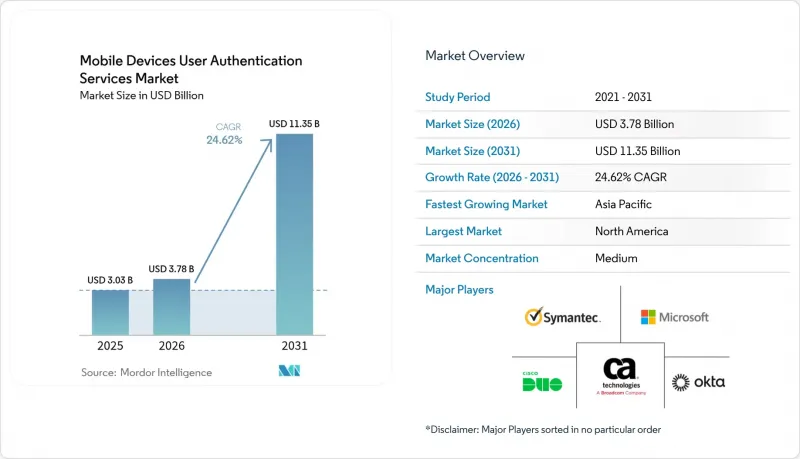
Mordor Intelligence에 의하면, 모바일 기기 사용자 인증 서비스 시장 규모는 2025년 30억 3,000만 달러로 평가되었습니다. 2026년에는 37억 8,000만 달러로 확대되어 2026-2031년에 걸쳐 CAGR 24.62%로 성장을 지속하여, 2031년까지 113억 5,000만 달러에 이를 것으로 예측됩니다.
본 보고서는 인증 유형별(비밀번호 및 PIN, 2단계 인증, 기타), 배포 모드별(클라우드 기반 인증 서비스, On-Premise, 기타), 인증 채널별(SMS OTP, 푸시 알림, 기타),기업 규모별(중소기업, 대기업), 최종 사용자 산업별(은행, 금융서비스 및 보험(BFSI), 가전·전자상거래, 기타), 지역별로 분류되어 있습니다. 시장 예측은 금액(미 달러) 기준으로 제시되어 있습니다.
세계의 모바일 기기 사용자 인증 서비스 시장 동향 및 인사이트
모바일 퍼스트 기업에서의 패스워드리스 및 WebAuthn 표준 채택
조직의 70%가 패스워드 없는 인증 도입을 계획 중이거나 이미 도입한 상태이며, 이는 WebAuthn이 보안 기준을 어떻게 혁신하고 있는지를 보여줍니다. Microsoft Entra ID와 같은 기존 플랫폼의 네이티브 지원 덕분에 패스키 기능이 기기의 하드웨어에 직접 통합되어, 공유 비밀 키의 위험을 제거하는 동시에 사용자 경험을 간소화하고 있습니다. 패스키에 대한 소비자 인지도는 3년 전 39%에서 2025년에는 57%로 상승했으며, 이는 대규모 전환을 위한 준비가 완료되었음을 시사합니다. 2025년에는 은행, 항공사, 여행 포털 사이트가 FIDO 준수 절차를 채택함에 따라 이러한 추세가 더욱 가속화되었으며, 비밀번호 없는 인증이 고액 모바일 거래에서 주류 인증 수단으로 자리 잡게 되었습니다. 크로스 플랫폼 간 인증 정보 이동을 통합적으로 관리할 수 있는 벤더는 모바일 기기 사용자 인증 서비스 시장에서 타사를 압도하는 점유율을 확보할 전망입니다.
핀테크와 모바일 뱅킹의 급증(SCA 준수)이 MFA 도입을 뒷받침
유럽은행감독청(EBA)이 기기 잠금 해제에 사용되는 생체 인증을 단독 SCA로 인정하지 않는다는 지침을 발표함에 따라 다단계 인증 도입이 가속화되고 있으며, 발급 기관은 생체 인증, 소유 요소, 동적 위험 점검을 결합한 다층적인 검증 체계를 구축할 수밖에 없게 되었습니다. 향후 제안될 것으로 예상되는 PSD3에서는 모바일 전용 인증 절차가 더욱 금지될 전망이며, 은행들은 아웃오브밴드(out-of-band) 인증 수단의 도입을 강요받을 것으로 보입니다. 인접한 디지털 커머스 부문으로의 파급 효과는 현저하며, 전자상거래, 차량 호출 서비스, 긱 워크 플랫폼은 소비자의 신뢰와 규제상의 일관성을 충족하기 위해 은행 수준의 관리 조치를 채택하고 있습니다. 이러한 수요의 수렴이 금융 및 준금융 생태계 전반에 걸쳐 모바일 기기 사용자 인증 서비스 시장의 두 자릿수 성장을 뒷받침하고 있습니다.
통신 사업자가 세분화된 지역에서의 SMS OTP 지연 및 실패
SMS OTP에 대한 전 세계 지출은 16억 달러를 초과합니다. 그러나 여러 통신 사업자가 존재하는 시장에서는 전달률이 기업의 허용 기준을 밑돌고 있어, 이로 인해 장바구니 포기나 로그인 실패가 발생하고 있습니다. 싱가포르, 인도, 미국의 규제 당국은 2025년까지 SMS OTP를 폐지하는 것을 목표로 해, 대체 수단이 도입되었습니다. NIST는 현재 SMS를 안전한 인증 수단으로 권장하지 않고 있으며, 코인베이스(Coinbase)와 같은 주요 거래소들도 계정 탈취 사례의 95%가 SIM 스왑 공격에 기인한다는 사실을 확인하고 있습니다. 전환 비용이 중소기업에 일시적인 걸림돌이 될 수는 있겠지만, 푸시 알림이나 패스키 비용이 낮아지고 있는 만큼 장기적으로는 이러한 장벽이 해소될 전망입니다.
부문 분석
2025년에는 MFA가 매출의 55.30%를 차지하며, 인증 정보 도난에 대한 초기 단계 방어 수단으로서의 역할을 수행했습니다. 현재, 패스워드 없는 인증은 플랫폼 차원의 FIDO 지원과 패스키에 대한 인지도 향상에 힘입어 연평균 성장률(CAGR) 25.20%의 성장세를 보이고 있습니다. 비밀번호 없는 인증 흐름을 위한 모바일 기기 사용자 인증 서비스 시장 규모는 2031년까지 46억 2,000만 달러에 달할 것으로 예측되며, 이는 2025년 기준 대비 거의 두 배로 증가하는 것입니다. 하드웨어 보안 키는 틈새 시장 부문이긴 하지만, 통신 및 국방 부문의 높은 신뢰성 요구를 충족시키고 있으며, 단위 경제성 개선에 힘입어 두 자릿수 성장률로 확대되고 있습니다. 행동 인증과 수동 인증은 지속적인 검증을 추가함으로써 사용자에게 표시되는 프롬프트를 줄이고 제로 트러스트(Zero Trust) 요구 사항을 충족합니다. 하드웨어 키와 보이지 않는 행동 인증 계층을 결합한 벤더는 기업의 업셀링 예산을 확보하는 데 유리한 입장에 있습니다.
지문, 얼굴 인식, 음성 대조가 생체 인증 도입의 대부분을 차지하고 있지만, 기존 모바일 SDK에 통합됨에 따라 행동 중심 모델이 더 빠르게 성장하고 있습니다. 번호 대조 및 기기 평판 분석은 다단계 인증(MFA)으로 인한 부담을 줄이고, 공격자가 악용할 수 있는 취약점을 차단합니다. 이러한 동향들이 결합되면서, 모바일 기기 사용자 인증 서비스 시장은 단순한 점검 지점이 아닌, 원활한 디지털 경험을 실현하는 수단으로 재정의되고 있으며, 이사회 차원의 투자에 대한 비즈니스 타당성이 강화되고 있습니다.
클라우드 기반 인증 서비스(Authentication-as-a-Service)는 SaaS의 급속한 확산과 탄력적인 확장이라는 이점에 힘입어 2025년에는 매출의 59.10%를 차지했습니다. 규제 대상 산업이 클라우드 ID 혁신을 활용하면서도 데이터 상주 요건을 확보함에 따라, 하이브리드형(엣지+클라우드) 옵션은 연평균 성장률(CAGR) 22.10%로 성장하고 있습니다. Microsoft의 하이브리드 Kerberos 트러스트 모델을 도입한 조직에서는 On-Premise 디렉터리와 클라우드 엔드포인트 모두를 통해 로컬 Windows Hello 인증 정보를 인증할 때 지연 시간 감소와 정책의 일관성이 입증되었습니다. 모바일 기기 사용자 인증 서비스 시장에서 On-Premise 아키텍처의 점유율은 2031년까지 14.75% 미만으로 떨어질 전망이지만, 데이터 주권에 관한 규제가 여전히 엄격한 지역에서는 그 점유율이 유지될 것으로 보입니다.
하이브리드 도입은 전환의 흐름에 따라 진행될 것입니다. 기업은 먼저 단순한 웹 워크로드를 마이그레이션하고, 다음으로 클라우드 네이티브 FIDO 브로커를 통합하며, 기존 메인프레임 기반 인증은 폐지될 때까지 On-Premise에 남겨둘 것입니다. 이러한 단계적인 마이그레이션을 통해 통합 업체의 서비스 수익은 수년에 걸쳐 유지되고, 평균 계약 기간도 장기화될 것입니다. 신뢰 플레인 전반에 걸친 조치 주도형 오케스트레이션을 제공하는 벤더는 고객과의 유대 관계를 강화하는 동시에, 클라이언트 입장에서의 ‘리펀드 앤 리플레이스(기존 시스템의 전면 교체)’ 위험을 최소화할 수 있습니다.
지역별 분석
북미는 2025년 부문별 수익의 37.40%를 차지했으며, 지속적인 검증을 추진하는 사이버보안 및 인프라 보안국(CISA)의 ‘제로 트러스트 성숙도 모델’과 같은 규제적 촉진요인이 이를 뒷받침하고 있습니다. 미국 기업의 절반은 이미 어떤 형태로든 비밀번호 없는 인증을 도입하고 있으며, 이는 후발 기업들의 도입을 가속화하는 벤치마크가 되고 있습니다. 벤더들의 진출이 활발한 가운데, 마이크로소프트, 옥타, 유비코가 표준을 형성하는 한편, 틈새 시장에 진입한 기업들이 행동 분석 분야의 선구자 역할을 하고 있습니다. 공공 부문 계약, 특히 국방부의 2027 회계연도(FY27) 의무화는 장기적인 수요 전망을 제시하는 동시에, 인접한 민간 기관에서의 파급적인 구매를 촉진하고 있습니다. 따라서 모바일 기기 사용자 인증 서비스 시장은 제로 트러스트 프로그램의 확대에 따라 여전히 경쟁이 치열하지만 성장 여지가 있습니다.
아시아는 스마트폰의 보급과 정부 주도의 디지털 ID 제도의 뒷받침을 받아 2031년 연평균 성장률(CAGR)이 27.90%로 가장 빠르게 성장하는 지역입니다. 중국 OEM 업체들의 첨단 생체 인식 센서 통합과 인도의 아다르(Aadhaar)와 연계된 결제 생태계가 결합되어 막대한 인증 처리량을 창출하고 있습니다. ASEAN-5 시장에서는 데이터 개인정보 보호에 관한 법규가 아직 성숙 단계에 이르지 못했지만, 전자정부 및 디지털 뱅킹의 확산을 통해 추가적인 추진력이 더해지면서 성장과 복잡성을 동시에 가져오고 있습니다. 통신 사업자가 지원하는 SIM 인증 API는 대역폭이 좁은 지역의 인프라 격차를 해소하고, 모바일 기기 사용자 인증 서비스 시장의 잠재적 수요를 확대하는 동시에, 통신 그룹을 밸류체인의 더 깊은 단계로 통합하고 있습니다.
유럽에서는 엄격한 GDPR(EU 개인정보보호규정) 준수와 SCA(강력한 고객 인증)의 급속한 보급 간에 균형이 잡혀 있습니다. 유럽은행감독청(EBA)의 디지털 지갑에 대한 명확한 지침은 상업 거래 전반에 걸친 다중 요소 인증 요건을 높였으며, 다른 산업이 본받을 수 있는 지침을 제시하고 있습니다. 예상되는 PSD3 규정에서는 모바일 전용 흐름이 금지될 전망이며, 동적 인증 요소를 단계적으로 강화할 수 있는 오케스트레이션 엔진을 보유한 벤더가 유리할 것입니다. 북유럽 국가들은 초기부터 디지털 ID 체계를 도입하여 가장 높은 보급률을 보이고 있는 반면, 영국, 독일, 프랑스에서는 오픈 뱅킹 및 eID 프레임워크가 성숙해짐에 따라 꾸준한 성장을 이루고 있습니다. 향후 도입될 EU 디지털 ID 지갑을 통한 국경 간 조화는 새로운 이용 사례를 개척할 것이며, 모바일 기기 사용자 인증 서비스 시장에서 유럽을 수익성이 높고 규정 준수 요건이 엄격한 부문으로 유지하게 될 것으로 보입니다.
기타 혜택
- 엑셀 형식 시장 예측(ME) 시트
- 3개월간의 애널리스트 지원
자주 묻는 질문
목차
제1장 서론
제2장 조사 방법
제3장 주요 요약
제4장 시장 구도
제5장 시장 규모 및 성장 예측
제6장 경쟁 구도
제7장 시장 기회 및 향후 전망
KTH 26.08.26According to Mordor Intelligence, the mobile devices user authentication services market size is expected to grow from USD 3.03 billion in 2025 to USD 3.78 billion in 2026 and is forecast to reach USD 11.35 billion by 2031 at 24.62% CAGR over 2026-2031.
This report is Segmented by Authentication Type (Passwords and PINs, Two-Factor Authentication, and More), Deployment Mode (Cloud-Based, On-Premise, and More), Authentication Channel (SMS OTP, Push Notification, and More), Enterprise Size (SMEs, Large Enterprises), End-User Vertical (BFSI, Consumer Electronics, and More), and by Geography. The Market Forecasts are Provided in Terms of Value (USD).
Global Mobile Devices User Authentication Services Market Trends and Insights
Adoption of Passwordless and WebAuthn Standards Across Mobile-First Enterprises
Seventy percent of organisations either plan to adopt or have already introduced passwordless authentication, illustrating how WebAuthn shifts the security baseline. Native support from platform incumbents such as Microsoft Entra ID embeds passkey functionality directly into device hardware, eradicating shared-secret risk while simplifying user journeys. Consumer familiarity with passkeys rose to 57% in 2025, up from 39% three years earlier, signalling readiness for large-scale transition.Momentum will intensify as banks, airlines and travel portals adopt FIDO-compliant flows in 2025, confirming passwordless as a mainstream control for high-value mobile transactions. Vendors able to orchestrate cross-platform credential mobility stand to win disproportionate share in the mobile devices user authentication services market.
Surge in FinTech and Mobile Banking (SCA Compliance) Driving MFA Roll-outs
European Banking Authority guidance ruling out device-unlock biometrics as a standalone SCA accelerates multi-factor adoption, forcing issuers to build layered verification that combines biometrics, possession factors, and dynamic risk checks. The expected PSD3 proposal will further prohibit mobile-only flows, prompting banks to embed out-of-band authenticators. Spillover into adjacent digital commerce is material; e-commerce, ride-hailing, and gig-work platforms adopt banking-grade controls to satisfy consumer trust and regulatory parity. These converging demands underpin double-digit growth in the mobile devices user authentication services market across financial and quasi-financial ecosystems.
SMS OTP Latency and Failure in Carrier-Fragmented Regions
Global spend on SMS OTP exceeds USD 1.6 billion even though delivery rates fall below enterprise thresholds in multi-operator markets, triggering cart abandonment and failed logins. Regulators in Singapore, India and the United States aim to retire SMS OTP by 2025, amplifying urgency for alternatives. NIST now discourages SMS as a secure factor, while leading exchanges such as Coinbase confirm that 95% of account takeovers leveraged SIM-swap attacks. Transition costs may temporarily restrain small businesses, but declining push notification and passkey expenses neutralise the barrier over time.
Other drivers and restraints analyzed in the detailed report include:
- Mid-Range Smartphone Biometric Hardware Penetration in Asia
- Enterprise Zero-Trust Security Architecture Accelerating Mobile Authenticator Adoption
- Biometric Data Privacy Concerns under GDPR
For complete list of drivers and restraints, kindly check the Table Of Contents.
Segment Analysis
MFA dominated revenue with 55.30% in 2025, reflecting early defences against credential theft. Passwordless now sets the growth pace at 25.20% CAGR, powered by platform-level FIDO support and rising passkey familiarity. The mobile devices user authentication services market size for passwordless flows is projected to reach USD 4.62 billion by 2031, nearly doubling its 2025 base. Hardware security keys, while niche, address high-assurance needs in telecom and defence, expanding at double-digit rates as unit economics improve. Behavioural and passive authentication add continuous verification, reducing user prompts and aligning with zero-trust mandates. Vendors marrying hardware keys with invisible behavioural layers are well-positioned to capture enterprise up-sell budgets.
Fingerprints, facial recognition, and voice match account for the bulk of biometric adoption, yet behaviour-centric models grow faster by embedding in existing mobile SDKs. Number matching and device reputation analytics reduce MFA fatigue, closing an exploit path that attackers manipulate. The combination of these trends repositions the mobile devices user authentication services market as an enabler of seamless digital experience rather than a checkpoint, strengthening the business case for board-level investment
Cloud Authentication-as-a-Service delivered 59.10% revenue in 2025, driven by rapid SaaS roll-outs and elastic scaling advantages. The hybrid edge-plus-cloud option grows at 22.10% CAGR as regulated industries safeguard data residency while using cloud identity innovation. Organisations deploying Microsoft's hybrid Kerberos trust model demonstrate latency reductions and policy coherence when authenticating local Windows Hello credentials through both on-premises directory and cloud endpoint. The mobile devices user authentication services market share for on-premise architectures will slide below 14.75% by 2031, yet it persists wherever sovereign data mandates remain strict.
Hybrid adoption follows migration waves: firms lift simple web workloads first, then layer cloud-native FIDO brokers, leaving heritage mainframe authentications on-site until retirement. This staged transition sustains multi-year service revenue for integrators and lengthens average contract duration. Vendors offering policy-driven orchestration across trust planes achieve stickier relationships while minimising rip-and-replace risk for clients.
Complete Report Scope:
- By Authentication Type
- Passwords and PINs
- Two-Factor Authentication
- Multi-Factor Authentication
- Biometric Authentication
- Behavioral and Passive Authentication
- Risk-Based / Contextual Authentication
- Soft Tokens and Authenticator Apps
- Hardware Security Keys / FIDO Tokens
- By Deployment Mode
- Cloud-Based Authentication as-a-Service
- On-Premise
- Hybrid (Edge + Cloud)
- By Authentication Channel
- SMS OTP
- Push Notification
- In-App Biometric API
- SIM / Silent Mobile Network Authentication
- Email OTP / Magic Link
- By Enterprise Size
- SMEs (< 1,000 Employees)
- Large Enterprises
- By End-user Vertical
- BFSI
- Consumer Electronics and E-Commerce
- Government and Public Sector
- Telecommunications and IT Services
- Healthcare and Life Sciences
- Manufacturing and Industrial IoT
- Education and eLearning
- Travel and Hospitality
- By Geography
- North America
- United States
- Canada
- Mexico
- South America
- Brazil
- Argentina
- Rest of South America
- Europe
- Nordics
- Sweden
- Norway
- Finland
- Germany
- United Kingdom
- France
- Italy
- Spain
- Rest of Europe
- Nordics
- APAC
- China
- India
- Japan
- South Korea
- ASEAN-5
- Australia
- New Zealand
- Rest of APAC
- Middle East
- GCC
- Saudi Arabia
- UAE
- Turkey
- Israel
- Rest of Middle East
- GCC
- Africa
- South Africa
- Nigeria
- Kenya
- Rest of Africa
- North America
Geography Analysis
North America generated 37.40% of 2025 sectoral revenue, anchored by regulatory catalysts like the Cybersecurity and Infrastructure Security Agency Zero Trust Maturity Model that champions continuous verification. Half of U.S. enterprises have already deployed some form of passwordless authentication, creating a reference base that accelerates late-mover adoption. Vendor presence is dense, with Microsoft, Okta, and Yubico shaping standards while niche players pioneer behaviour analytics. Public-sector contracts, notably the Department of Defense FY27 mandate, provide long-term volume visibility and drive spill-over purchases in adjacent civilian agencies. The mobile devices user authentication services market, therefore, remains highly competitive yet expandable as zero-trust programmes scale.
Asia is the fastest-growing theatre at 27.90% CAGR through 2031, propelled by smartphone ubiquity and government digital identity schemes. Chinese OEM integration of advanced biometric sensors combined with India's Aadhaar-linked payments ecosystem creates massive authentication throughput. ASEAN-5 markets add incremental momentum via e-government and digital banking roll-outs, even though data privacy legislation is still maturing, injecting both growth and complexity. Carrier-backed SIM authentication APIs fill infrastructure gaps in low-bandwidth geographies, enlarging the addressable demand for the mobile devices user authentication services market while embedding telecom groups deeper into the value chain.
Europe balances strict GDPR compliance with rapid SCA uptake. The European Banking Authority's clarification on digital wallets elevates multi-factor requirements across commerce and sets a playbook that other verticals can emulate. Anticipated PSD3 rules will forbid mobile-only flows, favouring vendors with orchestration engines capable of dynamic factor step-ups. Northern Europe demonstrates highest penetration due to early digital identity schemes, while the United Kingdom, Germany and France post robust growth as Open Banking and eID frameworks mature. Cross-border harmonisation under the forthcoming EU Digital Identity Wallet will unlock new use cases, maintaining Europe as a lucrative yet compliance-heavy segment of the mobile devices user authentication services market.
- Symantec Corporation
- Broadcom Inc. (CA Technologies)
- Cisco Systems Inc. (Duo Security)
- Microsoft Corporation
- Okta Inc.
- Thales Group (Gemalto)
- RSA Security LLC (Dell Technologies)
- OneSpan Inc.
- Entrust Corporation
- HID Global Corporation
- IDEMIA
- NEC Corporation
- Ping Identity Holding Corp.
- ForgeRock Inc.
- Authy (Twilio Inc.)
- Yubico AB
- Trustwave Holdings Inc.
- Micro Focus International plc
- Google LLC
- IBM Corporation
- Nexus Group
- SecurEnvoy Ltd.
- Aware Inc.
- Fujitsu Limited
Additional Benefits:
- The market estimate (ME) sheet in Excel format
- 3 months of analyst support
TABLE OF CONTENTS
1 INTRODUCTION
- 1.1 Study Deliverables
- 1.2 Study Assumptions
- 1.3 Scope of the Study
2 RESEARCH METHODOLOGY
3 EXECUTIVE SUMMARY
4 MARKET LANDSCAPE
- 4.1 Market Overview
- 4.2 Market Drivers
- 4.2.1 Adoption of Passwordless and WebAuthn Standards Across Mobile-First Enterprises
- 4.2.2 Surge in FinTech and Mobile Banking (SCA Compliance) Driving MFA Roll-outs
- 4.2.3 Mid-Range Smartphone Biometric Hardware Penetration in Asia
- 4.2.4 Carrier-Backed SIM-Based Authentication APIs in Emerging Markets
- 4.2.5 Global Regulatory Mandates (PSD2, CCPA, HIPAA) Boosting Authentication Spend
- 4.2.6 Enterprise Zero-Trust Security Architecture Accelerating Mobile Authenticator Adoption
- 4.3 Market Restraints
- 4.3.1 SMS OTP Latency and Failure in Carrier-Fragmented Regions
- 4.3.2 Biometric Data Privacy Concerns under GDPR
- 4.3.3 High Integration Cost for Legacy SME Mobile Applications
- 4.3.4 Interoperability Gaps among Proprietary Mobile Auth SDKs
- 4.4 Value / Supply-Chain Analysis
- 4.5 Technological Outlook
- 4.6 Investment Analysis
- 4.7 Porter's Five Forces
- 4.7.1 Threat of New Entrants
- 4.7.2 Bargaining Power of Buyers
- 4.7.3 Bargaining Power of Suppliers
- 4.7.4 Threat of Substitutes
- 4.7.5 Intensity of Competitive Rivalry
5 MARKET SIZE AND GROWTH FORECASTS (VALUE)
- 5.1 By Authentication Type
- 5.1.1 Passwords and PINs
- 5.1.2 Two-Factor Authentication
- 5.1.3 Multi-Factor Authentication
- 5.1.4 Biometric Authentication
- 5.1.5 Behavioral and Passive Authentication
- 5.1.6 Risk-Based / Contextual Authentication
- 5.1.7 Soft Tokens and Authenticator Apps
- 5.1.8 Hardware Security Keys / FIDO Tokens
- 5.2 By Deployment Mode
- 5.2.1 Cloud-Based Authentication as-a-Service
- 5.2.2 On-Premise
- 5.2.3 Hybrid (Edge + Cloud)
- 5.3 By Authentication Channel
- 5.3.1 SMS OTP
- 5.3.2 Push Notification
- 5.3.3 In-App Biometric API
- 5.3.4 SIM / Silent Mobile Network Authentication
- 5.3.5 Email OTP / Magic Link
- 5.4 By Enterprise Size
- 5.4.1 SMEs (< 1,000 Employees)
- 5.4.2 Large Enterprises
- 5.5 By End-user Vertical
- 5.5.1 BFSI
- 5.5.2 Consumer Electronics and E-Commerce
- 5.5.3 Government and Public Sector
- 5.5.4 Telecommunications and IT Services
- 5.5.5 Healthcare and Life Sciences
- 5.5.6 Manufacturing and Industrial IoT
- 5.5.7 Education and eLearning
- 5.5.8 Travel and Hospitality
- 5.6 By Geography
- 5.6.1 North America
- 5.6.1.1 United States
- 5.6.1.2 Canada
- 5.6.1.3 Mexico
- 5.6.2 South America
- 5.6.2.1 Brazil
- 5.6.2.2 Argentina
- 5.6.2.3 Rest of South America
- 5.6.3 Europe
- 5.6.3.1 Nordics
- 5.6.3.1.1 Sweden
- 5.6.3.1.2 Norway
- 5.6.3.1.3 Finland
- 5.6.3.2 Germany
- 5.6.3.3 United Kingdom
- 5.6.3.4 France
- 5.6.3.5 Italy
- 5.6.3.6 Spain
- 5.6.3.7 Rest of Europe
- 5.6.3.1 Nordics
- 5.6.4 APAC
- 5.6.4.1 China
- 5.6.4.2 India
- 5.6.4.3 Japan
- 5.6.4.4 South Korea
- 5.6.4.5 ASEAN-5
- 5.6.4.6 Australia
- 5.6.4.7 New Zealand
- 5.6.4.8 Rest of APAC
- 5.6.5 Middle East
- 5.6.5.1 GCC
- 5.6.5.1.1 Saudi Arabia
- 5.6.5.1.2 UAE
- 5.6.5.2 Turkey
- 5.6.5.3 Israel
- 5.6.5.4 Rest of Middle East
- 5.6.5.1 GCC
- 5.6.6 Africa
- 5.6.6.1 South Africa
- 5.6.6.2 Nigeria
- 5.6.6.3 Kenya
- 5.6.6.4 Rest of Africa
- 5.6.1 North America
6 COMPETITIVE LANDSCAPE
- 6.1 Market Concentration
- 6.2 Strategic Moves
- 6.3 Market Share Analysis
- 6.4 Company Profiles {(includes Global Level Overview, Market Level Overview, Core Segments, Financials as available, Strategic Information, Market Rank/Share for key companies, Products and Services, Recent Developments)}
- 6.4.1 Symantec Corporation
- 6.4.2 Broadcom Inc. (CA Technologies)
- 6.4.3 Cisco Systems Inc. (Duo Security)
- 6.4.4 Microsoft Corporation
- 6.4.5 Okta Inc.
- 6.4.6 Thales Group (Gemalto)
- 6.4.7 RSA Security LLC (Dell Technologies)
- 6.4.8 OneSpan Inc.
- 6.4.9 Entrust Corporation
- 6.4.10 HID Global Corporation
- 6.4.11 IDEMIA
- 6.4.12 NEC Corporation
- 6.4.13 Ping Identity Holding Corp.
- 6.4.14 ForgeRock Inc.
- 6.4.15 Authy (Twilio Inc.)
- 6.4.16 Yubico AB
- 6.4.17 Trustwave Holdings Inc.
- 6.4.18 Micro Focus International plc
- 6.4.19 Google LLC
- 6.4.20 IBM Corporation
- 6.4.21 Nexus Group
- 6.4.22 SecurEnvoy Ltd.
- 6.4.23 Aware Inc.
- 6.4.24 Fujitsu Limited
7 MARKET OPPORTUNITIES AND FUTURE OUTLOOK
- 7.1 White-Space and Unmet-Need Assessment