

|
시장보고서
상품코드
2113891
원격 환자 모니터링 시스템 : 시장 점유율 분석, 업계 동향 및 통계, 성장 예측(2026-2031년)Remote Patient Monitoring Systems - Market Share Analysis, Industry Trends & Statistics, Growth Forecasts (2026 - 2031) |
||||||
 Mordor Intelligence
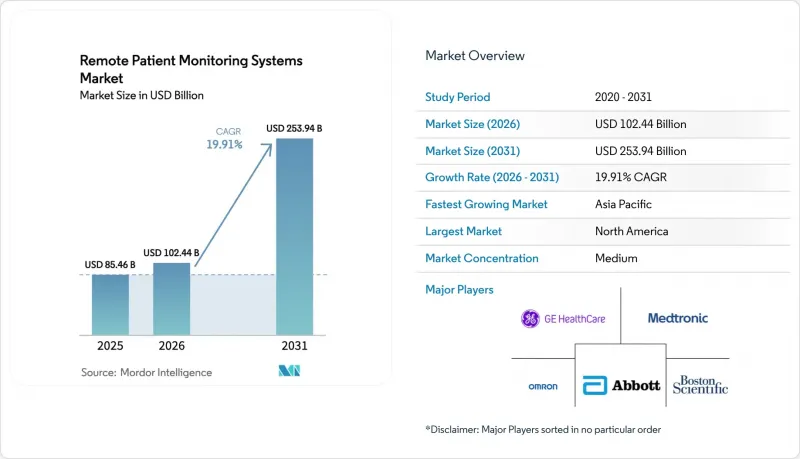
Mordor Intelligence에 의하면, 원격 환자 모니터링 시스템 시장 규모는 2025년 854억 6,000만 달러로 평가되었습니다. 2026년에는 1,024억 4,000만 달러로 확대되어 2031년까지 2,539억 4,000만 달러에 이를 것으로 예상되고 2026년부터 2031년에 걸쳐 CAGR 19.91%로 성장할 전망입니다.
본 보고서는 기기 유형(생체 징후 모니터, 특정 질환용 모니터 등), 용도(심혈관 질환, 당뇨병 관리 등), 최종 사용자(병원 및 진료소, 재택 간호 환경, 외래수술센터(ASC)), 지역(북미, 유럽, 아시아태평양 등)별로 분류되어 있습니다. 시장 전망은 금액(미 달러) 기준으로 제시되어 있습니다.
세계의 원격 환자 모니터링 시스템 시장 동향 및 인사이트
만성 질환의 부담 증가
심혈관 질환과 당뇨병은 현재 연간 1,800만 명 이상의 목숨을 앗아가고 있으며, 고소득 국가 경제에 연간 1조 2,000억 미 달러의 부담을 안겨주고 있습니다. 원격 환자 모니터링 플랫폼은 간헐적인 건강 검진을 지속적인 모니터링으로 전환하여, 심각한 상황이 발생하기 전에 건강 상태의 악화를 감지합니다. 2024년 『랜싯 디지털 헬스(The Lancet Digital Health)』 저널의 연구에 따르면, 이식형 폐 센서를 사용한 경우 심부전으로 인한 입원이 33% 감소하고, 환자 1인당 8,200달러의 비용 절감이 실현된 것으로 나타났습니다. 미국 질병통제예방센터(CDC)는 2025년, 미국 성인의 60%가 적어도 하나의 만성 질환을 앓고 있는 것으로 확인했습니다. 이는 5년 동안 9포인트 증가한 수치입니다. 이에 따라 보험사들은 보험금 지급을 치료 성과 지표와 연계하고, 응급 상황을 미연에 방지하기 위해 원격 모니터링을 도입하는 의료 제공업체에게 우대 조치를 취하고 있습니다. 그 결과, 원격 환자 모니터링 시스템 시장은 만성 질환 유병률의 동향과 밀접하게 연결되어 있습니다.
고령화 인구와 재택 간호로의 전환
세계적으로 이미 65세 이상 고령자가 7억 6,100만 명에 달하며, 2050년까지 16억 명에 이를 것으로 예측됩니다. 미국에서는 장기 요양 시설의 가동률이 94%에 달하고,, 급증 시 수용 여력이 거의 남아 있지 않습니다. 2026년 12월까지 연장된 메디케어의 ‘재택 병원(Hospital-at-Home)’ 면제 제도에 따라, 지속적인 원격 모니터링이 조인트 커미션(Joint Commission)의 기준을 충족하는 것을 조건으로 자택에서의 급성기 치료가 가능해집니다. 『JAMA Network Open』지에서는 가정용 RPM 키트 사용으로 인해 30일 이내 재입원이 19% 감소하고, 1회 치료당 비용이 24% 절감된 것으로 보고되었습니다. 이러한 인구 통계학적 변화와 정책의 시너지 효과로 인해 치료가 병동에서 자택으로 전환되는 추세가 가속화되며, 원격 환자 모니터링 시스템 시장을 더욱 견인하고 있습니다.
데이터 개인정보 보호 및 사이버 보안에 대한 우려
미국에서 의료 서비스 제공업체를 표적으로 한 랜섬웨어 공격은 전년 대비 45% 증가하여, 2025년에는 725건의 사고가 기록되었습니다. 체인지 헬스케어(Change Healthcare)의 2024년 정보 유출 사건에서는 1억 명의 개인 정보가 유출되어 시스템적 취약성이 부각되었습니다. EU는 2025년, 암호화 대책이 불충분하다는 이유로 한 다국적 전자건강기록(EHR) 공급업체에 12억 유로의 벌금을 부과했습니다. 신뢰를 회복하기 위해 벤더는 다단계 인증 및 제로 트러스트 아키텍처에 대한 투자를 강요받게 되었으며, 이로 인해 기기당 비용이 18-22% 증가하게 됩니다. 규제상의 마찰이 도입을 지연시키고, 원격 환자 모니터링 시스템 시장의 성장을 둔화시키고 있습니다.
부문 분석
2025년, 특정 질환에 특화된 모니터는 원격 환자 모니터링 시스템 시장에서 40.12%의 점유율을 차지했습니다. 웨어러블 패치는 14일 동안 피부에 안전하게 부착할 수 있는 접착제와 부피가 큰 송신기가 필요 없는 BLE(Bluetooth Low Energy) 통신 기술에 힘입어 연평균 성장률(CAGR) 20.11%로 성장을 지속하고 있습니다. 애보트(Abbott)사의 ‘Lingo’는 2mm 크기의 패치에 연속 혈당, 젖산, 케톤체 측정 기능을 통합하여 손가락 채혈을 통한 보정이 필요하지 않습니다. 다중 매개변수 모니터는 수술 후 재택 회복기 동안의 생체 신호를 모니터링하지만, 간병이 재택으로 전환됨에 따라 병상용 생체 신호 측정 장치의 이익률은 압박을 받고 있습니다. 메드트로닉사의 ‘LINQ II’와 같은 이식형 기기는 4.5년의 배터리 수명으로 장기간의 부정맥 데이터를 수집하며, 원인 불명의 뇌졸중 사례에서 고액의 보험 환급을 보장하고 있습니다.
피트니스 트래커에 대한 소비자의 친숙함이 패치형 기기의 도입 장벽을 낮추고 있습니다. 환자들은 멸균에 드는 수고를 덜어주는 일회용 기기를 선호합니다. 『Journal of Clinical Monitoring and Computing』지에 따르면, 휴대용 패치는 병상 모니터와 동등한 정확도를 초기 비용의 3분의 1 수준으로 제공할 수 있는 것으로 밝혀졌습니다. 간질이나 중증 심장 질환 분야에서는 전용 모니터가 여전히 우위를 점하고 있지만, 패치에 다중 모드 센서가 탑재됨에 따라 범용화의 물결이 다가오고 있습니다. 다중 매개변수 기기는 메디케어의 ‘재택 병원(Hospital-at-Home)’ 면제 제도의 뒷받침을 받아, 전환기 치료 현장에서 활약하고 있습니다. 이러한 제품 구성의 진화가 원격 환자 모니터링 시스템 시장에서 지속적인 수익 다각화를 뒷받침하고 있습니다.
지역별 분석
북미는 메디케어 코드 확대와 2027년까지 RPM의 보편화를 목표로 하는 재향군인부(VA)의 노력에 힘입어 2025년 매출의 41.22%를 차지했습니다. 2025년 12월 기준으로 1,200만 명의 메디케어 수급자가 등록되었으며, 이는 2년 전 480만 명에서 증가한 수치입니다. 캐나다는 RPM을 포함한 지방 지역의 가상 진료에 2억 캐나다 달러(1억 4,800만 달러)를 배정하는 한편, 멕시코에서는 8만 명의 환자를 대상으로 당뇨병 및 고혈압 모니터링 시범 사업을 실시했습니다.
아시아태평양은 2031년까지 연평균 성장률(CAGR) 21.78%를 나타낼 것으로 예측됩니다. 중국은 ‘건강 중국 2030’ 계획에 따라 고혈압, 당뇨병, 만성폐쇄성폐질환(COPD)에 대한 RPM의 보험 급여를 실시했습니다. 인도의 ‘아유슈만 바라트 디지털 미션’은 2025년 말까지 2억 명의 국민을 클라우드 기반 건강 기록 시스템에 연결했습니다. 일본에서는 내원 없이 RPM을 통한 만성 질환 관리가 허용되고 있습니다. 한국에서는 서울과 부산에서 뇌졸중 후 경과 관찰이 시범적으로 실시되고 있습니다. 호주에서는 2024년에 RPM용 원격의료 항목 번호가 추가되었으나, 보상액은 대면 진료 요금보다 30% 낮은 수준에 머물렀습니다.
2025년, 유럽은 큰 점유율을 차지했습니다. 독일은 인증된 디지털 헬스 용도에 대한 보험 급여를 지급하고 있으며, 2025년 중반까지 40개 이상의 RPM 도구를 승인했습니다. 영국은 심부전 및 COPD 원격 모니터링에 2억 5,000만 파운드를 배정했습니다. 프랑스는 커넥티드 의료기기 승인 절차를 통해 12개의 기기를 허가했으나, 국가 전자건강기록(EHR)과의 통합은 지연되고 있습니다. UAE 등 GCC 국가들은 2025년에 1만 명의 환자를 대상으로 한 당뇨병 시범 사업을 시작하며 초기 성장세를 보이고 있습니다. 인프라 부족과 보험 환급 제도의 제한으로 인해 중동 및 아프리카(MEA) 지역 및 남미에서의 보급은 제한적이지만, 디지털 헬스를 대상으로 한 다자간 개발 금융이 잠재적 수요를 자극하여 장기적으로는 원격 환자 모니터링 시스템 시장을 뒷받침할 가능성이 있습니다.
기타 혜택 :
- 엑셀 형식 시장 예측(ME) 시트
- 3개월간 애널리스트 지원
자주 묻는 질문
목차
제1장 서론
제2장 조사 방법
제3장 주요 요약
제4장 시장 구도
제5장 시장 규모 및 성장 예측
제6장 경쟁 구도
제7장 시장 기회 및 향후 전망
KTH 26.08.26According to Mordor Intelligence, the remote patient monitoring systems market size is expected to increase from USD 85.46 billion in 2025 to USD 102.44 billion in 2026 and reach USD 253.94 billion by 2031, growing at a CAGR of 19.91% over 2026-2031.
This report is Segmented by Device Type (Vital-Sign Monitors, Specialized Disease-Specific Monitors, and More), Application (Cardiovascular Diseases, Diabetes Management, and More), End-User (Hospitals & Clinics, Home-Care Settings, Ambulatory Surgical Centers), and Geography (North America, Europe, Asia-Pacific, and More). The Market Forecasts are Provided in Terms of Value (USD).
Global Remote Patient Monitoring Systems Market Trends and Insights
Chronic-Disease Burden Escalation
Cardiovascular disease and diabetes now claim over 18 million lives per year, costing high-income economies USD 1.2 trillion annually . Remote patient monitoring platforms convert episodic check-ups into continuous oversight, catching deterioration before a critical event. A 2024 Lancet Digital Health study showed a 33% drop in heart-failure admissions and USD 8,200 savings per patient when implantable pulmonary sensors were used. The Centers for Disease Control confirmed in 2025 that 60% of U.S. adults live with at least one chronic condition, up nine points in five years. Payers are therefore tying reimbursement to outcome metrics, rewarding providers that deploy remote surveillance to prevent emergency episodes. As a result, the Remote patient monitoring system market is tightly coupled to chronic-disease prevalence trends.
Geriatric Population and Home-Care Shift
The world already counts 761 million people aged 65+ and will reach 1.6 billion by 2050. Long-term-care facilities operate at 94% occupancy in the United States, leaving scant surge capacity. Medicare's Hospital-at-Home waiver, extended to December 2026, enables acute-level treatment in residences, provided continuous telemetry meets Joint Commission standards. JAMA Network Open documented a 19% decline in 30-day readmissions and 24% episode-cost savings using home-based RPM kits. This demographic and policy convergence accelerates migration of care from wards to living rooms, further lifting the Remote patient monitoring system market.
Data-Privacy and Cybersecurity Concerns
Ransomware events affecting U.S. providers jumped 45% year on year, with 725 incidents logged in 2025 . Change Healthcare's 2024 breach exposed data for 100 million individuals, underscoring systemic vulnerabilities. The EU imposed a EUR 1.2 billion fine on a multinational EHR vendor in 2025 for inadequate encryption. To regain trust, vendors must fund multifactor authentication and zero-trust architectures, adding 18-22% to per-device costs. Regulatory friction slows deployments and dents growth for the Remote patient monitoring system market.
Other drivers and restraints analyzed in the detailed report include:
- AI-Based Digital Biomarkers Enabling Predictive RPM
- Private 5G Hospital Campuses Reducing Latency
- Interoperability and Integration Costs
For complete list of drivers and restraints, kindly check the Table Of Contents.
Segment Analysis
Specialized disease-specific monitors held a 40.12% remote patient monitoring system market share in 2025 . Wearable patches are on track for a 20.11% CAGR, driven by 14-day skin-safe adhesives and Bluetooth Low Energy radios that eliminate bulky transmitters. Abbott's Lingo integrates continuous glucose, lactate, and ketone sensing in a 2 mm patch, avoiding finger-stick calibrations. Multi-parameter monitors cover vital signs for post-surgical home recovery, whereas vital-sign bedside units face margin compression as care migrates home. Implantables like Medtronic's LINQ II capture long-term arrhythmia data with a 4.5-year battery, securing high reimbursement for cryptogenic-stroke cases.
Consumer familiarity with fitness trackers lowers adoption hurdles for patches. Patients prefer disposable devices that avoid sterilization overheads. Journal of Clinical Monitoring and Computing found ambulatory patches offer comparable accuracy to bedside monitors at one-third the capital cost. Specialized monitors maintain supremacy in epilepsy or advanced cardiology, yet commoditization looms as patches add multi-modal sensors. Multi-parameter devices serve transitional-care scenarios, strengthened by Medicare's Hospital-at-Home waiver. This product-mix evolution anchors sustained revenue diversification inside the Remote patient monitoring system market.
Complete Report Scope:
- By Device Type
- Vital-sign Monitors
- Specialized Disease-specific Monitors
- Multi-parameter Monitors
- Wearable Sensor Patches
- Implantable Sensors
- By Application
- Cardiovascular Diseases
- Diabetes Management
- Respiratory (COPD / Asthma)
- Oncology Support
- Sleep & Mental-health Monitoring
- Weight Management & Fitness
- By End-User
- Hospitals & Clinics
- Home-care Settings
- Ambulatory Surgical centers
- By Geography
- North America
- United States
- Canada
- Mexico
- Europe
- Germany
- United Kingdom
- France
- Italy
- Spain
- Rest of Europe
- Asia-Pacific
- China
- India
- Japan
- South Korea
- Australia
- Rest of Asia-Pacific
- Middle East and Africa
- GCC
- South Africa
- Rest of Middle East and Africa
- South America
- Brazil
- Argentina
- Rest of South America
- North America
Geography Analysis
North America captured 41.22% of 2025 revenue, propelled by Medicare's expanded codes and the VA commitment to universal RPM by 2027. Twelve million Medicare beneficiaries were enrolled by December 2025, up from 4.8 million two years earlier. Canada earmarked CAD 200 million (USD 148 million) for rural virtual care, including RPM, while Mexico piloted diabetes and hypertension monitoring across 80,000 patients.
Asia-Pacific is forecast to grow at 21.78% CAGR through 2031. China reimburses RPM for hypertension, diabetes, and COPD under its Healthy China 2030 blueprint. India's Ayushman Bharat Digital Mission connected 200 million citizens to cloud health records by late 2025. Japan allows RPM chronic-care management without clinic visits; South Korea pilots post-stroke surveillance in Seoul and Busan. Australia added telehealth item numbers for RPM in 2024, though reimbursement sits 30% below in-person rates.
Europe held a significant share in 2025. Germany reimburses certified digital health applications, approving over 40 RPM tools by mid-2025. The UK allocated GBP 250 million for remote heart-failure and COPD monitoring. France cleared 12 devices under its connected-medical-device pathway, though integration with the national EHR lags. GCC states such as the UAE launched a 10,000-patient diabetes pilot in 2025, indicating early traction. Infrastructure gaps and limited reimbursement restrain broader MEA and South American adoption, but multi-lateral development loans targeting digital health could unlock latent demand, bolstering the Remote patient monitoring system market over the long term.
- Abbott Laboratories
- Aerotel Medical Systems
- AliveCor
- AMD Global Telemedicine
- Baxter
- Koninklijke Philips
- Boston Scientific
- Dexcom
- GE Healthcare
- Honeywell Life Sciences
- Masimo
- Medtronic
- Nihon Kohden
- OMRON
- Koninklijke Philips
- Resmed
- Teladoc Health
- Tunstall Healthcare
- Vital Connect
- VivaLNK
Additional Benefits:
- The market estimate (ME) sheet in Excel format
- 3 months of analyst support
TABLE OF CONTENTS
1 Introduction
- 1.1 Study Assumptions & Market Definition
- 1.2 Scope of the Study
2 Research Methodology
3 Executive Summary
4 Market Landscape
- 4.1 Market Overview
- 4.2 Market Drivers
- 4.2.1 Chronic-Disease Burden Escalation
- 4.2.2 Geriatric Population & Home-Care Shift
- 4.2.3 Favorable Reimbursement Expansion
- 4.2.4 Post-COVID Telehealth Normalization
- 4.2.5 AI-Based Digital Biomarkers Enabling Predictive RPM
- 4.2.6 Private-5G Hospital Campuses Reducing Latency For RPM
- 4.3 Market Restraints
- 4.3.1 Data-Privacy & Cybersecurity Concerns
- 4.3.2 Interoperability & Integration Costs
- 4.3.3 Tariff / Cross-Border Data-Localization Cost Inflation
- 4.3.4 Device Fatigue & Long-Term Patient Adherence
- 4.4 Supply-Chain Analysis
- 4.5 Regulatory Landscape
- 4.6 Technological Outlook
- 4.7 Porter's Five Forces
- 4.7.1 Threat of New Entrants
- 4.7.2 Bargaining Power of Buyers
- 4.7.3 Bargaining Power of Suppliers
- 4.7.4 Threat of Substitutes
- 4.7.5 Intensity of Competitive Rivalry
5 Market Size & Growth Forecasts (Value, USD)
- 5.1 By Device Type
- 5.1.1 Vital-sign Monitors
- 5.1.2 Specialized Disease-specific Monitors
- 5.1.3 Multi-parameter Monitors
- 5.1.4 Wearable Sensor Patches
- 5.1.5 Implantable Sensors
- 5.2 By Application
- 5.2.1 Cardiovascular Diseases
- 5.2.2 Diabetes Management
- 5.2.3 Respiratory (COPD / Asthma)
- 5.2.4 Oncology Support
- 5.2.5 Sleep & Mental-health Monitoring
- 5.2.6 Weight Management & Fitness
- 5.3 By End-User
- 5.3.1 Hospitals & Clinics
- 5.3.2 Home-care Settings
- 5.3.3 Ambulatory Surgical centers
- 5.4 By Geography
- 5.4.1 North America
- 5.4.1.1 United States
- 5.4.1.2 Canada
- 5.4.1.3 Mexico
- 5.4.2 Europe
- 5.4.2.1 Germany
- 5.4.2.2 United Kingdom
- 5.4.2.3 France
- 5.4.2.4 Italy
- 5.4.2.5 Spain
- 5.4.2.6 Rest of Europe
- 5.4.3 Asia-Pacific
- 5.4.3.1 China
- 5.4.3.2 India
- 5.4.3.3 Japan
- 5.4.3.4 South Korea
- 5.4.3.5 Australia
- 5.4.3.6 Rest of Asia-Pacific
- 5.4.4 Middle East and Africa
- 5.4.4.1 GCC
- 5.4.4.2 South Africa
- 5.4.4.3 Rest of Middle East and Africa
- 5.4.5 South America
- 5.4.5.1 Brazil
- 5.4.5.2 Argentina
- 5.4.5.3 Rest of South America
- 5.4.1 North America
6 Competitive Landscape
- 6.1 Market Concentration
- 6.2 Market Share Analysis
- 6.3 Company Profiles (includes Global level Overview, Market level overview, Core Segments, Financials as available, Strategic Information, Market Rank/Share, Products & Services, Recent Developments)
- 6.3.1 Abbott Laboratories
- 6.3.2 Aerotel Medical Systems
- 6.3.3 AliveCor
- 6.3.4 AMD Global Telemedicine
- 6.3.5 Baxter International
- 6.3.6 Koninklijke Philips N.V.
- 6.3.7 Boston Scientific
- 6.3.8 Dexcom
- 6.3.9 GE Healthcare
- 6.3.10 Honeywell Life Sciences
- 6.3.11 Masimo
- 6.3.12 Medtronic
- 6.3.13 Nihon Kohden
- 6.3.14 Omron Corporation
- 6.3.15 Philips Healthcare
- 6.3.16 ResMed
- 6.3.17 Teladoc Health
- 6.3.18 Tunstall Healthcare
- 6.3.19 VitalConnect
- 6.3.20 VivaLNK
7 Market Opportunities & Future Outlook
- 7.1 White-space & Unmet-need Assessment


