|
시장보고서
상품코드
2113903
체외진단용 실험실 자동화 : 시장 점유율 분석, 업계 동향 및 통계, 성장 예측(2026-2031년)Lab Automation For In-Vitro Diagnostics - Market Share Analysis, Industry Trends & Statistics, Growth Forecasts (2026 - 2031) |
||||||
 Mordor Intelligence
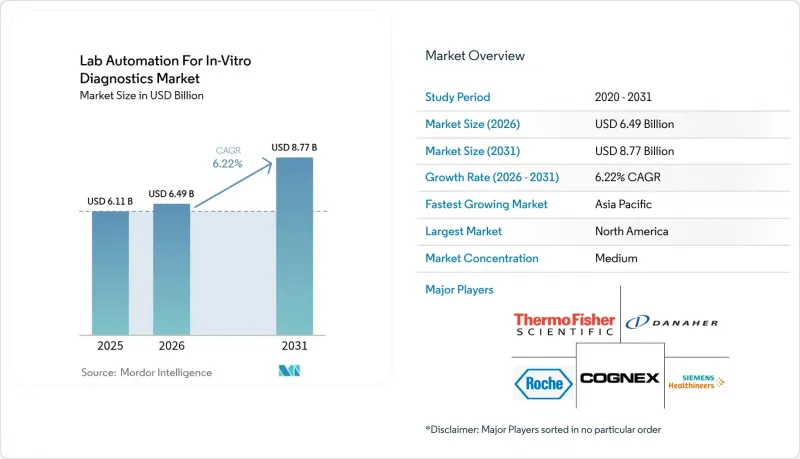
Mordor Intelligence에 의하면, 체외진단용 실험실 자동화 시장 규모는 2025년에 61억 1,000만 달러로 평가되었습니다. 2026년 64억 9,000만 달러에서 2031년까지 87억 7,000만 달러에 이를 것으로 예상되며, 예측 기간(2026-2031년) CAGR은 6.22%를 나타낼 전망입니다.
본 보고서는 장비별(자동 플레이트 핸들러, 자동 액체 핸들러, 기타), 공정 단계별(분석 전 처리, 분석, 분석 후 처리, 기타), 기술별(임상화학 자동화, 면역측정 자동화, 기타), 최종 사용자별(병원·참조 실험실, 임상 진단 실험실, 기타), 지역별로 분류되어 있습니다. 시장 전망은 금액(달러) 기준으로 제시되어 있습니다.
세계의 체외진단용 실험실 자동화 시장 동향 및 인사이트
고처리량 검체 처리에 대한 수요
집중형 검사실에서는 현재 하루에 수천 건의 검체를 처리하고 있으며, 수동 워크플로우로는 2024년 이후 기록된 연간 15-20%의 처리량 증가에 대응할 수 없습니다. 통합 워크셀은 액체 처리, 배양, 검출을 단일 생산 라인으로 통합함으로써 이 과제를 해결합니다. 의료 시스템 조달 팀은 자본 비용보다 ‘시간당 검체 처리 수’라는 지표를 점점 더 중시하게 되어, 입찰 평가의 중점이 완전 자동화 구성으로 이동하고 있습니다. 또한, 높은 처리량은 수작업 접촉 지점이 줄어들어 누적 오류 위험이 감소하므로 통합적인 품질 관리에도 기여합니다. 각 벤더사는 1교대당 500-5,000개의 검체를 처리할 수 있는 모듈식 설계로 이에 대응하고 있으며, 병원은 검사 항목 확대에 맞추어 단계적으로 투자할 수 있게 되었습니다.
만성 질환으로 인한 검사 건수 증가
인구 고령화와 보편적인 선별 검사 노력으로 인해 당뇨병, 심혈관 마커, 종양학 바이오마커를 추적하는 검사에 대한 지속적인 수요가 발생하고 있습니다. 종양학 환자의 경우 1인당 여러 개의 분자 패널 검사가 필요한 경우가 있어, 이로 인해 1회 진료당 검사 의뢰 건수가 실질적으로 두 배로 늘어납니다. 개발도상국에서는 공중보건 프로그램을 통해 진단이 지방 클리닉으로 확대되고 있는 반면, 검체는 도시 지역의 거점으로 보내지기 때문에 검사량이 급격히 증가하고 있어 중앙 검사실의 부담이 더욱 커지고 있습니다. 자동화를 통해 PCR 및 NGS 분석에 필요한 일관된 피펫팅 정밀도가 확보되어, 확대되는 검사 메뉴 전반에 걸쳐 재현성이 향상됩니다. 배치 규모가 커질수록 결과당 비용이 감소하기 때문에 정부의 보험 지급 기관은 자동화 플랫폼을 선호하여 도입하고 있습니다.
막대한 설비 투자와 ROI의 불확실성
종합적인 자동화 시스템 한 세트의 가격은 50만-500만 달러에 달하여, 중규모 민간 검사실에게는 장벽이 되고 있습니다. CFO는 오류 감소 및 검사 결과 신속화를 통한 비용 절감 효과를 모델화하는 데 어려움을 겪고 있어, 승인 절차가 장기화되고 있습니다. 유지보수 계약 및 소프트웨어 라이선스에 따른 지속적인 비용이 더해짐에 따라 총 소유 비용은 구매 가격을 초과하게 됩니다. 2급 병원의 경우, 3-5년 내에 투자 회수가 예상되는 환자 수의 임계치에 도달할 때까지 투자를 미루는 경우도 있습니다.
부문 분석
2025년, 자동 액체 핸들러는 체외진단용 실험실 자동화 시장의 37.25%를 차지했으며, 분자진단 및 면역 측정 워크플로우의 핵심으로서의 역할이 두드러지고 있습니다. 로봇 그리퍼와 머신 비전 모듈을 통해 이러한 플랫폼은 원심 분리, 가열, 실시간 오류 감지를 통합할 수 있게 되어 배치당 수율이 향상되고 있습니다. 검사의 복잡성이 증가함에 따라, 검사실에서는 자외선 살균 및 HEPA 필터를 핸들러 본체에 통합하여 민감도가 높은 핵산 분석을 보호하려는 움직임이 활발해지고 있습니다. 통합 워크셀은 보관, 피펫팅, 검출을 하나의 섀시에 집약하여, 시설이 바닥 면적을 절약하면서 종단간 자동화를 실현하는 데 도움이 됩니다.
마이크로유체 부문은 연평균 성장률(CAGR) 6.66%로 가장 빠른 성장세를 기록하고 있습니다. 소형화된 카트리지는 마이크로리터 단위의 시약량으로 다중 PCR, 면역측정, ELISA 반응을 수행하여 시약 비용과 생물학적 유해 폐기물을 줄여줍니다. 병원에서는 응급실에 탁상형 마이크로플루이딕스 분석 장치를 도입하여 1시간 이내에 호흡기 분자 검사 패널의 결과를 제공합니다. 연구 기관에서는 기존 로봇으로는 대규모 처리가 불가능한 단일 세포 분석이나 ‘장기 온 칩(organ-on-a-chip)’ 프로젝트에서 이 플랫폼의 가치를 높이 평가했습니다.
바코드 부착, 분주, 캡 제거와 같은 작업이 여전히 기본적인 작업이기 때문에 분석 전 시료 전처리는 2025년 매출의 42.20%를 계속 차지했습니다. 적응형 그리퍼와 인공 시각을 활용한 검사 기술의 발전으로 용혈 및 응고 검출 오류가 감소하고, 다운스트림 공정에서 결과의 신뢰성이 향상되고 있습니다. 그러나 검사실에서는 완전한 처리 시간(turnaround time)을 기준으로 투자 수익률(ROI)을 측정하는 경향이 강해지고 있으며, 그 결과 데이터 오케스트레이션에 대한 관심이 높아지고 있습니다.
데이터 관리 및 연결성은 분석의 ‘고립된 섬’을 실시간 대시보드에 통합하는 미들웨어의 혜택을 받아 연평균 성장률(CAGR) 6.86%로 성장을 지속하고 있습니다. 클라우드 호스팅형 플랫폼은 여러 병원 네트워크에 걸쳐 장비 성능, 시약 재고, 품질 지표를 동기화하여 기업 전체의 의사 결정을 지원합니다. 각 벤더는 익명화된 데이터를 연구 파이프라인에 공급하는 애플리케이션 프로그래밍 인터페이스(API)를 통합하여, 개인정보 보호 규정을 준수하면서도 일상적인 진단 정보를 연구 자산으로 전환하고 있습니다.
지역별 분석
2025년에 북미가 매출의 38.20%를 차지한 것은 이 지역의 엄격한 품질 기준과 분자진단에 대한 조기 보험 환급을 반영한 것입니다. 미국의 의료 네트워크는 검체를 익일 배송하는 중앙 검사 허브를 확대하고 있으며, 이로 인해 고처리량 통합 라인에 대한 주문이 촉진되고 있습니다. 캐나다의 공적 보험 제도는 제한된 기술자 수를 관리하기 위해 마이크로플루이딕스 자동화를 도입하는 주립 유전체학 센터에 자금을 지원하고 있습니다.
유럽에서는 IVDR 규정에 따라 전자적 추적 가능성과 성능 검사가 의무화되어, 도입이 균형 잡힌 형태로 진행되고 있습니다. 독일은 병원 검사실의 높은 밀도로 인해 공급업체의 매출을 뒷받침하고 있는 반면, 네덜란드는 클라우드 연결형 워크플로우 관리 시스템의 조기 현장 검사를 주도하고 있습니다. 영국의 조달에서는 하드웨어, 시약, 정보 시스템을 운영 리스로 통합한 서비스 계약이 선호되고 있으며, NHS 현대화에 따른 예산 승인이 원활하게 이루어지고 있습니다.
아시아태평양은 2031년까지 연평균 성장률(CAGR) 6.66%로 시장 확대를 주도할 것입니다. 중국은 로봇 분류기 및 추적·추적 가능성 기능을 갖춘 컨베이어를 다층 검사실에 도입하는 지역 진단 체인에 보조금을 지급하고 있습니다. 인도의 민간 병원은 중용량 액체 핸들러를 활용한 분자진단 스위트를 설치하여, 종양학 분야의 검사 결과 신속화를 통해 경쟁력을 높이고 있습니다. 일본의 초고령화로 인해 1인당 검사 건수는 높은 수준을 유지하고 있으며, 국내 벤더들은 대학과 제휴하여 AI를 활용한 품질 관리 모듈의 실증 실험을 진행하고 있습니다. 아세안(ASEAN)에서는 중앙 검사실 접근이 제한된 감염병 분야에서 마이크로플루이딕스식 현장 진단(POC) 기기에 주력하고 있습니다.
기타 혜택
- 엑셀 형식 시장 예측(ME) 시트
- 3개월간의 애널리스트 지원
자주 묻는 질문
목차
제1장 서론
제2장 조사 방법
제3장 주요 요약
제4장 시장 구도
제5장 시장 규모 및 성장 예측
제6장 경쟁 구도
제7장 시장 기회 및 향후 전망
KTH 26.08.26According to Mordor Intelligence, the lab automation for in-Vitro diagnostics market size was valued at USD 6.11 billion in 2025 and estimated to grow from USD 6.49 billion in 2026 to reach USD 8.77 billion by 2031, at a CAGR of 6.22% during the forecast period (2026-2031).
This report is Segmented by Equipment (Automated Plate Handlers, Automated Liquid Handlers, and More), Process Step (Pre-Analytical, Analytical, Post-Analytical, and More), Technology (Clinical-Chemistry, Immunoassay, and More), End User (Hospitals and Reference Labs, Clinical Diagnostics Labs, and More), and Geography. The Market Forecasts are Provided in Terms of Value (USD).
Global Lab Automation For In-Vitro Diagnostics Market Trends and Insights
Demand for High-Throughput Sample Processing
Centralized laboratories now process thousands of daily specimens, and manual workflows cannot meet the 15-20% annual volume growth recorded since 2024. Integrated workcells address this pressure by unifying liquid handling, incubation, and detection in a single production line. Health-system procurement teams increasingly value sample-per-hour metrics above capital cost, shifting tender evaluations toward fully automated configurations. High throughput also supports consolidated quality management because fewer touchpoints lower cumulative error risk. Vendors respond with modular designs that scale from 500 to 5,000 samples per shift, allowing hospitals to phase investments as test menus expand.
Rising Test Volumes from Chronic-Disease Burden
Population aging and universal screening initiatives generate sustained demand for assays that track diabetes, cardiovascular markers, and oncology biomarkers. Each oncology patient may require multiple molecular panels, effectively multiplying the requisition count per clinical encounter. Developing economies add volume rapidly because public health programs extend diagnostics to rural clinics yet transmit specimens to urban hubs, further taxing central laboratories. Automation delivers consistent pipetting precision necessary for PCR and NGS assays, improving reproducibility across expanding test menus. Government payers favor automated platforms when cost-per-result decreases as batch sizes grow.
High Capital Investment and ROI Uncertainty
Comprehensive automation suites cost USD 500,000-5 million, a hurdle for mid-size private laboratories. CFOs struggle to model savings from error reduction or faster turnaround, lengthening approval cycles. Maintenance contracts and software licenses add recurring fees that elevate total cost of ownership beyond sticker price. Tier-two hospitals sometimes postpone investment until patient volumes reach thresholds that assure a three-to-five-year payback.
Other drivers and restraints analyzed in the detailed report include:
- Shortage of Skilled Technicians Accelerating Automation
- AI-Driven Closed-Loop QC Algorithms
- Interoperability Issues with Legacy LIMS
For complete list of drivers and restraints, kindly check the Table Of Contents.
Segment Analysis
Automated liquid handlers accounted for 37.25% of Lab Automation For In-Vitro Diagnostics market share in 2025, underscoring their role as the backbone of molecular and immunoassay workflows. Robotic grippers and machine-vision modules enable these platforms to integrate centrifugation, heating, and real-time error detection, raising yield per batch. Growing test complexity encourages laboratories to layer ultraviolet decontamination and HEPA filtration into handler enclosures, protecting sensitive nucleic-acid assays. Integrated workcells bundle storage, pipetting, and detection in one chassis, helping facilities conserve floor space while achieving end-to-end automation.
The micro-fluidic segment records the quickest momentum at a 6.66% CAGR. Miniaturized cartridges carry out multiplex PCR, immunoassay, and ELISA reactions with microliter volumes, curbing reagent expense and biohazard waste. Hospitals adopt tabletop micro-fluidic analyzers in emergency departments to provide molecular respiratory panels within an hour. Research centers value the platform for single-cell analytics and organ-on-chip projects that traditional robots cannot handle at scale.
Pre-analytical sample preparation still represents 42.20% of 2025 revenue because barcoding, aliquoting, and decapping remain foundational tasks. Advances in adaptive grippers and artificial-vision inspection lower hemolysis and clot detection errors, improving downstream result integrity. Yet laboratories increasingly measure return on investment by complete turnaround time, causing attention to migrate toward data orchestration.
Data management and connectivity posts a 6.86% CAGR, benefiting from middleware that unifies analytical islands into a real-time dashboard. Cloud-hosted platforms synchronize instrument performance, reagent inventory, and quality metrics across multi-hospital networks, supporting enterprise-wide decision making. Vendors integrate application programming interfaces that feed anonymized data into research pipelines, converting routine diagnostics into discovery assets while meeting privacy regulations.
Complete Report Scope:
- By Equipment
- Automated Plate Handlers
- Automated Liquid Handlers
- Robotic Arms
- Automated Storage and Retrieval Systems
- Analyzers
- Integrated Workcells
- Micro-fluidic Platforms
- By Process Step
- Pre-analytical (Sample Prep)
- Analytical
- Post-analytical
- Data Management and Connectivity
- By Technology
- Clinical-chemistry Automation
- Immunoassay Automation
- Molecular and PCR Automation
- NGS Library-prep Automation
- ELISA Automation
- By End User
- Hospitals and Reference Laboratories
- Clinical Diagnostics Laboratories
- Academic and Research Institutions
- Biopharma and Biotechnology Companies
- Other End Users
- By Geography
- North America
- United States
- Canada
- Mexico
- South America
- Brazil
- Argentina
- Chile
- Rest of South America
- Europe
- Germany
- United Kingdom
- France
- Italy
- Netherlands
- Rest of Europe
- Asia-Pacific
- China
- India
- Japan
- South Korea
- Rest of Asia-Pacific
- Middle East and Africa
- Middle East
- Saudi Arabia
- United Arab Emirates
- Turkey
- Rest of Middle East
- Africa
- South Africa
- Nigeria
- Rest of Africa
- Middle East
- North America
Geography Analysis
North America's 38.20% revenue contribution in 2025 mirrors the region's stringent quality standards and early reimbursement for molecular diagnostics. U.S. health networks expand centralized testing hubs that courier specimens overnight, stimulating orders for high-throughput integrated lines. Canada's public plans fund provincial genomics centers that adopt micro-fluidic automation to manage limited technician rosters.
Europe demonstrates balanced adoption as IVDR rules enforce electronic traceability and proficiency testing. Germany anchors vendor revenue with its dense hospital laboratory base, while the Netherlands champions early field trials of cloud-connected workflow managers. United Kingdom procurement favors service contracts that bundle hardware, reagents, and informatics under operating leases, easing budget approvals during NHS modernization.
Asia-Pacific leads expansion at 6.66% CAGR through 2031. China subsidizes regional diagnostic chains that outfit multi-story labs with robotic sorters and track-and-trace conveyors. India's private hospitals set up molecular suites using mid-capacity liquid handlers to compete on oncology turnaround time. Japan's super-aging society keeps per-capita test volumes high, and domestic vendors partner with universities to pilot AI-enabled quality modules. ASEAN economies focus on micro-fluidic point-of-care devices for infectious diseases where central lab access is limited.
- F. Hoffmann-La Roche AG
- Danaher Corporation
- Abbott Laboratories
- Siemens Healthineers AG
- Thermo Fisher Scientific Inc.
- Becton, Dickinson and Company
- PerkinElmer, Inc.
- Agilent Technologies, Inc.
- Tecan Group Ltd.
- Bio-Rad Laboratories, Inc.
- Hamilton Company
- Qiagen N.V.
- Illumina, Inc.
- Azenta, Inc. (Brooks Automation)
- Cognex Corporation
- Beckman Coulter, Inc.
- Analytik Jena GmbH
- Eppendorf SE
- LGC Limited
- Sias AG
Additional Benefits:
- The market estimate (ME) sheet in Excel format
- 3 months of analyst support
TABLE OF CONTENTS
1 INTRODUCTION
- 1.1 Study Assumptions and Market Definition
- 1.2 Scope of the Study
2 RESEARCH METHODOLOGY
3 EXECUTIVE SUMMARY
4 MARKET LANDSCAPE
- 4.1 Market Overview
- 4.2 Market Drivers
- 4.2.1 Demand for high-throughput sample processing
- 4.2.2 Rising test volumes from chronic-disease burden
- 4.2.3 Shortage of skilled technicians accelerating automation
- 4.2.4 AI-driven closed-loop QC algorithms
- 4.2.5 Decentralization of genomics to hospital labs
- 4.2.6 EU IVDR traceability mandates
- 4.3 Market Restraints
- 4.3.1 High capital investment and ROI uncertainty
- 4.3.2 Interoperability issues with legacy LIMS
- 4.3.3 Cyber-security risks for networked analyzers
- 4.3.4 Robotics-component supply-chain volatility
- 4.4 Industry Value Chain Analysis
- 4.5 Regulatory Landscape
- 4.6 Technological Outlook
- 4.7 Porter's Five Forces Analysis
- 4.7.1 Threat of New Entrants
- 4.7.2 Bargaining Power of Buyers
- 4.7.3 Bargaining Power of Suppliers
- 4.7.4 Threat of Substitutes
- 4.7.5 Competitive Rivalry
- 4.8 Macroeconomic Impact Analysis
5 MARKET SIZE AND GROWTH FORECASTS (VALUE)
- 5.1 By Equipment
- 5.1.1 Automated Plate Handlers
- 5.1.2 Automated Liquid Handlers
- 5.1.3 Robotic Arms
- 5.1.4 Automated Storage and Retrieval Systems
- 5.1.5 Analyzers
- 5.1.6 Integrated Workcells
- 5.1.7 Micro-fluidic Platforms
- 5.2 By Process Step
- 5.2.1 Pre-analytical (Sample Prep)
- 5.2.2 Analytical
- 5.2.3 Post-analytical
- 5.2.4 Data Management and Connectivity
- 5.3 By Technology
- 5.3.1 Clinical-chemistry Automation
- 5.3.2 Immunoassay Automation
- 5.3.3 Molecular and PCR Automation
- 5.3.4 NGS Library-prep Automation
- 5.3.5 ELISA Automation
- 5.4 By End User
- 5.4.1 Hospitals and Reference Laboratories
- 5.4.2 Clinical Diagnostics Laboratories
- 5.4.3 Academic and Research Institutions
- 5.4.4 Biopharma and Biotechnology Companies
- 5.4.5 Other End Users
- 5.5 By Geography
- 5.5.1 North America
- 5.5.1.1 United States
- 5.5.1.2 Canada
- 5.5.1.3 Mexico
- 5.5.2 South America
- 5.5.2.1 Brazil
- 5.5.2.2 Argentina
- 5.5.2.3 Chile
- 5.5.2.4 Rest of South America
- 5.5.3 Europe
- 5.5.3.1 Germany
- 5.5.3.2 United Kingdom
- 5.5.3.3 France
- 5.5.3.4 Italy
- 5.5.3.5 Netherlands
- 5.5.3.6 Rest of Europe
- 5.5.4 Asia-Pacific
- 5.5.4.1 China
- 5.5.4.2 India
- 5.5.4.3 Japan
- 5.5.4.4 South Korea
- 5.5.4.5 Rest of Asia-Pacific
- 5.5.5 Middle East and Africa
- 5.5.5.1 Middle East
- 5.5.5.1.1 Saudi Arabia
- 5.5.5.1.2 United Arab Emirates
- 5.5.5.1.3 Turkey
- 5.5.5.1.4 Rest of Middle East
- 5.5.5.2 Africa
- 5.5.5.2.1 South Africa
- 5.5.5.2.2 Nigeria
- 5.5.5.2.3 Rest of Africa
- 5.5.5.1 Middle East
- 5.5.1 North America
6 COMPETITIVE LANDSCAPE
- 6.1 Market Concentration
- 6.2 Strategic Moves
- 6.3 Market Share Analysis
- 6.4 Company Profiles (includes Global level Overview, Market level overview, Core Segments, Financials as available, Strategic Information, Market Rank/Share for key companies, Products and Services, and Recent Developments)
- 6.4.1 F. Hoffmann-La Roche AG
- 6.4.2 Danaher Corporation
- 6.4.3 Abbott Laboratories
- 6.4.4 Siemens Healthineers AG
- 6.4.5 Thermo Fisher Scientific Inc.
- 6.4.6 Becton, Dickinson and Company
- 6.4.7 PerkinElmer, Inc.
- 6.4.8 Agilent Technologies, Inc.
- 6.4.9 Tecan Group Ltd.
- 6.4.10 Bio-Rad Laboratories, Inc.
- 6.4.11 Hamilton Company
- 6.4.12 Qiagen N.V.
- 6.4.13 Illumina, Inc.
- 6.4.14 Azenta, Inc. (Brooks Automation)
- 6.4.15 Cognex Corporation
- 6.4.16 Beckman Coulter, Inc.
- 6.4.17 Analytik Jena GmbH
- 6.4.18 Eppendorf SE
- 6.4.19 LGC Limited
- 6.4.20 Sias AG
7 MARKET OPPORTUNITIES AND FUTURE OUTLOOK
- 7.1 White-space and Unmet-need Assessment