

|
시장보고서
상품코드
2113909
의료 경보 시스템 및 개인 응급 응답 시스템 : 시장 점유율 분석, 업계 동향 및 통계, 성장 예측(2026-2031년)Medical Alert System/Personal Emergency Response System - Market Share Analysis, Industry Trends & Statistics, Growth Forecasts (2026 - 2031) |
||||||
 Mordor Intelligence
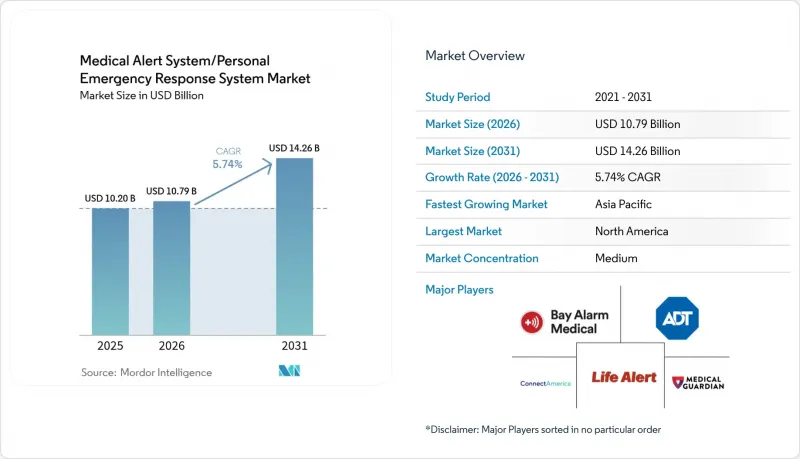
Mordor Intelligence에 의하면, 2026년 의료 경보 시스템 및 개인 응급 응답 시스템(PERS) 시장 규모는 107억 9,000만 달러로 추정되고 2025년 102억 달러에서 확대해, 2031년에는 142억 6,000만 달러에 이를 것으로 예측됩니다.
2026-2031년 동안의 연평균 성장률(CAGR)은 5.74%를 나타낼 전망입니다.
본 보고서는 제품 유형별(유선 전화 기반 시스템, 모바일 PERS(mPERS), 기타), 최종 사용자별(가정 사용자, 고령자 주택·요양 주택, 기타), 지역별(북미, 유럽, 아시아태평양, 중동 및 아프리카, 남미)로 분류되어 있습니다. 본 보고서에서는 상기 각 부문 시장 규모를 100만 미 달러 단위로 제시하고 있습니다.
세계의 의료 경보 시스템 및 개인 응급 응답 시스템(PERS) 시장 동향 및 인사이트
고령화와 낙상 발생률 증가
65세 이상 성인 인구가 꾸준히 증가함에 따라 예기치 못한 낙상 발생률이 높아지고 있으며, 낙상은 여전히 고령자의 부상 관련 사망의 주요 원인이 되고 있습니다. 병원과 보험사는 신속한 개입을 통한 경제적 이점을 인식하고 있으며, 이는 가정 및 요양 시설 내 모니터링 기기 도입을 촉진하고 있습니다. 선진국의 정부 지침에 따르면, 장기 요양 급여금이 문서화된 낙상 방지 전략과 연계되어 있어, 이에 따라 병원 조달 컨소시엄은 퇴원 시 제공 품목에 경보 버튼을 포함시키고 있습니다. 제조업체들은 이에 대응하여 청각 장애가 있는 이용자를 위해 촉각을 자극하는 표면이나 큰 음성 안내 기능을 갖춘 웨어러블 디자인을 개발하고 있습니다. 이러한 인구통계학적 요인과 정책적 요인이 기기 교체 및 업그레이드 주기를 통한 지속적인 수익을 뒷받침하고 있습니다.
자립 생활 및 재택치료로의 전환
간병인, 사회복지 기관, 보험사는 삶의 질을 유지하고 시설 요양 비용을 절감할 수 있다는 점에서 ‘익숙한 곳에서의 노화(에이징 인 플레이스)’를 추진하고 있습니다. 각 벤더사는 사용자가 복잡한 조작 없이도 도움을 요청할 수 있도록, 눈에 띄지 않는 웨어러블 기기와 스마트 스피커와의 연동 기능을 강조하고 있습니다. ‘재택 병원’ 시범 사업을 전개하는 의료 시스템에서는 생체 측정값의 임계치나 낙상 사고가 발생했을 때 경보가 울리면 임상의가 개입할 수 있도록 대응 기기를 공급 키트에 포함하고 있습니다. 건강 상태 확인 전화나 간병인용 용도이 세트로 제공됨으로써 체감 가치가 높아지고, 구독 계약 확보가 촉진되고 있습니다.
기기와 구독 서비스의 높은 비용
신흥 시장의 저소득 노인들에게 소매 가격은 여전히 감당하기 어려운 수준이며,월이용료는 고정 연금 소득의 상당 부분을 차지하게 됩니다. 공적 의료 제도에 따른 환급액은 제도에 따라 다르며, 많은 가구가 본인 부담으로 솔루션을 이용할 수밖에 없는 상황입니다. 반도체 가격 급등으로 부품 원가가 상승하고 있어, 제조업체가 새로운 LTE 하드웨어 가격을 얼마나 적극적으로 인하할 수 있는지가 제한되고 있습니다. 렌탈 프로그램은 초기 비용을 경감시켜 주지만, 농촌 지역에서는 아직 보급 규모가 충분하지 않아, 예산에 특히 민감한 지역에서의 보급을 지연시키고 있습니다.
부문 분석
2025년에는 유선 전화 기반 단말기가 의료 경보 시스템 및 개인 응급 응답 시스템(PERS) 시장 점유율의 56.42%를 차지했습니다. 이는 많은 고령자들이 유선식 버튼을 신뢰할 수 있고 익숙한 것으로 여기기 때문입니다. 병원 측도 기술적 위험이 낮다고 인식하고 있어 재활 병동에서의 도입을 유지하고 있습니다. 그러나 성장은 모바일 PERS로 이동하고 있으며, 2031년까지 연평균 성장률(CAGR) 6.05%로 확대될 것으로 예측됩니다. 휴대전화 회선을 통한 연결 덕분에 활동적인 고령자들은 쇼핑이나 운전, 야외 운동 중에도 안심감을 얻을 수 있습니다. 각 벤더사는 통화를 자동으로 모니터링 스테이션으로 전달하는 양방향 음성 기능을 기기에 탑재하고 있습니다. 월정액 요금제에 데이터 요금제가 포함되어 있어 통신 사업자는 지속적인 수익을 확보하기 쉬워졌습니다. LTE 통신 범위가 충분하지 않은 지방에서는 기본적인 고정식 펜던트형 단말기에 대한 수요가 여전히 존재하지만, 전국적인 마케팅 캠페인에서는 모바일 단말기가 제공하는 자유로움이 강조되고 있습니다.
각 제조업체가 음성 어시스턴트 기능을 추가하여 복약 알림이나 날씨 정보 조회가 가능해짐에 따라, 모바일 의료 경보 시스템 및 개인 응급 응답 시스템 시장 규모는 확대될 전망입니다. 집에서는 유선 전화 회선에, 야외에서는 휴대전화 회선에 연결되는 하이브리드형 ‘올인원’ 모델은 이중 통신 수단을 확보하고 있어, 위험을 꺼리는 간병인에게 매력적인 선택지가 되고 있습니다. 독립형 벽걸이형 버튼은 예산을 중시하는 소비자를 대상으로 하지만, 소비자가 착용하는 웨어러블 기기에 내장된 스마트 워치 앱으로부터의 경쟁 압력에 직면해 있습니다. 한편, 음성 제어 지원 스피커는 손이 불편한 사용자를 끌어들이며, 통신 사업자가 제공하는 광범위한 스마트 홈 생태계에 원활하게 통합됩니다. 다양한 활동 수준과 가격대의 사용자를 유지하기 위해서는 제품 라인업의 다양성이 핵심입니다.
2025년, 의료 경보 시스템 및 개인 응급 응답 시스템 시장(PERS) 시장 규모 중 유선 전화가 60.10%를 차지했으며, 이는 북미와 서유럽에서 오랫동안 지속되어 온 PSTN에 대한 의존도를 반영합니다. 그러나 통신 사업자들의 구리선 폐지 계획으로 인해 이러한 기반은 점차 약화될 것이며, 각 가정은 휴대전화나 VoIP와 같은 대체 수단으로 전환하게 될 것으로 보입니다. GPS 탑재 기기는 2031년까지 연평균 성장률(CAGR) 6.22%라는 가장 높은 성장률을 달성할 전망입니다. 이는 차세대 칩셋을 통해 실내 위치 측정 정확도가 향상되고, 긴급 대응 시간이 단축되기 때문입니다. 정확한 위치 정보로 인해 잘못된 주소로의 출동이 감소하므로, 공공 안전 기관의 신뢰도도 높아집니다.
유선 회선과 이동통신 네트워크를 전환할 수 있는 듀얼 모드 단말기는 전환 과정을 원활하게 하고, 단일 네트워크 장애로부터 보호해 줍니다. 블루투스와 Wi-Fi 비콘은 대규모 캠퍼스 내에서 방 단위의 추적이 가능하게 하여, 주 정부 차원의 검사용 규정 준수 문서 작성을 지원합니다. 5G 커버리지가 확대됨에 따라, 저지연 동영상 스트리밍을 통해 복잡한 사안에 대한 실시간 원격 분류가 가능해지며, 셀룰러 퍼스트 모델의 차별화가 더욱 진전됩니다. 다만, 저소득 지역에서는 비용이 여전히 장벽으로 작용하고 있으므로, 각 벤더들은 사용자가 아날로그 인프라에서 디지털 인프라로 전환하는 속도를 높이기 위해 기기 교환 할인 혜택을 제공합니다.
지역별 분석
2025년, 북미는 의료 경보 시스템 및 개인 응급 응답 시스템 시장(PERS) 시장의 43.80%를 차지했습니다. 이는 모니터링 기능이 있는 경보 단말기 비용을 보조하는 메디케어 어드밴티지의 보충 혜택에 힘입은 결과입니다. 대형 약국 및 전자상거래를 통한 소매 유통이 도입을 가속화하는 한편, 통신 사업자의 마케팅에서는 고속 LTE 커버리지가 강조되고 있습니다. 캐나다의 각 주에서는 PERS를 포함한 원격 의료 예산을 편성하고 있으며, 외딴 지역 사회에서는 휴대전화 통신 사각지대를 보완하기 위해 위성 백홀에 의존하고 있습니다. 현재의 경쟁 우위는 전자 건강 기록(EHR)과의 통합 및 HIPAA 준수 데이터 저장에 중점을 두고 있으며, 이는 병원 CIO(최고정보책임자)들의 관심을 끌고 있습니다.
유럽도 이에 뒤이어 독일, 영국, 프랑스가 도입을 주도하고 있습니다. 각국의 건강보험 기관은 의사의 처방이 있는 경우 기기 구독료를 환급하여 고령자의 본인 부담금을 경감하고 있습니다. 남유럽의 의료 경보 시스템 및 개인 응급 응답 시스템(PERS) 시장 규모는 지불 주체 모델이 세분화되어 있어 소규모이지만, EU의 디지털 헬스 보조금을 통해 이탈리아와 스페인에서의 시범 도입에 자금이 지원되고 있습니다. 일반 데이터 보호 규정(GDPR(EU 개인정보보호규정)) 준수가 제품 아키텍처를 형성하고 있으며, 현지 데이터 저장 옵션이 요구되고 있습니다. 브렉시트로 인해 인증 절차의 부담은 증가했으나, 영국 지방 자치단체가 고령자용 지역사회 예산을 안전 기술에 배정하고 있어 영국 수요는 견조한 추세를 유지하고 있습니다.
아시아태평양은 고령화가 가장 진전된 일본, 한국, 중국을 견인력으로 삼아 2031년까지 연평균 성장률(CAGR) 6.85%로 가장 높은 성장세를 보일 것으로 예측됩니다. 일본의 지자체는 독거 노인을 위해 기기 구입을 보조하고, 경보 시스템을 시 전체의 긴급 신고 시스템에 통합하고 있습니다. 중국의 제조업체들은 국내 시장 규모를 활용해 저가형 하드웨어를 출시하며, 지방성에서의 활용 기회를 확대되고 있습니다. 인도에서는 통신 사업자가 펜던트형 단말기 대여 서비스를 선불 데이터 요금제와 세트로 판매하여 저소득층으로의 보급을 촉진하고 있습니다. 호주의 ‘국가장애인보험제도(NDIS)’에서는 PERS가 지원 기술 카탈로그에 등재되어 있어, 이동에 어려움을 겪는 청년층의 도입이 촉진되고 있습니다.
라틴아메리카와 중동 및 아프리카에서는 아직 발전 단계에 있지만, 미래가 기대되고 있습니다. 브라질에서는 민간 병원 체인 내에서 도입이 서서히 진행되고 있습니다. 다만, 통화 변동이나 수입 관세로 인해 고가 제품의 수입은 제한되고 있습니다. 아르헨티나의 통신 규제 당국은 불안정한 유선 전화 인프라를 우회하는 VoIP 단말기의 이용을 장려하고 있습니다. 걸프협력회의(GCC)의 스마트 시티 프로젝트에서는 고령자용 주택에 경보 센서가 탑재되어 있으나, 시장 규모는 작습니다. 남아프리카에서는 광업 및 경비 분야의 단독 작업자 모니터링이 추진되고 있어, 내구성이 뛰어난 웨어러블 기기의 틈새 시장이 형성되고 있습니다. 단계적 가격 책정이나 소액 금융 수단을 도입하는 공급업체는 가격 측면의 장벽을 극복하는 데 있어 가장 유리한 입장에 있습니다.
기타 혜택
- 엑셀 형식 시장 예측(ME) 시트
- 3개월간의 애널리스트 지원
자주 묻는 질문
목차
제1장 서론
제2장 조사 방법
제3장 주요 요약
제4장 시장 구도
제5장 시장 규모 및 성장 예측
제6장 경쟁 구도
제7장 시장 기회 및 향후 전망
KTH 26.08.26According to Mordor Intelligence, the medical alert system/personal emergency response system market size in 2026 is estimated at USD 10.79 billion, growing from 2025 value of USD 10.20 billion with 2031 projections showing USD 14.26 billion, growing at 5.74% CAGR over 2026-2031.
This report is Segmented by Type (Landline PERS, Mobile PERS, and Other Types), End User (Home-Based Users, Assisted Living Facilities, Others), and Geography (North America, Europe, Asia-Pacific, Middle East and Africa, and South America). The Report Offers the Value (in USD Million) for the Above Segments.
Global Medical Alert System/Personal Emergency Response System Market Trends and Insights
Aging population and higher fall prevalence
A steadily expanding cohort of adults aged 65 years and older raises the incidence of unintentional falls, which remain the leading cause of injury-related deaths among seniors. Hospitals and insurers acknowledge the economic benefit of rapid intervention, fueling procurement of monitored devices inside both homes and care institutions. Government guidelines in mature economies link long-term-care reimbursement to documented fall-prevention strategies, prompting hospital purchasing consortia to incorporate alert buttons into discharge bundles. Manufacturers respond with wearable designs that feature tactile surfaces and loud audio prompts for hearing-impaired users. These demographic and policy forces underpin recurring revenue from replacement and upgrade cycles.
Shift toward independent living and home healthcare
Caregivers, social-service agencies, and payers promote aging-in-place because it preserves quality of life and curtails institutional care costs. Vendors emphasize discreet wearables and smart-speaker integrations that let users call for help without complicated interfaces. Health systems running hospital-at-home pilots include compliant devices in supply kits so clinicians can intervene when biometric thresholds or fall events trigger alerts. Bundled wellness check-in calls and caregiver applications increase perceived value, stimulating subscription take-up.
High device and subscription cost
Retail prices remain prohibitive for low-income seniors in emerging markets, and monthly fees can consume a significant share of fixed pensions. Reimbursement across public health systems varies, leaving many households to self-finance solutions. Semiconductor inflation raises bill-of-materials costs, limiting how aggressively manufacturers can discount new LTE hardware. Rental programs mitigate upfront expense but have yet to achieve scale in rural districts, slowing diffusion where budget sensitivity is acute.
Other drivers and restraints analyzed in the detailed report include:
- Advances in fall detection, GPS, and cellular technologies
- Integration with remote patient monitoring ecosystems
- False-alarm rates and workflow burden
For complete list of drivers and restraints, kindly check the Table Of Contents.
Segment Analysis
Landline-based units captured 56.42% of medical alert system/personal emergency response system market share in 2025 because many seniors view the fixed button as reliable and familiar. Hospitals also perceive low technical risk, preserving their deployments in rehabilitation wings. Growth, however, is shifting toward mobile PERS, which is projected to expand at a 6.05% CAGR through 2031. Cellular connectivity lets active seniors feel protected while shopping, driving, or exercising outdoors. Vendors enhance devices with two-way voice that automatically routes calls to monitoring stations. Data plans bundled in the monthly fee help carriers secure recurring revenue. In rural areas that lack robust LTE coverage, the basic fixed pendant will remain relevant, but nationwide marketing campaigns focus on mobile freedom.
The medical alert system/personal emergency response system market size for mobile PERS will grow as manufacturers add voice-assistant functionality, enabling medication reminders or weather queries. Hybrid "all-in-one" models that connect via landline at home and cellular outside the premises introduce redundancy, appealing to risk-averse caregivers. Stand-alone wall buttons serve budget shoppers but face competitive pressure from smart-watch applications that piggyback on consumer wearables. Voice-activated speakers, meanwhile, attract users with dexterity challenges and integrate smoothly into broader smart-home ecosystems offered by telecom operators. Portfolio variety will be key to retaining users across different activity levels and price points.
Landline telephony commanded 60.10% of medical alert system/personal emergency response system market size in 2025, reflecting years of PSTN reliance in North America and Western Europe. Carrier copper retirement plans, however, will gradually erode this base, pushing households toward cellular or VoIP alternatives. GPS-enabled devices are primed to realize the fastest 6.22% CAGR through 2031 because next-generation chipsets improve indoor-location precision and shorten emergency response times. Accurate geolocation reduces false dispatches to incorrect addresses, improving trust among public safety agencies.
Dual-mode devices that switch between landline and cellular networks smooth the migration path and guard against single-network outages. Bluetooth and Wi-Fi beacons help institutions achieve room-level tracking inside large campuses, aiding compliance documentation for state inspections. As 5G coverage widens, low-latency video streaming will enable real-time teletriage for complex incidents, further differentiating cellular-first models. Cost, however, remains a barrier in lower-income geographies, so vendors offer trade-in rebates to accelerate user transitions from analog to digital infrastructure.
Complete Report Scope:
- By Product Type
- Landline-based Systems
- Mobile PERS (mPERS)
- Stand-alone Devices
- Voice-Activated Systems
- By Connectivity Technology
- Cellular
- Dual (Landline + Cellular)
- GPS-enabled
- Bluetooth / Wi-Fi
- By End User
- Home-based Users
- Senior Housing & Assisted Living Facilities
- Hospitals & Clinics
- Lone Workers & Others
- By Component
- Hardware
- Software & Services
- By Region
- North America
- United States
- Canada
- Mexico
- Europe
- Germany
- United Kingdom
- France
- Italy
- Spain
- Rest of Europe
- Asia-Pacific
- China
- India
- Japan
- South Korea
- Australia
- Rest of Asia-Pacific
- South America
- Brazil
- Argentina
- Rest of South America
- Middle East and Africa
- GCC
- South Africa
- Rest of Middle East and Africa
- North America
Geography Analysis
North America controlled 43.80% of the medical alert system/personal emergency response system market in 2025, supported by Medicare Advantage supplemental benefits that subsidize monitored alert devices. Retail distribution through big-box pharmacies and e-commerce accelerates activation, while carrier marketing emphasizes fast LTE coverage. Canadian provinces allocate telehealth budgets that include PERS, and remote communities rely on satellite backhaul to mitigate cellular gaps. Competitive positioning now centers on electronic health record integration and HIPAA-compliant data storage, which resonate with hospital CIOs.
Europe follows closely, with Germany, the United Kingdom, and France leading adoption. National health insurers reimburse device subscriptions when prescribed by physicians, lowering out-of-pocket expense for seniors. The medical alert system/personal emergency response system market size in Southern Europe is smaller due to fragmented payer models, yet EU digital-health grants fund pilot rollouts in Italy and Spain. General Data Protection Regulation compliance shapes product architecture, requiring local data residency options. Although Brexit has increased certification paperwork, U.K. demand remains resilient because local councils earmark age-friendly community budgets for safety technology.
Asia-Pacific is forecast to post the fastest 6.85% CAGR to 2031, led by Japan, South Korea, and China where population aging is most advanced. Japanese municipalities subsidize devices for seniors living alone and integrate alerts into citywide dispatch systems. Chinese manufacturers leverage domestic scale to release lower-priced hardware, widening access in rural provinces. In India, telecom operators bundle pendant rentals with prepaid data, enabling penetration among lower-income segments. Australia's National Disability Insurance Scheme lists PERS in assistive-technology catalogs, fostering uptake among younger adults with mobility challenges.
Latin America and the Middle East & Africa remain nascent but promising. Brazil experiences gradual adoption inside private hospital chains, though currency volatility and import tariffs constrain premium imports. Argentina's telecom regulators encourage VoIP devices that bypass patchy fixed-line infrastructure. Gulf Cooperation Council smart-city projects integrate alert sensors into age-friendly housing, but market value is small. South Africa pushes lone-worker monitoring in mining and security, creating niches for ruggedized wearables. Vendors pursuing tiered pricing and micro-financing instruments are best positioned to overcome affordability barriers.
- Koninklijke Philips
- ADT Inc.
- Tunstall Healthcare Group Ltd.
- Connect America LLC
- Lifestation Inc.
- Bay Alarm Company
- Medical Guardian
- MobileHelp LLC
- Best Buy Co. Inc. (Lively)
- VRI - Valued Relationships Inc.
- QMedic Health Inc.
- Rescue Alert of California
- Guardian Alarm (Guardian Medical Monitoring)
- AlertOne Services LLC
- Best Buy Health
- Freeus LLC (Becklar)
- Essence SmartCare Ltd.
- Ascom
- Huawei Technologies
- Samsung Group
Additional Benefits:
- The market estimate (ME) sheet in Excel format
- 3 months of analyst support
TABLE OF CONTENTS
1 Introduction
- 1.1 Study Assumptions & Market Definition
- 1.2 Scope of the Study
2 Research Methodology
3 Executive Summary
4 Market Landscape
- 4.1 Market Overview
- 4.2 Market Drivers
- 4.2.1 Ageing population & fall prevalence
- 4.2.2 Shift toward independent living & home healthcare
- 4.2.3 Advancements in fall detection, GPS & cellular tech
- 4.2.4 Integration with remote patient monitoring ecosystems
- 4.2.5 Insurance reimbursement pilots (Medicare Advantage etc.)
- 4.2.6 Duty-of-care adoption for lone workers
- 4.3 Market Restraints
- 4.3.1 High device & subscription cost
- 4.3.2 False-alarm rates & workflow burden
- 4.3.3 Privacy concerns with voice/GPS data
- 4.3.4 2G/3G sunset driving hardware obsolescence
- 4.4 Value / Supply-Chain Analysis
- 4.5 Regulatory Landscape
- 4.6 Technological Outlook
- 4.7 Porter's Five Forces
- 4.7.1 Threat of New Entrants
- 4.7.2 Bargaining Power of Suppliers
- 4.7.3 Bargaining Power of Buyers
- 4.7.4 Threat of Substitutes
- 4.7.5 Competitive Rivalry
5 Market Size & Growth Forecasts (Value)
- 5.1 By Product Type
- 5.1.1 Landline-based Systems
- 5.1.2 Mobile PERS (mPERS)
- 5.1.3 Stand-alone Devices
- 5.1.4 Voice-Activated Systems
- 5.2 By Connectivity Technology
- 5.2.1 Cellular
- 5.2.2 Dual (Landline + Cellular)
- 5.2.3 GPS-enabled
- 5.2.4 Bluetooth / Wi-Fi
- 5.3 By End User
- 5.3.1 Home-based Users
- 5.3.2 Senior Housing & Assisted Living Facilities
- 5.3.3 Hospitals & Clinics
- 5.3.4 Lone Workers & Others
- 5.4 By Component
- 5.4.1 Hardware
- 5.4.2 Software & Services
- 5.5 By Region
- 5.5.1 North America
- 5.5.1.1 United States
- 5.5.1.2 Canada
- 5.5.1.3 Mexico
- 5.5.2 Europe
- 5.5.2.1 Germany
- 5.5.2.2 United Kingdom
- 5.5.2.3 France
- 5.5.2.4 Italy
- 5.5.2.5 Spain
- 5.5.2.6 Rest of Europe
- 5.5.3 Asia-Pacific
- 5.5.3.1 China
- 5.5.3.2 India
- 5.5.3.3 Japan
- 5.5.3.4 South Korea
- 5.5.3.5 Australia
- 5.5.3.6 Rest of Asia-Pacific
- 5.5.4 South America
- 5.5.4.1 Brazil
- 5.5.4.2 Argentina
- 5.5.4.3 Rest of South America
- 5.5.5 Middle East and Africa
- 5.5.5.1 GCC
- 5.5.5.2 South Africa
- 5.5.5.3 Rest of Middle East and Africa
- 5.5.1 North America
6 Competitive Landscape
- 6.1 Market Concentration
- 6.2 Market Share Analysis
- 6.3 Company Profiles (includes Global & Market Overview, Core Segments, Financials, Strategic Info, Rank/Share, Products & Recent Developments)
- 6.3.1 Koninklijke Philips N.V.
- 6.3.2 ADT Inc.
- 6.3.3 Tunstall Healthcare Group Ltd.
- 6.3.4 Connect America LLC
- 6.3.5 Lifestation Inc.
- 6.3.6 Bay Alarm Company
- 6.3.7 Medical Guardian LLC
- 6.3.8 MobileHelp LLC
- 6.3.9 Best Buy Co. Inc. (Lively)
- 6.3.10 VRI - Valued Relationships Inc.
- 6.3.11 QMedic Health Inc.
- 6.3.12 Rescue Alert of California
- 6.3.13 Guardian Alarm (Guardian Medical Monitoring)
- 6.3.14 AlertOne Services LLC
- 6.3.15 Best Buy Health
- 6.3.16 Freeus LLC (Becklar)
- 6.3.17 Essence SmartCare Ltd.
- 6.3.18 Ascom Holding AG
- 6.3.19 Huawei Technologies Co., Ltd.
- 6.3.20 Samsung Electronics Co., Ltd.
7 Market Opportunities & Future Outlook
- 7.1 White-space & Unmet-Need Assessment


