

|
시장보고서
상품코드
2113916
Drug Discovery 정보학 : 시장 점유율 분석, 업계 동향 및 통계, 성장 예측(2026-2031년)Drug Discovery Informatics - Market Share Analysis, Industry Trends & Statistics, Growth Forecasts (2026 - 2031) |
||||||
 Mordor Intelligence
Mordor Intelligence에 의하면, Drug Discovery 정보학 시장 규모는 2025년에 29억 7,000만 달러로 평가되었습니다. 2026년 32억 7,000만 달러에서 2031년까지 52억 5,000만 달러에 이를 것으로 추정되고 예측 기간(2026-2031년) CAGR은 9.97%를 나타낼 전망입니다.
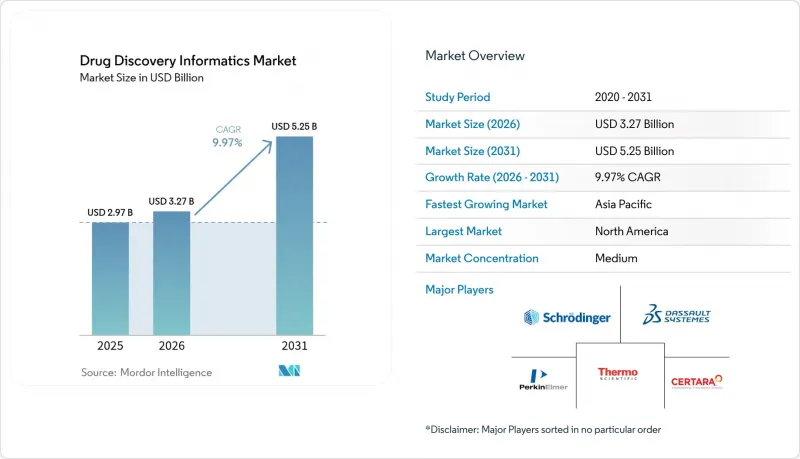
본 보고서는 기능별(서열·대상 데이터 분석, 기타), 최종 사용자별(제약 회사, 기타), 솔루션별(소프트웨어 및 서비스), 워크플로우별(Drug Discovery 정보학 및 개발 정보학), 지역별(북미, 유럽, 아시아태평양, 기타)로 분류되어 있습니다. 시장 전망은 금액(달러) 기준으로 제시되어 있습니다.
세계의 Drug Discovery 정보학 시장 동향 및 인사이트
인공지능(AI) 및 머신러닝의 발전
AI를 활용한 플랫폼을 통해 선도 화합물 식별 주기가 최대 50% 단축되었으며, 연구자들은 단 한 번의 합성 실험을 수행하기 전에 수백만 개의 인실리코 분자를 평가할 수 있게 되었습니다. Bioptimus가 기초 모델 개발을 위해 7,600만 달러의 자금을 조달한 것은 단백질 접힘이나 질병 표현형을 대규모로 예측할 수 있는 생물학적 지식을 갖춘 대규모 언어 모델(LLM) 개발 경쟁을 상징하는 사례입니다. 2025년 1월 FDA가 발표한 지침 초안은 스폰서에게 AI 모델의 ‘신뢰성’을 입증하기 위한 위험 기반 평가 기준을 제시하며, 디지털 실험 워크플로우의 승인을 가속화하고 있습니다. 일라이 릴리(Eli Lilly)와 OpenAI간의 제휴를 비롯한 제약 기업과 기술 기업의 협력은 생성 모델이 현재 신약 개발, 전임상, 임상 각 업무에 어떻게 통합되고 있는지를 보여줍니다. 또한 하류 단계에서는 AI가 전자 건강 기록(EHR) 코호트를 임상시험 프로토콜에 정의된 선정 기준과 동적으로 대조함으로써 환자 모집 기간을 단축하고, 이를 통해 등록률을 향상시켜 임상시험 지연을 완화하고 있습니다.
클라우드 기반 정보학 플랫폼의 도입 확대
클라우드의 확장성을 통해 온디맨드 방식으로 고성능 컴퓨팅을 제공함으로써, On-Premise형 클러스터에 비해 계산 화학 워크로드의 총 소유 비용을 60-80% 절감할 수 있습니다. 노보노르디스크(Novo Nordisk)가 NVIDIA의 Gefion 슈퍼컴퓨터를 활용하고 있는 사례는 GPU에 최적화된 인프라가 신경 질환을 대상으로 한 맞춤형 단백질 언어 모델의 학습을 어떻게 가속화하는지를 보여줍니다. FDA의 전자건강기록(EHR)에서 임상 데이터 수집(CDC)으로의 시범 프로그램은 표준화된 클라우드 호스팅형 API를 통해 시험 시작까지의 기간을 최대 60% 단축할 수 있음을 입증하고 있습니다. 지적 재산(IP) 유출을 최소화하기 위해, 대부분의 바이오의약품 기업들은 기밀성이 높은 데이터 세트를 가상 사설 클라우드(VPC)에 보관하면서, 대규모 시뮬레이션을 규정 준수가 보장된 지역의 퍼블릭 인스턴스로 버스트 처리하는 하이브리드 아키텍처를 도입하고 있습니다.
높은 도입 및 라이선싱 비용
엔터프라이즈급 신약 개발 제품군에는 50만-200만 달러의 초기 비용이 필요할 수 있으며, 3-5년 동안 서비스 비용이 2배로 증가하는 경우도 많아, 제한된 바이오기술 기업의 예산을 압박하고 있습니다. ELN, LIMS, 하이컨텐츠 스크리닝 시스템을 연동하는 통합 작업으로 인해 도입 기간이 12-18개월에 달할 가능성이 있습니다. 클라우드 구독 계약을 통해 설비 투자는 절감되지만, 많은 기업에서는 특히 특허 출원 중인 경우 공유 환경에서 독자적인 리드 시리즈가 공개될 것을 여전히 우려하고 있습니다. 또한, 지속적인 릴리스 주기로 인해 빈번한 업그레이드 비용이 발생하여 총 소유 비용(TCO) 산정 시 예측이 어려운 상황이 발생하고 있습니다.
부문 분석
2025년, Drug Discovery 정보학 시장에서 시퀀싱 및 대상 데이터 분석이 35.12%로 가장 큰 점유율을 차지했습니다. 이는 유전체학과 단백질체학이 초기 신약 개발 활동을 어떻게 형성하고 있는지를 반영합니다. 고성능 시퀀싱을 통해 하류 모델링 및 스크리닝 파이프라인에 방대한 데이터 세트가 공급되므로, 이 부문은 여전히 기초적인 역할을 수행하고 있습니다. 분자 모델링은 규모는 작지만, FeatureDock과 같은 트랜스포머 기반 아키텍처가 기존 도킹 도구를 능가하며 가상 스크리닝에서의 위양성을 줄여주고 있어, 연평균 성장률(CAGR) 13.34%로 가장 빠르게 성장하고 있습니다. 양자 지원 시뮬레이션이 개념 증명(PoC) 단계에서 리드 최적화 워크플로우의 일상적인 활용으로 전환됨에 따라, 분자 모델링 부문의 Drug Discovery 정보학 시장 규모는 급속히 확대될 전망입니다.
AI는 컨포머 생성, 자유 에너지 섭동, ADMET 특성 예측을 가속화하여 설계와 합성 간의 피드백 루프를 더욱 긴밀하게 만들고 있습니다. 클라우드 리소스 덕분에 진입 장벽이 낮아져 중견 기업도 하룻밤 사이에 수만 건의 분자 역학 궤적을 실행할 수 있게 되었습니다. 규제 당국이 특정 동물 실험을 면제하기 위해 컴퓨터 시뮬레이션 결과를 증거로 인정하기 시작하면서, 인실리코 독성학에 대한 호재도 강화되고 있습니다. 이러한 동향들이 맞물리면서, 분자 모델링은 여전히 수요가 높은 역량으로 자리매김하고 있으며, 벤처 캐피털을 유치하는 분야가 되고 있습니다.
2025년에는 Drug Discovery 정보학 시장의 47.85%를 제약 회사가 차지했으며, 이는 신약 개발, 전임상, 초기 개발 데이터를 단일 디지털 스레드 내에 통합하는 기업 수준의 도입이 뒷받침하고 있습니다. 노바티스와 슈뢰딩거 간의 23억 달러 규모 계약과 같은 제휴는 대형 제약사가 AI 플랫폼 라이선스를 취득하는 규모가 얼마나 큰지를 보여줍니다. 동시에, 계약 연구 기관(CRO)은 연평균 성장률(CAGR) 12.34%를 기록하며, 다른 모든 고객 그룹을 능가하는 성장세를 보이고 있습니다. 스폰서 기업은 전문적인 분석, 클라우드 호스팅, 알고리즘 타당성 검증을 CRO에 위탁함으로써 사내 팀이 IT 유지 관리가 아닌 치료 생물학에 집중할 수 있도록 하고 있습니다.
CRO는 데이터 사이언스, 규제 문서 작성, 분산형 임상시험 관리를 통합된 서비스 계약 하에 일괄 제공함으로써 그 매력을 높이고 있습니다. 이러한 통합적인 접근 방식은 자금력은 부족하지만 여전히 규정 준수를 충족하는 정보 인프라가 필요한 중소 바이오기술 기업 고객들로부터 지지를 받고 있습니다. 또한, 자금 지원 기관이 재현 가능하고 공유 가능한 데이터를 점점 더 요구함에 따라 대학 연구실과 정부 기관도 플랫폼 이용을 확대되고 있습니다. 전반적으로, 다양화된 최종 사용자 수요가 균형 잡힌 수익 구조를 뒷받침하고 있어, 공급업체의 로드맵이 특정 고객층에 좌우되기 어려워지고 있습니다.
지역별 분석
북미는 연간 1,000억 달러가 넘는 연구개발비와 AI 모델의 신뢰성에 대한 FDA의 명확한 지침에 힘입어, 2025년에는 전 세계 매출의 44.76%를 차지하며 계속해서 주도적인 위치를 유지했습니다. 2025년 JP모건 헬스케어 컨퍼런스에서 발표된 엔비디아(NVIDIA)의 여러 파트너가 참여하는 생명과학 프로그램과 같은 대규모 하드웨어 및 소프트웨어 제휴는 실리콘밸리와 월스트리트의 자본이 계산 과학을 활용한 신약 개발 분야에서 계속해서 융합되고 있음을 보여줍니다. 이 지역에는 막대한 인재 풀이 있음에도 불구하고, 기업의 83%가 여전히 채용에 어려움을 겪고 있다고 보고하고 있어, 서비스 제공업체에 대한 수요가 증가하고 있음을 뒷받침하고 있습니다.
유럽은 여전히 중요한 시장이며, 의약품 식별자의 표준화와 국경을 넘는 데이터 상호 운용성 향상을 도모하는 EMA(유럽의약품청)의 노력에 힘입고 있습니다. GDPR(EU 개인정보보호규정)에 따른 엄격한 개인정보 보호 규제는 연방 학습(Federated Learning)과 같은 개인정보 보호형 AI 기법의 개발을 촉진하고 있습니다. 브렉시트로 인해 병행되는 규제 체계가 생겨났지만, 영국은 AI 연구에 대한 넉넉한 세액 공제를 유지하고 있어 국내 중소기업이 경쟁력을 유지하는 데 도움이 되고 있습니다.
아시아태평양은 가장 성장세가 두드러지는 지역으로, 2031년까지의 예상 연평균 성장률(CAGR)은 13.98%입니다. 중국의 파이프라인은 2021년부터 2024년에 걸쳐 2배인 4,391건의 임상시험 대상 자산에 도달했으며, 중국에서 유럽 및 미국으로의 라이선싱 계약액은 2024년에 84억 달러에 달했습니다. 승인 기간을 단축하는 규제 개혁과 역뇌유출의 진전이 현지 인포매틱스 수요를 뒷받침하고 있습니다. 일본과 한국에서는 임상시험 거버넌스가 효율화되고 있는 반면, 인도의 견실한 CRO 부문은 비용 효율적인 데이터 관리 서비스를 제공합니다. 싱가포르의 생명공학 분야 인력은 향후 10년 동안 60% 증가할 것으로 예측되지만, 프로젝트 수가 증가함에 따라 인력 부족은 여전히 확대되고 있습니다.
기타 혜택
- 엑셀 형식 시장 예측(ME) 시트
- 3개월간의 애널리스트 지원
자주 묻는 질문
목차
제1장 서론
제2장 조사 방법
제3장 주요 요약
제4장 시장 구도
제5장 시장 규모 및 성장 예측
제6장 경쟁 구도
제7장 시장 기회 및 향후 전망
KTH 26.08.26According to Mordor Intelligence, the drug discovery informatics market size was valued at USD 2.97 billion in 2025 and estimated to grow from USD 3.27 billion in 2026 to reach USD 5.25 billion by 2031, at a CAGR of 9.97% during the forecast period (2026-2031).
This report is Segmented by Function (Sequencing & Target Data Analysis, and More), End User (Pharmaceutical Companies, and More), Solution (Software and Services), Workflow (Discovery Informatics and Development Informatics), Geography (North America, Europe, Asia-Pacific, and More). The Market Forecasts are Provided in Terms of Value (USD).
Global Drug Discovery Informatics Market Trends and Insights
Advancements in Artificial Intelligence and Machine Learning
AI-powered platforms now cut lead-identification cycles by up to 50%, allowing researchers to test millions of in-silico molecules before a single synthesis run occurs. Bioptimus' USD 76 million fundraising for foundation models exemplifies the race to generate biologically aware LLMs that can predict protein folding and disease phenotypes at scale. The FDA's January 2025 draft guidance gives sponsors a risk-based rubric for evidencing AI model "credibility," unlocking faster approvals for digital experimentation workflows. Pharmaceutical-tech alliances-including Eli Lilly's collaboration with OpenAI-showcase how generative models are now embedded across discovery, preclinical, and clinical operations. Downstream, AI also shortens patient-recruitment windows by dynamically matching electronic health record cohorts to protocol-defined inclusion criteria, thereby lifting enrollment rates and lowering trial delays.
Growing Adoption of Cloud-Based Informatics Platforms
Cloud elasticity supplies on-demand high-performance computing that trims total cost of ownership for computational chemistry workloads by 60-80% compared with on-premises clusters. Novo Nordisk's use of NVIDIA's Gefion supercomputer illustrates how GPU-optimized infrastructure speeds training of bespoke protein-language models aimed at neurological indications. The FDA's electronic-health-record-to-clinical-data-capture pilot proves that standardized, cloud-hosted APIs can shrink study-startup timelines by up to 60%. To mitigate IP leakage, most biopharma organizations are deploying hybrid architectures that keep sensitive datasets in virtual private clouds while bursting large simulations to public instances located in compliant regions.
High Implementation and Licensing Costs
Enterprise-grade discovery suites can require USD 500,000-2 million in upfront fees, and services often double the bill over a 3-5-year horizon, stretching lean biotech budgets. Integration work-linking ELNs, LIMS, and high-content screening systems-pushes deployment windows to 12-18 months. Even though cloud subscriptions cut capital outlay, many firms still worry about exposing proprietary lead series in shared environments, especially where patent filings are pending. Continuous release cycles also trigger frequent upgrade spending, creating a moving target for total cost-of-ownership calculations.
Other drivers and restraints analyzed in the detailed report include:
- Expansion of Omics Data Generation and Integration
- Rising Pharmaceutical R&D Investments Globally
- Shortage of Skilled Informatics Professionals
For complete list of drivers and restraints, kindly check the Table Of Contents.
Segment Analysis
Sequencing and target data analysis held the largest slice of the drug discovery informatics market at 35.12% in 2025, reflecting how genomics and proteomics shape early discovery campaigns. The segment remains foundational because high-throughput sequencing feeds gigantic datasets into downstream modeling and screening pipelines. Molecular modeling, although smaller, is the fastest riser with a 13.34% CAGR as transformer-based architectures such as FeatureDock outperform classical docking tools and reduce false positives in virtual screens. The drug discovery informatics market size for molecular modeling is on track to expand rapidly as quantum-assisted simulation moves from proof-of-concept to routine use in lead optimization workflows.
AI accelerates conformer generation, free-energy perturbation, and prediction of ADMET properties, tightening feedback loops between design and synthesis. Cloud resources lower entry barriers, allowing mid-tier firms to run tens of thousands of molecular dynamics trajectories overnight. Regulatory momentum further favors in-silico toxicology, as agencies accept computational evidence to waive certain animal studies. Together, these trends keep molecular modeling a coveted competency and a magnet for venture capital.
Pharmaceutical companies owned 47.85% of the drug discovery informatics market share in 2025, supported by enterprise rollouts that integrate discovery, preclinical, and early development data within a single digital thread. Collaborations such as Novartis' USD 2.3 billion agreement with Schrodinger illustrate the scale at which big pharmas now license AI platforms. At the same time, contract research organizations exhibit a 12.34% CAGR, outpacing all other customer groups. Sponsors turn to CROs for specialized analytics, cloud hosting, and algorithm validation, allowing internal teams to focus on therapeutic biology instead of IT upkeep.
CROs enhance appeal by bundling data science, regulatory writing, and decentralized trial management under unified service agreements. This integrated approach resonates with small biotechnology clients that lack deep pockets but still require compliant informatics infrastructure. University labs and government institutes also expand platform use as funding bodies increasingly demand reproducible, shareable data. Collectively, diversified end-user demand supports a balanced revenue mix, making vendor roadmaps less susceptible to any single customer cohort.
Complete Report Scope:
- By Function
- Sequencing & Target Data Analysis
- Docking
- Molecular Modeling
- Library & Database Preparation
- Other Functions
- By End User
- Pharmaceutical Companies
- Biotechnology Companies
- Contract Research Organizations
- Other End Users
- By Solution
- Software
- Services
- By Workflow
- Discovery Informatics
- Development Informatics
- Geography
- North America
- United States
- Canada
- Mexico
- Europe
- Germany
- United Kingdom
- France
- Italy
- Spain
- Rest of Europe
- Asia-Pacific
- China
- Japan
- India
- Australia
- South Korea
- Rest of Asia-Pacific
- Middle East & Africa
- GCC
- South Africa
- Rest of Middle East & Africa
- South America
- Brazil
- Argentina
- Rest of South America
- North America
Geography Analysis
North America retained leadership with 44.76% of global revenue in 2025, backed by USD 100 billion-plus annual R&D outlays and clear FDA guidance for AI model reliability. Large hardware-software alliances-such as NVIDIA's multi-partner life-sciences program announced at the 2025 JP Morgan Healthcare Conference-show that Silicon Valley and Wall Street capital continue to converge around computational discovery. Despite the region's vast talent pool, 83% of companies still report recruiting pain points, reinforcing service-provider demand.
Europe remains significant, propelled by EMA initiatives that standardize medicinal-product identifiers and improve cross-border data interoperability. Strong privacy rules under GDPR encourage development of privacy-preserving AI methods such as federated learning. While Brexit created parallel regulatory tracks, the United Kingdom sustains generous tax credits for AI research, helping domestic SMEs stay competitive.
Asia-Pacific is the fastest-growing territory with a 13.98% forecast CAGR through 2031. China's pipeline doubled to 4,391 investigational assets between 2021 and 2024, and China-to-West licensing deals hit USD 8.4 billion in 2024. Regulatory reforms curbing approval timelines and a reverse brain drain bolster local informatics demand. Japan and South Korea streamline trial governance, while India's robust CRO sector supplies cost-efficient data-management services. Singapore's biotech workforce is projected to grow 60% this decade, although talent gaps still widen as project counts rise.
- Thermo Fisher Scientific
- Dassault Systmes (BIOVIA)
- PerkinElmer
- Schrodinger
- Certara
- IBM
- Infosys
- Collaborative Care Diagnostics
- Genedata
- Charles River
- Jubilant Biosys
- Selvita
- Aragen Life Sciences
- Eurofins
- Zifo RnD Solutions
- Exscientia
- Benevolent AI
- Insilico Medicine
- Atomwise
- ChemAxon
- BioSolveIT
Additional Benefits:
- The market estimate (ME) sheet in Excel format
- 3 months of analyst support
TABLE OF CONTENTS
1 Introduction
- 1.1 Study Assumptions & Market Definition
- 1.2 Scope Of The Study
2 Research Methodology
3 Executive Summary
4 Market Landscape
- 4.1 Market Overview
- 4.2 Market Drivers
- 4.2.1 Advancements In Artificial Intelligence And Machine Learning
- 4.2.2 Growing Adoption Of Cloud-Based Informatics Platforms
- 4.2.3 Expansion Of Omics Data Generation And Integration
- 4.2.4 Rising Pharmaceutical R&D Investments Globally
- 4.2.5 Government Incentives For Domestic Drug Innovation
- 4.2.6 Increasing Demand For Precision Medicine And Personalized Therapies
- 4.3 Market Restraints
- 4.3.1 High Implementation And Licensing Costs
- 4.3.2 Shortage Of Skilled Informatics Professionals
- 4.3.3 Interoperability And Data Standardization Challenges
- 4.3.4 Data Security And Intellectual Property Concerns
- 4.4 Regulatory Landscape
- 4.5 Porter's Five Forces
- 4.5.1 Bargaining Power Of Suppliers
- 4.5.2 Bargaining Power Of Buyers
- 4.5.3 Threat Of New Entrants
- 4.5.4 Threat Of Substitutes
- 4.5.5 Competitive Rivalry
- 4.6 Investment & Funding Trends
5 Market Size & Growth Forecasts (Value, USD)
- 5.1 By Function
- 5.1.1 Sequencing & Target Data Analysis
- 5.1.2 Docking
- 5.1.3 Molecular Modeling
- 5.1.4 Library & Database Preparation
- 5.1.5 Other Functions
- 5.2 By End User
- 5.2.1 Pharmaceutical Companies
- 5.2.2 Biotechnology Companies
- 5.2.3 Contract Research Organizations
- 5.2.4 Other End Users
- 5.3 By Solution
- 5.3.1 Software
- 5.3.2 Services
- 5.4 By Workflow
- 5.4.1 Discovery Informatics
- 5.4.2 Development Informatics
- 5.5 Geography
- 5.5.1 North America
- 5.5.1.1 United States
- 5.5.1.2 Canada
- 5.5.1.3 Mexico
- 5.5.2 Europe
- 5.5.2.1 Germany
- 5.5.2.2 United Kingdom
- 5.5.2.3 France
- 5.5.2.4 Italy
- 5.5.2.5 Spain
- 5.5.2.6 Rest of Europe
- 5.5.3 Asia-Pacific
- 5.5.3.1 China
- 5.5.3.2 Japan
- 5.5.3.3 India
- 5.5.3.4 Australia
- 5.5.3.5 South Korea
- 5.5.3.6 Rest of Asia-Pacific
- 5.5.4 Middle East & Africa
- 5.5.4.1 GCC
- 5.5.4.2 South Africa
- 5.5.4.3 Rest of Middle East & Africa
- 5.5.5 South America
- 5.5.5.1 Brazil
- 5.5.5.2 Argentina
- 5.5.5.3 Rest of South America
- 5.5.1 North America
6 Competitive Landscape
- 6.1 Market Concentration
- 6.2 Market Share Analysis
- 6.3 Company Profiles (includes Global level Overview, Market level overview, Core Business Segments, Financials, Headcount, Key Information, Market Rank, Market Share, Products and Services, and analysis of Recent Developments)
- 6.3.1 Thermo Fisher Scientific, Inc.
- 6.3.2 Dassault Systmes (BIOVIA)
- 6.3.3 PerkinElmer
- 6.3.4 Schrdinger, Inc.
- 6.3.5 Certara
- 6.3.6 IBM
- 6.3.7 Infosys
- 6.3.8 Collaborative Drug Discovery
- 6.3.9 Genedata
- 6.3.10 Charles River Laboratories
- 6.3.11 Jubilant Biosys
- 6.3.12 Selvita
- 6.3.13 Aragen Life Sciences
- 6.3.14 Eurofins Discovery
- 6.3.15 Zifo RnD Solutions
- 6.3.16 Exscientia
- 6.3.17 BenevolentAI
- 6.3.18 Insilico Medicine
- 6.3.19 Atomwise
- 6.3.20 ChemAxon
- 6.3.21 BioSolveIT
7 Market Opportunities & Future Outlook
- 7.1 White-Space & Unmet-Need Assessment


