

|
시장보고서
상품코드
2113935
딥러닝 : 시장 점유율 분석, 업계 동향 및 통계, 성장 예측(2026-2031년)Deep Learning - Market Share Analysis, Industry Trends & Statistics, Growth Forecasts (2026 - 2031) |
||||||
 Mordor Intelligence
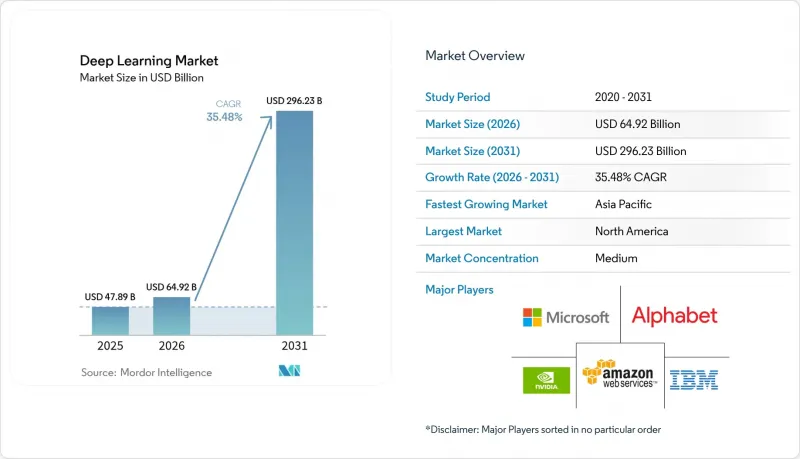
Mordor Intelligence에 의하면, 딥러닝 시장 규모는 2025년에 478억 9,000만 달러로 평가되었습니다. 2026년 649억 2,000만 달러에서 2031년까지 2,962억 3,000만 달러에 이를 것으로 예상되며, 예측 기간(2026-2031년) CAGR은 35.48%를 나타낼 전망입니다.
본 보고서는 제공 형태(하드웨어, 소프트웨어, 서비스), 최종 사용자 산업(은행, 금융서비스 및 보험(BFSI), 소매 및 전자상거래, 제조업 등),용도(이미지·동영상 인식, 음성 인식, NLP·텍스트 분석 등), 도입 형태(클라우드, On-Premise), 지역(북미, 남미 등)별로 분류되어 있습니다. 시장 예측은 금액(달러) 기준으로 제시되어 있습니다.
세계의 딥러닝 시장 동향 및 인사이트
비정형 데이터 양의 폭발적인 증가
기업은 매일 2.5 퀸트릴리언 바이트의 정보를 생성하고 있으며, 그 데이터의 약 80%는 비정형 데이터로 남아 있습니다. 광 뉴럴 프로세서의 처리 능력은 현재 초당 1.57 페타 연산에 달하며, 자율 시스템 및 산업용 모니터링에서 영상, 음성, 텍스트의 실시간 분석을 가능하게 하고 있습니다. 금융 기관에 따르면, 위성 이미지나 소셜 미디어 감정 분석과 같은 얼터너티브 데이터 피드가 300% 증가했으며, 이를 위해서는 서로 다른 정보원 간의 상관관계를 분석할 수 있는 전문적인 모델이 요구됩니다. 기업들이 배치 분석에서 저지연 추론으로 전환함에 따라, 엣지 컴퓨팅 도입은 전년 대비 34% 증가했습니다. 그 결과 발생하는 피드백 루프를 통해 모델의 정확도가 향상되는 동시에, 처리 가능한 워크로드도 확대되고 있습니다.
AI 가속기의 비용 절감 및 성능 도약
첨단 3나노미터 설계, 적층형 HBM 메모리, 포토닉 상호 연결을 통해 연산 비용이 연간 40% 절감되고 있습니다. NVIDIA의 ‘Blackwell Ultra’는 이전 세대에 비해 1.5배의 성능을 발휘합니다. AMD의 MI350 시리즈는 기존 칩에 비해 처리량이 35배 향상되었습니다. 이러한 비약적인 발전 덕분에 중견 기업도 분산 클러스터가 아닌 단일 노드 시스템에서 1,000억 파라미터의 모델을 실행할 수 있게 되었습니다. 설비 투자 감소로 고객 기반이 확대되고 조달 주기가 단축됨에 따라, 하드웨어는 딥러닝 시장에서 가장 빠르게 성장하는 부문이 되었습니다.
높은 에너지 소비량과 냉각 비용
AI 클러스터의 전력 소비량은 2025년에 46-82TWh에 달했으며, 2030년까지 1,050TWh까지 증가할 가능성이 있습니다. 현재 개별 훈련 실행에는 메가와트시의 전력이 소비되며, GPU가 탑재된 랙에는 40-140kW의 전력이 필요하지만, 일반 서버의 경우 10kW면 충분합니다. 직접 액체 냉각이나 침지 냉각은 설비 투자 비용을 15-20% 끌어올리는 한편, 재생에너지 공급 변동은 신뢰성 문제를 야기하고 있습니다. 현재 에너지 비용은 AI의 총 소유 비용의 최대 40%를 차지하고 있어, 구매자들은 규모를 확대하기 전에 전기 요금과 탄소 배출 목표를 신중하게 검토할 수밖에 없는 상황입니다.
부문 분석
하드웨어 시장은 GPU, 맞춤형 ASIC 및 웨이퍼 스케일 엔진에 대한 수요에 힘입어 2031년까지 연평균 성장률(CAGR)이 36.1%를 나타낼 것으로 예측됩니다. NVIDIA의 ‘GB10 Grace Blackwell’ 슈퍼 칩은 3,000달러짜리 개인용 AI 스테이션에 탑재되어 2,000억 개의 매개변수를 가진 모델을 처리할 수 있습니다. Cerebras Systems는 자사의 웨이퍼 스케일 플랫폼에서 초당 1,500 토큰의 추론 처리를 시연했으며, 이는 기존 GPU 클러스터에 비해 57배 빠른 속도 향상에 해당합니다. 통신 사업자, 자동차 OEM, 클라우드 제공업체는 설치 면적과 에너지 소비량을 줄이기 위해 이러한 가속기를 도입하고 있습니다. 스타트업 기업들은 자본 지출(Capex) 감소를 활용하여 산업별 특화 솔루션의 프로토타입을 개발하고, 산업 고유의 용도 시장 출시 기간을 단축하고 있습니다.
소프트웨어 및 서비스는 여전히 수익의 대부분을 차지하고 있는데, 이는 정기 구독, 관리형 플랫폼 및 통합 프로젝트가 예측 가능한 현금 흐름을 창출하기 때문입니다. 의료, 금융, 제조업을 위한 수직형 인프라 모델은 고객이 해당 분야의 전문 지식을 요구함에 따라 서비스 수요를 견인하고 있습니다. 클라우드 벤더는 MaaS(Model-as-a-Service) 제공을 오케스트레이션 도구와 번들로 제공함으로써, 기업이 인프라 관리의 부담을 피할 수 있도록 하고 있습니다. 맞춤형 서비스에는 컨설팅 지원이 필수적이며, 하드웨어 성장률이 백분율상으로는 더 높음에도 불구하고 컨설팅 분야는 두 자릿수 성장을 유지하고 있습니다. 하드웨어 혁신과 소프트웨어 수익화의 시너지 효과로 인해 딥러닝 시장 전체에 걸쳐 균형 잡힌 성장이 보장되고 있습니다.
BFSI(은행 및 금융 및 보험) 부문은 사기 감지, 리스크 모델링, 알고리즘 트레이딩를 활용하여 2025년에는 딥러닝 시장 점유율의 24.12%를 차지했습니다. 주요 은행들은 트랜스포머 기반의 고객 서비스 에이전트를 도입하여 첫 문의 시 70%의 문의를 해결함으로써 고객 만족도를 높이고 비용을 절감하고 있습니다. 결제 네트워크는 스트리밍 데이터에 이상 감지 기능을 통합하여 밀리초 단위로 부정 거래를 차단하고 있습니다.
의료 및 생명과학 분야는 진단 기술 승인이 급증함에 따라 36.75%라는 가장 높은 연평균 성장률(CAGR)을 보이고 있습니다. 과거에는 수작업으로 확인해야 했던 방사선 진단 워크플로에서 현재는 즉각적인 분류가 가능해졌으며, 유전체 분석 담당자들은 파운데이션 모델을 활용하여 몇 달이 아닌 몇 주 만에 유망한 신약 개발 표적을 특정하고 있습니다. 병원에서는 환자 기록을 보호하기 위해 개인정보를 보호하는 연합 학습(Federated Learning)을 도입하여 규제 당국 및 보험사의 요구 사항을 충족하고 있습니다. 제약 기업들은 AI를 활용한 단백질 접힘 및 시뮬레이션 도구에 투자하여 임상시험 일정을 앞당기고 있습니다. 이러한 모멘텀에 힘입어 헬스케어 분야는 딥러닝 시장의 중요한 수익원으로서의 입지를 확고히 하고 있습니다.
지역별 분석
2025년, 북미는 딥러닝 시장의 32.12%를 차지했습니다. TSMC가 애리조나 주 공장에 1,650억 달러를 투자하여 공급망 리스크를 줄이는 가운데, 국내 반도체 제조가 확대되고 있습니다. 캐나다는 뛰어난 연구 역량을 활용하여 자연어 처리(NLP) 스타트업의 분사를 촉진하고 있는 반면, 멕시코는 AI 하드웨어의 근해 조립 거점으로 부상하고 있습니다. 특히 버지니아주나 텍사스주 등의 지역 전력망은 최대 140kW를 소비하는 랙을 수용하는 데 어려움을 겪고 있으며, 이로 인해 전력 회사들은 재생에너지 발전 용량 확대를 가속화하고 있습니다.
아시아태평양은 연평균 성장률(CAGR) 35.92%를 나타낼 것으로 예측되며, 가장 빠른 성장을 보이고 있습니다. 인도는 스타트업 기업에 보조금이 포함된 컴퓨팅 크레딧을 제공하는 국가 AI 센터를 설립하여 핀테크 및 애그리테크 솔루션의 물결을 일으키고 있습니다. 일본은 로봇 공학의 전통을 살려 고령화 사회를 위한 서비스 로봇의 상용화를 추진하고 있는 반면, 한국은 5G 분야의 리더십과 스마트 공장에 엣지 AI를 도입하는 것을 결합하고 있습니다. 호주에서는 자율주행 광산 트럭의 시범 운영이 진행되고 있으며, 동남아시아의 전자상거래 기업들은 방대한 모바일 사용자 기반을 대상으로 추천 엔진을 활용하고 있습니다. 이러한 다양한 활용 사례가 딥러닝 솔루션에 대한 지역적 수요의 지속을 뒷받침하고 있습니다.
유럽은 위반 시 전 세계 매출의 최대 3%에 달하는 벌금이 부과될 수 있는 ‘EU AI법’으로 인한 규정 준수 부담이 있음에도 불구하고, 꾸준한 속도로 진전을 보이고 있습니다. 독일의 자동차 제조업체는 안전상 중요한 전기차의 인식 기능에 설명 가능한 AI를 통합하고 있으며, 이탈리아의 기계 제조업체는 예측 유지보수 분석 기능을 탑재하고 있습니다. 북유럽 국가들은 수력 및 풍력 자원을 활용해 데이터센터를 가동하며, 지속가능성을 중시하는 고객에게 어필하는 탄소 중립 AI 서비스를 전개하고 있습니다. 영국은 브렉시트 이후 유연한 체계를 운영하고 있어, 유럽 시장과 영연방 시장 모두에 진출하고자 하는 미국 및 아시아 기업들을 유치하고 있습니다. 이러한 동향들이 결합되어, 유럽은 책임감 있고 에너지 효율이 뛰어난 딥러닝 시장의 성장 거점으로서 입지를 확고히 하고 있습니다.
기타 혜택 :
- 엑셀 형식 시장 예측(ME) 시트
- 3개월간의 애널리스트 지원
자주 묻는 질문
목차
제1장 서론
제2장 조사 방법
제3장 주요 요약
제4장 시장 구도
제5장 시장 규모 및 성장 예측
제6장 경쟁 구도
제7장 시장 기회 및 향후 전망
KTH 26.08.26According to Mordor Intelligence, the deep learning market size was valued at USD 47.89 billion in 2025 and estimated to grow from USD 64.92 billion in 2026 to reach USD 296.23 billion by 2031, at a CAGR of 35.48% during the forecast period (2026-2031).
This report is Segmented by Offering (Hardware, Software, and Services), End User Industry (BFSI, Retail and ECommerce, Manufacturing, and More), Application (Image and Video Recognition, Speech and Voice Recognition, NLP and Text Analytics, and More), Deployment (Cloud, and On-Premises), and by Geography (North America, South America, and More). The Market Forecasts are Provided in Terms of Value (USD).
Global Deep Learning Market Trends and Insights
Explosive Growth in Unstructured Data Volumes
Every day enterprises generate 2.5 quintillion bytes of information, and roughly 80% of that data remains unstructured. Optical neural processors now reach 1.57 peta-operations per second, enabling real-time video, audio, and text analysis for autonomous systems and industrial monitoring. Financial institutions report a 300% increase in alternative data feeds, including satellite imagery and social sentiment, which demands specialized models able to correlate disparate sources. Edge computing deployments rise 34% year over year as firms shift from batch analytics to low-latency inference. The resulting feedback loop boosts model accuracy while expanding addressable workloads.
Declining Cost and Performance Leap of AI Accelerators
Advanced 3-nanometer designs, stacked HBM memory, and photonic interconnects push compute costs down by 40% annually. NVIDIA's Blackwell Ultra delivers 1.5X performance over its prior generation. AMD's MI350 series posts 35X throughput gains versus earlier chips . These leaps allow mid-market companies to run 100-billion-parameter models on single-node systems instead of distributed clusters. Lower capital outlays widen the customer base and shorten procurement cycles, turning hardware into the fastest-growing deep learning market segment.
High Energy Footprint and Cooling Costs
AI clusters are projected to consume 46-82 TWh in 2025 and could rise to 1,050 TWh by 2030. Individual training runs now draw megawatt-hours of power, and racks outfitted for GPUs require 40-140 kW versus 10 kW for typical servers. Direct-liquid and immersion cooling add 15-20% to capital costs, while fluctuating renewable supply creates reliability challenges. Energy now represents up to 40% of total AI ownership costs, forcing buyers to weigh electricity tariffs and carbon objectives before scaling.
Other drivers and restraints analyzed in the detailed report include:
- Consumer-Grade DL Integration
- Medical-Imaging and Diagnostics Adoption Surge
- Scarcity of Specialized DL Talent
For complete list of drivers and restraints, kindly check the Table Of Contents.
Segment Analysis
Hardware posted a 36.1% CAGR forecast through 2031, propelled by demand for GPUs, custom ASICs, and wafer-scale engines. NVIDIA's GB10 Grace Blackwell superchip powers personal AI stations priced at USD 3,000 that can handle 200-billion-parameter models . Cerebras Systems demonstrates inference at 1,500 tokens per second on its wafer-scale platform, representing a 57-fold speed improvement over legacy GPU clusters. Telecommunication operators, automotive OEMs, and cloud providers adopt these accelerators to shrink floor space and energy consumption. Start-ups leverage lower capex to prototype vertical solutions, narrowing time-to-market for industry-specific applications.
Software and Services still command most revenues because recurring subscriptions, managed platforms, and integration projects generate predictable cash-flows. Vertical foundation models for healthcare, finance, and manufacturing drive service demand as clients seek domain expertise. Cloud vendors bundle model-as-a-service offerings with orchestration tools, letting enterprises avoid infrastructure management. Customization mandates consulting help, sustaining double-digit growth even as hardware outpaces in percentage terms. The symbiosis between hardware innovation and software monetization ensures balanced expansion across the deep learning market.
BFSI controlled 24.12% of deep learning market share in 2025, leveraging fraud detection, risk modeling, and algorithmic trading. Large banks integrate transformer-based customer-service agents that resolve 70% of queries on first contact, raising satisfaction scores and trimming costs. Payment networks embed anomaly detection on streaming data to block fraudulent transactions within milliseconds.
Healthcare and Life Sciences display the fastest 36.75% CAGR as diagnostic approvals surge. Radiology workflows that once required manual review now achieve instant triage, while genomic analysts deploy foundation models to identify promising drug targets in weeks instead of months. Hospitals adopt privacy-preserving federated learning to safeguard patient records, satisfying regulators and insurance providers. Pharmaceutical firms invest in AI-driven protein-folding and simulation tools, accelerating clinical trial timelines. This momentum positions healthcare as a pivotal revenue engine for the deep learning market.
Complete Report Scope:
- By Offering
- Hardware
- Software and Services
- By End-user Industry
- BFSI
- Retail and eCommerce
- Manufacturing
- Healthcare and Life Sciences
- Automotive and Transportation
- Telecom and Media
- Security and Surveillance
- Other Applications
- By Application
- Image and Video Recognition
- Speech and Voice Recognition
- NLP and Text Analytics
- Autonomous Systems and Robotics
- Predictive Analytics and Forecasting
- Other Applications
- By Deployment Mode
- Cloud
- On-Premise
- By Geography
- North America
- United States
- Canada
- Mexico
- South America
- Brazil
- Argentina
- Rest of South America
- Europe
- Germany
- United Kingdom
- France
- Italy
- Spain
- Russia
- Rest of Europe
- Asia-Pacific
- China
- Japan
- India
- South Korea
- Australia
- Rest of Asia-Pacific
- Middle East and Africa
- Middle East
- Saudi Arabia
- United Arab Emirates
- Turkey
- Rest of Middle East
- Africa
- South Africa
- Nigeria
- Egypt
- Rest of Africa
- Middle East
- North America
Geography Analysis
North America held 32.12% of the deep learning market in 2025, semiconductor fabrication expands domestically as TSMC invests USD 165 billion in Arizona plants, reducing supply-chain risk. Canada capitalizes on research excellence to spin out NLP start-ups, while Mexico becomes a near-shore assembly base for AI hardware. Regional energy grids, especially in Virginia and Texas, struggle to accommodate racks drawing up to 140 kW, prompting utilities to accelerate renewable capacity.
Asia-Pacific is the fastest climber with a 35.92% CAGR forecas. India implements national AI centers that offer subsidized compute credits to start-ups, spawning a wave of fintech and agritech solutions. Japan leverages robotics heritage to commercialize service robots for aging populations, while South Korea couples 5G leadership with edge AI deployments in smart factories. Australia experiments with autonomous mining trucks, and Southeast Asian e-commerce firms apply recommendation engines to vast mobile consumer bases. The diversity of use cases underpins sustained regional demand for deep learning solutions.
Europe advances at a steady pace despite compliance overhead from the EU AI Act, which can impose fines up to 3% of global turnover for violations. German automakers integrate explainable AI for safety-critical perception in electric vehicles, while Italian machinery makers embed predictive maintenance analytics. Nordic countries power data centers with hydro and wind resources, marketing carbon-neutral AI services that appeal to sustainability-minded clients. The United Kingdom operates a flexible post-Brexit framework, attracting US and Asian firms seeking access to both European and Commonwealth markets. Collectively, these dynamics position Europe as a hub for responsible and energy-efficient deep learning market growth.
- NVIDIA Corporation
- Google LLC (Alphabet)
- Amazon Web Services, Inc.
- Microsoft Corporation
- IBM Corporation
- Meta Platforms, Inc.
- Intel Corporation
- Advanced Micro Devices, Inc.
- SAS Institute Inc.
- RapidMiner, Inc.
- Baidu, Inc.
- Qualcomm Technologies, Inc.
- Huawei Technologies Co., Ltd.
- Graphcore Ltd.
- Cerebras Systems, Inc.
- Xilinx (part of AMD)
- Samsung Electronics Co., Ltd.
- Oracle Corporation
- H2O.ai
- Databricks, Inc.
- SenseTime Group
- OpenAI LP
- Tesla, Inc.
- NEC Corporation
- Darktrace plc
Additional Benefits:
- The market estimate (ME) sheet in Excel format
- 3 months of analyst support
TABLE OF CONTENTS
1 INTRODUCTION
- 1.1 Study Assumptions and Market Definition
- 1.2 Scope of the Study
2 RESEARCH METHODOLOGY
3 EXECUTIVE SUMMARY
4 MARKET LANDSCAPE
- 4.1 Market Overview
- 4.2 Market Drivers
- 4.2.1 Explosive growth in unstructured data volumes
- 4.2.2 Declining cost and performance leap of AI accelerators
- 4.2.3 Consumer grade DL integration (voice, vision, IoT)
- 4.2.4 Medical-imaging and diagnostics adoption surge
- 4.2.5 Vertical foundation models unlocking niche markets
- 4.2.6 Edge/on-device DL for privacy and ultra-low latency
- 4.3 Market Restraints
- 4.3.1 High energy footprint and cooling costs
- 4.3.2 Scarcity of specialised DL talent
- 4.3.3 Tightening global AI regulation (e.g., EU AI Act)
- 4.3.4 IP/copyright liability for training data
- 4.4 Supply Chain Analysis
- 4.5 Regulatory Landscape
- 4.6 Technological Outlook
- 4.7 Porter's Five Force Analysis
- 4.7.1 Bargaining Power of Suppliers
- 4.7.2 Bargaining Power of Buyers
- 4.7.3 Threat of New Entrants
- 4.7.4 Threat of Substitutes
- 4.7.5 Intensity of Competitive Rivalry
- 4.8 Assesment of Macroeconomic Factors on the market
5 MARKET SIZE AND GROWTH FORECASTS (VALUE)
- 5.1 By Offering
- 5.1.1 Hardware
- 5.1.2 Software and Services
- 5.2 By End-user Industry
- 5.2.1 BFSI
- 5.2.2 Retail and eCommerce
- 5.2.3 Manufacturing
- 5.2.4 Healthcare and Life Sciences
- 5.2.5 Automotive and Transportation
- 5.2.6 Telecom and Media
- 5.2.7 Security and Surveillance
- 5.2.8 Other Applications
- 5.3 By Application
- 5.3.1 Image and Video Recognition
- 5.3.2 Speech and Voice Recognition
- 5.3.3 NLP and Text Analytics
- 5.3.4 Autonomous Systems and Robotics
- 5.3.5 Predictive Analytics and Forecasting
- 5.3.6 Other Applications
- 5.4 By Deployment Mode
- 5.4.1 Cloud
- 5.4.2 On-Premise
- 5.5 By Geography
- 5.5.1 North America
- 5.5.1.1 United States
- 5.5.1.2 Canada
- 5.5.1.3 Mexico
- 5.5.2 South America
- 5.5.2.1 Brazil
- 5.5.2.2 Argentina
- 5.5.2.3 Rest of South America
- 5.5.3 Europe
- 5.5.3.1 Germany
- 5.5.3.2 United Kingdom
- 5.5.3.3 France
- 5.5.3.4 Italy
- 5.5.3.5 Spain
- 5.5.3.6 Russia
- 5.5.3.7 Rest of Europe
- 5.5.4 Asia-Pacific
- 5.5.4.1 China
- 5.5.4.2 Japan
- 5.5.4.3 India
- 5.5.4.4 South Korea
- 5.5.4.5 Australia
- 5.5.4.6 Rest of Asia-Pacific
- 5.5.5 Middle East and Africa
- 5.5.5.1 Middle East
- 5.5.5.1.1 Saudi Arabia
- 5.5.5.1.2 United Arab Emirates
- 5.5.5.1.3 Turkey
- 5.5.5.1.4 Rest of Middle East
- 5.5.5.2 Africa
- 5.5.5.2.1 South Africa
- 5.5.5.2.2 Nigeria
- 5.5.5.2.3 Egypt
- 5.5.5.2.4 Rest of Africa
- 5.5.5.1 Middle East
- 5.5.1 North America
6 COMPETITIVE LANDSCAPE
- 6.1 Market Concentration
- 6.2 Strategic Moves
- 6.3 Market Share Analysis
- 6.4 Company Profiles (includes Global level Overview, Market level overview, Core Segments, Financials as available, Strategic Information, Market Rank/Share for key companies, Products and Services, and Recent Developments)
- 6.4.1 NVIDIA Corporation
- 6.4.2 Google LLC (Alphabet)
- 6.4.3 Amazon Web Services, Inc.
- 6.4.4 Microsoft Corporation
- 6.4.5 IBM Corporation
- 6.4.6 Meta Platforms, Inc.
- 6.4.7 Intel Corporation
- 6.4.8 Advanced Micro Devices, Inc.
- 6.4.9 SAS Institute Inc.
- 6.4.10 RapidMiner, Inc.
- 6.4.11 Baidu, Inc.
- 6.4.12 Qualcomm Technologies, Inc.
- 6.4.13 Huawei Technologies Co., Ltd.
- 6.4.14 Graphcore Ltd.
- 6.4.15 Cerebras Systems, Inc.
- 6.4.16 Xilinx (part of AMD)
- 6.4.17 Samsung Electronics Co., Ltd.
- 6.4.18 Oracle Corporation
- 6.4.19 H2O.ai
- 6.4.20 Databricks, Inc.
- 6.4.21 SenseTime Group
- 6.4.22 OpenAI LP
- 6.4.23 Tesla, Inc.
- 6.4.24 NEC Corporation
- 6.4.25 Darktrace plc
7 MARKET OPPORTUNITIES AND FUTURE OUTLOOK
- 7.1 White-space and Unmet-Need Assessment


