|
시장보고서
상품코드
2113937
아시아태평양의 컨베이어 : 시장 점유율 분석, 업계 동향 및 통계, 성장 예측(2026-2031년)Asia-Pacific Conveyors - Market Share Analysis, Industry Trends & Statistics, Growth Forecasts (2026 - 2031) |
||||||
 Mordor Intelligence
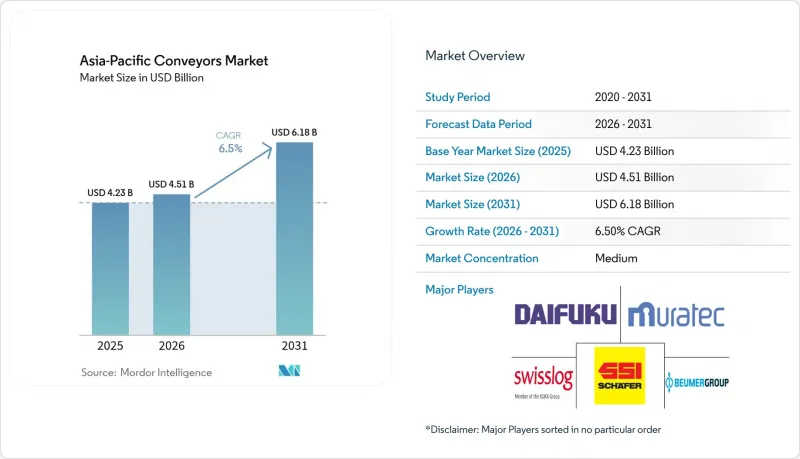
Mordor Intelligence에 의하면, 아시아태평양의 컨베이어 시장 규모는 2025년 42억 3,000만 달러로 평가되었습니다. 2026년에는 45억 1,000만 달러로 확대되어 2026-2031년에 걸쳐 CAGR 6.50%로 성장을 지속하여, 2031년에는 61억 8,000만 달러에 이를 것으로 예측됩니다.
본 보고서는 제품 유형(벨트, 롤러, 팔레트, 오버헤드, 체인), 설치 유형(바닥 설치형, 오버헤드형, 기타),적재 유형(벌크 적재, 유닛 적재), 최종 사용자 산업(공항, 소매 및 전자상거래, 자동차, 제조업, 식음료, 의약품, 광업, 기타), 국가별로 분류되어 있습니다. 시장 전망은 금액(달러) 기준으로 제시되어 있습니다.
아시아태평양의 컨베이어 시장 동향 및 인사이트
아시아태평양 전자상거래 창고의 급속한 확장
당일 배송 및 익일 배송 약속에 따라 소포 사업자들은 과거에는 임금 격차로 인해 수작업이 보완되던 2차 시장에서도 고속 크로스 벨트 소터와 수 킬로미터에 달하는 컨베이어 스파인의 도입을 추진하고 있습니다. 쿠팡은 2024년에 한국 내에 3개의 풀필먼트 센터를 신설하여, 각 센터에서 시간당 1만 2,000개의 소포를 처리할 수 있게 했습니다. 이 센터들에서는 자율 이동 로봇과 연동되는 오버헤드 컨베이어가 도입되었습니다. JD 로지스틱스는 중국에서 오버헤드 벨트와 이동 로봇의 조합을 활용해 2시간 이내 배송을 실현하는 8개의 자동화 지역 허브를 개설했습니다. 말레이시아에 위치한 다이소의 100만 제곱피트 규모의 나일리 시설에서는 총 길이 4.2km의 벨트 컨베이어를 가동해 주당 120만 상자를 운반함으로써, 수작업으로 물건을 들어 올리는 작업을 68% 줄였습니다. 호주에서는 울워스와 콜스가 8억 호주 달러를 투자해 자동화 센터를 건설함으로써, 주문 접수부터 발송까지의 주기를 48시간에서 18시간으로 단축했습니다. 이러한 프로젝트들은 아시아태평양의 컨베이어 시장에 대한 기초적인 수요를 확대하는 동시에, 컨베이어를 라스트 마일 물류에서 미션 크리티컬한 인프라로서 확고한 지위로 끌어올리고 있습니다.
제조업 자동화 및 인더스트리 4.0에 대한 투자
아시아에서는 2024년에 41만 5,400대의 산업용 로봇이 도입되었으며, 이는 전 세계 전체의 73%를 차지하고 있습니다. 컨베이어는 로봇의 피킹 앤 플레이스, 검사, 포장 작업을 연결하는 ‘결합 조직’으로서의 역할을 수행하고 있습니다. 도요타 공업의 카리야 공장에서는 모듈식 체인 컨베이어에 RFID 리더기를 통합하여, 1교대당 1만 8,000개의 부품을 99.8%의 정확도로 추적하고 있습니다. 베트남의 디지털 경제 로드맵에서는 2025년까지 제조업 수출액을 300억 달러로 늘렸으며, 컨베이어 가동률이 수율에 직결되는 부문에서 해외의 자동화 설비 투자를 유치했습니다. 태국 투자위원회(BOI)는 2024년에 총액 860억 바트에 달하는 42건의 스마트 팩토리 프로젝트를 신속하게 승인했으며, 그 중 최대 22%를 자재관리 시스템에 할당했습니다. 이러한 움직임에 힘입어 아시아태평양의 컨베이어 시장은 인더스트리 4.0의 요건에 부합하는 기술 갱신 주기를 유지하고 있습니다.
첨단 시스템에 필요한 막대한 초기 설비 투자
20만 평방피트 규모의 턴키형 자동화 센터는 분류기 및 소프트웨어를 포함할 경우 800만-2,500만 달러의 비용이 들 수 있어, 인도와 인도네시아의 중소기업에게는 장벽이 되고 있습니다. 인터롤의 ‘RollerDrive’를 활용하면 계획 용량의 25%를 선행 도입한 후 나중에 확장할 수 있어 자금 조달 부담을 줄일 수 있습니다. 데마틱(Dematic)은 인도에서 ‘피킹 1건당 과금 모델’을 시범 도입하고 있으며, 이를 통해 투자를 운영 비용(OPEX)으로 전환하여 취급 단위당 0.12-0.18달러의 요금 체계를 실현하고 있습니다. 그러나 인도네시아에서는 최대 15%에 달하는 수입 관세가 부품 가격을 끌어올리고 있으며, 소유 비용 산정이 불투명하기 때문에 신규 도입 기업들은 도입 후 18개월 동안 가동률이 65% 미만에 그치는 상황에 직면하고 있습니다.
부문별 분석
자동차 및 전자기기 생산 라인에서는 로봇이나 검사 스테이션을 위한 바닥 공간이 중요시되기 때문에 오버헤드 컨베이어 시장 규모는 2031년까지 연평균 성장률(CAGR) 7.12%로 확대될 것으로 예측되며, 이는 제품 카테고리 중 가장 높은 성장률입니다. 분당 30m 속도로 50-150kg을 운반할 수 있는 유안다(Yuanda)사의 모노레일은 도장 공정과 조립 공정의 흐름을 조화시키기 위해 중국의 자동차 공장 14곳에 도입되었습니다. SSI 셰퍼(SSI Schafer)사의 ‘RackBot’ 플랫폼은 일본의 전자기기 제조 거점에서 1,000제곱미터당 3만 개의 토트 컨테이너라는 고밀도를 실현하고 있습니다. 벨트 시스템은 장거리 운송이 필요한 광업 및 식품 가공 용도에 대응함으로써 2025년 매출의 42.24%를 차지하고 있으며, 아시아태평양의 컨베이어 시장 규모의 대부분을 중량 벌크 화물 부문에서 지탱하고 있습니다.
호주 필바라 지역에서는 벨트 컨베이어 도입이 계속되고 있으며, 빅 롤러(Big Roller)사의 육상 운송용 설계는 에너지 손실을 60% 줄이는 것을 목표로 하고 있습니다. 페너(Fener)사의 iBelt 게이지(gauge)는 초음파를 이용하여 벨트의 마모를 예측함으로써, 철광석 채굴 사업에서 예기치 못한 가동 중단을 28% 줄였습니다. 롤러 컨베이어는 여전히 소포 처리의 주류를 이루고 있는 반면, 팔레트 및 체인식 설계는 냉장 창고나 가혹한 가공 환경의 요구를 충족시키고 있습니다.
도시 지역의 임대료 급등에 따라 오버헤드 시스템의 연평균 성장률(CAGR)은 7.45%로 예상됩니다. 한편, 플로어 솔루션은 간편함과 높은 하중 수용 능력 덕분에 2025년에도 여전히 60.12%의 시장 점유율을 유지하고 있습니다. 싱가포르의 제한된 토지 시장 상황은 오버헤드 시스템으로의 개조를 촉진하여 지상 공간을 키트 조립용으로 확보하고 있습니다. 호주의 냉장 창고에서 가동 중인 스위스로그(Swisslog)사의 ‘Vectura’ 크레인은 -28°C 환경에서 작동하며, 최대 45m 높이에 도달합니다. 자동차 생산 라인에서는 단차 없는 이송을 통해 높이 차이를 해소하기 위해, 바닥 이식형 체인은 여전히 필수적입니다.
아시아태평양의 컨베이어 시장에서 오버헤드 시스템 시장 규모는 마이크로 풀필먼트 센터가 부피 효율을 중시함에 따라 확대될 전망입니다. 뉴질랜드의 칼덱스(Caldex) 리프트는 설치 면적을 최소화하면서도 보관 용량을 30% 향상시켰습니다. 한편, 광업 부문에서는 여전히 폭 2,400mm까지의 광폭 플로어 벨트가 선호되고 있습니다. 또한, 바닥 이식형 체인은 도장 공정 및 최종 조립 공정에서 차체를 이송하는 역할을 수행하고 있습니다.
기타 혜택
- 엑셀 형식 시장 예측(ME) 시트
- 3개월간의 애널리스트 지원
자주 묻는 질문
목차
제1장 서론
제2장 조사 방법
제3장 주요 요약
제4장 시장 구도
제5장 시장 규모 및 성장 예측
제6장 경쟁 구도
제7장 시장 기회 및 향후 전망
KTH 26.08.26According to Mordor Intelligence, the Asia-Pacific conveyors market size is expected to grow from USD 4.23 billion in 2025 to USD 4.51 billion in 2026 and is forecast to reach USD 6.18 billion by 2031 at 6.50% CAGR over 2026-2031.
This report is Segmented by Product Type (Belt, Roller, Pallet, Overhead, and Chain), Installation Type (Floor, Overhead, and More), Load Type (Bulk Load and Unit Load), End-User Industry (Airport, Retail and E-Commerce, Automotive, Manufacturing, Food and Beverage, Pharmaceuticals, Mining, and More), and Country. The Market Forecasts are Provided in Terms of Value (USD).
Asia-Pacific Conveyors Market Trends and Insights
Rapid E-commerce Warehouse Expansion Across Asia-Pacific
Same-day and next-day shipping commitments are prompting parcel operators to install high-speed cross-belt sorters and multi-kilometer conveyor spines even in secondary markets where wage arbitrage once offset manual handling. Coupang added three Korean fulfillment centers in 2024, each capable of processing 12,000 parcels per hour, utilizing overhead conveyors that integrate with autonomous mobile robots. JD Logistics has opened eight automated regional hubs in China that utilize a combination of overhead belts and mobile robots to achieve 2-hour delivery windows. Daiso's 1 million ft2 Nilai facility in Malaysia runs 4.2 km of belts to move 1.2 million cartons weekly, lowering manual lifts by 68%. In Australia, Woolworths and Coles invested AUD 800 million in automated centers that cut order-to-dispatch cycles from 48 hours to 18 hours. Together, these projects amplify baseline demand in the Asia-Pacific conveyors market and solidify conveyors as mission-critical infrastructure for last-mile logistics.
Manufacturing Sector Automation and Industry 4.0 Investments
Asia installed 415,400 industrial robots in 2024, 73% of global volume, embedding conveyors as the connective tissue for robotic pick-and-place, inspection, and packaging tasks. Toyota Industries' Kariya plant integrated modular chain conveyors with RFID readers to trace 18,000 components per shift at 99.8% accuracy. Vietnam's digital-economy roadmap targets USD 30 billion in manufacturing exports by 2025, drawing foreign automation capex where conveyor uptime is tied directly to yield. Thailand's Board of Investment fast-tracked 42 smart-factory projects worth THB 86 billion in 2024, earmarking up to 22% for material-handling systems BOI.GO.TH. Such moves keep the Asia-Pacific conveyor market on a technology-refresh cycle aligned with Industry 4.0 mandates.
High Initial Capital Expenditure for Advanced Systems
Turnkey automated centers spanning 200,000 ft2 can cost USD 8 million-25 million once sorters and software are included, a hurdle for small firms in India or Indonesia. Interroll's RollerDrive lets users install 25% of planned capacity upfront and expand later, easing cash pressure. Dematic piloted a pay-per-pick model in India that shifts investment to opex at USD 0.12-0.18 per unit handled. Nevertheless, import duties that reach 15% in Indonesia inflate component prices, and opaque ownership-cost calculations leave new adopters facing utilization rates below 65% in the first 18 months.
Other drivers and restraints analyzed in the detailed report include:
- Government Logistics-Infrastructure Modernization Programs
- Rising Labor Costs Prompting Automated Handling
- Skilled Maintenance Workforce Shortage
For complete list of drivers and restraints, kindly check the Table Of Contents.
Segment Analysis
Overhead conveyors are forecast to grow at 7.12% CAGR to 2031, the quickest among product categories, as automotive and electronics lines value floor clearance for robots and inspection stations. Yuanda's monorails, which can carry 50-150 kg at 30 m/min, have been installed at 14 Chinese auto plants to align paint-shop flow with assembly. SSI Schafer's RackBot platforms in Japanese electronics sites achieve densities of 30,000 totes per 1,000 m2. Belt systems still commanded 42.24% of 2025 revenue by serving long-haul mining and food-processing applications, and they anchor much of the Asia-Pacific conveyors market size in the heavy bulk segment.
Belt installations persist in Australia's Pilbara, where Big Roller's overland designs aim for 60% lower energy loss. Fenner's iBelt gauge uses ultrasonics to predict belt wear and has cut unscheduled stoppages 28% in iron-ore operations. Roller conveyors remain the workhorse of parcel handling, while pallet and chain designs address the needs of cold storage and harsh processing environments.
Overhead systems are set for a 7.45% CAGR as urban rents escalate; floor solutions still held 60.12% share in 2025 due to simplicity and heavy-load capability. Singapore's dense land market has catalyzed overhead retrofits, freeing up ground-level space for kitting. Swisslog's Vectura cranes in Australian cold stores operate at -28 °C and reach a height of 45 m. In-floor chains stay indispensable on automotive lines where flush transfers remove height transitions.
The Asia-Pacific conveyors market size for overhead systems is poised to widen as micro-fulfillment centers prioritize cubic efficiency. Kardex lifts in New Zealand improved storage 30% with minimal footprint. However, mining still favors broad floor belts up to 2,400 mm wide, and in-floor chains power vehicle bodies through the paint and final assembly stages.
Complete Report Scope:
- By Product Type
- Belt
- Roller
- Pallet
- Overhead
- Chain
- By Installation Type
- Floor
- Overhead
- In-floor
- By Load Type
- Bulk Load
- Unit Load
- By End-User Industry
- Airport
- Retail and E-commerce
- Automotive
- Manufacturing
- Food and Beverage
- Pharmaceuticals
- Mining
- Logistics and 3PL
- Other End-User Industries
- By Country
- Australia
- China
- India
- Japan
- Indonesia
- Malaysia
- Singapore
- South Korea
- Taiwan
- Rest of Asia-Pacific
List of Companies Covered in this Report:
- Daifuku Co., Ltd.
- Murata Machinery, Ltd.
- SSI Schafer AG
- Swisslog Holding AG
- BEUMER Group GmbH and Co. KG
- KNAPP AG
- Honeywell Intelligrated Inc.
- Kardex Holding AG
- FlexLink AB
- Interroll Holding AG
- Bastian Solutions LLC
- Godrej Consoveyo Logistics Automation Ltd.
- Armstrong Limited
- Siemens AG (Logistics)
- Fives Group
- TGW Logistics Group GmbH
- Vanderlande Industries B.V.
- Dematic Corp (KION Group)
- Toyota Industries Corporation
- Mahindra Tsubaki Conveyor Systems Pvt. Ltd.
- Yokohama Rubber Co., Ltd.
- Habasit AG
- Continental AG
Additional Benefits:
- The market estimate (ME) sheet in Excel format
- 3 months of analyst support
TABLE OF CONTENTS
1 INTRODUCTION
- 1.1 Study Assumptions and Market Definition
- 1.2 Scope of the Study
2 RESEARCH METHODOLOGY
3 EXECUTIVE SUMMARY
4 MARKET LANDSCAPE
- 4.1 Market Overview
- 4.2 Market Drivers
- 4.2.1 Rapid E-Commerce Warehouse Expansion Across Asia-Pacific
- 4.2.2 Manufacturing Sector Automation And Industry 4.0 Investments
- 4.2.3 Government Logistics-Infrastructure Modernization Programs
- 4.2.4 Rising Labor Costs Prompting Adoption Of Automated Handling
- 4.2.5 Micro-Fulfillment Retrofits In Tier-2/3 Asian Cities
- 4.2.6 Carbon-Reduction Mandates Favoring Energy-Efficient Conveyors
- 4.3 Market Restraints
- 4.3.1 High Initial Capital Expenditure For Advanced Systems
- 4.3.2 Skilled Maintenance Workforce Shortage
- 4.3.3 Space Constraints In Dense Urban Warehouses
- 4.3.4 Import-Tariff Volatility On Specialty Rubber and Steel Cord
- 4.4 Industry Value Chain Analysis
- 4.5 Regulatory Landscape
- 4.6 Technological Outlook
- 4.7 Porter's Five Forces Analysis
- 4.7.1 Threat of New Entrants
- 4.7.2 Bargaining Power of Buyers
- 4.7.3 Bargaining Power of Suppliers
- 4.7.4 Threat of Substitutes
- 4.7.5 Intensity of Competitive Rivalry
5 MARKET SIZE AND GROWTH FORECASTS (VALUE)
- 5.1 By Product Type
- 5.1.1 Belt
- 5.1.2 Roller
- 5.1.3 Pallet
- 5.1.4 Overhead
- 5.1.5 Chain
- 5.2 By Installation Type
- 5.2.1 Floor
- 5.2.2 Overhead
- 5.2.3 In-floor
- 5.3 By Load Type
- 5.3.1 Bulk Load
- 5.3.2 Unit Load
- 5.4 By End-User Industry
- 5.4.1 Airport
- 5.4.2 Retail and E-commerce
- 5.4.3 Automotive
- 5.4.4 Manufacturing
- 5.4.5 Food and Beverage
- 5.4.6 Pharmaceuticals
- 5.4.7 Mining
- 5.4.8 Logistics and 3PL
- 5.4.9 Other End-User Industries
- 5.5 By Country
- 5.5.1 Australia
- 5.5.2 China
- 5.5.3 India
- 5.5.4 Japan
- 5.5.5 Indonesia
- 5.5.6 Malaysia
- 5.5.7 Singapore
- 5.5.8 South Korea
- 5.5.9 Taiwan
- 5.5.10 Rest of Asia-Pacific
6 COMPETITIVE LANDSCAPE
- 6.1 Market Concentration
- 6.2 Strategic Moves
- 6.3 Market Share Analysis
- 6.4 Company Profiles {(includes Global level Overview, Market level overview, Core Segments, Financials as available, Strategic Information, Market Rank/Share for key companies, Products and Services, and Recent Developments)}
- 6.4.1 Daifuku Co., Ltd.
- 6.4.2 Murata Machinery, Ltd.
- 6.4.3 SSI Schafer AG
- 6.4.4 Swisslog Holding AG
- 6.4.5 BEUMER Group GmbH and Co. KG
- 6.4.6 KNAPP AG
- 6.4.7 Honeywell Intelligrated Inc.
- 6.4.8 Kardex Holding AG
- 6.4.9 FlexLink AB
- 6.4.10 Interroll Holding AG
- 6.4.11 Bastian Solutions LLC
- 6.4.12 Godrej Consoveyo Logistics Automation Ltd.
- 6.4.13 Armstrong Limited
- 6.4.14 Siemens AG (Logistics)
- 6.4.15 Fives Group
- 6.4.16 TGW Logistics Group GmbH
- 6.4.17 Vanderlande Industries B.V.
- 6.4.18 Dematic Corp (KION Group)
- 6.4.19 Toyota Industries Corporation
- 6.4.20 Mahindra Tsubaki Conveyor Systems Pvt. Ltd.
- 6.4.21 Yokohama Rubber Co., Ltd.
- 6.4.22 Habasit AG
- 6.4.23 Continental AG
7 MARKET OPPORTUNITIES AND FUTURE OUTLOOK
- 7.1 White-space and Unmet-Need Assessment