
|
시장보고서
상품코드
2113942
척추 비고정 장치 : 시장 점유율 분석, 업계 동향 및 통계, 성장 예측(2026-2031년)Spinal Non-Fusion Devices - Market Share Analysis, Industry Trends & Statistics, Growth Forecasts (2026 - 2031) |
||||||
 Mordor Intelligence
Mordor Intelligence에 의하면, 2026년 척추 비고정 장치 시장 규모는 40억 3,000만 달러로 추정되고 2025년 38억 5,000만 달러에서 확대해, 2031년에는 50억 3,000만 달러에 이를 것으로 예측됩니다.
2026년부터 2031년까지의 연평균 성장률(CAGR)은 4.58%를 나타낼 전망입니다.
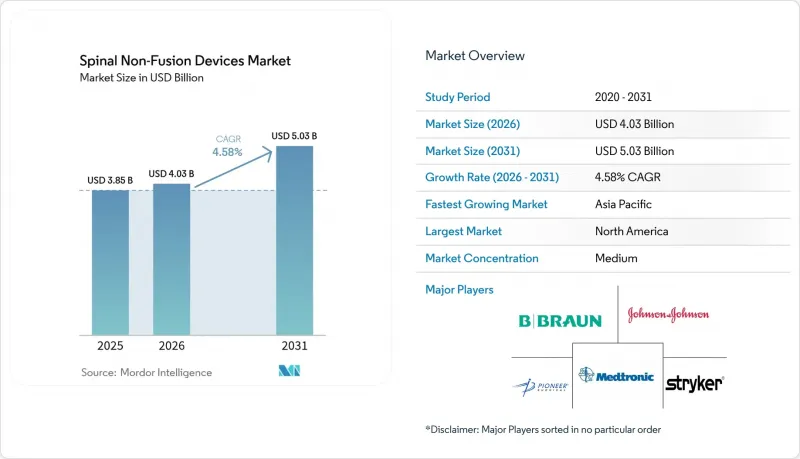
본 보고서는 제품별(인공 경추 추간판, 인공 요추 추간판, 동적 안정화 장치 등), 최종 사용자별(병원, 외래수술센터(ASC) 등), 수술 유형별(개방 척추 수술, 최소 침습 수술), 지역별(북미, 유럽, 아시아태평양 등)로 분류되어 있습니다. 시장 예측은 금액(달러) 기준으로 제시되어 있습니다.
세계의 척추 비고정 장치 시장 동향 및 인사이트
척추 가동성 보존 수술로의 전환
임상 현장에서는 유합을 최우선으로 하는 프로토콜에서 가동성 보존을 중시하는 치료법으로 결정적으로 전환되고 있습니다. 전향적 연구 결과에 따르면, 전경부 하이브리드 임플란트는 다단계 융합술에서 4.7°에 비해 16.3°의 추간 가동성을 유지하고 있으며, 이러한 기능적 우위는 재수술률 감소와 상관관계가 있습니다. TOPS와 같은 추간관절 성형술용 기기는 FDA 임상시험에서 93%의 환자 만족도가 보고되었으며, 초기 비용은 높지만 그 경제적 가치가 입증되었습니다. 따라서 생리학적 운동학을 중시하는 외과의사의 경향이 척추 비고정 장치 시장 전체에서 견조한 구매 모멘텀으로 이어지고 있습니다.
추간판 퇴행성 질환의 유병률 증가
세계적인 고령화로 인해 수술 건수는 지속적으로 증가하고 있으며, 메디케어 데이터에 따르면 2050년까지 척추 임플란트 수요가 대폭 확대될 것으로 예측됩니다. 영상 진단을 통한 조기 진단으로 인해, 돌이킬 수 없는 손상이 발생하기 전에 가동성을 보존하는 치료법이 선택되면서 척추 비고정 장치 시장이 확대되고 있습니다. 또한 젊은 세대도 향후 재수술의 필요성을 최소화하는 임플란트를 중시하고 있어, 장기적인 수요를 더욱 높이고 있습니다.
의료기기의 높은 비용과 제한된 병원 예산
병원에서는 운송비, 인건비, 원자재비가 20% 상승함에 따라 자금 배분이 어려워져 고가 임플란트의 도입이 주춤하고 있습니다. 프랑스에서 정형외과용 임플란트의 보험 급여액 삭감은 가격 압박이 커지고 있음을 여실히 보여주고 있으며, 척추 비유합용 기기 시장의 단기 판매량을 억제하는 요인이 되고 있습니다.
부문 분석
인공 경추 추간판은 2025년에 매출의 34.62%를 차지하며, 척추 비고정 장치 시장의 주력 제품으로 자리매김했습니다. Mobi-C에 대한 장기 데이터에 따르면, 유합 수술에 비해 인접 부위의 병변 발생률이 낮은 것으로 나타나, 이는 외과의들의 선호도를 높이는 요인이 되고 있습니다. 인공 경추 추간판의 척추 비고정 장치 시장 규모는 2025년에 13억 3,000만 달러에 달했으며, 한 자릿수 중반의 성장률로 꾸준히 확대되고 있습니다.
수핵 및 섬유륜 복원용 임플란트는 재생 의학의 발전과 자금 조달 확대를 반영하여 2031년까지 연평균 성장률(CAGR) 6.39%로 성장할 전망입니다. 임상시험을 통해 추간판 높이의 지속적인 회복이 확인됨에 따라, 척추 비융합 기기 시장에서 이들의 점유율은 상승할 전망입니다. 동적 안정화 시스템은 생체역학적 우위 덕분에 뚜렷한 시장 점유율을 유지하고 있는 반면, 척추간 스페이서는 보험 적용 여부가 제각각인 탓에 성장이 주춤하고 있습니다. 추간관절 치환술 및 기타 신흥 의료기기는 현재로서는 점진적인 기여에 그치고 있지만, 증거가 축적됨에 따라 장기적인 성장 잠재력을 지니고 있습니다.
지역별 분석
북미는 성숙한 보험 환급 제도와 외과 의사의 높은 연수 밀도를 배경으로 2025년에는 매출의 41.74%를 차지했습니다. VELYS Spine 플랫폼 등의 FDA 승인은 임플란트와 내비게이션 및 로봇 공학 생태계 간의 지속적인 통합을 부각시키고 있습니다. 경추 추간판 치환술에 대한 보험 적용 범위의 세분화는 판매량 성장을 더욱 공고히 하여, 척추 비융합용 기기 시장을 견조하게 유지하고 있습니다.
아시아태평양은 인구 고령화와 인프라 확충을 원동력으로, 2031년까지 연평균 성장률(CAGR)이 5.68%로 각 지역 중 가장 높은 성장률을 보일 것으로 전망됩니다. 중국에서는 의료기기 등록 절차의 합리화로 시장 출시까지의 기간이 단축되었으며, 병원 건설이 여전히 활발한 이 나라에서 척추 비융합용 의료기기 시장이 확대되고 있습니다. 일본에서는 선진적인 로봇 기술의 도입과 초고령화 사회가 견조한 수요를 창출하고 있지만, 임상적 근거에 대한 기대치는 여전히 낮은 상황입니다.
유럽에서는 비용 절감 움직임이 격화되고 있지만, 근거에 기반한 착실한 도입이 진행되고 있습니다. 재생의료용 임플란트의 CE 인증 절차는 규제 측면에서 유연성을 보이고 있으나, 각국의 예산 상한선으로 인해 도입 초기 단계에서는 진전이 더뎌질 가능성이 있습니다. 남미 및 중동 및 아프리카에서는 민간 병원 체인이 첨단 척추 수술실에 대한 투자를 추진하고 있어 장기적인 기회가 예상되지만, 경제적 부담과 인력 부족의 영향으로 현재 도입 규모는 여전히 소규모에 그치고 있습니다.
기타 혜택 :
- 엑셀 형식 시장 예측(ME) 시트
- 3개월간의 애널리스트 지원
자주 묻는 질문
목차
제1장 서론
제2장 조사 방법
제3장 주요 요약
제4장 시장 구도
제5장 시장 규모 및 성장 예측
제6장 경쟁 구도
제7장 시장 기회 및 향후 전망
KTH 26.08.26According to Mordor Intelligence, the spinal non-fusion devices market size in 2026 is estimated at USD 4.03 billion, growing from 2025 value of USD 3.85 billion with 2031 projections showing USD 5.03 billion, growing at 4.58% CAGR over 2026-2031.
This report is Segmented by Product (Artificial Cervical Disc, Artificial Lumbar Disc, Dynamic Stabilization Devices, and More), End User (Hospitals, Ambulatory Surgical Centers, and More), Surgery Type (Open Spine Surgery, Minimally-Invasive Surgery), and Geography (North America, Europe, Asia-Pacific, and More). The Market Forecasts are Provided in Terms of Value (USD).
Global Spinal Non-Fusion Devices Market Trends and Insights
Shift toward motion-preserving spinal surgeries
Clinical practice is moving decisively from fusion-first protocols to motion-preservation pathways. Prospective evidence shows anterior cervical hybrid constructs preserve 16.3° of segmental motion versus 4.7° in multilevel fusion, a functional edge that correlates with lower revision rates. Facet arthroplasty devices such as TOPS reported 93% patient satisfaction in FDA trials, reinforcing economic value despite higher up-front cost. Surgeon preference for physiologic kinematics is therefore translating into robust purchasing momentum across the spinal non-fusion devices market.
Rising prevalence of degenerative disc diseases
An aging global population is driving sustained procedural volume, with Medicare data predicting significant expansion in spinal instrumentation demand through 2050. Earlier imaging-driven diagnosis favors motion-preserving interventions before irreversible damage, enlarging the spinal non-fusion devices market. Younger cohorts also value implants that minimize the need for later revision, intensifying long-run demand.
High device cost & limited hospital budgets
Hospitals face 20% jumps in shipping, labor and raw-material expenses, leading to tighter capital allocation that slows premium implant adoption. France's reimbursement cuts for orthopedic hardware underscore mounting price pressure, dampening near-term volume in the spinal non-fusion devices market.
Other drivers and restraints analyzed in the detailed report include:
- Rapid adoption of minimally invasive dynamic stabilizers
- Reimbursement expansion for artificial disc replacement
- Stringent multi-region regulatory approval timelines
For complete list of drivers and restraints, kindly check the Table Of Contents.
Segment Analysis
Artificial cervical discs captured 34.62% revenue in 2025 and remain the anchor of the spinal non-fusion devices market. Long-term data on Mobi-C show lower adjacent-segment pathology compared with fusion, reinforcing surgeon preference. The spinal non-fusion devices market size for artificial cervical discs stood at USD 1.33 billion in 2025 and is expanding steadily at a mid-single-digit rate.
Nucleus and annulus repair implants are on track for a 6.39% CAGR through 2031, reflecting regenerative-medicine traction and growing funding. Their share of the spinal non-fusion devices market size is set to rise as clinical trials confirm sustained disc-height restoration. Dynamic stabilization systems hold notable share through biomechanical superiority, whereas interspinous spacers lag amid mixed coverage decisions. Facet joint replacements and other emerging devices contribute incrementally but hold long-run upside as evidence builds.
Complete Report Scope:
- By Product Type
- Artificial Cervical Disc
- Artificial Lumbar Disc
- Dynamic Stabilization Devices (Pedicle Screw/Rod)
- Interspinous Process Spacers
- Facet Joint Replacement
- Nucleus & Annulus Repair Implants
- Other Motion-Preservation Devices
- By End User
- Hospitals
- Ambulatory Surgical Centers
- Specialty Spine Clinics
- By Surgery Type
- Open Spine Surgery
- Minimally-Invasive Surgery
- By Geography
- North America
- United States
- Canada
- Mexico
- Europe
- Germany
- United Kingdom
- France
- Italy
- Spain
- Rest of Europe
- Asia-Pacific
- China
- India
- Japan
- South Korea
- Australia
- Rest of Asia-Pacific
- South America
- Brazil
- Argentina
- Rest of South America
- Middle East and Africa
- GCC
- South Africa
- Rest of Middle East and Africa
- North America
Geography Analysis
North America delivered 41.74% revenue in 2025 on the back of mature reimbursement and high surgeon training density. FDA clearances, such as the VELYS Spine platform, highlight continual integration of implants with navigation and robotics ecosystems. Coverage refinements around cervical disc replacement further secure volume growth, keeping the spinal non-fusion devices market buoyant.
Asia-Pacific is poised for the fastest regional CAGR of 5.68% through 2031, propelled by demographic aging and infrastructure upgrades. China's streamlined device-registration catalogue accelerates time-to-market, enlarging the spinal non-fusion devices market in a nation where hospital build-outs remain strong. Japan's adoption of advanced robotics and its super-aged society create robust demand, though clinical-evidence expectations remain rigorous.
Europe faces intensified cost-containment but continues to drive steady, evidence-based uptake. CE pathways for regenerative implants demonstrate regulatory openness, yet national budget caps may slow early-stage adoption. South America and Middle East & Africa present long-term opportunities as private hospital chains invest in advanced spine suites, although current volumes remain modest due to affordability and workforce constraints.
- Medtronic
- Stryker
- Johnson & Johnson
- NuVasive
- Globus Medical
- Centinel Spine
- B. Braun (Aesculap)
- Spineart
- RTI Surgical
- Exactech
- Stryker
- Orthofix
- Zimmer Biomet
- Alphatec Spine
- Boston Scientific
Additional Benefits:
- The market estimate (ME) sheet in Excel format
- 3 months of analyst support
TABLE OF CONTENTS
1 Introduction
- 1.1 Study Assumptions & Market Definition
- 1.2 Scope of the Study
2 Research Methodology
3 Executive Summary
4 Market Landscape
- 4.1 Market Overview
- 4.2 Market Drivers
- 4.2.1 Shift toward motion-preserving spinal surgeries
- 4.2.2 Rising prevalence of degenerative disc diseases
- 4.2.3 Rapid adoption of minimally-invasive dynamic stabilizers
- 4.2.4 Reimbursement expansion for artificial disc replacement
- 4.2.5 Growing venture funding for nucleus & annulus repair start-ups
- 4.2.6 AI-guided patient-specific implant design breakthroughs
- 4.3 Market Restraints
- 4.3.1 High device cost & limited hospital budgets
- 4.3.2 Stringent multi-region regulatory approval timelines
- 4.3.3 Payer reluctance toward lumbar disc replacement reimbursement
- 4.3.4 Supply-chain dependence on specialty Nitinol alloys
- 4.4 Value / Supply-Chain Analysis
- 4.5 Regulatory Landscape
- 4.6 Technological Outlook
- 4.7 Porter's Five Forces
- 4.7.1 Threat of New Entrants
- 4.7.2 Bargaining Power of Suppliers
- 4.7.3 Bargaining Power of Buyers
- 4.7.4 Threat of Substitutes
- 4.7.5 Competitive Rivalry
5 Market Size & Growth Forecasts (Value)
- 5.1 By Product Type
- 5.1.1 Artificial Cervical Disc
- 5.1.2 Artificial Lumbar Disc
- 5.1.3 Dynamic Stabilization Devices (Pedicle Screw/Rod)
- 5.1.4 Interspinous Process Spacers
- 5.1.5 Facet Joint Replacement
- 5.1.6 Nucleus & Annulus Repair Implants
- 5.1.7 Other Motion-Preservation Devices
- 5.2 By End User
- 5.2.1 Hospitals
- 5.2.2 Ambulatory Surgical Centers
- 5.2.3 Specialty Spine Clinics
- 5.3 By Surgery Type
- 5.3.1 Open Spine Surgery
- 5.3.2 Minimally-Invasive Surgery
- 5.4 By Geography
- 5.4.1 North America
- 5.4.1.1 United States
- 5.4.1.2 Canada
- 5.4.1.3 Mexico
- 5.4.2 Europe
- 5.4.2.1 Germany
- 5.4.2.2 United Kingdom
- 5.4.2.3 France
- 5.4.2.4 Italy
- 5.4.2.5 Spain
- 5.4.2.6 Rest of Europe
- 5.4.3 Asia-Pacific
- 5.4.3.1 China
- 5.4.3.2 India
- 5.4.3.3 Japan
- 5.4.3.4 South Korea
- 5.4.3.5 Australia
- 5.4.3.6 Rest of Asia-Pacific
- 5.4.4 South America
- 5.4.4.1 Brazil
- 5.4.4.2 Argentina
- 5.4.4.3 Rest of South America
- 5.4.5 Middle East and Africa
- 5.4.5.1 GCC
- 5.4.5.2 South Africa
- 5.4.5.3 Rest of Middle East and Africa
- 5.4.1 North America
6 Competitive Landscape
- 6.1 Market Concentration
- 6.2 Market Share Analysis
- 6.3 Company Profiles (includes Global level Overview, Market level overview, Core Segments, Financials as available, Strategic Information, Market Rank/Share for key companies, Products & Services, and Recent Developments)
- 6.3.1 Medtronic
- 6.3.2 Stryker Corporation
- 6.3.3 DePuy Synthes (Johnson & Johnson)
- 6.3.4 NuVasive
- 6.3.5 Globus Medical
- 6.3.6 Centinel Spine
- 6.3.7 B. Braun (Aesculap)
- 6.3.8 Spineart
- 6.3.9 RTI Surgical
- 6.3.10 Exactech
- 6.3.11 Stryker
- 6.3.12 Orthofix
- 6.3.13 Zimmer Biomet
- 6.3.14 Alphatec Spine
- 6.3.15 Boston Scientific
7 Market Opportunities & Future Outlook
- 7.1 White-space & Unmet-Need Assessment