

|
시장보고서
상품코드
2113952
골이식재 및 골대체재 : 시장 점유율 분석, 업계 동향 및 통계, 성장 예측(2026-2031년)Bone Grafts And Substitutes - Market Share Analysis, Industry Trends & Statistics, Growth Forecasts (2026 - 2031) |
||||||
 Mordor Intelligence
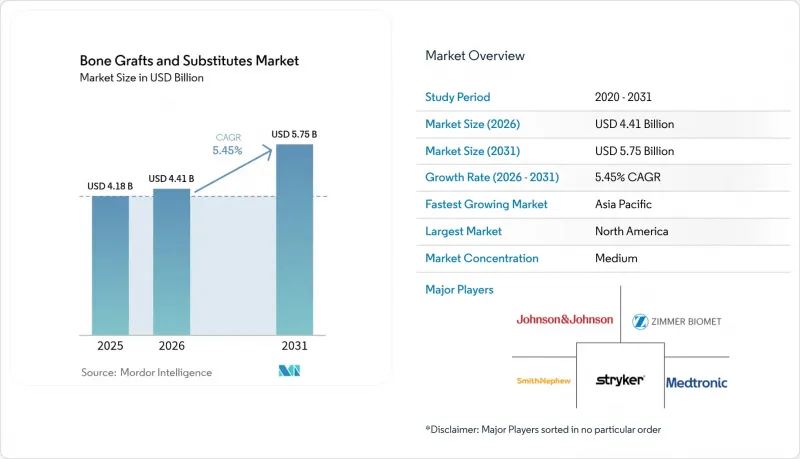
Mordor Intelligence에 의하면, 2026년 골이식재 및 골대체재 시장 규모는 44억 1,000만 달러로 추정되고 2025년 41억 8,000만 달러에서 확대해, 2031년에는 57억 5,000만 달러에 이를 것으로 예측됩니다.
2026년부터 2031년까지 연평균 성장률(CAGR) 5.45%로 성장할 것으로 전망됩니다.
본 보고서는 제품 유형(동종 골이식재, 합성 골이식재 등), 소재(인산칼슘 세라믹, 생체활성 유리 등),용도(외상·두개악안면, 관절 재건 등), 최종 사용자(병원, 전문 클리닉 등), 지역(북미, 유럽, 아시아태평양 등)별로 분류되어 있습니다. 시장 전망은 금액(달러)으로 표시되어 있습니다.
세계의 골이식재 및 골대체재 시장 동향과 인사이트
척추 고정술 및 관절 재건술 건수 증가
변형에 대한 후방 경추 고정술은 표준 사례(CAGR 9.7%)에 비해 CAGR(16.5%)로 증가하고 있으며, 이는 현대적인 임플란트를 사용하여 복잡한 해부학적 구조를 다루는 것에 대한 외과의사의 신뢰를 뒷받침하고 있습니다. 외래수술센터(ASC)에서는 향후 10년 동안 정형외과 외래 환자 수가 13% 증가할 것으로 예측되며, 당일 퇴원 목표를 달성하기 위해서는 속경화형 이식재가 필수적입니다. 처리 능력의 향상과 수술의 복잡화가 맞물리면서, 채취 부위의 합병증을 줄이고 수술 시간을 단축하며, 척추체 간 케이지와 매끄럽게 통합될 수 있는 골이식 대체재에 대한 구매 경향이 강해지고 있습니다. 외과의사들은 골 이식 대체재를 단순한 2차 충전재로만 여기지 않고, 워크플로우의 효율화와 환자의 회복 촉진을 가능하게 하는 최전선의 수단으로 취급하고 있습니다.
골다공증 및 외상 위험을 안고 있는 고령 인구 증가
콜롬비아의 하지 인공관절 치환술 예상 건수는 세계적 추세를 여실히 보여주고 있으며, 주로 고령 여성층 증가에 힘입어 연평균 성장률(CAGR) 5.54%를 기록하며 2050년까지 3만 9,270건에 달할 것으로 전망됩니다. 고령 환자는 골형성 능력이 저하되고 감염 위험이 높기 때문에 이식 재료의 생체 활성 및 항균 성능에 대한 요구 수준이 높아지고 있습니다. 『Journal of Orthopaedic Experience &Innovation』지에 게재된 2024년 9월 메디케어 파트 B 데이터베이스 분석에 따르면, 수급자 수가 증가하고 있음에도 불구하고 2013년부터 2021년에 걸쳐 메디케어의 관절 치환술 보상액은 대폭 감소했습니다. 이로 인해 의료 시스템은 치료 횟수당 비용을 늘리지 않으면서 자가 이식편을 능가하는 성능을 지닌, 비용 대비 효과가 높은 이식편을 우선적으로 선택하지 않을 수 없게 되었습니다.
칼슘이 도핑된 티타늄 표면은 피브리노겐의 흡착과 박테리아의 부착을 조절하여 감염을 최소화할 가능성을 보여주고 있으며, 이는 면역 기능이 저하된 고령층에게 매우 중요합니다. 이러한 인구통계학적 및 임상적 압력으로 인해, 골유도 능력과 강력한 항균 방어 기능을 겸비한 골이식 대체재에 대한 수요가 증가하고 있습니다.
높은 비용과 불균일한 보험 환급 제도에 직면한 프리미엄 이식재
기본적인 합성 재료의 비용이 46.2-140달러인 반면, 프리미엄 이식재는 보험 급여 상한액을 초과하기 때문에 의료 기관은 사용을 복잡한 증례로만 제한할 수밖에 없습니다. 줄기세포가 강화된 제품에 대한 보험 적용은 여전히 조건부이며, 증거에 기반한 보험 급여의 장벽을 극복하려는 혁신 기업들에게는 불확실성이 더욱 커지고 있습니다. 지역별 편차가 이 문제를 더욱 복잡하게 만들고 있습니다. 미국 북동부 지역은 기준선 보상률이 가장 높았음에도 불구하고 지급액 감소폭이 가장 컸기 때문에 경제적 실행 가능성 측면에서 지역 간 불균형이 두드러지게 나타났습니다.
부문 분석
2025년, 동종 이식편은 임상의들이 익숙하게 사용해 온 실적과 강력한 골유도능에 힘입어 골이식재 및 골대체재 시장에서 42.10%라는 최대 점유율을 차지했습니다. 병원 측은 공급의 확실성을 중시하는 반면, 조직 은행은 생물학적 유효성과 바이러스 안전성을 확보하기 위해 처리 기술을 정교화하고 있습니다. 동종 이식편의 골 이식편 및 대체재 시장 규모는 취급 편의성 개선과 기증 부위의 합병증을 최소화하는 섬유 기반 탈회 매트릭스에 힘입어 꾸준히 확대될 것으로 전망됩니다. 합성 이식재는 나노 엔지니어링을 적용한 표면 처리와 제어된 분해 특성 덕분에 그 격차를 좁혀가고 있으며, 세포 기반 매트릭스는 규제 명확화에 따라 가장 빠른 성장을 이루고 있습니다.
경쟁 동향은 특정 시술에 따른 차별화에 초점이 맞추어져 있습니다. 이종 이식편은 비흡수성 특성을 활용할 수 있는 치과 적응증 분야에서 틈새 수요를 확보하고 있습니다. 새로운 비흡수성 동종 이식편은 내구성을 높여, 하중이 가해지는 부위의 재수술에 대한 불안을 완화하고 있습니다. Enovis사와 Ossium Health사가 유통망과 생물학적 혁신을 결합함에 따라, 냉동 보존된 생체골 매트릭스는 고급 임상 분야를 목표로 하고 있습니다. 따라서 각 제품 카테고리는 안전성, 생물학적 유효성, 또는 사용 편의성과 같은 개별적인 임상적 요구에 따라 포지셔닝되고 있습니다.
인산칼슘 세라믹은 예측 가능한 생체 적합성과 확립된 규제 경로 덕분에 2025년에 골이식재 및 골대체재 시장의 44.00%를 차지했습니다. 다공성 조절 및 실리콘 도핑 기술의 발전으로 기계적 강도가 향상되는 동시에 골유착이 촉진되고 있습니다. 생체활성 유리와 관련된 골이식재 및 골대체재 시장 규모는 새로운 제제가 분해 동태를 제어하고 골자극 작용을 높임으로써 가장 빠르게 성장하고 있습니다. 폴리머 기반 제품은 외상 치료에서의 탄력성과 약물 방출 가능성이 높이 평가받고 있으며, 여전히 도입 초기 단계에 있습니다. 하이드록시아파타이트와 콜라겐을 결합한 복합 매트릭스는 채취에 따른 통증을 없애면서도 현재 장골능 이식편과 동등한 골유합률을 실현하고 있습니다. 공급의 신뢰성도 재료 선정의 요인이 되고 있으며, 황산칼슘을 개질하여 구조적 완전성을 해치지 않으면서 흡수를 지연시키려는 시도가 이루어지고 있습니다.
지역별 분석
북미는 2025년에 41.85%의 점유율을 차지했으며, 그 배경에는 수술 건수의 많음, 광범위한 보험 적용 범위, 그리고 외과의사들이 고품질 제품에 대해 가지고 있는 높은 신뢰도가 있습니다. 변형에 대한 후방 경추 고정술은 다른 부문을 능가하는 성장을 지속하고 있으며, 이는 까다로운 생체역학적 조건에서도 성능을 발휘하는 이식편에 대한 수요가 높음을 뒷받침합니다. Renovos사의 젤 등 FDA 브레이크스루 프로그램을 통해 혁신적인 기술이 신속하게 수술실로 도입되고 있습니다.
유럽은 2위를 차지하고 있으며, 엄격한 증거 요건과 세라믹 및 복합재료 솔루션에 대한 선호가 특징입니다. 독일과 영국은 생체 재료 연구에 막대한 투자를 하고 있으며, 분해 프로파일이 제어된 유리-세라믹 하이브리드 제품의 파이프라인을 구축하고 있습니다. 남유럽에서는 비용 절감에 따른 가격 하락 압력이 있음에도 불구하고, 고령화가 진행되는 인구 구조가 수요를 뒷받침하고 있습니다.
아시아태평양은 중국의 병원 확대, 인도의 급성장하는 의료 관광, 그리고 일본의 초고령화 사회에 힘입어 7.05%라는 가장 높은 연평균 성장률(CAGR)을 기록하고 있습니다. 각국 정부는 정형외과 분야에 대한 자금 지원을 확대하고 있는 한편, 현지 제조업체들은 수입 의존도를 낮추기 위해 적층 가공(애디티브 매뉴팩처링) 생산 능력을 확대되고 있습니다. 보험 보급 확대와 외과의를 위한 연수 프로그램을 통해 차세대 골이식 대체재의 도입이 더욱 촉진되고 있습니다.
기타 혜택 :
- 엑셀 형식 시장 예측(ME) 시트
- 3개월간의 애널리스트 지원
자주 묻는 질문
목차
제1장 서론
제2장 조사 방법
제3장 주요 요약
제4장 시장 구도
제5장 시장 규모 및 성장 예측
제6장 경쟁 구도
제7장 시장 기회 및 향후 전망
KTH 26.08.26According to Mordor Intelligence, the bone grafts and substitutes market size in 2026 is estimated at USD 4.41 billion, growing from 2025 value of USD 4.18 billion with 2031 projections showing USD 5.75 billion, growing at 5.45% CAGR over 2026-2031.
This report is Segmented by Product Type (Allografts, Synthetic Bone Grafts, and More), Material (Calcium-Phosphate Ceramics, Bioactive Glass, and More), Application (Trauma & Craniomaxillofacial, Joint Reconstruction, and More), End User (Hospitals, Specialty Clinics, and More), and Geography (North America, Europe, Asia-Pacific and More). The Market Forecasts are Provided in Terms of Value (USD).
Global Bone Grafts And Substitutes Market Trends and Insights
Increasing Spinal-Fusion & Joint-Reconstruction Volumes
Posterior cervical fusions for deformity grew at a 16.5% CAGR versus 9.7% for standard cases, confirming surgeon confidence to tackle complex anatomy with modern implants. ASCs expect orthopedic outpatient cases to climb 13% this decade, making rapid-setting grafts essential to same-day discharge targets. High throughput combined with heightened complexity shifts purchasing toward bone graft substitutes that reduce harvest-site morbidity, shorten operating time, and integrate seamlessly with interbody cages. Surgeons increasingly treat graft substitutes not as secondary fillers but as frontline enablers of workflow efficiency and enhanced patient recovery.
Rising Geriatric Population with Osteoporosis & Trauma Risk
Projected lower-limb arthroplasties in Colombia illustrate global momentum, rising to 39,270 procedures by 2050 at a 5.54% CAGR, driven primarily by aging female cohorts. Elderly patients present diminished osteogenic capacity and higher infection risk, raising the bar for graft bioactivity and antimicrobial performance. Medicare joint-arthroplasty reimbursements slid substantially from 2013 to 2021 despite higher beneficiary counts, forcing health systems to prioritize cost-effective grafts that outperform autografts without inflating episode costs, according to a September 2024 analysis of the Medicare Part B database published in the Journal of Orthopaedic Experience & Innovation.
Calcium-doped titanium surfaces show promise in minimizing infection by modulating fibrinogen adsorption and bacterial adherence, which is vital in older populations with compromised immunity. Together these demographic and clinical pressures propel demand for bone graft substitutes that pair osteoinductivity with robust antimicrobial defenses.
High Cost & Patchy Reimbursement for Premium Grafts
Basic synthetic materials cost USD 46.2-140, while premium grafts exceed reimbursement caps, leading facilities to limit use to complex cases. Coverage for stem-cell-enhanced products remains conditional, intensifying uncertainty for innovators navigating evidence-based reimbursement hurdles. Regional variability compounds the issue; U.S. Northeast saw the steepest payment declines despite the highest baseline rates, underscoring geographic inconsistency in economic viability.
Other drivers and restraints analyzed in the detailed report include:
- Technological Advances in Synthetic & Cell-Based Matrices
- 3-D Printed, Patient-Specific Scaffolds Enable Complex Reconstructions
- Disease-Transmission / Immune-Response Risk with Allo- & Xenografts
For complete list of drivers and restraints, kindly check the Table Of Contents.
Segment Analysis
Allografts captured the largest slice of bone grafts and substitutes market share at 42.10% in 2025, supported by clinician familiarity and strong osteoinductive profiles. Hospitals value their supply predictability, while tissue banks refine processing to safeguard biologic potency and viral safety. The bone grafts and substitutes market size for allografts is projected to rise steadily, propelled by fiber-based demineralized matrices that deliver improved handling and minimal donor-site morbidity. Synthetic grafts are closing the gap through nano-engineered surfaces and controlled degradation, and cell-based matrices post the fastest growth as regulatory clarity improves.
Competitive dynamics center on differentiation by specific procedure. Xenografts hold niche traction in dental indications that benefit from non-resorbable properties. Novel non-resorbable allografts extend longevity, easing revision anxiety in load-bearing zones. Cryopreserved viable bone matrices target premium clinical segments after Enovis and Ossium Health linked distribution reach with biologic innovation. Each product category therefore positions itself around a discrete clinical need set-safety, biological potency, or ease of use.
Calcium-phosphate ceramics represented 44.00% of bone grafts and substitutes market share in 2025 thanks to predictable biocompatibility and established regulatory paths. Advances in porosity tuning and silicon doping improve mechanical strength while accelerating osseointegration. The bone grafts and substitutes market size attached to bioactive glass grows fastest as newer formulations manage degradation kinetics and heighten osteostimulation. Polymer-based options remain in early adoption, valued for elasticity and drug-release potential in trauma settings. Composite matrices combining hydroxyapatite and collagen now rival iliac crest graft fusion rates while eliminating harvest pain. Supply reliability also shapes material selection; calcium sulfate modifications attempt to slow resorption without sacrificing structural integrity.
Complete Report Scope:
- By Product Type
- Allografts
- Synthetic Bone Grafts
- Demineralized Bone Matrix (DBM)
- Cell-based Matrices
- Xenografts
- By Material
- Calcium-phosphate ceramics
- Bioactive glass
- Polymer-based grafts
- Composite materials
- By Application
- Spinal Fusion
- Trauma & Craniomaxillofacial
- Joint Reconstruction
- Dental Bone Grafting
- Foot & Ankle
- Others
- By End User
- Hospitals
- Specialty Clinics
- Ambulatory Surgical Centers
- Dental Clinics
- By Geography
- North America
- United States
- Canada
- Mexico
- Europe
- Germany
- United Kingdom
- France
- Italy
- Spain
- Rest of Europe
- Asia-Pacific
- China
- India
- Japan
- South Korea
- Australia
- Rest of Asia-Pacific
- South America
- Brazil
- Argentina
- Rest of South America
- Middle East and Africa
- GCC
- South Africa
- Rest of Middle East and Africa
- North America
Geography Analysis
North America held 41.85% share in 2025, anchored by high procedure volumes, broad insurance coverage, and high surgeon comfort with premium products. Posterior cervical fusions for deformity continue to outpace other segments, underscoring demand for grafts that perform in challenging biomechanics. FDA breakthrough programs, such as Renovos's gel, channel innovation swiftly into operating rooms.
Europe stands second, characterized by rigorous evidence requirements and a penchant for ceramic and composite solutions. Germany and the United Kingdom invest heavily in biomaterials research, seeding a pipeline of glass-ceramic hybrids with controlled degradation profiles. Southern Europe's aging demographics sustain demand even as cost containment exerts downward price pressure.
Asia-Pacific records the fastest CAGR at 7.05%, driven by China's hospital expansion, India's burgeoning medical tourism, and Japan's super-aged populace. Governments increase orthopedic funding, while local manufacturers scale additive-manufacturing capacity to lower import dependency. Wider insurance penetration and surgeon training programs further lift adoption of next-generation bone graft substitutes.
- Medtronic
- Stryker
- Johnson & Johnson
- Zimmer Biomet
- Baxter International Inc. (Advanced Surgery)
- Integra LifeSciences Holdings Corp.
- Orthofix
- NuVasive
- Smith+Nephew plc
- RTI Surgical
- Geistlich Pharma
- Dentsply Sirona
- Biocomposites Ltd.
- Straumann Group
- Collagen Matrix
- SeaSpine Holdings Corp.
- Kuros Biosciences AG
- OsteoMed LLC
- AlloSource Inc.
Additional Benefits:
- The market estimate (ME) sheet in Excel format
- 3 months of analyst support
TABLE OF CONTENTS
1 Introduction
- 1.1 Study Assumptions & Market Definition
- 1.2 Scope of the Study
2 Research Methodology
3 Executive Summary
4 Market Landscape
- 4.1 Market Overview
- 4.2 Market Drivers
- 4.2.1 Increasing spinal-fusion & joint-reconstruction volumes
- 4.2.2 Rising geriatric population with osteoporosis & trauma risk
- 4.2.3 Technological advances in synthetic & cell-based matrices
- 4.2.4 Shift from autografts to off-the-shelf substitutes
- 4.2.5 3-D printed, patient-specific scaffolds enable complex reconstructions
- 4.2.6 Ambulatory-surgery-center demand for minimally-invasive delivery kits
- 4.3 Market Restraints
- 4.3.1 High cost & patchy reimbursement for premium grafts
- 4.3.2 Disease-transmission / immune-response risk with allo- & xenografts
- 4.3.3 Medical-grade calcium-phosphate supply bottlenecks
- 4.3.4 Nano-ceramic-particle inflammation triggering tougher regulation
- 4.4 Value / Supply-Chain Analysis
- 4.5 Regulatory Landscape
- 4.6 Technological Outlook
- 4.7 Porter's Five Forces
- 4.7.1 Bargaining Power of Suppliers
- 4.7.2 Bargaining Power of Buyers
- 4.7.3 Threat of New Entrants
- 4.7.4 Threat of Substitutes
- 4.7.5 Competitive Rivalry
5 Market Size & Growth Forecasts (Value)
- 5.1 By Product Type
- 5.1.1 Allografts
- 5.1.2 Synthetic Bone Grafts
- 5.1.3 Demineralized Bone Matrix (DBM)
- 5.1.4 Cell-based Matrices
- 5.1.5 Xenografts
- 5.2 By Material
- 5.2.1 Calcium-phosphate ceramics
- 5.2.2 Bioactive glass
- 5.2.3 Polymer-based grafts
- 5.2.4 Composite materials
- 5.3 By Application
- 5.3.1 Spinal Fusion
- 5.3.2 Trauma & Craniomaxillofacial
- 5.3.3 Joint Reconstruction
- 5.3.4 Dental Bone Grafting
- 5.3.5 Foot & Ankle
- 5.3.6 Others
- 5.4 By End User
- 5.4.1 Hospitals
- 5.4.2 Specialty Clinics
- 5.4.3 Ambulatory Surgical Centers
- 5.4.4 Dental Clinics
- 5.5 By Geography
- 5.5.1 North America
- 5.5.1.1 United States
- 5.5.1.2 Canada
- 5.5.1.3 Mexico
- 5.5.2 Europe
- 5.5.2.1 Germany
- 5.5.2.2 United Kingdom
- 5.5.2.3 France
- 5.5.2.4 Italy
- 5.5.2.5 Spain
- 5.5.2.6 Rest of Europe
- 5.5.3 Asia-Pacific
- 5.5.3.1 China
- 5.5.3.2 India
- 5.5.3.3 Japan
- 5.5.3.4 South Korea
- 5.5.3.5 Australia
- 5.5.3.6 Rest of Asia-Pacific
- 5.5.4 South America
- 5.5.4.1 Brazil
- 5.5.4.2 Argentina
- 5.5.4.3 Rest of South America
- 5.5.5 Middle East and Africa
- 5.5.5.1 GCC
- 5.5.5.2 South Africa
- 5.5.5.3 Rest of Middle East and Africa
- 5.5.1 North America
6 Competitive Landscape
- 6.1 Market Concentration
- 6.2 Market Share Analysis
- 6.3 Company Profiles (includes Global-level Overview, Market-level Overview, Core Segments, Financials as available, Strategic Information, Market Rank/Share, Products & Services, Recent Developments)
- 6.3.1 Medtronic plc
- 6.3.2 Stryker Corporation
- 6.3.3 Johnson & Johnson (DePuy Synthes)
- 6.3.4 Zimmer Biomet Holdings Inc.
- 6.3.5 Baxter International Inc. (Advanced Surgery)
- 6.3.6 Integra LifeSciences Holdings Corp.
- 6.3.7 Orthofix Medical Inc.
- 6.3.8 NuVasive Inc.
- 6.3.9 Smith+Nephew plc
- 6.3.10 RTI Surgical Inc.
- 6.3.11 Geistlich Pharma AG
- 6.3.12 Dentsply Sirona Inc.
- 6.3.13 Biocomposites Ltd.
- 6.3.14 Institut Straumann AG
- 6.3.15 Collagen Matrix Inc.
- 6.3.16 SeaSpine Holdings Corp.
- 6.3.17 Kuros Biosciences AG
- 6.3.18 OsteoMed LLC
- 6.3.19 AlloSource Inc.
7 Market Opportunities & Future Outlook
- 7.1 White-space & Unmet-need Assessment


