
|
시장보고서
상품코드
2113961
무선 ECG 기기 : 시장 점유율 분석, 업계 동향 및 통계, 성장 예측(2026-2031년)Wireless ECG Devices - Market Share Analysis, Industry Trends & Statistics, Growth Forecasts (2026 - 2031) |
||||||
 Mordor Intelligence
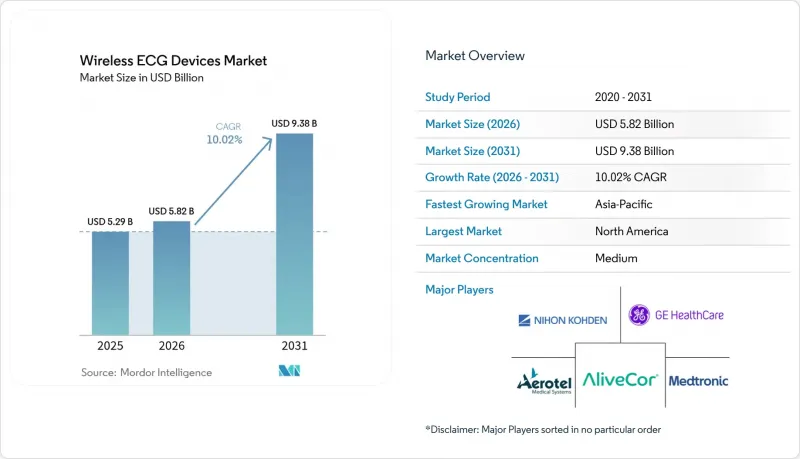
Mordor Intelligence에 의하면, 무선 ECG 기기 시장 규모는 2025년 52억 9,000만 달러로 평가되었습니다. 2026년에는 58억 2,000만 달러로 확대되어 2026년부터 2031년에 걸쳐 CAGR 10.02%로 성장을 지속하여, 2031년에는 93억 8,000만 달러에 이를 것으로 예측됩니다.
본 보고서는 제품 유형(심전도 모니터링 시스템(원격 데이터 모니터링 등) 및 진단용 심전도 시스템), 리드 유형(싱글 리드, 3-6리드, 12리드 이상), 최종 사용자(병원·순환기 클리닉 등), 연결 방식(블루투스 전용 등), 지역(북미, 유럽,아시아태평양 등)별로 분류되어 있습니다. 시장 예측은 금액(미 달러) 기준으로 제시되어 있습니다.
세계의 무선 ECG 기기 시장 동향 및 인사이트
AI를 활용한 적응형 압축을 통해 배터리 수명 연장
적응형 압축 알고리즘을 통해 심전도 신호의 선명도를 저하시키지 않으면서 무선 데이터 양을 최대 85%까지 줄일 수 있습니다. 기기 상의 추론을 통해 심박의 질을 실시간으로 분류하고, 임상적으로 관련성이 있는 파형만 전송함으로써 작동 기간을 2일에서 최대 14일까지 연장하고 있습니다. 이러한 변경으로 인해, 장기 연구에서 이전에는 30%를 초과했던 사용 중단률이 감소하고 있습니다. 각 기기 제조업체들은 이 알고리즘을 10µA 미만의 절전 모드 지원 마이크로컨트롤러 및 첨단 리튬 폴리머 배터리 기술과 결합하여, 다중 전극 진단 패치를 통한 1주일간의 모니터링을 실현하고 있습니다. 이 기술은 연평균 성장률(CAGR) 12.25%로 성장하고 있는 진단 시스템 분야를 직접 견인하고 있습니다. 또한, 배터리 구동 시간의 연장으로 인해 병원에서는 직원이 충전 업무에서 해방되어 임상 해석 업무에 전념할 수 있게 되었으며, 이는 총 소유 비용(TCO) 절감으로 이어지고 있습니다.
원격의료 보험 적용 범위 확대
CMS는 2024년에 코드 99453-99458 및 99091에 원격 심전도 모니터링을 추가하여, 환자 1명당 1회 에피소드당월60-120달러의 청구가 가능하도록 했습니다. 메디케이드와의 급여 수준 균등화는 현재 38개 주로 확대되었으며, 대다수의 주요 민간 보험사도 유사한 요금 체계를 채택하고 있습니다. 의료 제공업체들은 코드에 포함된 지속적인 연결 요건을 충족하기 위해 셀룰러 eSIM 기기를 도입하고 있습니다. 각 보험사가 독자적인 문서화 기준을 적용하고 있어 관리상의 부담은 여전히 증가하고 있지만, 수익 전망이 명확해짐에 따라 통합 의료 제공 네트워크 도입 로드맵은 안정적입니다. 이러한 상환 제도 변경은 재택 이용자가 기록한 연평균 성장률(CAGR) 18.87%의 배경이 되고 있으며, 이 이용자층은 이미 진료소에서의 모니터링보다 더 높은 만족도 점수를 보고하고 있습니다.
RPM 코드에 대한 복잡하고 파편화된 상환
임상의는 99453-99458, 99091, 99490-99491과 같은 여러 코드를 동시에 처리해야 하며, 각 코드는 서로 다른 등록 요건과 심사 빈도를 요구합니다. 소규모 심혈관 진료소에서는 모니터링 대상 환자 1명당 매달 2-4시간을 행정 업무에 소비하고 있으며, 이는 경제적 이점을 저해하고 있습니다. 주별 메디케이드 프로그램 간의 차이로 인해 확인 작업이 더욱 복잡해지고 있습니다. 이미 인력 부족으로 어려움을 겪고 있는 지방의 의료 제공업체들은 기기 가격이 저렴해졌음에도 불구하고 원격 심전도(ECG) 도입을 미루는 경우가 많습니다. 하드웨어와 통합된 청구 서비스를 제공하는 시장 진출기업들은 현장의 사무 처리 문제를 해결함으로써 전략적 우위를 확보하고 있습니다.
부문 분석
진단용 기기는 간헐적인 증상을 포착하기 위해 의료 기관들이 휴대용 12유도 심전도 검사를 점점 더 많이 처방함에 따라 연평균 성장률(CAGR) 12.07%를 기록했습니다. 모니터링 시스템은 만성 질환 관리에 대한 보험 환급 제도가 확립되어 있어, 2025년 무선 심전도 기기 시장 규모의 52.12%를 차지했습니다. AI를 통한 분류로 인해 심장 전문의의 진료 시간이 소정의 기준치 내에 포함될 경우, 보험사는 진단 세션 연장을 승인하여 임상적 이점과 비용 관리를 양립시키고 있습니다. 각 기업은 병변이 의심되는 구간만 표시하는 클라우드 기반 알고리즘을 통합하여, 이를 통해 데이터 과부하와 의사의 피로를 대폭 경감시키고 있습니다. 또한, 진단용 패치는 기업의 웰니스 프로그램 내 스트레스 테스트에서도 보급이 확대되고 있어, 대상 수요가 병원 네트워크 밖으로 확장되고 있습니다. 한편, 모니터링 기기는 매일 심박 리듬 확인이 의무화된 심부전 프로그램에서의 일상적인 사용 덕분에 판매 대수 측면에서 계속해서 1위 자리를 유지하고 있습니다. 그 결과, 기존 모니터링 분야의 판매 대수 증가세는 견조하지만, 수익 구조는 프리미엄 진단 플랫폼으로 이동하고 있습니다.
고성능 마이크로 전극 어레이 덕분에 진단용 웨어러블 기기는 과거 병원 유선 카트에서만 가능했던 신호 대 잡음비(SNR)를 구현할 수 있게 되었습니다. 엣지 AI를 통한 패킷화와 결합함으로써, 원격에서 전송된 12도심전도 파형이 지연 급증 없이 순환기내과 대시보드에 도달하여, 중요 경로(Critical Path)에서의 지연을 방지합니다. 신규 진출기업들은 몇 주 분량의 데이터를 색상으로 구분된 이벤트 요약으로 통합하는 임상의가 사용하기 편리한 포털 기능을 통해 차별화를 꾀하고 있습니다. 이러한 워크플로우 개선을 통해 3차 의료 기준에 부합하기 위해 노력하는 지역 병원 내 도입이 촉진되고 있습니다. 매출액에 더해 진단 용도로의 활용으로 인해 기기 교체 주기가 안정화되고 평균 판매 가격도 상승하고 있어, 지속 가능한 연구개발 예산이 확보됨에 따라 무선 심전도 기기 시장은 혁신의 궤도를 유지하고 있습니다.
2025년에는 일반 소비자 웰니스 구매자들이 저렴한 비용과 사용 편의성을 우선시함에 따라, 단일 채널 웨어러블 기기가 46.05%의 시장 점유율을 차지했습니다. 그러나 12채널 이상의 솔루션은 허혈 및 복잡한 부정맥 감지에 있어 임상적으로 필수적이라는 강점을 바탕으로 13.72%의 연평균 성장률(CAGR)로 확대되고 있습니다. 기존 홀터 루프에서는 일시적인 병리를 놓치는 사례가 증가하는 가운데, 보험사의 다도선 휴대용 검사에 대한 보험 적용이 확대되면서 프리미엄 부문의 입지가 더욱 공고해지고 있습니다. 각 벤더는 모듈식 기판 설계와 규제 변경 관리 신청을 효율화하는 공통 펌웨어 스택을 채택함으로써 부품 수 증가를 상쇄하고 있습니다. 알고리즘 공급업체들은 수학적으로 추가 리드를 추출하는 벡터 재구성 엔진을 제공하고 있지만, 심장 전문의들은 여전히 실용적인 진단을 위해 진정한 하드웨어 기반의 멀티 리드가 제공하는 정확도를 선호하고 있습니다.
리드 수 선택은 서비스 수준 계약(SLA)에도 영향을 미치고 있습니다. 병원 측은 진단 등급의 ‘분’ 단위로 측정되는 가동 시간 보장을 협상하고 있으며, 규정 준수 관점에서 중복 리드 그리드가 매력적으로 다가오고 있습니다. 일반 소비자용 채널에서는 싱글 리드 모델에 자동 소개 기능이 채택되어 사용자를 임상 상담으로 유도함으로써 멀티 리드 제품의 파이프라인을 강화하고 있습니다. 그 결과 발생하는 시장 세분화로 인해 두 가격대가 모두 유지되는 한편, 독자적인 신호 처리 지적 재산(IP)을 보유한 멀티 리드 혁신 기업으로 이익이 집중되고 있습니다. 클라우드 스토리지가 계층형 저장 플랜으로 전환되면 단위 경제성이 더욱 개선되어, 멀티 리드 데이터의 풍부함을 수익화할 수 있는 차별화된 구독 계층이 가능해집니다.
지역별 분석
북미는 성숙한 병원 원격 모니터링 인프라에 힘입어 2025년 매출의 41.10%를 차지했으나, 시장 포화가 진행되고 청구 처리 부담이 지속됨에 따라 연평균 성장률(CAGR)은 둔화되고 있습니다. 무선 심전도 기기 시장은 지불자 측의 인센티브가 여전히 재입원율 감소를 중시하고 있어 안정세를 유지하고 있지만, 소규모 진료소에서는 코딩 기준이 명확해질 때까지 도입을 미루고 있습니다. 캐나다에서는 심장학 분야에서 전국 규모의 RPM(원격 환자 모니터링) 환급 제도의 시범 운영이 진행되고 있으며, 초기 미국 모델을 따르면서도 단일 지불자 제도의 효율성을 활용하고 있습니다. 멕시코의 사회보장제도에서는 의료 서비스가 미치지 못하는 지역에 전문의의 접근성을 확대하는 것을 목표로, 지방 진료소에 보조금을 지급하는 시범 도입이 진행되고 있습니다.
아시아태평양은 중국의 정책에 따른 호재와 제조 자급자족에 힘입어 연평균 성장률(CAGR) 15.61%라는 견실한 성장세를 보이고 있습니다. 국가약품감독관리국(NMPA)의 신속 승인으로 상품화 주기가 단축되어, 신속한 제품 개선과 현지 가격 인하가 촉진되고 있습니다. 일본의 초고령 사회를 배경으로, 재택 간호 프로그램에서 지속적인 모니터링 도입이 진행되고 있습니다. 한편, 한국에서는 5G 인프라와 AI 트라이아지 엔진을 결합하여 순환기과 진료 대기 줄을 효율화하고 있습니다. 인도에서는 저비용 의료기기와 지역 보건 요원을 결합한 민관 협력을 통해 성장세가 가속화되고 있으나, 인프라의 불균형으로 인해 주별 보급 현황에는 편차가 나타나고 있습니다. 호주와 동남아시아 국가들에서는 외딴 지역을 위한 보조금을 활용하여 원주민 및 도서 지역 사회에 웨어러블 기기를 공급하고 있으며, 견고한 설계의 제품 수출 가능성이 입증되고 있습니다.
유럽은 성숙 시장과 성장 시장 사이의 위치에 있습니다. 북부 시장에서는 심전도 원격 모니터링이 장기 질환 관리 예산에 포함된 반면, 남부 지역에서는 비용 절감을 우선시하면서도 고위험군을 대상으로 저리드형 패치의 시범 도입이 진행되고 있습니다. GDPR(EU 개인정보보호규정)(일반 데이터 보호 규정) 준수에 따라 공급업체는 EU 역내에서 데이터를 호스팅해야 하며, 이에 따라 해당 지역 내 클라우드 파트너를 보유한 공급업체를 통해 조달하는 경향이 강해지고 있습니다. 독일에서는 의사회가 워크플로우 지침을 승인하는 대로 법정 건강보험사가 진단용 패치의 비용을 환급하게 되어 기초적인 수요가 증가하고 있습니다. 영국은 브렉시트 이후, 승인 일정을 FDA의 승인 절차와 병행하여 진행하는 MHRA의 절차에 맞추고 있으며, 이를 통해 현지 스타트업 기업들에게 국내 사업 확장의 발판을 제공합니다. 이 3개 지역 이외에는 라틴아메리카와 중동에서 일반적으로 보조금을 통한 소규모 시범 사업이 시작되고 있으며, 인프라와 구매력이 갖춰지는 대로 향후 수요가 예상됩니다.
기타 혜택 :
- 엑셀 형식 시장 예측(ME) 시트
- 3개월간의 애널리스트 지원
자주 묻는 질문
목차
제1장 서론
제2장 조사 방법
제3장 주요 요약
제4장 시장 구도
제5장 시장 규모 및 성장 예측
제6장 경쟁 구도
제7장 시장 기회 및 향후 전망
KTH 26.08.26According to Mordor Intelligence, the wireless ECG devices market size is expected to grow from USD 5.29 billion in 2025 to USD 5.82 billion in 2026 and is forecast to reach USD 9.38 billion by 2031 at 10.02% CAGR over 2026-2031.
This report is Segmented by Product Type (Monitoring ECG Systems [Remote Data Monitoring, and More] and Diagnostic ECG Systems), Lead Type (Single-Lead, 3-6 Lead and >=12-Lead), End User (Hospitals & Cardiology Clinics, and More), Connectivity (Bluetooth-Only, and More), and Geography (North America, Europe, Asia-Pacific, and More). The Market Forecasts are Provided in Terms of Value (USD).
Global Wireless ECG Devices Market Trends and Insights
AI-Enabled Adaptive Compression Lengthens Battery Life
Adaptive compression algorithms reduce wireless data volume by as much as 85% without degrading ECG signal clarity. On-device inference now classifies beat quality in real time and transmits only clinically relevant waveforms, extending operational life from two days to as long as fourteen. This change lowers abandonment rates that previously exceeded 30% in long-term studies. Device makers pair the algorithms with sub-10-µA sleep-mode microcontrollers and advanced lithium-polymer chemistries, bringing multi-lead diagnostic patches into week-long monitoring windows. The technology directly fuels the diagnostic systems segment that is growing at 12.25% CAGR. Battery-life gains also allow hospitals to redeploy staff away from recharging logistics and toward clinical interpretation, tightening total cost of ownership.
Tele-Health Reimbursement Expansion
CMS added remote ECG monitoring to codes 99453-99458 and 99091 in 2024, enabling USD 60-120 in monthly billables per patient episode. Medicaid parity now spans 38 states and most large commercial payers honor similar rates. Providers deploy cellular eSIM devices to satisfy continuous connectivity criteria embedded in the codes. Administrative overhead still rises because each payer enforces unique documentation thresholds, but revenue visibility stabilizes adoption roadmaps for integrated-delivery networks. The reimbursement change underpins the 18.87% CAGR logged by home-based users, a cohort that already reports higher satisfaction scores than in-clinic monitoring.
Complex and Fragmented Reimbursement for RPM Codes
Clinicians juggle multiple codes-99453-99458, 99091, 99490-99491-each demanding different enrollment milestones and review frequencies. Small cardiology practices report two-four hours of monthly paperwork per monitored patient, eroding the economic upside. Variability across state Medicaid programs adds extra layers of checks. Rural providers, already short-staffed, often choose to defer remote ECG initiatives despite device affordability gains. Market participants that offer integrated billing services alongside hardware gain tactical advantage by removing frontline administrative pain points.
Other drivers and restraints analyzed in the detailed report include:
- Cost Decline of Bluetooth Low-Energy Chipsets
- China's Class III Domestic Fast-Track for Wearable ECGs
- Data-Privacy / Cybersecurity Liabilities
For complete list of drivers and restraints, kindly check the Table Of Contents.
Segment Analysis
Diagnostic devices generated 12.07% CAGR because providers increasingly prescribe ambulatory 12-lead studies to capture intermittent events. Monitoring systems accounted for 52.12% of the wireless ECG devices market size in 2025 owing to established chronic-care reimbursement. Payers approve extended diagnostic sessions when AI triage keeps cardiologist time under defined thresholds, aligning clinical benefit with cost controls. Players integrate cloud-based algorithms that flag only pathology-suspect intervals, slashing data overload and physician fatigue. Diagnostic patches also gain traction in corporate wellness stress tests, widening addressable demand beyond hospital networks. Meanwhile, monitoring devices retain volume leadership due to routine use in heart-failure programs that mandate daily rhythm checks. Revenue mix therefore tilts toward premium diagnostic platforms even as unit growth remains solid in traditional monitoring.
Enhanced microelectrode arrays allow diagnostic wearables to achieve signal-to-noise ratios once limited to tethered hospital carts. Combined with edge AI packetization, remote 12-lead traces arrive at cardiology dashboards without latency spikes, preventing critical-path delays. Market entrants differentiate with clinician-friendly portals that synthesize weeks' worth of data into color-coded event summaries. These workflow improvements elevate adoption inside community hospitals striving to match tertiary-care standards. Beyond revenue, diagnostic use stabilizes device replacement cycles at higher average selling prices, supporting sustainable R&D budgets that keep the wireless ECG devices market on its innovation trajectory.
Single-lead wearables held 46.05% market share in 2025 because consumer wellness buyers prioritize low cost and ease of use. However, >= 12-lead solutions are compounding at 13.72% on the strength of clinical indispensability in ischemia and complex arrhythmia detection. Payers increasingly reimburse multi-lead ambulatory studies once traditional Holter loops miss transient pathologies, solidifying the premium tier. Vendors offset higher component counts with modular board designs and shared firmware stacks that streamline regulatory change-control filings. Algorithm vendors supply vector-reconstruction engines that extract additional leads mathematically, yet cardiologists still favor true hardware-based multi-lead fidelity for actionable diagnosis.
Lead-count choice also shapes service-level agreements. Hospitals negotiate uptime commitments measured in diagnostic-grade minutes, making redundant-lead grids attractive for compliance. In direct consumer channels, single-lead models adopt auto-referral features that nudge users toward clinical consults, thereby feeding multi-lead product pipelines. The resulting segmentation keeps both price points viable but shifts profit pools toward multi-lead innovators with proprietary signal-processing IP. Unit economics improve further when cloud storage moves to tiered retention plans, enabling differentiated subscription tiers that monetize multi-lead data richness.
Complete Report Scope:
- By Product Type
- Monitoring ECG Systems
- Remote Data Monitoring
- Event Monitoring
- Continuous Monitoring Systems
- Diagnostic ECG Systems
- Rest ECG Systems
- Stress ECG Systems
- Holter ECG Systems
- Monitoring ECG Systems
- By Lead Type
- Single-lead
- 3-6 lead
- Greater Than 12-lead
- By End User
- Hospitals & Cardiology Clinics
- Home-based Users
- Ambulatory Surgical & Diagnostic Centers
- By Connectivity
- Bluetooth-only
- Cellular / eSIM-enabled
- Hybrid (BLE + Cellular)
- Geography
- North America
- United States
- Canada
- Mexico
- Europe
- Germany
- United Kingdom
- France
- Italy
- Spain
- Rest of Europe
- Asia-Pacific
- China
- Japan
- India
- Australia
- South Korea
- Rest of Asia-Pacific
- Middle East and Africa
- GCC
- South Africa
- Rest of Middle East and Africa
- South America
- Brazil
- Argentina
- Rest of South America
- North America
Geography Analysis
North America retained 41.10% of revenue in 2025, supported by mature hospital telemetry infrastructure, but CAGRs taper as saturation rises and administrative billing burden persists. The wireless ECG devices market remains steady because payer incentives still favor readmission reduction, yet smaller practices slow rollouts until coding clarity improves. Canada pilots nationwide RPM reimbursement in cardiology, mirroring early U.S. models but leveraging single-payer efficiencies. Mexico's social-security system tests subsidized patches in rural clinics, aiming to extend specialist reach across underserved areas.
Asia-Pacific grows at a brisk 15.61% CAGR, anchored by China's policy tailwinds and manufacturing self-reliance. NMPA fast-track approvals shorten commercialization cycles, inviting rapid iteration and local price drops. Japan's super-aged society drives continuous monitoring adoption in home-nursing programs, while South Korea pairs 5G infrastructure with AI triage engines to streamline cardiology consult queues. India gains momentum through public-private partnerships that combine low-cost devices with community health workers, although infrastructure variability keeps uptake uneven across states. Australia and Southeast Asian nations leverage remote-area grants to supply wearables in indigenous and island communities, validating export potential for ruggedized designs.
Europe sits between mature and growth profiles. Northern markets integrate ECG telemetry into long-term disease-management budgets, whereas Southern regions prioritize cost containment but trial low-lead patches for high-risk groups. GDPR compliance pushes vendors to host data inside EU borders, shaping procurement towards suppliers with in-region cloud partners. Germany's statutory insurers reimburse diagnostic patches once physician associations ratify workflow guidelines, raising baseline demand. The United Kingdom-post-Brexit-aligns its approval timings with MHRA processes that run parallel to FDA pathways, giving local startups a domestic launch pad. Outside the triad, Latin America and the Middle East start small pilots, usually grant-financed, signaling future demand once infrastructure and purchasing power converge.
- Abbott Laboratories
- Aerotel Medical Systems
- AliveCor
- Apple
- Bittium Corporation
- CardioComm Solutions
- Contec Medical Systems
- GE Healthcare
- iRhythm Technologies
- Medtronic
- Nihon Kohden
- Koninklijke Philips
- Preventice (Boston Scientific)
- Qardio Inc.
- Schiller
- Vital Connect
- Withings
- ZOLL Medical
Additional Benefits:
- The market estimate (ME) sheet in Excel format
- 3 months of analyst support
TABLE OF CONTENTS
1 Introduction
- 1.1 Study Assumptions & Market Definition
- 1.2 Scope of the Study
2 Research Methodology
3 Executive Summary
4 Market Landscape
- 4.1 Market Overview
- 4.2 Market Drivers
- 4.2.1 Rising Geriatric Population & CVD Prevalence
- 4.2.2 Tele-Health Reimbursement Expansion
- 4.2.3 Cost Decline of Bluetooth Low-Energy Chipsets
- 4.2.4 AI-Enabled Adaptive Compression Lengthens Battery Life
- 4.2.5 China's Class III Domestic Fast-Track for Wearable ECGs
- 4.2.6 Employer-Funded Cardiac-Wellness Programs
- 4.3 Market Restraints
- 4.3.1 Complex & Fragmented Reimbursement for RPM Codes
- 4.3.2 Data-Privacy / Cybersecurity Liabilities
- 4.3.3 Dry-Electrode Dermatitis Driving Patch Abandon-Rates
- 4.3.4 2025 US Tariff Surge on Medical Electronics Sub-Assemblies
- 4.4 Supply-Chain Analysis
- 4.5 Regulatory Landscape
- 4.6 Technological Outlook
- 4.7 Porter's Five Forces
- 4.7.1 Threat of New Entrants
- 4.7.2 Bargaining Power of Buyers
- 4.7.3 Bargaining Power of Suppliers
- 4.7.4 Threat of Substitutes
- 4.7.5 Competitive Rivalry
5 Market Size & Growth Forecasts (Value, USD)
- 5.1 By Product Type
- 5.1.1 Monitoring ECG Systems
- 5.1.1.1 Remote Data Monitoring
- 5.1.1.2 Event Monitoring
- 5.1.1.3 Continuous Monitoring Systems
- 5.1.2 Diagnostic ECG Systems
- 5.1.2.1 Rest ECG Systems
- 5.1.2.2 Stress ECG Systems
- 5.1.2.3 Holter ECG Systems
- 5.1.1 Monitoring ECG Systems
- 5.2 By Lead Type
- 5.2.1 Single-lead
- 5.2.2 3-6 lead
- 5.2.3 Greater Than 12-lead
- 5.3 By End User
- 5.3.1 Hospitals & Cardiology Clinics
- 5.3.2 Home-based Users
- 5.3.3 Ambulatory Surgical & Diagnostic Centers
- 5.4 By Connectivity
- 5.4.1 Bluetooth-only
- 5.4.2 Cellular / eSIM-enabled
- 5.4.3 Hybrid (BLE + Cellular)
- 5.5 Geography
- 5.5.1 North America
- 5.5.1.1 United States
- 5.5.1.2 Canada
- 5.5.1.3 Mexico
- 5.5.2 Europe
- 5.5.2.1 Germany
- 5.5.2.2 United Kingdom
- 5.5.2.3 France
- 5.5.2.4 Italy
- 5.5.2.5 Spain
- 5.5.2.6 Rest of Europe
- 5.5.3 Asia-Pacific
- 5.5.3.1 China
- 5.5.3.2 Japan
- 5.5.3.3 India
- 5.5.3.4 Australia
- 5.5.3.5 South Korea
- 5.5.3.6 Rest of Asia-Pacific
- 5.5.4 Middle East and Africa
- 5.5.4.1 GCC
- 5.5.4.2 South Africa
- 5.5.4.3 Rest of Middle East and Africa
- 5.5.5 South America
- 5.5.5.1 Brazil
- 5.5.5.2 Argentina
- 5.5.5.3 Rest of South America
- 5.5.1 North America
6 Competitive Landscape
- 6.1 Market Concentration
- 6.2 Market Share Analysis
- 6.3 Company Profiles (includes Global level Overview, Market level overview, Core Business Segments, Financials, Headcount, Key Information, Market Rank, Market Share, Products and Services, and analysis of Recent Developments)
- 6.3.1 Abbott Laboratories
- 6.3.2 Aerotel Medical Systems
- 6.3.3 AliveCor
- 6.3.4 Apple Inc.
- 6.3.5 Bittium Corporation
- 6.3.6 CardioComm Solutions
- 6.3.7 Contec Medical Systems
- 6.3.8 GE Healthcare
- 6.3.9 iRhythm Technologies
- 6.3.10 Medtronic PLC
- 6.3.11 Nihon Kohden
- 6.3.12 Philips Healthcare
- 6.3.13 Preventice (Boston Scientific)
- 6.3.14 Qardio Inc.
- 6.3.15 Schiller AG
- 6.3.16 VitalConnect
- 6.3.17 Withings
- 6.3.18 ZOLL Medical
7 Market Opportunities & Future Outlook
- 7.1 White-Space & Unmet-Need Assessment


