

|
시장보고서
상품코드
2113966
DDI(DNS, DHCP, IPAM) 솔루션 : 시장 점유율 분석, 업계 동향 및 통계, 성장 예측(2026-2031년)DDI (DNS, DHCP, And IPAM) Solutions - Market Share Analysis, Industry Trends & Statistics, Growth Forecasts (2026 - 2031) |
||||||
 Mordor Intelligence
Mordor Intelligence에 의하면, DDI(DNS, DHCP, IPAM) 솔루션 시장 규모는 2025년 154억 9,000만 달러로 평가되었습니다. 2026년에는 167억 5,000만 달러로 확대되어 2026년부터 2031년에 걸쳐 CAGR 8.12%로 성장을 지속하여, 2031년에는 247억 4,000만 달러에 이를 것으로 예측됩니다.
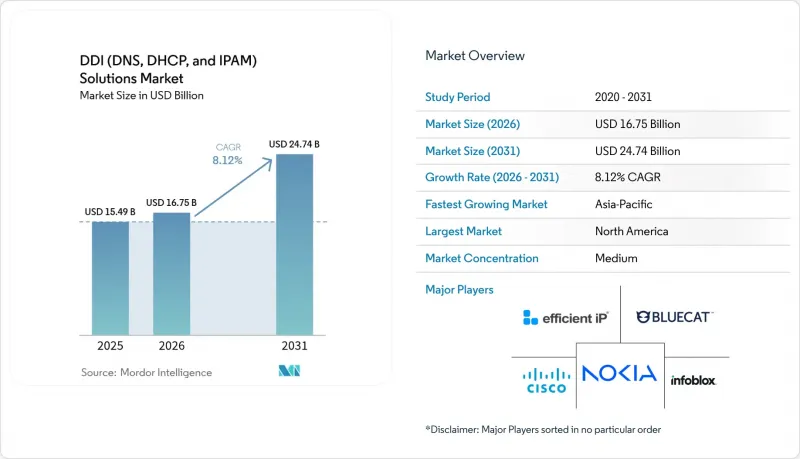
본 보고서는 구성 요소(하드웨어, 소프트웨어), 도입 형태(On-Premise, 클라우드), 최종 사용자 산업(제조, 소매, 의료 및 생명과학 등), 용도(네트워크 자동화, 가상화 및 클라우드 오케스트레이션 등), 그리고 지역별로 분류되어 있습니다. 시장 예측은 금액(달러) 기준으로 제시되어 있습니다.
세계의 DDI(DNS, DHCP, IPAM) 솔루션 시장 동향 및 인사이트
클라우드 및 IoT로 인한 IP 주소 수의 급증
연결된 엔드포인트의 기하급수적인 증가로 인해 기업들은 On-Premise 데이터센터, 여러 퍼블릭 클라우드, 그리고 신흥 엣지 위치에 걸쳐 있는 방대한 주소 공간을 관리해야만 합니다. 구글과 엔비디아의 투자에 힘입어 말레이시아가 지역 데이터센터 허브로 부상하고 있는 것은 현재 진행 중인 네트워크 확장의 규모를 여실히 보여줍니다. 아시아태평양의 데이터센터 시장은 2032년까지 연평균 12.6% 성장할 것으로 예상되며, 이기종 인프라 전반에 걸친 IP 주소의 자동 오케스트레이션이 시급한 과제가 되고 있습니다. 따라서 실시간 감지, 정책 기반 프로비저닝 및 상세한 분석 기능을 제공하는 DDI 플랫폼은 디지털 확장을 위한 기반 도구가 될 것입니다.
데이터 보안 및 개인정보 보호 규제의 강화
보안 규제가 강화됨에 따라 DDI는 백오피스 유틸리티에서 최전선 제어 수단으로 그 위상을 높이고 있습니다. NIS2 지침은 DNS 서비스 제공업체에 사고 발생 후 24시간 이내에 보고할 의무를 부과하며, 위반 시 최대 1,000만 유로(1,179만 달러)의 벌금을 부과합니다. 미국에서는 대통령령 제14144호에 따라 연방 기관에 제로 트러스트 도입의 일환으로 DNS 트래픽 암호화를 지시하고 있습니다. 이에 따라 기업들은 적응형 위협 인텔리전스, DNS-over-HTTPS 암호화 및 자동화된 규정 준수 보고 기능을 통합한 DDI 제품군을 도입하고 있습니다.
IT 예산 부족과 도입 리스크에 대한 우려
관세로 인한 하드웨어 가격 급등이 설비 투자 예산을 압박하고 있습니다. 네트워크 장비 전반에 걸쳐 8-20%의 가격 상승이 예상되며, 2025년 IT 지출 증가율이 당초 예상치의 절반으로 축소되었습니다. 중견 기업들은 현금을 확보하기 위해 하드웨어 교체 주기를 연장하고, DDI 업그레이드를 미루고 있습니다. 이전 과정 중 발생할 수 있는 서비스 중단에 대한 우려도 도입을 더욱 지연시키고 있습니다. 벤더 측은 투자 대비 효과를 명확히 하기 위해 구독 모델, 단계적 도입, 성과 기반 가격 책정과 같은 대응책을 마련하고 있습니다.
부문 분석
2025년, DDI(DNS, DHCP, IPAM) 솔루션 시장 중 소프트웨어가 52.42%를 차지했으며, 2031년까지 연평균 성장률(CAGR) 8.53%로 확대될 것으로 예측됩니다. 각 벤더사는 IP 주소 관리, DNS 보안 분석, DHCP 자동화를 모든 클라우드 환경에서 작동하는 마이크로서비스로 패키지화하여 전용 어플라이언스가 더 이상 필요하지 않게 되었습니다. Infoblox사의 ‘Universal DDI Suite’는 AWS, Microsoft Azure, Google Cloud를 아우르는 단일 제어 평면을 제공합니다. 소프트웨어 부문은 초기 비용 절감, 자동 버전 업데이트, DevOps 워크플로우에 적합한 API 기반 확장성 등의 이점을 누리고 있습니다. 하드웨어 솔루션은 지연 시간에 민감한 엣지 사이트에서는 여전히 중요하지만, 가상화의 진전에 따라 이익률 압박에 직면하고 있습니다.
머신러닝 알고리즘에 대한 의존도가 높아짐에 따라 소프트웨어의 우위는 더욱 공고해지고 있습니다. 예측적 경쟁 감지, 의도 기반 정책 검증, 그리고 자가 복구형 DNS 기능은 프리미엄 제품을 차별화하는 요소가 되고 있습니다. 조직들이 클라우드 네이티브 아키텍처를 추구함에 따라 자본 지출(CAPEX)을 운영 지출(OPEX)로 전환하는 구독형 라이선싱을 선호하게 되었으며, 이로 인해 소프트웨어 수익의 확대가 더욱 지속될 것입니다. 따라서 소프트웨어 분야는 기존 벤더와 신흥 벤더 모두에게 제품 로드맵의 우선순위를 정하는 기준이 되고 있습니다.
2025년, DDI(DNS, DHCP, IPAM) 솔루션 시장 규모의 65.05%를 클라우드 도입이 차지했으며, 2031년까지 연평균 성장률(CAGR) 10.25%를 나타낼 것으로 예측됩니다. 멀티 클라우드 환경을 성숙시켜 온 기업들은 여러 공급자를 아우르는 DDI 관리를 통합함으로써 22%의 비용 절감을 실현하고 있다고 보고하고 있습니다. 각 하이퍼스케일러 기업들은 2025년, 10개국에서 데이터센터용량을 확대하고, 데이터 주권에 관한 법규를 준수하면서 고객에게 로컬 지연 시간 프로파일을 제공했습니다. 이러한 요인들이 클라우드 호스팅형 DDI 서비스의 직접 이용을 촉진하고 있습니다.
그럼에도 불구하고 하이브리드 모델은 여전히 일반적입니다. 금융 서비스 기업과 국방 기관은 정책 관리를 위해 On-Premise DNS 루트 서버를 유지하면서, 보조 영역을 클라우드 호스팅에 위임하고 있습니다. 5G 및 IoT 이용 사례에서는 현지화된 DHCP 서비스가 필요하기 때문에 엣지 컴퓨팅을 통해 도입 방식의 선택지는 더욱 다양해지고 있습니다. 이에 따라 각 벤더는 SaaS, 컨테이너, 어플라이언스 등 다양한 환경에 걸쳐 정책을 동기화하는 이식 가능한 제어 플레인에 투자하여, 위치에 관계없이 일관된 거버넌스를 확보하고 있습니다.
지역별 분석
2025년, 북미는 DDI(DNS, DHCP, IPAM) 솔루션 시장을 주도하며 매출 점유율 34.35%를 차지했습니다. 연방 정부의 제로 트러스트 의무화와 대기업의 클라우드 도입 성숙도 증대가 기능이 풍부한 플랫폼에 대한 수요를 뒷받침하고 있습니다. 관세와 관련된 물가 상승 및 거시경제에 대한 경계감으로 인해 중견 기업의 지출은 억제될 가능성이 있지만, 연방 정부가 정한 기한 내에 IPv6로의 전환은 여전히 필수 요건입니다. 각 하이퍼스케일러 기업들은 클라우드 DNS의 전개 범위를 확대하고, SaaS 형식으로 제공되는 IPAM 서비스 이용을 촉진하는 지역 존을 계속해서 개설하고 있습니다.
아시아태평양은 2031년까지 연평균 성장률(CAGR) 8.39%라는 가장 높은 성장세를 보이고 있습니다. 말레이시아, 인도네시아, 인도에서 진행 중인 급속한 도시 디지털화, 5G 구축, 대규모 데이터센터 건설로 인해 여러 지역에 걸친 주소 관리 문제가 발생하고 있습니다. 경제적 역풍에도 불구하고, IPv6 도입을 가속화하겠다는 중국의 지침에 따라 국내 수요는 높은 수준을 유지하고 있습니다. 그러나 지역별 규제의 다양성으로 인해 벤더들은 서로 다른 법적 요건을 충족하기 위해 호스팅 및 데이터 레지던시 기능을 현지화해야 할 필요에 직면해 있습니다.
유럽의 NIS2 프레임워크는 중요 부문 전반에 걸친 사이버 보안 의무를 공식적으로 규정하고 있으며, DNS 리스크 관리는 이사회 차원의 우선 과제가 되었습니다. 벨기에, 헝가리, 크로아티아, 라트비아는 조기에 법적 체계에 이를 반영하는 작업을 완료한 반면, 다른 회원국들은 승인 단계가 제각각입니다. 에너지 비용 상승과 신중한 자금 조달 환경으로 인해 단기적으로는 데이터센터 확장이 제한될 가능성이 있지만, 정보 유출 보고 의무화로 인해 안전한 DDI 제어에 대한 지속적인 투자가 보장되고 있습니다. 남미, 중동 및 아프리카는 장기적인 잠재력을 지니고 있으나, 현재는 인프라 및 인력 문제에 직면해 있어 광범위한 도입이 지연되고 있습니다.
기타 혜택 :
- 엑셀 형식 시장 예측(ME) 시트
- 3개월간의 애널리스트 지원
자주 묻는 질문
목차
제1장 서론
제2장 조사 방법
제3장 주요 요약
제4장 시장 구도
제5장 시장 규모 및 성장 예측
제6장 경쟁 구도
제7장 시장 기회 및 향후 전망
KTH 26.08.26According to Mordor Intelligence, the dDI (DNS, dHCP, and iPAM) solutions market size is expected to grow from USD 15.49 billion in 2025 to USD 16.75 billion in 2026 and is forecast to reach USD 24.74 billion by 2031 at 8.12% CAGR over 2026-2031.
This report is Segmented by Component (Hardware, Software), Deployment Mode (On-Premises, Cloud), End User Industry (Manufacturing, Retail, Healthcare and Life Sciences, and More), Application (Network Automation, Virtualization and Cloud Orchestration, and More) and by Geography. The Market Forecasts are Provided in Terms of Value (USD).
Global DDI (DNS, DHCP, And IPAM) Solutions Market Trends and Insights
Surge in Cloud and IoT-Driven IP Address Volume
The exponential rise in connected endpoints forces enterprises to manage sprawling address spaces that span on-premises data centers, multiple public clouds and emerging edge locations. Malaysia's rise as a regional data-center hub, supported by investments from Google and Nvidia, illustrates the magnitude of network scaling now underway. The Asia-Pacific data-center market is projected to advance at 12.6% per year to 2032, underscoring the pressing need for automated IP address orchestration across heterogeneous infrastructure. DDI platforms that deliver real-time discovery, policy-driven provisioning and deep analytics therefore become foundational tools for digital expansion.
Heightened Data-Security and Privacy Regulations
Security mandates elevate DDI from a back-office utility to a frontline control. The NIS2 directive obliges DNS service providers to report incidents within 24 hours and imposes penalties up to EUR 10 million (USD 11.79 million) for non-compliance. In the United States, Executive Order 14144 instructs federal agencies to encrypt DNS traffic as part of Zero Trust implementation. Enterprises therefore turn to DDI suites that integrate adaptive threat intelligence, DNS-over-HTTPS encryption and automated compliance reporting.
Tight IT Budgets and Perceived Deployment Risk
Tariff-driven hardware inflation is compressing capital budgets. Forecast price increases of 8-20% across networking gear threaten to halve anticipated IT spending growth in 2025. Mid-size enterprises extend hardware refresh cycles and defer DDI upgrades to conserve cash. Concerns over service disruption during migrations further slow adoption. Vendors respond with subscription models, phased rollouts and outcome-based pricing to clarify return on investment.
Other drivers and restraints analyzed in the detailed report include:
- Accelerated IPv6 Transition Across Enterprises
- Network-Automation Demand in Zero-Touch Ops
- Scarcity of Skilled DDI and DNS-Security Talent
For complete list of drivers and restraints, kindly check the Table Of Contents.
Segment Analysis
Software accounted for 52.42% of the DDI (DNS, DHCP, and IPAM) solutions market in 2025 and is forecast to expand at an 8.53% CAGR through 2031. Vendors package IP address management, DNS security analytics and DHCP automation as microservices that run in any cloud, removing the need for specialized appliances. Infoblox's Universal DDI Suite offers a single control plane spanning AWS, Microsoft Azure and Google Cloud. The software segment benefits from lower upfront cost, automatic version updates and API-based extensibility that aligns with DevOps workflows. Hardware solutions remain relevant for latency-sensitive edge sites but face margin pressure as virtualization advances.
Growing reliance on machine-learning algorithms reinforces software leadership. Predictive conflict detection, intent-based policy validation and self-healing DNS capabilities differentiate premium offerings. As organizations pursue cloud-native architectures, they prefer subscription licensing that converts capital expenditure to operating expenditure, further sustaining software revenue expansion. The software segment therefore underpins product-roadmap prioritization for incumbent and emerging vendors alike.
Cloud deployments comprised 65.05% of the DDI (DNS, DHCP, and IPAM) solutions market size in 2025 and are projected to grow at a 10.25% CAGR to 2031. Mature multi-cloud enterprises report 22% cost avoidance when centralizing DDI control across providers. Hyperscalers added data-center capacity in ten countries during 2025, giving customers local latency profiles while complying with data-sovereignty laws. These factors encourage direct consumption of cloud-hosted DDI services.
Hybrid models nonetheless remain common. Financial services firms and defense agencies retain on-premises DNS roots for policy control while delegating secondary zones to cloud hosts. Edge computing further diversifies deployment decisions, as 5G and IoT use cases require localized DHCP services. Vendors therefore invest in portable control planes that synchronize policies across SaaS, container and appliance footprints, ensuring consistent governance regardless of location.
Complete Report Scope:
- By Component
- Hardware
- Software
- By Deployment Model
- On-premise
- Cloud
- By End-user Industry
- Manufacturing
- Retail
- Healthcare and Life Sciences
- Education
- BFSI
- IT and Telecom
- Government and Defense
- Other Industries
- By Application
- Network Automation
- Virtualization and Cloud Orchestration
- Data-center Transformation
- Network Security and Zero-Trust
- Others
- By Geography
- North America
- United States
- Canada
- Mexico
- South America
- Brazil
- Argentina
- Rest of South America
- Europe
- Germany
- United Kingdom
- France
- Italy
- Spain
- Rest of Europe
- Asia-Pacific
- China
- Japan
- India
- South Korea
- Southeast Asia
- Rest of Asia-Pacific
- Middle East and Africa
- Middle East
- Saudi Arabia
- United Arab Emirates
- Turkey
- Rest of Middle East
- Africa
- South Africa
- Nigeria
- Egypt
- Rest of Africa
- Middle East
- North America
Geography Analysis
North America led the DDI (DNS, DHCP, and IPAM) solutions market in 2025 with 34.35% revenue share. Federal Zero Trust mandates and large-enterprise cloud maturity sustain demand for feature-rich platforms. Tariff-related price inflation and macroeconomic caution could temper mid-market spending, but migration to IPv6 remains non-negotiable under federal deadlines. Hyperscalers continue to launch regional zones that expand cloud DNS footprints and encourage consumption of SaaS-delivered IPAM services.
Asia-Pacific generates the highest growth momentum at 8.39% CAGR to 2031. Rapid urban digitalization, 5G rollouts and substantial data-center construction in Malaysia, Indonesia and India create multiregional address-management challenges. China's directive to accelerate IPv6 adoption despite economic headwinds keeps domestic demand elevated. Regional regulatory diversity, however, forces vendors to localize hosting and data residency features to satisfy divergent legal requirements.
Europe's NIS2 framework formalizes cybersecurity obligations across critical sectors, making DNS risk management a board-level priority. Belgium, Hungary, Croatia and Latvia achieved early legislative transposition, while other member states remain in varying stages of approval. Energy costs and a cautious funding environment may limit near-term data-center expansion, but mandatory breach-reporting rules ensure sustained investment in secure DDI controls. South America, the Middle East and Africa offer long-run potential but currently face infrastructure and skills challenges that delay widespread deployment.
- Infoblox
- EfficientIP
- BlueCat Networks
- Cisco Systems
- Nokia (VitalQIP)
- TCPWave
- FusionLayer
- Cygna Labs
- Microsoft
- SolarWinds
- Men and Mice
- BT Diamond IP
- 6connect
- ApplianSys
- ManageEngine (Zoho Corp)
- DiamondIT
- Alcatel-Lucent Enterprise
- Infobip
- Verisign
- Amazon Route 53 (AWS)
- NS1
Additional Benefits:
- The market estimate (ME) sheet in Excel format
- 3 months of analyst support
TABLE OF CONTENTS
1 INTRODUCTION
- 1.1 Study Assumptions and Market Definition
- 1.2 Scope of the Study
2 RESEARCH METHODOLOGY
3 EXECUTIVE SUMMARY
4 MARKET LANDSCAPE
- 4.1 Market Overview
- 4.2 Market Drivers
- 4.2.1 Surge in cloud and IoT-driven IP address volume
- 4.2.2 Heightened data-security and privacy regulations
- 4.2.3 Accelerated IPv6 transition across enterprises
- 4.2.4 Network-automation demand in Zero-Touch Ops
- 4.2.5 Government Zero-Trust cybersecurity mandates
- 4.2.6 5G and edge roll-outs amplifying DDI complexity
- 4.3 Market Restraints
- 4.3.1 Tight IT budgets and perceived deployment risk
- 4.3.2 Scarcity of skilled DDI and DNS-security talent
- 4.3.3 Multi-cloud integration and API-interoperability hurdles
- 4.3.4 Vendor lock-in fears amid proprietary platforms
- 4.4 Industry Value Chain Analysis
- 4.5 Regulatory Landscape
- 4.6 Technological Outlook
- 4.7 Porter's Five Forces
- 4.7.1 Bargaining Power of Suppliers
- 4.7.2 Bargaining Power of Buyers
- 4.7.3 Threat of New Entrants
- 4.7.4 Threat of Substitutes
- 4.7.5 Intensity of Competitive Rivalry
- 4.8 Assesment of Macroeconomic Factors on the market
5 MARKET SIZE AND GROWTH FORECASTS (VALUE)
- 5.1 By Component
- 5.1.1 Hardware
- 5.1.2 Software
- 5.2 By Deployment Model
- 5.2.1 On-premise
- 5.2.2 Cloud
- 5.3 By End-user Industry
- 5.3.1 Manufacturing
- 5.3.2 Retail
- 5.3.3 Healthcare and Life Sciences
- 5.3.4 Education
- 5.3.5 BFSI
- 5.3.6 IT and Telecom
- 5.3.7 Government and Defense
- 5.3.8 Other Industries
- 5.4 By Application
- 5.4.1 Network Automation
- 5.4.2 Virtualization and Cloud Orchestration
- 5.4.3 Data-center Transformation
- 5.4.4 Network Security and Zero-Trust
- 5.4.5 Others
- 5.5 By Geography
- 5.5.1 North America
- 5.5.1.1 United States
- 5.5.1.2 Canada
- 5.5.1.3 Mexico
- 5.5.2 South America
- 5.5.2.1 Brazil
- 5.5.2.2 Argentina
- 5.5.2.3 Rest of South America
- 5.5.3 Europe
- 5.5.3.1 Germany
- 5.5.3.2 United Kingdom
- 5.5.3.3 France
- 5.5.3.4 Italy
- 5.5.3.5 Spain
- 5.5.3.6 Rest of Europe
- 5.5.4 Asia-Pacific
- 5.5.4.1 China
- 5.5.4.2 Japan
- 5.5.4.3 India
- 5.5.4.4 South Korea
- 5.5.4.5 Southeast Asia
- 5.5.4.6 Rest of Asia-Pacific
- 5.5.5 Middle East and Africa
- 5.5.5.1 Middle East
- 5.5.5.1.1 Saudi Arabia
- 5.5.5.1.2 United Arab Emirates
- 5.5.5.1.3 Turkey
- 5.5.5.1.4 Rest of Middle East
- 5.5.5.2 Africa
- 5.5.5.2.1 South Africa
- 5.5.5.2.2 Nigeria
- 5.5.5.2.3 Egypt
- 5.5.5.2.4 Rest of Africa
- 5.5.5.1 Middle East
- 5.5.1 North America
6 COMPETITIVE LANDSCAPE
- 6.1 Market Concentration
- 6.2 Strategic Moves
- 6.3 Market Share Analysis
- 6.4 Company Profiles (includes Global level Overview, Market level overview, Core Segments, Financials as available, Strategic Information, Market Rank/Share, Products and Services, Recent Developments)
- 6.4.1 Infoblox
- 6.4.2 EfficientIP
- 6.4.3 BlueCat Networks
- 6.4.4 Cisco Systems
- 6.4.5 Nokia (VitalQIP)
- 6.4.6 TCPWave
- 6.4.7 FusionLayer
- 6.4.8 Cygna Labs
- 6.4.9 Microsoft
- 6.4.10 SolarWinds
- 6.4.11 Men and Mice
- 6.4.12 BT Diamond IP
- 6.4.13 6connect
- 6.4.14 ApplianSys
- 6.4.15 ManageEngine (Zoho Corp)
- 6.4.16 DiamondIT
- 6.4.17 Alcatel-Lucent Enterprise
- 6.4.18 Infobip
- 6.4.19 Verisign
- 6.4.20 Amazon Route 53 (AWS)
- 6.4.21 NS1
7 MARKET OPPORTUNITIES AND FUTURE OUTLOOK
- 7.1 White-space and Unmet-Need Assessment


