

|
시장보고서
상품코드
2113968
접착 촉진제 : 시장 점유율 분석, 업계 동향 및 통계, 성장 예측(2026-2031년)Adhesion Promoters - Market Share Analysis, Industry Trends & Statistics, Growth Forecasts (2026 - 2031) |
||||||
 Mordor Intelligence
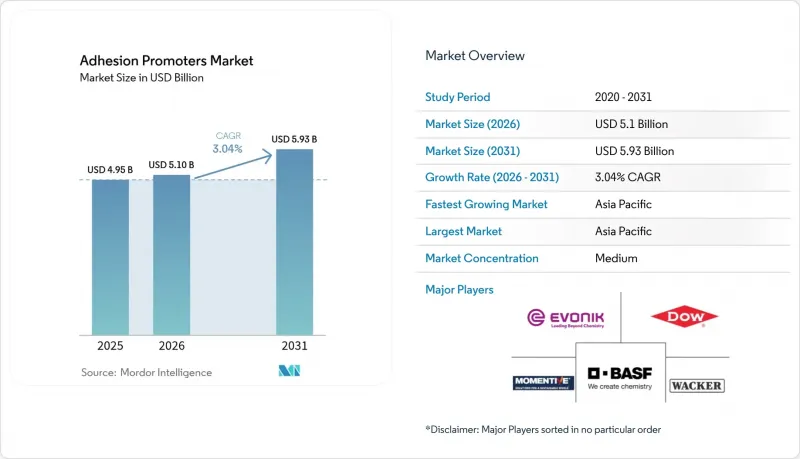
Mordor Intelligence에 의하면, 접착 촉진제 시장 규모는 2025년에 49억 5,000만 달러로 평가되었습니다. 2026년에는 51억 달러에 달하고, 2031년까지 59억 3,000만 달러에 이를 것으로 예측됩니다.
예측 기간(2026-2031년) 동안 연평균 성장률(CAGR)은 3.04%가 될 것으로 전망됩니다.
본 보고서에서는 업계를 유형별(실란, 무수 말레산, 티타네이트 및 지르코네이트 등), 용도별(플라스틱 및 복합재료, 도료 및 코팅 등), 최종 사용자 산업별(자동차 및 운송, 전기 및 전자 등), 지역별(아시아태평양, 북미, 유럽 등)로 분류하고 있습니다. 시장 예측은 금액(달러) 기준으로 제시됩니다.
세계의 접착 촉진제 시장 동향 및 인사이트
자동차용 경량 플라스틱 및 복합재료에 대한 수요 증가
세계 자동차 플랫폼은 탄소섬유, 유리 섬유, 알루미늄, 고장력 강철을 조합한 다중 소재 구조로 전환되고 있습니다. 이러한 이종 기판 간의 공유 결합은 150°C를 초과하는 열 사이클을 견디면서 갈바닉 부식을 억제하는 실란계, 티타네이트계, 지르코네이트계 접착 촉진제에 의존하고 있습니다. 최신 배합 기술을 통해 충돌 안전 성능을 저해하지 않으면서 차량 중량을 15% 절감할 수 있게 되었으며, 이는 전기차의 주행 거리 목표를 직접적으로 뒷받침하고 있습니다. 각 OEM 업체들이 배터리 팩 생산 라인을 현지화하는 가운데, 접착 촉진제의 지역 조달 능력은 경쟁상의 차별화 요소가 되고 있습니다. 특히 북미에서는 ‘인플레이션 감축법(IRA)’의 함유율 규정을 준수하는지가 공급업체 선정에 결정적인 영향을 미치고 있어 이러한 경향이 두드러집니다. 따라서 접착 촉진제 시장은 모델 연도마다 자동차 밸류체인에 더욱 깊이 통합되어 갈 것입니다.
전자기기의 소형화와 전기차(EV) 배터리 패키징 수요
폴더블 디스플레이, 카메라 렌즈 스택, 시스템 인 패키지(SiP) 기판에는 수천 번의 굴곡을 견디면서 광학적 투명성을 유지할 수 있는 초박형 접착층이 요구됩니다. 유리 전이 온도가 낮은 모노머를 사용하여 설계된 접착 촉진제는 투명성을 유지하고 황변을 억제하므로 베젤이 없는 스마트폰 설계를 가능하게 합니다. 이와 동시에, 전기차(EV)의 ‘셀 투 팩(Cell-to-Pack)’ 아키텍처에서는 기존의 모듈 벽이 제거되었습니다. 현재 특수 접착 촉진제가 셀과 냉각판을 접합하여 -40°C에서 85°C에 이르는 온도 변동을 견디며, 열 폭주의 전파를 억제하고 있습니다. 이러한 이중 요구 사항으로 인해 열전도성과 전기 절연성을 모두 갖춘 접착 촉진제의 화학 조성 채택이 가속화되고 있으며, 접착 촉진제 시장은 소비자 가전 및 모빌리티 전자기기 분야로 확대되고 있습니다.
실란 및 무수 말레인의 원자재 가격 변동
2024년부터 2025년에 걸쳐 에너지 관련 원자재 가격 및 물류 병목 현상이 중국 생산자들에게 파급된 영향으로, 실란의 현물 가격은 25% 변동했습니다. 무수 말레인은 벤젠 및 부탄의 가격 변동에 연동되어, 배합 제조업체들은 분기별로 계약을 재협상할 수밖에 없었습니다. 1차 공급업체들이 후방 통합을 가속화하는 한편, 중견 블렌딩 업체들은 추가 비용을 하류로 전가하고 있어, 이로 인해 접착제 제조업체의 이익률이 압박받고 있습니다. 이러한 동향으로 인해, 예측 기간 후반에 신규 생산 능력이 공급을 안정화시킬 때까지 접착 촉진제 시장의 연평균 성장률(CAGR)은 1퍼센트 포인트 가까이 하락할 것으로 예측됩니다.
부문 분석
2025년 기준, 실란계 제품은 접착 촉진제 시장 규모의 38.74%를 차지했으며, 2031년까지의 연평균 성장률(CAGR)이 5.72%인 것은 자동차, 타이어, 전자기기 기판 분야로의 지속적인 다각화를 뒷받침합니다. 가수분해성 알콕시기는 유리, 금속 산화물 및 실리카와의 결합을 보장하는 한편, 관능성 유기물은 에폭시, 폴리에스테르 또는 우레탄과 공중합합니다. 이러한 이중 반응성 덕분에 조립 시간이 단축되고 기계적 전처리의 필요성이 감소합니다. 차세대 실란은 펜던트형 이미드 고리 또는 에폭시 고리가 그래프트되어 있어, 배터리 팩 및 항공우주용 부품의 내열성을 높이고 있습니다. 무수 말레인을 그래프트한 폴리올레핀은 폴리프로필렌의 표면 개질에 여전히 필수적이지만, 그 수요는 저비용이 염소계 대체품을 능가하는 분야로 제한되어 있습니다. 티타네이트 및 지르코네이트계 촉진제는 틈새 시장이지만, 200°C를 초과하는 엔진룸 내 용도나 오토클레이브 사이클로 경화되는 복합재료 분야에서 수주를 확보하고 있습니다.
현재 경쟁의 핵심은 공급 안정성에 있습니다. 에보닉(Evonik)은 업스트림 중간체와 고객 고유의 커플링제를 연계하기 위해 실리카 및 실란 사업을 ‘Smart Effects’ 사업 부문으로 통합했습니다. 중소규모의 배합 제조업체들은 이러한 실란에 대한 라이선스를 취득하여, 사용자의 혼합 실수를 줄여주는 사전 축합 블렌드를 개발하고 있습니다. 환경 규제가 강화됨에 따라 수요는 염소계 폴리올레핀에서 새로 제정되고 있는 PFAS 규정을 준수하는 무할로겐 등급으로 전환되고 있습니다. 그 결과, 화학 물질 간의 역동적인 재균형이 향후 10년 동안 접착 촉진제 시장을 형성하게 될 것입니다.
지역별 분석
아시아태평양은 자동차 조립 클러스터, 전자기기 수출 거점, 그리고 급속한 도시 인프라 구축에 힘입어 2025년에는 매출의 46.92%를 차지하며 접착 촉진제 시장을 주도했습니다. 이 지역의 연포장 변환 업체들은 전자빔 경화 기술 도입을 서두르고 있으며, 이러한 전환에는 표면으로의 이동 속도가 빠르고 악취가 적은 접착 촉진제가 필요합니다(『Adhesives Magazine』). 중국, 인도, 인도네시아에서 경형 전기차에 대한 정부의 장려 정책이 추가적인 수요를 뒷받침하고 있으며, 국내 실란 생산 덕분에 지역 구매자들은 환율 변동에 따른 영향으로부터 보호받고 있습니다.
북미는 성숙하지만 혁신이 활발한 시장이며, 규제 준수가 수요를 좌우하고 있습니다. 캘리포니아주의 VOC 규제로 인해 수성 촉진제 시스템의 채택이 가속화되고 있으며, 미국-멕시코-캐나다 협정(USMCA)은 현지화된 화학물질 공급망을 뒷받침하고 있습니다. 미시간주와 텍사스주에서 전기 픽업 트럭이 출시됨에 따라, 겨울철 동결 및 해빙, 고온 노출과 같은 극한 조건을 견디는 촉진제의 유효성이 입증되어 특수 실리콘 변성 커플링제의 수주량이 확대되고 있습니다. 따라서 이 지역의 접착 촉진제 시장은 판매량의 급증보다는 사양의 고도화를 통해 진화하고 있습니다.
유럽에서는 여전히 환경 규제가 엄격하게 적용되고 있어, 이에 따라 배합 개발자들은 비할로겐계 및 바이오 촉진제를 채택하도록 유도되고 있습니다. 자동차 업계에서 친환경 타이어가 의무화됨에 따라, CO₂ 배출량 함대 목표를 달성하고자 하는 OEM에게 실란 공급업체는 전략적 파트너가 되고 있습니다. ‘리노베이션 웨이브(Renovation Wave)’ 이니셔티브에 기반한 개보수 프로그램으로 인해, 차세대 파사드 클래딩에 대한 접착력을 높이는 인산 에스테르계 촉진제를 배합한 건축용 실란트의 소비량이 더욱 증가하고 있습니다. GDP 성장세는 완만하지만, 해당 지역의 엄격한 기준으로 인해 프리미엄 가격대가 형성되어 매출 기준 접착 촉진제 시장 규모 확대로 이어지고 있습니다.
기타 혜택 :
- 엑셀 형식 시장 예측(ME) 시트
- 3개월간의 애널리스트 지원
자주 묻는 질문
목차
제1장 서론
제2장 조사 방법
제3장 주요 요약
제4장 시장 구도
제5장 시장 규모 및 성장 예측
제6장 경쟁 구도
제7장 시장 기회 및 향후 전망
KTH 26.08.26According to Mordor Intelligence, the adhesion promoters market size was valued at USD 4.95 billion in 2025 and estimated to grow from USD 5.1 billion in 2026 to reach USD 5.93 billion by 2031, at a CAGR of 3.04% during the forecast period (2026-2031).
This report Segments the Industry by Type (Silanes, Maleic Anhydride, Titanates and Zirconates, and More), Application (Plastics and Composites, Paints and Coatings, and More), End-User Industry (Automotive and Transportation, Electrical and Electronics, and More) and Geography (Asia-Pacific, North America, Europe, and More). The Market Forecasts are Provided in Terms of Value (USD).
Global Adhesion Promoters Market Trends and Insights
Rising demand for lightweight automotive plastics and composites
Global vehicle platforms are migrating toward multi-material architectures that combine carbon fiber, glass fiber, aluminum, and high-strength steel. Covalent bonding across such dissimilar substrates hinges on silane, titanate, and zirconate promoters that tolerate thermal cycling beyond 150 °C while curbing galvanic corrosion. Latest formulations enable a 15% curb-weight reduction without compromising crash metrics, directly supporting electric-vehicle range goals. As OEMs localize battery-pack lines, regional sourcing of adhesion promoters becomes a competitive differentiator, particularly in North America where compliance with Inflation Reduction Act content rules shapes supplier selection. The adhesion promoters market therefore embeds itself deeper into the automotive value chain each model year.
Electronics miniaturization and EV battery packaging needs
Foldable displays, camera lens stacks, and system-in-package boards call for ultra-thin adhesive layers able to flex thousands of times while remaining optically clear. Promoters engineered with low glass-transition monomers preserve transparency and suppress yellowing, enabling bezel-free smartphone designs. In parallel, cell-to-pack EV architectures eliminate conventional module walls; specialized promoters now link cells to cooling plates, withstanding -40 °C to 85 °C swings and inhibiting thermal-runaway propagation. These dual pressures speed adoption of thermally conductive, electrically insulating promoter chemistries, expanding the adhesion promoters market across consumer and mobility electronics.
Volatile silane and maleic-anhydride feedstock prices
Spot silane quotes swung 25% during 2024-2025 as energy-linked inputs and logistical bottlenecks rippled through Chinese producers. Maleic anhydride followed benzene and butane volatility, forcing formulators to renegotiate quarterly contracts. While tier-one suppliers accelerate backward integration, mid-size blenders pass surcharges downstream, eroding adhesive makers' margins. These dynamics shave nearly 1 percentage point from the adhesion promoters market CAGR until fresh capacity stabilizes supply late in the forecast window.
Other drivers and restraints analyzed in the detailed report include:
- Expansion of flexible packaging converters in Asia
- Shift to silane-based green-tire formulations
- VOC and halogenated CPO regulatory pressure
For complete list of drivers and restraints, kindly check the Table Of Contents.
Segment Analysis
Silane-based products captured 38.74% of the adhesion promoters market size in 2025 and their 5.72% CAGR through 2031 underscores continued diversification into automotive, tire, and electronics substrates. Hydrolyzable alkoxy groups secure bonds to glass, metal oxides, and silica, while functional organics co-polymerize with epoxies, polyesters, or urethanes. This dual reactivity shortens assembly time and reduces the need for mechanical pretreatment. Next-generation silanes graft pendant imide or epoxy rings, enhancing high-temperature tolerance for battery pack and aerospace components. Maleic-anhydride grafted polyolefins remain indispensable in polypropylene surface modification but grow only where lower cost outweighs chlorinated alternatives. Titanate and zirconate promoters, though niche, win contracts in under-hood applications exceeding 200 °C and in composites cured by autoclave cycles.
Competition now hinges on supply security; Evonik consolidated its silica and silane operations into the Smart Effects business line to synchronize upstream intermediates with customer-specific coupling agents. Smaller formulators are licensing these silanes to develop pre-condensed blends that cut user mixing errors. Environmental scrutiny is steering demand from chlorinated polyolefins toward non-halogenated grades compliant with emerging PFAS limits. As a result, dynamic rebalancing among chemistries will shape the adhesion promoters market across the decade.
Complete Report Scope:
- By Type
- Silane
- Maleic Anhydride
- Titanate and Zirconate
- Chlorinated Polyolefins
- Non-chlorinated Polyolefins
- Other Types
- By Application
- Plastics and Composites
- Paints and Coatings
- Rubber
- Adhesives
- Metal Substrates
- Other Applications
- By End-Use Industry
- Automotive and Transportation
- Electrical and Electronics
- Packaging
- Consumer Goods
- Construction
- Others End-Use Industries
- By Geography
- Asia-Pacific
- China
- India
- Japan
- South Korea
- Rest of Asia-Pacific
- North America
- United States
- Canada
- Mexico
- Europe
- Germany
- United Kingdom
- France
- Italy
- Rest of Europe
- South America
- Brazil
- Argentina
- Rest of South America
- Middle East and Africa
- Saudi Arabia
- South Africa
- Rest of Middle East and Africa
- Asia-Pacific
Geography Analysis
Asia-Pacific dominated the adhesion promoters market with 46.92% revenue in 2025, propelled by automotive assembly clusters, electronics export bases, and swift urban infrastructure rollout. The region's flexible-packaging converters are racing to adopt electron-beam curing, a shift that requires promoters with rapid surface migration yet low odor Adhesives Magazine. Government incentives for light-duty EVs in China, India, and Indonesia add further pull, and domestic silane output shields regional buyers from exchange-rate shocks.
North America represents a mature but innovation-heavy arena where regulatory compliance shapes demand. California's VOC limits accelerated adoption of water-borne promoter systems, and the United States-Mexico-Canada Agreement favors localized chemical supply chains. Electric-pickup launches in Michigan and Texas validate promoters that survive winter freeze-thaw and hot-soak extremes, expanding contract volumes for specialty silicone-modified coupling agents. The adhesion promoters market therefore evolves here through specification upgrades rather than unit-growth spurts.
Europe remains tightly governed by environmental legislation, steering formulators to non-halogenated and bio-based promoters. Automotive green-tire mandates make silane suppliers strategic partners for OEMs chasing CO2 fleet targets. Retrofit programs under the Renovation Wave initiative further lift consumption in building sealants that embed phosphate-ester promoters for adhesion to new-generation facade claddings. Despite modest GDP growth, the region's rigorous standards create premium pricing corridors that lift the adhesion promoters market size in revenue terms.
- 3M
- Arkema
- Atlanta Group (BYK-Chemie GmbH)
- BASF
- Borica Co., Ltd
- DIC Corporation
- Dow
- Eastman Chemical Company
- EMS-CHEMIE Holding AG
- Evonik Industries AG
- Huntsman International LLC
- Kemipex
- Momentive
- Nagase ChemteX Corporation
- NIPPON PAPER INDUSTRIES CO., LTD.
- Nouryon
- ROWA GROUP Holding GmbH (TRAMACO Gmbh)
- ShinEtsu Microsi
- Sika AG
- Solvay
- Toyobo Co. Ltd.
- Wacker Chemie AG
Additional Benefits:
- The market estimate (ME) sheet in Excel format
- 3 months of analyst support
TABLE OF CONTENTS
1 Introduction
- 1.1 Study Assumptions and Market Definition
- 1.2 Scope of the Study
2 Research Methodology
3 Executive Summary
4 Market Landscape
- 4.1 Market Overview
- 4.2 Market Drivers
- 4.2.1 Rising Demand for Lightweight Automotive Plastics and Composites
- 4.2.2 Electronics Miniaturisation and EV Battery Packaging Needs
- 4.2.3 Expansion of Flexible Packaging Converters in Asia
- 4.2.4 Shift to Silane-Based Green-Tire Formulations
- 4.2.5 Increasing Usage in the Electrical and Electronics Industry
- 4.3 Market Restraints
- 4.3.1 Volatile Silane and Maleic-Anhydride Feedstock Prices
- 4.3.2 VOC and Halogenated CPO Regulatory Pressure
- 4.3.3 Cost-Performance Gap of Bio-Based Promoters
- 4.4 Value Chain Analysis
- 4.5 Porter's Five Forces
- 4.5.1 Bargaining Power of Suppliers
- 4.5.2 Bargaining Power of Buyers
- 4.5.3 Threat of New Entrants
- 4.5.4 Threat of Substitutes
- 4.5.5 Degree of Competition
5 Market Size and Growth Forecasts (Value)
- 5.1 By Type
- 5.1.1 Silane
- 5.1.2 Maleic Anhydride
- 5.1.3 Titanate and Zirconate
- 5.1.4 Chlorinated Polyolefins
- 5.1.5 Non-chlorinated Polyolefins
- 5.1.6 Other Types
- 5.2 By Application
- 5.2.1 Plastics and Composites
- 5.2.2 Paints and Coatings
- 5.2.3 Rubber
- 5.2.4 Adhesives
- 5.2.5 Metal Substrates
- 5.2.6 Other Applications
- 5.3 By End-Use Industry
- 5.3.1 Automotive and Transportation
- 5.3.2 Electrical and Electronics
- 5.3.3 Packaging
- 5.3.4 Consumer Goods
- 5.3.5 Construction
- 5.3.6 Others End-Use Industries
- 5.4 By Geography
- 5.4.1 Asia-Pacific
- 5.4.1.1 China
- 5.4.1.2 India
- 5.4.1.3 Japan
- 5.4.1.4 South Korea
- 5.4.1.5 Rest of Asia-Pacific
- 5.4.2 North America
- 5.4.2.1 United States
- 5.4.2.2 Canada
- 5.4.2.3 Mexico
- 5.4.3 Europe
- 5.4.3.1 Germany
- 5.4.3.2 United Kingdom
- 5.4.3.3 France
- 5.4.3.4 Italy
- 5.4.3.5 Rest of Europe
- 5.4.4 South America
- 5.4.4.1 Brazil
- 5.4.4.2 Argentina
- 5.4.4.3 Rest of South America
- 5.4.5 Middle East and Africa
- 5.4.5.1 Saudi Arabia
- 5.4.5.2 South Africa
- 5.4.5.3 Rest of Middle East and Africa
- 5.4.1 Asia-Pacific
6 Competitive Landscape
- 6.1 Market Concentration
- 6.2 Strategic Moves
- 6.3 Market Share(%)/Ranking Analysis
- 6.4 Company Profiles (includes Global level Overview, Market level Overview, Core Segments, Financials, Strategic Information, Market Rank/Share, Products and Services, Recent Developments)
- 6.4.1 3M
- 6.4.2 Arkema
- 6.4.3 Atlanta Group (BYK-Chemie GmbH)
- 6.4.4 BASF
- 6.4.5 Borica Co., Ltd
- 6.4.6 DIC Corporation
- 6.4.7 Dow
- 6.4.8 Eastman Chemical Company
- 6.4.9 EMS-CHEMIE Holding AG
- 6.4.10 Evonik Industries AG
- 6.4.11 Huntsman International LLC
- 6.4.12 Kemipex
- 6.4.13 Momentive
- 6.4.14 Nagase ChemteX Corporation
- 6.4.15 NIPPON PAPER INDUSTRIES CO., LTD.
- 6.4.16 Nouryon
- 6.4.17 ROWA GROUP Holding GmbH (TRAMACO Gmbh)
- 6.4.18 ShinEtsu Microsi
- 6.4.19 Sika AG
- 6.4.20 Solvay
- 6.4.21 Toyobo Co. Ltd.
- 6.4.22 Wacker Chemie AG
7 Market Opportunities and Future Outlook
- 7.1 White-space and Unmet-need Assessment


