

|
시장보고서
상품코드
2113974
정전용량식 세라믹 압력 센서 : 시장 점유율 분석, 업계 동향 및 통계, 성장 예측(2026-2031년)Capacitive Ceramic Pressure Sensors - Market Share Analysis, Industry Trends & Statistics, Growth Forecasts (2026 - 2031) |
||||||
 Mordor Intelligence
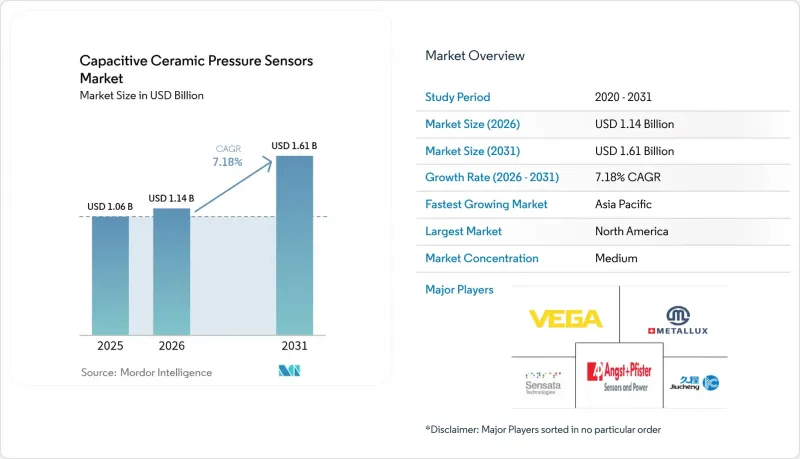
Mordor Intelligence에 의하면, 정전용량식 세라믹 압력 센서 시장 규모는 2025년 10억 6,000만 달러로 평가되었습니다. 2026년에는 11억 4,000만 달러로 확대되어 2026년부터 2031년에 걸쳐 CAGR 7.18%로 성장을 지속하여, 2031년까지 16억 1,000만 달러에 이를 것으로 예측됩니다.
본 보고서는 센서 유형(절대압, 게이지압, 차압, 밀폐형), 용도(자동차 및 운송, 산업, 의료 및 헬스케어 등), 압력 범위(저압, 중압, 고압), 최종 이용 산업(자동차 OEM, 산업용 OEM 등) 및 지역별로 분류되어 있습니다. 시장 전망은 금액(달러) 기준으로 제시되어 있습니다.
세계의 정전용량식 세라믹 압력 센서 시장 동향 및 인사이트
TPMS에 관한 규제 요건이 자동차에의 탑재를 촉진하고 있습니다.
미국의 FMVSS 138 및 유럽의 ECE R64와 같은 안전 규정에 따라 모든 신형 승용차에 타이어 공기압 모니터링 시스템의 탑재가 의무화되어 있어, 견고한 센싱 솔루션에 대한 안정적인 수요가 보장되고 있습니다. 세라믹 정전용량식 소자는 -40°C에서 +125°C 범위에서 교정 정확도를 유지하지만, 실리콘 MEMS형은 +85°C를 초과하면 드리프트가 발생합니다. 또한, 전기차 제조업체들은 열 스파이크가 발생하는 급속 충전 시 배터리 팩의 압력을 모니터링하기 위해 밀폐형 배터리 인클로저 내에 세라믹 유닛을 탑재하고 있습니다. 800V 파워트레인으로의 전환에 따라 전자기 간섭이 증가하고 있지만, 세라믹 장치는 반도체 제품보다 고유 잡음이 낮기 때문에 자동차 제조업체가 데이터 무결성을 보호하는 데 도움이 되고 있습니다. 2024년에는 자동차 OEM이 전 세계 수요의 35.83%를 차지했으며, 이는 이 부문이 수요량에 미치는 영향이 크다는 것을 뒷받침합니다.
인더스트리 4.0에 따른 설비 갱신이 산업용 센서의 보급을 가속화
인더스트리 4.0에 기반해 현대화가 진행되고 있는 공장에서는 기존 컨트롤러에 디지털 피드백 루프 및 예측 유지보수 소프트웨어가 연결되어 있습니다. 세라믹 정전용량식 센서는 4-20 mA 및 IO-Link 출력을 갖추고 있어, 기존 입력 카드의 배선 재설정 없이 공장 전체에 신속하게 도입할 수 있습니다. 내식성 다이어프램을 통해 부식성 세정제나 산성 공정 매체로 인한 예기치 못한 가동 중지 시간을 최소화합니다. 분석 플랫폼에서는 센서의 안정성이 저렴한 단가보다 더 중요하게 여겨지므로, 세라믹 센서는 높은 구매 비용을 상쇄할 만큼의 수명 주기 비용 절감 효과를 가져옵니다. 무선 게이트웨이는 낮은 누설 전류를 활용하여 원격지의 설비에서 배터리 수명을 연장합니다. 현재 산업용 OEM 제조업체가 두 번째로 큰 구매층을 형성하고 있으며, 특히 500°C까지의 온도에서 가동되는 화학 및 펄프·제지 라인에서 수요가 증가하고 있습니다.
실리콘 MEMS 제품과의 경쟁이 가격에 압박을 가하고 있습니다.
대량 생산을 하는 MEMS 팹에서는 기본적인 압전 저항형 센서를 5달러 미만으로 출하하는 반면, 세라믹 정전용량형 유닛은 측정 범위나 인증 수준에 따라 대개 15-50달러의 가격대를 형성하고 있습니다. 소비자용 IoT 구매자들은 엄격한 부품 원가 목표를 달성하기 위해 더 엄격한 온도 정격 감소를 수용하는 경우가 많습니다. 가혹한 환경에서는 세라믹이 선호되지만, 가격 하락 압력으로 인해 제조업체들은 LTCC 소성 주기를 합리화하고 최종 보정을 자동화할 수밖에 없게 되었습니다. 일부 공급업체는 현재 외부 전자 부품을 배제하고 모듈 비용을 절감하기 위해 박막 신호 컨디셔너를 동일한 패키지에 통합하고 있습니다.
부문 분석
2025년, 게이지형 장치는 정전용량식 세라믹 압력 센서 시장의 38.32%를 차지했으며, 이는 타이어 공기압 모니터링, 브레이크 유압 시스템 및 산업용 압축기에서 광범위하게 도입되고 있음을 반영합니다. 같은 해 게이지형 정전용량식 세라믹 압력 센서 시장 규모는 4억 1,000만 달러에 달했으며, 전기차 제조업체들이 인휠형 압력 노드를 통합함에 따라 꾸준히 확대될 것으로 예측됩니다. 자동차 업계의 규정 준수 주기로 인해 안정적이고 대량의 입찰이 발생하고 있으며, 공급업체는 금형 투자 비용을 상각할 수 있게 되었습니다. 이와 동시에 수도 유틸리티자의 스마트 계량기 도입이 진행되고 있으며, 수중 설치 환경에서는 세라믹의 내식성이 유리하기 때문에 게이지형에 대한 수요가 점차 증가하고 있습니다.
차압형은 HVAC 필터 모니터링 및 연료전지 스택 관리를 주동력으로 하여 2031년까지 연평균 성장률(CAGR) 7.96%로 확대될 것으로 예측됩니다. 이러한 장치는 정전용량식 플레이트의 고유한 선형성을 활용하여, 의료용 인공호흡기에서 중요한 지표인 20 Pa 미만의 압력 강하를 감지합니다. 절대압형 및 밀폐형 센서는 합쳐서 소규모 틈새 시장을 차지하고 있지만, 고고도 드론이나 심정 펌프 분야에서 그 중요성이 커지고 있습니다. 광의의 정전용량식 세라믹 압력 센서 시장 전체에서는 공급업체들이 설치를 간소화하기 위해 스테인리스 스틸 하우징 내에 디지털 ASIC을 통합하는 사례가 증가하고 있습니다.
2025년에는 자동차 및 운송 분야가 매출의 41.25%를 차지하며 시장을 주도했습니다. 이는 TPMS(타이어 공기압 모니터링 시스템)에 대한 법적 규제로 인한 탑재 의무화와 신흥 배터리 팩 압력 루프가 배경에 있습니다. 800V 인버터를 채택한 차량 아키텍처는 전자기장을 발생시키지만, 세라믹 센서는 신호 왜곡을 일으키지 않고 이를 견뎌내며 트랙션 제어 알고리즘을 보호합니다. 또한, 철도 사업자들도 주변 온도가 -40°C에 달하는 것이 일상적인 고산 노선에서 브레이크 라인의 안전을 확보하기 위해 세라믹 다이어프램을 지정하고 있습니다.
의료 및 헬스케어 분야의 지출은 2031년까지 연평균 성장률(CAGR) 8.06%라는 가장 빠른 성장세를 보이고 있으며, 그 원동력은 수천 번에 달하는 멸균 주기를 거치면서도 드리프트 제로가 요구되는 중환자용 인공호흡기, 주입 펌프 및 투석 회로입니다. 의료기기용 정전용량식 세라믹 압력 센서 시장 규모는 2031년까지 3억 2,000만 달러에 달할 것으로 예측되며, 이는 ISO 13485 인증을 취득한 기업들에게 중요한 공급 계약으로 이어질 것입니다. 고령화에 따라 외래 치료 옵션을 찾는 환자가 늘어나는 가운데, 장기적인 재택 호흡 요법 및 원격 모니터링이 수익의 파이를 더욱 확대되고 있습니다.
산업용 자동화는 여전히 견고한 제3의 축을 이루고 있습니다. 황산, 암모니아 또는 황화수소를 취급하는 공장에서는 화학적 부식으로 인해 폴리머제 MEMS 코팅에 팽창이 발생하기 때문에 세라믹 인서트로의 전환이 진행되고 있습니다. 소비자용 웨어러블 기기에서는 기압 및 고도 측정을 위해 소형 세라믹 칩이 채택되고 있지만, 자동차 분야에 비해 생산량은 여전히 미미한 수준입니다.
지역별 분석
북미는 2025년에 전 세계 매출의 38.40%를 차지했으며, 조기 TPMS(타이어 공기압 모니터링 시스템) 규제, 확립된 의료기기 클러스터, 그리고 대규모 전기차 생산 덕분에 여전히 가장 큰 단일 지역으로 남아 있습니다. 미국의 센서 공급업체들은 수소 공급망을 대상으로 한 DOE(미국 에너지부)의 보조금을 활용하여 700바의 세라믹 어셈블리에 대한 시범 테스트를 진행하고 있습니다. 캐나다의 한랭지용 트럭 시장에서는 -30°C에서도 안정적인 성능을 발휘하는 세라믹이 중시되고 있으며, 이는 국내 2차 공급업체들의 제조를 뒷받침하고 있습니다.
아시아태평양은 연평균 성장률(CAGR) 7.97%를 기록하며 성장의 원동력이 되고 있습니다. BYD 등 중국의 주요 전기차 기업들은 급속 충전 시 발생하는 가스 발생을 모니터링하기 위해 블레이드형 배터리 모듈 내에 세라믹 노드를 통합하고 있습니다. 일본의 로봇 시스템 통합사업자들은 가압 증기로 살균을 수행하는 6축 암에 알루미나 재질의 다이어프램을 채택하고 있습니다. 한국에서는 공공 보조금을 그린 수소 허브에 투입하고 있으며, 이곳에서는 전해조 스택이 약 30 bar의 압력 하에서 가동되어 세라믹의 신뢰성이 요구되고 있습니다. 유럽에서는 독일의 대형 자동차 기업인 보쉬와 콘티넨탈이 차세대 운전 지원 플랫폼용 세라믹 칩을 공동 개발하고 있으며, 견실한 시장 점유율을 유지하고 있습니다. 스칸디나비아에서는 염수 분무 및 진동 부하 사이클에 노출되는 해상 풍력 터빈의 기어박스에 센서가 도입되고 있습니다. 중동의 정유시설에서는 400°C 이상에서 가동되는 황 회수 장치에 세라믹 패키지가 채택되고 있으며, 아프리카의 광업 회사에서는 산 침출 패드에서 세라믹 원격 측정 기술의 실증 실험이 진행되고 있습니다.
기타 혜택 :
- 엑셀 형식 시장 예측(ME) 시트
- 3개월간의 애널리스트 지원
자주 묻는 질문
목차
제1장 서론
제2장 조사 방법
제3장 주요 요약
제4장 시장 구도
제5장 시장 규모 및 성장 예측
제6장 경쟁 구도
제7장 시장 기회 및 향후 전망
KTH 26.08.26According to Mordor Intelligence, the capacitive ceramic pressure sensors market size is expected to grow from USD 1.06 billion in 2025 to USD 1.14 billion in 2026 and is forecast to reach USD 1.61 billion by 2031 at 7.18% CAGR over 2026-2031.
This report is Segmented by Sensor Type (Absolute, Gauge, Differential, and Sealed), Application (Automotive and Transportation, Industrial, Medical and Healthcare, and More), Pressure Range (Low-Pressure, Medium-Pressure, and High-Pressure), End-Use Industry (Automotive OEMs, Industrial OEMs, and More), and Geography. The Market Forecasts are Provided in Terms of Value (USD).
Global Capacitive Ceramic Pressure Sensors Market Trends and Insights
Regulatory mandates for TPMS drive automotive integration
Safety rules such as FMVSS 138 in the United States and ECE R64 in Europe require tire pressure monitoring in every new passenger vehicle, locking in stable demand for robust sensing solutions. Ceramic capacitive elements preserve calibration from -40 °C to +125 °C, whereas silicon MEMS variants drift above +85 °C. Electric-vehicle makers additionally install ceramic units in sealed battery enclosures to monitor pack pressure during rapid charging events that create thermal spikes. The move toward 800 V powertrains elevates electromagnetic interference, yet ceramic devices exhibit lower intrinsic noise than semiconductor alternatives, helping automakers protect data integrity. In 2024, automotive OEMs accounted for 35.83% of global offtake, underscoring the segment's volume influence.
Industry 4.0 retrofits accelerate industrial sensor adoption
Factories modernizing under Industry 4.0 connect established controllers with digital feedback loops and predictive-maintenance software. Ceramic capacitive sensors ship with 4-20 mA and IO-Link outputs, enabling rapid plant-wide installation without rewiring legacy input cards. Corrosion-proof diaphragms minimize unplanned downtime caused by caustic cleaners or acidic process media. As analytics platforms rank sensor stability above lowest piece-price, ceramic units benefit from life-cycle savings that outweigh higher purchase cost. Wireless gateways exploit their low leakage current to extend battery life in remote assets. Industrial OEMs now form the second-largest buyer cohort, particularly in chemical and pulp-and-paper lines operating up to 500 °C.
Cost competition from silicon MEMS alternatives pressures pricing
High-volume MEMS fabs ship basic piezoresistive sensors below USD 5, whereas ceramic capacitive units often list between USD 15-50 depending on range and certification tier. Consumer IoT buyers frequently accept tighter temperature deratings to hit aggressive bill-of-materials targets. While ceramics hold favor in harsh settings, downward price pressure forces makers to streamline LTCC firing cycles and automate final calibration. Some vendors now co-package thin-film signal conditioners to eliminate external electronics and trim module cost.
Other drivers and restraints analyzed in the detailed report include:
- Post-pandemic medical device expansion boosts precision requirements
- Ceramic sensors' high-temperature and chemical-resistance edge
- High ceramic manufacturing costs limit market penetration
For complete list of drivers and restraints, kindly check the Table Of Contents.
Segment Analysis
Gauge devices accounted for 38.32% of the capacitive ceramic pressure sensors market in 2025, reflecting wide deployment in tire pressure monitoring, brake hydraulics, and industrial compressors. The capacitive ceramic pressure sensors market size for gauge designs stood at USD 0.41 billion the same year and is projected to expand steadily as electric-vehicle makers integrate in-wheel pressure nodes. Automotive compliance cycles drive steady, high-volume bids, enabling suppliers to amortize their tooling investments. In parallel, the rollout of smart meters by water utilities is creating incremental demand for gauges, as submerged installations favor ceramic corrosion immunity.
Differential variants are projected to advance at an 7.96% CAGR through 2031, driven by HVAC filter monitoring and fuel-cell stack management. These devices exploit the inherent linearity of capacitive plates to resolve sub-20 Pa pressure drops, a key metric in medical ventilators. Absolute and sealed sensors together occupy a modest niche but gain relevance in altitude drones and deep-well pumping. Across the broader capacitive ceramic pressure sensor market, technology vendors are increasingly bundling digital ASICs inside stainless housings to simplify installation.
Automotive and transportation dominated revenue with 41.25% share in 2025, underpinned by statutory TPMS inclusion and emerging battery-pack pressure loops. Vehicle architectures adopting 800 V inverters generate electromagnetic fields that ceramic sensors tolerate without signal distortion, protecting traction-control algorithms. Rail operators also specify ceramic diaphragms for brake-line safety in alpine routes where -40 °C ambient is routine.
Medical and healthcare spending accelerates fastest at an 8.06% CAGR to 2031, fueled by intensive-care ventilators, infusion pumps, and dialysis circuits that demand zero drift over thousands of sterilization cycles. The capacitive ceramic pressure sensors market size for medical equipment is predicted to reach USD 0.32 billion by 2031, translating into meaningful supply contracts for firms holding ISO 13485 lines. Long-term home respiratory therapy and remote monitoring further widen the revenue funnel as aging populations seek outpatient options.
Industrial automation remains a resilient third pillar. Plants handling sulfuric acid, ammonia, or hydrogen sulfide migrate to ceramic inserts because polymer MEMS coatings blister under chemical attack. Consumer wearables adopt miniature ceramic chips for barometric altitude, though volumes remain modest versus automotive.
Complete Report Scope:
- By Sensor Type
- Absolute
- Gauge
- Differential
- Sealed
- By Application
- Automotive and Transportation
- Marine Systems
- Electric and Hybrid Vehicles
- Industrial
- Food and Beverage Processing
- HVAC and Refrigeration
- Energy and Chemical
- Industrial Robotics and Factory Automation
- Medical and Healthcare
- Respiratory and Ventilation Equipment
- Hemodialysis and Infusion Pumps
- Consumer Electronics and IoT
- Other Applications (Aerospace, Smart Agriculture)
- Automotive and Transportation
- By Pressure Range
- Low-Pressure (less than 10 bar)
- Medium-Pressure (10-100 bar)
- High-Pressure (above 100 bar)
- By End-Use Industry
- Automotive OEMs
- Industrial OEMs
- Medical Device Manufacturers
- Process Industries
- Utilities and Energy
- ODMs / Contract Manufacturers
- By Geography
- North America
- United States
- Canada
- Europe
- Germany
- United Kingdom
- France
- Italy
- Spain
- Rest of Europe
- Asia-Pacific
- China
- Japan
- India
- South Korea
- ASEAN
- Rest of Asia-Pacific
- Middle East and Africa
- Middle East
- Saudi Arabia
- United Arab Emirates
- Turkey
- Rest of Middle East
- Africa
- South Africa
- Egypt
- Rest of Africa
- Middle East
- South America
- Brazil
- Mexico
- Argentina
- Rest of South America
- North America
Geography Analysis
North America held 38.40% of global sales in 2025 and remains the single largest region thanks to early TPMS legislation, entrenched medical-device clusters, and substantial electric-vehicle output. U.S. sensor suppliers leverage DOE grants targeting hydrogen supply chains to pilot 700 bar ceramic assemblies. Canada's cold-weather truck market values ceramic consistency at -30 °C, supporting domestic Tier-2 fabrication.
Asia-Pacific is the growth engine at 7.97% CAGR. China's EV leaders such as BYD embed ceramic nodes inside blade-battery modules to monitor gas formation during fast charging. Japan's robotics integrators specify alumina diaphragms for six-axis arms that sanitize with pressurized steam. South Korea channels public subsidies into green-hydrogen hubs where electrolyzer stacks operate near 30 bar and demand ceramic reliability. Europe sustains a solid share through German automotive giants Bosch and Continental, which co-develop ceramic chips for next-generation driver-assistance platforms. Scandinavia deploys sensors in offshore wind turbine gearboxes exposed to salt spray and oscillating load cycles. Middle East refiners adopt ceramic packages for sulfur recovery units running above 400 °C, while Africa's mining firms experiment with ceramic telemetry in acid leach pads.
- Sensata Technologies Holding plc
- Metallux SA
- Vega Americas, Inc.
- Pewatron AG
- BD|SENSORS GmbH
- Angst+Pfister Sensors and Power AG
- Nanjing Jiucheng Technology Co. Limited
- Baumer Electric AG
- ifm electronic gmbh
- Sitron Sensores Industriais Ltda.
- Shenzhen Amperon Technology Co., Ltd.
- Suzhou Novosense Microelectronics Co., Ltd.
- TE Connectivity Ltd.
- STMicroelectronics N.V.
- Bosch Sensortec GmbH
- Honeywell International Inc.
- Amphenol Advanced Sensors
- Infineon Technologies AG
- NXP Semiconductors N.V.
- Shanghai Camozzi Automation Co., Ltd.
- WIKA Alexander Wiegand SE and Co. KG
- ABB Ltd.
- Emerson Electric Co.
- Analog Devices, Inc.
- Endress+Hauser Group Services AG
Additional Benefits:
- The market estimate (ME) sheet in Excel format
- 3 months of analyst support
TABLE OF CONTENTS
1 INTRODUCTION
- 1.1 Study Assumptions and Market Definition
- 1.2 Scope of the Study
2 RESEARCH METHODOLOGY
3 EXECUTIVE SUMMARY
4 MARKET LANDSCAPE
- 4.1 Market Overview
- 4.2 Market Drivers
- 4.2.1 Regulatory mandates for TPMS and engine management in next-gen vehicles
- 4.2.2 Industry 4.0 retrofits demanding rugged, corrosion-resistant sensors
- 4.2.3 Post-pandemic boom in ventilators and infusion pumps
- 4.2.4 Ceramic sensors' high-temperature and chemical-resistance edge
- 4.2.5 Electro-lyzer pressure monitoring for green-hydrogen plants
- 4.2.6 Chiplet-based sensor-fusion modules for EV battery packs
- 4.3 Market Restraints
- 4.3.1 Cost-competition from piezoresistive MEMS alternatives
- 4.3.2 High tooling and calibration cost of ceramic capacitive lines
- 4.3.3 Supply-risk of high-purity alumina feedstock
- 4.3.4 EMI issues in 800-V EV platforms
- 4.4 Industry Value Chain Analysis
- 4.5 Regulatory Landscape
- 4.6 Technological Outlook
- 4.7 Porter's Five Forces Analysis
- 4.7.1 Bargaining Power of Suppliers
- 4.7.2 Bargaining Power of Buyers
- 4.7.3 Threat of New Entrants
- 4.7.4 Threat of Substitutes
- 4.7.5 Intensity of Competitive Rivalry
5 MARKET SIZE AND GROWTH FORECASTS (VALUE)
- 5.1 By Sensor Type
- 5.1.1 Absolute
- 5.1.2 Gauge
- 5.1.3 Differential
- 5.1.4 Sealed
- 5.2 By Application
- 5.2.1 Automotive and Transportation
- 5.2.1.1 Marine Systems
- 5.2.1.2 Electric and Hybrid Vehicles
- 5.2.2 Industrial
- 5.2.2.1 Food and Beverage Processing
- 5.2.2.2 HVAC and Refrigeration
- 5.2.2.3 Energy and Chemical
- 5.2.2.4 Industrial Robotics and Factory Automation
- 5.2.3 Medical and Healthcare
- 5.2.3.1 Respiratory and Ventilation Equipment
- 5.2.3.2 Hemodialysis and Infusion Pumps
- 5.2.4 Consumer Electronics and IoT
- 5.2.5 Other Applications (Aerospace, Smart Agriculture)
- 5.2.1 Automotive and Transportation
- 5.3 By Pressure Range
- 5.3.1 Low-Pressure (less than 10 bar)
- 5.3.2 Medium-Pressure (10-100 bar)
- 5.3.3 High-Pressure (above 100 bar)
- 5.4 By End-Use Industry
- 5.4.1 Automotive OEMs
- 5.4.2 Industrial OEMs
- 5.4.3 Medical Device Manufacturers
- 5.4.4 Process Industries
- 5.4.5 Utilities and Energy
- 5.4.6 ODMs / Contract Manufacturers
- 5.5 By Geography
- 5.5.1 North America
- 5.5.1.1 United States
- 5.5.1.2 Canada
- 5.5.2 Europe
- 5.5.2.1 Germany
- 5.5.2.2 United Kingdom
- 5.5.2.3 France
- 5.5.2.4 Italy
- 5.5.2.5 Spain
- 5.5.2.6 Rest of Europe
- 5.5.3 Asia-Pacific
- 5.5.3.1 China
- 5.5.3.2 Japan
- 5.5.3.3 India
- 5.5.3.4 South Korea
- 5.5.3.5 ASEAN
- 5.5.3.6 Rest of Asia-Pacific
- 5.5.4 Middle East and Africa
- 5.5.4.1 Middle East
- 5.5.4.1.1 Saudi Arabia
- 5.5.4.1.2 United Arab Emirates
- 5.5.4.1.3 Turkey
- 5.5.4.1.4 Rest of Middle East
- 5.5.4.2 Africa
- 5.5.4.2.1 South Africa
- 5.5.4.2.2 Egypt
- 5.5.4.2.3 Rest of Africa
- 5.5.4.1 Middle East
- 5.5.5 South America
- 5.5.5.1 Brazil
- 5.5.5.2 Mexico
- 5.5.5.3 Argentina
- 5.5.5.4 Rest of South America
- 5.5.1 North America
6 COMPETITIVE LANDSCAPE
- 6.1 Market Concentration
- 6.2 Strategic Moves
- 6.3 Market Share Analysis
- 6.4 Company Profiles (includes Global level Overview, Market level overview, Core Segments, Financials as available, Strategic Information, Market Rank/Share, Products and Services, Recent Developments)
- 6.4.1 Sensata Technologies Holding plc
- 6.4.2 Metallux SA
- 6.4.3 Vega Americas, Inc.
- 6.4.4 Pewatron AG
- 6.4.5 BD|SENSORS GmbH
- 6.4.6 Angst+Pfister Sensors and Power AG
- 6.4.7 Nanjing Jiucheng Technology Co. Limited
- 6.4.8 Baumer Electric AG
- 6.4.9 ifm electronic gmbh
- 6.4.10 Sitron Sensores Industriais Ltda.
- 6.4.11 Shenzhen Amperon Technology Co., Ltd.
- 6.4.12 Suzhou Novosense Microelectronics Co., Ltd.
- 6.4.13 TE Connectivity Ltd.
- 6.4.14 STMicroelectronics N.V.
- 6.4.15 Bosch Sensortec GmbH
- 6.4.16 Honeywell International Inc.
- 6.4.17 Amphenol Advanced Sensors
- 6.4.18 Infineon Technologies AG
- 6.4.19 NXP Semiconductors N.V.
- 6.4.20 Shanghai Camozzi Automation Co., Ltd.
- 6.4.21 WIKA Alexander Wiegand SE and Co. KG
- 6.4.22 ABB Ltd.
- 6.4.23 Emerson Electric Co.
- 6.4.24 Analog Devices, Inc.
- 6.4.25 Endress+Hauser Group Services AG
7 MARKET OPPORTUNITIES AND FUTURE OUTLOOK
- 7.1 White-space and Unmet-Need Assessment


