

|
시장보고서
상품코드
2113979
아페레시스 : 시장 점유율 분석, 업계 동향 및 통계, 성장 예측(2026-2031년)Apheresis - Market Share Analysis, Industry Trends & Statistics, Growth Forecasts (2026 - 2031) |
||||||
 Mordor Intelligence
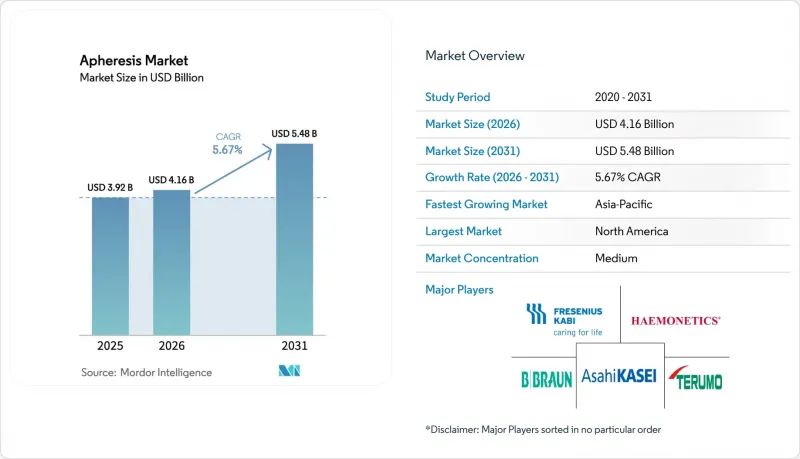
Mordor Intelligence에 의하면, 아페레시스 시장 규모는 2025년 39억 2,000만 달러로 평가되었습니다. 2026년에는 41억 6,000만 달러로 확대되어 2031년까지 54억 8,000만 달러에 이를 것으로 예상되고 2026년부터 2031년에 걸쳐 CAGR 5.67%로 성장할 전망입니다.
본 보고서에서는 업계를 제품별(기기, 일회용 제품 및 소모품),시술별(혈장 분리, 혈소판 분리 등), 용도별(혈액 질환 등), 최종 사용자별(혈액 은행 및 혈액 성분 공급업체 등), 지역별(북미, 유럽, 아시아태평양, 중동 및 아프리카, 남미)로 분류하고 있습니다. 시장 전망은 금액(달러) 기준으로 제시되어 있습니다.
세계의 아페레시스 시장 동향 및 인사이트
혈액 질환 및 자가면역 질환 유병률 증가
미국혈액학회(ASH) 및 유럽혈액학회(EHA)의 레지스트리 데이터에 따르면, 2024년부터 2025년에 걸쳐 아페레시스 적응증 사례가 18% 증가한 것으로 나타났습니다. 이는 주로 다발성 골수종 및 형질세포성 질환에 기인한 것입니다. 중증 근력 약화증 및 만성 염증성 탈수초성 다발성 신경염의 진단 건수는 22% 증가하여, 치료적 혈장 교환을 1차 치료법으로 하는 지침 개정을 뒷받침하는 결과가 되었습니다. 일본에서는 2025년 4월 면역흡착 아페레시스가 승인됨에 따라 전신성 홍반성 루푸스(SLE)의 보험 적용 환자 수가 1만 4,000명 증가했습니다. OECD 국가들의 고령화가 진행됨에 따라, 기초적 단클론성 감마글로불린혈증의 유병률은 계속 상승하고 있으며, 환자 1인당 치료 빈도가 정점에 도달하더라도 시술 건수는 견조한 추세를 보일 것으로 전망됩니다. 이러한 역학적 변화는 공급업체에게 안정적인 장비 이용과 소모품의 지속적인 수익원을 뒷받침해 줄 것입니다.
자동화 및 막 여과 분야의 기술적 진보
프레제니우스 카비(Fresenius Kabi)사의 ‘Lovo’ 시스템은 광학식 헤마토크리트 센서를 도입했습니다. 이로 인해 저칼슘혈증 발생률이 34% 감소하여, 운영자의 모니터링 필요성이 줄어들었고, 지역 병원에서의 도입이 확대되었습니다. FDA 승인을 받은 ‘오로라 Xi’ 분리 장치는 0.2미크론 중공사막을 채택하여 원심분리에 따른 혈소판 손상을 최소화함으로써, 단일 기증자로부터의 혈소판 수율을 최대 22% 증가시켰습니다. 테르모 BCT는 2025년 중반에 ‘스펙트라 옵티아’에 전자건강기록(EHR) 연동 기능을 통합하여 환자 매개변수를 자동으로 입력함으로써, 6개 검증 사이트 전체에서 설정 오류를 41% 줄였습니다. 연속 유동식 백혈구 분리 모듈은 현재 전혈 15리터를 3시간 이내에 처리할 수 있게 되어, 배치식 원심분리 시스템에 비해 수율이 12퍼센트 포인트 향상되었습니다. 이러한 업그레이드를 종합하면, 교육 시간 단축, 안전성 프로파일 향상, 시설 가동 중단 기간 단축으로 이어져, 이미 도입된 장비의 교체 주기가 가속화됩니다.
높은 설비 투자 및 소모품 비용
자동 아페레시스 장치의 정가는 8만 5,000-14만 달러이지만, 연간 200건의 수술을 수행하는 시설에서는 일회용 소모품에 연간 18만-26만 달러를 지출하고 있습니다. 2025년 CMS가 병원의 외래 혈장 교환에 대한 보상률을 18% 인하함에 따라, 간접비 공제 전 이익률은 1회당 불과 67달러로 축소되었으며, 이로 인해 신규 장비 발주가 둔화되었습니다. 벤더가 제공하는 리스나 시약 대여 모델이 등장하고 있지만, 병원 측은 공급 중단 시 소모품에 의존할 수밖에 없습니다는 점을 우려하고 있어 도입이 더딘 상황입니다. 가격 책정 모델이 진화하기 전까지는 자금 면의 제약으로 인해 비용에 민감한 지역에서의 보급은 더뎌질 것입니다.
부문별 분석
2025년 시점에서 의료기기 부문은 시장 가치 점유율 67.43%를 유지했습니다. 그러나 멸균 공정을 생략하고 ESG 요건에도 부합하는 일회용 키트의 인기에 힘입어, 일회용 제품은 2031년까지 연평균 성장률(CAGR) 7.24%를 기록하며 아페레시스 시장 전체의 성장률을 상회할 전망입니다. Amicus사의 폐쇄형 루프 세트를 도입한 병원에서는 설정 시간이 9분 단축되고 오염 위험이 62% 감소했습니다. 이를 통해 40%의 매출 총이익률을 기록하는 소모품 공급원이 확고해졌습니다. 한편, 중국의 신규 진출기업들이 기존 기업들의 제품 가격보다 22-28% 저렴한 가격을 책정함에 따라 의료기기의 평균 판매 가격은 4.3% 하락했으며, 독자적으로 개발한 일회용 제품으로의 이익률 전환이 두드러지게 나타났습니다.
CAR-T 채혈 센터에서는 신원 추적 감사 요건을 충족하기 위해 전자건강기록(EHR)과 연동된 자동화 시스템이 필요하기 때문에 설비 갱신 주기는 여전히 중요합니다. 테르모 BCT는 2025년 ‘Spectra Optia’ 출하 대수의 58%가 백혈구 분리 채혈 능력 확장을 지원하는 제품이었습니다고 밝혔습니다. 그럼에도 불구하고 일회용 제품은 견고한 경쟁 우위를 유지하고 있습니다. FDA 승인을 받은 커넥터 형상으로 인해 타사 대체품이 배제되어, 하드웨어 가격 하락에도 불구하고 매출을 지탱하고 있습니다. 이러한 정기적인 소모품으로의 전환이 아페레시스 시장에서 주요 공급업체의 장기적인 수익성을 뒷받침하고 있습니다.
2025년에는 혈장 분리 요법이 전체 시술의 41.62%를 차지했으며, 이는 만성 면역글로불린 보충 요법 및 신경학적 혈장 교환 요법의 적응증을 반영한 것입니다. 한편, 광아페레시스는 연평균 성장률(CAGR) 8.35%로 확대되고 있습니다. 이는 시술 시간을 3시간으로 단축하고, 소아 GVHD에 대해 CMS(미국 의료보험서비스센터)의 광범위한 보험 적용을 확보한 FDA 승인 CELLEX 시스템에 의해 주도되고 있습니다. 혈소판 아페레시스는 혈액은행 물류에서 여전히 필수적인 반면, 백혈구 아페레시스 시술 건수는 CAR-T 요법의 도입 확대에 따라 꾸준히 증가하고 있습니다.
적혈구 아페레시스는 4.1%라는 완만한 성장에 그치고 있습니다. 이는 자동화 장비가 여전히 부족한 사하라 이남 아프리카에서 겸상적혈구증 치료의 54%가 수동 교환으로 이루어지고 있기 때문입니다. 미국 아페레시스 학회는 급성 흉부 증후군 치료에 있어 자동 적혈구 교환을 카테고리 I로 상향 조정했으나, 그 보급은 장비 가격의 타당성과 기술자 교육에 달려 있습니다. 전반적으로 시술 방식의 변화로 인해 하드웨어 교체 없이도 여러 치료 방식에 대응할 수 있는 플랫폼이 유리해지고 있으며, 바로 이러한 기능이 아페레시스 시장에서 하이엔드 시스템의 입지를 공고히 하고 있습니다.
지역별 분석
2025년에는 북미가 43.35%의 시장 점유율로 1위를 차지하며, 4,200대의 장비를 사용하여 치료, 혈액 은행 및 CAR-T 세포 채취 수요를 충족시켰습니다. CMS(미국 의료보험서비스센터)에 의한 외래 진료 보수 인하로 인해 혈장 교환 시술 건수가 외래 진료소로 이동하고, 간접비가 32% 절감됨에 따라, 콤팩트하고 기술자가 다루기 쉬운 시스템에 대한 수요가 높아졌습니다. 캐나다에서는 9곳의 새로운 혈장 센터가 개설되어 수입 의존도가 14% 감소함에 따라, PCS2 장치의 판매 대수가 19% 증가했습니다. 멕시코에서는 대상 병원이 12곳으로 확대되었으나, 예산 제약으로 인해 장치 보급률은 여전히 40% 미만에 머물고 있습니다.
CliniMACS Prodigy가 EMA(유럽의약품청)의 승인을 획득함에 따라 18곳에서 분산형 CAR-T 처리가 가능해졌으며, 환자 1인당 1만 2,000유로의 물류 비용 절감으로 이어졌습니다. 독일에서는 스테로이드 저항성 GVHD에 대한 광선 요법이 보험 적용 대상이 되면서 환자 수가 1,600명 증가함에 따라 CELLEX 도입이 촉진되었습니다. 영국에서는 14개 지역에서 ‘Trima Accel’ 도입이 진행된 결과, 혈소판 채혈이 6.8% 증가했습니다. 남유럽에서는 환급률이 낮아 성장세가 둔화되고 있습니다.
아시아태평양은 2031년까지 연평균 성장률(CAGR) 8.08%로 확대될 것으로 예측되며, 이는 세계에서 가장 빠른 속도입니다. 중국은 수입 제한에 대비하여 2024년에 14종의 의료기기를 승인하고, 혈장 분획 능력을 18% 향상시켰습니다. 인도는 2027년까지 채혈 센터 수를 두 배로 늘리는 것을 목표로 하고 있으며, 프레제니우스 카비(Fresenius Kabi) 및 헤모네틱스(Hemoneetics)로부터 80대의 장비를 발주했으나, 루피화 약세로 인해 비용 면에서 어려움이 발생하고 있습니다. 일본에서는 고령화에 따라 자가면역 질환에 대한 혈장 분리 요법 시행 건수가 12% 증가했으나, 훈련을 받은 420명의 인력 부족으로 인해 지방으로의 확대가 저해되고 있습니다. 호주와 한국은 각각 LDL 아페레시스와 휴대용 채혈 장치의 적용 범위를 확대하고 있어 꾸준한 성장을 뒷받침하고 있습니다.
중동 및 아프리카는 매출의 6.2%를 차지하고 있으며, GCC 국가들은 혈장 자급자족을 위한 투자를 추진하고 있고, 남아프리카에서는 혈소판 아페레시스가 22% 확대되고 있습니다. 사하라 이남 아프리카에서는 자동 장비가 여전히 부족하여, 겸상적혈구증 치료에서는 수동적 적혈구 교환이 주류를 이루고 있습니다.
기타 혜택 :
- 엑셀 형식 시장 예측(ME) 시트
- 3개월간의 애널리스트 지원
자주 묻는 질문
목차
제1장 서론
제2장 조사 방법
제3장 주요 요약
제4장 시장 구도
제5장 시장 규모 및 성장 예측
제6장 경쟁 구도
제7장 시장 기회 및 향후 전망
KTH 26.08.26According to Mordor Intelligence, the apheresis market size is expected to increase from USD 3.92 billion in 2025 to USD 4.16 billion in 2026 and reach USD 5.48 billion by 2031, growing at a CAGR of 5.67% over 2026-2031.
This report Segments the Industry Into by Product (Devices, Disposables & Consumables), Procedure (Plasmapheresis, Plateletpheresis, and More), Application (Hematological Disorders, and More), End User (Blood Banks & Component Providers, and More), and Geography (North America, Europe, Asia-Pacific, Middle East & Africa, South America). The Market Forecasts are Provided in Terms of Value (USD).
Global Apheresis Market Trends and Insights
Rising Prevalence of Hematologic & Autoimmune Disorders
Registry data from the American Society of Hematology and the European Hematology Association revealed an 18% increase in apheresis-eligible cases between 2024 and 2025, primarily driven by multiple myeloma and plasma cell dyscrasias. Myasthenia gravis and chronic inflammatory demyelinating polyneuropathy diagnoses rose 22%, reinforcing guideline upgrades that position therapeutic plasma exchange as first-line care. Japan added 14,000 reimbursable systemic lupus erythematosus patients after approving immunoadsorption apheresis in April 2025. An aging OECD population continues to raise baseline monoclonal-gammopathy rates, ensuring that procedure volumes remain resilient even when per-patient intensity plateaus. These epidemiologic shifts support stable device utilization and recurrent consumable revenue streams for vendors.
Technological Advances in Automation & Membrane Filtration
Fresenius Kabi's Lovo system introduced optical hematocrit sensors, which reduced hypocalcemia events by 34%, thereby reducing operator oversight requirements and broadening adoption in community hospitals. The FDA-cleared Aurora Xi separator utilizes 0.2-micron hollow-fiber membranes to minimize platelet damage associated with centrifugation, thereby increasing single-donor platelet yields by up to 22%. Terumo BCT integrated EHR connectivity into Spectra Optia in mid-2025, automatically populating patient parameters and reducing setup errors by 41% across six validation sites. Continuous-flow leukapheresis modules now process 15 liters of whole blood in under three hours, a 12-percentage-point yield gain over batch centrifugal systems. Collectively, these upgrades reduce training time, improve safety profiles, and shorten facility turnover, amplifying installed-base refresh cycles.
High Capital & Consumable Costs
Automated apheresis devices list between USD 85,000 and USD 140,000, while a 200-procedure facility spends USD 180,000-260,000 annually on disposables. Following an 18% CMS rate cut for hospital outpatient plasma exchange in 2025, profit margins narrowed to as little as USD 67 per session before overhead, which dampened new-equipment orders. Vendor-financed leasing and reagent-rental models have emerged, but adoption has been tepid because hospitals worry about being locked into consumables during supply disruptions. Until pricing models evolve, capital constraints will slow penetration in cost-sensitive regions.
Other drivers and restraints analyzed in the detailed report include:
- Expansion of Cell & Gene Therapies Needing Leukapheresis
- Growing Demand for Plasma-Derived Therapeutics & Blood Components
- Shortage of Trained Specialists
For complete list of drivers and restraints, kindly check the Table Of Contents.
Segment Analysis
The devices segment retained a 67.43% value share in 2025; however, disposables are set to outpace the apheresis market at a 7.24% CAGR through 2031, driven by single-use kits that eliminate sterilization steps and align with ESG mandates. Hospitals adopting Amicus closed-loop sets shortened setup by nine minutes and reduced contamination risk by 62%, cementing locked-in consumable streams with 40% gross margins. Concurrently, device average selling prices slipped 4.3% as Chinese entrants priced their products 22-28% below those of incumbents, underscoring a shift in margin toward proprietary disposables.
Capital refresh cycles still matter because CAR-T collection centers need EHR-integrated automation to meet chain-of-identity audit demands. Terumo BCT disclosed that 58% of 2025 Spectra Optia shipments supported leukapheresis capacity expansions. Even so, disposables command defensible moats; FDA-cleared connector geometries prevent third-party substitutes, thereby anchoring revenue despite hardware price erosion. This pivot toward recurring consumables underpins long-run profitability for leading vendors in the apheresis market.
Plasmapheresis accounted for 41.62% of the procedures in 2025, reflecting chronic immunoglobulin replacement and neurological plasma-exchange indications. Photopheresis, however, is expanding at an 8.35% CAGR, driven by FDA-approved CELLEX systems that reduce procedure time to three hours and secure broad CMS coverage for pediatric GVHD. Plateletpheresis remains indispensable to blood-bank logistics, while leukapheresis volumes climb in lock-step with CAR-T therapy rollouts.
Erythrocytapheresis is growing modestly at 4.1% because manual exchange still accounts for 54% of sickle-cell procedures in sub-Saharan Africa, where automated devices remain scarce. The American Society for Apheresis has upgraded automated red-cell exchange to Category I for the treatment of acute chest syndrome; however, uptake hinges on device affordability and technician training. Overall, a shifting procedure mix favors platforms that handle multiple modalities without hardware swaps, a capability that entrenches premium systems in the apheresis market.
Complete Report Scope:
- By Product
- Devices
- Disposables & Consumables
- By Procedure
- Plasmapheresis
- Plateletpheresis
- Leukapheresis
- Erythrocytapheresis
- Photopheresis
- By Application
- Hematological Disorders
- Neurological Disorders
- Renal Disorders
- Autoimmune Disorders
- Other Applications
- By End User
- Blood Banks & Component Providers
- Hospitals & Transfusion Centers
- Ambulatory & Specialty Clinics
- By Geography
- North America
- United States
- Canada
- Mexico
- Europe
- Germany
- United Kingdom
- France
- Italy
- Spain
- Rest of Europe
- Asia-Pacific
- China
- Japan
- India
- Australia
- South Korea
- Rest of Asia-Pacific
- Middle East & Africa
- GCC
- South Africa
- Rest of Middle East & Africa
- South America
- Brazil
- Argentina
- Rest of South America
- North America
Geography Analysis
North America led with a 43.35% market share in 2025, servicing the therapeutic, blood-bank, and CAR-T collection needs of 4,200 devices. CMS outpatient rate cuts redirected plasma-exchange volumes to ambulatory clinics, reducing overhead by 32% and driving demand for compact, technician-friendly systems. Canada's nine new plasma centers reduced import reliance by 14%, driving PCS2 device sales up 19%. Mexico expanded coverage to 12 hospitals, yet device penetration remains under 40% because of budgetary limits.
EMA clearance of the CliniMACS Prodigy enabled decentralized CAR-T processing at 18 sites, resulting in a savings of EUR 12,000 per patient in logistics. Germany reimbursed photopheresis for steroid-refractory GVHD, adding 1,600 patients and driving CELLEX installs. The United Kingdom increased plateletpheresis by 6.8% after rolling out Trima Accel in 14 regions. Southern Europe lags amid lower reimbursement rates.
Asia-Pacific is forecast to expand at an 8.08% CAGR through 2031, the fastest pace globally. China approved 14 device models and raised plasma fractionation capacity by 18% in 2024 to hedge against import constraints. India aims to double the number of collection centers by 2027 and has ordered 80 devices from Fresenius Kabi and Haemonetics, although the rupee's weakness challenges affordability. Japan's aging cohort increased plasmapheresis for autoimmune diseases by 12%, but a shortage of 420 trained staff curbs rural expansion. Australia and South Korea are widening coverage for LDL-apheresis and portable collection devices, respectively, supporting steady growth.
The Middle East and Africa capture 6.2% of revenue, with GCC states investing in plasma self-sufficiency and South Africa expanding plateletpheresis by 22%. Manual red-cell exchange dominates sickle-cell care in sub-Saharan Africa because automated devices remain scarce.
- Asahi Kasei
- B. Braun
- Baxter
- Bioelettronica
- Cerus
- Fresenius
- Grifols
- Haemonetics
- HemaCare Corporation
- Infomed
- Kaneka
- Kawasumi Laboratories
- MacoPharma
- Mallinckrodt plc
- Medica S.p.A.
- Miltenyi Biotec
- Nikkiso Co., Ltd.
- Sumitomo Bakelite Co. Ltd.
- Terumo
- Therakos (Mallinckrodt)
Additional Benefits:
- The market estimate (ME) sheet in Excel format
- 3 months of analyst support
TABLE OF CONTENTS
1 Introduction
- 1.1 Study Assumptions & Market Definition
- 1.2 Scope of the Study
2 Research Methodology
3 Executive Summary
4 Market Landscape
- 4.1 Market Overview
- 4.2 Market Drivers
- 4.2.1 Rising Prevalence of Hematologic & Autoimmune Disorders
- 4.2.2 Growing Demand for Plasma-Derived Therapeutics & Blood Components
- 4.2.3 Technological Advances in Automation & Membrane Filtration
- 4.2.4 Expansion Of Cell & Gene Therapies Needing Leukapheresis
- 4.2.5 Emergence Of Portable Point-of-Care Apheresis Systems
- 4.2.6 ESG-Driven Investment in Low-Waste Single-Use Kits
- 4.3 Market Restraints
- 4.3.1 High Capital & Consumable Costs
- 4.3.2 Shortage of Trained Specialists
- 4.3.3 Supply-Chain Risks for Critical Disposables
- 4.3.4 Competition From Pathogen-Reduced Whole-Blood Tech
- 4.4 Value / Supply-Chain Analysis
- 4.5 Regulatory Landscape
- 4.6 Technological Outlook
- 4.7 Porter's Five Forces Analysis
- 4.7.1 Threat of New Entrants
- 4.7.2 Bargaining Power of Buyers
- 4.7.3 Bargaining Power of Suppliers
- 4.7.4 Threat of Substitutes
- 4.7.5 Competitive Rivalry
5 Market Size & Growth Forecasts
- 5.1 By Product
- 5.1.1 Devices
- 5.1.2 Disposables & Consumables
- 5.2 By Procedure
- 5.2.1 Plasmapheresis
- 5.2.2 Plateletpheresis
- 5.2.3 Leukapheresis
- 5.2.4 Erythrocytapheresis
- 5.2.5 Photopheresis
- 5.3 By Application
- 5.3.1 Hematological Disorders
- 5.3.2 Neurological Disorders
- 5.3.3 Renal Disorders
- 5.3.4 Autoimmune Disorders
- 5.3.5 Other Applications
- 5.4 By End User
- 5.4.1 Blood Banks & Component Providers
- 5.4.2 Hospitals & Transfusion Centers
- 5.4.3 Ambulatory & Specialty Clinics
- 5.5 By Geography
- 5.5.1 North America
- 5.5.1.1 United States
- 5.5.1.2 Canada
- 5.5.1.3 Mexico
- 5.5.2 Europe
- 5.5.2.1 Germany
- 5.5.2.2 United Kingdom
- 5.5.2.3 France
- 5.5.2.4 Italy
- 5.5.2.5 Spain
- 5.5.2.6 Rest of Europe
- 5.5.3 Asia-Pacific
- 5.5.3.1 China
- 5.5.3.2 Japan
- 5.5.3.3 India
- 5.5.3.4 Australia
- 5.5.3.5 South Korea
- 5.5.3.6 Rest of Asia-Pacific
- 5.5.4 Middle East & Africa
- 5.5.4.1 GCC
- 5.5.4.2 South Africa
- 5.5.4.3 Rest of Middle East & Africa
- 5.5.5 South America
- 5.5.5.1 Brazil
- 5.5.5.2 Argentina
- 5.5.5.3 Rest of South America
- 5.5.1 North America
6 Competitive Landscape
- 6.1 Market Concentration
- 6.2 Market Share Analysis
- 6.3 Company Profiles (includes Global level Overview, Market-level Overview, Core Segments, Financials, Strategic Information, Market Rank/Share, Products & Services, Recent Developments)
- 6.3.1 Asahi Kasei Corporation
- 6.3.2 B. Braun SE
- 6.3.3 Baxter International Inc.
- 6.3.4 Bioelettronica
- 6.3.5 Cerus Corporation
- 6.3.6 Fresenius SE & Co. KGaA
- 6.3.7 Grifols S.A.
- 6.3.8 Haemonetics Corporation
- 6.3.9 HemaCare Corporation
- 6.3.10 Infomed SA
- 6.3.11 Kaneka Corporation
- 6.3.12 Kawasumi Laboratories Inc.
- 6.3.13 Macopharma SA
- 6.3.14 Mallinckrodt plc
- 6.3.15 Medica S.p.A.
- 6.3.16 Miltenyi Biotec GmbH
- 6.3.17 Nikkiso Co., Ltd.
- 6.3.18 Sumitomo Bakelite Co. Ltd.
- 6.3.19 Terumo Corporation
- 6.3.20 Therakos (Mallinckrodt)
7 Market Opportunities & Future Outlook
- 7.1 White-space & Unmet-need Assessment


