
|
시장보고서
상품코드
2113980
편두통 치료제 : 시장 점유율 분석, 업계 동향과 통계, 성장 예측(2026-2031년)Migraine Therapeutics - Market Share Analysis, Industry Trends & Statistics, Growth Forecasts (2026 - 2031) |
||||||
 Mordor Intelligence
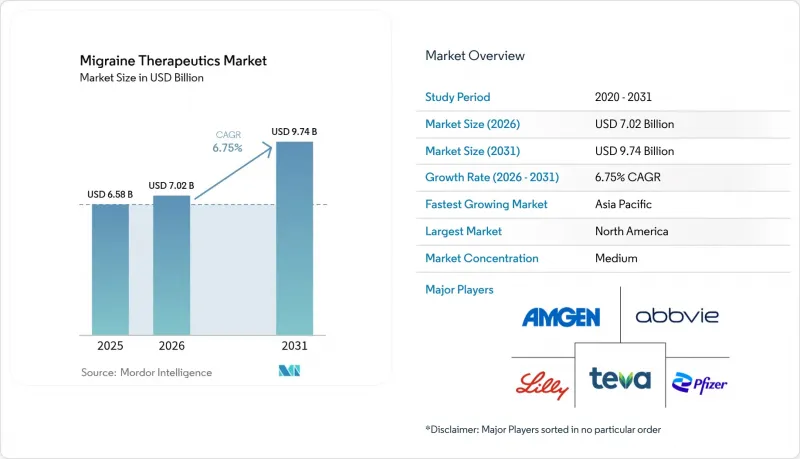
Mordor Intelligence에 따르면 편두통 치료제 시장 규모는 2025년 65억 8,000만 달러에서 2026년에는 70억 2,000만 달러로 확대하며, 2031년까지 97억 4,000만 달러에 달할 것으로 예측되고 있으며, 2026-2031년에 CAGR 6.75%로 확대할 전망입니다.
이 보고서에서는 시장을 치료 유형별(진통제, 예방제), 투여 경로별(경구, 정맥내 등), 환자층별(성인(18세 이상), 청소년(12-17세), 소아(12세 미만)), 그리고 지역별(북미, 유럽, 기타)로 분류하고 있습니다. 시장 전망은 금액(달러) 기준으로 제시되어 있습니다.
전 세계 편두통 치료제 시장의 동향 및 인사이트
CGRP 항체의 1차 예방약으로서의 급속한 보급
미국내과의사회(ACP)는 2025년 지침에서 단일 예방약이 효과를 보이지 않을 경우 CGRP 항체 사용을 허용함에 따라 민간 보험에 가입한 미국 성인의 경우 생물제제로 전환하기까지의 기간 중앙값이 18개월에서 5.7개월로 단축되었습니다. 덴마크의 실세계 레지스트리 추적 조사에 따르면 리메게판트의 12개월간 복약 순응도는 52%인 반면, 토피라메이트는 31%에 그쳤습니다. 이는 주로 게판트 계열 약물이 인지 기능에 미치는 부작용이나 체중 증가를 피할 수 있기 때문입니다. 에프티네즈맙의 분기별 정맥 주사 투여 일정은 월 1회 주사를 견디기 어려운 환자들을 끌어모아, 출시 2년 이내에 미국 생물제제 시장 점유율의 18%를 차지했으며, 2024년 10월 6-17세 대상 승인을 받아 소아 분야로도 확대되고 있습니다. CGRP 치료를 받은 만성 편두통 환자에서 응급실 방문이 53% 감소하고 입원 일수가 41% 감소함에 따라 보험사는 약제비 급등을 수용하고 있으며, 피보험자 1인당 연간 4,200달러의 순절감 효과를 가져오고 있습니다. 메타분석에 따르면 엘레누맙 및 프레마네주맙은 월간 편두통 발작 일수를 2.4-3.1일(대조군은 1.6-2.0일)로 감소시킴으로써, 풀나리딘이나 발프로산보다 우수한 것으로 나타났으며,이는 보험 적용 리스트에 우선적으로 포함되는 데 힘을 실어주고 있습니다.
경구용 게판트 계열 약물이 ‘트립탄 불응자’의 공백을 메운다
편두통 환자의 약 30-40%는 효능 부족이나 심혈관계 금기 사항으로 인해 트립탄 계열 약물로부터 거의 혜택을 받지 못하고 있으며, 혈관 수축을 동반하지 않고 CGRP 수용체를 차단하는 경구용 게판트 계열 약물의 시장 진입 여지가 생기고 있습니다. 1,856명의 환자를 대상으로 한 HeAD-US 임상 연구에서는 게판트와 트립탄의 2시간 후 통증 소실률이 비슷한 수준(약 21%)이었으나, 게판트는 24시간 후 통증 완화율이 8포인트 더 높았으며, 약물 과다 사용 위험을 줄일 수 있음이 입증되었습니다. 2024년 12월, 아토게판트는 만성 편두통에 대한 최초의 1일 1회 경구 투여형 CGRP 예방제로 승인되었습니다. 이는 냉장 시설을 이용할 수 없는 지방의 환자분들에게도 호평을 받고 있는 주사가 필요 없는 편의성을 제공합니다. 자베게판트 비강 스프레이는 2시간 이내에 24%의 환자에서 통증이 사라지게 하며, 15분 이내에 효과가 나타나기 때문에 정제와 주사제 간의 효과 발현 속도 격차를 해소하고 있습니다. 리메게판트의 ‘급성기 치료 + 예방’이라는 이중 적응증 덕분에 발작성 편두통 환자의 치료 계획이 간소화되며, 발작 빈도가 변동하는 경우에도 복약 순응도가 향상됩니다.
바이오의약품의 고가 정가와 단계적 치료 제한
미국에서 CGRP 모노클로널 항체의 연간 정가는 8,100-9,400달러이며, 민간 보험의 72%, 메디케이드의 89% 플랜에서 단계적 치료가 적용되고 있습니다. 단계적 치료 프로토콜로 인해 CGRP 사용이 14.3개월 지연되고, 응급실 방문이 38% 증가하여, 약제 가격을 상회하는 1만 1,200달러의 피할 수 있는 비용이 발생하고 있습니다. 프랑스에서는 모노클로널 항체 제제에 ASMR V("추가적 이점 없음") 분류가 부여되어 보험 환급이 인정되지 않으며, 신경과 전문의는 아토게판트 또는 적응증 외 사용의 보톡스를 처방하도록 유도되고 있습니다. 2029-2031년까지는 바이오시밀러 CGRP 항체 제제가 존재하지 않기 때문에 가격 경직성이 유지될 것이며, 예측 기간이 지나도 지불자 측의 저항이 지속될 것으로 확실시됩니다.
부문 분석
2025년에는 진통제가 편두통 치료제 시장 점유율의 65.55%를 차지하며, 트립탄 계열 약물과 NSAIDs가 주도하는 반면, 예방약은 2031년까지 연평균 성장률(CAGR) 9.85%로 성장하여 편두통 치료제 시장내 점유율을 확대할 것으로 예측됩니다. 트립탄 계열 약물은 제네릭 의약품의 가격과 처방 의사의 익숙함 덕분에 여전히 지배적인 지위를 유지하고 있지만, 경구용 게판트 계열 약물이 트립탄 계열 약물에 반응하지 않는 환자의 최대 30-40%를 차지하게 됨에 따라이 기간 중 트립탄 계열 약물의 판매량은 소폭 감소할 전망입니다. 디탄 계열 약물은 주요 적응증이 평일 사용을 제한하고 있으며, 틈새 시장 위치에 머물러 있습니다. CGRP 모노클로널 항체 및 경구용 게판트 계열 약물은 가이드라인에 따라 2차 선택약으로서의 지위가 확립됨에 따라 예방 요법의 채택을 촉진하고 있습니다. 보툴리눔 독소 A는 오랜 기간 입증된 유효성으로 인해 만성 편두통 예방 치료의 주축이 되고 있으나, 아토게판트의 만성 편두통에 대한 적응증 표기가 그 거의 독점적인 지위에 도전장을 내밀고 있습니다. 항경련제나 베타-차단제는 12개월간 지속 사용률이 28-35%에 그치는 것에서도 알 수 있듯이, 낮은 내약성으로 인해 시장 점유율을 잃고 있으며, 이는 CGRP 계열 치료제로의 전환을 촉진하고 있습니다. 메타분석에 따르면 엘레누맙과 프레마네즈맙은 월간 편두통 발작 일수를 2.4-3.1일 감소시키는 반면, 풀나리진은 1.6-2.0일 감소에 그치고 있으며, 비용이 높음에도 불구하고 보험사가 생물제제를 우선시하는 근거가 되고 있습니다. 프랑스가 모노클로널 항체의 공적 보험 적용을 거부하는 반면, 아토게판트를 적용 대상으로 삼고 있는 점은 브랜드 전략에 영향을 미치는 유럽 각국의 처방 지침 차이를 여실히 드러내고 있습니다.
편두통 치료제 시장 규모의 변화는 임상적 혁신의 속도를 반영하고 있습니다. 분기마다 한 번씩 투여하는 엡티네즈맙 정맥 주사는 매월 자가 주사를 원하지 않는 환자들을 끌어들이고 있습니다. 아토게판트와 같은 경구용 게판트 계열 약물은 매일 주사 바늘 없이 투여할 수 있기를 원하는 만성 환자들에게 지지를 받고 있습니다. 리메게판트는 급성기 치료와 예방 모두에 대응할 수 있는 범용성을 갖추고 있으며, 발작성 환자의 복약 부담을 경감시킵니다. 디탄 계열 약물은 이동 제한 해제를 위한 적응증 확대를 기다리고 있습니다. 에르고트 알칼로이드는 혈관 수축의 위험이 있으며, 시장 점유율이 하락하고 있습니다. 2030년까지는 바이오시밀러의 등장이 예상되지 않기 때문에 오리지널 제약사는 가격 결정력을 유지하고 있는 반면, 제네릭 트립탄 공급업체들은 판매량과 가격을 통해 시장 점유율을 지키고 있습니다.
지역별 분석
북미는 높은 진단율, CGRP 바이오제제에 대한 광범위한 보험 적용, 그리고 밀집된 전문 클리닉 네트워크 덕분에 2025년 매출의 42.55%를 차지하고 있습니다. 그러나 단계적 치료로 인해 14.3개월의 지연이 발생하고, 응급실 방문이 38% 증가하여 최적의 치료 성과를 저해하고 있습니다. 캐나다에서는 각 주마다 처방약 리스트이 제각각이어서 접근성에 차이가 발생하고 있습니다. 온타리오주에서는 월 4일 이상 편두통이 발생하는 경우를 조건으로 바이오제제의 보험 급여를 제공하고 있지만, 퀘벡주에서는 만성 사례로만 제한하고 있습니다. 멕시코에서는 민간 보험사가 도시 지역의 부유층을 대상으로 CGRP 억제제의 보험 적용을 하고 있지만, 전국적인 보험 적용 범위의 미비로 인해 대다수의 환자는 트립탄 계열 약물에 의존할 수밖에 없는 상황입니다.
유럽의 상황은 양극화되어 있습니다. 영국에서는 두 가지 예방 요법이 실패한 경우 아토게판트, 엘렌마브, 에프티네즈마브의 비용을 공적 보험으로 부담하고 있으며, 이는 임상적 기준에 부합하는 것입니다. 독일에서는 ‘기타 혜택’에 관한 긍정적인 판정에 따라 광범위한 보험 급여가 이루어지고 있는 반면, 스페인에서는 지출 상한선으로 인해 연도 중반에 치료가 중단되는 사태가 발생하고 있습니다. 프랑스에서는 CGRP 억제제 중 아토게판트만이 공적 보험 적용 대상이며, 수요는 경구용 약물이나 보톡스로 이동하고 있습니다. 이탈리아에서는 대폭적인 가격 인하로 인해 생물제제의 예산이 관리 가능한 수준으로 억제되고 처방량도 증가하고 있으며, 비용에 민감한 다른 EU 국가들에게 베스트 프랙티스가 되고 있습니다.
아시아태평양은 연평균 성장률(CAGR) 9.72%로 성장을 주도하고 있습니다. 중국에서는 2024년에 원격의료에 대한 보험 적용이 시작되어, 그동안 전문의의 진료를 받을 수 없었던 1억 8,000만 명의 잠재적 환자가 대상이 되었습니다. 인도는 최초의 CGRP 제제 승인을 기다리고 있는 상황이며, 그때까지는 제네릭 트립탄 계열 약물과 항경련제가 주류를 이루고 있습니다. 호주에서는 만성 편두통에 대해 엘렌마브와 프레마네즈마브의 보험 적용이 이루어지고 있으나, 발작성 편두통에는 적용되지 않으며 가장 중증인 환자층을 대상으로 하고 있습니다. 한국은 2024년에 리메게판트를 승인했으며, 해당 지역에서 최초로 보험 적용을 받은 경구용 게판트 제제로서 도입세가 가속화되고 있습니다. 중동 및 아프리카에서는 콜드 체인 제약으로 인해 생물제제의 유통에 4-6주의 지연이 발생하고 있으며, 경구용 및 비강용 약물의 우위가 유지되고 있습니다. 남미의 성장은 브라질과 아르헨티나에 집중되어 있으며, 이들 국가에서는 민간 보험이 CGRP 생물제제를 보장하는 반면, 공적 의료제도에서는 여전히 가격 측면의 제약이 남아 있습니다.
기타 혜택:
- 엑셀 형식의 시장 예측(ME) 시트
- 3개월간의 애널리스트 지원
자주 묻는 질문
목차
제1장 서론
제2장 조사 방법
제3장 개요
제4장 시장 구도
제5장 시장 규모와 성장 예측
제6장 경쟁 구도
제7장 시장 기회와 향후 전망
KSA 26.08.25According to Mordor Intelligence, the migraine therapeutics market size expanded from USD 6.58 billion in 2025 to USD 7.02 billion in 2026 and is projected to reach USD 9.74 billion by 2031, advancing at a 6.75% CAGR over 2026-2031.
This report Segments the Industry Into by Therapeutics (Pain-Relieving Medications [Analgesics, and More], Preventive Medications [Anticonvulsants and More]), Route of Administration (Oral, Intravenous, and More), Patient Group (Adults (>=18 Yrs), Adolescents (12-17 Yrs), and Children (<12 Yrs)), and Geography (North America, Europe, and More). The Market Forecasts are Provided in Terms of Value (USD).
Global Migraine Therapeutics Market Trends and Insights
Rapid Penetration of CGRP Antibodies Into First-Line Prevention
The American College of Physicians allowed CGRP antibodies after failure of a single preventive in its 2025 guideline, trimming median time to biologic from 18 months to 5.7 months for commercially insured U.S. adults. Real-world Danish registry tracking shows 52% 12-month adherence for rimegepant compared with 31% for topiramate, largely because gepants avoid cognitive side effects and weight gain. Eptinezumab's quarterly infusion schedule attracts patients intolerant of monthly injections, capturing 18% U.S. biologic share within two years of launch and broadening into pediatrics after October 2024 approval for ages 6-17. Payers accept higher drug costs as emergency-department admissions fall 53% and inpatient stays drop 41% among chronic migraine patients treated with CGRP therapy, delivering USD 4,200 net savings per member annually. Meta-analysis positions erenumab and fremanezumab as superior to flunarizine or valproate by reducing monthly migraine days by 2.4-3.1 versus 1.6-2.0, fueling formulary prioritization.
Oral Gepants Closing the "Triptan-Non-Responder" Gap
Roughly 30-40% of migraine sufferers gain little benefit from triptans because of inadequate efficacy or cardiovascular contraindications, creating headroom for oral gepants that block CGRP receptors without vasoconstriction. The HeAD-US real-world study in 1,856 patients showed similar two-hour pain freedom between gepants and triptans (about 21%) but eight-point higher 24-hour pain relief for gepants, lowering risk of medication overuse. Atogepant became the first oral daily CGRP preventive for chronic migraine in December 2024, offering needle-free convenience that resonates with rural patients lacking refrigeration access. Zavegepant nasal spray delivers pain freedom in 24% within two hours and onset inside 15 minutes, bridging the speed gap between tablets and injections. Rimegepant's dual acute-plus-preventive label simplifies regimens for episodic patients, improving adherence when attack frequency fluctuates.
High Biologic List Prices & Step-Therapy Restrictions
CGRP monoclonal antibodies list at USD 8,100-9,400 annually in the U.S., prompting step-therapy in 72% of commercial and 89% of Medicaid plans. Step protocols postpone CGRP use by 14.3 months and correspond with 38% higher emergency visits, adding USD 11,200 avoidable costs that eclipse the drug price. France assigned ASMR V ("no added benefit") to monoclonals, denying reimbursement and steering neurologists to atogepant or off-label Botox. Absence of biosimilar CGRP antibodies before 2029-2031 preserves price rigidity, ensuring payer resistance will persist beyond the forecast window.
Other drivers and restraints analyzed in the detailed report include:
- Post-Pandemic Telehealth Adoption Accelerates Accurate Diagnosis & Rx
- Favorable Reimbursement in EU for Preventive Biologics
- Safety Concerns Around Ditans' Driving-Impairment Label
For complete list of drivers and restraints, kindly check the Table Of Contents.
Segment Analysis
Pain-relieving medications retained 65.55% of migraine therapeutics market share in 2025, led by triptans and NSAIDs, whereas preventive agents are forecast to grow 9.85% CAGR through 2031, increasing their slice of migraine therapeutics market size. Triptans stay dominant because of generic prices and prescriber familiarity, yet oral gepants capture up to 30-40% of triptan-non-responders, shrinking triptan volumes modestly over the period. Ditans remain niche as their driving label curbs weekday use. CGRP monoclonal antibodies and oral gepants propel preventive uptake after guidelines moved them to second-line status. Botulinum toxin A anchors chronic migraine prevention with long-standing efficacy, although atogepant's chronic label now challenges its near-monopoly. Anticonvulsants and beta-blockers lose ground because of poor tolerability, evidenced by 28-35% 12-month persistence, fueling migration to CGRP options. Meta-analysis shows erenumab and fremanezumab lower monthly migraine days by 2.4-3.1 versus 1.6-2.0 for flunarizine, justifying payer preference for biologics despite cost premium. France's refusal to fund monoclonals but coverage of atogepant illustrates divergent European formularies that influence brand strategy.
Shifts within migraine therapeutics market size mirror clinical innovation tempo. Quarterly eptinezumab infusions entice patients unwilling to self-inject monthly. Oral gepants such as atogepant appeal to chronic patients seeking daily, needle-free dosing. Rimegepant offers dual acute-plus-preventive versatility, easing pill burden for episodic sufferers. Ditans await label refinements to lift mobility restrictions. Ergot alkaloids slide because of vasoconstrictive risk. As biosimilars are unlikely before 2030, originators keep pricing power, while generic triptan suppliers defend share on volume and price.
Complete Report Scope:
- By Drug Class
- Pain-relieving Medications
- Analgesics
- Triptans
- Ergot Alkaloids
- Ditans
- NSAIDs
- Preventive Medications
- Blood-pressure-lowering Agents
- Anticonvulsants
- Calcitonin Gene-related Peptide (CGRP) Antagonists
- Botulinum Toxin A
- Antidepressants
- Pain-relieving Medications
- By Route of Administration
- Oral
- Subcutaneous Injection
- Intranasal
- Intravenous
- Transdermal / Other Novel
- By Patient Group
- Adults (Greater Than 18 yrs)
- Adolescents (12-17 yrs)
- Children (Less than 12 yrs)
- By Geography
- North America
- United States
- Canada
- Mexico
- Europe
- Germany
- United Kingdom
- France
- Italy
- Spain
- Rest of Europe
- Asia-Pacific
- China
- India
- Japan
- Australia
- South Korea
- Rest of Asia-Pacific
- Middle East and Africa
- GCC
- South Africa
- Rest of Middle East and Africa
- South America
- Brazil
- Argentina
- Rest of South America
- North America
Geography Analysis
North America secured 42.55% of 2025 revenue thanks to high diagnosis rates, broad commercial coverage for CGRP biologics, and dense specialty-clinic networks. Yet step-therapy adds 14.3-month delays and 38% more emergency visits, undercutting optimal outcomes. Canada's fragmented provincial formularies cause inconsistent access; Ontario funds biologics after four migraine days monthly, while Quebec restricts to chronic cases. Mexico's private insurers reimburse CGRP agents for urban elites, but national coverage gaps leave most reliant on triptans.
Europe presents a split landscape. The UK funds atogepant, erenumab, and eptinezumab after two preventive failures, aligning with clinical norms. Germany's positive "additional benefit" rulings give broad reimbursement, whereas Spain's spending caps enforce mid-year pauses. France funds only atogepant among CGRP agents, channeling demand to oral therapy and Botox. Italy's steep discounts keep biologic budgets manageable and volumes rising, offering a blueprint for other cost-sensitive EU states.
Asia-Pacific leads growth at 9.72% CAGR. China's 2024 telemedicine reimbursement adds 180 million potential patients who previously lacked specialist care. India awaits its first CGRP approvals; until then, generic triptans and anticonvulsants dominate. Australia reimburses erenumab and fremanezumab for chronic migraine but not episodic disease, capturing the sickest cohort. South Korea listed rimegepant in 2024, the region's first reimbursed oral gepant, catalyzing adoption momentum. Middle East and Africa confront 4-6-week biologic distribution delays because of cold-chain limitations, sustaining dominance of oral and intranasal drugs. South America's growth focuses on Brazil and Argentina, where private insurance covers CGRP biologics, whereas public systems remain price-constrained.
- Abbvie
- Amgen
- Amneal Pharmaceuticals
- AstraZeneca
- Biohaven Pharmaceutical Holding Company Ltd.
- Bausch Health
- Bayer
- Dr. Reddy's Laboratories
- Eli Lilly and Company
- GlaxoSmithKline
- H. Lundbeck
- Impel Pharmaceuticals Inc.
- Johnson & Johnson
- Merck
- Novartis
- Pfizer
- Sun Pharmaceuticals Industries
- Teva Pharmaceutical Industries
- Viatris
Additional Benefits:
- The market estimate (ME) sheet in Excel format
- 3 months of analyst support
TABLE OF CONTENTS
1 Introduction
- 1.1 Study Assumptions & Market Definition
- 1.2 Scope of the Study
2 Research Methodology
3 Executive Summary
4 Market Landscape
- 4.1 Market Overview
- 4.2 Market Drivers
- 4.2.1 Post-pandemic telehealth adoption accelerates accurate diagnosis & Rx
- 4.2.2 Rapid penetration of CGRP antibodies into first-line prevention
- 4.2.3 Oral gepants closing the triptan-non-responder gap
- 4.2.4 Favorable reimbursement in EU for preventive biologics
- 4.2.5 Devices enabling upper-nasal or POD DHE delivery
- 4.2.6 Employer-funded migraine-care programmes in Asia-Pacific
- 4.3 Market Restraints
- 4.3.1 High biologic list prices & step-therapy restrictions
- 4.3.2 Safety concerns around ditans driving-impairment label
- 4.3.3 Limited paediatric approvals outside US & JP
- 4.3.4 Supply-chain cold-chain gaps in GCC & Africa
- 4.4 Supply-Chain Analysis
- 4.5 Regulatory Landscape
- 4.6 Technological Outlook
- 4.7 Porter's Five Forces
- 4.7.1 Threat of New Entrants
- 4.7.2 Bargaining Power of Suppliers
- 4.7.3 Bargaining Power of Buyers
- 4.7.4 Threat of Substitutes
- 4.7.5 Competitive Rivalry
5 Market Size & Growth Forecasts (Value, USD)
- 5.1 By Drug Class
- 5.1.1 Pain-relieving Medications
- 5.1.1.1 Analgesics
- 5.1.1.2 Triptans
- 5.1.1.3 Ergot Alkaloids
- 5.1.1.4 Ditans
- 5.1.1.5 NSAIDs
- 5.1.2 Preventive Medications
- 5.1.2.1 Blood-pressure-lowering Agents
- 5.1.2.2 Anticonvulsants
- 5.1.2.3 Calcitonin Gene-related Peptide (CGRP) Antagonists
- 5.1.2.4 Botulinum Toxin A
- 5.1.2.5 Antidepressants
- 5.1.1 Pain-relieving Medications
- 5.2 By Route of Administration
- 5.2.1 Oral
- 5.2.2 Subcutaneous Injection
- 5.2.3 Intranasal
- 5.2.4 Intravenous
- 5.2.5 Transdermal / Other Novel
- 5.3 By Patient Group
- 5.3.1 Adults (Greater Than 18 yrs)
- 5.3.2 Adolescents (12-17 yrs)
- 5.3.3 Children (Less than 12 yrs)
- 5.4 By Geography
- 5.4.1 North America
- 5.4.1.1 United States
- 5.4.1.2 Canada
- 5.4.1.3 Mexico
- 5.4.2 Europe
- 5.4.2.1 Germany
- 5.4.2.2 United Kingdom
- 5.4.2.3 France
- 5.4.2.4 Italy
- 5.4.2.5 Spain
- 5.4.2.6 Rest of Europe
- 5.4.3 Asia-Pacific
- 5.4.3.1 China
- 5.4.3.2 India
- 5.4.3.3 Japan
- 5.4.3.4 Australia
- 5.4.3.5 South Korea
- 5.4.3.6 Rest of Asia-Pacific
- 5.4.4 Middle East and Africa
- 5.4.4.1 GCC
- 5.4.4.2 South Africa
- 5.4.4.3 Rest of Middle East and Africa
- 5.4.5 South America
- 5.4.5.1 Brazil
- 5.4.5.2 Argentina
- 5.4.5.3 Rest of South America
- 5.4.1 North America
6 Competitive Landscape
- 6.1 Market Concentration
- 6.2 Market Share Analysis
- 6.3 Company Profiles (includes Global level Overview, Market level overview, Core Segments, Financials as available, Strategic Information, Market Rank/Share for key companies, Products & Services, and Recent Developments)
- 6.3.1 AbbVie Inc.
- 6.3.2 Amgen Inc.
- 6.3.3 Amneal Pharmaceuticals Inc.
- 6.3.4 AstraZeneca plc
- 6.3.5 Biohaven Pharmaceutical Holding Company Ltd.
- 6.3.6 Bausch Health Companies Inc.
- 6.3.7 Bayer AG
- 6.3.8 Dr. Reddy's Laboratories Ltd.
- 6.3.9 Eli Lilly and Company
- 6.3.10 GSK plc
- 6.3.11 H. Lundbeck A/S
- 6.3.12 Impel Pharmaceuticals Inc.
- 6.3.13 Johnson & Johnson
- 6.3.14 Merck & Co., Inc.
- 6.3.15 Novartis AG
- 6.3.16 Pfizer Inc.
- 6.3.17 Sun Pharmaceutical Industries Ltd.
- 6.3.18 Teva Pharmaceutical Industries Ltd.
- 6.3.19 Viatris Inc.
7 Market Opportunities & Future Outlook
- 7.1 White-space & Unmet-Need Assessment