

|
시장보고서
상품코드
2114002
과일 및 채소 가공 장비 : 시장 점유율 분석, 업계 동향과 통계, 성장 예측(2026-2031년)Fruit And Vegetable Processing Equipment - Market Share Analysis, Industry Trends & Statistics, Growth Forecasts (2026 - 2031) |
||||||
 Mordor Intelligence
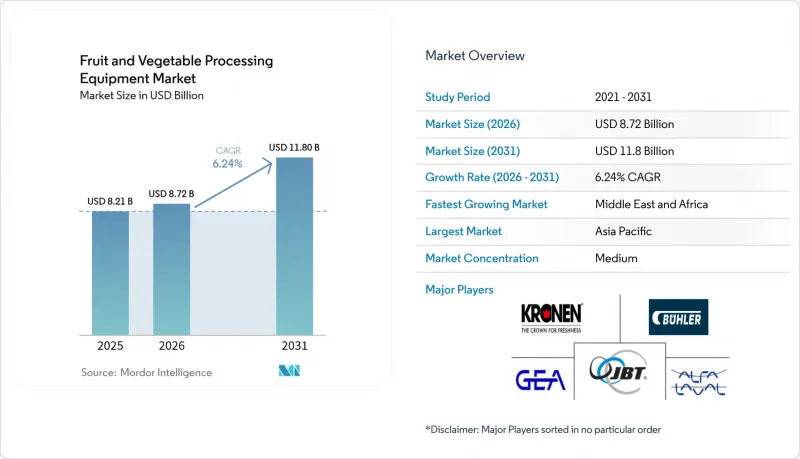
Mordor Intelligence에 따르면 과일·채소 가공 장비 시장 규모는 2025년에 82억 1,000만 달러로 평가되며, 2026년 87억 2,000만 달러에서 2031년까지 118억 달러에 달할 것으로 예측되고 있으며, 예측 기간(2026-2031년)에 CAGR은 6.24%에 달할 전망입니다.
이 보고서는 장비 유형(전처리 설비, 가공 장비, 포장·이송 설비),제품 유형(주스·퓌레, 냉동 농산물, 통조림 농산물, 건조·탈수 농산물, 신선 농산물, 절단 신선 농산물) 및 지역(북미, 유럽, 아시아태평양, 남미, 중동 및 아프리카)별로 분류되어 있습니다. 시장 예측은 금액(달러) 기준으로 제시되어 있습니다.
전 세계 과일·채소 가공 장비 시장의 동향 및 인사이트
콜드체인 및 저장 기술의 도입 확대
콜드 체인 인프라는 수확 후 손실을 줄이고 수출 시장을 위한 저장 기간을 연장하라는 정부의 요청에 힘입어 전례 없는 속도로 확대되고 있습니다. 인도는 2024년, Pradhan Mantri Kisan Sampada Yojana에 따라 399건의 콜드 체인 프로젝트를 승인했으며, 이는 예냉, 숙성실, 냉장 운송 네트워크를 갖춘 통합형 포장 시설을 대상으로 합니다. 이로 인해 수확 시점의 품질을 유지하는 블라스트 냉동고, 개별 급속 냉동 터널, 조절 대기 포장 장비에 대한 파생 수요가 발생하고 있습니다. 마찬가지로 싱가포르의 ‘30 by 30’ 식량안보 구상 역시 국산 농산물의 냉장 보관 능력을 의무화하고 있으며, 수직 농장 및 제어 환경 농업 사업자들에게 수확 후 가공 라인 설치를 촉구하고 있습니다. 이러한 점에서 전략적으로 볼 때, 콜드 체인에 대한 투자는 더 이상 유통 단계에 국한되지 않고 가공 단계까지 확대되면서, 농장과 공장의 설비 경계가 모호해지고 있습니다.
자동화·고효율 가공 장비의 기술적 진보
자동화는 선별이나 절단과 같은 반복적인 작업에서 결함 탐지나 수율 최적화와 같은 인지 기능으로 전환되고 있습니다. 불러(Buhler)사의 ‘LumoVision’ 광학 선별기는 하이퍼스펙트럼 이미징과 기계학습 알고리즘을 활용하여, 인간 검사원이 볼 수 없는 내부 결함을 식별함으로써 오배출을 15% 줄이고 처리 능력을 향상시키고 있습니다. JBT 코퍼레이션의 ‘Frigoscandia GYRoCOMPACT’ 나선형 냉동기는 IoT 센서를 통합하여 벨트 속도와 냉매 유량을 실시간으로 조정함으로써 기존 시스템에 비해 에너지 소비량을 20% 절감하고 있습니다. 이러한 발전이 중요한 이유는 가치 제안을 ‘인력 대체’에서 ‘데이터베이스 공정 제어’로 전환하여, 가공업체가 일관된 품질과 추적성을 보장할 수 있도록 하기 때문입니다. 이는 소매업계의 자체 브랜드 계약 및 수출 인증의 필수 조건이 되고 있습니다. 예지 보전 및 원격 진단 기능을 탑재한 장비 공급업체는 프리미엄 가격을 받고 있습니다. 이는 예기치 못한 가동 중단으로 인해 가공업체에 하루 5만-20만 달러의 생산 손실 및 폐기 비용이 발생하기 때문입니다.
첨단 가공 장비에는 막대한 초기 투자가 필요
세척, 선별, 절단, 블랜칭, 포장에 이르기까지 자동화가 통합된 가공 라인에는 200만-500만 달러의 자본이 필요하며, 이러한 장벽으로 인해 대부분의 중소기업은 구형 설비를 업그레이드할 수 없습니다. 투자 수익률(ROI) 산정은 처리 능력 향상과 인건비 절감에 달려 있지만, 신흥 시장의 가공업체들은 설비 대출 금리가 12%에서 18%에 달하고 있으며, 이로 인해 투자 회수 기간이 7년 이상으로 늘어나고 순현재가치가 하락하고 있습니다. 리스나 ‘서비스로서의 장비(Equipment-as-a-Service)’와 같은 모델은 북미와 유럽 이외의 지역에서는 여전히 미발달 상태이며, 가공업체들은 자체 자금으로 충당하거나 정부의 보조금에 의존할 수밖에 없습니다. 그러나 정부 보조금은 지급이 지연되거나 프로젝트 비용의 30%로 상한선이 설정되는 경우가 많습니다. 이러한 자금면의 제약으로 인해 시장은 양극화되고 있습니다. 대형 가공업체는 대량 수주 계약을 통해 투자를 상각할 수 있는 반면, 소규모 사업자는 설비 교체를 미룰 수밖에 없어, 그 결과 품질 편차가 해소되지 않고, 추적성 및 HACCP 준수가 의무화된 수출 시장 진출이 제한되고 있습니다.
부문 분석
2025년 시점에 가공 장비는 시장의 53.78%를 차지하고 있으며, 이는 신선 농산물을 블랜칭, 살균, 추출, 농축과 같은 공정을 통해 소비자에게 제공 가능한 형태로 변환하는 핵심적인 부가가치 단계로서의 역할을 반영합니다. 그러나 ‘포장·이송 설비’는 2031년까지 연평균 7.71%의 성장률을 기록하고 있으며, 이는 모든 설비 유형 중 가장 빠른 성장률입니다. 이는 가공업체들이 조절 대기 포장(MAP) 기준을 충족하고 최종 처리 단계에서의 오염 위험을 줄이기 위해 라인 말단의 자동화를 우선시하고 있기 때문입니다. 수직형 성형·충진·밀봉기, 로봇식 케이스 패커, 인라인 체크웨이는 ‘Safe Quality Food’ 및 ‘British Retail Consortium’ 인증 획득을 목표로 하는 시설에서 수작업을 대체하고 있습니다. 이러한 인증에서는 포장 공정의 모든 접촉 지점에서 문서화된 관리가 의무화되어 있습니다. 세척기, 껍질 벗기기 기계, 이물질 제거기 등을 포함한 전처리 설비는 여전히 필수적이지만, 상품화가 진행되고 있으며, 차별화 요소는 물 재순환 효율이나 3-A 및 EHEDG 위생 기준을 준수한 위생적인 설계 특성으로 제한됩니다.
‘포장·취급’ 분야로의 전환은 보다 광범위한 전략적 변화를 반영하고 있습니다. 가공업체들은 가공 공정에서 확립된 제품 품질이 부적절한 포장으로 인해 훼손될 가능성이 있음을 인식하고 있습니다. 이는 특히 유통기한이 7일에서 14일인 신선 절단 제품이나 최소한의 가공만 거친 제품에서 두드러집니다. GEA의 로봇식 픽 앤 플레이스 시스템은 비전 가이드식 선별 기능과 통합되어 분당 120개 이상의 속도로 SKU 혼합 포장이 가능합니다. 이는 E-Commerce 주문 처리 및 소매용 버라이어티 팩에 있으며, 매우 중요한 기능입니다. ISO 22000과 같은 규정 준수 프레임워크에 따라 포장 라인의 검증 요건은 알레르기 유발 물질의 교차 오염 방지 및 위변조 방지 실까지 확대되었으며, 이로 인해 자동 전환 기능 및 CIP(정지 세척) 기능을 갖춘 설비에 대한 자본 배분이 촉진되고 있습니다. 전처리 장비는 기반이 되는 요소이지만, 공급업체가 기존에 가공 공정과 연관되어 온 광학 선별이나 불량품 제거와 같은 기술을 통합하지 않는 한, 이익률 확대에는 한계가 있습니다. 이로 인해 장비 카테고리 간의 융합이 진행되고 있습니다.
지역별 분석
아시아태평양은 2025년에 시장의 31.05%를 차지할 것으로 예상되며, 중국의 콜드체인 규제, 인도의 PMFME 보조금, 그리고 일본의 인력 부족으로 인한 자동화 진전이 그 요인으로 꼽힙니다. 중국 국가발전개혁위원회에 따르면 중국의 ‘제14차 5개년 계획’에서는 콜드체인 물류에 150억 달러가 배정되었으며, 여기에는 산둥성, 광둥성, 쓰촨성의 가공 허브가 포함되어 있으며, 소규모 농가의 생산물을 수출 기준량으로 집약하고 있습니다. 일본에서는 노동력 인구 감소(2019-2024년에 제조업 고용이 8% 감소)로 인해 편의점 및 레토르트 식품 제조업체에 공급하는 채소 가공 시설에서 협업 로봇과 AI를 활용한 품질 검사 도입이 가속화되고 있습니다. 호주에서는 수출 지향적인 원예 농업, 특히 동남아시아로 수출되는 베리류와 핵과류에 중점을 두고 있으며, 식물 검역 기준을 충족하는 광학 선별기 및 조절 분위기 포장 라인에 대한 투자가 촉진되고 있습니다. 이 지역의 성장은 고르지 않습니다. 중국 연안 지역이나 인도의 도시 지역에서는 다국적 가공업체가 지배적인 반면, 내륙이나 농촌 지역에서는 수작업에 의존하고 있으며, 고급 장비 공급업체가 기술력으로 경쟁하고 현지 제조업체가 가격 경쟁을 펼치는 양극화된 시장이 형성되어 있습니다.
중동 및 아프리카는 식량안보의 필요성과 수입 대체 정책에 힘입어 연평균 7.92%라는 지역내 가장 높은 성장률로 확대되고 있습니다. 아랍에미리트(UAE)의 ‘2051년 국가 식량안보 전략’에서는 신선 농산물의 자급률 70%를 의무화하고 있으며, 이에 따라 UAE 정부에 따르면 수직 농장 사업자와 제어 환경 농업 프로젝트가 잎채소 및 토마토용 수확 후 가공 라인을 도입하고 있습니다. 사우디아라비아 정부에 따르면 해당 국가의 ‘비전 2030’에서는 농업 가공 인프라에 32억 달러가 배정되어 있습니다. 여기에는 알 아하사의 대추야자 가공 시설과 지잔의 채소 포장 시설이 포함되어 있으며, 이집트 및 요르단으로부터의 수입 의존도를 낮추는 것을 목표로 하고 있습니다. 남아프리카의 감귤류 및 포도 수출 부문(연간 25억 달러 규모)에서는 유럽연합(EU)의 추적성 요건 및 글로벌 GAP 인증을 충족하기 위해 선별·포장 라인의 업그레이드가 진행되고 있습니다.
유럽과 북미는 성숙한 시장이지만, 지속가능성에 초점을 맞춘 설비 업그레이드에 대한 투자를 계속하고 있습니다. 유럽연합 집행위원회의 발표에 따르면 유럽의 ‘농장에서 식탁까지(Farm to Fork)’ 전략에서는 2030년까지 식품 폐기물을 50% 감축할 것을 의무화하고 있으며, 외관상 결함이 있는 농산물을 주스나 퓨레 생산에 활용하는 AI 탑재 선별 시스템의 도입이 촉진되고 있습니다. 북미에서는 인건비 절감이 중시되고 있으며, 캘리포니아주와 워싱턴주에서는 최저임금이 시간당 15달러를 초과함에 따라 로봇을 활용한 수확 및 자동 포장 기술이 가속화되고 있습니다. 장비 공급업체들은 밭용 기계와 가공 라인을 통합한 턴키 솔루션을 제공하고 있습니다. 브라질과 아르헨티나를 비롯한 남미에서는 북미 및 유럽으로의 냉동 과일 수출이 확대되고 있으며, HACCP 및 코셔 인증 기준을 충족하는 IQF 터널과 급속 냉동고가 필요하고 있습니다. FDA, EFSA, 코덱스 알리멘타리우스(Codex Alimentarius) 등의 기관에 의한 규제 영향으로 모든 지역에서 설비 사양이 정해져 있으며, 수출 시장을 목표로 하는 가공업체에게 위생적인 설계와 추적성은 필수 조건이 되고 있습니다.
기타 혜택:
- 엑셀 형식의 시장 예측(ME) 시트
- 3개월간의 애널리스트 지원
자주 묻는 질문
목차
제1장 서론
제2장 조사 방법
제3장 개요
제4장 시장 구도
제5장 시장 규모와 성장 예측
제6장 경쟁 구도
제7장 시장 기회와 향후 전망
KSA 26.08.26According to Mordor Intelligence, the fruit and vegetable processing equipment market size was valued at USD 8.21 billion in 2025 and estimated to grow from USD 8.72 billion in 2026 to reach USD 11.8 billion by 2031, at a CAGR of 6.24% during the forecast period (2026-2031).
This report is Segmented by Equipment Type (Pre-Processing Equipment, Processing Equipment, Packaging, and Handling Equipment), End-Product Type (Juices and Purees, Frozen Produce, Canned Produce, Dried and Dehydrated, Fresh, Fresh Cut), and Geography (North America, Europe, Asia-Pacific, South America, and Middle East and Africa). The Market Forecasts are Provided in Terms of Value (USD).
Global Fruit And Vegetable Processing Equipment Market Trends and Insights
Increasing Adoption of Cold Chain and Preservation Technologies
Cold chain infrastructure is expanding at an unprecedented pace, driven by government mandates to reduce post-harvest losses and extend shelf life for export markets. India approved 399 cold chain projects under the Pradhan Mantri Kisan Sampada Yojana in 2024, targeting integrated pack-houses with pre-cooling, ripening chambers, and refrigerated transport links. This creates derived demand for blast freezers, individual quick freezing tunnels, and modified atmosphere packaging equipment that lock in quality at the point of harvest. Singapore's 30 by 30 food security initiative similarly mandates cold storage capacity for domestic produce, compelling vertical farms and controlled-environment agriculture operators to install post-harvest processing lines. The strategic implication is that cold chain investments are no longer confined to distribution; they now encompass processing, blurring the line between farm-gate and factory-floor equipment.
Technological Advancements in Automated and High-Efficiency Processing Equipment
Automation is migrating from repetitive tasks like sorting and cutting to cognitive functions such as defect detection and yield optimization. Buhler's LumoVision optical sorters deploy hyperspectral imaging and machine learning algorithms to identify internal defects invisible to human inspectors, reducing false rejects by 15% and improving throughput. JBT Corporation's Frigoscandia GYRoCOMPACT spiral freezers integrate IoT sensors that adjust belt speed and refrigerant flow in real time, cutting energy consumption by 20% compared to legacy systems. These advancements matter because they shift the value proposition from labor replacement to data-driven process control, enabling processors to guarantee consistent quality and traceability, prerequisites for retail private-label contracts and export certifications. Equipment suppliers that embed predictive maintenance and remote diagnostics are capturing premium pricing, as unplanned downtime costs processors USD 50,000 to USD 200,000 per day in lost production and spoilage.
High Initial Capital Investment Required for Advanced Processing Equipment
Processing lines with integrated automation, spanning washing, sorting, cutting, blanching, and packaging, demand USD 2 million to USD 5 million in capital, a threshold that excludes most small and medium enterprises from upgrading legacy equipment. Return-on-investment calculations hinge on throughput gains and labor savings, yet processors in emerging markets face 12% to 18% interest rates on equipment loans, extending payback periods beyond 7 years, and eroding net present value. Leasing and equipment-as-a-service models remain underdeveloped outside North America and Europe, leaving processors to self-finance or rely on government subsidies that are often delayed or capped at 30% of project costs. This capital constraint bifurcates the market: large processors amortize investments across high-volume contracts, while smaller operators defer upgrades, perpetuating quality inconsistencies and limiting access to export markets that mandate traceability and HACCP compliance.
Other drivers and restraints analyzed in the detailed report include:
- Growing Consumer Preference for Minimally Processed and Fresh-Tasting Products
- Government Initiatives Promoting Food Processing and Agri-Tech Modernization
- Shortage of Skilled Workforce to Operate Sophisticated Equipment
For complete list of drivers and restraints, kindly check the Table Of Contents.
Segment Analysis
Processing Equipment held 53.78% of the market in 2025, reflecting its role as the core value-add stage where raw produce is transformed into consumer-ready formats through blanching, pasteurization, extraction, and concentration. However, Packaging and Handling Equipment is expanding at 7.71% annually through 2031, the fastest growth among all equipment types, as processors prioritize end-of-line automation to meet modified atmosphere packaging standards and reduce contamination risks during final handling. Vertical form-fill-seal machines, robotic case packers, and inline checkweighers are displacing manual labor in facilities pursuing Safe Quality Food and British Retail Consortium certifications, which mandate documented controls at every packaging touchpoint. Pre-processing Equipment, encompassing washers, peelers, and destoners, remains essential but commoditized, with differentiation limited to water recirculation efficiency and sanitary design features that comply with 3-A and EHEDG hygiene standards.
The shift toward Packaging and Handling reflects a broader strategic reorientation: processors recognize that product quality established during processing can be compromised by inadequate packaging, particularly for fresh-cut and minimally processed items with 7- to 14-day shelf lives. GEA's robotic pick-and-place systems, integrated with vision-guided sorting, enable mixed-SKU packing at speeds exceeding 120 units per minute, a capability critical for e-commerce fulfillment and retail variety packs. Compliance frameworks such as ISO 22000 now extend packaging line validation requirements to include allergen cross-contact prevention and tamper-evident sealing, driving capital allocation toward equipment with automated changeover and clean-in-place functionality. Pre-processing Equipment, while foundational, offers limited margin expansion unless suppliers incorporate optical sorting or defect rejection, technologies traditionally associated with processing stages, creating convergence between equipment categories.
Complete Report Scope:
- By Equipment Type
- Pre-processing Equipment
- Processing Equipment
- Packaging and Handling Equipment
- By End-Product Type
- Juices and Purees
- Frozen Produce
- Canned Produce
- Dried and Dehydrated
- Fresh
- Fresh Cut
- By Geography
- North America
- United States
- Canada
- Mexico
- Rest of North America
- Europe
- Germany
- United Kingdom
- Italy
- France
- Spain
- Netherlands
- Rest of Europe
- Asia-Pacific
- China
- India
- Japan
- Australia
- Rest of Asia-Pacific
- South America
- Brazil
- Argentina
- Rest of South America
- Middle East and Africa
- South Africa
- Saudi Arabia
- United Arab Emirates
- Rest of Middle East and Africa
- North America
Geography Analysis
Asia-Pacific captured 31.05% of the market in 2025, driven by China's cold chain mandates, India's PMFME subsidies, and Japan's labor-shortage-induced automation. China's 14th Five-Year Plan allocated USD 15 billion for cold chain logistics, including processing hubs in Shandong, Guangdong, and Sichuan provinces that consolidate smallholder output into export-grade volumes according to the National Development and Reform Commission, China. Japan's labor force contraction, manufacturing employment fell 8% from 2019 to 2024, is accelerating the adoption of collaborative robots and AI-driven quality inspection in vegetable processing facilities supplying convenience stores and ready-meal manufacturers. Australia's focus on export-oriented horticulture, particularly berries and stone fruit destined for Southeast Asia, is driving investments in optical sorters and modified atmosphere packaging lines that meet phytosanitary standards. The region's growth is uneven: multinational processors dominate in coastal China and urban India, while inland and rural areas rely on manual processing, creating a dual market where premium equipment suppliers compete on technology and local manufacturers compete on price.
The Middle East and Africa are expanding at 7.92% annually, the fastest regional growth rate, propelled by food security imperatives and import substitution policies. UAE's National Food Security Strategy 2051 mandates 70% self-sufficiency in perishable produce, prompting vertical farm operators and controlled-environment agriculture projects to install post-harvest processing lines for leafy greens and tomatoes according to the Government of the United Arab Emirates. Saudi Arabia's Vision 2030 allocated USD 3.2 billion for agri-processing infrastructure, including date processing facilities in Al-Ahsa and vegetable packing houses in Jizan that reduce reliance on imports from Egypt and Jordan, according to the Government of Saudi Arabia. South Africa's citrus and grape export sector, valued at USD 2.5 billion annually, is upgrading sorting and packing lines to meet European Union traceability requirements and Global GAP certification.
Europe and North America, while mature, continue to invest in sustainability-focused equipment upgrades. Europe's Farm to Fork Strategy mandates a 50% reduction in food waste by 2030, driving adoption of AI-powered sorting systems that salvage cosmetically imperfect produce for juice and puree production according to the European Commission. North America's focus on labor cost mitigation, minimum wages in California and Washington exceeding USD 15 per hour, is accelerating robotic harvesting and automated packing, with equipment suppliers offering turnkey solutions that integrate field machinery with processing lines. South America, led by Brazil and Argentina, is expanding frozen fruit exports to North America and Europe, requiring IQF tunnels and blast freezers that meet HACCP and Kosher certification standards. Compliance influence from bodies such as the FDA, EFSA, and Codex Alimentarius shapes equipment specifications across all geographies, with sanitary design and traceability features becoming non-negotiable for processors targeting export markets.
- Buhler AG
- GEA Group Aktiengesellschaft
- JBT
- KRONEN GmbH
- Alfa Laval AB
- Turatti Group
- Navatta Group Food Processing S.r.l.
- Allround Vegetable Processing
- FENCO Food Machinery S.r.l.
- Bertuzzi Food Processing S.r.l.
- Sormac B.V.
- Mepaco
- Heat and Control, Inc.
- Key Technology, Inc.
- Krones AG
- Bucher Industries AG
- ANKO Food Machine Co., Ltd.
- Bigtem Makine A.S.
- Syntegon Technology GmbH
- SPX FLOW, Inc.
- LVMH (Maison Francis Kurkdjian, Fresh)
Additional Benefits:
- The market estimate (ME) sheet in Excel format
- 3 months of analyst support
TABLE OF CONTENTS
1 INTRODUCTION
- 1.1 Study Assumptions and Market Definition
- 1.2 Scope of the Study
2 RESEARCH METHODOLOGY
3 EXECUTIVE SUMMARY
4 MARKET LANDSCAPE
- 4.1 Market Overview
- 4.2 Market Drivers
- 4.2.1 Increasing adoption of cold chain and preservation technologies
- 4.2.2 Technological advancements in automated and high-efficiency processing equipment
- 4.2.3 Growing consumer preference for minimally processed and fresh-tasting products
- 4.2.4 Government initiatives promoting food processing and agri-tech modernization
- 4.2.5 Development of multifunctional equipment reducing processing time and labor costs
- 4.2.6 Rising awareness about food safety and hygiene standards
- 4.3 Market Restraints
- 4.3.1 High initial capital investment required for advanced processing equipment
- 4.3.2 Complexity and maintenance requirements of automated machinery
- 4.3.3 Shortage of skilled workforce to operate sophisticated equipment
- 4.3.4 Strict regulatory compliance and certification requirements in different regions
- 4.4 Technological Outlook
- 4.5 Regulatory Landscape
- 4.6 Porter's Five Forces
- 4.6.1 Threat of New Entrants
- 4.6.2 Bargaining Power of Buyers
- 4.6.3 Bargaining Power of Suppliers
- 4.6.4 Threat of Substitutes
- 4.6.5 Competitive Rivalry
5 MARKET SIZE AND GROWTH FORECASTS (VALUE)
- 5.1 By Equipment Type
- 5.1.1 Pre-processing Equipment
- 5.1.2 Processing Equipment
- 5.1.3 Packaging and Handling Equipment
- 5.2 By End-Product Type
- 5.2.1 Juices and Purees
- 5.2.2 Frozen Produce
- 5.2.3 Canned Produce
- 5.2.4 Dried and Dehydrated
- 5.2.5 Fresh
- 5.2.6 Fresh Cut
- 5.3 By Geography
- 5.3.1 North America
- 5.3.1.1 United States
- 5.3.1.2 Canada
- 5.3.1.3 Mexico
- 5.3.1.4 Rest of North America
- 5.3.2 Europe
- 5.3.2.1 Germany
- 5.3.2.2 United Kingdom
- 5.3.2.3 Italy
- 5.3.2.4 France
- 5.3.2.5 Spain
- 5.3.2.6 Netherlands
- 5.3.2.7 Rest of Europe
- 5.3.3 Asia-Pacific
- 5.3.3.1 China
- 5.3.3.2 India
- 5.3.3.3 Japan
- 5.3.3.4 Australia
- 5.3.3.5 Rest of Asia-Pacific
- 5.3.4 South America
- 5.3.4.1 Brazil
- 5.3.4.2 Argentina
- 5.3.4.3 Rest of South America
- 5.3.5 Middle East and Africa
- 5.3.5.1 South Africa
- 5.3.5.2 Saudi Arabia
- 5.3.5.3 United Arab Emirates
- 5.3.5.4 Rest of Middle East and Africa
- 5.3.1 North America
6 COMPETITIVE LANDSCAPE
- 6.1 Market Concentration
- 6.2 Strategic Moves
- 6.3 Market Positioning Analysis
- 6.4 Company Profiles (includes Global level Overview, Market level overview, Core Segments, Financials as available, Strategic Information, Market Rank/Share for key companies, Products and Services, and Recent Developments)
- 6.4.1 Buhler AG
- 6.4.2 GEA Group Aktiengesellschaft
- 6.4.3 JBT
- 6.4.4 KRONEN GmbH
- 6.4.5 Alfa Laval AB
- 6.4.6 Turatti Group
- 6.4.7 Navatta Group Food Processing S.r.l.
- 6.4.8 Allround Vegetable Processing
- 6.4.9 FENCO Food Machinery S.r.l.
- 6.4.10 Bertuzzi Food Processing S.r.l.
- 6.4.11 Sormac B.V.
- 6.4.12 Mepaco
- 6.4.13 Heat and Control, Inc.
- 6.4.14 Key Technology, Inc.
- 6.4.15 Krones AG
- 6.4.16 Bucher Industries AG
- 6.4.17 ANKO Food Machine Co., Ltd.
- 6.4.18 Bigtem Makine A.S.
- 6.4.19 Syntegon Technology GmbH
- 6.4.20 SPX FLOW, Inc.
- 6.4.21 LVMH (Maison Francis Kurkdjian, Fresh)


