

|
시장보고서
상품코드
2114012
내열성 폴리머 : 시장 점유율 분석, 업계 동향 및 통계, 성장 예측(2026-2031년)Heat Resistant Polymer - Market Share Analysis, Industry Trends & Statistics, Growth Forecasts (2026 - 2031) |
||||||
 Mordor Intelligence
Mordor Intelligence에 의하면, 내열성 폴리머 시장 규모는 2025년에 1,324만 달러로 평가되었습니다. 2026년 1,406만 달러에서 2031년까지 1,896만 달러에 이를 것으로 예상되며, 예측 기간(2026-2031년) CAGR은 6.18%를 나타낼 전망입니다.
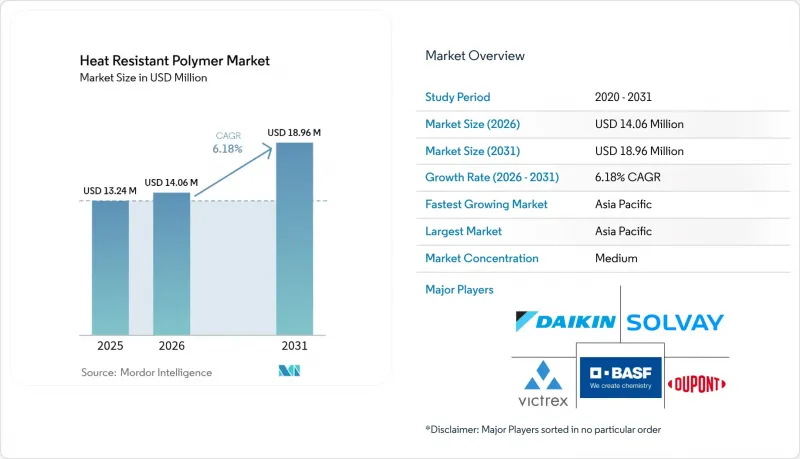
본 보고서는 유형별(불소수지, 폴리아미드, 폴리페닐렌설파이드(PPS), 폴리에테르에테르케톤(PEEK) 등),최종 사용자 산업별(자동차, 항공우주 및 방위, 전기 및 전자, 산업 장비 등), 지역별(아시아태평양, 북미, 유럽, 남미, 중동 및 아프리카)로 분류되어 있습니다. 시장 전망은 금액(미 달러) 기준으로 제시되어 있습니다.
세계의 내열성 폴리머 시장 동향 및 인사이트
`항공우주 및 자동차 부품 분야의 높은 수요
항공기 제조업체들은 금속에서 연속 섬유 열가소성 복합 소재로의 전환을 가속화하고 있으며, 피로 성능을 저하시키지 않으면서 더 신속한 조립을 실현하고 있습니다. 에어버스와 보잉은월100대 이상의 단일 통로 제트기 생산을 목표로 하고 있으며, 경량화와 생산 효율 향상을 위해 폴리에테르에테르케톤(PEEK) 및 폴리페닐렌설파이드(PPS)로 제작된 구조 부품을 널리 사용하고 있습니다. 현재 전기차 배터리 하우징에는 탄소섬유 강화 폴리에테르에테르케톤(PEEK)이 채택되어 있으며, 50%의 경량화와 정밀한 치수 공차를 실현함으로써 OEM(주문자 상표 제조업체)이 주행 거리를 연장하는 데 기여하고 있습니다. OEM 인증 절차에는 바이오 유래 소재에 대한 옵션도 포함되어 있어, 향후 공급의 다각화를 시사하고 있습니다. 두 부문에 걸친 견고한 조달 파이프라인이 내열성 폴리머 시장의 근본적인 성장을 뒷받침하고 있습니다.
소형화된 전기 어셈블리에 대한 뛰어난 보호
첨단 폴리이미드는 400°C를 넘는 내열성과 구리와 동등한 열팽창 계수를 겸비하고 있어, AI 서버 및 5G 기지국에서 미세 배선을 구현할 수 있게 합니다. 듀폰의 ‘Circuposit SAP8000’ 도금 약제 및 ‘Microfill SFP-II-M’ 구리 충전재는 이러한 필름과 함께 사용되어 고전류 밀도 하에서 비아 보이드를 방지합니다. 한편, 반도체 팹에서는 퍼플루오로알킬 및 폴리플루오로알킬 물질(PFAS)을 포함하는 가공 보조제의 사용 중단이 진행되고 있습니다. 연구 그룹에 따르면, 불소를 포함하지 않는 폴리이미드 층에서 유전율 3.0 미만을 실현하여 칩 상호 연결의 고속화가 기대되고 있습니다. 또한, 플렉서블 OLED 디스플레이에서도 수천 회의 굽힘 사이클을 견디는 내균열성 폴리이미드 커버 필름이 활용되고 있습니다. 이러한 특성이 내열성 폴리머 시장에서 지속적인 소재 대체를 뒷받침하고 있습니다.
원자재 및 에너지 비용의 변동
공급 차질로 인해 벤젠과 카프로락탐 가격이 상승함에 따라, BASF는 2024년 6월 PA66 컴파운드 가격을 파운드당 0.15달러 인상했습니다. 동시에, 캐나다 및 멕시코에서 조달되는 특정 엔지니어링 수지에 대한 25% 관세가 미국 가공업체들의 비용 전가를 위협하고 있습니다. 유럽의 에너지 가격 급등은 중합 공정의 제반 비용을 끌어올려 특수 컴파운드의 이익률을 압박하고 있습니다. 각 제조업체는 원자재 가격 변동을 헤지하기 위해 실시간 분석을 도입하고 있지만, 하류 부문의 프로젝트 지연으로 인해 때때로 판매량이 억제되기도 합니다. 이러한 변동성으로 인해 내열성 폴리머 시장 전체의 단기적인 수익성은 억제되고 있습니다.
부문 분석
불소 수지는 반도체, 항공우주 및 화학 처리 환경에서 타의 추종을 불허하는 화학적 비활성 특성을 지니고 있어, 2025년에는 내열성 폴리머 시장의 34.62% 점유율을 차지했습니다. 그러나 퍼플루오로알킬 물질 및 폴리플루오로알킬 물질(PFAS)에 대한 규제적 역풍으로 인해 OEM(주문자 상표 제조업체)은 PPS 및 폴리설폰과 같은 용융 가공이 가능한 대체 소재의 시험 도입을 추진하고 있습니다. 폴리에테르에테르케톤(PEEK)은 7.55%라는 가장 높은 연평균 성장률(CAGR)을 기록하고 있으며, 척추 케이지에서의 생체 적합성과 복잡한 격자 구조를 가진 임플란트에서의 성형 적합성이라는 장점 덕분에 수요가 증가하고 있습니다. 빅토렉스(Victrex)와 솔베이(Solvay)는 각각 미국재료시험협회(ASTM) F2026 규격 인증을 받은 의료용 등급 필라멘트를 출시하여, 병원에서의 도입이 가속화되고 있습니다. 적층 가공 분야에서는 폴리에테르에테르케톤(PEEK)을 이용한 파우더 베드 퓨전(PBF)의 생산량이 2030년까지 1,200t을 넘어설 것으로 예측되어, 이 소재의 내열성 폴리머 시장 규모를 확대될 전망입니다. 폴리페닐렌 설파이드(PPS)도 증가 추세를 보이고 있습니다. Syensqo사의 ‘Ryton PPS XE-5000’은 200°C에서 1,200 psi의 내압 성능을 지닌 파이프의 압출 성형을 가능하게 하여, 부식성이 강한 화학 물질이 흐르는 배관 라인을 위한 드롭인형 업그레이드를 제공합니다. 폴리벤즈이미다졸과 특수 폴리이미드는 여전히 틈새 시장에 머물러 있지만, 300°C 이상의 환경에서 사용되는 열 차폐재 및 막 분리기에는 필수적이며, 내열성 폴리머 시장에서 프리미엄 가격대를 유지하고 있습니다.
지역별 분석
아시아태평양은 2025년에 내열성 폴리머 시장에서 52.74%라는 압도적인 점유율을 유지했으며, 2031년까지 연평균 7.28%의 성장률이 예상됩니다. 중국의 ‘중국 제조 2025’ 반도체 로드맵은 첨단 리소그래피 장비용 씰링재에 대한 폴리머 수요를 견인하고 있으며, 중국의 전기차(EV) 생산량은 전 세계 생산량의 60%를 차지하여 열 관리용 수지의 장기적인 소비를 보장하고 있습니다. 일본은 지속 가능한 소재 연구를 선도하고 있으며, 도레이의 바이오매스 유래 아크릴로니트릴-부타디엔-스티렌(ABS) 파일럿 플랜트는 2025년 10월 가동을 시작해, 바이오 원료의 대규모 통합을 입증하고 있습니다. 한국의 토레 어드밴스드 머티리얼즈는 군산에 PPS 생산 능력을 연간 5,000톤 증설하여 해당 지역공급 안정성을 높이고 있습니다. 인도가 상업용 항공기의 현지 조립을 목표로 함에 따라, 국내 열가소성 복합재료 시설에 대한 투자가 촉진되어 내열성 폴리머 시장이 더욱 확대되고 있습니다.
북미는 여전히 기술의 인큐베이터 역할을 수행하고 있습니다. 미국은 연방 정부 자금을 항공우주 분야의 혁신에 투입하고 있으며, NASA는 ‘Hi-Rate Composite Aircraft Manufacturing(HiCAM)’을 통한 복합재료 연구를 지원하고 있습니다. 캐나다와 멕시코는 북미 대륙공급망에 깊이 통합되어 있지만, 관세와 관련된 불확실성에 직면해 있어, 이로 인해 압출 성형 능력이 남쪽 방향으로 재분배될 가능성이 있습니다. 미국의 3대 자동차 제조업체들이 추진하는 전기 픽업트럭 개발 프로그램에서는 난연성 PPS 소재의 배터리 실드에 대해 다년간에 걸친 대규모 발주가 이루어지고 있어, 폴리머에 대한 안정적인 수요를 견인하고 있습니다. 내열성 폴리머 시장의 약 20.75%를 차지하는 유럽은 규제 개혁을 주도하고 있습니다. 프랑스는 2025년 2월부터 화장품 및 일부 섬유 제품에 대한 PFAS 사용을 금지했으며, 유럽화학물질청(ECHA)은 1만 종 이상의 물질에 영향을 미칠 수 있는 보다 광범위한 규제안을 마련 중입니다. 이러한 입법 움직임은 대체 소재로의 전환을 가속화하며, 불소를 포함하지 않는 대체품에 대한 연구 개발비의 기반이 되고 있습니다. 남미, 중동 및 아프리카 등 기타 지역은 현재 내열성 폴리머 시장 규모의 7.80% 미만을 차지할 뿐이지만, 장기적인 성장 잠재력을 지니고 있습니다. 브라질의 하이브리드 전기 버스 도입 계획과 칠레 구리 광산의 유지보수 수요에서는 모두 내열성 나일론 부품이 지정되어 있습니다. 사우디아라비아의 ‘비전 2030’에 따른 석유화학 산업의 확장은 수지 원료의 통합을 촉진하고 있는 반면, 남아프리카공화국의 재생에너지 인프라 구축에는 자외선에 내성이 있는 폴리머 하우징이 요구되고 있습니다. 설비 투자 비용이 높아 생산 능력 확대 속도는 완만하지만, OEM 제조업체의 현지 생산 목표와 수입 대체를 촉진하는 인센티브 덕분에 2030년까지 시장 점유율이 점차 확대될 것으로 예측됩니다.
기타 혜택 :
- 엑셀 형식 시장 예측(ME) 시트
- 3개월간의 애널리스트 지원
자주 묻는 질문
목차
제1장 서론
제2장 조사 방법
제3장 주요 요약
제4장 시장 구도
제5장 시장 규모 및 성장 예측
제6장 경쟁 구도
제7장 시장 기회 및 향후 전망
KTH 26.08.26According to Mordor Intelligence, the heat resistant polymer market size was valued at USD 13.24 million in 2025 and estimated to grow from USD 14.06 million in 2026 to reach USD 18.96 million by 2031, at a CAGR of 6.18% during the forecast period (2026-2031).
This report is Segmented by Type (Fluoropolymers, Polyamides, Polyphenylene Sulfide (PPS), Polyether-Ether-Ketone (PEEK), and More), End-User Industry (Automotive, Aerospace & Defence, Electrical & Electronics, Industrial Equipment, and More), and Geography (Asia-Pacific, North America, Europe, South America, and Middle East and Africa). The Market Forecasts are Provided in Terms of Value (USD).
Global Heat Resistant Polymer Market Trends and Insights
High Demand in Aerospace & Automotive Components
Aircraft builders are accelerating the shift from metal to continuous-fiber thermoplastic composites, enabling faster assembly rates without compromising fatigue performance. Airbus and Boeing target monthly output exceeding 100 single-aisle jets, relying heavily on Polyether-ether-ketone (PEEK) and Polyphenylene Sulfide (PPS) structures for weight savings and production efficiency . Electric-vehicle battery housings now integrate carbon-fiber-reinforced Polyether-ether-ketone (PEEK) that delivers 50% weight reduction and precise dimensional tolerance, helping Original Equipment Manufacturers (OEMs) extend driving range. Original Equipment Manufacturer (OEM) qualification pipelines also include bio-derived variants, signalling future supply diversification. Robust procurement pipelines across both sectors sustain baseline growth for the Heat Resistant Polymer market.
Superior Protection for Miniaturised Electrical Assemblies
Advanced polyimides combine thermal endurance above 400°C with copper-matched expansion, enabling fine-line circuitry in AI servers and 5G base stations. DuPont's Circuposit SAP8000 plating chemistry and Microfill SFP-II-M copper fill pair with these films to prevent via voids under high current densities. Semiconductor fabs, meanwhile, pivot away from Per- and polyfluoroalkyl Substances (PFAS) processing aids; research groups report dielectric-constant cuts below 3.0 in fluorine-free polyimide layers, holding promise for faster chip interconnects. Flexible Organic Light Emitting Diode (OLED) displays also benefit from crack-resistant polyimide cover films that survive thousands of folding cycles. These attributes anchor continual material substitution within the Heat Resistant Polymer market.
Volatile Raw-material & Energy Costs
Supply disruptions have pushed benzene and caprolactam prices upward, leading BASF to add USD 0.15/lb to PA66 compound prices in June 2024. Concurrently, a 25% tariff on certain engineering resins sourced from Canada and Mexico threatens cost pass-through for United States (US) converters. Energy spikes in Europe escalate polymerisation overheads, narrowing margins for specialty compounds. Manufacturers deploy real-time analytics to hedge feedstock swings, yet project delays in downstream sectors occasionally curtail offtake. Such volatility caps near-term profitability across the Heat Resistant Polymer market.
Other drivers and restraints analyzed in the detailed report include:
- Surge in EV-fast-charger Power Electronics Adoption
- Additive-manufactured Spares for Next-gen Aircraft Engines
- Capital-intensive Processing Equipment Requirement
For complete list of drivers and restraints, kindly check the Table Of Contents.
Segment Analysis
Fluoropolymers captured 34.62% of Heat Resistant Polymer Market share in 2025 owing to unrivalled chemical inertness in semiconductor, aerospace, and chemical-processing environments. Regulatory headwinds targeting Per- and polyfluoroalkyl Substances (PFAS), however, spur Original Equipment Manufacturers (OEMs) to trial melt-processable alternatives such as PPS and polysulfones. Polyether-ether-ketone (PEEK), recording the fastest 7.55% CAGR, benefits from its biocompatibility in spinal cages and its printability in complex lattice implants. Victrex and Solvay have each launched medical-grade filaments certified under American Society for Testing and Materials (ASTM) F2026, accelerating hospital adoption. In additive manufacturing, Polyether-ether-ketone (PEEK) powder bed fusion volumes are projected to exceed 1,200 t by 2030, enlarging the Heat Resistant Polymer Market size for the material. Polyphenylene Sulfide (PPS) is also rising; Syensqo's Ryton PPS XE-5000 enables extrusion of pipe rated to 1,200 psi at 200°C, offering a drop-in upgrade for aggressive chemical service lines. Polybenzimidazole and specialty polyimides remain niche but indispensable in thermal shields and membrane separators above 300°C, preserving a premium pricing tier within the Heat Resistant Polymer market.
Complete Report Scope:
- By Type
- Fluoropolymers
- Polyamides
- Polyphenylene Sulfide (PPS)
- Polybenzimidazole (PBI)
- Polyether-ether-ketone (PEEK)
- Other Types (Polyimides, Polysulfones, etc.)
- By End-user Industry
- Automotive
- Aerospace & Defence
- Electrical & Electronics
- Industrial Equipment
- Marine
- Other End-user Industries (Healthcare, etc.)
- By Geography
- Asia-Pacific
- China
- Japan
- India
- South Korea
- ASEAN Countries
- Rest of Asia-Pacific
- North America
- United States
- Canada
- Mexico
- Europe
- Germany
- United Kingdom
- France
- Italy
- Spain
- Russia
- NORDIC Countries
- Rest of Europe
- South America
- Brazil
- Argentina
- Rest of South America
- Middle East and Africa
- Saudi Arabia
- South Africa
- Rest of Middle East and Africa
- Asia-Pacific
Geography Analysis
Asia-Pacific retained a commanding 52.74% Heat Resistant Polymer Market share in 2025 and is forecast to grow 7.28% annually through 2031. China's "Made in China 2025" semiconductor roadmap fuels polymer demand for advanced lithography equipment seals, while the country's electric vehicle (EV) production captures 60% of global output, ensuring long-run consumption of thermal-management resins. Japan leads sustainable-materials research; Toray's biomass-derived Acrylonitrile Butadiene Styrene (ABS) pilot, set for October 2025 start-up, demonstrates large-scale bio-feedstock integration. South Korea's Toray Advanced Materials unit is adding 5,000 t/y PPS capacity at Gunsan, enhancing regional supply security. India's ambition to assemble commercial aircraft locally encourages investment in domestic thermoplastic-composite facilities, further broadening the Heat Resistant Polymer Market.
North America remains a technology incubator. The United States channels federal funding to aerospace innovation, with NASA backing Hi-Rate Composite Aircraft Manufacturing (HiCAM) composite research. Canada and Mexico integrate deeply into the continent's supply chain but face tariff uncertainties that may re-allocate extrusion capacity southwards. Electric-pickup programmes by a trio of US OEMs are placing sizeable multi-year orders for flame-retardant PPS battery shields, anchoring steady polymer pull-through. Europe, accounting for roughly 20.75% of the Heat Resistant Polymer market, drives regulatory transformation. France banned PFAS in cosmetics and selected textiles in February 2025, and the European Chemicals Agency is drafting broader restrictions that could impact over 10,000 substances. This legislative momentum accelerates substitution efforts and underpins research and development spending on fluorine-free alternatives. The remaining regions, such as South America, the Middle East, and Africa collectively represent under 7.80% of Heat Resistant Polymer market size today but offer long-term upside. Brazil's hybrid-electric bus programmes and Chile's copper-mining maintenance needs both specify high-temperature nylon parts. Saudi Arabia's Vision 2030 petrochemicals expansion underpins resin feedstock integration, while South Africa's renewable-energy build-out demands UV-stable polymeric housings. Capacity additions are slower due to capital costs; nevertheless, OEM localisation targets and import-substitution incentives foreshadow gradual share gains through 2030.
- Alfa Chemistry
- Arkema
- BASF SE
- Celanese Corporation
- Covestro AG
- Daikin Industries, Ltd.
- DIC Corporation
- DuPont
- EMS-CHEMIE HOLDING AG
- Ensinger GmbH
- Evonik Industries AG
- Honeywell International Inc.
- LANXESS
- Mitsubishi Chemical Group Corporation.
- PBI Performance Products Inc.
- Polyplastics Co., Ltd.
- RTP Company
- SABIC
- Solvay
- Toray Industries Inc.
- Victrex plc
Additional Benefits:
- The market estimate (ME) sheet in Excel format
- 3 months of analyst support
TABLE OF CONTENTS
1 Introduction
- 1.1 Study Assumptions & Market Definition
- 1.2 Scope of the Study
2 Research Methodology
3 Executive Summary
4 Market Landscape
- 4.1 Market Overview
- 4.2 Market Drivers
- 4.2.1 High Demand in Aerospace & Automotive Components
- 4.2.2 Superior Protection for Miniaturised Electrical Assemblies
- 4.2.3 Surge in EV-fast-charger Power Electronics Adoption
- 4.2.4 Additive-manufactured Spares for Next-gen Aircraft Engines
- 4.2.5 Regulatory Tail-winds for Per- and polyfluoroalkyl Substances (PFAS)-free High-heat Polymers
- 4.3 Market Restraints
- 4.3.1 Volatile Raw-material & Energy Costs
- 4.3.2 Capital-intensive Processing Equipment Requirement
- 4.3.3 Looming Global Per- and polyfluoroalkyl Substances (PFAS) Restrictions on Fluoropolymers
- 4.4 Value Chain Analysis
- 4.5 Porter's Five Forces
- 4.5.1 Bargaining Power of Suppliers
- 4.5.2 Bargaining Power of Buyers
- 4.5.3 Threat of New Entrants
- 4.5.4 Threat of Substitutes
- 4.5.5 Degree of Competition
5 Market Size & Growth Forecasts (Value)
- 5.1 By Type
- 5.1.1 Fluoropolymers
- 5.1.2 Polyamides
- 5.1.3 Polyphenylene Sulfide (PPS)
- 5.1.4 Polybenzimidazole (PBI)
- 5.1.5 Polyether-ether-ketone (PEEK)
- 5.1.6 Other Types (Polyimides, Polysulfones, etc.)
- 5.2 By End-user Industry
- 5.2.1 Automotive
- 5.2.2 Aerospace & Defence
- 5.2.3 Electrical & Electronics
- 5.2.4 Industrial Equipment
- 5.2.5 Marine
- 5.2.6 Other End-user Industries (Healthcare, etc.)
- 5.3 By Geography
- 5.3.1 Asia-Pacific
- 5.3.1.1 China
- 5.3.1.2 Japan
- 5.3.1.3 India
- 5.3.1.4 South Korea
- 5.3.1.5 ASEAN Countries
- 5.3.1.6 Rest of Asia-Pacific
- 5.3.2 North America
- 5.3.2.1 United States
- 5.3.2.2 Canada
- 5.3.2.3 Mexico
- 5.3.3 Europe
- 5.3.3.1 Germany
- 5.3.3.2 United Kingdom
- 5.3.3.3 France
- 5.3.3.4 Italy
- 5.3.3.5 Spain
- 5.3.3.6 Russia
- 5.3.3.7 NORDIC Countries
- 5.3.3.8 Rest of Europe
- 5.3.4 South America
- 5.3.4.1 Brazil
- 5.3.4.2 Argentina
- 5.3.4.3 Rest of South America
- 5.3.5 Middle East and Africa
- 5.3.5.1 Saudi Arabia
- 5.3.5.2 South Africa
- 5.3.5.3 Rest of Middle East and Africa
- 5.3.1 Asia-Pacific
6 Competitive Landscape
- 6.1 Market Concentration
- 6.2 Strategic Moves
- 6.3 Market Share (%)/Ranking Analysis
- 6.4 Company Profiles (includes Global level Overview, Market level overview, Core Segments, Financials as available, Strategic Information, Market Rank/Share, Products & Services, Recent Developments)
- 6.4.1 Alfa Chemistry
- 6.4.2 Arkema
- 6.4.3 BASF SE
- 6.4.4 Celanese Corporation
- 6.4.5 Covestro AG
- 6.4.6 Daikin Industries, Ltd.
- 6.4.7 DIC Corporation
- 6.4.8 DuPont
- 6.4.9 EMS-CHEMIE HOLDING AG
- 6.4.10 Ensinger GmbH
- 6.4.11 Evonik Industries AG
- 6.4.12 Honeywell International Inc.
- 6.4.13 LANXESS
- 6.4.14 Mitsubishi Chemical Group Corporation.
- 6.4.15 PBI Performance Products Inc.
- 6.4.16 Polyplastics Co., Ltd.
- 6.4.17 RTP Company
- 6.4.18 SABIC
- 6.4.19 Solvay
- 6.4.20 Toray Industries Inc.
- 6.4.21 Victrex plc
7 Market Opportunities & Future Outlook
- 7.1 White-space & Unmet-Need Assessment
- 7.2 Addition of Nanoparticles to the Mixture of Polymers


