
|
시장보고서
상품코드
2114030
분진 제어 억제제 : 시장 점유율 분석, 업계 동향 및 통계, 성장 예측(2026-2031년)Dust Control Suppression Chemicals - Market Share Analysis, Industry Trends & Statistics, Growth Forecasts (2026 - 2031) |
||||||
 Mordor Intelligence
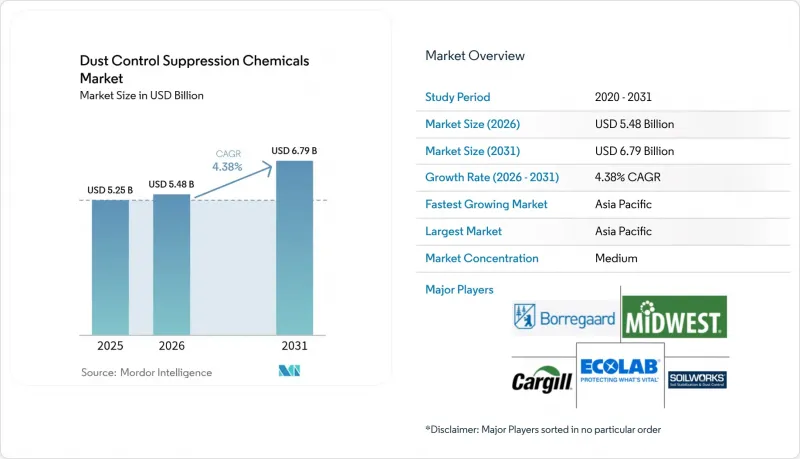
Mordor Intelligence에 의하면, 분진 제어 억제제 시장 규모는 2025년에 52억 5,000만 달러로 평가되었습니다. 2026년 54억 8,000만 달러에서 2031년까지 67억 9,000만 달러에 이를 것으로 예상되며, 예측 기간(2026-2031년) CAGR은 4.38%를 나타낼 전망입니다.
본 보고서는 화학 물질 유형(리그닌 설포네이트, 염화칼슘 등), 최종 사용자 산업(광업, 건설업, 식품 및 음료업, 석유 및 가스·석유화학 산업, 제약업, 기타 최종 사용자 산업), 지역(아시아태평양, 북미, 유럽,남미, 중동 및 아프리카)별로 세분화되어 있습니다. 시장 예측은 금액(달러) 기준으로 제시되어 있습니다.
세계의 분진 제어 억제제 시장 동향 및 인사이트
아시아태평양의 인프라 확충 및 광업 활동 활성화
중국, 인도, 인도네시아에서는 석탄, 니켈, 갈탄의 생산이 확대되고 있습니다. 이러한 생산량의 급증으로 인해, 특히 채굴 현장, 퇴적장 및 운반 도로망 주변에서 도로용 방진제에 대한 안정적인 수요가 발생하고 있습니다. 인도는 향후 몇 년간 생산 능력 확대를 목표로 하는 새로운 석탄 프로젝트를 승인했습니다. 주 정부로부터 허가를 획득하기 위해서는 이러한 프로젝트에서 연중 내내 먼지 대책이 필수적입니다. 인도네시아에서는 새로운 니켈 라텔라이트 광산이 가동을 시작했으며, 일정 길이를 초과하는 진입로에서는 화학 약품을 이용한 먼지 억제가 의무화되어 있습니다. 베트남에서는 야심 찬 남북 고속도로 프로젝트에서 주거지와 가까운 토공 현장의 먼지 대책이 의무화되어 있습니다. 이러한 상황을 고려할 때, 임시 운송 도로에서는 비용 대비 효과가 높은 염화칼슘 제제가 현저히 선호되는 반면, 영구적인 인프라에서는 리그닌설포네이트나 폴리머 에멀젼이 채택되는 경향이 있습니다.
전 세계 PM10/PM2.5 배출 기준의 강화
2024년 2월, 미국 환경보호청(EPA)은 연례 PM2.5 국가 대기질 기준(NAAQS)을 개정했습니다. 이 조치에 따라 캘리포니아주, 애리조나주, 유타주에서 기준을 충족하지 못하는 지역은 2026년까지 측정 가능한 감축 실적을 제시해야 합니다. 한편, 유럽연합(EU)의 지침 2024/2881에서는 더 엄격한 제한이 설정되어 있으며, 독일과 폴란드에서는 폴리머의 도입이 가속화되고 있습니다. 2024년, 중국은 현(縣) 단위에서 ‘청천 감사’를 확대하고, 대규모 건설 현장에 대해 PM10 실시간 데이터 제공을 의무화했습니다. 이러한 규제로 인해 구매자들은 단순한 현장 경험칙에 기반한 증명에서 벗어나, ISO 17025 시험 데이터로 인증된 배합 제품을 선택하게 되었습니다.
염화물 염 및 리그닌 원료의 가격 변동
2024년, 북미의 염화칼슘 현물 가격은 그레이트 솔트 호수에서의 염수 생산량 감소로 인해 변동했습니다. 한편, 중국 칭하이성의 환경 할당량으로 인해 2024년 염화마그네슘공급량이 제한되어 수출 증가세가 억제되었습니다. 북미의 크라프트 펄프 생산량 감소로 인해 리그닌 설포네이트공급이 줄어들면서 현물 가격이 급등했습니다. 장기 계약을 체결하지 않은 배합 제조업체들은 이익률 압박에 직면하여 비용을 흡수할지 가격을 인상할지 선택의 기로에 놓였고, 그 결과 지방자치단체의 도로 정비 사업 조달이 지연되었습니다. 또한 턴키 리스 모델은 도입 장벽을 낮출 뿐만 아니라, 규정 준수 측면에서도 구체적인 이점을 제공합니다.
부문별 분석
염화칼슘은 2025년 매출의 29.05%를 차지했으며, 2031년까지 연평균 4.78%의 성장이 예상되어, 분진 제어 억제제 시장에서 주도적인 위치를 유지할 것으로 전망됩니다. 염화마그네슘은 규모는 작지만, -15℃ 이하의 환경에서 성능이 요구되는 한랭지 광산에서 일정한 입지를 유지하고 있습니다. 리그닌설포네이트는 염화물의 침출 없이 미세 입자를 결합시키기 때문에 환경에 민감한 수자원 지역 인근의 구매자들에게 지지를 받고 있습니다. 고분자 에멀젼(주로 아크릴레이트 및 비닐아세테이트 공중합체)은 장기적인 인프라 프로젝트에서 단가보다 수명 기간에 걸친 유지 관리가 중요시됨에 따라 주목을 받고 있습니다. 아스팔트 및 오일 에멀젼은 틈새 시장을 차지하고 있으며, 바이오 배합물은 시장 가치의 극히 일부만을 차지하지만, LEED 준수 대체재로서 연구 개발 자금을 유치하고 있습니다.
장기적인 수요 동향은 원자재 비용, 부식 문제, 규제 당국의 승인 여부에 좌우됩니다. 염화물계 용액은 처리 면적 1제곱미터당 비용 측면에서 우위를 유지할 것입니다. 특히 물 부족이 심각하고 설비 교체 주기가 빠른 지역에서는 이러한 경향이 두드러집니다. 반면, 폴리머와 리그닌은 자산의 내구성과 빗물 규제 준수가 최우선으로 고려되는 유럽이나 아시아의 일부 메가 프로젝트에서 앞으로도 염화물계 제품을 계속 대체해 나갈 것입니다.
지역별 분석
아시아태평양은 2025년에 전 세계 시장 규모의 47.10%를 차지했으며, 2031년까지 연평균 4.62%의 성장률을 보일 것으로 전망됩니다. 인도네시아의 탄광 확장, 인도의 대규모 인프라 건설 계획, 그리고 중국의 현급 ‘청천 감사’가 이러한 성장을 주도하고 있습니다. 아시아태평양의 분진 제어 억제제 시장 규모는 상당한 성장이 예상됩니다. 인도 석탄부의 승인 및 인도네시아의 니켈 생산 대폭 확대에 힘입어, 이 지역은 지속적인 성장을 누리고 있습니다. 또한 베트남과 말레이시아 등에서는 신규 고속도로 및 공항에 먼지 억제 규제가 도입되면서 시장 범위가 확대되고 있습니다.
북미는 2024년 시장 매출의 상당 부분을 차지했습니다. EPA(미국 환경보호청)의 엄격한 PM2.5 기준을 충족하기 위해, 기준을 충족하지 못하는 지역의 광산 및 계약업체들은 지속적인 모니터링에 더해 화학 물질을 이용한 분진 억제 방식을 점점 더 많이 채택하고 있습니다. 주요 수요처로는 구리, 리튬, 오일샌드를 중심으로 한 프로젝트가 포함됩니다. 특히, IoT 통합형 스프레이 바가 신규 운송 트럭 차량군에 표준 사양으로 탑재되면서, 규제 준수를 저해하지 않으면서 연간 화학약품 수요를 줄이고 있습니다.
2024년 매출에 크게 기여하고 있는 유럽에서는 폴리머 에멀젼과 리그닌 설포네이트가 특히 선호되고 있습니다. 독일 및 북유럽 국가에서는 철근 콘크리트의 부식을 방지하기 위해 고속도로나 교량의 보수 공사에서 염화물이 포함되지 않은 용액의 사용이 의무화되어 있습니다. 한편, 폴란드와 체코 공화국에서는 광산 운송 도로용으로 비용 효율적인 염화칼슘이 선호되고 있지만, 유지 관리 비용을 최소화하기 위해 폴리머 블렌드의 도입도 진행되고 있습니다. 또한, 튀르키예의 지진 복구 노력에 힘입어 도시 지역 프로젝트에서 폴리머의 활용이 가속화되고 있습니다.
남미는 중동 및 아프리카와 함께 2024년 매출에서 상당한 점유율을 차지했습니다. 칠레의 아타카마 지역에서는 엄격한 물 사용 제한 속에서 살포 간격을 최대한 늘리기 위해 광산 업체들이 고농도의 염화마그네슘을 활용하고 있습니다. 브라질의 철광석 산업은 원주민 거주지 인근의 새로운 PM10 기준에 대응하기 위해 규제 준수를 위한 실시간 센서를 도입하고 있습니다. 한편, 사우디아라비아와 UAE는 광업 및 건설 허가에 분진 억제 규정을 포함시키고 있어, 이러한 신흥 시장에서 PM 규제를 준수하기 위한 규제 조화가 진행되고 있음이 부각되고 있습니다.
기타 혜택 :
- 엑셀 형식 시장 예측(ME) 시트
- 3개월간의 애널리스트 지원
자주 묻는 질문
목차
제1장 서론
제2장 조사 방법
제3장 주요 요약
제4장 시장 구도
제5장 시장 규모 및 성장 예측
제6장 경쟁 구도
제7장 시장 기회 및 향후 전망
KTH 26.08.26According to Mordor Intelligence, the dust control suppression chemicals market size was valued at USD 5.25 billion in 2025 and estimated to grow from USD 5.48 billion in 2026 to reach USD 6.79 billion by 2031, at a CAGR of 4.38% during the forecast period (2026-2031).
This report is Segmented by Chemical Type (Lignin Sulfonate, Calcium Chloride, and More), End-User Industry (Mining, Construction, Food and Beverage, Oil and Gas and Petrochemical, Pharmaceutical, and Other End-User Industries), and Geography (Asia-Pacific, North America, Europe, South America, and Middle-East and Africa). The Market Forecasts are Provided in Terms of Value (USD).
Global Dust Control Suppression Chemicals Market Trends and Insights
Rising Infrastructure and Mining Activity in Asia-Pacific
China, India, and Indonesia are ramping up their production of coal, nickel, and lignite. This surge in output is driving a consistent demand for road-dust suppressants, especially at pit faces, stockpiles, and along haul-road networks. India has approved new coal projects, aiming to increase capacity in the coming years. To secure state permits, these projects necessitate year-round dust mitigation. Indonesia has inaugurated new nickel laterite mines, enforcing chemical suppression on access roads exceeding a certain length. Vietnam's ambitious North-South Expressway project mandates dust-control measures for earthworks situated near residential zones. Given this landscape, there's a pronounced preference for cost-effective calcium-chloride solutions on temporary haul roads, while permanent infrastructures gravitate towards lignin sulfonate and polymer emulsions.
Stricter Global PM10/PM2.5 Emission Standards
In February 2024, the U.S. Environmental Protection Agency updated the annual PM2.5 NAAQS. This move requires non-attainment zones in California, Arizona, and Utah to show measurable reductions by 2026. Meanwhile, the European Union's Directive 2024/2881 sets stricter limits, spurring faster polymer adoption in Germany and Poland. In 2024, China broadened its county-level Blue-Sky audits, mandating large construction sites to provide real-time PM10 data. These regulations are steering buyers towards formulations certified by ISO 17025 test data, moving away from anecdotal field proofs alone.
Price Volatility of Chloride Salts and Lignin Feedstock
In 2024, spot prices for calcium chloride in North America fluctuated due to tightening brine output from the Great Salt Lake. Meanwhile, environmental quotas in China's Qinghai province capped magnesium chloride supplies in 2024, restricting export growth. A decline in North American kraft-pulp production led to reduced availability of lignin sulfonate, causing spot prices to surge. Formulators lacking long-term contracts faced margin compression, leading them to either absorb the costs or raise prices, which in turn delayed procurements for municipal road programs. Additionally, turnkey leasing models are not only lowering adoption barriers but also yielding a tangible compliance dividend.
Other drivers and restraints analyzed in the detailed report include:
- Shift from Water-Only Spraying to Chemical Binders
- Adoption of IoT-Enabled Smart Misting and Dosing Systems
- Corrosion Concerns Limiting Chloride Use
For complete list of drivers and restraints, kindly check the Table Of Contents.
Segment Analysis
Calcium chloride captured 29.05% of the 2025 revenue and is forecasted to grow at 4.78% through 2031, maintaining its leadership position within the Dust Control Suppression Chemicals Market share. Magnesium chloride, though smaller, retains a foothold in cold-climate mines where performance is required below -15 °C. Lignin sulfonate appeals to buyers near sensitive watersheds because it binds fine particles without chloride leaching. Polymeric emulsions-mainly acrylate and vinyl acetate copolymers-are gaining traction as long-life infrastructure projects prioritize lifetime maintenance over unit price. Asphalt and oil emulsions fill niche roles, and bio-based formulations, although accounting for a small portion of the market value, are drawing research and development dollars as LEED-compliant alternatives.
Longer-term demand dynamics hinge on feedstock costs, corrosion considerations, and regulatory acceptance. Chloride solutions will maintain their edge in terms of cost per treated square meter, particularly where water scarcity is acute and equipment turnover is rapid. Polymers and lignin will continue to displace chlorides in Europe and selected Asian megaprojects where asset longevity and stormwater compliance are paramount.
Complete Report Scope:
- By Chemical Type
- Lignin Sulfonate
- Calcium Chloride
- Magnesium Chloride
- Asphalt Emulsions
- Oil Emulsions
- Polymeric Emulsions
- Other Chemical Types
- By End-user Industry
- Mining
- Construction
- Food and Beverage
- Oil and Gas and Petrochemical
- Pharmaceutical
- Other End-user Industries
- By Geography
- Asia-Pacific
- China
- India
- Japan
- South Korea
- Indonesia
- Thailand
- Vietnam
- Malaysia
- Rest of Asia-Pacific
- North America
- United States
- Canada
- Mexico
- Europe
- Germany
- United Kingdom
- France
- Italy
- Spain
- Nordic Countries
- Turkey
- Russia
- Rest of Europe
- South America
- Brazil
- Argentina
- Colombia
- Rest of South America
- Middle-East and Africa
- Saudi Arabia
- United Arab Emirates
- Qatar
- South Africa
- Nigeria
- Egypt
- Rest of Middle-East and Africa
- Asia-Pacific
Geography Analysis
The Asia-Pacific region anchored 47.10% of the global value in 2025 and is projected to grow at 4.62% through 2031. Coal mine expansions in Indonesia, a massive infrastructure pipeline in India, and county-level Blue Sky audits in China largely fuel this growth. The market size for Dust Control Suppression Chemicals in the Asia-Pacific is anticipated to witness significant growth. With approvals from India's Ministry of Coal and a significant push in nickel production in Indonesia, the region is enjoying a sustained boost. Furthermore, countries such as Vietnam and Malaysia are implementing dust-control regulations on new highways and airports, thereby expanding the market's reach.
North America captured a substantial portion of the 2024 market revenue. In response to the EPA's stringent PM2.5 standards, mines and contractors in non-compliant areas are increasingly adopting chemical suppression alongside continuous monitoring. The primary consumers include projects centered around copper, lithium, and oil sands. Notably, IoT-integrated spray bars are becoming standard on new haul-truck fleets, reducing annual chemical demand without compromising compliance.
Europe, contributing significantly to the 2024 revenue, shows a distinct preference for polymer emulsions and lignin sulfonate. In Germany and the Nordic region, chloride-free solutions are mandated for highway and bridge upgrades to safeguard reinforced concrete from corrosion. While Poland and the Czech Republic favor cost-effective calcium chloride for mine haul roads, they're also adopting polymer blends to minimize maintenance costs. Additionally, Turkey's initiative for earthquake recovery is accelerating the use of polymers in urban projects.
South America, along with the Middle East and Africa, jointly represented a notable share of the 2024 revenue. In Chile's Atacama region, miners are utilizing high-concentration magnesium chloride to maximize application intervals amidst stringent water limitations. Brazil's iron-ore industry is adapting to new PM10 standards near indigenous lands, integrating real-time sensors for compliance. Meanwhile, both Saudi Arabia and the UAE are incorporating dust-control stipulations in mining and construction permits, highlighting a regulatory alignment towards PM compliance in these emerging markets.
- ADM
- Benetech, Inc.
- Borregaard AS
- Cargill, Incorporated
- Chemtex Speciality Limited
- Ecolab Inc.
- Evonik Industries AG
- GelTech Solutions
- Hexion
- Midwest Industrial Supply Inc.
- Quaker Houghton
- Shaw Almex Industries Ltd
- Soilworks, LLC
- Veolia
Additional Benefits:
- The market estimate (ME) sheet in Excel format
- 3 months of analyst support
TABLE OF CONTENTS
1 Introduction
- 1.1 Study Assumptions and Market Definition
- 1.2 Scope of the Study
2 Research Methodology
3 Executive Summary
4 Market Landscape
- 4.1 Market Overview
- 4.2 Market Drivers
- 4.2.1 Rising infrastructure and mining activity in Asia-Pacific
- 4.2.2 Stricter global PM10/PM2.5 emission standards
- 4.2.3 Shift from water-only spraying to chemical binders (cost and water-scarcity)
- 4.2.4 Adoption of IoT-enabled smart misting and dosing systems
- 4.2.5 Carbon-credit revenue for dust-reduction projects at mines
- 4.3 Market Restraints
- 4.3.1 Price volatility of chloride salts and lignin feedstock
- 4.3.2 Corrosion concerns limiting chloride use on capital equipment
- 4.3.3 Fragmented regulations slowing product standardisation
- 4.4 Value Chain Analysis
- 4.5 Porter's Five Forces
- 4.5.1 Bargaining Power of Suppliers
- 4.5.2 Bargaining Power of Buyers
- 4.5.3 Threat of New Entrants
- 4.5.4 Threat of Substitutes
- 4.5.5 Intensity of Competitive Rivalry
5 Market Size and Growth Forecasts (Value)
- 5.1 By Chemical Type
- 5.1.1 Lignin Sulfonate
- 5.1.2 Calcium Chloride
- 5.1.3 Magnesium Chloride
- 5.1.4 Asphalt Emulsions
- 5.1.5 Oil Emulsions
- 5.1.6 Polymeric Emulsions
- 5.1.7 Other Chemical Types
- 5.2 By End-user Industry
- 5.2.1 Mining
- 5.2.2 Construction
- 5.2.3 Food and Beverage
- 5.2.4 Oil and Gas and Petrochemical
- 5.2.5 Pharmaceutical
- 5.2.6 Other End-user Industries
- 5.3 By Geography
- 5.3.1 Asia-Pacific
- 5.3.1.1 China
- 5.3.1.2 India
- 5.3.1.3 Japan
- 5.3.1.4 South Korea
- 5.3.1.5 Indonesia
- 5.3.1.6 Thailand
- 5.3.1.7 Vietnam
- 5.3.1.8 Malaysia
- 5.3.1.9 Rest of Asia-Pacific
- 5.3.2 North America
- 5.3.2.1 United States
- 5.3.2.2 Canada
- 5.3.2.3 Mexico
- 5.3.3 Europe
- 5.3.3.1 Germany
- 5.3.3.2 United Kingdom
- 5.3.3.3 France
- 5.3.3.4 Italy
- 5.3.3.5 Spain
- 5.3.3.6 Nordic Countries
- 5.3.3.7 Turkey
- 5.3.3.8 Russia
- 5.3.3.9 Rest of Europe
- 5.3.4 South America
- 5.3.4.1 Brazil
- 5.3.4.2 Argentina
- 5.3.4.3 Colombia
- 5.3.4.4 Rest of South America
- 5.3.5 Middle-East and Africa
- 5.3.5.1 Saudi Arabia
- 5.3.5.2 United Arab Emirates
- 5.3.5.3 Qatar
- 5.3.5.4 South Africa
- 5.3.5.5 Nigeria
- 5.3.5.6 Egypt
- 5.3.5.7 Rest of Middle-East and Africa
- 5.3.1 Asia-Pacific
6 Competitive Landscape
- 6.1 Market Concentration
- 6.2 Strategic Moves
- 6.3 Market Share (%)/Ranking Analysis
- 6.4 Company Profiles (includes Global level Overview, Market level overview, Core Segments, Financials as available, Strategic Information, Market Rank/Share, Products and Services, Recent Developments)
- 6.4.1 ADM
- 6.4.2 Benetech, Inc.
- 6.4.3 Borregaard AS
- 6.4.4 Cargill, Incorporated
- 6.4.5 Chemtex Speciality Limited
- 6.4.6 Ecolab Inc.
- 6.4.7 Evonik Industries AG
- 6.4.8 GelTech Solutions
- 6.4.9 Hexion
- 6.4.10 Midwest Industrial Supply Inc.
- 6.4.11 Quaker Houghton
- 6.4.12 Shaw Almex Industries Ltd
- 6.4.13 Soilworks, LLC
- 6.4.14 Veolia
7 Market Opportunities and Future Outlook
- 7.1 White-space and Unmet-need Assessment