|
시장보고서
상품코드
2114038
항공기 도어 : 시장 점유율 분석, 업계 동향 및 통계, 성장 예측(2026-2031년)Aircraft Door - Market Share Analysis, Industry Trends & Statistics, Growth Forecasts (2026 - 2031) |
||||||
 Mordor Intelligence
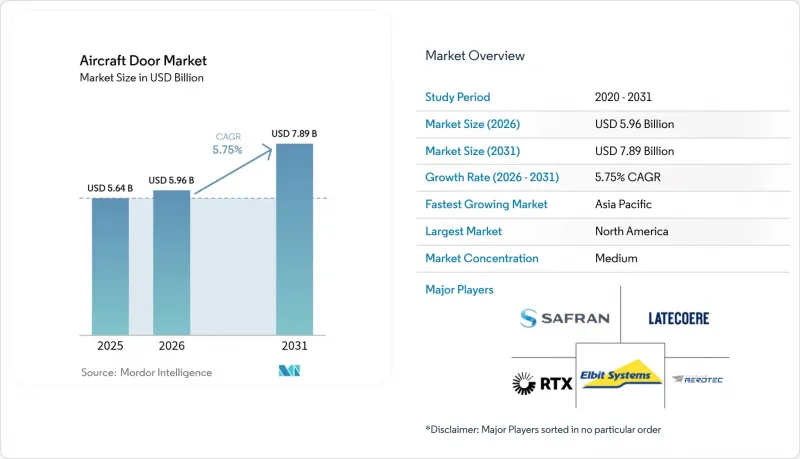
Mordor Intelligence에 의하면, 항공기 도어 시장 규모는 2025년에 56억 4,000만 달러로 평가되었습니다. 2026년 59억 6,000만 달러에서 2031년까지 78억 9,000만 달러에 이를 것으로 예상되며, 예측 기간(2026-2031년) CAGR은 5.75%를 나타낼 전망입니다.
본 보고서는 용도별(고정익기, 회전익기, EVTOL기), 도어 유형별(승객용, 화물용, 비상구, 서비스/유틸리티용, 랜딩 베이, 조종실),최종 용도(OEM 및 애프터마켓), 작동 방식(유압식, 전동식, 공압식), 지역(북미, 유럽, 아시아태평양, 남미, 중동 및 아프리카)별로 분류되어 있습니다. 시장 예측은 금액(달러) 기준으로 제시되어 있습니다.
세계의 항공기 도어 시장 동향 및 인사이트
항공기 대수 증가 및 항공기 인도 급증
2024년 말 기준, 에어버스가 8,658대, 보잉이 5,595대라는 사상 최대 규모의 미이행 수주를 보유하고 있었기 때문에 항공기 도어 시장에는 향후 수년 동안 수요 전망이 확립되었습니다. 현재의 생산 속도로는 이 미이행 수주를 소화하는 데 약 14년이 소요되므로, 공급업체들은 장기적인 생산 능력 확보에 박차를 가하고 있습니다. 에어버스는 향후 20년 동안 42,000대 이상의 인도를 예측하고 있으며, 이에 따라 도어 공급업체들은 공장 확장,프라운호퍼 IWU가 개발한 연간 4,000장의 도어를 생산할 수 있는 4시간 열가소성 수지 성형 공정 등, 보다 신속한 생산 방식의 도입을 피할 수 없게 되었습니다. MRO 제공업체들도 이에 발맞추어 와이드바디 항공기 대응을 위해 시설에 높이가 높은 격납고 문을 도입하고 있습니다.
연비 효율 향상을 위한 경량 복합재료의 채택
첨단 CFRP 및 열가소성 복합재료를 통해 도어 무게를 최대 20% 줄여 연료 소비량을 감소시키는 동시에 정비 주기를 연장할 수 있게 되었습니다. 콜린스 에어로스페이스(Collins Aerospace)사의 일체형 열가소성 수지 도어는 기계식 패스너를 용접으로 대체함으로써 제조 시간을 110시간에서 4시간으로 단축했습니다. 헥셀(Hexel)사의 급속 경화형 프리프레그 ‘HexPly M51’은 구조적 무결성을 유지하면서 더 높은 타크트율을 실현합니다. 이러한 소재들은 전동 액추에이터와 쉽게 통합될 수 있어, 항공 업계의 ‘더 전동화된 항공기(MEA)’ 아키텍처로의 전환을 뒷받침하고 있습니다.
높은 연구개발비 및 인증 비용이라는 장벽
FAA(미국 연방항공청)의 심사 강화로 인해 시험 프로토콜이 복잡해지고 시제품 제작 비용이 상승하여, 중소규모의 신규 진출기업들이 시장 진입을 주저하는 상황이 되고 있습니다. 재료나 작동 방식이 변경될 때마다 새로운 인증 절차가 요구되기 때문에 프로그램 기간이 장기화되며, 광범위한 제품 라인에 규정 준수 비용을 분산할 수 있는 대형 Tier 1 통합 업체들이 협상에서 우위를 점하고 있습니다.
부문 분석
2025년, 고정익기 부문은 항공기 도어 시장 점유율의 90.98%를 차지했으며, 그 주된 요인은 전 세계 항공기 보유 대수의 62%를 차지하는 협폭기였습니다. 항공사들이 중거리 노선에 단일 통로 항공기를 선호하는 경향이 있어, 이러한 우위는 더욱 확대될 전망입니다. 개인 여행 수요가 견조한 추세를 보임에 따라 비즈니스 항공 및 일반 항공이 확대되었고, MRO(정비·수리·오버홀) 업그레이드가 촉진되었습니다. 또한, 2024년 미국의 국방비가 8,860억 달러에 달함에 따라 군사 프로그램은 안정적인 수주량을 유지했습니다.
eVTOL 부문의 연평균 성장률(CAGR) 8.06%는 Eve Air Mobility와 같은 신규 진출기업들을 끌어들이고 있으며, 이 회사는 2026년부터의 납품을 위해 도어 공급업체로 Latecoere를 선정했습니다. 현재 인증 기준에는 수직 이륙과 관련된 제약이 포함되어 있어, 더 가볍고 개구부가 넓으며 직관적인 잠금 장치가 요구되고 있습니다. 이러한 항공기에 전기 추진 시스템이 탑재됨에 따라 분산형 전력 관리에 대응하는 도어에 대한 수요가 가속화될 것입니다.
2025년 매출액 중 승객용 도어가 45.52%를 차지했으며, 그 중심에는 대피 및 기내 좌석으로의 동선을 단순화한 폭이 넓은 싱글 리프(single-leaf) 설계가 있었습니다. 항공사들이 센서와 방음 패널을 장착하여 도어 개조를 진행함에 따라, 승객용 도어 시장은 2031년까지 연평균 성장률(CAGR) 5.36%로 확대될 것으로 예측됩니다. 화물용 도어는 P2F(여객기에서 화물기로의) 개조 및 특송 소포 운송에 힘입어, ULD 팔레트를 처리할 수 있는 넓은 개구부 개발을 촉진함으로써 2위를 차지했습니다. 비상구는 비행 중 발생한 사고를 계기로 주목을 받으며, 래치 설계에 대한 근본적인 재검토를 불러왔습니다.
서비스 도어, 유틸리티 도어, 조종실 도어는 틈새 시장 요구 사항을 충족하는 제품이었지만, 복합 소재로의 전환으로 인한 혜택을 받았습니다. 항공기 도어 시장에서는 ‘Zen Privacy Door’와 같이 조립을 간소화하고 부품 수를 줄이는 종이접기에서 영감을 얻은 접이식 설계를 채택한 제품의 점유율이 확대되고 있습니다.
지역별 분석
북미는 보잉사, 견고한 MRO 네트워크, 그리고 지속적인 국방 예산에 힘입어 2025년 항공기 도어 시장 매출의 37.88%를 차지했습니다. FAA(연방항공국)의 지침은 종종 전 세계의 선례가 되기 때문에 국내 공급업체들은 먼저 자사 제품을 개량한 후 다른 국가로 수출하고 있습니다. 이 지역의 항공사 기단은 평균 기령이 높았기 때문에 애프터마켓에서의 도어 교체 수요가 증가했습니다. 미국의 eVTOL(전기 수직 이착륙기) 인증 일정에 따라, 국내 도어 공급업체들은 회전익기 및 고정익기 기준을 충족하는 프로토타입 제조에 주력했습니다.
아시아태평양은 연평균 성장률(CAGR) 6.63%로 가장 높은 성장이 예상됩니다. 중국의 국내 항공 수요 회복, 인도의 ‘메이크 인 인디아(Make in India)’ 이니셔티브, 그리고 A220과 다이나매틱 테크놀로지스(Dynamatic Technologies) 간의 도어 계약으로 인해 공급망이 동쪽으로 이동했습니다. 이 지역의 항공기 기단은 비교적 새롭고 빠르게 확대되고 있으며, 도어 OEM 기업들은 물류 비용을 절감하기 위해 지역 내에 복합재 적층 공장을 설립하고 있습니다. 일본에서 완전 자동화된 탑승교의 도입을 추진하는 것은 공항 인프라와 도어 기술이 어떻게 연계되어 있는지를 보여줍니다.
유럽은 에어버스의 최종 조립 라인과 지속 가능한 항공 분야에서의 리더십에 힘입어 계속해서 기술의 선도자 역할을 유지했습니다. EASA(유럽항공안전청)가 복합재의 가연성 및 내충격성 기준을 중시함에 따라 인증 부담이 증가했고, 이는 간접적으로 유럽의 소재 제조업체들을 뒷받침했습니다. 열가소성 플라스틱에 대한 수요가 증가함에 따라, 항공기 도어 시장에서 유럽 복합재 공급업체 시장 점유율은 상승할 것으로 예측됩니다. 중동 및 아프리카에서는 걸프 지역 항공사들의 화물기 발주로 생산 능력이 확대되었으며, 지역 정비 허브를 보완하는 대형 화물용 도어에 대한 수요 기회가 증가했습니다.
기타 혜택 :
- 엑셀 형식 시장 예측(ME) 시트
- 3개월간의 애널리스트 지원
자주 묻는 질문
목차
제1장 서론
제2장 조사 방법
제3장 주요 요약
제4장 시장 구도
제5장 시장 규모 및 성장 예측
제6장 경쟁 구도
제7장 시장 기회 및 향후 전망
KTH 26.08.26According to Mordor Intelligence, the aircraft door market size was valued at USD 5.64 billion in 2025 and estimated to grow from USD 5.96 billion in 2026 to reach USD 7.89 billion by 2031, at a CAGR of 5.75% during the forecast period (2026-2031).
This report is Segmented by Application (Fixed-Wing, Rotary Wing, and EVTOL Aircraft), Door Type (Passenger, Cargo, Emergency Exit, Service/Utility, Landing Bay, and Cockpit), End Use (OEM and Aftermarket), Mechanism (Hydraulic, Electric, and Pneumatic), and Geography (North America, Europe, Asia-Pacific, South America, and the Middle East and Africa). The Market Forecasts are Provided in Terms of Value (USD).
Global Aircraft Door Market Trends and Insights
Fleet Expansion and Aircraft Deliveries Surge
The record number of unfilled orders, 8,658 at Airbus and 5,595 at Boeing in late 2024, created multi-year visibility for the aircraft door market. The backlog would take approximately 14 years to clear at current build rates, prompting suppliers to secure long-term capacity. Airbus projected more than 42,000 deliveries over 20 years, forcing door suppliers to expand their factories and adopt faster production methods, such as Fraunhofer IWU's four-hour thermoplastic process, which yields 4,000 doors annually. MRO providers have followed suit, with facilities adding taller hangar doors to handle widebody traffic.
Lightweight Composite Adoption for Fuel-efficiency
Advanced CFRP and thermoplastic composites cut door weight by up to 20%, trimming fuel burn and extending maintenance intervals. Collins Aerospace's one-piece thermoplastic door demonstrated a production cut from 110 hours to 4 hours by replacing mechanical fasteners with welding. Hexcel's rapid-curing HexPly M51 prepreg supports higher takt rates while retaining structural integrity. These materials integrate easily with electric actuators, reinforcing the industry's move toward a more electric aircraft (MEA) architecture.
High R&D and Certification Cost Barrier
Enhanced FAA scrutiny multiplied testing protocols and raised prototype costs, discouraging smaller entrants. Each material or actuation shift invites new certification pathways, lengthening programs, and tilting bargaining power toward large tier-1 integrators that can spread compliance expense across wide product lines.
Other drivers and restraints analyzed in the detailed report include:
- Stricter Passenger-safety and Evacuation Mandates
- Passenger-to-freighter Conversion Boom
- Raw Material Price and Supply-chain Volatility
For complete list of drivers and restraints, kindly check the Table Of Contents.
Segment Analysis
The fixed-wing segment held 90.98% of the aircraft door market share in 2025, primarily driven by narrowbody aircraft, which comprised 62% of the global fleet. That dominance is likely to widen as airlines favor single-aisles for medium-haul routes. Business and general aviation expanded as private travel stayed resilient, encouraging MRO upgrades. Military programs offered steady volumes because US defense spending reached USD 886 billion in 2024.
The eVTOL segment's 8.06% CAGR has attracted new entrants, such as Eve Air Mobility, which has selected Latecoere as its door supplier for deliveries starting in 2026. Certification frameworks now include vertical take-off constraints that require lighter, wider apertures and intuitive locking. As these aircraft integrate electric propulsion, demand for doors compatible with distributed power management will accelerate.
Passenger doors captured 45.52% of 2025 revenue, led by wide single-leaf designs that simplify evacuation and cabin seating flow. Passenger doors are expected to advance at a 5.36% CAGR to 2031 as airlines retrofit them with sensors and noise-dampening panels. Cargo doors ranked next, backed by P2F conversions and express-parcel trade, which spurred the development of wide apertures capable of handling ULD pallets. Emergency exits gained attention following mid-flight events, triggering latch design overhauls.
Service, utility, and cockpit doors filled niche requirements but benefited from the migration to composite materials. A growing share of the aircraft door market incorporates origami-inspired folding designs, such as the Zen Privacy Door, which simplifies assembly and reduces the number of parts.
Complete Report Scope:
- By Application
- Fixed-Wing
- Commercial Aviation
- Narrowbody Aircraft
- Widebody Aircraft
- Regional Jets
- Business and General Aviation
- Business Jets
- Light Aircraft
- Military Aviation
- Combat Aircraft
- Transport Aircraft
- Special Mission Aircraft
- Commercial Aviation
- Rotary Wing
- Commercial Helicopter
- Military Helicopter
- eVTOL Aircraft
- Fixed-Wing
- By Door Type
- Passenger
- Cargo
- Emergency Exit
- Service/Utility
- Landing Bay
- Cockpit
- By End Use
- OEM
- Aftermarket (MRO/Retrofit)
- By Mechanism
- Hydraulic
- Electric
- Pneumatic
- By Geography
- North America
- United States
- Canada
- Mexico
- South America
- Brazil
- Rest of South America
- Europe
- United Kingdom
- Germany
- France
- Italy
- Russia
- Rest of Europe
- Asia-Pacific
- China
- India
- Japan
- South Korea
- Australia
- Rest of Asia-Pacific
- Middle East and Africa
- Middle East
- Saudi Arabia
- United Arab Emirates
- Turkey
- Rest of Middle East
- Africa
- South Africa
- Rest of Africa
- Middle East
- North America
Geography Analysis
North America accounted for 37.88% of the 2025 revenue for the aircraft door market, supported by Boeing, a robust MRO network, and sustained defense budgets. FAA directives often set global precedents, so domestic suppliers refine their products first and then export them to other countries. The region's airline fleets had a higher average age, which led to increased aftermarket door replacements. eVTOL certification timelines in the United States drove domestic door suppliers to produce prototypes that pass rotary and fixed-wing criteria.
Asia-Pacific posted the fastest 6.63% CAGR outlook. China's domestic traffic recovery, India's Make-in-India initiative, and A220's door contract with Dynamatic Technologies shifted supply chains eastward. Regional fleets skew young but are growing quickly; door OEMs are establishing in-region composite lay-up plants to reduce logistics costs. Japan's push for fully automated passenger boarding bridges illustrates how airport infrastructure synchronizes with door technology.
Europe remained a technology driver, anchored by Airbus' final-assembly lines and its leadership in sustainable aviation. EASA's emphasis on composite flammability and crashworthiness standards increased certification burdens, indirectly supporting European materials firms. The market share of European composite suppliers in the aircraft door market is expected to rise as demand for thermoplastics increases. Middle East and Africa expanded capacity via Gulf carrier freighter orders, adding large cargo door opportunities that complement regional maintenance hubs.
- Safran SA
- Collins Aerospace (RTX Corporation)
- LATECOERE S.A
- Mitsubishi Heavy Industries, Ltd.
- Saab AB
- Terma Group
- SICAMB S.p.A
- Elbit Systems Ltd.
- Spirit AeroSystems Inc.
- Korea Aerospace Industries, Ltd.
- DAHER
- Kaman Corporation
- NIPPI Corporation
- Premium AEROTEC GmbH (Airbus SE)
- Aernnova Group
- Dynamatic Technologies Limited
- NORCO Holdings Ltd.
- Barnes Group Inc.
- Astronics PECO Inc.
Additional Benefits:
- The market estimate (ME) sheet in Excel format
- 3 months of analyst support
TABLE OF CONTENTS
1 INTRODUCTION
- 1.1 Study Assumptions and Market Definition
- 1.2 Scope of the Study
2 RESEARCH METHODOLOGY
3 EXECUTIVE SUMMARY
4 MARKET LANDSCAPE
- 4.1 Market Overview
- 4.2 Market Drivers
- 4.2.1 Fleet expansion and aircraft deliveries surge
- 4.2.2 Lightweight composite adoption for fuel-efficiency
- 4.2.3 Stricter passenger-safety and evacuation mandates
- 4.2.4 Passenger-to-freighter conversion boom
- 4.2.5 Urban-air-mobility (eVTOL) door innovations
- 4.2.6 Aging-fleet MRO door replacements
- 4.3 Market Restraints
- 4.3.1 High R&D and certification cost barrier
- 4.3.2 Raw-material price and supply-chain volatility
- 4.3.3 Lengthy regulatory approval cycles
- 4.3.4 Heightened OEM risk-aversion post door-failure incidents
- 4.4 Value Chain Analysis
- 4.5 Regulatory Landscape
- 4.6 Technological Outlook
- 4.7 Porter's Five Forces Analysis
- 4.7.1 Threat of New Entrants
- 4.7.2 Bargaining Power of Buyers
- 4.7.3 Bargaining Power of Suppliers
- 4.7.4 Threat of Substitute Products
- 4.7.5 Intensity of Competitive Rivalry
5 MARKET SIZE AND GROWTH FORECASTS (VALUE)
- 5.1 By Application
- 5.1.1 Fixed-Wing
- 5.1.1.1 Commercial Aviation
- 5.1.1.1.1 Narrowbody Aircraft
- 5.1.1.1.2 Widebody Aircraft
- 5.1.1.1.3 Regional Jets
- 5.1.1.2 Business and General Aviation
- 5.1.1.2.1 Business Jets
- 5.1.1.2.2 Light Aircraft
- 5.1.1.3 Military Aviation
- 5.1.1.3.1 Combat Aircraft
- 5.1.1.3.2 Transport Aircraft
- 5.1.1.3.3 Special Mission Aircraft
- 5.1.1.1 Commercial Aviation
- 5.1.2 Rotary Wing
- 5.1.2.1 Commercial Helicopter
- 5.1.2.2 Military Helicopter
- 5.1.3 eVTOL Aircraft
- 5.1.1 Fixed-Wing
- 5.2 By Door Type
- 5.2.1 Passenger
- 5.2.2 Cargo
- 5.2.3 Emergency Exit
- 5.2.4 Service/Utility
- 5.2.5 Landing Bay
- 5.2.6 Cockpit
- 5.3 By End Use
- 5.3.1 OEM
- 5.3.2 Aftermarket (MRO/Retrofit)
- 5.4 By Mechanism
- 5.4.1 Hydraulic
- 5.4.2 Electric
- 5.4.3 Pneumatic
- 5.5 By Geography
- 5.5.1 North America
- 5.5.1.1 United States
- 5.5.1.2 Canada
- 5.5.1.3 Mexico
- 5.5.2 South America
- 5.5.2.1 Brazil
- 5.5.2.2 Rest of South America
- 5.5.3 Europe
- 5.5.3.1 United Kingdom
- 5.5.3.2 Germany
- 5.5.3.3 France
- 5.5.3.4 Italy
- 5.5.3.5 Russia
- 5.5.3.6 Rest of Europe
- 5.5.4 Asia-Pacific
- 5.5.4.1 China
- 5.5.4.2 India
- 5.5.4.3 Japan
- 5.5.4.4 South Korea
- 5.5.4.5 Australia
- 5.5.4.6 Rest of Asia-Pacific
- 5.5.5 Middle East and Africa
- 5.5.5.1 Middle East
- 5.5.5.1.1 Saudi Arabia
- 5.5.5.1.2 United Arab Emirates
- 5.5.5.1.3 Turkey
- 5.5.5.1.4 Rest of Middle East
- 5.5.5.2 Africa
- 5.5.5.2.1 South Africa
- 5.5.5.2.2 Rest of Africa
- 5.5.5.1 Middle East
- 5.5.1 North America
6 COMPETITIVE LANDSCAPE
- 6.1 Market Concentration
- 6.2 Strategic Moves
- 6.3 Market Share Analysis
- 6.4 Company Profiles (includes Global level Overview, Market level overview, Core Segments, Financials as available, Strategic Information, Market Rank/Share for key companies, Products and Services, and Recent Developments)
- 6.4.1 Safran SA
- 6.4.2 Collins Aerospace (RTX Corporation)
- 6.4.3 LATECOERE S.A
- 6.4.4 Mitsubishi Heavy Industries, Ltd.
- 6.4.5 Saab AB
- 6.4.6 Terma Group
- 6.4.7 SICAMB S.p.A
- 6.4.8 Elbit Systems Ltd.
- 6.4.9 Spirit AeroSystems Inc.
- 6.4.10 Korea Aerospace Industries, Ltd.
- 6.4.11 DAHER
- 6.4.12 Kaman Corporation
- 6.4.13 NIPPI Corporation
- 6.4.14 Premium AEROTEC GmbH (Airbus SE)
- 6.4.15 Aernnova Group
- 6.4.16 Dynamatic Technologies Limited
- 6.4.17 NORCO Holdings Ltd.
- 6.4.18 Barnes Group Inc.
- 6.4.19 Astronics PECO Inc.
7 MARKET OPPORTUNITIES AND FUTURE OUTLOOK
- 7.1 White-space and Unmet-Need Assessment