
|
시장보고서
상품코드
2114046
결핵 진단 : 시장 점유율 분석, 업계 동향 및 통계, 성장 예측(2026-2031년)Tuberculosis Diagnostics - Market Share Analysis, Industry Trends & Statistics, Growth Forecasts (2026 - 2031) |
||||||
 Mordor Intelligence
Mordor Intelligence에 의하면, 결핵 진단 시장 규모는 2025년 25억 8,000만 달러로 평가되었습니다. 2026년에는 27억 3,000만 달러로 확대되어 2031년까지 36억 3,000만 달러에 이를 것으로 예상되고 2026년부터 2031년에 걸쳐 CAGR 5.87%로 성장할 전망입니다.
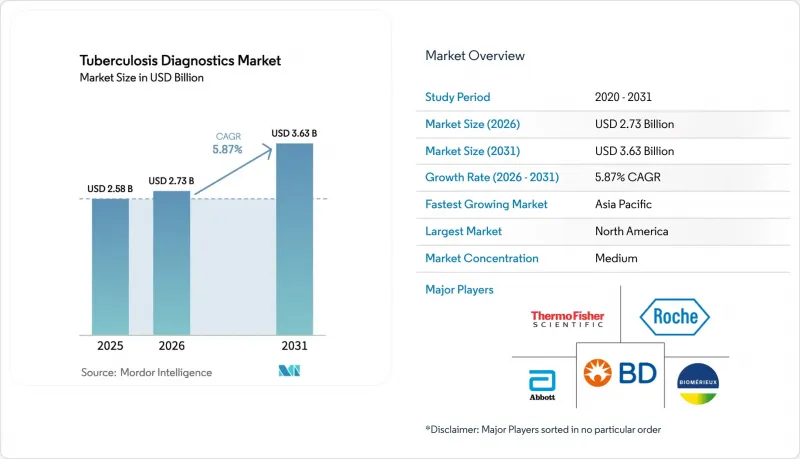
본 보고서는 진단 검사 유형(배양법에 기반한 검사, 도말 현미경 검사 등), 기술(배양법에 기반한 기술, 분자진단(PCR/NAAT) 등), 최종 사용자(병원 및 진료소, 진단·연구소, 기타 최종 사용자), 지역(북미, 유럽,아시아태평양, 중동 및 아프리카, 남미)별로 분류되어 있습니다. 시장 전망은 금액(미 달러) 기준으로 제시되어 있습니다.
세계의 결핵 진단 시장 동향 및 인사이트
약제 내성 결핵 균주의 확산 확대
WHO의 감시 데이터에 따르면, 2025년에는 전 세계 다제내성 결핵 사례 수가 약 41만 건에 달했으며, 리팜피신 내성 균주는 신규 사례의 3.6%, 기존 치료 사례의 18%를 차지했습니다. 이러한 역학적 변화로 인해 각국의 프로그램은 경험적 치료에서 유전자형 약물 감수성 검사로 전환할 수밖에 없게 되었으며, 이를 위해서는 rpoB, katG 및 inhA 유전자의 변이를 2시간 이내에 검출할 수 있는 분자 검사법이 필요합니다. 현재 이러한 기술적 요건을 대규모로 충족하고 있는 것은 카트리지 방식의 NAAT 플랫폼뿐입니다. 독일의 다제내성 결핵 발생률 5.7%와 코트디부아르의 재치료 사례에서 리팜피신 내성률 22%는 내성 패턴이 지역에 따라 얼마나 다른지를 보여줍니다. Xpert MTB/XDR은 90분 만에 실용적인 약물 프로파일을 제공하는 반면, 애보트(Abbott)사의 RealTime MTB RIF/INH 분석법은 리팜피신에 대해 94.8%, 이소니아지드에 대해 88.3%의 민감도를 달성하여, 임상의가 신속하게 치료를 조정할 수 있게 해줍니다. 또한 각국에서는 내성을 종합적으로 파악하기 위해 표적형 차세대 염기서열 분석(NGS)의 시범 운영을 진행하고 있으며, 진단 워크플로우를 배양 의존형에서 분자진단 우선형으로 전환하고 있습니다.
WHO의 권고 및 각국에서의 NAAT 플랫폼 도입
2024년 3월 WHO 가이드라인 개정에서는 분자 신속 검사가 모든 진단 알고리즘에서 최우선 순위로 자리 잡았으며, 약물 내성 감시를 위한 타겟 시퀀싱에 관한 권고 사항이 도입되었습니다. 인도의 ‘저렴하고 질 높은 결핵 검사 촉진 이니셔티브’를 통해 Xpert 도입 건수는 10배로 증가했고, 가격은 최대 50% 인하되었으며, 5년 동안 도입 시설은 56곳에서 211곳으로 확대되었습니다. 우간다 : NAAT를 지역 병원으로 분산함으로써 치료 시작까지의 중앙값 시간을 단축하고, 당일 확정 진단 건수를 증가시켰습니다(NEJM). WHO의 사전 인증은 세계 펀드, USAID, UNITAID의 자금 지원에 있어 사실상 관문 역할을 하고 있습니다. Cepheid사의 Ultra 분석법과 Eiken사의 TB-LAMP는 2025년 1분기를 목표로 3억 4,000만 달러의 자금 지원 약정을 이끌어 냈습니다. 인도의 NTEP는 전국적으로 분자진단 처리 능력을 확대한 반면, 필리핀에서는 반타얀 제도에서 진행된 Truenat 시범 사업에서 불안정한 전력 공급을 배터리 구동 장치를 통해 우회한 결과, 사례 검출률이 1,008% 급증했습니다. 이러한 일련의 정책 덕분에 아시아태평양 전체에서 기술 보급 주기가 24개월 미만으로 단축되었으며, 이는 과거에는 고소득 시장에서만 볼 수 있었던 속도입니다.
분자 검사와 카트리지의 높은 비용
기존의 데스크톱형 플랫폼은 1만 9,000달러를 초과하는 경우도 있지만, 튜레인 대학의 ‘랩 인 튜브(Lab-in-Tube)’형 장치는 800달러 미만으로, 검사당 가격을 3달러 이하로 억제하고 있습니다. 브라질과 인도의 경제 분석에 따르면, Diaskintest는 양성 사례 1건당 비용이 22.6달러 및 41달러인 반면, TSPOT.TB는 55-74달러의 추가 비용으로 더 높은 유효성을 보였습니다. 세페이드(Cepheid)사의 원가 수준에 맞는 카트리지 제품은 가격 격차를 좁히고 있지만, 보급을 위해서는 여전히 지속 가능한 보험 환급 모델이 필수적입니다.
부문 분석
2025년에는 배양 검사가 매출의 38.45%를 차지하며 연평균 6.54%의 성장이 예상됩니다. 이러한 증가는 리팜피신 내성 사례에 대해 모두 표현형에 의한 확인을 의무화하는 WHO 지침에 기인합니다. 1차 선별 검사의 주요 기법으로는 NAAT가 여전히 주류를 이루고 있지만, 검사 기관에서는 신속한 유전자형 판정과 그에 이어지는 배양 검사를 병행하는 사례가 증가하고 있습니다. 이 두 가지 기법을 병행하는 워크플로우를 통해 분자진단법을 이용한 신속한 치료 시작이 가능해지는 한편, 배양 검사는 치료 요법을 최적화하기 위한 상세한 정보를 제공합니다.
기부자들의 지속적인 자금 지원 덕분에, 특히 인도와 같이 젤-닐슨(Zell-Nielsen)법을 이용한 검사 건수가 많은 지역에서 슬라이드당 2달러라는 도말 현미경 검사의 비용 대비 효과가 유지되고 있습니다. 그러나 디지털 현미경과 AI 알고리즘이 NAAT에 필적하는 민감도 수준을 달성하면서도 시약 비용을 대폭 절감할 수 있기 때문에 기존의 도말 현미경 검사는 점차 주변적인 선별 용도로 전환되고 있습니다.
지역별 분석
2025년, 북미는 결핵 진단 시장의 39.10%를 차지했습니다. 이는 종합적인 보험 적용과 CDC에 의한 검사실 설비의 지속적인 갱신이 기여한 결과입니다. 아시아태평양은 인도가 전 세계 결핵 환자 수의 3분의 1을 차지하고 있으며, 도말 현미경 검사에서 NAAT로의 정책 전환을 배경으로 연평균 성장률(CAGR) 6.75%로 확대될 것으로 예측됩니다. 유럽에서는 2024년 EU/EEA 회원국 29개국에서 3만 8,993건의 사례가 보고되었습니다. 우크라이나 난민 선별 검사에서는 10만 명당 12.8건의 발생률이 기록되었으며, 이 중 26%가 다제내성인 것으로 나타나 입국 시 선별 검사가 강화되었습니다. 남미에서는 각국에서 Xpert 도입 확대가 효과를 거두고 있으며, 브라질에서의 도입으로 보고 건수가 9.7% 증가했고, 다부문 간 협력이 촉진되었습니다. 중동 및 아프리카에서는 진척 상황에 편차가 보입니다. 나이지리아에서는 AI 연계형 검사 차량을 통해 감염 핫스팟의 양성률이 1.75배 높아진 반면, 라인 프로브 분석(LPA)을 실시할 수 있는 검사실은 고작 4%에 그치고 있습니다. 브라질과 인도에서는 디아스키 테스트가 투베르쿨린 검사보다 저렴하지만, TSPOT.TB는 비용이 더 많이 드는 검사보다 높은 정확도를 제공하여 조달 정책의 차이가 두드러지고 있습니다.
기타 혜택 :
- 엑셀 형식 시장 예측(ME) 시트
- 3개월간 애널리스트 지원
자주 묻는 질문
목차
제1장 서론
제2장 조사 방법
제3장 주요 요약
제4장 시장 구도
제5장 시장 규모 및 성장 예측
제6장 경쟁 구도
제7장 시장 기회 및 향후 전망
KTH 26.08.26According to Mordor Intelligence, the tuberculosis diagnostics market size is expected to increase from USD 2.58 billion in 2025 to USD 2.73 billion in 2026 and reach USD 3.63 billion by 2031, growing at a CAGR of 5.87% over 2026-2031.
This report is Segmented by Diagnostic Test Type (Culture Based Test, Smear Microscopy, and More), Technology (Culture-Based), Molecular Diagnostics (PCR/NAAT) and More), End-User (Hospital/Clinics, Diagnostics/Research Laboratory, and Other End Users), and Geography (North America, Europe, Asia-Pacific, Middle East and Africa, and South America. The Market Forecasts are Provided in Terms of Value (USD).
Global Tuberculosis Diagnostics Market Trends and Insights
Rising Prevalence of Drug-Resistant TB Strains
Multidrug-resistant tuberculosis cases climbed to an estimated 410,000 globally in 2025, with rifampicin-resistant strains accounting for 3.6% of new cases and 18% of previously treated cases, according to WHO surveillance data. This epidemiological shift is forcing national programs to pivot from empirical treatment to genotypic drug-susceptibility testing, which requires molecular assays capable of detecting mutations in rpoB, katG, and inhA genes within 2 hours. This technical bar only cartridge-based NAAT platforms currently meet at scale. Germany's 5.7% multidrug-resistant incidence and Cote d'Ivoire's 22% rifampicin resistance among retreatment cases show how resistance patterns differ by geography. Xpert MTB/XDR delivers actionable drug profiles in 90 minutes, while Abbott's RealTime MTB RIF/INH assay achieves 94.8% sensitivity for rifampicin and 88.3% for isoniazid, letting clinicians tailor therapy promptly. Nations are also piloting targeted next-generation sequencing to comprehensively map resistance, moving diagnostic workflows from culture-dependent to molecular-first approaches.
WHO Endorsement & National Roll-Outs of NAAT Platforms
WHO's March 2024 guideline update placed molecular rapid tests at the front of all diagnostic algorithms and introduced targeted sequencing advice for drug-resistant surveillance WHO. India's Initiative for Promoting Affordable and Quality TB Tests boosted Xpert uptake tenfold and cut prices by up to 50%, scaling from 56 to 211 labs in five years. Uganda: by decentralizing NAATs to district hospitals, shortened the median time to treatment initiation and increased same-day confirmations, NEJM. WHO prequalification is the de facto gatekeeper for Global Fund, USAID, and UNITAID financing; Cepheid's Ultra assay and Eiken's TB-LAMP together triggered USD 340 million of commitments in 1Q 2025. India's NTEP scaled molecular capacity nationwide, while the Philippines achieved a 1,008% surge in case detection during a Truenat pilot on the Bantayan Islands, where battery-powered devices bypass erratic grid supply. The policy cascade shortens technology diffusion cycles to fewer than 24 months across Asia-Pacific, a timeline once witnessed only in high-income markets.
High Cost of Molecular Tests & Cartridges
Traditional desktop platforms can exceed USD 19,000, whereas Tulane's lab-in-tube device costs under USD 800 and keeps per-test pricing below USD 3. Economic analyses in Brazil and India showed Diaskintest at USD 22.6 and USD 41.0 per correct case, while TSPOT.TB delivered greater effectiveness at incremental costs of USD 55-74. Cepheid's cost-price cartridge offer narrows the gap, yet a sustainable reimbursement model remains critical for widespread adoption.
Other drivers and restraints analyzed in the detailed report include:
- Emergence of AI-Powered Microscopy & Digital Radiology
- Decentralized Near-POC Molecular Platforms
- Shortage of Skilled Laboratory Infrastructure
For complete list of drivers and restraints, kindly check the Table Of Contents.
Segment Analysis
In 2025, culture-based assays accounted for 38.45% of the revenue, with projections indicating a 6.54% annual growth rate. This increase is driven by WHO guidelines requiring phenotypic confirmation for all rifampicin-resistant cases. While NAAT remains the leading method for primary screening, laboratories are increasingly integrating rapid genotyping with subsequent culture testing. This dual-track workflow enables quick therapy initiation through molecular methods, while culture testing provides detailed insights to optimize treatment regimens.
Continued donor funding sustains the cost-effectiveness of smear microscopy at USD 2 per slide, particularly in regions conducting high volumes of Ziehl-Neelsen tests, such as India. However, as digital microscopy and AI algorithms achieve sensitivity levels comparable to NAAT at significantly lower reagent costs, traditional smear microscopy is gradually being relegated to peripheral triage applications.
Complete Report Scope:
- By Test Type
- Culture-based Tests
- Smear Microscopy
- Nucleic Acid Amplification Tests (NAAT)
- Interferon-Gamma Release Assays (IGRA)
- Tuberculin Skin Test (Mantoux)
- Radiographic & Imaging Tests
- Other Tests
- By Technology
- Culture-based
- Molecular Diagnostics
- Immunoassays
- Radiology / X-ray
- AI-enhanced Digital Microscopy
- Others
- By End-User
- Hospitals & Clinics
- Diagnostic Laboratories
- Academic & Research Institutes
- Others
- By Geography
- North America
- United States
- Canada
- Mexico
- Europe
- Germany
- United Kingdom
- France
- Italy
- Spain
- Rest of Europe
- Asia-Pacific
- China
- India
- Japan
- Australia
- South Korea
- Rest of Asia-Pacific
- Middle East and Africa
- GCC
- South Africa
- Rest of Middle East and Africa
- South America
- Brazil
- Argentina
- Rest of South America
- North America
Geography Analysis
North America accounted for 39.10% of the tuberculosis diagnostics market in 2025, aided by comprehensive insurance coverage and consistent CDC laboratory upgrades. Asia-Pacific is forecast to expand at a 6.75% CAGR, driven by India's one-third share of the global burden and policy shifts from smear microscopy to NAAT. Europe posted 38,993 cases across 29 EU/EEA nations in 2024; Ukrainian refugee screening recorded 12.8 per 100,000 incidence with 26% multidrug resistance, prompting intensified entry screening. South America benefits from national Xpert scale-up; Brazil's rollout increased notifications by 9.7% and catalyzed multisector coordination. The Middle East and Africa see uneven progress: while Nigeria's AI-linked vans record 1.75 times higher positivity in hotspots, only 4% of labs can run Line Probe Assays. Diaskintest is cheaper than tuberculin in Brazil and India, but TSPOT.TB delivers higher accuracy at added expense, underscoring divergent procurement choices
- Abbott Laboratories
- Beckton Dickinson
- bioMerieux
- Danaher
- Roche
- FUJIFILM
- Hologic
- Luminex Corporation (DiaSorin)
- LumiraDx Ltd.
- Meridian Bioscience
- Molbio Diagnostics Private Limited.
- Oxford Immunotec Ltd.
- QIAGEN
- QuantuMDx Ltd.
- SD Biosensor Inc.
- Seegene
- Siemens Healthineers
- Tauns Laboratories Inc
- Thermo Fisher Scientific
Additional Benefits:
- The market estimate (ME) sheet in Excel format
- 3 months of analyst support
TABLE OF CONTENTS
1 Introduction
- 1.1 Study Assumptions & Market Definition
- 1.2 Scope of the Study
2 Research Methodology
3 Executive Summary
4 Market Landscape
- 4.1 Market Overview
- 4.2 Market Drivers
- 4.2.1 Rising Prevalence of Drug-Resistant TB Strains
- 4.2.2 WHO Endorsement & National Roll-Outs of NAAT Platforms
- 4.2.3 Government Funding & Global Health Initiatives
- 4.2.4 Emergence of AI-Powered Microscopy & Digital Radiology Triage
- 4.2.5 Decentralised Near-POC Molecular Platforms
- 4.2.6 Subscription-Based Diagnostics-As-A-Service Models
- 4.3 Market Restraints
- 4.3.1 High Cost of Molecular Tests & Cartridges
- 4.3.2 Shortage of Skilled Laboratory Infrastructure
- 4.3.3 Supply-Chain Fragility for Single-Source Cartridges
- 4.3.4 Competition from Emerging Non-Sputum Biomarkers
- 4.4 Supply-Chain Analysis
- 4.5 Regulatory Landscape
- 4.6 Technological Outlook
- 4.7 Porter's Five Forces Analysis
- 4.7.1 Threat of New Entrants
- 4.7.2 Bargaining Power of Suppliers
- 4.7.3 Bargaining Power of Buyers
- 4.7.4 Threat of Substitutes
- 4.7.5 Competitive Rivalry
5 Market Size & Growth Forecasts (Value, USD)
- 5.1 By Test Type
- 5.1.1 Culture-based Tests
- 5.1.2 Smear Microscopy
- 5.1.3 Nucleic Acid Amplification Tests (NAAT)
- 5.1.4 Interferon-Gamma Release Assays (IGRA)
- 5.1.5 Tuberculin Skin Test (Mantoux)
- 5.1.6 Radiographic & Imaging Tests
- 5.1.7 Other Tests
- 5.2 By Technology
- 5.2.1 Culture-based
- 5.2.2 Molecular Diagnostics
- 5.2.3 Immunoassays
- 5.2.4 Radiology / X-ray
- 5.2.5 AI-enhanced Digital Microscopy
- 5.2.6 Others
- 5.3 By End-User
- 5.3.1 Hospitals & Clinics
- 5.3.2 Diagnostic Laboratories
- 5.3.3 Academic & Research Institutes
- 5.3.4 Others
- 5.4 By Geography
- 5.4.1 North America
- 5.4.1.1 United States
- 5.4.1.2 Canada
- 5.4.1.3 Mexico
- 5.4.2 Europe
- 5.4.2.1 Germany
- 5.4.2.2 United Kingdom
- 5.4.2.3 France
- 5.4.2.4 Italy
- 5.4.2.5 Spain
- 5.4.2.6 Rest of Europe
- 5.4.3 Asia-Pacific
- 5.4.3.1 China
- 5.4.3.2 India
- 5.4.3.3 Japan
- 5.4.3.4 Australia
- 5.4.3.5 South Korea
- 5.4.3.6 Rest of Asia-Pacific
- 5.4.4 Middle East and Africa
- 5.4.4.1 GCC
- 5.4.4.2 South Africa
- 5.4.4.3 Rest of Middle East and Africa
- 5.4.5 South America
- 5.4.5.1 Brazil
- 5.4.5.2 Argentina
- 5.4.5.3 Rest of South America
- 5.4.1 North America
6 Competitive Landscape
- 6.1 Market Concentration
- 6.2 Market Share Analysis
- 6.3 Company Profiles (includes Global level Overview, Market-level Overview, Core Segments, Financials, Strategic Information, Market Rank/Share, Products & Services, Recent Developments)
- 6.3.1 Abbott Laboratories
- 6.3.2 Becton, Dickinson and Company
- 6.3.3 BioMerieux SA
- 6.3.4 Danaher Corporation (Cepheid)
- 6.3.5 F. Hoffmann-La Roche Ltd.
- 6.3.6 Fujifilm Corporation
- 6.3.7 Hologic Inc.
- 6.3.8 Luminex Corporation (DiaSorin)
- 6.3.9 LumiraDx Ltd.
- 6.3.10 Meridian Bioscience
- 6.3.11 Molbio Diagnostics Private Limited.
- 6.3.12 Oxford Immunotec Ltd.
- 6.3.13 Qiagen N.V.
- 6.3.14 QuantuMDx Ltd.
- 6.3.15 SD Biosensor Inc.
- 6.3.16 Seegene Inc.
- 6.3.17 Siemens Healthineers AG
- 6.3.18 Tauns Laboratories Inc
- 6.3.19 Thermo Fisher Scientific Inc.
7 Market Opportunities & Future Outlook
- 7.1 White-space & Unmet-Need Assessment